Stay Ahead in Fast-Growing Economies.
Browse Reports Now




Medical Elastomers Market- Latest Advancement & Future Trends (2024-2032)
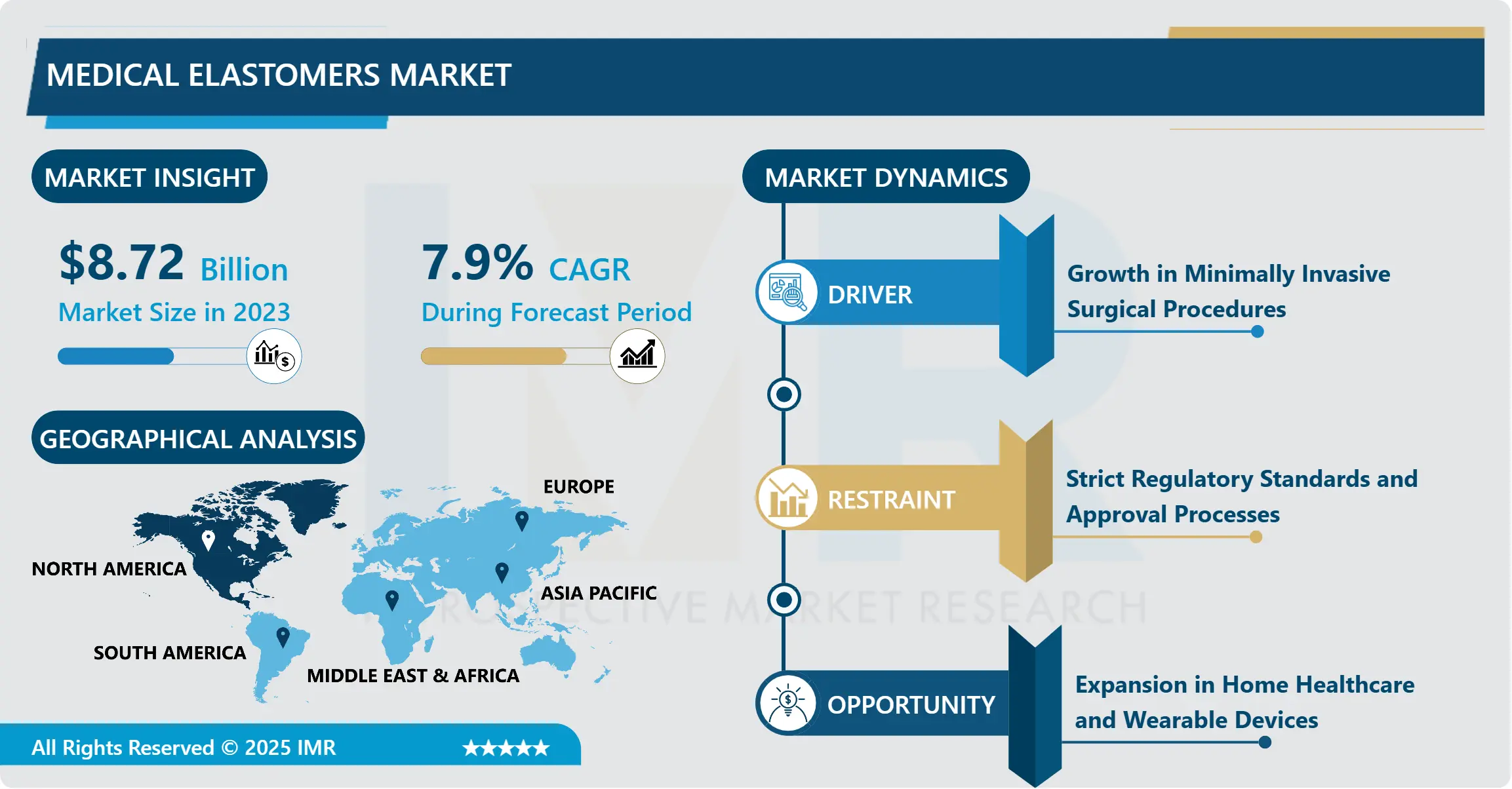
Medical Elastomers Market Size Was Valued at USD 8.72 Billion in 2023, and is Projected to Reach USD 17.29 Billion by 2032, Growing at a CAGR of 7.9% From 2024-2032.

IMR Group
Description
Medical Elastomers Market Synopsis
Medical Elastomers Market Size Was Valued at USD 8.72 Billion in 2023, and is Projected to Reach USD 17.29 Billion by 2032, Growing at a CAGR of 7.9% From 2024-2032.
The Medical Elastomers Market has been defined based on the production and usage of the elastomer products that are meant to be utilized in medical devices and related applications including thermoplastic elastomers TPE, silicone and Isoprene rubber (IR). These materials are flexible, resistant to wear and tear, and very durable making the medical tubing, catheters, syringes, gloves and implants. Medical elastomers are widely in the development of better products and performance for improving the patients’ care and thus overcoming challenges of meeting regulatory strictures on safety and biocompatibility in healthcare applications.
The Medical Elastomers Market is steadily expanding because of growing healthcare needs, allowing people to live longer, increased application of medical devices and equipment that have to be made from high-quality, elastic, and safe materials. The elastomers used in medical applications are prized because of the non-interaction with body fluids, stability under different sterilization methods, and the capability of being shaped and loaded in any form and functionality. Their innate properties as a result make them suitable for various health care uses such as IV tubing, catheters, gloves and in addition implantable products.
Another strong factor that diversify this market is the demand for biocompatible materials that can be used in material that cannot be contaminated by chemicals or body fluids. Silicone and thermoplastic polyurethane (TPU) medical elastomers have been evident to effectively meet to these requirements. The critical issue that companies are pursuing active research for creating elastomers with improved antimicrobial and hypoallergenic characters. For the same reason, the growth in minimally invasive surgeries has led to more pressures for accurate, dependable and versatile elastomers which are used in surgery and catheters. With increasing scrutiny from regulatory bodies as the FDA and EMA on material safety and patient compatibility, the usage of medical elastomers remains to rise across the globe in healthcare.
Medical Elastomers Market Trend Analysis:
Increasing Demand for Silicone in Medical Devices
Silicone is among the materials that are fast gaining market in the medical elastomers market, more so when it comes to applications that require the material to be durable, biocompatible besides being hypoallergenic. It is widely used for medical tubing, implantable devices such as catheters, and contact lenses. The market base of silicone rubber products is gradually expanding as producers seek for flexible materials that have excellent resistance to high temperatures, chemicals, and environmental conditions without safety compromise as well as superior service performance.
This trend is supported by silicone’s characteristic of being flexible and strong and the ability to be processed into different forms. Now that improved technologies like 3D printing providing exact and intricate medical device manufacturing, the utility is evident for change in manufacturing them through silicone materials. Also, remaining stable in sterile circumstances makes it appropriate for single use and reusable medical goods, the latter of which is gaining popularity as healthcare centers become increasingly concerned about infections.
Expansion in Home Healthcare and Wearable Devices
A key opportunity within Medical Elastomers Market includes the increasing home healthcare market and the increase in wearable medical devices. With more and more people aging globally, and advancements in chronic disease care, there is a growing need for health care devices that the patient can use at home. These elastomeric materials play an important role in the comfort, ease of use and long term success of these devices.
Products like glucose measuring devices, heart rate monitoring devices, and drug delivery devices demand slippery, skin-friendly, and highly allergen-free flexible medical grade elastomers. Healthcare decentralization is also driving new opportunities for elastomers in products to be used at home and include monitoring equipment and home care devices. This change is a vast opportunity for firms that will design elastomers that will fulfill the requirements of home healthcare uses.
Medical Elastomers Market Segment Analysis:
Medical Elastomers Market Segmented on the basis of Type, Application, End User, and Region
By Type, Thermoplastic Elastomers (TPE) segment is expected to dominate the market during the forecast period
In the Medical Elastomers Market, there are different requirements that are fulfilled with various kinds of elastomers. TPE and TPU are used most frequently as they are highly flexible, easy to mold and resistant to some types of sterilization. For instance, TPEs are ideally positioned as materials that offer resilience and softness for use in medical tubing and gaskets for example. Due to its enhanced physical properties such as high tensile strength and abrasion TPU is preferred more in severe applications areas including catheters and drug delivery systems.
Silicone is another, which has the best biocompatibility characteristics and is practically non-irritating, therefore it is widely used in implants, catheters, etc. Styrene block copolymers (SBC) and isoprene rubber (IR) find their applications where elasticity along with stability are required for a product. These elastomers, and others, shape the fundamental platform for material advances in the medical device industry.
By Application, Medical Tubes segment expected to held the largest share
Medical elastomers are used in numerous health care products with certain types used in tubes, catheters, syringes, gloves, implants and bags. For example, medical tubing requires elastomers that can be flexible, non-kinking, and capable of to retain shape in the presence of pressure. The elastomers used in catheter manufacturing have to be comfortable, biocompatible and elastic in order to move through the human body passages with minimal harm to the patient.
Other products like gloves and syringes also deserve elastomeric materials to make them last long, flexible and sterile. Silicone is preferred for implant applications as it is hypoallergenic and bio compatible with the body tissues, while other elastomers are tougher, more puncture resistant and used in products like medical bags. These different uses demonstrate the general malleability of elastomers as well as their indispensability in all types of medical gear.
Medical Elastomers Market Regional Insights:
North America is Expected to Dominate the Market Over the Forecast period
Now, the regions that play a leading role in consuming medical elastomers are the USA and other countries of North America which have developed health care systems, high rates of investments in the health care industry, and strict standards of quality. The United States alone is one of the largest and most active markets for medical devices and applications, with key companies constantly researching, manufacturing and improving medical devices and equipment that incorporate elastomeric materials.
Currently, there are developed healthcare systems in many countries, and the proportion of the elderly population is growing, and the demand for high-quality medical devices is rising rapid, all these factors drive the market’s growth in this region. Also, the standards provided to the regulatory authorities in North America are focused on the protection of patients, thus stimulating the usage of the latest types of elastomers, which meet the highest standards of biocompatibility and performance.
Active Key Players in the Medical Elastomers Market:
BASF SE (Germany)
Dow Inc. (USA)
Kraton Corporation (USA)
Celanese Corporation (USA)
Arkema S.A. (France)
RTP Company (USA)
Trelleborg AB (Sweden)
Kuraray Co., Ltd. (Japan)
Covestro AG (Germany)
Tosoh Corporation (Japan)
Asahi Kasei Corporation (Japan)
Polyone Corporation (USA)
Other Active Players
Chapter 1: Introduction
1.1 Scope and Coverage
Chapter 2:Executive Summary
Chapter 3: Market Landscape
3.1 Market Dynamics
3.1.1 Drivers
3.1.2 Restraints
3.1.3 Opportunities
3.1.4 Challenges
3.2 Market Trend Analysis
3.3 PESTLE Analysis
3.4 Porter’s Five Forces Analysis
3.5 Industry Value Chain Analysis
3.6 Ecosystem
3.7 Regulatory Landscape
3.8 Price Trend Analysis
3.9 Patent Analysis
3.10 Technology Evolution
3.11 Investment Pockets
3.12 Import-Export Analysis
Chapter 4: Medical Elastomers Market by Type
4.1 Medical Elastomers Market Snapshot and Growth Engine
4.2 Medical Elastomers Market Overview
4.3 Thermoplastic Elastomers (TPE)
4.3.1 Introduction and Market Overview
4.3.2 Historic and Forecasted Market Size in Value USD and Volume Units (2017-2032F)
4.3.3 Key Market Trends, Growth Factors and Opportunities
4.3.4 Thermoplastic Elastomers (TPE): Geographic Segmentation Analysis
4.4 Thermoplastic Polyurethane (TPU)
4.4.1 Introduction and Market Overview
4.4.2 Historic and Forecasted Market Size in Value USD and Volume Units (2017-2032F)
4.4.3 Key Market Trends, Growth Factors and Opportunities
4.4.4 Thermoplastic Polyurethane (TPU): Geographic Segmentation Analysis
4.5 Silicone
4.5.1 Introduction and Market Overview
4.5.2 Historic and Forecasted Market Size in Value USD and Volume Units (2017-2032F)
4.5.3 Key Market Trends, Growth Factors and Opportunities
4.5.4 Silicone: Geographic Segmentation Analysis
4.6 Isoprene Rubber (IR)
4.6.1 Introduction and Market Overview
4.6.2 Historic and Forecasted Market Size in Value USD and Volume Units (2017-2032F)
4.6.3 Key Market Trends, Growth Factors and Opportunities
4.6.4 Isoprene Rubber (IR): Geographic Segmentation Analysis
4.7 Styrene Block Copolymers (SBC)
4.7.1 Introduction and Market Overview
4.7.2 Historic and Forecasted Market Size in Value USD and Volume Units (2017-2032F)
4.7.3 Key Market Trends, Growth Factors and Opportunities
4.7.4 Styrene Block Copolymers (SBC): Geographic Segmentation Analysis
4.8 Others
4.8.1 Introduction and Market Overview
4.8.2 Historic and Forecasted Market Size in Value USD and Volume Units (2017-2032F)
4.8.3 Key Market Trends, Growth Factors and Opportunities
4.8.4 Others: Geographic Segmentation Analysis
Chapter 5: Medical Elastomers Market by Application
5.1 Medical Elastomers Market Snapshot and Growth Engine
5.2 Medical Elastomers Market Overview
5.3 Medical Tubes
5.3.1 Introduction and Market Overview
5.3.2 Historic and Forecasted Market Size in Value USD and Volume Units (2017-2032F)
5.3.3 Key Market Trends, Growth Factors and Opportunities
5.3.4 Medical Tubes: Geographic Segmentation Analysis
5.4 Catheters
5.4.1 Introduction and Market Overview
5.4.2 Historic and Forecasted Market Size in Value USD and Volume Units (2017-2032F)
5.4.3 Key Market Trends, Growth Factors and Opportunities
5.4.4 Catheters: Geographic Segmentation Analysis
5.5 Syringes
5.5.1 Introduction and Market Overview
5.5.2 Historic and Forecasted Market Size in Value USD and Volume Units (2017-2032F)
5.5.3 Key Market Trends, Growth Factors and Opportunities
5.5.4 Syringes: Geographic Segmentation Analysis
5.6 Gloves
5.6.1 Introduction and Market Overview
5.6.2 Historic and Forecasted Market Size in Value USD and Volume Units (2017-2032F)
5.6.3 Key Market Trends, Growth Factors and Opportunities
5.6.4 Gloves: Geographic Segmentation Analysis
5.7 Implants
5.7.1 Introduction and Market Overview
5.7.2 Historic and Forecasted Market Size in Value USD and Volume Units (2017-2032F)
5.7.3 Key Market Trends, Growth Factors and Opportunities
5.7.4 Implants: Geographic Segmentation Analysis
5.8 Medical Bags
5.8.1 Introduction and Market Overview
5.8.2 Historic and Forecasted Market Size in Value USD and Volume Units (2017-2032F)
5.8.3 Key Market Trends, Growth Factors and Opportunities
5.8.4 Medical Bags: Geographic Segmentation Analysis
5.9 Others
5.9.1 Introduction and Market Overview
5.9.2 Historic and Forecasted Market Size in Value USD and Volume Units (2017-2032F)
5.9.3 Key Market Trends, Growth Factors and Opportunities
5.9.4 Others: Geographic Segmentation Analysis
Chapter 6: Medical Elastomers Market by End-User
6.1 Medical Elastomers Market Snapshot and Growth Engine
6.2 Medical Elastomers Market Overview
6.3 Hospitals
6.3.1 Introduction and Market Overview
6.3.2 Historic and Forecasted Market Size in Value USD and Volume Units (2017-2032F)
6.3.3 Key Market Trends, Growth Factors and Opportunities
6.3.4 Hospitals: Geographic Segmentation Analysis
6.4 Clinics
6.4.1 Introduction and Market Overview
6.4.2 Historic and Forecasted Market Size in Value USD and Volume Units (2017-2032F)
6.4.3 Key Market Trends, Growth Factors and Opportunities
6.4.4 Clinics: Geographic Segmentation Analysis
6.5 Ambulatory Surgical Centers
6.5.1 Introduction and Market Overview
6.5.2 Historic and Forecasted Market Size in Value USD and Volume Units (2017-2032F)
6.5.3 Key Market Trends, Growth Factors and Opportunities
6.5.4 Ambulatory Surgical Centers: Geographic Segmentation Analysis
6.6 Diagnostic Centers
6.6.1 Introduction and Market Overview
6.6.2 Historic and Forecasted Market Size in Value USD and Volume Units (2017-2032F)
6.6.3 Key Market Trends, Growth Factors and Opportunities
6.6.4 Diagnostic Centers: Geographic Segmentation Analysis
6.7 Others
6.7.1 Introduction and Market Overview
6.7.2 Historic and Forecasted Market Size in Value USD and Volume Units (2017-2032F)
6.7.3 Key Market Trends, Growth Factors and Opportunities
6.7.4 Others: Geographic Segmentation Analysis
Chapter 7: Company Profiles and Competitive Analysis
7.1 Competitive Landscape
7.1.1 Competitive Benchmarking
7.1.2 Medical Elastomers Market Share by Manufacturer (2023)
7.1.3 Industry BCG Matrix
7.1.4 Heat Map Analysis
7.1.5 Mergers and Acquisitions
7.2 BASF SE (GERMANY)
7.2.1 Company Overview
7.2.2 Key Executives
7.2.3 Company Snapshot
7.2.4 Role of the Company in the Market
7.2.5 Sustainability and Social Responsibility
7.2.6 Operating Business Segments
7.2.7 Product Portfolio
7.2.8 Business Performance
7.2.9 Key Strategic Moves and Recent Developments
7.2.10 SWOT Analysis
7.3 DOW INC. (USA)
7.4 KRATON CORPORATION (USA)
7.5 CELANESE CORPORATION (USA)
7.6 ARKEMA S.A. (FRANCE)
7.7 RTP COMPANY (USA)
7.8 TRELLEBORG AB (SWEDEN)
7.9 OTHER ACTIVE PLAYERS
Chapter 8: Global Medical Elastomers Market By Region
8.1 Overview
8.2. North America Medical Elastomers Market
8.2.1 Key Market Trends, Growth Factors and Opportunities
8.2.2 Top Key Companies
8.2.3 Historic and Forecasted Market Size by Segments
8.2.4 Historic and Forecasted Market Size By Type
8.2.4.1 Thermoplastic Elastomers (TPE)
8.2.4.2 Thermoplastic Polyurethane (TPU)
8.2.4.3 Silicone
8.2.4.4 Isoprene Rubber (IR)
8.2.4.5 Styrene Block Copolymers (SBC)
8.2.4.6 Others
8.2.5 Historic and Forecasted Market Size By Application
8.2.5.1 Medical Tubes
8.2.5.2 Catheters
8.2.5.3 Syringes
8.2.5.4 Gloves
8.2.5.5 Implants
8.2.5.6 Medical Bags
8.2.5.7 Others
8.2.6 Historic and Forecasted Market Size By End-User
8.2.6.1 Hospitals
8.2.6.2 Clinics
8.2.6.3 Ambulatory Surgical Centers
8.2.6.4 Diagnostic Centers
8.2.6.5 Others
8.2.7 Historic and Forecast Market Size by Country
8.2.7.1 US
8.2.7.2 Canada
8.2.7.3 Mexico
8.3. Eastern Europe Medical Elastomers Market
8.3.1 Key Market Trends, Growth Factors and Opportunities
8.3.2 Top Key Companies
8.3.3 Historic and Forecasted Market Size by Segments
8.3.4 Historic and Forecasted Market Size By Type
8.3.4.1 Thermoplastic Elastomers (TPE)
8.3.4.2 Thermoplastic Polyurethane (TPU)
8.3.4.3 Silicone
8.3.4.4 Isoprene Rubber (IR)
8.3.4.5 Styrene Block Copolymers (SBC)
8.3.4.6 Others
8.3.5 Historic and Forecasted Market Size By Application
8.3.5.1 Medical Tubes
8.3.5.2 Catheters
8.3.5.3 Syringes
8.3.5.4 Gloves
8.3.5.5 Implants
8.3.5.6 Medical Bags
8.3.5.7 Others
8.3.6 Historic and Forecasted Market Size By End-User
8.3.6.1 Hospitals
8.3.6.2 Clinics
8.3.6.3 Ambulatory Surgical Centers
8.3.6.4 Diagnostic Centers
8.3.6.5 Others
8.3.7 Historic and Forecast Market Size by Country
8.3.7.1 Russia
8.3.7.2 Bulgaria
8.3.7.3 The Czech Republic
8.3.7.4 Hungary
8.3.7.5 Poland
8.3.7.6 Romania
8.3.7.7 Rest of Eastern Europe
8.4. Western Europe Medical Elastomers Market
8.4.1 Key Market Trends, Growth Factors and Opportunities
8.4.2 Top Key Companies
8.4.3 Historic and Forecasted Market Size by Segments
8.4.4 Historic and Forecasted Market Size By Type
8.4.4.1 Thermoplastic Elastomers (TPE)
8.4.4.2 Thermoplastic Polyurethane (TPU)
8.4.4.3 Silicone
8.4.4.4 Isoprene Rubber (IR)
8.4.4.5 Styrene Block Copolymers (SBC)
8.4.4.6 Others
8.4.5 Historic and Forecasted Market Size By Application
8.4.5.1 Medical Tubes
8.4.5.2 Catheters
8.4.5.3 Syringes
8.4.5.4 Gloves
8.4.5.5 Implants
8.4.5.6 Medical Bags
8.4.5.7 Others
8.4.6 Historic and Forecasted Market Size By End-User
8.4.6.1 Hospitals
8.4.6.2 Clinics
8.4.6.3 Ambulatory Surgical Centers
8.4.6.4 Diagnostic Centers
8.4.6.5 Others
8.4.7 Historic and Forecast Market Size by Country
8.4.7.1 Germany
8.4.7.2 UK
8.4.7.3 France
8.4.7.4 The Netherlands
8.4.7.5 Italy
8.4.7.6 Spain
8.4.7.7 Rest of Western Europe
8.5. Asia Pacific Medical Elastomers Market
8.5.1 Key Market Trends, Growth Factors and Opportunities
8.5.2 Top Key Companies
8.5.3 Historic and Forecasted Market Size by Segments
8.5.4 Historic and Forecasted Market Size By Type
8.5.4.1 Thermoplastic Elastomers (TPE)
8.5.4.2 Thermoplastic Polyurethane (TPU)
8.5.4.3 Silicone
8.5.4.4 Isoprene Rubber (IR)
8.5.4.5 Styrene Block Copolymers (SBC)
8.5.4.6 Others
8.5.5 Historic and Forecasted Market Size By Application
8.5.5.1 Medical Tubes
8.5.5.2 Catheters
8.5.5.3 Syringes
8.5.5.4 Gloves
8.5.5.5 Implants
8.5.5.6 Medical Bags
8.5.5.7 Others
8.5.6 Historic and Forecasted Market Size By End-User
8.5.6.1 Hospitals
8.5.6.2 Clinics
8.5.6.3 Ambulatory Surgical Centers
8.5.6.4 Diagnostic Centers
8.5.6.5 Others
8.5.7 Historic and Forecast Market Size by Country
8.5.7.1 China
8.5.7.2 India
8.5.7.3 Japan
8.5.7.4 South Korea
8.5.7.5 Malaysia
8.5.7.6 Thailand
8.5.7.7 Vietnam
8.5.7.8 The Philippines
8.5.7.9 Australia
8.5.7.10 New Zealand
8.5.7.11 Rest of APAC
8.6. Middle East & Africa Medical Elastomers Market
8.6.1 Key Market Trends, Growth Factors and Opportunities
8.6.2 Top Key Companies
8.6.3 Historic and Forecasted Market Size by Segments
8.6.4 Historic and Forecasted Market Size By Type
8.6.4.1 Thermoplastic Elastomers (TPE)
8.6.4.2 Thermoplastic Polyurethane (TPU)
8.6.4.3 Silicone
8.6.4.4 Isoprene Rubber (IR)
8.6.4.5 Styrene Block Copolymers (SBC)
8.6.4.6 Others
8.6.5 Historic and Forecasted Market Size By Application
8.6.5.1 Medical Tubes
8.6.5.2 Catheters
8.6.5.3 Syringes
8.6.5.4 Gloves
8.6.5.5 Implants
8.6.5.6 Medical Bags
8.6.5.7 Others
8.6.6 Historic and Forecasted Market Size By End-User
8.6.6.1 Hospitals
8.6.6.2 Clinics
8.6.6.3 Ambulatory Surgical Centers
8.6.6.4 Diagnostic Centers
8.6.6.5 Others
8.6.7 Historic and Forecast Market Size by Country
8.6.7.1 Turkiye
8.6.7.2 Bahrain
8.6.7.3 Kuwait
8.6.7.4 Saudi Arabia
8.6.7.5 Qatar
8.6.7.6 UAE
8.6.7.7 Israel
8.6.7.8 South Africa
8.7. South America Medical Elastomers Market
8.7.1 Key Market Trends, Growth Factors and Opportunities
8.7.2 Top Key Companies
8.7.3 Historic and Forecasted Market Size by Segments
8.7.4 Historic and Forecasted Market Size By Type
8.7.4.1 Thermoplastic Elastomers (TPE)
8.7.4.2 Thermoplastic Polyurethane (TPU)
8.7.4.3 Silicone
8.7.4.4 Isoprene Rubber (IR)
8.7.4.5 Styrene Block Copolymers (SBC)
8.7.4.6 Others
8.7.5 Historic and Forecasted Market Size By Application
8.7.5.1 Medical Tubes
8.7.5.2 Catheters
8.7.5.3 Syringes
8.7.5.4 Gloves
8.7.5.5 Implants
8.7.5.6 Medical Bags
8.7.5.7 Others
8.7.6 Historic and Forecasted Market Size By End-User
8.7.6.1 Hospitals
8.7.6.2 Clinics
8.7.6.3 Ambulatory Surgical Centers
8.7.6.4 Diagnostic Centers
8.7.6.5 Others
8.7.7 Historic and Forecast Market Size by Country
8.7.7.1 Brazil
8.7.7.2 Argentina
8.7.7.3 Rest of SA
Chapter 9 Analyst Viewpoint and Conclusion
9.1 Recommendations and Concluding Analysis
9.2 Potential Market Strategies
Chapter 10 Research Methodology
10.1 Research Process
10.2 Primary Research
10.3 Secondary Research
Q1: What would be the forecast period in the Medical Elastomers Market research report?
A1: The forecast period in the Medical Elastomers Market research report is 2024-2032.
Q2: Who are the key players in the Medical Elastomers Market?
A2: BASF SE (Germany), Dow Inc. (USA), Kraton Corporation (USA), Celanese Corporation (USA), Arkema S.A. (France), RTP Company (USA), Trelleborg AB (Sweden), Kuraray Co., Ltd. (Japan), Covestro AG (Germany), Tosoh Corporation (Japan), Asahi Kasei Corporation (Japan), Polyone Corporation (USA), and Other Active Players.
Q3: What are the segments of the Medical Elastomers Market?
A3: The Medical Elastomers Market is segmented into Type, Application, End User and region. By Type, the market is categorized into Thermoplastic Elastomers (TPE), Thermoplastic Polyurethane (TPU), Silicone, Isoprene Rubber (IR), Styrene Block Copolymers (SBC), Others. By Application, the market is categorized into Medical Tubes, Catheters, Syringes, Gloves, Implants, Medical Bags, Others. By End-User, the market is categorized into Hospitals, Clinics, Ambulatory Surgical Centers, Diagnostic Centers, Others. By region, it is analyzed across North America (U.S., Canada, Mexico), Eastern Europe (Russia, Bulgaria, The Czech Republic, Hungary, Poland, Romania, Rest of Eastern Europe), Western Europe (Germany, UK, France, The Netherlands, Italy, Spain, Rest of Western Europe), Asia Pacific (China, India, Japan, South Korea, Malaysia, Thailand, Vietnam, The Philippines, Australia, New-Zealand, Rest of APAC), Middle East & Africa (Turkiye, Bahrain, Kuwait, Saudi Arabia, Qatar, UAE, Israel, South Africa), South America (Brazil, Argentina, Rest of SA).
Q4: What is the Medical Elastomers Market?
A4: The Medical Elastomers Market has been defined based on the production and usage of the elastomer products that are meant to be utilized in medical devices and related applications including thermoplastic elastomers TPE, silicone and Isoprene rubber (IR). These materials are flexible, resistant to wear and tear, and very durable making the medical tubing, catheters, syringes, gloves and implants. Medical elastomers are widely in the development of better products and performance for improving the patients’ care and thus overcoming challenges of meeting regulatory strictures on safety and biocompatibility in healthcare applications.
Q5: How big is the Medical Elastomers Market?
A5: Medical Elastomers Market Size Was Valued at USD 8.72 Billion in 2023, and is Projected to Reach USD 17.29 Billion by 2032, Growing at a CAGR of 7.9% From 2024-2032
How to Buy a Report from eminsights.jp
On the product page, choose the license you want: Single-User License, Multi-User License or Enterprise License.
If you required report in your native language, then you can click on Translated Report button and fill out the form with report name and language you want, then our team will contact you as soon as possible.
Click the Buy Now button.
You will be redirected to the checkout page. Enter your company details and payment information.
Click Place Order to complete the purchase.
Confirmation: You’ll receive an order confirmation and our team will contact you shortly with your ordered report.
If you have any questions, fill out the contact form below or email us at [email protected].
Thank you for choosing eminsights.jp!