Stay Ahead in Fast-Growing Economies.
Browse Reports Now
Low Molecular Weight Heparin Market – In-Depth Analysis & Trends 2032
LMWH products play a strategic role in the anticoagulant industry, serving mainly as preventive & therapeutic agents used in thromboembolic cases. LMWHs are made from standard heparin but have lower molecular weight; they are more available in the circulation and act faster, have a much more even response and require much less monitoring, such as daily. Such qualities make LMWHs very ideal for treating diseases such as deep vein thrombosis (DVT), pulmonary embolism and myocardial infarction among others. Since LMWHs provide a highly clinical value and the feature of efficient safety compared to conventional heparin the LMWHs have become a leadingcompound in the anticoagulation therapy all across the global area.

IMR Group
Description
Low Molecular Weight Heparin Market Synopsis:
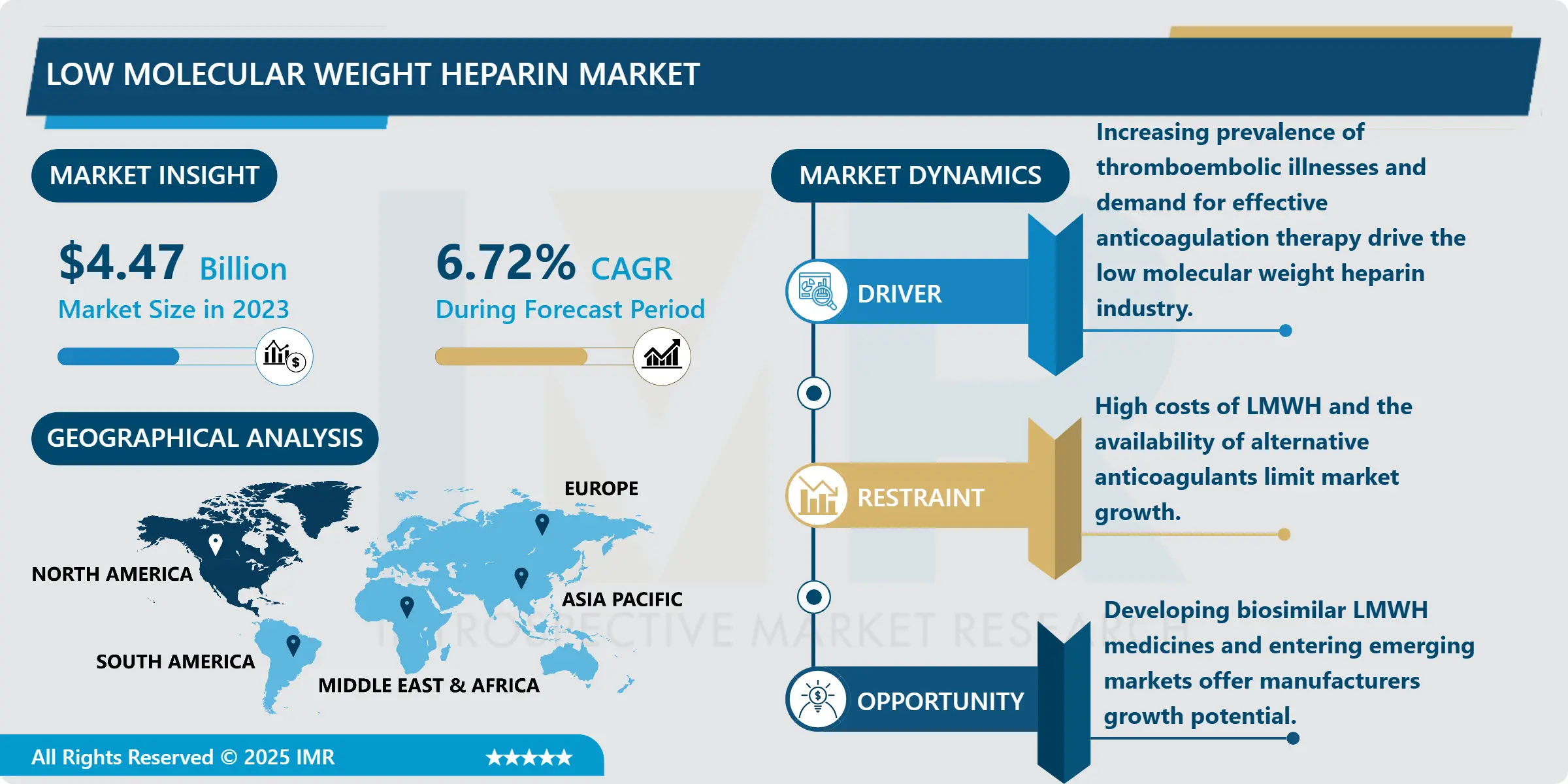
Low Molecular Weight Heparin Market Size Was Valued at USD 4.47 Billion in 2023, and is Projected to Reach USD 8.03 Billion by 2032, Growing at a CAGR of 6.72% From 2024-2032.
LMWH products play a strategic role in the anticoagulant industry, serving mainly as preventive & therapeutic agents used in thromboembolic cases. LMWHs are made from standard heparin but have lower molecular weight; they are more available in the circulation and act faster, have a much more even response and require much less monitoring, such as daily. Such qualities make LMWHs very ideal for treating diseases such as deep vein thrombosis (DVT), pulmonary embolism and myocardial infarction among others. Since LMWHs provide a highly clinical value and the feature of efficient safety compared to conventional heparin the LMWHs have become a leadingcompound in the anticoagulation therapy all across the global area.
It has been found that LMWHs holds a continuously growing market as there is an increasing number of cardiovascular diseases and people seeking for safe and efficient anticoagulants.. The changing global demographic profile, characterized by the ageing population, together dietary and living habits promoting cardiovascular diseases and thrombotic disorders, the demand for LMWH therapy has stepped up. Further, the increased prescription of LMWH in the surgical procedures for thromboprophylaxis is also underpinning market growth since these medications prevent clot formation during and upon surgeries. Major market stakeholders are thus directing their efforts towards product diversification and a search for new and improved LMWH formulations.• Nonetheless, the market has its issues, one of which is the relatively expensive price range of LMWHs and other emerging and novel anticoagulant agents which include DOACs due to their easy use and minimal monitoring required.that contribute to a higher incidence of cardiovascular and thrombotic conditions, is fueling demand for LMWH treatments. Additionally, the widespread use of LMWHs in surgical settings for thromboprophylaxis further supports market growth, as these drugs help prevent the formation of clots during and after major surgeries. Key players in the market are focusing on expanding their product portfolios and developing advanced LMWH formulations to meet growing patient needs.
However, the market also faces challenges, including the high cost of LMWHs and competition from newer anticoagulants, such as direct oral anticoagulants (DOACs), which are gaining popularity for their ease of use and reduced need for monitoring. Nonetheless these restraints LMWH’s still remain in a favourable position appreciable because of the proven efficacy and safety. New opportunities for LMWH providers are opening up due to the enhanced availability of healthcare and increased knowledge of thromboembolic diseases in emerged markets. They further stated that with innovations and partnerships progressing on a continuous basis during the upcoming years the low molecular weight heparin market is to remain stable and display a positive growth rate.
Low Molecular Weight Heparin Market Trend Analysis:
Increased Adoption of LMWH in Outpatient Settings
There is growing shift from inpatient use of LMWH to outpatient and home care mainly owing to the flexibility associated with LMWH therapies.. This shift is most obvious in the management of such diseases as DVT and pulmonary embolism, for LMWH deals with subcutaneous injections instead of intravenous ones thereby decreasing hospital stay. It is really quite congruent with is equitable contemporary healthcare systems’ concern for cost-efficient treatment modalities with the practical consideration of using LMWH in treating thromboembolic disorders out of hospital structures.
Development of Biosimilar LMWH Products
The biosimilar LMWH products are being developed and marketed at a faster pace as companies look forward to extending and improving the existing anticoagulant treatment services.. As the healthcare costs continue to increase and patient needs becoming more demanding, biosimilar LMWHs are on the way to becoming good competitors. The global regulatory agencies have taken an active role for promoting biosimilars by providing easy approval and thus are fast coming into markets. This trend not only improves patients’ availability for fundamental anticoagulants but also leads to a proliferation of competition within LMWH market promoting improvement and lower prices.
Low Molecular Weight Heparin Market Segment Analysis:
Low Molecular Weight Heparin Market is Segmented on the basis of Drug, Packaging, Application, End User, Application, and Region.
By Drug, Enoxaparin segment is expected to dominate the market during the forecast period
This LMWH market further segmented based on drug types provided by Enoxaparin, Dalteparin, Nadroparin, Bemiparin, Tinzaparin, and other drugs, where each of these drugs is used according to the clinical need and patients’ requirements.. It is used widely and proven, both clinically and in the market, as the gold standard of this class of drugs in the prevention and treatment of DVT and other thromboembolic syndromes. Others include; Dalteparin and Tinzaparin commonly used in patients who need to undergo long-term anticoagulants based on their safety profile in dealing with clotting dysfunctions. Other LMWH options such as Nadroparin and Bemiparin also provided broad treatment choice that can ensure the healthcare provider offer specific treatment to his respondents based on some factors hence improving the treatment options hence improving patient outcomes in all health care settings.
By Application, Acute Coronary Syndrome (ACS) segment expected to held the largest share
According to the application, LMWH has a segment of application prospects mainly in deep vein thrombosis (DVT), acute coronary syndrome (ACS), pulmonary embolism and atrial fibrillation.. DVT still remains the core area since LMHW which is used in preventing the clot formation will help to minimize the chances of an emoblism amongst immobile patients. In the case of ACS, LMWHs are emerging to have filled the gap of anticoagulation to prevent thrombus formation and support stabilization of patients with heart related issues. The risk of pulmonary embolism, a potentially fatal sequela of DVT, is also a factor for LMWH use since it provides a safe and effective means of discouraging clot propagation to the lung. Furthermore, in Atrial fibrillation patients LMWH is useful in prevention of formation of blood clots which would be beneficial in wide-spread application in various cardio vascular diseases. This extended applicability reminds that LMWH plays an indispensable part in treatment of thromboembolic diseases and highlights its importance within the anticoagulant therapy market.
Low Molecular Weight Heparin Market Regional Insights:
North America is Expected to Dominate the Market Over the Forecast period
North America is anticipated to dominate the low molecular weight heparin (LMWH) market over the forecast period, supported by a robust healthcare infrastructure, a high prevalence of cardiovascular and thromboembolic diseases, and strong adoption of advanced anticoagulation therapies. The region benefits from substantial investments in research and development, which have led to innovations in LMWH formulations and applications, further bolstering its market leadership. Additionally, growing awareness of thrombosis prevention and favorable reimbursement policies contribute to the demand for LMWHs across the United States and Canada. With increasing cases of lifestyle-related diseases and an aging population, North America’s dominance in the LMWH market is expected to continue as healthcare providers seek effective and safe anticoagulation options for a variety of medical conditions.
Active Key Players in the Low Molecular Weight Heparin Market:
Pfizer, Inc. (US)
LEO Pharma A/S (Denmark)
Sanofi S.A. (France)
Teva Pharmaceutical Industries Ltd. (Israel)
Amphastar Pharmaceuticals Inc. (US)
Abbott Laboratories (US)
Aspen Pharmacare Holdings (South Africa)
Laboratorios Farmaceuticos ROVI SA (Spain)
Changzhou Qianhong Biopharma (China)
Intrapharm Laboratories (UK)
Other Active Players
Chapter 1: Introduction
1.1 Scope and Coverage
Chapter 2:Executive Summary
Chapter 3: Market Landscape
3.1 Market Dynamics
3.1.1 Drivers
3.1.2 Restraints
3.1.3 Opportunities
3.1.4 Challenges
3.2 Market Trend Analysis
3.3 PESTLE Analysis
3.4 Porter’s Five Forces Analysis
3.5 Industry Value Chain Analysis
3.6 Ecosystem
3.7 Regulatory Landscape
3.8 Price Trend Analysis
3.9 Patent Analysis
3.10 Technology Evolution
3.11 Investment Pockets
3.12 Import-Export Analysis
Chapter 4: Low Molecular Weight Heparin Market by Drug
4.1 Low Molecular Weight Heparin Market Snapshot and Growth Engine
4.2 Low Molecular Weight Heparin Market Overview
4.3 Enoxaparin
4.3.1 Introduction and Market Overview
4.3.2 Historic and Forecasted Market Size in Value USD and Volume Units (2017-2032F)
4.3.3 Key Market Trends, Growth Factors and Opportunities
4.3.4 Enoxaparin: Geographic Segmentation Analysis
4.4 Dalteparin
4.4.1 Introduction and Market Overview
4.4.2 Historic and Forecasted Market Size in Value USD and Volume Units (2017-2032F)
4.4.3 Key Market Trends, Growth Factors and Opportunities
4.4.4 Dalteparin: Geographic Segmentation Analysis
4.5 Nadroparin
4.5.1 Introduction and Market Overview
4.5.2 Historic and Forecasted Market Size in Value USD and Volume Units (2017-2032F)
4.5.3 Key Market Trends, Growth Factors and Opportunities
4.5.4 Nadroparin: Geographic Segmentation Analysis
4.6 Bemiparin
4.6.1 Introduction and Market Overview
4.6.2 Historic and Forecasted Market Size in Value USD and Volume Units (2017-2032F)
4.6.3 Key Market Trends, Growth Factors and Opportunities
4.6.4 Bemiparin: Geographic Segmentation Analysis
4.7 Tinzaparin
4.7.1 Introduction and Market Overview
4.7.2 Historic and Forecasted Market Size in Value USD and Volume Units (2017-2032F)
4.7.3 Key Market Trends, Growth Factors and Opportunities
4.7.4 Tinzaparin: Geographic Segmentation Analysis
4.8 and Others
4.8.1 Introduction and Market Overview
4.8.2 Historic and Forecasted Market Size in Value USD and Volume Units (2017-2032F)
4.8.3 Key Market Trends, Growth Factors and Opportunities
4.8.4 and Others: Geographic Segmentation Analysis
Chapter 5: Low Molecular Weight Heparin Market by Packaging
5.1 Low Molecular Weight Heparin Market Snapshot and Growth Engine
5.2 Low Molecular Weight Heparin Market Overview
5.3 Multi-vials and Prefilled Syringes
5.3.1 Introduction and Market Overview
5.3.2 Historic and Forecasted Market Size in Value USD and Volume Units (2017-2032F)
5.3.3 Key Market Trends, Growth Factors and Opportunities
5.3.4 Multi-vials and Prefilled Syringes: Geographic Segmentation Analysis
Chapter 6: Low Molecular Weight Heparin Market by Application
6.1 Low Molecular Weight Heparin Market Snapshot and Growth Engine
6.2 Low Molecular Weight Heparin Market Overview
6.3 Deep Vein Thrombosis
6.3.1 Introduction and Market Overview
6.3.2 Historic and Forecasted Market Size in Value USD and Volume Units (2017-2032F)
6.3.3 Key Market Trends, Growth Factors and Opportunities
6.3.4 Deep Vein Thrombosis: Geographic Segmentation Analysis
6.4 Acute Coronary Syndrome (ACS)
6.4.1 Introduction and Market Overview
6.4.2 Historic and Forecasted Market Size in Value USD and Volume Units (2017-2032F)
6.4.3 Key Market Trends, Growth Factors and Opportunities
6.4.4 Acute Coronary Syndrome (ACS): Geographic Segmentation Analysis
6.5 Pulmonary Embolism and Atrial Fibrillation
6.5.1 Introduction and Market Overview
6.5.2 Historic and Forecasted Market Size in Value USD and Volume Units (2017-2032F)
6.5.3 Key Market Trends, Growth Factors and Opportunities
6.5.4 Pulmonary Embolism and Atrial Fibrillation: Geographic Segmentation Analysis
Chapter 7: Low Molecular Weight Heparin Market by End User
7.1 Low Molecular Weight Heparin Market Snapshot and Growth Engine
7.2 Low Molecular Weight Heparin Market Overview
7.3 Hospitals (Private and Public)
7.3.1 Introduction and Market Overview
7.3.2 Historic and Forecasted Market Size in Value USD and Volume Units (2017-2032F)
7.3.3 Key Market Trends, Growth Factors and Opportunities
7.3.4 Hospitals (Private and Public): Geographic Segmentation Analysis
7.4 Clinics
7.4.1 Introduction and Market Overview
7.4.2 Historic and Forecasted Market Size in Value USD and Volume Units (2017-2032F)
7.4.3 Key Market Trends, Growth Factors and Opportunities
7.4.4 Clinics: Geographic Segmentation Analysis
7.5 and Home
7.5.1 Introduction and Market Overview
7.5.2 Historic and Forecasted Market Size in Value USD and Volume Units (2017-2032F)
7.5.3 Key Market Trends, Growth Factors and Opportunities
7.5.4 and Home: Geographic Segmentation Analysis
Chapter 8: Company Profiles and Competitive Analysis
8.1 Competitive Landscape
8.1.1 Competitive Benchmarking
8.1.2 Low Molecular Weight Heparin Market Share by Manufacturer (2023)
8.1.3 Industry BCG Matrix
8.1.4 Heat Map Analysis
8.1.5 Mergers and Acquisitions
8.2 PFIZER INC. (US)
8.2.1 Company Overview
8.2.2 Key Executives
8.2.3 Company Snapshot
8.2.4 Role of the Company in the Market
8.2.5 Sustainability and Social Responsibility
8.2.6 Operating Business Segments
8.2.7 Product Portfolio
8.2.8 Business Performance
8.2.9 Key Strategic Moves and Recent Developments
8.2.10 SWOT Analysis
8.3 LEO PHARMA A/S (DENMARK)
8.4 SANOFI S.A. (FRANCE)
8.5 TEVA PHARMACEUTICAL INDUSTRIES LTD. (ISRAEL)
8.6 AMPHASTAR PHARMACEUTICALS INC. (US)
8.7 ABBOTT LABORATORIES (US)
8.8 ASPEN PHARMACARE HOLDINGS (SOUTH AFRICA)
8.9 LABORATORIOS FARMACEUTICOS ROVI SA (SPAIN)
8.10 CHANGZHOU QIANHONG BIOPHARMA (CHINA)
8.11 INTRAPHARM LABORATORIES (UK)
8.12 OTHER ACTIVE PLAYERS
Chapter 9: Global Low Molecular Weight Heparin Market By Region
9.1 Overview
9.2. North America Low Molecular Weight Heparin Market
9.2.1 Key Market Trends, Growth Factors and Opportunities
9.2.2 Top Key Companies
9.2.3 Historic and Forecasted Market Size by Segments
9.2.4 Historic and Forecasted Market Size By Drug
9.2.4.1 Enoxaparin
9.2.4.2 Dalteparin
9.2.4.3 Nadroparin
9.2.4.4 Bemiparin
9.2.4.5 Tinzaparin
9.2.4.6 and Others
9.2.5 Historic and Forecasted Market Size By Packaging
9.2.5.1 Multi-vials and Prefilled Syringes
9.2.6 Historic and Forecasted Market Size By Application
9.2.6.1 Deep Vein Thrombosis
9.2.6.2 Acute Coronary Syndrome (ACS)
9.2.6.3 Pulmonary Embolism and Atrial Fibrillation
9.2.7 Historic and Forecasted Market Size By End User
9.2.7.1 Hospitals (Private and Public)
9.2.7.2 Clinics
9.2.7.3 and Home
9.2.8 Historic and Forecast Market Size by Country
9.2.8.1 US
9.2.8.2 Canada
9.2.8.3 Mexico
9.3. Eastern Europe Low Molecular Weight Heparin Market
9.3.1 Key Market Trends, Growth Factors and Opportunities
9.3.2 Top Key Companies
9.3.3 Historic and Forecasted Market Size by Segments
9.3.4 Historic and Forecasted Market Size By Drug
9.3.4.1 Enoxaparin
9.3.4.2 Dalteparin
9.3.4.3 Nadroparin
9.3.4.4 Bemiparin
9.3.4.5 Tinzaparin
9.3.4.6 and Others
9.3.5 Historic and Forecasted Market Size By Packaging
9.3.5.1 Multi-vials and Prefilled Syringes
9.3.6 Historic and Forecasted Market Size By Application
9.3.6.1 Deep Vein Thrombosis
9.3.6.2 Acute Coronary Syndrome (ACS)
9.3.6.3 Pulmonary Embolism and Atrial Fibrillation
9.3.7 Historic and Forecasted Market Size By End User
9.3.7.1 Hospitals (Private and Public)
9.3.7.2 Clinics
9.3.7.3 and Home
9.3.8 Historic and Forecast Market Size by Country
9.3.8.1 Russia
9.3.8.2 Bulgaria
9.3.8.3 The Czech Republic
9.3.8.4 Hungary
9.3.8.5 Poland
9.3.8.6 Romania
9.3.8.7 Rest of Eastern Europe
9.4. Western Europe Low Molecular Weight Heparin Market
9.4.1 Key Market Trends, Growth Factors and Opportunities
9.4.2 Top Key Companies
9.4.3 Historic and Forecasted Market Size by Segments
9.4.4 Historic and Forecasted Market Size By Drug
9.4.4.1 Enoxaparin
9.4.4.2 Dalteparin
9.4.4.3 Nadroparin
9.4.4.4 Bemiparin
9.4.4.5 Tinzaparin
9.4.4.6 and Others
9.4.5 Historic and Forecasted Market Size By Packaging
9.4.5.1 Multi-vials and Prefilled Syringes
9.4.6 Historic and Forecasted Market Size By Application
9.4.6.1 Deep Vein Thrombosis
9.4.6.2 Acute Coronary Syndrome (ACS)
9.4.6.3 Pulmonary Embolism and Atrial Fibrillation
9.4.7 Historic and Forecasted Market Size By End User
9.4.7.1 Hospitals (Private and Public)
9.4.7.2 Clinics
9.4.7.3 and Home
9.4.8 Historic and Forecast Market Size by Country
9.4.8.1 Germany
9.4.8.2 UK
9.4.8.3 France
9.4.8.4 The Netherlands
9.4.8.5 Italy
9.4.8.6 Spain
9.4.8.7 Rest of Western Europe
9.5. Asia Pacific Low Molecular Weight Heparin Market
9.5.1 Key Market Trends, Growth Factors and Opportunities
9.5.2 Top Key Companies
9.5.3 Historic and Forecasted Market Size by Segments
9.5.4 Historic and Forecasted Market Size By Drug
9.5.4.1 Enoxaparin
9.5.4.2 Dalteparin
9.5.4.3 Nadroparin
9.5.4.4 Bemiparin
9.5.4.5 Tinzaparin
9.5.4.6 and Others
9.5.5 Historic and Forecasted Market Size By Packaging
9.5.5.1 Multi-vials and Prefilled Syringes
9.5.6 Historic and Forecasted Market Size By Application
9.5.6.1 Deep Vein Thrombosis
9.5.6.2 Acute Coronary Syndrome (ACS)
9.5.6.3 Pulmonary Embolism and Atrial Fibrillation
9.5.7 Historic and Forecasted Market Size By End User
9.5.7.1 Hospitals (Private and Public)
9.5.7.2 Clinics
9.5.7.3 and Home
9.5.8 Historic and Forecast Market Size by Country
9.5.8.1 China
9.5.8.2 India
9.5.8.3 Japan
9.5.8.4 South Korea
9.5.8.5 Malaysia
9.5.8.6 Thailand
9.5.8.7 Vietnam
9.5.8.8 The Philippines
9.5.8.9 Australia
9.5.8.10 New Zealand
9.5.8.11 Rest of APAC
9.6. Middle East & Africa Low Molecular Weight Heparin Market
9.6.1 Key Market Trends, Growth Factors and Opportunities
9.6.2 Top Key Companies
9.6.3 Historic and Forecasted Market Size by Segments
9.6.4 Historic and Forecasted Market Size By Drug
9.6.4.1 Enoxaparin
9.6.4.2 Dalteparin
9.6.4.3 Nadroparin
9.6.4.4 Bemiparin
9.6.4.5 Tinzaparin
9.6.4.6 and Others
9.6.5 Historic and Forecasted Market Size By Packaging
9.6.5.1 Multi-vials and Prefilled Syringes
9.6.6 Historic and Forecasted Market Size By Application
9.6.6.1 Deep Vein Thrombosis
9.6.6.2 Acute Coronary Syndrome (ACS)
9.6.6.3 Pulmonary Embolism and Atrial Fibrillation
9.6.7 Historic and Forecasted Market Size By End User
9.6.7.1 Hospitals (Private and Public)
9.6.7.2 Clinics
9.6.7.3 and Home
9.6.8 Historic and Forecast Market Size by Country
9.6.8.1 Turkiye
9.6.8.2 Bahrain
9.6.8.3 Kuwait
9.6.8.4 Saudi Arabia
9.6.8.5 Qatar
9.6.8.6 UAE
9.6.8.7 Israel
9.6.8.8 South Africa
9.7. South America Low Molecular Weight Heparin Market
9.7.1 Key Market Trends, Growth Factors and Opportunities
9.7.2 Top Key Companies
9.7.3 Historic and Forecasted Market Size by Segments
9.7.4 Historic and Forecasted Market Size By Drug
9.7.4.1 Enoxaparin
9.7.4.2 Dalteparin
9.7.4.3 Nadroparin
9.7.4.4 Bemiparin
9.7.4.5 Tinzaparin
9.7.4.6 and Others
9.7.5 Historic and Forecasted Market Size By Packaging
9.7.5.1 Multi-vials and Prefilled Syringes
9.7.6 Historic and Forecasted Market Size By Application
9.7.6.1 Deep Vein Thrombosis
9.7.6.2 Acute Coronary Syndrome (ACS)
9.7.6.3 Pulmonary Embolism and Atrial Fibrillation
9.7.7 Historic and Forecasted Market Size By End User
9.7.7.1 Hospitals (Private and Public)
9.7.7.2 Clinics
9.7.7.3 and Home
9.7.8 Historic and Forecast Market Size by Country
9.7.8.1 Brazil
9.7.8.2 Argentina
9.7.8.3 Rest of SA
Chapter 10 Analyst Viewpoint and Conclusion
10.1 Recommendations and Concluding Analysis
10.2 Potential Market Strategies
Chapter 11 Research Methodology
11.1 Research Process
11.2 Primary Research
11.3 Secondary Research
Q1: What would be the forecast period in the Low Molecular Weight Heparin Market research report?
A1: The forecast period in the Low Molecular Weight Heparin Market research report is 2024-2032.
Q2: Who are the key players in the Low Molecular Weight Heparin Market?
A2: Pfizer, Inc. (US), LEO Pharma A/S (Denmark), Sanofi S.A. (France), Teva Pharmaceutical Industries Ltd. (Israel), Amphastar Pharmaceuticals Inc. (US), Abbott Laboratories (US), Aspen Pharmacare Holdings (South Africa), Laboratorios Farmaceuticos ROVI SA (Spain), Changzhou Qianhong Biopharma (China), Intrapharm Laboratories (UK), and Other Active Players.
Q3: What are the segments of the Botanical Market?
A3: The Low Molecular Weight Heparin Market is segmented into by Drug, by Packaging, by Application, by End User and region. by Drug (Enoxaparin, Dalteparin, Nadroparin, Bemiparin, Tinzaparin, and Others), by Packaging (Multi-vials and Prefilled Syringes), by Application (Deep Vein Thrombosis, Acute Coronary Syndrome (ACS), Pulmonary Embolism and Atrial Fibrillation), by End User (Hospitals (Private and Public), Clinics, and Home). By region, it is analyzed across North America (U.S., Canada, Mexico), Eastern Europe (Russia, Bulgaria, The Czech Republic, Hungary, Poland, Romania, Rest of Eastern Europe), Western Europe (Germany, UK, France, The Netherlands, Italy, Spain, Rest of Western Europe), Asia Pacific (China, India, Japan, South Korea, Malaysia, Thailand, Vietnam, The Philippines, Australia, New-Zealand, Rest of APAC), Middle East & Africa (Turkiye, Bahrain, Kuwait, Saudi Arabia, Qatar, UAE, Israel, South Africa), South America (Brazil, Argentina, Rest of SA).
Q4: What is the Low Molecular Weight Heparin Market?
A4: LMWH products play a strategic role in anticoagulant industry serving mainly as preventive & therapeutic agents used in thromboembolic cases. LMWHs are made from standard heparin but have lower molecular weight, they are more available in the circulation and act faster, have a much more even response and require much less monitoring, such as daily. Such qualities make LMWHs very ideal for treating diseases such as deep vein thrombosis (DVT), pulmonary embolism and myocardial infarction among others. Since LMWHs provide a highly clinical value and the feature of efficient safety compared to conventional heparin the LMWHs have become a leadingcompound in the anticoagulation therapy all across the global area.
Q5: How big is the Low Molecular Weight Heparin Market?
A5: Low Molecular Weight Heparin Market Size Was Valued at USD 4.47 Billion in 2023, and is Projected to Reach USD 8.03 Billion by 2032, Growing at a CAGR of 6.72% From 2024-2032
How to Buy a Report from eminsights.jp
On the product page, choose the license you want: Single-User License, Multi-User License or Enterprise License.
If you required report in your native language, then you can click on Translated Report button and fill out the form with report name and language you want, then our team will contact you as soon as possible.
Click the Buy Now button.
You will be redirected to the checkout page. Enter your company details and payment information.
Click Place Order to complete the purchase.
Confirmation: You’ll receive an order confirmation and our team will contact you shortly with your ordered report.
If you have any questions, fill out the contact form below or email us at [email protected].
Thank you for choosing eminsights.jp!