Stay Ahead in Fast-Growing Economies.
Browse Reports Now
IgG4-Related Disease Market-Overview and Outlook by Potential Growth
Immunoglobulin G4-related disease (IgG4-RD) is a chronic immune-mediated disease that may present with tumefactive lesions, fibrosis, and a polyclonal IgG4-positive (IgG4) plasma cell-enriched infiltrate in nearly any anatomic site. IgG4-related disease (IgG4-RD) was described in Japan in the first years of the 21st century, characterized pathologically by the infiltration of IgG4-bearing plasma cells into involved organs.

IMR Group
Description
IgG4-Related Disease Market Synopsis
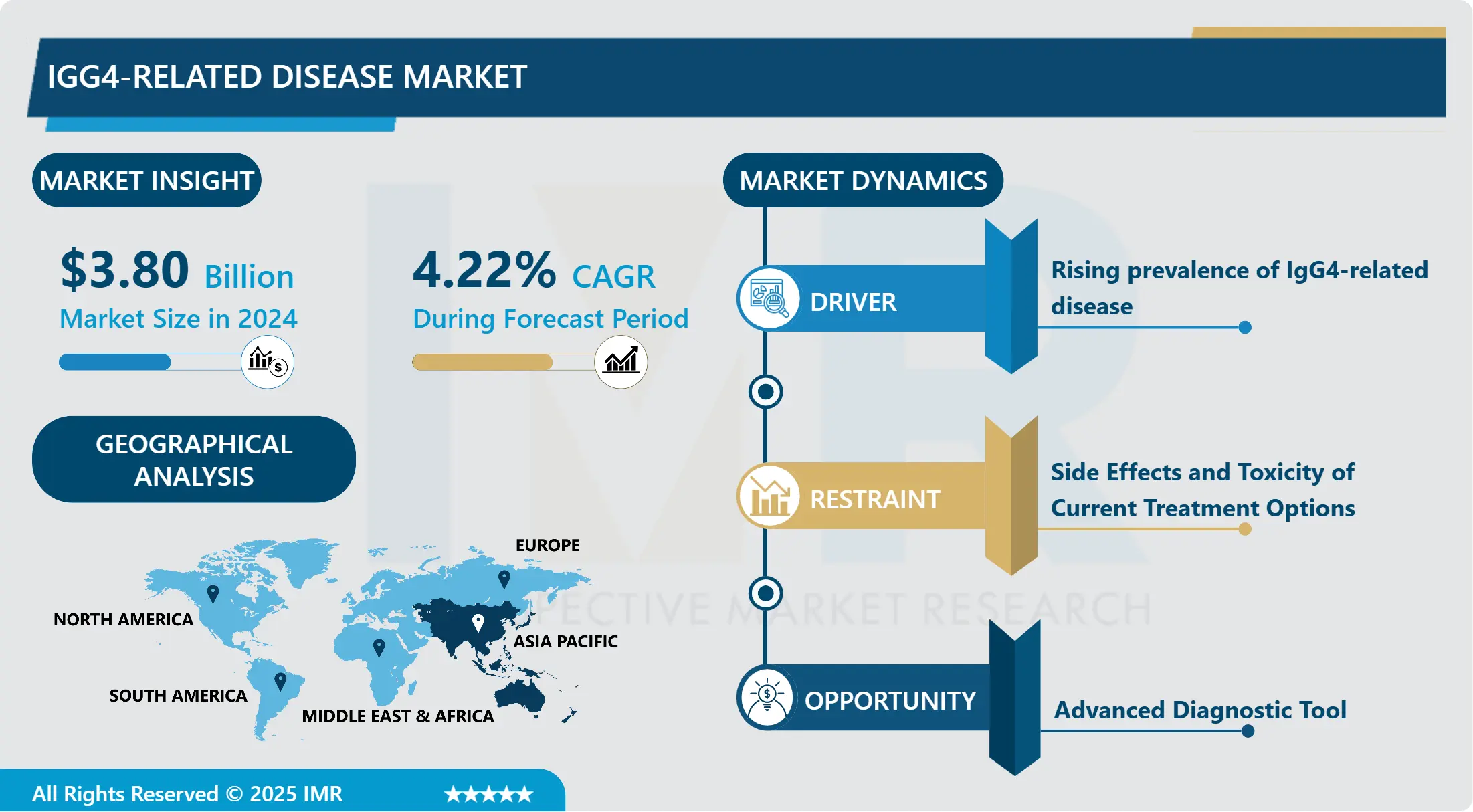
IgG4-Related Disease Market Size Was Valued at USD 3.80 Billion in 2024 and is Projected to Reach USD 5.29 Billion by 2032, Growing at a CAGR of 4.22% From 2025-2032.
Immunoglobulin G4-related disease (IgG4-RD) is a chronic immune-mediated disease that may present with tumefactive lesions, fibrosis, and a polyclonal IgG4-positive (IgG4) plasma cell-enriched infiltrate in nearly any anatomic site. IgG4-related disease (IgG4-RD) was described in Japan in the first years of the 21st century, characterized pathologically by the infiltration of IgG4-bearing plasma cells into involved organs.
IgG4-RD presents with a wide range of symptoms, mimicking other conditions like cancers, infections, and autoimmune diseases. Therefore, accurate diagnosis often requires a combination of clinical evaluation, imaging, histopathological examination, and serological tests. The identification of elevated serum IgG4 levels and specific histopathological features (such as dense lymphoplasmacytic infiltrate and storiform fibrosis) are crucial for confirming the diagnosis?.
Advances in identifying biomarkers for IgG4-RD have the potential to revolutionize its diagnosis and monitoring. Reliable biomarkers could enable early detection and assess disease activity and response to therapy, facilitating more personalized treatment plans. Ongoing research is focused on discovering and validating these biomarkers.
Traditional treatments for IgG4-RD, such as corticosteroids and immunosuppressants, often lead to significant side effects and require long-term management. The development of targeted biological therapies, such as monoclonal antibodies (e.g., rituximab and obexelimab), represents a major advancement. These therapies specifically target components of the immune system involved in IgG4-RD, potentially offering more effective and safer treatment options?.
IgG4-Related Disease Market Trend Analysis
IgG4-Related Disease Market Growth Driver- Rising prevalence of IgG4-related disease
IgG4-RD, first recognized as a distinct clinical entity in the early 2000s, has seen a steady increase in reported cases. This condition is now understood to affect multiple organs, making it a key area of focus in autoimmune and inflammatory disease research.
IgG4-RD represents a very young entity of disease, having emerged within only 1 decade. Although it is generally thought to be a rare condition, it is likely that with growing awareness and recent advances in research, the number of patients diagnosed with IgG4-RD will increase in the future.
By analysing identified IgG4-RD cases. The mean age was 56.5 years with 57.6% female and 66% White. The incidence of IgG4-RD increased during the study period from 0.78 to 1.39 per 100,000 person-years in 2015 and 2019, respectively. The point prevalence in recent years was 5.3/100 000 persons. During follow-up, there were 39 and 164 deaths among 515 IgG4-RD cases and 5160 comparators, resulting in a mortality rate of 3.42 and 1.46/100 person-years, respectively, and adjusted HR of 2.51 (95% CI 1.76 to 3.56). Thus, raising the disease simultaneously prevalence of IgG4-related disease is increasing.
IgG4-Related Disease Market Opportunity- Advanced Diagnostic Tools
IgG4-Related Disease (IgG4-RD) is a complex and rare autoimmune condition that often mimics other diseases, making accurate and timely diagnosis challenging. The development of advanced diagnostic tools presents a significant market opportunity.
IgG4-RD can affect multiple organs, including the pancreas, bile ducts, salivary glands, and kidneys. Symptoms often overlap with other conditions, leading to misdiagnosis or delayed diagnosis. Current diagnostic methods rely on a combination of clinical observation, imaging, serology, and histopathology, often requiring invasive biopsies. IgG4 serum levels, although commonly measured, are not specific and can be elevated in other conditions, leading to potential false positives.
The development of non-invasive diagnostic tools, such as advanced imaging techniques and molecular assays, could revolutionize the management of IgG4-RD. Innovations in imaging, like positron emission tomography (PET) scans using novel radiotracers, offer the potential for early and accurate detection of organ involvement in IgG4-RD. Additionally, molecular diagnostics, including next-generation sequencing (NGS) and gene expression profiling, could identify specific biomarkers associated with IgG4-RD. These tools can enhance the accuracy of diagnosis and facilitate differentiation from other similar conditions.
IgG4-Related Disease Market Segment Analysis:
IgG4-Related Disease Market Segmented based on Disease Type, Type, Drug Type, Route of Administration, End-users, and Region.
By Disease Type, Type 1 (IgG4-Related) Autoimmune Pancreatitis (AIP) segment is expected to dominate the market during the forecast period
Type 1 AIP is the most common subtype of autoimmune pancreatitis. Its prevalence is higher compared to other types, contributing to a larger patient pool and market demand. Improvements in diagnostic techniques have led to better identification and understanding of Type 1 AIP. This increased detection contributes to its dominant position in the market. Therapeutic developments tailored specifically for Type 1 AIP have enhanced patient outcomes. As treatment options become more effective and tailored to this subtype, it further solidifies its dominance in the market.
Although commonly observed, approximately 32% (7–40%) of the patients with type 1 AIP may develop pancreatic calcification or chronic pancreatitis. The association of malignant tumors with type 1 AIP or IgG4-RD is controversial, several cases of pancreatic cancer or other malignancies have been described in patients with AIP or IgG4-RD.22,40–44) In recent reports,22,40–44) in about 1,000 patients, 8.5% (10.1–13.9%) of IgG4-RD cases and 1% of AIP cases (2.1–13.9%) exhibited malignant tumors. Therefore, it is noted that pancreatic cancer or other malignant tumors may be complicated with AIP or IgG4-RD.
A Japanese multicenter study of 108 cases of AIP reported that the highest risk for cancer is in the first year after AIP diagnosis. The absence of a relapse after successful treatment of the coexisting cancers suggests that AIP may develop as a paraneoplastic syndrome in some patients.
By Drug Type, the Prednisone segment held the largest share in 2024
Treatment for IgG4-RSD traditionally has involved prednisone, a steroid medication. Prednisone has proven very effective in treating this condition. The initial recommended dose of oral prednisolone for induction of remission is 0.6 mg/kg/day, administered for 2-4 weeks. This dose is gradually tapered to a maintenance dose of 2.5-5 mg/day over a period of 2-3 months.
Prednisone is often the first-line treatment for IgG4-related disease (IgG4-RD) due to its potent anti-inflammatory properties. IgG4-RD is characterized by tissue inflammation and fibrosis, and prednisone helps reduce inflammation and suppress the immune response, which can alleviate symptoms and prevent disease progression.
Other drugs used to treat IgG4-RD include immunosuppressants like azathioprine and methotrexate, as well as rituximab, which targets B-cells involved in the immune response. However, prednisone is frequently chosen as the initial therapy because of its effectiveness and relatively low cost compared to some of these alternatives.
Additionally, prednisone is widely available and has a long history of use in treating various inflammatory conditions, making it a familiar option for many healthcare providers. Its dominance in the IgG4-RD market is thus a combination of its efficacy, accessibility, and familiarity among clinicians.
IgG4-Related Disease Market Regional Insights:
Asia Pacific is Expected to Dominate the Market Over the Forecast Period
Igg4-related disease is more prevalent in certain Asian populations compared to others. Japan, for example, has a relatively high prevalence of the disease. There may be higher awareness and better diagnostic capabilities for IgG4-Related Diseases in the Asia Pacific region, leading to more accurate diagnoses and higher reported cases. The Asia Pacific region is home to many pharmaceutical and biotech companies conducting research and development in the field of rare diseases, including IGg4-related diseases. These companies may be more focused on addressing the needs of their local populations, driving innovation and investment in this area.
For Instance, In a Japanese cohort, reportedly 70% of patients later diagnosed with IgG4-RD presented with symptoms, while 30% were found incidentally. Most frequently, symptoms were related to tumefaction, such as obstructive jaundice and exophthalmos (41%), followed by general abdominal symptoms (18%) and malaise (4%). Renal (4%) and pulmonary symptoms (3%) were only present in a minority of patients. Another frequently reported symptom preceding the diagnosis of IgG4-RD is weight loss.
With a large and diverse population, there may be a significant number of patients with IGg4-related disease in the Asia Pacific region, creating a sizable market for related treatments and therapies. Improvements in healthcare infrastructure and access to medical care in countries across the Asia Pacific region may also contribute to better detection, diagnosis, and management of IgG4-Related Disease, further driving market growth.
Clinical characteristics of patients from two large published cohorts
Japan (n=334)17
Boston (125)16
Mean age at diagnosis
63.8 years
55.2 years
Male sex
61.4%
61.4%
Ethnicity
100% Japanese
76% White
Elevated serum IgG4
>95%
51%
The mean number of organs involved (range)
3.2 (1-11)
2.3 (1-7)
AFFECTED ORGANS
Salivary glands
72.3%
28% (submandibular)
+ 16.8% (parotid)
Lacrimal glands/orbit
57.1%
22.4%
Lymph nodes
56.5%
27.2%
Pancreas
25.5%
19.2%
Retroperitoneal/aorta
24.9%
18.4% (retroperitoneal)
+ 11.2% (aorta)
Kidney
23.7%
12%
IgG4-Related Disease Market Top Key Players:
Accord-UK Ltd. (U.K.)
Amgen Inc. (U.S.)
Amneal Pharmaceuticals LLC (U.S.)
Antares Pharma (U.S.)
Baxter (U.S.)
Celltrion Healthcare Co., Ltd. (South Korea)
Cipla Inc. (India)
Fresenius Kabi AG (Germany)
Genentech, Inc. (U.S.)
Hikma Pharmaceuticals PLC (U.K.)
Lannett (U.S.)
Pfizer Inc. (U.S.)
Sandoz Group AG (Switzerland)
Sun Pharmaceutical Industries Ltd. (India)
Viatris Inc. (U.S.)
Zydus Group (India)
Other Active Players.
Chapter 1: Introduction
1.1 Scope and Coverage
Chapter 2:Executive Summary
Chapter 3: Market Landscape
3.1 Market Dynamics
3.1.1 Drivers
3.1.2 Restraints
3.1.3 Opportunities
3.1.4 Challenges
3.2 Market Trend Analysis
3.3 PESTLE Analysis
3.4 Porter’s Five Forces Analysis
3.5 Industry Value Chain Analysis
3.6 Ecosystem
3.7 Regulatory Landscape
3.8 Price Trend Analysis
3.9 Patent Analysis
3.10 Technology Evolution
3.11 Investment Pockets
3.12 Import-Export Analysis
Chapter 4: IgG4-Related Disease Market by Disease Type (2018-2032)
4.1 IgG4-Related Disease Market Snapshot and Growth Engine
4.2 Market Overview
4.3 Type 1 (IgG4-Related) Autoimmune Pancreatitis (AIP)
4.3.1 Introduction and Market Overview
4.3.2 Historic and Forecasted Market Size in Value USD and Volume Units
4.3.3 Key Market Trends, Growth Factors, and Opportunities
4.3.4 Geographic Segmentation Analysis
4.4 Retroperitoneal Fibrosis
4.5 IgG4-Related Tubulointerstitial Nephritis (TIN)
4.6 Serum IgG4 Concentration
4.7 IgG4-Related Thyroid Disease
4.8 Others
Chapter 5: IgG4-Related Disease Market by Type (2018-2032)
5.1 IgG4-Related Disease Market Snapshot and Growth Engine
5.2 Market Overview
5.3 Diagnostic
5.3.1 Introduction and Market Overview
5.3.2 Historic and Forecasted Market Size in Value USD and Volume Units
5.3.3 Key Market Trends, Growth Factors, and Opportunities
5.3.4 Geographic Segmentation Analysis
5.4 Treatment
Chapter 6: IgG4-Related Disease Market by Drug Type (2018-2032)
6.1 IgG4-Related Disease Market Snapshot and Growth Engine
6.2 Market Overview
6.3 Corticosteroids
6.3.1 Introduction and Market Overview
6.3.2 Historic and Forecasted Market Size in Value USD and Volume Units
6.3.3 Key Market Trends, Growth Factors, and Opportunities
6.3.4 Geographic Segmentation Analysis
6.4 Biologics
6.5 Immunosuppressants
6.6 Antimetabolites
6.7 Prednisone
Chapter 7: IgG4-Related Disease Market by Route of Administration (2018-2032)
7.1 IgG4-Related Disease Market Snapshot and Growth Engine
7.2 Market Overview
7.3 Parenteral
7.3.1 Introduction and Market Overview
7.3.2 Historic and Forecasted Market Size in Value USD and Volume Units
7.3.3 Key Market Trends, Growth Factors, and Opportunities
7.3.4 Geographic Segmentation Analysis
7.4 Oral
7.5 Others
Chapter 8: IgG4-Related Disease Market by End-User (2018-2032)
8.1 IgG4-Related Disease Market Snapshot and Growth Engine
8.2 Market Overview
8.3 Hospitals
8.3.1 Introduction and Market Overview
8.3.2 Historic and Forecasted Market Size in Value USD and Volume Units
8.3.3 Key Market Trends, Growth Factors, and Opportunities
8.3.4 Geographic Segmentation Analysis
8.4 Specialty Clinics
8.5 Others
Chapter 9: IgG4-Related Disease Market by Distribution Channel (2018-2032)
9.1 IgG4-Related Disease Market Snapshot and Growth Engine
9.2 Market Overview
9.3 Hospital Pharmacy
9.3.1 Introduction and Market Overview
9.3.2 Historic and Forecasted Market Size in Value USD and Volume Units
9.3.3 Key Market Trends, Growth Factors, and Opportunities
9.3.4 Geographic Segmentation Analysis
9.4 Retail Pharmacy
9.5 Online Pharmacy
9.6 Others
Chapter 10: Company Profiles and Competitive Analysis
10.1 Competitive Landscape
10.1.1 Competitive Benchmarking
10.1.2 IgG4-Related Disease Market Share by Manufacturer (2024)
10.1.3 Industry BCG Matrix
10.1.4 Heat Map Analysis
10.1.5 Mergers and Acquisitions
10.2 ZYDUS GROUP (INDIA)
10.2.1 Company Overview
10.2.2 Key Executives
10.2.3 Company Snapshot
10.2.4 Role of the Company in the Market
10.2.5 Sustainability and Social Responsibility
10.2.6 Operating Business Segments
10.2.7 Product Portfolio
10.2.8 Business Performance
10.2.9 Key Strategic Moves and Recent Developments
10.2.10 SWOT Analysis
10.3 HIKMA PHARMACEUTICALS PLC (U.K.)
10.4 LANNETT (U.S.)
10.5 SUN PHARMACEUTICAL INDUSTRIES LTD. (INDIA)
10.6 BAXTER (U.S.)
10.7 VIATRIS INC. (U.S.)
10.8 AMGEN INC. (U.S.)
10.9 SANDOZ GROUP AG (SWITZERLAND)
10.10 FRESENIUS KABI AG (GERMANY)
10.11 PFIZER INC. (U.S.)
10.12 CIPLA INC. (INDIA)
10.13 CELLTRION HEALTHCARE COLTD. (SOUTH KOREA)
10.14 ANTARES PHARMA (U.S.)
10.15 AMNEAL PHARMACEUTICALS LLC (U.S.)
10.16 ACCORD-UK LTD. (U.K.)
10.17 GENENTECH INC. (U.S.)
10.18 INGENUS PHARMACEUTICALS (U.S.)
10.19 STI PHARMA (CANADA)
10.20 SEBELA PHARMACEUTICALS (FRANCE)
10.21 ANI PHARMACEUTICALS INC. (U.S.)
10.22 AND OTHER ACTIVE PLAYER.
Chapter 11: Global IgG4-Related Disease Market By Region
11.1 Overview
11.2. North America IgG4-Related Disease Market
11.2.1 Key Market Trends, Growth Factors and Opportunities
11.2.2 Top Key Companies
11.2.3 Historic and Forecasted Market Size by Segments
11.2.4 Historic and Forecasted Market Size by Disease Type
11.2.4.1 Type 1 (IgG4-Related) Autoimmune Pancreatitis (AIP)
11.2.4.2 Retroperitoneal Fibrosis
11.2.4.3 IgG4-Related Tubulointerstitial Nephritis (TIN)
11.2.4.4 Serum IgG4 Concentration
11.2.4.5 IgG4-Related Thyroid Disease
11.2.4.6 Others
11.2.5 Historic and Forecasted Market Size by Type
11.2.5.1 Diagnostic
11.2.5.2 Treatment
11.2.6 Historic and Forecasted Market Size by Drug Type
11.2.6.1 Corticosteroids
11.2.6.2 Biologics
11.2.6.3 Immunosuppressants
11.2.6.4 Antimetabolites
11.2.6.5 Prednisone
11.2.7 Historic and Forecasted Market Size by Route of Administration
11.2.7.1 Parenteral
11.2.7.2 Oral
11.2.7.3 Others
11.2.8 Historic and Forecasted Market Size by End-User
11.2.8.1 Hospitals
11.2.8.2 Specialty Clinics
11.2.8.3 Others
11.2.9 Historic and Forecasted Market Size by Distribution Channel
11.2.9.1 Hospital Pharmacy
11.2.9.2 Retail Pharmacy
11.2.9.3 Online Pharmacy
11.2.9.4 Others
11.2.10 Historic and Forecast Market Size by Country
11.2.10.1 US
11.2.10.2 Canada
11.2.10.3 Mexico
11.3. Eastern Europe IgG4-Related Disease Market
11.3.1 Key Market Trends, Growth Factors and Opportunities
11.3.2 Top Key Companies
11.3.3 Historic and Forecasted Market Size by Segments
11.3.4 Historic and Forecasted Market Size by Disease Type
11.3.4.1 Type 1 (IgG4-Related) Autoimmune Pancreatitis (AIP)
11.3.4.2 Retroperitoneal Fibrosis
11.3.4.3 IgG4-Related Tubulointerstitial Nephritis (TIN)
11.3.4.4 Serum IgG4 Concentration
11.3.4.5 IgG4-Related Thyroid Disease
11.3.4.6 Others
11.3.5 Historic and Forecasted Market Size by Type
11.3.5.1 Diagnostic
11.3.5.2 Treatment
11.3.6 Historic and Forecasted Market Size by Drug Type
11.3.6.1 Corticosteroids
11.3.6.2 Biologics
11.3.6.3 Immunosuppressants
11.3.6.4 Antimetabolites
11.3.6.5 Prednisone
11.3.7 Historic and Forecasted Market Size by Route of Administration
11.3.7.1 Parenteral
11.3.7.2 Oral
11.3.7.3 Others
11.3.8 Historic and Forecasted Market Size by End-User
11.3.8.1 Hospitals
11.3.8.2 Specialty Clinics
11.3.8.3 Others
11.3.9 Historic and Forecasted Market Size by Distribution Channel
11.3.9.1 Hospital Pharmacy
11.3.9.2 Retail Pharmacy
11.3.9.3 Online Pharmacy
11.3.9.4 Others
11.3.10 Historic and Forecast Market Size by Country
11.3.10.1 Russia
11.3.10.2 Bulgaria
11.3.10.3 The Czech Republic
11.3.10.4 Hungary
11.3.10.5 Poland
11.3.10.6 Romania
11.3.10.7 Rest of Eastern Europe
11.4. Western Europe IgG4-Related Disease Market
11.4.1 Key Market Trends, Growth Factors and Opportunities
11.4.2 Top Key Companies
11.4.3 Historic and Forecasted Market Size by Segments
11.4.4 Historic and Forecasted Market Size by Disease Type
11.4.4.1 Type 1 (IgG4-Related) Autoimmune Pancreatitis (AIP)
11.4.4.2 Retroperitoneal Fibrosis
11.4.4.3 IgG4-Related Tubulointerstitial Nephritis (TIN)
11.4.4.4 Serum IgG4 Concentration
11.4.4.5 IgG4-Related Thyroid Disease
11.4.4.6 Others
11.4.5 Historic and Forecasted Market Size by Type
11.4.5.1 Diagnostic
11.4.5.2 Treatment
11.4.6 Historic and Forecasted Market Size by Drug Type
11.4.6.1 Corticosteroids
11.4.6.2 Biologics
11.4.6.3 Immunosuppressants
11.4.6.4 Antimetabolites
11.4.6.5 Prednisone
11.4.7 Historic and Forecasted Market Size by Route of Administration
11.4.7.1 Parenteral
11.4.7.2 Oral
11.4.7.3 Others
11.4.8 Historic and Forecasted Market Size by End-User
11.4.8.1 Hospitals
11.4.8.2 Specialty Clinics
11.4.8.3 Others
11.4.9 Historic and Forecasted Market Size by Distribution Channel
11.4.9.1 Hospital Pharmacy
11.4.9.2 Retail Pharmacy
11.4.9.3 Online Pharmacy
11.4.9.4 Others
11.4.10 Historic and Forecast Market Size by Country
11.4.10.1 Germany
11.4.10.2 UK
11.4.10.3 France
11.4.10.4 The Netherlands
11.4.10.5 Italy
11.4.10.6 Spain
11.4.10.7 Rest of Western Europe
11.5. Asia Pacific IgG4-Related Disease Market
11.5.1 Key Market Trends, Growth Factors and Opportunities
11.5.2 Top Key Companies
11.5.3 Historic and Forecasted Market Size by Segments
11.5.4 Historic and Forecasted Market Size by Disease Type
11.5.4.1 Type 1 (IgG4-Related) Autoimmune Pancreatitis (AIP)
11.5.4.2 Retroperitoneal Fibrosis
11.5.4.3 IgG4-Related Tubulointerstitial Nephritis (TIN)
11.5.4.4 Serum IgG4 Concentration
11.5.4.5 IgG4-Related Thyroid Disease
11.5.4.6 Others
11.5.5 Historic and Forecasted Market Size by Type
11.5.5.1 Diagnostic
11.5.5.2 Treatment
11.5.6 Historic and Forecasted Market Size by Drug Type
11.5.6.1 Corticosteroids
11.5.6.2 Biologics
11.5.6.3 Immunosuppressants
11.5.6.4 Antimetabolites
11.5.6.5 Prednisone
11.5.7 Historic and Forecasted Market Size by Route of Administration
11.5.7.1 Parenteral
11.5.7.2 Oral
11.5.7.3 Others
11.5.8 Historic and Forecasted Market Size by End-User
11.5.8.1 Hospitals
11.5.8.2 Specialty Clinics
11.5.8.3 Others
11.5.9 Historic and Forecasted Market Size by Distribution Channel
11.5.9.1 Hospital Pharmacy
11.5.9.2 Retail Pharmacy
11.5.9.3 Online Pharmacy
11.5.9.4 Others
11.5.10 Historic and Forecast Market Size by Country
11.5.10.1 China
11.5.10.2 India
11.5.10.3 Japan
11.5.10.4 South Korea
11.5.10.5 Malaysia
11.5.10.6 Thailand
11.5.10.7 Vietnam
11.5.10.8 The Philippines
11.5.10.9 Australia
11.5.10.10 New Zealand
11.5.10.11 Rest of APAC
11.6. Middle East & Africa IgG4-Related Disease Market
11.6.1 Key Market Trends, Growth Factors and Opportunities
11.6.2 Top Key Companies
11.6.3 Historic and Forecasted Market Size by Segments
11.6.4 Historic and Forecasted Market Size by Disease Type
11.6.4.1 Type 1 (IgG4-Related) Autoimmune Pancreatitis (AIP)
11.6.4.2 Retroperitoneal Fibrosis
11.6.4.3 IgG4-Related Tubulointerstitial Nephritis (TIN)
11.6.4.4 Serum IgG4 Concentration
11.6.4.5 IgG4-Related Thyroid Disease
11.6.4.6 Others
11.6.5 Historic and Forecasted Market Size by Type
11.6.5.1 Diagnostic
11.6.5.2 Treatment
11.6.6 Historic and Forecasted Market Size by Drug Type
11.6.6.1 Corticosteroids
11.6.6.2 Biologics
11.6.6.3 Immunosuppressants
11.6.6.4 Antimetabolites
11.6.6.5 Prednisone
11.6.7 Historic and Forecasted Market Size by Route of Administration
11.6.7.1 Parenteral
11.6.7.2 Oral
11.6.7.3 Others
11.6.8 Historic and Forecasted Market Size by End-User
11.6.8.1 Hospitals
11.6.8.2 Specialty Clinics
11.6.8.3 Others
11.6.9 Historic and Forecasted Market Size by Distribution Channel
11.6.9.1 Hospital Pharmacy
11.6.9.2 Retail Pharmacy
11.6.9.3 Online Pharmacy
11.6.9.4 Others
11.6.10 Historic and Forecast Market Size by Country
11.6.10.1 Turkiye
11.6.10.2 Bahrain
11.6.10.3 Kuwait
11.6.10.4 Saudi Arabia
11.6.10.5 Qatar
11.6.10.6 UAE
11.6.10.7 Israel
11.6.10.8 South Africa
11.7. South America IgG4-Related Disease Market
11.7.1 Key Market Trends, Growth Factors and Opportunities
11.7.2 Top Key Companies
11.7.3 Historic and Forecasted Market Size by Segments
11.7.4 Historic and Forecasted Market Size by Disease Type
11.7.4.1 Type 1 (IgG4-Related) Autoimmune Pancreatitis (AIP)
11.7.4.2 Retroperitoneal Fibrosis
11.7.4.3 IgG4-Related Tubulointerstitial Nephritis (TIN)
11.7.4.4 Serum IgG4 Concentration
11.7.4.5 IgG4-Related Thyroid Disease
11.7.4.6 Others
11.7.5 Historic and Forecasted Market Size by Type
11.7.5.1 Diagnostic
11.7.5.2 Treatment
11.7.6 Historic and Forecasted Market Size by Drug Type
11.7.6.1 Corticosteroids
11.7.6.2 Biologics
11.7.6.3 Immunosuppressants
11.7.6.4 Antimetabolites
11.7.6.5 Prednisone
11.7.7 Historic and Forecasted Market Size by Route of Administration
11.7.7.1 Parenteral
11.7.7.2 Oral
11.7.7.3 Others
11.7.8 Historic and Forecasted Market Size by End-User
11.7.8.1 Hospitals
11.7.8.2 Specialty Clinics
11.7.8.3 Others
11.7.9 Historic and Forecasted Market Size by Distribution Channel
11.7.9.1 Hospital Pharmacy
11.7.9.2 Retail Pharmacy
11.7.9.3 Online Pharmacy
11.7.9.4 Others
11.7.10 Historic and Forecast Market Size by Country
11.7.10.1 Brazil
11.7.10.2 Argentina
11.7.10.3 Rest of SA
Chapter 12 Analyst Viewpoint and Conclusion
12.1 Recommendations and Concluding Analysis
12.2 Potential Market Strategies
Chapter 13 Research Methodology
13.1 Research Process
13.2 Primary Research
13.3 Secondary Research
Q1: What would be the forecast period in the IgG4-Related Disease Market research report?
A1: The forecast period in the IgG4-Related Disease Market research report is 2025-2032.
Q2: Who are the key players in the IgG4-Related Disease Market?
A2: Zydus Group (India), Hikma Pharmaceuticals PLC (U.K.), Lannett (U.S.), Sun Pharmaceutical Industries Ltd. (India), Baxter (U.S.), Viatris Inc. (U.S.), Amgen Inc. (U.S.), Sandoz Group AG (Switzerland), Fresenius Kabi AG (Germany), Pfizer Inc. (U.S.), Cipla Inc. (India), Celltrion Healthcare Co., Ltd. (South Korea), Antares Pharma (U.S.), Amneal Pharmaceuticals LLC (U.S.), Accord-UK Ltd. (U.K.), Genentech, Inc. (U.S.), Ingenus Pharmaceuticals (U.S.), STI PHARMA (Canada), Sebela Pharmaceuticals (France), ANI Pharmaceuticals, Inc. (U.S.) and Other Active Players.
Q3: What are the segments of the IgG4-Related Disease Market?
A3: The IgG4-Related Disease Market is segmented into Disease Type, Type, Drug Type, Route of Administration,end-users., and region. By Disease Type, the market is categorized into Type 1 (IgG4-Related) Autoimmune Pancreatitis (AIP), Retroperitoneal Fibrosis, IgG4-Related Tubulointerstitial Nephritis (TIN), Serum IgG4 Concentration, IgG4-Related Thyroid Disease, and Others. By Type, the market is categorized into Diagnostic and Treatment. By Drug Type, the market is categorized into Corticosteroids, Biologics, Immunosuppressants, Antimetabolites, and Prednisone. By Route of Administration, the market is categorized into Parenteral, Oral, and Others. By End-User, the market is categorized into Hospitals, Specialty Clinics, and Others. By Distribution Channel, the market is categorized into Hospital Pharmacy, Retail Pharmacy, Online Pharmacy, and Others. By Region, it is analyzed across North America (U.S.; Canada; Mexico), Eastern Europe (Russia; Bulgaria; The Czech Republic; Hungary; Poland; Romania; Rest of Eastern Europe), Western Europe (Germany; UK; France; The Netherlands; Italy; Spain; Rest of Western Europe), Asia-Pacific (China; India; Japan; South Korea; Malaysia; Thailand; Vietnam; The Philippines; Australia; New Zealand; Rest of APAC), Middle East & Africa (Türkiye; Bahrain; Kuwait; Saudi Arabia; Qatar; UAE; Israel; South Africa), South America (Brazil; Argentina; Rest of SA).
Q4: What is the IgG4-Related Disease Market?
A4: Immunoglobulin G4-related disease (IgG4-RD) is a chronic immune-mediated disease that may present with tumefactive lesions, fibrosis, and a polyclonal IgG4-positive (IgG4) plasma cell-enriched infiltrate in nearly any anatomic site. IgG4-related disease (IgG4-RD) was described in Japan in the first years of the 21st century, characterized pathologically by the infiltration of IgG4-bearing plasma cells into involved organs.
Q5: How big is the IgG4-Related Disease Market?
A5: IgG4-Related Disease Market Size Was Valued at USD 3.80 Billion in 2024 and is Projected to Reach USD 5.29 Billion by 2032, Growing at a CAGR of 4.22% From 2025-2032.
How to Buy a Report from eminsights.jp
On the product page, choose the license you want: Single-User License, Multi-User License or Enterprise License.
If you required report in your native language, then you can click on Translated Report button and fill out the form with report name and language you want, then our team will contact you as soon as possible.
Click the Buy Now button.
You will be redirected to the checkout page. Enter your company details and payment information.
Click Place Order to complete the purchase.
Confirmation: You’ll receive an order confirmation and our team will contact you shortly with your ordered report.
If you have any questions, fill out the contact form below or email us at [email protected].
Thank you for choosing eminsights.jp!