Stay Ahead in Fast-Growing Economies.
Browse Reports Now
Wood Chips Market – Global Industry Growth and Trend Analysis
Small to medium-sized pieces of wood, such as branches, trees, stumps, and debris from forestry operations are turned into woodchips by cutting or chipping bigger pieces of wood. Woodchips are the raw material for making wood pulp and can be used as a biomass solid fuel. They can be utilized as a substrate for the growth of mushrooms as well as an organic mulch for landscaping, gardening, and ecosystem restoration.

IMR Group
Description
Global Wood Chips Market Overview
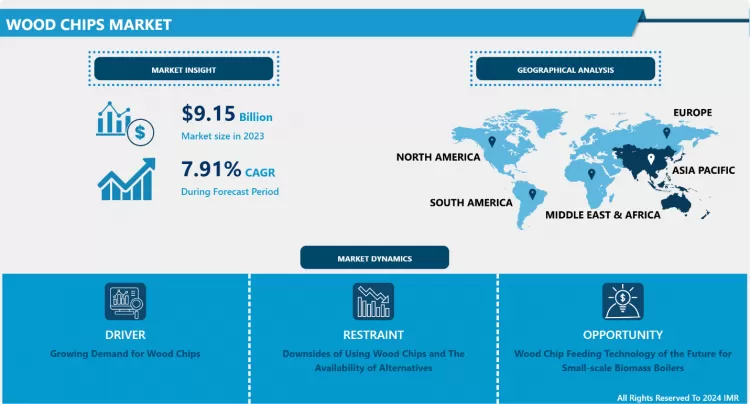
The Global Wood Chips Market size is expected to grow from USD 9.15 billion in 2023 to USD 18.15 billion by 2032, at a CAGR of 7.91% during the forecast period (2024-2032).
Small to medium-sized pieces of wood, such as branches, trees, stumps, and debris from forestry operations are turned into woodchips by cutting or chipping bigger pieces of wood. Woodchips are the raw material for making wood pulp and can be used as a biomass solid fuel. They can be utilized as a substrate for the growth of mushrooms as well as an organic mulch for landscaping, gardening, and ecosystem restoration. Using a wood chipper, the process of creating woodchips is known as wood chipping. The kind of wood chipper utilized and the substance used to make the chips determine what kind of woodchips are produced after chipping. Forest chips are made from forested areas, while wood residue chips are made from off-cuts, recycled wood, and untreated wood residues. Sawing residue chips are made from sawmill leftovers. Short rotation forestry chips are another type of woodchip (from energy crops).
Additionally, woodchips can be made from pulpwood, waste wood, and leftover wood from logging, sawmills, agricultural, landscaping, and landscaping. Additionally, forestry debris such as tree crowns, limbs, unsalable parts, or undersized trees can be used to make woodchips. The stability and long-term growth of the forests from which wood chips are taken may be harmed by their increased use, even though they have some advantages. Additionally, wood pellets have been identified as one of the bioenergy areas with the highest global growth in recent years. As a result, the rising demand for wood chips accelerates the growth of the market over the forecast period.
Market Dynamics And Factors For Wood Chips Market
Drivers:
Growing Demand for Wood Chips
The most important factor driving demand for wood chips is an increase in demand from the pulp industry. Wood chips are used to manufacture pulp, which is subsequently burned to produce biochar, also known as charcoal. Furthermore, the rising need for renewable energy generation leads to market expansion. As conventional energy sources deplete, the rising usage of renewable energy sources such as biomass is boosting the wood chips industry. Increased demand for wood chips in the pulp industry, where wood chips are used as a raw material to make pulp, is also driving the growth of the wood chips market. When wood chips are burned, biochar, also known as charcoal, is produced. It can be burned as charcoal or used as fertilizer in the soil. During the projected period, this is also expected to drive the wood chips market. The rising demand for thermal energy generation utilizing renewable and green feedstock materials is expected to help the market. The greater energy coefficient of wood chips is predicted to keep demand high during the projection period. During the forecast period, the wood chips market is likely to be stymied by requirements for sustainability-related certifications and restrictions on GHG emissions from wood chips used for energy generation.
Restraints:
Downsides of Using Wood Chips and The Availability of Alternatives
Market growth is hampered by price volatility brought on by shifting raw material costs, climatic variations, and strict regulatory standards governing the growing of wood. The market growth rate for wood chips will face difficulties as a result of these reasons. However, it is anticipated that the usage of wood pellets as a substitute for wood chips and their rising penetration into the residential and commercial sectors for power production will hinder the growth of the wood chip market.
Opportunity:
Wood Chip Feeding Technology of the Future for Small-scale Biomass Boilers
Wood chip boilers are one of the key technologies, although there are already 0.7 million small-scale biomass boilers sold in Europe each year. By 2020, it is anticipated that number would climb to 1.6 million. The fuel feeding methods used with these wood chip boilers continue to be a significant weak point. They cause 80 to 90 percent of unforeseen plant shutdowns, more emissions, and lower efficiency. Additionally, discharge from the bottom predominates in currently used feeding systems, which has the drawbacks of requiring large constructions, wearing down equipment more quickly, complicating maintenance, and having high operating expenses. Creating a novel wood chip feeding method for small-scale heating plants was the objective of BioChipFeeding. A gripper that enables feeding from above the pile of stored fuel is a key part of the system. It will be fitted with sensors to check the gasoline’s moisture content and particle size, allowing it to produce the right fuel blends and maintain fairly consistent fuel quality. In addition, a brand-new fuel feeding screw that can continuously convey wood chips into the furnace regardless of shape or size will be created. Due to a more consistent and equal fuel supply, the performance of the boiler will be substantially improved with this innovative technology. It should be particularly appealing to customers due to lower operation and maintenance expenses, which will greatly expand its possibilities for use.
Segmentation Analysis Of Wood Chips Market
By Product Type, the softwood segment is anticipated to dominate the wood chips market over the forecast period. The segment is anticipated to grow throughout the predicted period because of increased demand for items like garden pulp and other uses like playground surfaces. Throughout the projection period, demand is anticipated to increase due to the high carbon content of hardwood goods.
By Raw materials, forest chips are expected to hold the maximum market share over the forecast period. Log chips made from stem wood make up forest chips. Chips are made entirely from the biomass found above ground in a tree. chipping up leftover wood from branches, rubbish, etc. A significant number of needles, bark, and branches are present in wood chips manufactured from forest leftover wood (in this case, spruce). Due to the vast array of potential raw materials and processing techniques, the quality of forest woodchips as a fuel varies greatly.
By Application, the combined Heat and Power segment is expected to grow at a faster pace during the forecast period. During the projected period, demand for the product as a fuel in combined heat and power applications is anticipated to soar. One of the product’s most popular uses is residential heating, but because pellets are so widely used for interior heating, residential heating’s growth is expected to be limited. Wood chips are anticipated to grow in popularity as garden mulch due to their remarkable water-absorbing qualities and low product prices.
Regional Analysis Of Wood Chips Market
Asia Pacific economies, notably China and Japan, are experiencing an increase in demand for these chips in the commercial energy generation sector, which is boosting the regional market. The inclusion of precondition constraints in the Renewable Energy Directive 2 (RED 2) and the existence of GHG emission criteria in developing nations together are likely to promote market expansion. Additionally, Japan’s Feed-In Tariff program, which offers incentives for the use of biomass, is assisting the industry’s expansion in APAC. In addition, the countries in the region are increasingly using wood chips for household heating. The Feed-in-Tariff subsidy program is helping Japan create a sizable pipeline of biomass projects. Japan, which exports a significant amount of wood chips for pulp and paper, is anticipated to increase the number of wood chips it uses for domestic energy production.
Europe is expected to hold a significant market share of the global wood chips market, closely followed by South and North America. Historically, small-scale (20MW) facilities in Europe have generated heat and electricity using wood chips. For this purpose, local wood is typically used. For many years, West Africa has provided wood chips for energy, albeit in relatively tiny quantities. In Europe, the majority of the time, wood that has been grown locally is used to generate heat.
South American eucalyptus plantations are a key source of supplies for pulpmills in China and Japan. However, due to the increased availability of plantation fiber in Southeast Asia (mostly from Vietnam) and the rising demand for fiber from local pulpmills in Latin America, the share of Latin America in overall Asian import volumes has decreased over the previous five years. As a result, since 2018, when a record high of 4.6 million odmt was established, total export volumes from the continent have continuously decreased. Chile has been Latin America’s largest exporter for the past ten years. However, in 2021, the nation’s shipments decreased as Brazil and Uruguay expanded their proportions of the continent’s supply of wood chips for export.
Due to customers’ growing reliance on conventional energy sources, demand for the product is expected to remain moderate across the Middle East. In addition, it is anticipated that a lack of home heating use of the product in the Middle East will restrain market expansion in the area.
Top Key Players Covered In Wood Chips Market
St. Boniface Pallet
American Wood Resources
Axpo Group
Great Northern Timber
EVOWORLD GmbH
Mitsui & Co., Ltd.
Cogent Fibre
Enviva Pellets
Oji Holdings
Orsted A/S
Sojitz Corporation
Verdo A/S and other major players.
Key Industry Development In The Wood Chips Market
In March 2024, Orsted announced its plan to expand its biomass power generation capacity across Europe, driving up the demand for wood chips as a fuel source.
In March 2024, Great Northern Timber announced its collaboration with a local conservation group to plant new trees in areas previously cut for wood chips. This project is estimated to demonstrate the company’s commitment to sustainable forestry methods.
Chapter 1: Introduction
1.1 Scope and Coverage
Chapter 2:Executive Summary
Chapter 3: Market Landscape
3.1 Market Dynamics
3.1.1 Drivers
3.1.2 Restraints
3.1.3 Opportunities
3.1.4 Challenges
3.2 Market Trend Analysis
3.3 PESTLE Analysis
3.4 Porter’s Five Forces Analysis
3.5 Industry Value Chain Analysis
3.6 Ecosystem
3.7 Regulatory Landscape
3.8 Price Trend Analysis
3.9 Patent Analysis
3.10 Technology Evolution
3.11 Investment Pockets
3.12 Import-Export Analysis
Chapter 4: Wood Chips Market by Product Type (2018-2032)
4.1 Wood Chips Market Snapshot and Growth Engine
4.2 Market Overview
4.3 Softwood
4.3.1 Introduction and Market Overview
4.3.2 Historic and Forecasted Market Size in Value USD and Volume Units
4.3.3 Key Market Trends, Growth Factors, and Opportunities
4.3.4 Geographic Segmentation Analysis
4.4 Hardwood
4.5 Others
Chapter 5: Wood Chips Market by Raw Material (2018-2032)
5.1 Wood Chips Market Snapshot and Growth Engine
5.2 Market Overview
5.3 Forest Chips
5.3.1 Introduction and Market Overview
5.3.2 Historic and Forecasted Market Size in Value USD and Volume Units
5.3.3 Key Market Trends, Growth Factors, and Opportunities
5.3.4 Geographic Segmentation Analysis
5.4 Wood Residue Chips
5.5 Sawing Residue Chips
5.6 Short Rotation Coppice Chips
Chapter 6: Wood Chips Market by Application (2018-2032)
6.1 Wood Chips Market Snapshot and Growth Engine
6.2 Market Overview
6.3 Combined Heat and Power
6.3.1 Introduction and Market Overview
6.3.2 Historic and Forecasted Market Size in Value USD and Volume Units
6.3.3 Key Market Trends, Growth Factors, and Opportunities
6.3.4 Geographic Segmentation Analysis
6.4 Residential and Commercial Heating
6.5 Playground Surfacing
6.6 Pulp Manufacturing
6.7 Mulch
6.8 Others
Chapter 7: Company Profiles and Competitive Analysis
7.1 Competitive Landscape
7.1.1 Competitive Benchmarking
7.1.2 Wood Chips Market Share by Manufacturer (2024)
7.1.3 Industry BCG Matrix
7.1.4 Heat Map Analysis
7.1.5 Mergers and Acquisitions
7.2 NESTLÉ (SWITZERLAND)
7.2.1 Company Overview
7.2.2 Key Executives
7.2.3 Company Snapshot
7.2.4 Role of the Company in the Market
7.2.5 Sustainability and Social Responsibility
7.2.6 Operating Business Segments
7.2.7 Product Portfolio
7.2.8 Business Performance
7.2.9 Key Strategic Moves and Recent Developments
7.2.10 SWOT Analysis
7.3 J.M. SMUCKER (USA)
7.4 MCCAIN FOODS (CANADA)
7.5 MONDELEZ INTERNATIONAL (USA)
7.6 AJINOMOTO COINC. (JAPAN)
7.7 NOMAD FOODS (UNITED KINGDOM)
7.8 CP FOODS (THAILAND)
7.9 MCCORMICK & COMPANY (USA)
7.10 GREEN GIANT (USA)
7.11 OSI INDUSTRIES INC. (USA)
7.12 PREMIER FOODS PLC (ENGLAND)
7.13 VAN DEN BERGHE FOODS (NETHERLANDS)
7.14 FRONERI INTERNATIONAL LTD. (ENGLAND)
7.15 SAMYANG FOOD (SOUTH KOREA)
7.16 MCCORMICK PLC (USA)
7.17 C.F. MUELLER COMPANY (USA)
7.18 CP KELLOGGS INDIA (INDIA)
7.19 IGLO FOODS HOLDINGS LIMITED (GERMANY)
7.20 FUJI FOOD CORPORATION (JAPAN)
7.21 B&G FOODS INC. (USA)
Chapter 8: Global Wood Chips Market By Region
8.1 Overview
8.2. North America Wood Chips Market
8.2.1 Key Market Trends, Growth Factors and Opportunities
8.2.2 Top Key Companies
8.2.3 Historic and Forecasted Market Size by Segments
8.2.4 Historic and Forecasted Market Size by Product Type
8.2.4.1 Softwood
8.2.4.2 Hardwood
8.2.4.3 Others
8.2.5 Historic and Forecasted Market Size by Raw Material
8.2.5.1 Forest Chips
8.2.5.2 Wood Residue Chips
8.2.5.3 Sawing Residue Chips
8.2.5.4 Short Rotation Coppice Chips
8.2.6 Historic and Forecasted Market Size by Application
8.2.6.1 Combined Heat and Power
8.2.6.2 Residential and Commercial Heating
8.2.6.3 Playground Surfacing
8.2.6.4 Pulp Manufacturing
8.2.6.5 Mulch
8.2.6.6 Others
8.2.7 Historic and Forecast Market Size by Country
8.2.7.1 US
8.2.7.2 Canada
8.2.7.3 Mexico
8.3. Eastern Europe Wood Chips Market
8.3.1 Key Market Trends, Growth Factors and Opportunities
8.3.2 Top Key Companies
8.3.3 Historic and Forecasted Market Size by Segments
8.3.4 Historic and Forecasted Market Size by Product Type
8.3.4.1 Softwood
8.3.4.2 Hardwood
8.3.4.3 Others
8.3.5 Historic and Forecasted Market Size by Raw Material
8.3.5.1 Forest Chips
8.3.5.2 Wood Residue Chips
8.3.5.3 Sawing Residue Chips
8.3.5.4 Short Rotation Coppice Chips
8.3.6 Historic and Forecasted Market Size by Application
8.3.6.1 Combined Heat and Power
8.3.6.2 Residential and Commercial Heating
8.3.6.3 Playground Surfacing
8.3.6.4 Pulp Manufacturing
8.3.6.5 Mulch
8.3.6.6 Others
8.3.7 Historic and Forecast Market Size by Country
8.3.7.1 Russia
8.3.7.2 Bulgaria
8.3.7.3 The Czech Republic
8.3.7.4 Hungary
8.3.7.5 Poland
8.3.7.6 Romania
8.3.7.7 Rest of Eastern Europe
8.4. Western Europe Wood Chips Market
8.4.1 Key Market Trends, Growth Factors and Opportunities
8.4.2 Top Key Companies
8.4.3 Historic and Forecasted Market Size by Segments
8.4.4 Historic and Forecasted Market Size by Product Type
8.4.4.1 Softwood
8.4.4.2 Hardwood
8.4.4.3 Others
8.4.5 Historic and Forecasted Market Size by Raw Material
8.4.5.1 Forest Chips
8.4.5.2 Wood Residue Chips
8.4.5.3 Sawing Residue Chips
8.4.5.4 Short Rotation Coppice Chips
8.4.6 Historic and Forecasted Market Size by Application
8.4.6.1 Combined Heat and Power
8.4.6.2 Residential and Commercial Heating
8.4.6.3 Playground Surfacing
8.4.6.4 Pulp Manufacturing
8.4.6.5 Mulch
8.4.6.6 Others
8.4.7 Historic and Forecast Market Size by Country
8.4.7.1 Germany
8.4.7.2 UK
8.4.7.3 France
8.4.7.4 The Netherlands
8.4.7.5 Italy
8.4.7.6 Spain
8.4.7.7 Rest of Western Europe
8.5. Asia Pacific Wood Chips Market
8.5.1 Key Market Trends, Growth Factors and Opportunities
8.5.2 Top Key Companies
8.5.3 Historic and Forecasted Market Size by Segments
8.5.4 Historic and Forecasted Market Size by Product Type
8.5.4.1 Softwood
8.5.4.2 Hardwood
8.5.4.3 Others
8.5.5 Historic and Forecasted Market Size by Raw Material
8.5.5.1 Forest Chips
8.5.5.2 Wood Residue Chips
8.5.5.3 Sawing Residue Chips
8.5.5.4 Short Rotation Coppice Chips
8.5.6 Historic and Forecasted Market Size by Application
8.5.6.1 Combined Heat and Power
8.5.6.2 Residential and Commercial Heating
8.5.6.3 Playground Surfacing
8.5.6.4 Pulp Manufacturing
8.5.6.5 Mulch
8.5.6.6 Others
8.5.7 Historic and Forecast Market Size by Country
8.5.7.1 China
8.5.7.2 India
8.5.7.3 Japan
8.5.7.4 South Korea
8.5.7.5 Malaysia
8.5.7.6 Thailand
8.5.7.7 Vietnam
8.5.7.8 The Philippines
8.5.7.9 Australia
8.5.7.10 New Zealand
8.5.7.11 Rest of APAC
8.6. Middle East & Africa Wood Chips Market
8.6.1 Key Market Trends, Growth Factors and Opportunities
8.6.2 Top Key Companies
8.6.3 Historic and Forecasted Market Size by Segments
8.6.4 Historic and Forecasted Market Size by Product Type
8.6.4.1 Softwood
8.6.4.2 Hardwood
8.6.4.3 Others
8.6.5 Historic and Forecasted Market Size by Raw Material
8.6.5.1 Forest Chips
8.6.5.2 Wood Residue Chips
8.6.5.3 Sawing Residue Chips
8.6.5.4 Short Rotation Coppice Chips
8.6.6 Historic and Forecasted Market Size by Application
8.6.6.1 Combined Heat and Power
8.6.6.2 Residential and Commercial Heating
8.6.6.3 Playground Surfacing
8.6.6.4 Pulp Manufacturing
8.6.6.5 Mulch
8.6.6.6 Others
8.6.7 Historic and Forecast Market Size by Country
8.6.7.1 Turkiye
8.6.7.2 Bahrain
8.6.7.3 Kuwait
8.6.7.4 Saudi Arabia
8.6.7.5 Qatar
8.6.7.6 UAE
8.6.7.7 Israel
8.6.7.8 South Africa
8.7. South America Wood Chips Market
8.7.1 Key Market Trends, Growth Factors and Opportunities
8.7.2 Top Key Companies
8.7.3 Historic and Forecasted Market Size by Segments
8.7.4 Historic and Forecasted Market Size by Product Type
8.7.4.1 Softwood
8.7.4.2 Hardwood
8.7.4.3 Others
8.7.5 Historic and Forecasted Market Size by Raw Material
8.7.5.1 Forest Chips
8.7.5.2 Wood Residue Chips
8.7.5.3 Sawing Residue Chips
8.7.5.4 Short Rotation Coppice Chips
8.7.6 Historic and Forecasted Market Size by Application
8.7.6.1 Combined Heat and Power
8.7.6.2 Residential and Commercial Heating
8.7.6.3 Playground Surfacing
8.7.6.4 Pulp Manufacturing
8.7.6.5 Mulch
8.7.6.6 Others
8.7.7 Historic and Forecast Market Size by Country
8.7.7.1 Brazil
8.7.7.2 Argentina
8.7.7.3 Rest of SA
Chapter 9 Analyst Viewpoint and Conclusion
9.1 Recommendations and Concluding Analysis
9.2 Potential Market Strategies
Chapter 10 Research Methodology
10.1 Research Process
10.2 Primary Research
10.3 Secondary Research
Q1: What would be the forecast period in the Wood Chips Market research report?
A1: The forecast period in the Wood Chips Market research report is 2024-2032.
Q2: Who are the key players in Wood Chips Market?
A2: St. Boniface Pallet, American Wood Resources, Axpo Group, Great Northern Timber, EVOWORLD GmbH, Boniface Pallet Company Ltd, Mitsui & Co., Ltd., Cogent Fibre, Enviva Pellets, Oji Holdings, Orsted A/S, Sojitz Corporation, Verdo A/S, and other major players.
Q3: What are the segments of the Wood Chips Market?
A3: The Wood Chips Market is segmented into Product Type, Raw Material, Application and region. By Product Type, the market is categorized into Softwood, Hardwood, Others. By Raw Material, the market is categorized into Forest Chips, Wood Residue Chips, Sawing Residue Chips, Short Rotation Coppice Chips. By Application, the market is categorized into Combined Heat and Power, Residential and Commercial Heating, Playground Surfacing, Pulp Manufacturing, Mulch, Others. By region, it is analyzed across North America (U.S.; Canada; Mexico), Europe (Germany; U.K.; France; Italy; Russia; Spain, etc.), Asia-Pacific (China; India; Japan; Southeast Asia, etc.), South America (Brazil; Argentina, etc.), Middle East & Africa (Saudi Arabia; South Africa, etc.).
Q4: What is the Wood Chips Market?
A4: Small to medium-sized pieces of wood, such as branches, trees, stumps, and debris from forestry operations are turned into woodchips by cutting or chipping bigger pieces of wood. Woodchips are the raw material for making wood pulp and can be used as a biomass solid fuel. They can be utilized as a substrate for the growth of mushrooms as well as an organic mulch for landscaping, gardening, and ecosystem restoration.
How to Buy a Report from eminsights.jp
On the product page, choose the license you want: Single-User License, Multi-User License or Enterprise License.
If you required report in your native language, then you can click on Translated Report button and fill out the form with report name and language you want, then our team will contact you as soon as possible.
Click the Buy Now button.
You will be redirected to the checkout page. Enter your company details and payment information.
Click Place Order to complete the purchase.
Confirmation: You’ll receive an order confirmation and our team will contact you shortly with your ordered report.
If you have any questions, fill out the contact form below or email us at bizdev@eminsights.net.
Thank you for choosing eminsights.jp!