Stay Ahead in Fast-Growing Economies.
Browse Reports Now




Wood Adhesives Market – Comprehensive Study Report & Trends
Wood adhesives are specialized adhesives used in industries like construction, furniture manufacturing, woodworking, and carpentry to bond wood components, laminates, veneers, and composite materials. They come in various types like water-based, solvent-based, and hot melt adhesives, each suited for different applications and performance requirements. These adhesives enhance the structural integrity and longevity of wood assemblies, making them crucial for the fabrication and assembly of wood products.

IMR Group
Description
Wood Adhesives Market Synopsis
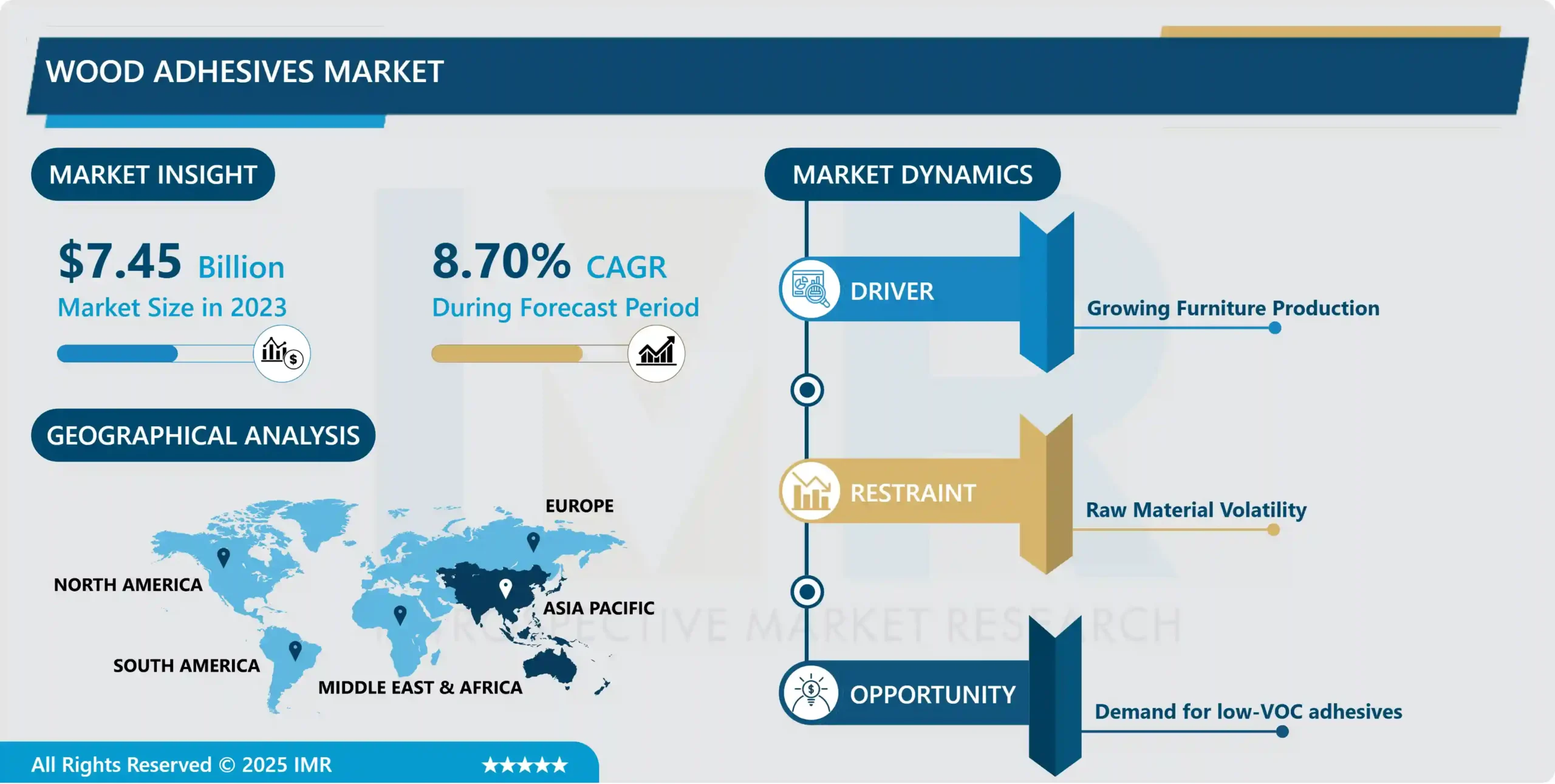
Wood Adhesives Market Size Was Valued at USD 7.45 Billion in 2023, and is Projected to Reach USD 15.78 Billion by 2032, Growing at a CAGR of 8.7% From 2024-2032.
Wood adhesives are specialized adhesives used in industries like construction, furniture manufacturing, woodworking, and carpentry to bond wood components, laminates, veneers, and composite materials. They come in various types like water-based, solvent-based, and hot melt adhesives, each suited for different applications and performance requirements. These adhesives enhance the structural integrity and longevity of wood assemblies, making them crucial for the fabrication and assembly of wood products.
Wood adhesives are widely utilized due to their array of benefits, driving their extensive adoption across industries. They provide robust and enduring bonds, bolstering the structural integrity of wood assemblies and ensuring prolonged functionality. Moreover, their versatility allows for bonding diverse wood types, composites, laminates, and veneers, accommodating various manufacturing requirements efficiently and economically.
In terms of market trends, there’s a noticeable surge in demand for eco-friendly and sustainable adhesive solutions. This shift propels the development of water-based and solvent-free adhesives, renowned for their lower VOC emissions and enhanced safety for both workers and the environment. Additionally, there’s a growing preference for high-performance adhesives offering exceptional resistance to heat and moisture, particularly in applications facing challenging environmental conditions.
The demand for wood adhesives is intricately linked to the expansion of key industries like construction, furniture manufacturing, and woodworking. As these sectors witness global growth, the necessity for dependable bonding solutions for wood products escalates correspondingly. Furthermore, ongoing advancements in adhesive technology, including the emergence of hybrid adhesives and bio-based resins, drive market expansion by offering enhanced performance and eco-friendliness. Overall, the wood adhesives market experiences continuous growth, fueled by the quest for sturdy, adaptable, and environmentally sustainable bonding solutions across diverse industrial realms.
Wood Adhesives Market Trend Analysis
Growing Furniture Production
The furniture production sector is driving the demand for wood adhesives due to the increasing global population and urbanization. Wood adhesives are crucial in furniture manufacturing processes, serving as the primary bonding agent for joining wood components, laminates, and veneers. The furniture industry’s evolution towards innovative designs, customized solutions, and sustainable practices further amplifies the need for high-performance wood adhesives.
Manufacturers rely on adhesives to ensure structural integrity, durability, and aesthetic appeal in their products. The emergence of e-commerce platforms and changing consumer preferences further drive demand for diverse furniture offerings, including ready-to-assemble (RTA) furniture and bespoke designs. Thus, the wood adhesives market is driven by the growing furniture production sector. The furniture industry is experiencing a surge in production due to factors like rising disposable incomes, urbanization, and changing lifestyles. Consumers are seeking modern, minimalist, and sustainable designs, necessitating versatile wood adhesives for bonding materials and ensuring durability.
The industry’s focus on sustainability and eco-friendly practices encourages the use of low VOC emissions and environmentally friendly formulations. Manufacturers maintain high standards of performance and quality, ensuring high performance and quality. This growth not only drives demand for wood adhesives but also drives innovation in adhesive technology to meet market demands for durable, aesthetically pleasing, and environmentally sustainable furniture products.
Demand for low-VOC adhesives
The wood adhesives market is experiencing a surge in demand due to growing environmental concerns and stringent regulations. Low-VOC adhesives, which contain fewer harmful chemicals, are being sought by manufacturers of wood products like furniture, flooring, and cabinetry. These adhesives not only reduce harmful emissions but also contribute to improved workplace safety by minimizing exposure to harmful chemicals. They are also linked to better indoor air quality and a healthier living environment, attracting more adoption in residential and commercial applications. The increasing demand for low-VOC adhesives presents a significant opportunity for innovation and growth in the wood adhesives market.
Low-VOC adhesives are gaining popularity due to their environmental benefits and market differentiation. They can appeal to eco-conscious consumers and businesses, and as sustainability becomes a key factor in purchasing decisions, wood product manufacturers can benefit from using these adhesives. This presents an opportunity for manufacturers to innovate and develop new formulations that meet performance and environmental standards, driving market growth and establishing a strong foothold in the sustainable adhesive solution landscape.
Wood Adhesives Market Segment Analysis:
Wood Adhesives Market Segmented on the basis of Type, Resin Type, Application, and End-Use Industry.
By Type, Water-based adhesives segment is expected to dominate the market during the forecast period
Water-based adhesives, composed of water, polymers, and additives, are eco-friendly, suitable for porous or non-porous substrates, and safe for use in the work environment due to their evaporation process. Adhesives are mixtures used to bond surfaces, typically polymer-based and made from natural or synthetic sources. They are formulated for specific applications and industries.
Water-based adhesives are supplied as pre-mixed solutions or dry powders, which must be mixed with water to achieve their adhesive properties. These properties are obtained when water is lost from the glue line or absorbed by the substrate. It is crucial to use at least one permeable substrate when applying water-based adhesives.
Water-soluble polymers in water-based adhesives make bonds more susceptible to moisture and water, but some types, like plant and casein glues, have an insoluble base material. Although this improves resistance, water-based solution adhesives are still perishable and have a shorter storage life. The water-based adhesives segment is poised to dominate the wood adhesives market for several compelling reasons
By Application, Furniture segment is expected to dominate the market during the forecast period
Wood adhesives are crucial in furniture for efficient use of wood. They are commonly used in various wood products like plywood, MDF, particleboard, OSB, structural frames, and wooden architectural doors, windows, and frames. Adhesives are essential for retaining structure and increasing the strength and stiffness of composite sheets. They are also used in non-structural applications like car upholstery and accessories. The adhesion of the glue depends on the wood-adhesive bonding chain.
The furniture segment is expected to dominate the wood adhesives market due to its significant consumption in bonding wood components, laminates, veneers, and assemblies. With rising disposable incomes and urbanization, the demand for furniture products is expected to surge. Furniture makers are prioritizing quality, durability, and design versatility, relying heavily on wood adhesives’ performance. High-performance adhesives enable manufacturers to meet stringent quality standards and customer expectations. The furniture industry’s focus on eco-friendly practices drives demand for eco-friendly wood adhesives with low VOC emissions and minimal environmental impact. This aligns with consumer preferences for eco-conscious products, further boosting the adoption of wood adhesives in the furniture segment.
Wood Adhesives Market Regional Insights:
Asia Pacific is Expected to Dominate the Market Over the Forecast period
The Asia Pacific region is experiencing rapid urbanization and construction activity, with countries like China, India, and Southeast Asia leading to increased demand for wood adhesive in furniture manufacturing, building construction, and interior decoration. The region’s furniture manufacturing countries, including China, Vietnam, and Malaysia, rely on wood adhesive for bonding wood components.
Governments in the region are investing heavily in infrastructure development projects, and wood adhesive is widely used in construction applications like laminated timber beams and plywood. The woodworking industry in the Asia Pacific is also growing due to increasing demand for wood products in domestic and export markets. The region has emerged as a global manufacturing hub for wood products due to cost-effective labor, abundant raw materials, and supportive government policies. Technological advancements, such as eco-friendly and high-performance wood adhesives, are also contributing to the market growth.
Wood Adhesives Market Top Key Players:
3M Company (US)
H.B. Fuller Company (US)
Ashland Global Holdings Inc. (US)
Dow Inc. (US)
Huntsman Corporation (US)
Avery Dennison Corporation (US)
LORD Corporation (US)
Permabond LLC (US)
Franklin International (US)
Illinois Tool Works Inc. (US)
DAP Products Inc. (RPM International) (US)
Mapei Corporation (US)
Eastman Chemical Company (US)
Royal Adhesives & Sealants (H.B. Fuller) (US)
Chemence Ltd. (US)
RPM International Inc. (US)
Wacker Chemie AG (Germany)
Henkel AG & Co. KGaA (Germany)
Jowat SE (Germany)
Bostik (Arkema) (France)
Akzo Nobel N.V. (Netherlands)
Sika AG (Switzerland)
Pidilite Industries Limited (India)
DIC Corporation (Japan), and Other Major Players.
Key Industry Developments in the Wood Adhesives Market:
In January 2023, Sika introduced MB EZ Rapid, a swift-drying moisture barrier and adhesive substrate consolidator designed for use in residential and commercial floor covering installations. This single-component solution caters to various surfaces such as plywood, concrete, gypsum, and old cutback adhesive.
In March 2023, Pidilite Industries Limited announced to manufacture of hot melt adhesive in India with support from Jowats team.
In July 2022, Henkel Adhesive Technologies extended its capabilities in timber construction solutions through an investment in 3RT located in Melbourne, Australia. Henkel aims to bolster its presence in the engineered wood sector and advance the integration of sustainable technology for future initiatives.
Chapter 1: Introduction
1.1 Scope and Coverage
Chapter 2:Executive Summary
Chapter 3: Market Landscape
3.1 Market Dynamics
3.1.1 Drivers
3.1.2 Restraints
3.1.3 Opportunities
3.1.4 Challenges
3.2 Market Trend Analysis
3.3 PESTLE Analysis
3.4 Porter’s Five Forces Analysis
3.5 Industry Value Chain Analysis
3.6 Ecosystem
3.7 Regulatory Landscape
3.8 Price Trend Analysis
3.9 Patent Analysis
3.10 Technology Evolution
3.11 Investment Pockets
3.12 Import-Export Analysis
Chapter 4: Wood Adhesives Market by Type (2018-2032)
4.1 Wood Adhesives Market Snapshot and Growth Engine
4.2 Market Overview
4.3 Water-Based Adhesive
4.3.1 Introduction and Market Overview
4.3.2 Historic and Forecasted Market Size in Value USD and Volume Units
4.3.3 Key Market Trends, Growth Factors, and Opportunities
4.3.4 Geographic Segmentation Analysis
4.4 Solvent-Based Adhesives
4.5 Reactive Adhesives
4.6 Hot Melt Adhesives
Chapter 5: Wood Adhesives Market by Resin Type (2018-2032)
5.1 Wood Adhesives Market Snapshot and Growth Engine
5.2 Market Overview
5.3 Natural
5.3.1 Introduction and Market Overview
5.3.2 Historic and Forecasted Market Size in Value USD and Volume Units
5.3.3 Key Market Trends, Growth Factors, and Opportunities
5.3.4 Geographic Segmentation Analysis
5.4 Synthetic
Chapter 6: Wood Adhesives Market by Application (2018-2032)
6.1 Wood Adhesives Market Snapshot and Growth Engine
6.2 Market Overview
6.3 Furniture
6.3.1 Introduction and Market Overview
6.3.2 Historic and Forecasted Market Size in Value USD and Volume Units
6.3.3 Key Market Trends, Growth Factors, and Opportunities
6.3.4 Geographic Segmentation Analysis
6.4 Flooring
6.5 Cabinets
6.6 Windows & Doors
6.7 Plywood and Board
Chapter 7: Wood Adhesives Market by End-Use Industry (2018-2032)
7.1 Wood Adhesives Market Snapshot and Growth Engine
7.2 Market Overview
7.3 Construction
7.3.1 Introduction and Market Overview
7.3.2 Historic and Forecasted Market Size in Value USD and Volume Units
7.3.3 Key Market Trends, Growth Factors, and Opportunities
7.3.4 Geographic Segmentation Analysis
7.4 Furniture
7.5 Packaging
7.6 Automotive
7.7 Aerospace
Chapter 8: Company Profiles and Competitive Analysis
8.1 Competitive Landscape
8.1.1 Competitive Benchmarking
8.1.2 Wood Adhesives Market Share by Manufacturer (2024)
8.1.3 Industry BCG Matrix
8.1.4 Heat Map Analysis
8.1.5 Mergers and Acquisitions
8.2 3M COMPANY (US)
8.2.1 Company Overview
8.2.2 Key Executives
8.2.3 Company Snapshot
8.2.4 Role of the Company in the Market
8.2.5 Sustainability and Social Responsibility
8.2.6 Operating Business Segments
8.2.7 Product Portfolio
8.2.8 Business Performance
8.2.9 Key Strategic Moves and Recent Developments
8.2.10 SWOT Analysis
8.3 H.B. FULLER COMPANY (US)
8.4 ASHLAND GLOBAL HOLDINGS INC. (US)
8.5 DOW INC. (US)
8.6 HUNTSMAN CORPORATION (US)
8.7 AVERY DENNISON CORPORATION (US)
8.8 LORD CORPORATION (US)
8.9 PERMABOND LLC (US)
8.10 FRANKLIN INTERNATIONAL (US)
8.11 ILLINOIS TOOL WORKS INC. (US)
8.12 DAP PRODUCTS INC. (RPM INTERNATIONAL) (US)
8.13 MAPEI CORPORATION (US)
8.14 EASTMAN CHEMICAL COMPANY (US)
8.15 ROYAL ADHESIVES & SEALANTS (H.B. FULLER) (US)
8.16 CHEMENCE LTD. (US)
8.17 RPM INTERNATIONAL INC. (US)
8.18 WACKER CHEMIE AG (GERMANY)
8.19 HENKEL AG & CO. KGAA (GERMANY)
8.20 JOWAT SE (GERMANY)
8.21 BOSTIK (ARKEMA) (FRANCE)
8.22 AKZO NOBEL N.V. (NETHERLANDS)
8.23 SIKA AG (SWITZERLAND)
8.24 PIDILITE INDUSTRIES LIMITED (INDIA)
8.25 DIC CORPORATION (JAPAN)
8.26
Chapter 9: Global Wood Adhesives Market By Region
9.1 Overview
9.2. North America Wood Adhesives Market
9.2.1 Key Market Trends, Growth Factors and Opportunities
9.2.2 Top Key Companies
9.2.3 Historic and Forecasted Market Size by Segments
9.2.4 Historic and Forecasted Market Size by Type
9.2.4.1 Water-Based Adhesive
9.2.4.2 Solvent-Based Adhesives
9.2.4.3 Reactive Adhesives
9.2.4.4 Hot Melt Adhesives
9.2.5 Historic and Forecasted Market Size by Resin Type
9.2.5.1 Natural
9.2.5.2 Synthetic
9.2.6 Historic and Forecasted Market Size by Application
9.2.6.1 Furniture
9.2.6.2 Flooring
9.2.6.3 Cabinets
9.2.6.4 Windows & Doors
9.2.6.5 Plywood and Board
9.2.7 Historic and Forecasted Market Size by End-Use Industry
9.2.7.1 Construction
9.2.7.2 Furniture
9.2.7.3 Packaging
9.2.7.4 Automotive
9.2.7.5 Aerospace
9.2.8 Historic and Forecast Market Size by Country
9.2.8.1 US
9.2.8.2 Canada
9.2.8.3 Mexico
9.3. Eastern Europe Wood Adhesives Market
9.3.1 Key Market Trends, Growth Factors and Opportunities
9.3.2 Top Key Companies
9.3.3 Historic and Forecasted Market Size by Segments
9.3.4 Historic and Forecasted Market Size by Type
9.3.4.1 Water-Based Adhesive
9.3.4.2 Solvent-Based Adhesives
9.3.4.3 Reactive Adhesives
9.3.4.4 Hot Melt Adhesives
9.3.5 Historic and Forecasted Market Size by Resin Type
9.3.5.1 Natural
9.3.5.2 Synthetic
9.3.6 Historic and Forecasted Market Size by Application
9.3.6.1 Furniture
9.3.6.2 Flooring
9.3.6.3 Cabinets
9.3.6.4 Windows & Doors
9.3.6.5 Plywood and Board
9.3.7 Historic and Forecasted Market Size by End-Use Industry
9.3.7.1 Construction
9.3.7.2 Furniture
9.3.7.3 Packaging
9.3.7.4 Automotive
9.3.7.5 Aerospace
9.3.8 Historic and Forecast Market Size by Country
9.3.8.1 Russia
9.3.8.2 Bulgaria
9.3.8.3 The Czech Republic
9.3.8.4 Hungary
9.3.8.5 Poland
9.3.8.6 Romania
9.3.8.7 Rest of Eastern Europe
9.4. Western Europe Wood Adhesives Market
9.4.1 Key Market Trends, Growth Factors and Opportunities
9.4.2 Top Key Companies
9.4.3 Historic and Forecasted Market Size by Segments
9.4.4 Historic and Forecasted Market Size by Type
9.4.4.1 Water-Based Adhesive
9.4.4.2 Solvent-Based Adhesives
9.4.4.3 Reactive Adhesives
9.4.4.4 Hot Melt Adhesives
9.4.5 Historic and Forecasted Market Size by Resin Type
9.4.5.1 Natural
9.4.5.2 Synthetic
9.4.6 Historic and Forecasted Market Size by Application
9.4.6.1 Furniture
9.4.6.2 Flooring
9.4.6.3 Cabinets
9.4.6.4 Windows & Doors
9.4.6.5 Plywood and Board
9.4.7 Historic and Forecasted Market Size by End-Use Industry
9.4.7.1 Construction
9.4.7.2 Furniture
9.4.7.3 Packaging
9.4.7.4 Automotive
9.4.7.5 Aerospace
9.4.8 Historic and Forecast Market Size by Country
9.4.8.1 Germany
9.4.8.2 UK
9.4.8.3 France
9.4.8.4 The Netherlands
9.4.8.5 Italy
9.4.8.6 Spain
9.4.8.7 Rest of Western Europe
9.5. Asia Pacific Wood Adhesives Market
9.5.1 Key Market Trends, Growth Factors and Opportunities
9.5.2 Top Key Companies
9.5.3 Historic and Forecasted Market Size by Segments
9.5.4 Historic and Forecasted Market Size by Type
9.5.4.1 Water-Based Adhesive
9.5.4.2 Solvent-Based Adhesives
9.5.4.3 Reactive Adhesives
9.5.4.4 Hot Melt Adhesives
9.5.5 Historic and Forecasted Market Size by Resin Type
9.5.5.1 Natural
9.5.5.2 Synthetic
9.5.6 Historic and Forecasted Market Size by Application
9.5.6.1 Furniture
9.5.6.2 Flooring
9.5.6.3 Cabinets
9.5.6.4 Windows & Doors
9.5.6.5 Plywood and Board
9.5.7 Historic and Forecasted Market Size by End-Use Industry
9.5.7.1 Construction
9.5.7.2 Furniture
9.5.7.3 Packaging
9.5.7.4 Automotive
9.5.7.5 Aerospace
9.5.8 Historic and Forecast Market Size by Country
9.5.8.1 China
9.5.8.2 India
9.5.8.3 Japan
9.5.8.4 South Korea
9.5.8.5 Malaysia
9.5.8.6 Thailand
9.5.8.7 Vietnam
9.5.8.8 The Philippines
9.5.8.9 Australia
9.5.8.10 New Zealand
9.5.8.11 Rest of APAC
9.6. Middle East & Africa Wood Adhesives Market
9.6.1 Key Market Trends, Growth Factors and Opportunities
9.6.2 Top Key Companies
9.6.3 Historic and Forecasted Market Size by Segments
9.6.4 Historic and Forecasted Market Size by Type
9.6.4.1 Water-Based Adhesive
9.6.4.2 Solvent-Based Adhesives
9.6.4.3 Reactive Adhesives
9.6.4.4 Hot Melt Adhesives
9.6.5 Historic and Forecasted Market Size by Resin Type
9.6.5.1 Natural
9.6.5.2 Synthetic
9.6.6 Historic and Forecasted Market Size by Application
9.6.6.1 Furniture
9.6.6.2 Flooring
9.6.6.3 Cabinets
9.6.6.4 Windows & Doors
9.6.6.5 Plywood and Board
9.6.7 Historic and Forecasted Market Size by End-Use Industry
9.6.7.1 Construction
9.6.7.2 Furniture
9.6.7.3 Packaging
9.6.7.4 Automotive
9.6.7.5 Aerospace
9.6.8 Historic and Forecast Market Size by Country
9.6.8.1 Turkiye
9.6.8.2 Bahrain
9.6.8.3 Kuwait
9.6.8.4 Saudi Arabia
9.6.8.5 Qatar
9.6.8.6 UAE
9.6.8.7 Israel
9.6.8.8 South Africa
9.7. South America Wood Adhesives Market
9.7.1 Key Market Trends, Growth Factors and Opportunities
9.7.2 Top Key Companies
9.7.3 Historic and Forecasted Market Size by Segments
9.7.4 Historic and Forecasted Market Size by Type
9.7.4.1 Water-Based Adhesive
9.7.4.2 Solvent-Based Adhesives
9.7.4.3 Reactive Adhesives
9.7.4.4 Hot Melt Adhesives
9.7.5 Historic and Forecasted Market Size by Resin Type
9.7.5.1 Natural
9.7.5.2 Synthetic
9.7.6 Historic and Forecasted Market Size by Application
9.7.6.1 Furniture
9.7.6.2 Flooring
9.7.6.3 Cabinets
9.7.6.4 Windows & Doors
9.7.6.5 Plywood and Board
9.7.7 Historic and Forecasted Market Size by End-Use Industry
9.7.7.1 Construction
9.7.7.2 Furniture
9.7.7.3 Packaging
9.7.7.4 Automotive
9.7.7.5 Aerospace
9.7.8 Historic and Forecast Market Size by Country
9.7.8.1 Brazil
9.7.8.2 Argentina
9.7.8.3 Rest of SA
Chapter 10 Analyst Viewpoint and Conclusion
10.1 Recommendations and Concluding Analysis
10.2 Potential Market Strategies
Chapter 11 Research Methodology
11.1 Research Process
11.2 Primary Research
11.3 Secondary Research
Q1: What would be the forecast period in the Wood Adhesives Market research report?
A1: The forecast period in the Wood Adhesives Market research report is 2024-2032.
Q2: Who are the key players in the Wood Adhesives Market?
A2: 3M Company (US), H.B. Fuller Company (US), Ashland Global Holdings Inc. (US), Dow Inc. (US), Huntsman Corporation (US), Avery Dennison Corporation (US), LORD Corporation (US), Permabond LLC (US), Franklin International (US), Illinois Tool Works Inc. (US), DAP Products Inc. (RPM International) (US), Mapei Corporation (US), Eastman Chemical Company (US), Royal Adhesives & Sealants (H.B. Fuller) (US), Chemence Ltd. (US), RPM International Inc. (US), Wacker Chemie AG (Germany), Henkel AG & Co. KGazA (Germany), Jowat SE (Germany), Bostik (Arkema) (France), Akzo Nobel N.V. (Netherlands), Sika AG (Switzerland), Pidilite Industries Limited (India), DIC Corporation (Japan), and Other Major Players.
Q3: What are the segments of the Wood Adhesives Market?
A3: The Wood Adhesives Market is segmented into Type, Resin Type, Application, End-Use Industry, and region. By Type, the market is categorized into Water-Based Adhesives, Solvent-Based Adhesives, Reactive Adhesives, and Hot Melt Adhesives. By Resin Type, the market is categorized into Natural and Synthetic. By Application, the market is categorized into Furniture, Flooring, Cabinets, Windows & Doors, Plywood and Board. By End-Use Industry, the market is categorized into Construction, Furniture, Packaging, Automotive, and Aerospace. By region, it is analyzed across North America (U.S.; Canada; Mexico), Eastern Europe (Bulgaria; The Czech Republic; Hungary; Poland; Romania; Rest of Eastern Europe), Western Europe (Germany; UK; France; Netherlands; Italy; Russia; Spain; Rest of Western Europe), Asia-Pacific (China; India; Japan; Southeast Asia, etc.), South America (Brazil; Argentina, etc.), Middle East & Africa (Saudi Arabia; South Africa, etc.).
Q4: What is the Wood Adhesives Market?
A4: Wood adhesives are specialized adhesives used in industries like construction, furniture manufacturing, woodworking, and carpentry to bond wood components, laminates, veneers, and composite materials. They come in various types like water-based, solvent-based, and hot melt adhesives, each suited for different applications and performance requirements. These adhesives enhance the structural integrity and longevity of wood assemblies, making them crucial for the fabrication and assembly of wood products.
Q5: How big is the Wood Adhesives Market?
A5: Wood Adhesives Market Size Was Valued at USD 7.45 Billion in 2023, and is Projected to Reach USD 15.78 Billion by 2032, Growing at a CAGR of 8.7% From 2024-2032.
How to Buy a Report from eminsights.jp
On the product page, choose the license you want: Single-User License, Multi-User License or Enterprise License.
If you required report in your native language, then you can click on Translated Report button and fill out the form with report name and language you want, then our team will contact you as soon as possible.
Click the Buy Now button.
You will be redirected to the checkout page. Enter your company details and payment information.
Click Place Order to complete the purchase.
Confirmation: You’ll receive an order confirmation and our team will contact you shortly with your ordered report.
If you have any questions, fill out the contact form below or email us at bizdev@eminsights.net.
Thank you for choosing eminsights.jp!