Stay Ahead in Fast-Growing Economies.
Browse Reports Now

Wifi Market In-Deep Analysis Focusing on Market Share
Wi-fi is a technological measure that enables handhelds such as the smart-phones, laptops and other electronics instruments to connect over the internet to share information through wireless means using radio frequencies.

IMR Group
Description
Wifi Market Synopsis
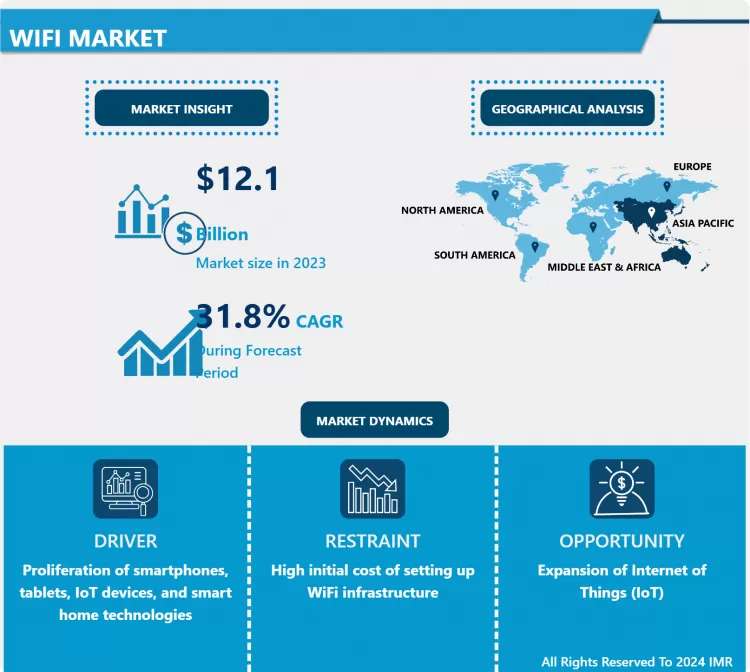
Wifi Market Size Was Valued at USD 31.8 Billion in 2023, and is Projected to Reach USD 88.9 Billion by 2032, Growing at a CAGR of 12.1% From 2024-2032.
Wi-fi is a technological measure that enables handhelds such as the smart-phones, laptops and other electronics instruments to connect over the internet to share information through wireless means using radio frequencies. Such, it operates on the 2. Citizens band or CB RF, either at 4 GHz and 5 GHz, offers high data rate of data transfer between the associated devices within the coverage area. Those are formed from Wireless Access Points, like routers that relay data between different Wi-Fi connected devices and the Internet; this lets users have feasibly usable Internet connections without necessarily requiring miles of physical cables. It is commonly seen in homes, offices, commercial buildings, and practically any place you can think of as well as in different industries that requires connection between devices and Internet as well as Local networks.
The growing use of bring your own device (BYOD) policies at workplaces, where employees are allowed to use their own devices such as smart phones, laptops etc for work related affairs, is further aggravating the growth of the market. Also, there is a calendar year growing the tendencies to share information and materials on social networks, which increase a tendency of Wi-Fi usage in public places and areas.
Furthermore, the current market has smart and contemporary homes with digital and electronic gadgets, helping boost the market. In addition to this, trends such as the increasing focus on online gaming and e-sports that entails predictable and accelerated internet connection through Wi-Fi so as to enhance seamless gameplay are the factors boosting this market. In addition, the evolving number of hotels, restaurants, cafes, etc. , that offer Wi-Fi to boost guest satisfaction, add convenience to customers’, and use digital services in their buildings is contributing to the market’s growth.
IoT technology is a key driver of WI-Fi use as most industries are implementing the use of IoT devices at a very fast rate. IoT devices contain sensors, and are interconnected to the internet so that they can transfer information and execute operations. Internet of things in smart homes, industrial automation, health care, Agriculture, and many other areas depend on the Wi-Fi connection. For optimum performance of these devices, they need well integrated Wireless networks that are also secure. Whenever business and people incorporate more Internet of Things devices in their operations or lives respectively, stronger Wi-Fi networks is all the more necessary.
Wifi Market Trend Analysis
Increase use of connected devices
Increasing penetration of smart and expanding range of connectivity like smart phones, tablets, laptops, home appliances, wearable, IoT devises and so on are driving need of Wi-Fi connectivity. All these devices depend on the wireless network for connectivity to the internet and smooth interaction between them. While the usages of these devices increases around the world, people and companies require durable and fast internet connectivity to solve their demand. The flexibility that comes with using Wireless fidelity empowers a user to gain access to a desired information, complete transactions and communicate while on the move, and therefore is crucial in the current world.
Rise in the development of smart cities
The growth of smart cities as well as the overall increasing urbanization throughout the global region is acting as a strong driver on the need for Wi-Fi connections. Many applications in smart city include Wi-Fi infrastructure as the basis for the integration of different intertwined functionalities including transportation, safety, and communal. Mobile users and Establishments on the move require Internet connectivity from places such as internet cafes, terminals found in business and social joinery, stations, and eateries. Wireless technologies such as location based services, and indoor navigation provide the users with better experiences as well improved operations in urban settings. Following cities’ transition to a smarter environment, the need for wireless Internet should increase while enhancing people’s quality of living.
Wifi Market Segment Analysis:
Wifi Market Segmented based on Component, Density, Location Type, Organization Size and Industry Vertical.
By Component, Hardware segment is expected to dominate the market during the forecast period
Wi-Fi hardware entails the physical devices that make up the communicational equipment for wireless technology. Wi-Fi devices are typically wireless routers, wireless access points, built-in or install NICs in laptop, Smartphone etc and wireless extenders. Routers and access points generate Wi-Fi networks; devices equipped with Wi-Fi NICs can associate with these networks without physical cables. This is because Wi-Fi hardware is configured to transmit and receive data using radio waves and as a result, allow the exchange of data between devices such as computers and smartphones, and access internet without the use of cables.
Wi-Fi solutions refer to the all-encompassing software and settings that are required to govern and fine-tune the Wi-Fi networks. This consists of firmware and software in routers and access points often used to configure network and security parameters. Another common component of Wi-Fi solutions is managing and regulating software through which administrators can monitor the performance of the network and maintain its stability. Wireless networks can be of the home use, enterprise use and other public uses as hotspots.
By Location Type, Indoor segment held the largest share in 2023
Wi-Fi for indoors is systematic wireless setup and implementations used to give internet connection and local area network inside buildings or confined areas. He also deemed it to be present in households, offices, schools, shopping centers, hospitals, airports, and other similar indoors. They are typically mounted at ceilings or walls for good signal dissemination that can be linked to a wire or a router which is the Internet connection. Inter-connected Indoor Wi-Fi networks are more crucial in delivering continuity of internet connectivity to Wi-Fi enabled devices such as laptops, smart phones, tablet computers, smart devices and the IoT devices within the building.
Outdoor Wi-Fi enables the connection of the internet or wireless data networks that are established to deliver WAN connectivity and coverage in the exteriors. It is primarily used in parks, stadiums, city central business districts, cafes that are located outside, and other places that are covered outside. Outdoor APS are expected to be resistant to conditions such as weather and climate differences in that they are located in open areas.
Wifi Market Regional Insights:
Asia Pacific is Expected to Dominate the Market Over the Forecast period
The Asia Pacific region has a significantly high usage of the internet and an even higher reliance on smartphones, making it among the main drivers of Wi-Fi adoption. Further, the increase in the emergence of smart cities, increasing access to Wi-Fi for supporting the healthcare and education sector is boosting the market in the region. Besides, the increasing expenditure on transportation, public safety, utility & education related works tends to bolster the market in the particular region.
Active Key Players in the Wifi Market
AT&T Inc.
Broadcom Inc.
Cisco Systems Inc.
Extreme Networks
Fortinet Inc.
Fujitsu Limited
Hewlett Packard Enterprise Company
Huawei Technologies Co. Ltd.
Juniper Networks Inc.
Motorola Solutions Inc.
Panasonic Corporation
Singapore Telecommunications Limited
Telefonaktiebolaget LM Ericsson
Telstra Corporation Limited
Ubiquiti Inc
Other Key Players
Key Industry Developments in the Wifi Market:
In February 2022, Juniper Networks Inc. gained WiteSand, a pioneer of the integrated and cloud-native zero-trust Network Access Control (NAC). This acquisition has a highly experienced and skilled engineering team and superior technology which truly boosts their continuous process of delivering next-generation Advanced NAC solution as one of the important parts of the company’s AI-driven enterprise lineup.
Chapter 1: Introduction
1.1 Scope and Coverage
Chapter 2:Executive Summary
Chapter 3: Market Landscape
3.1 Market Dynamics
3.1.1 Drivers
3.1.2 Restraints
3.1.3 Opportunities
3.1.4 Challenges
3.2 Market Trend Analysis
3.3 PESTLE Analysis
3.4 Porter’s Five Forces Analysis
3.5 Industry Value Chain Analysis
3.6 Ecosystem
3.7 Regulatory Landscape
3.8 Price Trend Analysis
3.9 Patent Analysis
3.10 Technology Evolution
3.11 Investment Pockets
3.12 Import-Export Analysis
Chapter 4: Wifi Market by Component (2018-2032)
4.1 Wifi Market Snapshot and Growth Engine
4.2 Market Overview
4.3 Hardware
4.3.1 Introduction and Market Overview
4.3.2 Historic and Forecasted Market Size in Value USD and Volume Units
4.3.3 Key Market Trends, Growth Factors, and Opportunities
4.3.4 Geographic Segmentation Analysis
4.4 Solutions
4.5 Services
Chapter 5: Wifi Market by Density (2018-2032)
5.1 Wifi Market Snapshot and Growth Engine
5.2 Market Overview
5.3 High-Density Wi-Fi
5.3.1 Introduction and Market Overview
5.3.2 Historic and Forecasted Market Size in Value USD and Volume Units
5.3.3 Key Market Trends, Growth Factors, and Opportunities
5.3.4 Geographic Segmentation Analysis
5.4 Enterprise-Class Wi-Fi
Chapter 6: Wifi Market by Location Type (2018-2032)
6.1 Wifi Market Snapshot and Growth Engine
6.2 Market Overview
6.3 Indoor
6.3.1 Introduction and Market Overview
6.3.2 Historic and Forecasted Market Size in Value USD and Volume Units
6.3.3 Key Market Trends, Growth Factors, and Opportunities
6.3.4 Geographic Segmentation Analysis
6.4 Outdoor
Chapter 7: Wifi Market by Organization Size (2018-2032)
7.1 Wifi Market Snapshot and Growth Engine
7.2 Market Overview
7.3 Large Enterprises
7.3.1 Introduction and Market Overview
7.3.2 Historic and Forecasted Market Size in Value USD and Volume Units
7.3.3 Key Market Trends, Growth Factors, and Opportunities
7.3.4 Geographic Segmentation Analysis
7.4 Small and Medium-sized Enterprises
Chapter 8: Wifi Market by Industry Vertical (2018-2032)
8.1 Wifi Market Snapshot and Growth Engine
8.2 Market Overview
8.3 IT and Telecommunication
8.3.1 Introduction and Market Overview
8.3.2 Historic and Forecasted Market Size in Value USD and Volume Units
8.3.3 Key Market Trends, Growth Factors, and Opportunities
8.3.4 Geographic Segmentation Analysis
8.4 Education
8.5 BFSI
8.6 Healthcare
8.7 Logistics and Transportation
8.8 Retail
8.9 Government
8.10 Other
Chapter 9: Company Profiles and Competitive Analysis
9.1 Competitive Landscape
9.1.1 Competitive Benchmarking
9.1.2 Wifi Market Share by Manufacturer (2024)
9.1.3 Industry BCG Matrix
9.1.4 Heat Map Analysis
9.1.5 Mergers and Acquisitions
9.2 AT&T INCBROADCOM INCCISCO SYSTEMS INCEXTREME NETWORKS
9.2.1 Company Overview
9.2.2 Key Executives
9.2.3 Company Snapshot
9.2.4 Role of the Company in the Market
9.2.5 Sustainability and Social Responsibility
9.2.6 Operating Business Segments
9.2.7 Product Portfolio
9.2.8 Business Performance
9.2.9 Key Strategic Moves and Recent Developments
9.2.10 SWOT Analysis
9.3 FORTINET INCFUJITSU LIMITED
9.4 HEWLETT PACKARD ENTERPRISE COMPANY
9.5 HUAWEI TECHNOLOGIES CO. LTDJUNIPER NETWORKS INCMOTOROLA SOLUTIONS INCPANASONIC CORPORATION
9.6 SINGAPORE TELECOMMUNICATIONS LIMITED
9.7 TELEFONAKTIEBOLAGET LM ERICSSON
9.8 TELSTRA CORPORATION LIMITED
9.9 UBIQUITI INC
9.10 OTHER KEY PLAYERS
Chapter 10: Global Wifi Market By Region
10.1 Overview
10.2. North America Wifi Market
10.2.1 Key Market Trends, Growth Factors and Opportunities
10.2.2 Top Key Companies
10.2.3 Historic and Forecasted Market Size by Segments
10.2.4 Historic and Forecasted Market Size by Component
10.2.4.1 Hardware
10.2.4.2 Solutions
10.2.4.3 Services
10.2.5 Historic and Forecasted Market Size by Density
10.2.5.1 High-Density Wi-Fi
10.2.5.2 Enterprise-Class Wi-Fi
10.2.6 Historic and Forecasted Market Size by Location Type
10.2.6.1 Indoor
10.2.6.2 Outdoor
10.2.7 Historic and Forecasted Market Size by Organization Size
10.2.7.1 Large Enterprises
10.2.7.2 Small and Medium-sized Enterprises
10.2.8 Historic and Forecasted Market Size by Industry Vertical
10.2.8.1 IT and Telecommunication
10.2.8.2 Education
10.2.8.3 BFSI
10.2.8.4 Healthcare
10.2.8.5 Logistics and Transportation
10.2.8.6 Retail
10.2.8.7 Government
10.2.8.8 Other
10.2.9 Historic and Forecast Market Size by Country
10.2.9.1 US
10.2.9.2 Canada
10.2.9.3 Mexico
10.3. Eastern Europe Wifi Market
10.3.1 Key Market Trends, Growth Factors and Opportunities
10.3.2 Top Key Companies
10.3.3 Historic and Forecasted Market Size by Segments
10.3.4 Historic and Forecasted Market Size by Component
10.3.4.1 Hardware
10.3.4.2 Solutions
10.3.4.3 Services
10.3.5 Historic and Forecasted Market Size by Density
10.3.5.1 High-Density Wi-Fi
10.3.5.2 Enterprise-Class Wi-Fi
10.3.6 Historic and Forecasted Market Size by Location Type
10.3.6.1 Indoor
10.3.6.2 Outdoor
10.3.7 Historic and Forecasted Market Size by Organization Size
10.3.7.1 Large Enterprises
10.3.7.2 Small and Medium-sized Enterprises
10.3.8 Historic and Forecasted Market Size by Industry Vertical
10.3.8.1 IT and Telecommunication
10.3.8.2 Education
10.3.8.3 BFSI
10.3.8.4 Healthcare
10.3.8.5 Logistics and Transportation
10.3.8.6 Retail
10.3.8.7 Government
10.3.8.8 Other
10.3.9 Historic and Forecast Market Size by Country
10.3.9.1 Russia
10.3.9.2 Bulgaria
10.3.9.3 The Czech Republic
10.3.9.4 Hungary
10.3.9.5 Poland
10.3.9.6 Romania
10.3.9.7 Rest of Eastern Europe
10.4. Western Europe Wifi Market
10.4.1 Key Market Trends, Growth Factors and Opportunities
10.4.2 Top Key Companies
10.4.3 Historic and Forecasted Market Size by Segments
10.4.4 Historic and Forecasted Market Size by Component
10.4.4.1 Hardware
10.4.4.2 Solutions
10.4.4.3 Services
10.4.5 Historic and Forecasted Market Size by Density
10.4.5.1 High-Density Wi-Fi
10.4.5.2 Enterprise-Class Wi-Fi
10.4.6 Historic and Forecasted Market Size by Location Type
10.4.6.1 Indoor
10.4.6.2 Outdoor
10.4.7 Historic and Forecasted Market Size by Organization Size
10.4.7.1 Large Enterprises
10.4.7.2 Small and Medium-sized Enterprises
10.4.8 Historic and Forecasted Market Size by Industry Vertical
10.4.8.1 IT and Telecommunication
10.4.8.2 Education
10.4.8.3 BFSI
10.4.8.4 Healthcare
10.4.8.5 Logistics and Transportation
10.4.8.6 Retail
10.4.8.7 Government
10.4.8.8 Other
10.4.9 Historic and Forecast Market Size by Country
10.4.9.1 Germany
10.4.9.2 UK
10.4.9.3 France
10.4.9.4 The Netherlands
10.4.9.5 Italy
10.4.9.6 Spain
10.4.9.7 Rest of Western Europe
10.5. Asia Pacific Wifi Market
10.5.1 Key Market Trends, Growth Factors and Opportunities
10.5.2 Top Key Companies
10.5.3 Historic and Forecasted Market Size by Segments
10.5.4 Historic and Forecasted Market Size by Component
10.5.4.1 Hardware
10.5.4.2 Solutions
10.5.4.3 Services
10.5.5 Historic and Forecasted Market Size by Density
10.5.5.1 High-Density Wi-Fi
10.5.5.2 Enterprise-Class Wi-Fi
10.5.6 Historic and Forecasted Market Size by Location Type
10.5.6.1 Indoor
10.5.6.2 Outdoor
10.5.7 Historic and Forecasted Market Size by Organization Size
10.5.7.1 Large Enterprises
10.5.7.2 Small and Medium-sized Enterprises
10.5.8 Historic and Forecasted Market Size by Industry Vertical
10.5.8.1 IT and Telecommunication
10.5.8.2 Education
10.5.8.3 BFSI
10.5.8.4 Healthcare
10.5.8.5 Logistics and Transportation
10.5.8.6 Retail
10.5.8.7 Government
10.5.8.8 Other
10.5.9 Historic and Forecast Market Size by Country
10.5.9.1 China
10.5.9.2 India
10.5.9.3 Japan
10.5.9.4 South Korea
10.5.9.5 Malaysia
10.5.9.6 Thailand
10.5.9.7 Vietnam
10.5.9.8 The Philippines
10.5.9.9 Australia
10.5.9.10 New Zealand
10.5.9.11 Rest of APAC
10.6. Middle East & Africa Wifi Market
10.6.1 Key Market Trends, Growth Factors and Opportunities
10.6.2 Top Key Companies
10.6.3 Historic and Forecasted Market Size by Segments
10.6.4 Historic and Forecasted Market Size by Component
10.6.4.1 Hardware
10.6.4.2 Solutions
10.6.4.3 Services
10.6.5 Historic and Forecasted Market Size by Density
10.6.5.1 High-Density Wi-Fi
10.6.5.2 Enterprise-Class Wi-Fi
10.6.6 Historic and Forecasted Market Size by Location Type
10.6.6.1 Indoor
10.6.6.2 Outdoor
10.6.7 Historic and Forecasted Market Size by Organization Size
10.6.7.1 Large Enterprises
10.6.7.2 Small and Medium-sized Enterprises
10.6.8 Historic and Forecasted Market Size by Industry Vertical
10.6.8.1 IT and Telecommunication
10.6.8.2 Education
10.6.8.3 BFSI
10.6.8.4 Healthcare
10.6.8.5 Logistics and Transportation
10.6.8.6 Retail
10.6.8.7 Government
10.6.8.8 Other
10.6.9 Historic and Forecast Market Size by Country
10.6.9.1 Turkiye
10.6.9.2 Bahrain
10.6.9.3 Kuwait
10.6.9.4 Saudi Arabia
10.6.9.5 Qatar
10.6.9.6 UAE
10.6.9.7 Israel
10.6.9.8 South Africa
10.7. South America Wifi Market
10.7.1 Key Market Trends, Growth Factors and Opportunities
10.7.2 Top Key Companies
10.7.3 Historic and Forecasted Market Size by Segments
10.7.4 Historic and Forecasted Market Size by Component
10.7.4.1 Hardware
10.7.4.2 Solutions
10.7.4.3 Services
10.7.5 Historic and Forecasted Market Size by Density
10.7.5.1 High-Density Wi-Fi
10.7.5.2 Enterprise-Class Wi-Fi
10.7.6 Historic and Forecasted Market Size by Location Type
10.7.6.1 Indoor
10.7.6.2 Outdoor
10.7.7 Historic and Forecasted Market Size by Organization Size
10.7.7.1 Large Enterprises
10.7.7.2 Small and Medium-sized Enterprises
10.7.8 Historic and Forecasted Market Size by Industry Vertical
10.7.8.1 IT and Telecommunication
10.7.8.2 Education
10.7.8.3 BFSI
10.7.8.4 Healthcare
10.7.8.5 Logistics and Transportation
10.7.8.6 Retail
10.7.8.7 Government
10.7.8.8 Other
10.7.9 Historic and Forecast Market Size by Country
10.7.9.1 Brazil
10.7.9.2 Argentina
10.7.9.3 Rest of SA
Chapter 11 Analyst Viewpoint and Conclusion
11.1 Recommendations and Concluding Analysis
11.2 Potential Market Strategies
Chapter 12 Research Methodology
12.1 Research Process
12.2 Primary Research
12.3 Secondary Research
Q1: What would be the forecast period in the Wifi Market research report?
A1: The forecast period in the Wifi Market research report is 2024-2032.
Q2: Who are the key players in the Wifi Market?
A2: AT&T Inc., Broadcom Inc., Cisco Systems Inc., Extreme Networks, Fortinet Inc., Fujitsu Limited, Hewlett Packard Enterprise Company, Huawei Technologies Co. Ltd., Juniper Networks Inc., Motorola Solutions Inc., Panasonic Corporation, Singapore Telecommunications Limited, Telefonaktiebolaget LM Ericsson, Telstra Corporation Limited, Ubiquiti Inc, and Other Major Players.
Q3: What are the segments of the Wifi Market?
A3: The Wifi Market is segmented into component, density, location type, organization size, industry vertical, and region. By component, the market is categorized into hardware, solutions, and services. By density, the market is categorized into high-density Wi-Fi and enterprise-class Wi-Fi. By location type, the market is categorized into indoor and outdoor. By region, it is analyzed across North America (U.S.; Canada; Mexico), Europe (Germany; U.K.; France; Italy; Russia; Spain, etc.), Asia-Pacific (China; India; Japan; Southeast Asia, etc.), South America (Brazil; Argentina, etc.), Middle East & Africa (Saudi Arabia; South Africa, etc.).
Q4: What is the Wifi Market?
A4: WiFi (Wireless Fidelity), is a method used by electronic gadgets to connect to the Internet and other gadgets without the use of wire in an area. This technique employs radio waves to deliver fast Internet and network connection without the use of wires. It is common to have wireless internet in homes, offices, and various public areas for proper operation of computers, smartphones, tablets, and others.
Q5: How big is the Wifi Market?
A5: Wifi Market Size Was Valued at USD 31.8 Billion in 2023, and is Projected to Reach USD 88.9 Billion by 2032, Growing at a CAGR of 12.1% From 2024-2032.
How to Buy a Report from eminsights.jp
On the product page, choose the license you want: Single-User License, Multi-User License or Enterprise License.
If you required report in your native language, then you can click on Translated Report button and fill out the form with report name and language you want, then our team will contact you as soon as possible.
Click the Buy Now button.
You will be redirected to the checkout page. Enter your company details and payment information.
Click Place Order to complete the purchase.
Confirmation: You’ll receive an order confirmation and our team will contact you shortly with your ordered report.
If you have any questions, fill out the contact form below or email us at bizdev@eminsights.net.
Thank you for choosing eminsights.jp!