Stay Ahead in Fast-Growing Economies.
Browse Reports Now

Widefield Imaging Systems Market – Analysis and Forecast (2024-2032)
The Widefield Imaging Systems Market sector can be described as the field in which specific modern techniques for optic imaging are created for capturing a wide field of view of the retina and other ocular structures. This is a common imaging system that is mostly applied in the ophthalmologic field as a screening, diagnostic, and therapeutic tool for eye diseases including diabetic retinopathy, glaucoma and AMDs. Different from nonwidefield imaging systems, widefield imaging systems offer detailed maps of the eye’s interior and help healthcare individuals diagnose diseases and track the growth of the diseases successfully.

IMR Group
Description
Widefield Imaging Systems Market Synopsis:
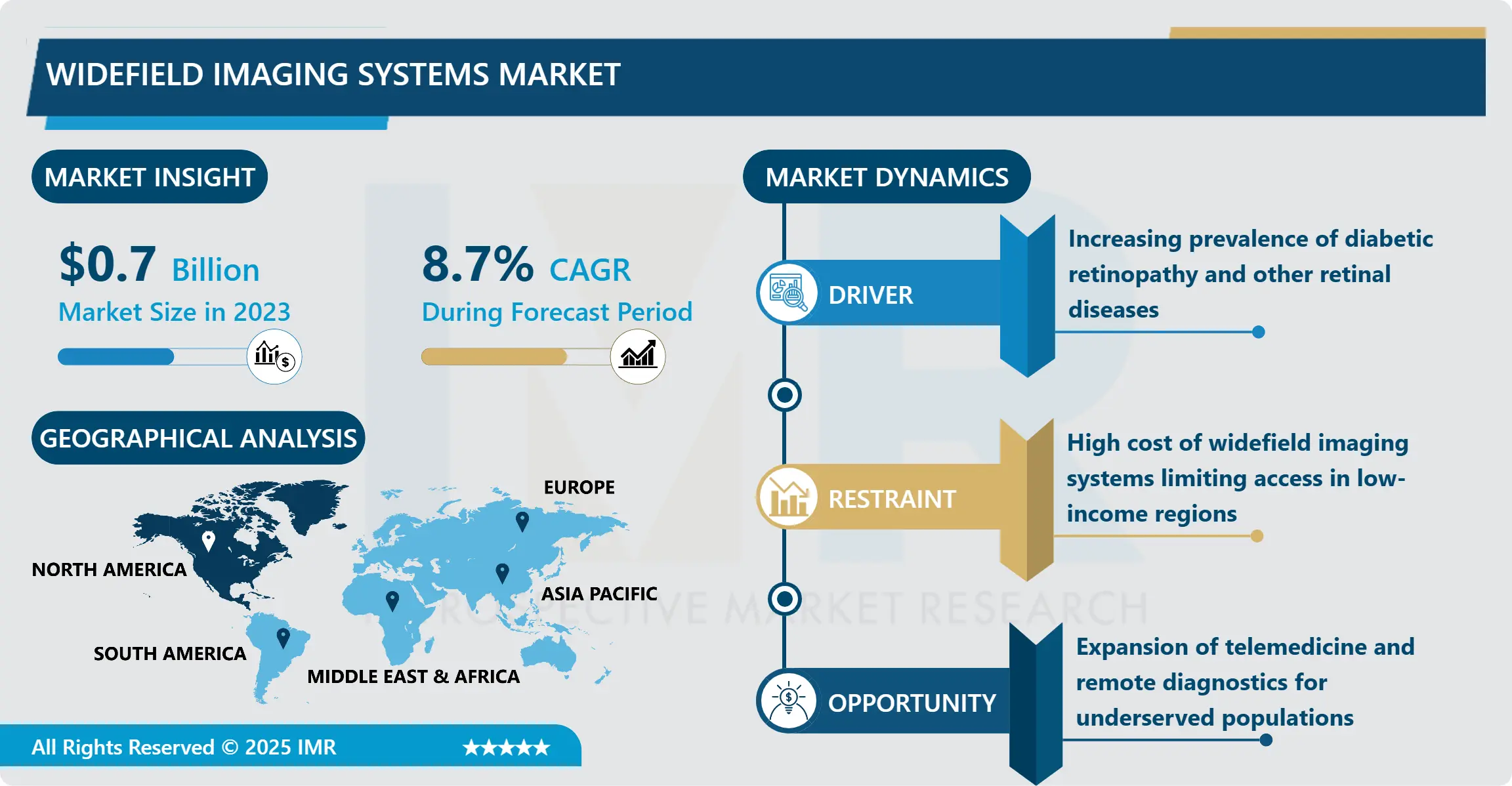
Widefield Imaging Systems Market Size Was Valued at USD 0.7 Billion in 2023, and is Projected to Reach USD 1.48 Billion by 2032, Growing at a CAGR of 8.7% From 2024-2032.
The Widefield Imaging Systems Market sector can be described as the field in which specific modern techniques for optic imaging are created for capturing a wide field of view of the retina and other ocular structures. This is a common imaging system that is mostly applied in the ophthalmologic field as a screening, diagnostic, and therapeutic tool for eye diseases including diabetic retinopathy, glaucoma and AMDs. Different from nonwidefield imaging systems, widefield imaging systems offer detailed maps of the eye’s interior and help healthcare individuals diagnose diseases and track the growth of the diseases successfully.
The market for Widefield Imaging Systems has witnessed enormous changes in the past several years because of a higher incidence of eye diseases starting with retinal diseases. The lens design of this technology allows the imaging of almost the whole retina in one visit, helping ophthalmologists get a 360-degree view of the eye. The factors to incorporate widefield imaging systems include; the need to diagnose eye ailments at an early stage, growing number of elderly people, advancement in imaging features. In addition, continuous advancement in diagnostic instruments in ophthalmology ensured that simple diagnostic techniques will be exclusively non-invasive and improved systems that are easier to use and yield faster results.
Pathologies such as diabetic retinopathy, which if not diagnosed on time the patient loses his vision, have been the leading factors to the use of widefield imaging systems. Also, the healthcare sectors of the world are integrating and adopting complicated technologies to get more reliable diagnoses and better results of treatments. The rising demand for recognition and surveillance of chorus diseases like diabetic retinopathy and macular degeneration is catalyzing the WF imaging systems market. These systems have benefited from improved imaging technologies making their resolution better and expanding the field of view in the manner that corresponds to the effective retinal space that can be covered thus becoming more valuable in diagnosis and management of ocular diseases.
Widefield Imaging Systems Market Trend Analysis:
Growing Adoption of Artificial Intelligence in Widefield Imaging
One of the most significant trends seen in strategic ophthalmology business development is the use of AI in widefield imaging systems. Advanced technologies across the field of Artificial Intelligence have been adopted to improve image processing which results in much quicker and more precise diagnosis. Such solutions can perform automated analysis of the lesions, detect abnormalities, classify them, and even estimate the likely scenario of a disease progression, which minimizes the use of analysis performed manually. Worth noting is that integrating widefield imaging and AI allows ophthalmologists to create individualized treatment protocols of eye disorders as well as optimize overall treatment approaches. It is on these grounds that this technological convergence is expected to give the global market for widefield imaging systems the push it needs to order growth.
Expansion of Telemedicine and Remote Diagnostics
One of the primary future trends impacting the Widefield Imaging Systems Market is the advancement of the telemedicine and remote diagnostic space. Especially as the improvement of the healthcare services for the underprivileged or the areas, which are geographically located far from large medical centers, the role of the telemedicine as a pathway providing diagnostic services without patients’ traveling long distance seems to be particularly relevant. Wide field imaging systems are very important in this regard, given that the images of the retina can be captured and evaluated by an ophthalmologist, usually from a distance. The increasing application of mobile healthcare solutions and the need for home monitoring constitute a potent niche for the creation and application of these imaging solutions across the developed and developing areas of the global market.
Widefield Imaging Systems Market Segment Analysis:
Widefield Imaging Systems Market Segmented on the basis of Component, Indication, Modality, End User, and End User.
By Component, Instruments segment is expected to dominate the market during the forecast period
Analysis of the Widefield Imaging Systems Market reveals that the instruments segment of the widefield imaging systems market will lead the market during the coming years. The reason is that these systems call for high-quality imaging instruments to deliver the level of clarity to help with diagnosis. The ever-increasing technical advancement of the imaging equipment hardware increases the quality of the images captured and process, recommending high-performance instruments. In addition there is rising usage of complex imaging systems that are used in both diagnostic facilities and hospitals, which increases the need for these tools.
These instruments come in handy to enhance the capture of widefield images through the retinal imaging systems as they help to identify ocular diseases. Advanced innovations which are portrayed in the creation of more progressive instruments; enhanced approaches of cameras, scanner, joining of data and so forth guarantees this segment keep on driving the market. Because the healthcare industry is slowly shifting toward using non-invasive, highly effective diagnostic devices and tools, the instruments segment should continue to propel the market forward.
By Indication, Diabetic Retinopathy segment expected to held the largest share
Of all the widefield applications, the diabetic retinopathy segment is likely to contribute to the largest market share for Widefield Imaging Systems. Diabetic retinopathy has become such a trend and accounts for blindness majorly in diabetic clients and therefore, a subject that deserves early detection and periodical assessment. Due to courtesy of widefield imaging system in capturing high resolution images of the retina and determining changes due to the diabetic retinopathy in their early stages, the widefield imaging system is widely used to detect and manage this condition. The need for these systems will also be boosted in the future by increased rates of diabetes around the world.
Since diabetic retinopathy is often initially presenting with few or no symptoms, the application of improved imaging technologies for monitoring the disease has significantly shifted. This contributes to early diagnosis which in turns triggers the right measures that avoid worsening of the vision. This is because the number of people with diabetes is on the rise globally and the widespread use of widefield imaging for diagnosis that is less invasive than traditional solutions.
Widefield Imaging Systems Market Regional Insights:
North America is Expected to Dominate the Market Over the Forecast period
By 2023, North America will lead the Widefield Imaging Systems Market due to it has a good degree of healthcare facilities, high acceptance of new technologies of medicine, and a high rate of diseases of the macula and retinas such as the diabetic retinopathy and macular degeneration.
The United States particularly makes a huge contribution to the specific market dominance of the region the dominance is due to market giants in manufacture of widefield imaging systems and high investment on healthcare. Further, North America is believed to capture the market share between 35% to 40% in 2023. The high disposable income, an aging population and rising focus on the early diagnosis of ocular diseases also fuels widefield imaging requirements in the region.
Active Key Players in the Widefield Imaging Systems Market
Canon Medical Systems Corporation (Japan)
Carl Zeiss Meditec AG (Germany)
Centervue S.p.A. (Italy)
Clarity Medical Systems (USA)
Draegerwerk AG & Co. KGaA (Germany)
Epiphan Systems (Canada)
Heidelberg Engineering GmbH (Germany)
Kowa Company Ltd. (Japan)
NIDEK Co. Ltd. (Japan)
Optos PLC (UK)
Reichert Technologies (USA)
Remidio Innovative Solutions Pvt. Ltd. (India)
Topcon Corporation (Japan)
Volk Optical Inc. (USA)
ZEISS (Germany)
Other Active Players
Chapter 1: Introduction
1.1 Scope and Coverage
Chapter 2:Executive Summary
Chapter 3: Market Landscape
3.1 Market Dynamics
3.1.1 Drivers
3.1.2 Restraints
3.1.3 Opportunities
3.1.4 Challenges
3.2 Market Trend Analysis
3.3 PESTLE Analysis
3.4 Porter’s Five Forces Analysis
3.5 Industry Value Chain Analysis
3.6 Ecosystem
3.7 Regulatory Landscape
3.8 Price Trend Analysis
3.9 Patent Analysis
3.10 Technology Evolution
3.11 Investment Pockets
3.12 Import-Export Analysis
Chapter 4: Widefield Imaging Systems Market by Component
4.1 Widefield Imaging Systems Market Snapshot and Growth Engine
4.2 Widefield Imaging Systems Market Overview
4.3 Instruments
4.3.1 Introduction and Market Overview
4.3.2 Historic and Forecasted Market Size in Value USD and Volume Units (2017-2032F)
4.3.3 Key Market Trends, Growth Factors and Opportunities
4.3.4 Instruments: Geographic Segmentation Analysis
4.4 Software
4.4.1 Introduction and Market Overview
4.4.2 Historic and Forecasted Market Size in Value USD and Volume Units (2017-2032F)
4.4.3 Key Market Trends, Growth Factors and Opportunities
4.4.4 Software: Geographic Segmentation Analysis
Chapter 5: Widefield Imaging Systems Market by Indication
5.1 Widefield Imaging Systems Market Snapshot and Growth Engine
5.2 Widefield Imaging Systems Market Overview
5.3 Diabetic Retinopathy
5.3.1 Introduction and Market Overview
5.3.2 Historic and Forecasted Market Size in Value USD and Volume Units (2017-2032F)
5.3.3 Key Market Trends, Growth Factors and Opportunities
5.3.4 Diabetic Retinopathy: Geographic Segmentation Analysis
5.4 Retinopathy of Prematurity
5.4.1 Introduction and Market Overview
5.4.2 Historic and Forecasted Market Size in Value USD and Volume Units (2017-2032F)
5.4.3 Key Market Trends, Growth Factors and Opportunities
5.4.4 Retinopathy of Prematurity: Geographic Segmentation Analysis
5.5 Pediatric Retinal Diseases
5.5.1 Introduction and Market Overview
5.5.2 Historic and Forecasted Market Size in Value USD and Volume Units (2017-2032F)
5.5.3 Key Market Trends, Growth Factors and Opportunities
5.5.4 Pediatric Retinal Diseases: Geographic Segmentation Analysis
5.6 Retinal Vein Occlusion
5.6.1 Introduction and Market Overview
5.6.2 Historic and Forecasted Market Size in Value USD and Volume Units (2017-2032F)
5.6.3 Key Market Trends, Growth Factors and Opportunities
5.6.4 Retinal Vein Occlusion: Geographic Segmentation Analysis
5.7 Ocular Oncology
5.7.1 Introduction and Market Overview
5.7.2 Historic and Forecasted Market Size in Value USD and Volume Units (2017-2032F)
5.7.3 Key Market Trends, Growth Factors and Opportunities
5.7.4 Ocular Oncology: Geographic Segmentation Analysis
5.8 Uveitis
5.8.1 Introduction and Market Overview
5.8.2 Historic and Forecasted Market Size in Value USD and Volume Units (2017-2032F)
5.8.3 Key Market Trends, Growth Factors and Opportunities
5.8.4 Uveitis: Geographic Segmentation Analysis
5.9 Chorioretinal Disease
5.9.1 Introduction and Market Overview
5.9.2 Historic and Forecasted Market Size in Value USD and Volume Units (2017-2032F)
5.9.3 Key Market Trends, Growth Factors and Opportunities
5.9.4 Chorioretinal Disease: Geographic Segmentation Analysis
5.10 Glaucoma
5.10.1 Introduction and Market Overview
5.10.2 Historic and Forecasted Market Size in Value USD and Volume Units (2017-2032F)
5.10.3 Key Market Trends, Growth Factors and Opportunities
5.10.4 Glaucoma: Geographic Segmentation Analysis
5.11 Others
5.11.1 Introduction and Market Overview
5.11.2 Historic and Forecasted Market Size in Value USD and Volume Units (2017-2032F)
5.11.3 Key Market Trends, Growth Factors and Opportunities
5.11.4 Others: Geographic Segmentation Analysis
Chapter 6: Widefield Imaging Systems Market by Modality
6.1 Widefield Imaging Systems Market Snapshot and Growth Engine
6.2 Widefield Imaging Systems Market Overview
6.3 Standalone
6.3.1 Introduction and Market Overview
6.3.2 Historic and Forecasted Market Size in Value USD and Volume Units (2017-2032F)
6.3.3 Key Market Trends, Growth Factors and Opportunities
6.3.4 Standalone: Geographic Segmentation Analysis
6.4 Portable
6.4.1 Introduction and Market Overview
6.4.2 Historic and Forecasted Market Size in Value USD and Volume Units (2017-2032F)
6.4.3 Key Market Trends, Growth Factors and Opportunities
6.4.4 Portable: Geographic Segmentation Analysis
Chapter 7: Widefield Imaging Systems Market by End User
7.1 Widefield Imaging Systems Market Snapshot and Growth Engine
7.2 Widefield Imaging Systems Market Overview
7.3 Speciality Clinics
7.3.1 Introduction and Market Overview
7.3.2 Historic and Forecasted Market Size in Value USD and Volume Units (2017-2032F)
7.3.3 Key Market Trends, Growth Factors and Opportunities
7.3.4 Speciality Clinics: Geographic Segmentation Analysis
7.4 Hospitals
7.4.1 Introduction and Market Overview
7.4.2 Historic and Forecasted Market Size in Value USD and Volume Units (2017-2032F)
7.4.3 Key Market Trends, Growth Factors and Opportunities
7.4.4 Hospitals: Geographic Segmentation Analysis
7.5 Ambulatory Surgical Centers)
7.5.1 Introduction and Market Overview
7.5.2 Historic and Forecasted Market Size in Value USD and Volume Units (2017-2032F)
7.5.3 Key Market Trends, Growth Factors and Opportunities
7.5.4 Ambulatory Surgical Centers) : Geographic Segmentation Analysis
Chapter 8: Company Profiles and Competitive Analysis
8.1 Competitive Landscape
8.1.1 Competitive Benchmarking
8.1.2 Widefield Imaging Systems Market Share by Manufacturer (2023)
8.1.3 Industry BCG Matrix
8.1.4 Heat Map Analysis
8.1.5 Mergers and Acquisitions
8.2 CANON MEDICAL SYSTEMS CORPORATION
8.2.1 Company Overview
8.2.2 Key Executives
8.2.3 Company Snapshot
8.2.4 Role of the Company in the Market
8.2.5 Sustainability and Social Responsibility
8.2.6 Operating Business Segments
8.2.7 Product Portfolio
8.2.8 Business Performance
8.2.9 Key Strategic Moves and Recent Developments
8.2.10 SWOT Analysis
8.3 CARL ZEISS MEDITEC AG
8.4 CENTERVUE S.P.A.
8.5 CLARITY MEDICAL SYSTEMS
8.6 OTHER ACTIVE PLAYERS
Chapter 9: Global Widefield Imaging Systems Market By Region
9.1 Overview
9.2. North America Widefield Imaging Systems Market
9.2.1 Key Market Trends, Growth Factors and Opportunities
9.2.2 Top Key Companies
9.2.3 Historic and Forecasted Market Size by Segments
9.2.4 Historic and Forecasted Market Size By Component
9.2.4.1 Instruments
9.2.4.2 Software
9.2.5 Historic and Forecasted Market Size By Indication
9.2.5.1 Diabetic Retinopathy
9.2.5.2 Retinopathy of Prematurity
9.2.5.3 Pediatric Retinal Diseases
9.2.5.4 Retinal Vein Occlusion
9.2.5.5 Ocular Oncology
9.2.5.6 Uveitis
9.2.5.7 Chorioretinal Disease
9.2.5.8 Glaucoma
9.2.5.9 Others
9.2.6 Historic and Forecasted Market Size By Modality
9.2.6.1 Standalone
9.2.6.2 Portable
9.2.7 Historic and Forecasted Market Size By End User
9.2.7.1 Speciality Clinics
9.2.7.2 Hospitals
9.2.7.3 Ambulatory Surgical Centers)
9.2.8 Historic and Forecast Market Size by Country
9.2.8.1 US
9.2.8.2 Canada
9.2.8.3 Mexico
9.3. Eastern Europe Widefield Imaging Systems Market
9.3.1 Key Market Trends, Growth Factors and Opportunities
9.3.2 Top Key Companies
9.3.3 Historic and Forecasted Market Size by Segments
9.3.4 Historic and Forecasted Market Size By Component
9.3.4.1 Instruments
9.3.4.2 Software
9.3.5 Historic and Forecasted Market Size By Indication
9.3.5.1 Diabetic Retinopathy
9.3.5.2 Retinopathy of Prematurity
9.3.5.3 Pediatric Retinal Diseases
9.3.5.4 Retinal Vein Occlusion
9.3.5.5 Ocular Oncology
9.3.5.6 Uveitis
9.3.5.7 Chorioretinal Disease
9.3.5.8 Glaucoma
9.3.5.9 Others
9.3.6 Historic and Forecasted Market Size By Modality
9.3.6.1 Standalone
9.3.6.2 Portable
9.3.7 Historic and Forecasted Market Size By End User
9.3.7.1 Speciality Clinics
9.3.7.2 Hospitals
9.3.7.3 Ambulatory Surgical Centers)
9.3.8 Historic and Forecast Market Size by Country
9.3.8.1 Russia
9.3.8.2 Bulgaria
9.3.8.3 The Czech Republic
9.3.8.4 Hungary
9.3.8.5 Poland
9.3.8.6 Romania
9.3.8.7 Rest of Eastern Europe
9.4. Western Europe Widefield Imaging Systems Market
9.4.1 Key Market Trends, Growth Factors and Opportunities
9.4.2 Top Key Companies
9.4.3 Historic and Forecasted Market Size by Segments
9.4.4 Historic and Forecasted Market Size By Component
9.4.4.1 Instruments
9.4.4.2 Software
9.4.5 Historic and Forecasted Market Size By Indication
9.4.5.1 Diabetic Retinopathy
9.4.5.2 Retinopathy of Prematurity
9.4.5.3 Pediatric Retinal Diseases
9.4.5.4 Retinal Vein Occlusion
9.4.5.5 Ocular Oncology
9.4.5.6 Uveitis
9.4.5.7 Chorioretinal Disease
9.4.5.8 Glaucoma
9.4.5.9 Others
9.4.6 Historic and Forecasted Market Size By Modality
9.4.6.1 Standalone
9.4.6.2 Portable
9.4.7 Historic and Forecasted Market Size By End User
9.4.7.1 Speciality Clinics
9.4.7.2 Hospitals
9.4.7.3 Ambulatory Surgical Centers)
9.4.8 Historic and Forecast Market Size by Country
9.4.8.1 Germany
9.4.8.2 UK
9.4.8.3 France
9.4.8.4 The Netherlands
9.4.8.5 Italy
9.4.8.6 Spain
9.4.8.7 Rest of Western Europe
9.5. Asia Pacific Widefield Imaging Systems Market
9.5.1 Key Market Trends, Growth Factors and Opportunities
9.5.2 Top Key Companies
9.5.3 Historic and Forecasted Market Size by Segments
9.5.4 Historic and Forecasted Market Size By Component
9.5.4.1 Instruments
9.5.4.2 Software
9.5.5 Historic and Forecasted Market Size By Indication
9.5.5.1 Diabetic Retinopathy
9.5.5.2 Retinopathy of Prematurity
9.5.5.3 Pediatric Retinal Diseases
9.5.5.4 Retinal Vein Occlusion
9.5.5.5 Ocular Oncology
9.5.5.6 Uveitis
9.5.5.7 Chorioretinal Disease
9.5.5.8 Glaucoma
9.5.5.9 Others
9.5.6 Historic and Forecasted Market Size By Modality
9.5.6.1 Standalone
9.5.6.2 Portable
9.5.7 Historic and Forecasted Market Size By End User
9.5.7.1 Speciality Clinics
9.5.7.2 Hospitals
9.5.7.3 Ambulatory Surgical Centers)
9.5.8 Historic and Forecast Market Size by Country
9.5.8.1 China
9.5.8.2 India
9.5.8.3 Japan
9.5.8.4 South Korea
9.5.8.5 Malaysia
9.5.8.6 Thailand
9.5.8.7 Vietnam
9.5.8.8 The Philippines
9.5.8.9 Australia
9.5.8.10 New Zealand
9.5.8.11 Rest of APAC
9.6. Middle East & Africa Widefield Imaging Systems Market
9.6.1 Key Market Trends, Growth Factors and Opportunities
9.6.2 Top Key Companies
9.6.3 Historic and Forecasted Market Size by Segments
9.6.4 Historic and Forecasted Market Size By Component
9.6.4.1 Instruments
9.6.4.2 Software
9.6.5 Historic and Forecasted Market Size By Indication
9.6.5.1 Diabetic Retinopathy
9.6.5.2 Retinopathy of Prematurity
9.6.5.3 Pediatric Retinal Diseases
9.6.5.4 Retinal Vein Occlusion
9.6.5.5 Ocular Oncology
9.6.5.6 Uveitis
9.6.5.7 Chorioretinal Disease
9.6.5.8 Glaucoma
9.6.5.9 Others
9.6.6 Historic and Forecasted Market Size By Modality
9.6.6.1 Standalone
9.6.6.2 Portable
9.6.7 Historic and Forecasted Market Size By End User
9.6.7.1 Speciality Clinics
9.6.7.2 Hospitals
9.6.7.3 Ambulatory Surgical Centers)
9.6.8 Historic and Forecast Market Size by Country
9.6.8.1 Turkiye
9.6.8.2 Bahrain
9.6.8.3 Kuwait
9.6.8.4 Saudi Arabia
9.6.8.5 Qatar
9.6.8.6 UAE
9.6.8.7 Israel
9.6.8.8 South Africa
9.7. South America Widefield Imaging Systems Market
9.7.1 Key Market Trends, Growth Factors and Opportunities
9.7.2 Top Key Companies
9.7.3 Historic and Forecasted Market Size by Segments
9.7.4 Historic and Forecasted Market Size By Component
9.7.4.1 Instruments
9.7.4.2 Software
9.7.5 Historic and Forecasted Market Size By Indication
9.7.5.1 Diabetic Retinopathy
9.7.5.2 Retinopathy of Prematurity
9.7.5.3 Pediatric Retinal Diseases
9.7.5.4 Retinal Vein Occlusion
9.7.5.5 Ocular Oncology
9.7.5.6 Uveitis
9.7.5.7 Chorioretinal Disease
9.7.5.8 Glaucoma
9.7.5.9 Others
9.7.6 Historic and Forecasted Market Size By Modality
9.7.6.1 Standalone
9.7.6.2 Portable
9.7.7 Historic and Forecasted Market Size By End User
9.7.7.1 Speciality Clinics
9.7.7.2 Hospitals
9.7.7.3 Ambulatory Surgical Centers)
9.7.8 Historic and Forecast Market Size by Country
9.7.8.1 Brazil
9.7.8.2 Argentina
9.7.8.3 Rest of SA
Chapter 10 Analyst Viewpoint and Conclusion
10.1 Recommendations and Concluding Analysis
10.2 Potential Market Strategies
Chapter 11 Research Methodology
11.1 Research Process
11.2 Primary Research
11.3 Secondary Research
Q1: What would be the forecast period in the Widefield Imaging Systems Market research report?
A1: The forecast period in the Widefield Imaging Systems Market research report is 2024-2032.
Q2: Who are the key players in the Widefield Imaging Systems Market?
A2: Canon Medical Systems Corporation, Carl Zeiss Meditec AG, Centervue S.p.A., Clarity Medical Systems and Other Active Players.
Q3: What are the segments of the Widefield Imaging Systems Market?
A3: The Widefield Imaging Systems Market is segmented into Component, Indication, Modality and region. By Component, the market is categorized into Instruments, Software. By Indication, the market is categorized into Diabetic Retinopathy, Retinopathy of Prematurity, Pediatric Retinal Diseases, Retinal Vein Occlusion, Ocular Oncology, Uveitis, Chorioretinal Disease, Glaucoma, Others. By Modality, the market is categorized into Standalone, Portable. By region, it is analyzed across North America (U.S., Canada, Mexico), Eastern Europe (Russia, Bulgaria, The Czech Republic, Hungary, Poland, Romania, Rest of Eastern Europe), Western Europe (Germany, UK, France, The Netherlands, Italy, Spain, Rest of Western Europe), Asia Pacific (China, India, Japan, South Korea, Malaysia, Thailand, Vietnam, The Philippines, Australia, New-Zealand, Rest of APAC), Middle East & Africa (Turkiye, Bahrain, Kuwait, Saudi Arabia, Qatar, UAE, Israel, South Africa), South America (Brazil, Argentina, Rest of SA).
Q4: What is the Widefield Imaging Systems Market?
A4: The Widefield Imaging Systems Market sector can be described as the field in which specific modern techniques for optic imaging are created for capturing a wide field of view of the retina and other ocular structures. This is a common imaging system that is mostly applied in the ophthalmologic field as a screening, diagnostic, and therapeutic tool for eye diseases including diabetic retinopathy, glaucoma and AMDs. Different from nonwidefield imaging systems, widefield imaging systems offer detailed maps of the eye’s interior and help healthcare individuals diagnose diseases and track the growth of the diseases successfully.
Q5: How big is the Widefield Imaging Systems Market?
A5: Widefield Imaging Systems Market Size Was Valued at USD 0.7 Billion in 2023, and is Projected to Reach USD 1.48 Billion by 2032, Growing at a CAGR of 8.7% From 2024-2032.
How to Buy a Report from eminsights.jp
On the product page, choose the license you want: Single-User License, Multi-User License or Enterprise License.
If you required report in your native language, then you can click on Translated Report button and fill out the form with report name and language you want, then our team will contact you as soon as possible.
Click the Buy Now button.
You will be redirected to the checkout page. Enter your company details and payment information.
Click Place Order to complete the purchase.
Confirmation: You’ll receive an order confirmation and our team will contact you shortly with your ordered report.
If you have any questions, fill out the contact form below or email us at bizdev@eminsights.net.
Thank you for choosing eminsights.jp!