Stay Ahead in Fast-Growing Economies.
Browse Reports Now




Whey Protein Product Market-In Deep Analysis Focusing on Market Share
Whey protein products are dietary supplements derived from whey, which is a byproduct of cheese production. Whey protein is extracted from whey through various processing methods and is widely used as a source of high-quality protein in various forms such as powders, bars, beverages, and ready-to-drink (RTD) products.

IMR Group
Description
Whey Protein Product Market Synopsis
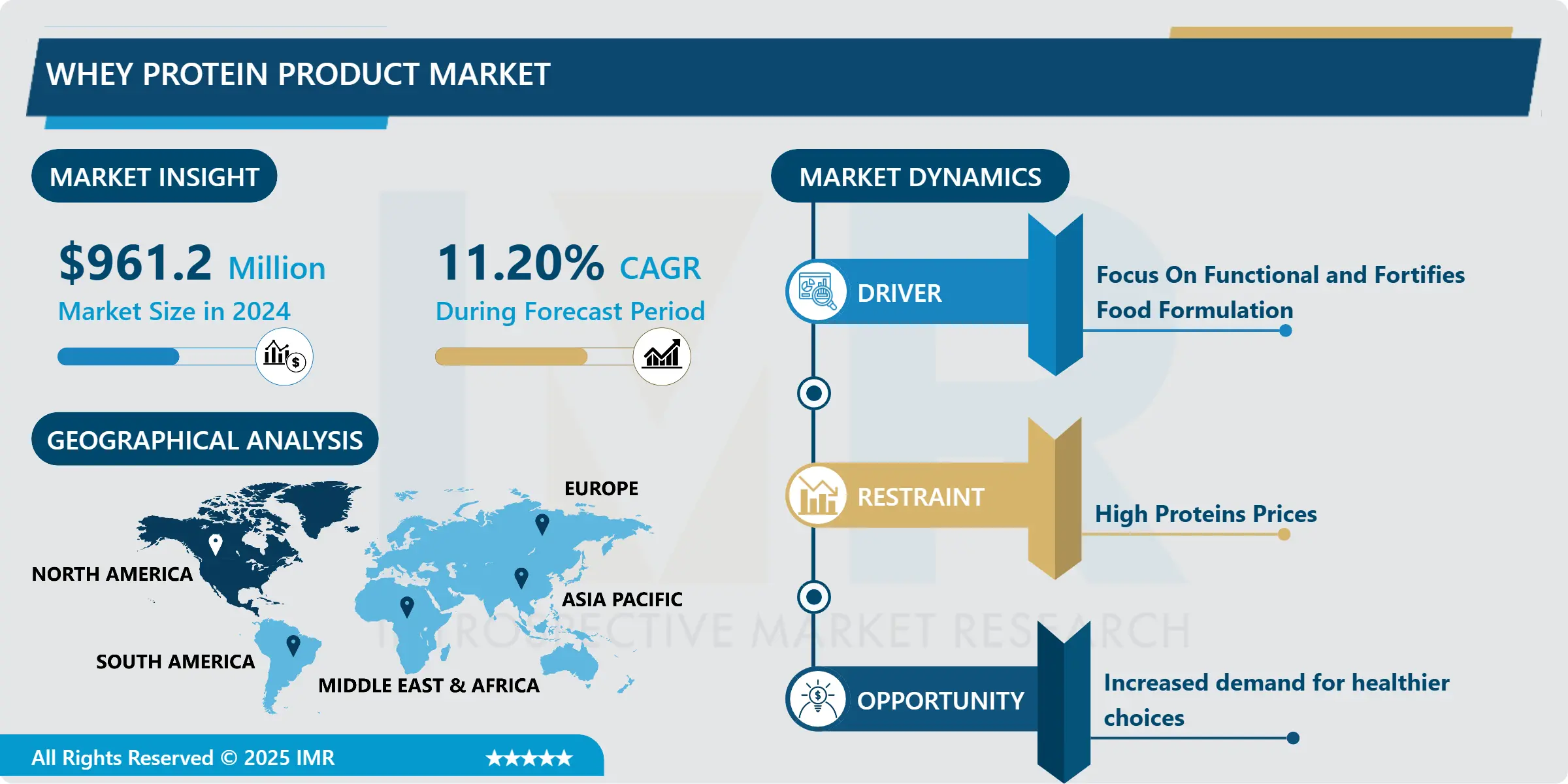
Whey Protein Product Market Size Was Valued at USD 961.2 Million in 2024, and is Projected to Reach USD 2247.25 Million by 2032, Growing at a CAGR of 11.20% From 2025-2032.
Whey protein products are dietary supplements derived from whey, which is a byproduct of cheese production. Whey protein is extracted from whey through various processing methods and is widely used as a source of high-quality protein in various forms such as powders, bars, beverages, and ready-to-drink (RTD) products.
The increasing awareness of healthy lifestyles is increasing the demand for whey protein, with fitness and sports clubs often endorsing protein supplements, thereby attracting customers’ interest in whey protein. Moreover, the food industry utilizes whey protein in various products such as baked goods, dairy items, beverages, cereals, chocolates, and baby foods, leveraging its antihypertensive and antibacterial properties. Consequently, global whey protein sales are expected to surge.
Regulatory frameworks governing the production, labelling, and marketing of whey protein products vary by region. Companies operating in the market need to comply with regulations set forth by relevant authorities such as the Food and Drug Administration (FDA) in the United States and the European Food Safety Authority (EFSA) in Europe.
Whey protein products are valued for their high biological value, meaning they contain all essential amino acids needed by the body and are efficiently absorbed and utilized for protein synthesis. They are also rich in branched-chain amino acids (BCAAs) such as leucine, isoleucine, and valine, which play a crucial role in muscle protein synthesis and recovery.
Whey Protein Product Market Trend Analysis
Whey Protein Product Market Growth Drivers- Focus On Functional and Fortifies Food Formulation
Functional and fortified foods are indeed creating a trend in the whey protein products market. This trend highlights a growing consumer interest in products that offer not only basic nutrition but also additional health benefits. Manufacturers are increasingly incorporating functional ingredients such as probiotics, vitamins, minerals, and antioxidants into whey protein products to enhance their nutritional value and cater to specific health objectives. This trend aligns with consumer preferences for holistic wellness solutions and convenience, driving the demand for whey protein products that offer multifaceted health benefits beyond simple protein supplementation. ?
whey protein products market towards fortified and functional formulations, emphasizing specific health benefits. This shift mirrors the growing consumer demand for convenient and versatile dietary solutions, along with products that provide comprehensive wellness benefits beyond basic protein supplementation. ?
Whey Protein Product Market Opportunities- Increased Demand for Healthier Choices
As people become more health-conscious, there’s a growing demand for products that support their wellness goals. Whey protein, known for its high-quality protein content and essential amino acids, is perceived as a beneficial dietary supplement for muscle growth, recovery, and overall health. This increased awareness creates a favourable environment for whey protein products. The rising health consciousness is not limited to athletes or fitness enthusiasts but extends to a broader consumer base seeking healthier lifestyle choices. This includes individuals looking to manage weight, improve nutrition, or address specific health concerns.
Whey protein products can cater to various market segments by offering solutions tailored to different health and fitness goals. The growing global health and wellness trend presents opportunities for whey protein manufacturers to expand into new geographic markets where health-consciousness is on the rise. Emerging economies with a burgeoning middle class and increasing disposable incomes offer untapped opportunities for market penetration and growth in the whey protein segment.
Whey Protein Product Market Segment Analysis:
Whey Protein Product Market is Segmented on The Basis of Type, Distribution Channels, Application, And Region.
By Type, Whey Protein Concentrate Segment is Expected to Dominate the Market During the Forecast Period
Whey protein concentrate (WPC) dominates whey protein product market. It’s a popular choice among athletes, fitness enthusiasts, and individuals looking to increase their protein intake due to its relatively lower cost compared to other whey protein forms like isolate, while still offering a good protein content. Whey protein concentrate typically contains around 70-80% protein along with some amount of lactose and fat.
This makes it a versatile option for various applications such as protein shakes, smoothies, protein bars, and baking recipes. Its affordability and relatively good protein content make it a preferred choice for many consumers. However, it’s worth noting that other forms like whey protein isolate, which contains a higher percentage of protein and fewer carbs and fats, may be preferred by those who are more focused on maximizing protein intake while minimizing other macronutrients.
By Application, Sports and Performance Nutrition Segment Held the Largest Share in 2024
Whey protein products are extensively used in sports nutrition due to their ability to promote muscle growth, enhance muscle recovery, and support overall athletic performance. Athletes and fitness enthusiasts often consume whey protein supplements before or after workouts to meet their protein needs and facilitate muscle repair and growth. Whey protein is a complete protein source, containing all essential amino acids required for muscle growth and repair.
Whey protein products come in various formulations, including whey protein concentrates, isolates, and hydrolysates, each offering different protein concentrations and processing methods. This allows athletes to customize their protein intake based on their individual goals, preferences, and dietary requirements, further driving the demand for whey protein products in the sports nutrition market.
Whey Protein Product Market Regional Insights:
North America is Expected to Dominate the Market Over the Forecast period
North America’s dominance in the whey protein product market is indeed multifaceted, stemming from its robust fitness and sports nutrition industry, consumer awareness of health and wellness trends, and the widespread availability of whey protein products in various forms. The perceived effectiveness of whey protein in muscle building, weight management, and overall health further fuels its popularity in the region.
North America’s strong manufacturing infrastructure and distribution networks play a crucial role in making whey protein products easily accessible to consumers. However, as you rightly pointed out, market dynamics are subject to change due to various factors, necessitating continuous monitoring and adaptation by industry players to maintain competitiveness.
Whey Protein Product Market Key Players
Glanbia plc (Ireland)
Fonterra Co-operative Group Limited (New Zealand)
Kerry Group plc (Ireland)
Arla Foods (Denmark)
Hilmar Cheese Company, Inc. (United States)
AMCO Proteins (United States)
Davisco Foods International, Inc. (United States)
Milk Specialties Global (United States)
Agropur Inc. (Canada)
Leprino Foods Company (United States)
Carbery Group (Ireland)
Lactalis Ingredients (France)
Grande Cheese Company (United States)
Erie Foods International, Inc. (United States)
DMK Group (Germany)
Westland Milk Products (New Zealand)
Omega Protein Corporation (United States)
Saputo Inc. (Canada)
Idaho Milk Products (United States)
Land O’Lakes, Inc. (United States)
American Dairy Products Institute (United States)
Darigold, Inc. (United States)
Glanbia Nutritionals (Ireland)
Volac International Limited (United Kingdom) and other active players.
Key Industry Developments in the Whey Protein Product Market:
In Nov 2023, Max Protein, a leading name in the fitness and nutrition industry, introduces its comprehensive range of Protein Powders, including Whey Protein, Plant Protein, and Roti Mix, through its latest campaign, #MadeForOneMore. This campaign showcases the return of the popular ‘Protein Police’ featuring actor Thakur Anoop Singh on an exciting new mission.
In Sep 2023, Max Protein’s Game-Changing New Launch: Whey, Plant Protein, and Roti Mix Driving Towards Market Dominance.
Chapter 1: Introduction
1.1 Scope and Coverage
Chapter 2:Executive Summary
Chapter 3: Market Landscape
3.1 Market Dynamics
3.1.1 Drivers
3.1.2 Restraints
3.1.3 Opportunities
3.1.4 Challenges
3.2 Market Trend Analysis
3.3 PESTLE Analysis
3.4 Porter’s Five Forces Analysis
3.5 Industry Value Chain Analysis
3.6 Ecosystem
3.7 Regulatory Landscape
3.8 Price Trend Analysis
3.9 Patent Analysis
3.10 Technology Evolution
3.11 Investment Pockets
3.12 Import-Export Analysis
Chapter 4: Whey Protein Product Market by Type (2018-2032)
4.1 Whey Protein Product Market Snapshot and Growth Engine
4.2 Market Overview
4.3 Whey Protein Concentrate
4.3.1 Introduction and Market Overview
4.3.2 Historic and Forecasted Market Size in Value USD and Volume Units
4.3.3 Key Market Trends, Growth Factors, and Opportunities
4.3.4 Geographic Segmentation Analysis
4.4 Whey Protein Isolate
4.5 Hydrolysed Whey Protein
Chapter 5: Whey Protein Product Market by Application (2018-2032)
5.1 Whey Protein Product Market Snapshot and Growth Engine
5.2 Market Overview
5.3 Sports and Performance Nutrition
5.3.1 Introduction and Market Overview
5.3.2 Historic and Forecasted Market Size in Value USD and Volume Units
5.3.3 Key Market Trends, Growth Factors, and Opportunities
5.3.4 Geographic Segmentation Analysis
5.4 Infant Formulation
5.5 Functional and Fortified Food
5.6 Beverages
Chapter 6: Company Profiles and Competitive Analysis
6.1 Competitive Landscape
6.1.1 Competitive Benchmarking
6.1.2 Whey Protein Product Market Share by Manufacturer (2024)
6.1.3 Industry BCG Matrix
6.1.4 Heat Map Analysis
6.1.5 Mergers and Acquisitions
6.2 GLANBIA PLC (IRELAND)
6.2.1 Company Overview
6.2.2 Key Executives
6.2.3 Company Snapshot
6.2.4 Role of the Company in the Market
6.2.5 Sustainability and Social Responsibility
6.2.6 Operating Business Segments
6.2.7 Product Portfolio
6.2.8 Business Performance
6.2.9 Key Strategic Moves and Recent Developments
6.2.10 SWOT Analysis
6.3 FONTERRA CO-OPERATIVE GROUP LIMITED (NEW ZEALAND)
6.4 KERRY GROUP PLC (IRELAND)
6.5 ARLA FOODS (DENMARK)
6.6 HILMAR CHEESE COMPANY INC. (UNITED STATES)
6.7 AMCO PROTEINS (UNITED STATES)
6.8 DAVISCO FOODS INTERNATIONAL INC. (UNITED STATES)
6.9 MILK SPECIALTIES GLOBAL (UNITED STATES)
6.10 AGROPUR INC. (CANADA)
6.11 LEPRINO FOODS COMPANY (UNITED STATES)
6.12 CARBERY GROUP (IRELAND)
6.13 LACTALIS INGREDIENTS (FRANCE)
6.14 GRANDE CHEESE COMPANY (UNITED STATES)
6.15 ERIE FOODS INTERNATIONAL INC. (UNITED STATES)
6.16 DMK GROUP (GERMANY)
6.17 WESTLAND MILK PRODUCTS (NEW ZEALAND)
6.18 OMEGA PROTEIN CORPORATION (UNITED STATES)
6.19 SAPUTO INC. (CANADA)
6.20 IDAHO MILK PRODUCTS (UNITED STATES)
6.21 LAND O’LAKES INC. (UNITED STATES)
6.22 AMERICAN DAIRY PRODUCTS INSTITUTE (UNITED STATES)
6.23 DARIGOLD INC. (UNITED STATES)
6.24 GLANBIA NUTRITIONALS (IRELAND)
6.25 VOLAC INTERNATIONAL LIMITED (UNITED KINGDOM)
Chapter 7: Global Whey Protein Product Market By Region
7.1 Overview
7.2. North America Whey Protein Product Market
7.2.1 Key Market Trends, Growth Factors and Opportunities
7.2.2 Top Key Companies
7.2.3 Historic and Forecasted Market Size by Segments
7.2.4 Historic and Forecasted Market Size by Type
7.2.4.1 Whey Protein Concentrate
7.2.4.2 Whey Protein Isolate
7.2.4.3 Hydrolysed Whey Protein
7.2.5 Historic and Forecasted Market Size by Application
7.2.5.1 Sports and Performance Nutrition
7.2.5.2 Infant Formulation
7.2.5.3 Functional and Fortified Food
7.2.5.4 Beverages
7.2.6 Historic and Forecast Market Size by Country
7.2.6.1 US
7.2.6.2 Canada
7.2.6.3 Mexico
7.3. Eastern Europe Whey Protein Product Market
7.3.1 Key Market Trends, Growth Factors and Opportunities
7.3.2 Top Key Companies
7.3.3 Historic and Forecasted Market Size by Segments
7.3.4 Historic and Forecasted Market Size by Type
7.3.4.1 Whey Protein Concentrate
7.3.4.2 Whey Protein Isolate
7.3.4.3 Hydrolysed Whey Protein
7.3.5 Historic and Forecasted Market Size by Application
7.3.5.1 Sports and Performance Nutrition
7.3.5.2 Infant Formulation
7.3.5.3 Functional and Fortified Food
7.3.5.4 Beverages
7.3.6 Historic and Forecast Market Size by Country
7.3.6.1 Russia
7.3.6.2 Bulgaria
7.3.6.3 The Czech Republic
7.3.6.4 Hungary
7.3.6.5 Poland
7.3.6.6 Romania
7.3.6.7 Rest of Eastern Europe
7.4. Western Europe Whey Protein Product Market
7.4.1 Key Market Trends, Growth Factors and Opportunities
7.4.2 Top Key Companies
7.4.3 Historic and Forecasted Market Size by Segments
7.4.4 Historic and Forecasted Market Size by Type
7.4.4.1 Whey Protein Concentrate
7.4.4.2 Whey Protein Isolate
7.4.4.3 Hydrolysed Whey Protein
7.4.5 Historic and Forecasted Market Size by Application
7.4.5.1 Sports and Performance Nutrition
7.4.5.2 Infant Formulation
7.4.5.3 Functional and Fortified Food
7.4.5.4 Beverages
7.4.6 Historic and Forecast Market Size by Country
7.4.6.1 Germany
7.4.6.2 UK
7.4.6.3 France
7.4.6.4 The Netherlands
7.4.6.5 Italy
7.4.6.6 Spain
7.4.6.7 Rest of Western Europe
7.5. Asia Pacific Whey Protein Product Market
7.5.1 Key Market Trends, Growth Factors and Opportunities
7.5.2 Top Key Companies
7.5.3 Historic and Forecasted Market Size by Segments
7.5.4 Historic and Forecasted Market Size by Type
7.5.4.1 Whey Protein Concentrate
7.5.4.2 Whey Protein Isolate
7.5.4.3 Hydrolysed Whey Protein
7.5.5 Historic and Forecasted Market Size by Application
7.5.5.1 Sports and Performance Nutrition
7.5.5.2 Infant Formulation
7.5.5.3 Functional and Fortified Food
7.5.5.4 Beverages
7.5.6 Historic and Forecast Market Size by Country
7.5.6.1 China
7.5.6.2 India
7.5.6.3 Japan
7.5.6.4 South Korea
7.5.6.5 Malaysia
7.5.6.6 Thailand
7.5.6.7 Vietnam
7.5.6.8 The Philippines
7.5.6.9 Australia
7.5.6.10 New Zealand
7.5.6.11 Rest of APAC
7.6. Middle East & Africa Whey Protein Product Market
7.6.1 Key Market Trends, Growth Factors and Opportunities
7.6.2 Top Key Companies
7.6.3 Historic and Forecasted Market Size by Segments
7.6.4 Historic and Forecasted Market Size by Type
7.6.4.1 Whey Protein Concentrate
7.6.4.2 Whey Protein Isolate
7.6.4.3 Hydrolysed Whey Protein
7.6.5 Historic and Forecasted Market Size by Application
7.6.5.1 Sports and Performance Nutrition
7.6.5.2 Infant Formulation
7.6.5.3 Functional and Fortified Food
7.6.5.4 Beverages
7.6.6 Historic and Forecast Market Size by Country
7.6.6.1 Turkiye
7.6.6.2 Bahrain
7.6.6.3 Kuwait
7.6.6.4 Saudi Arabia
7.6.6.5 Qatar
7.6.6.6 UAE
7.6.6.7 Israel
7.6.6.8 South Africa
7.7. South America Whey Protein Product Market
7.7.1 Key Market Trends, Growth Factors and Opportunities
7.7.2 Top Key Companies
7.7.3 Historic and Forecasted Market Size by Segments
7.7.4 Historic and Forecasted Market Size by Type
7.7.4.1 Whey Protein Concentrate
7.7.4.2 Whey Protein Isolate
7.7.4.3 Hydrolysed Whey Protein
7.7.5 Historic and Forecasted Market Size by Application
7.7.5.1 Sports and Performance Nutrition
7.7.5.2 Infant Formulation
7.7.5.3 Functional and Fortified Food
7.7.5.4 Beverages
7.7.6 Historic and Forecast Market Size by Country
7.7.6.1 Brazil
7.7.6.2 Argentina
7.7.6.3 Rest of SA
Chapter 8 Analyst Viewpoint and Conclusion
8.1 Recommendations and Concluding Analysis
8.2 Potential Market Strategies
Chapter 9 Research Methodology
9.1 Research Process
9.2 Primary Research
9.3 Secondary Research
Q1: What would be the forecast period in the Whey Protein Product Market research report?
A1: The forecast period in the Whey Protein Product Market research report is 2025-2032.
Q2: Who are the key players in the Whey Protein Product Market?
A2: Glanbia plc (Ireland), Fonterra Co-operative Group Limited (New Zealand), Kerry Group plc (Ireland), Arla Foods (Denmark), Hilmar Cheese Company, Inc. (United States), AMCO Proteins (United States), Davisco Foods International, Inc. (United States), Milk Specialties Global (United States), Agropur Inc. (Canada), Leprino Foods Company (United States), Carbery Group (Ireland), Lactalis Ingredients (France), Grande Cheese Company (United States), Erie Foods International, Inc. (United States), DMK Group (Germany), Westland Milk Products (New Zealand), Omega Protein Corporation (United States), Saputo Inc. (Canada), Idaho Milk Products (United States), Land O'Lakes, Inc. (United States), AMCO Proteins (United States), American Dairy Products Institute (United States), Darigold Inc. (United States), Glanbia Nutritional (Ireland), Volac International Limited (United Kingdom), and Other Active Players.
Q3: What are the segments of the Whey Protein Product Market?
A3: The Whey Protein Product Market is segmented into Type, Distribution channel Application, and region. By Type, the market is categorized into (Whey Protein Concentrate (WHP), Whey Protein Isolate (WPI), Hydrolyzed Whey Protein (HWP). By Nature, the market is categorized into Supermarkets and Hypermarkets, Specialty Stores, Online Retail. By Application, the market is categorized into Sports and Performance Nutrition, Infant Formula, Fortified Food, And Beverages). By region, it is analyzed across• North America (U.S., Canada, Mexico) • Eastern Europe (Russia, Bulgaria, The Czech Republic, Hungary, Poland, Romania, Rest of Eastern Europe) • Western Europe (Germany, UK, France, The Netherlands, Italy, Spain, Rest of Western Europe) • Asia Pacific (China, India, Japan, South Korea, Malaysia, Thailand, Vietnam, The Philippines, Australia, New Zealand, Rest of APAC) • Middle East & Africa (Türkiye, Bahrain, Kuwait, Saudi Arabia, Qatar, UAE, Israel, South Africa) • South America (Brazil, Argentina, Rest of SA)
Q4: What is the Whey Protein Product Market?
A4: Whey protein products are dietary supplements derived from whey, which is a byproduct of cheese production. Whey protein is extracted from whey through various processing methods and is widely used as a source of high-quality protein in various forms such as powders, bars, beverages, and ready-to-drink (RTD) products.
Q5: How big is the Whey Protein Product Market?
A5: Whey Protein Product Market Size Was Valued at USD 961.2 Million in 2024, and is Projected to Reach USD 2247.25 Million by 2032, Growing at a CAGR of 11.20% From 2025-2032.
How to Buy a Report from eminsights.jp
On the product page, choose the license you want: Single-User License, Multi-User License or Enterprise License.
If you required report in your native language, then you can click on Translated Report button and fill out the form with report name and language you want, then our team will contact you as soon as possible.
Click the Buy Now button.
You will be redirected to the checkout page. Enter your company details and payment information.
Click Place Order to complete the purchase.
Confirmation: You’ll receive an order confirmation and our team will contact you shortly with your ordered report.
If you have any questions, fill out the contact form below or email us at bizdev@eminsights.net.
Thank you for choosing eminsights.jp!