Stay Ahead in Fast-Growing Economies.
Browse Reports Now




Water Desalination Equipment Market 2024- Global Demand & Analysis By 2032
Desalination is a technological process that is administered to extract freshwater from brackish or saltwater. The main raw source used for desalination is always seawater. The Royal Navy (the United Kingdom’s naval warfare force) at the end of the 18th century pioneered the process of desalination intending to increase navigational autonomy by eliminating water-storing on the ships.

IMR Group
Description
Water Desalination Equipment Market Synopsis
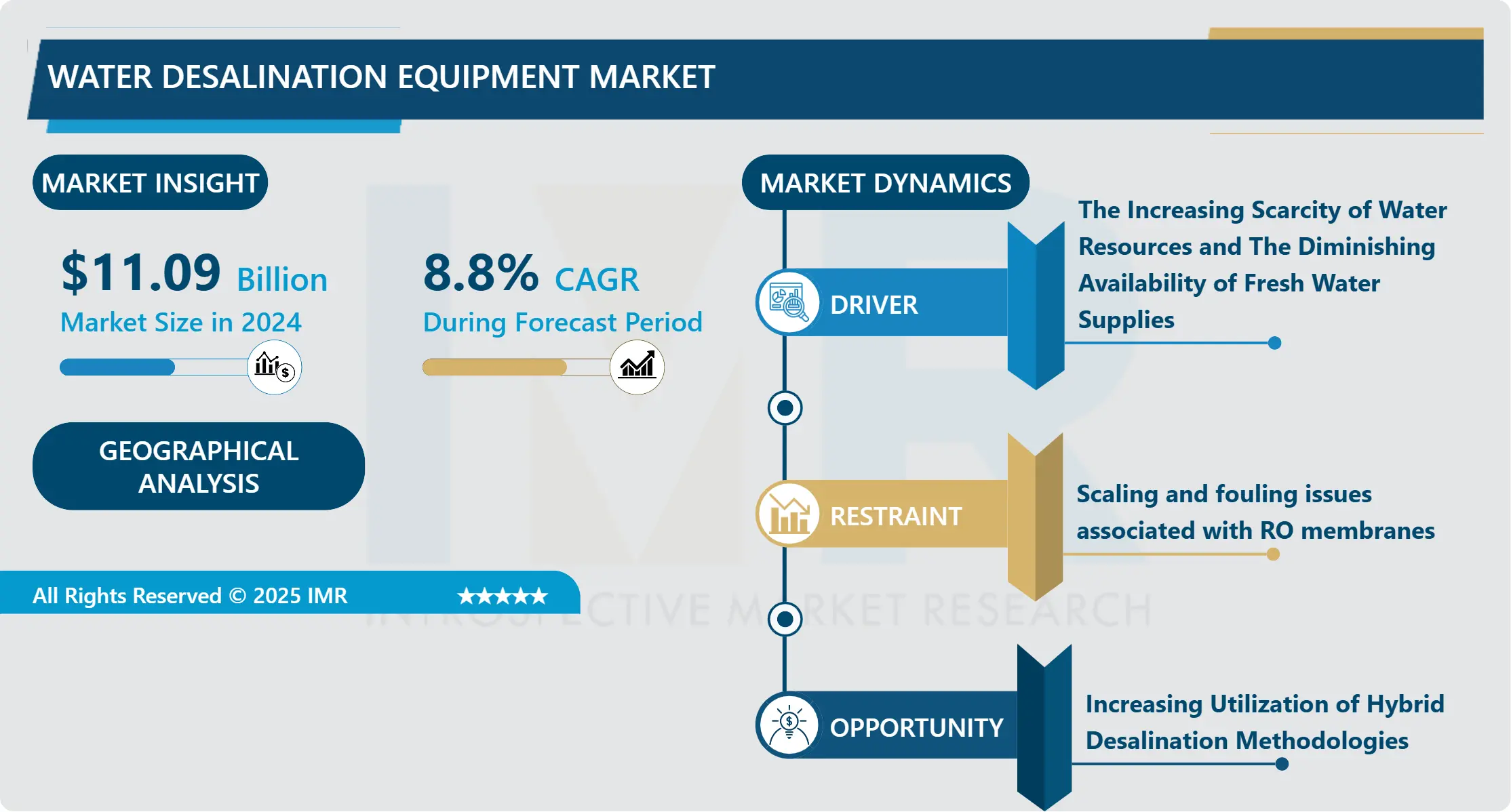
Water Desalination Equipment Market Size Was Valued at USD 11.09 Billion in 2024, and is Projected to Reach USD 21.77 Billion by 2032, Growing at a CAGR of 8.8% From 2025-2032.
The global water desalination equipment market has been experiencing steady growth, driven by factors such as increasing water scarcity, population growth, urbanization, and industrialization. Technological advancements, particularly in membrane-based technologies like reverse osmosis (RO) and electro-dialysis (ED), have enhanced efficiency and lowered costs, making desalination a viable solution for water supply. RO desalination systems dominate the market, catering to diverse end-user industries such as municipal, industrial, and agricultural sectors.
While the Middle East leads in demand, regions like North America, Asia Pacific, and parts of Europe are also witnessing significant growth. Key players such as Veolia Water Technologies, SUEZ Water Technologies & Solutions, and Doosan Heavy Industries & Construction are investing in research and development to improve technologies. With continued population growth, urbanization, and climate change-induced water scarcity, the future outlook for the water desalination equipment market remains promising, driven by ongoing advancements in technology and increased investments in water infrastructure.
The water desalination equipment market has witnessed substantial growth and evolution driven by increasing global water scarcity and the need for freshwater resources. Desalination, the process of removing salts and minerals from seawater or brackish water to obtain potable water, has gained traction as a viable solution to address water shortages, especially in regions facing arid climates or limited access to freshwater sources. The market encompasses various technologies like reverse osmosis, thermal distillation, and electrodialysis, among others, catering to diverse geographical and industrial needs.
In recent years, advancements in desalination technology, coupled with growing investments in research and development, have significantly improved efficiency, reduced energy consumption, and lowered operational costs. This progress has broadened the market’s scope, making desalination an increasingly feasible option for municipal, industrial, and agricultural water supply needs worldwide. Additionally, governmental initiatives promoting sustainable water management, along with increasing private sector participation, have further propelled the market’s expansion, fostering innovations and driving down the overall cost of desalination equipment.
Water Desalination Equipment Market Trend Analysis
The Increasing Scarcity of Water Resources and The Diminishing Availability of Fresh Water Supplies
The world is grappling with a concerning trend marked by the escalating scarcity of water resources. Across various regions, this scarcity is becoming more pronounced due to a combination of factors, including population growth, rapid urbanization, climate change, and inefficient water management practices. As a result, many areas are facing a critical shortage of freshwater, intensifying competition for this essential resource among communities, industries, and agricultural sectors. The strain on existing water sources is exacerbated by environmental stresses, such as prolonged droughts and the contamination of surface and groundwater, further reducing the availability of clean, potable water.
This mounting scarcity of water resources poses a significant threat to global sustainability and human well-being. It adversely impacts agriculture, which heavily relies on irrigation, affecting crop yields and food security. Industries face operational challenges as their processes often require substantial water usage, leading to potential disruptions and increased costs. Moreover, communities confront hardships in accessing safe drinking water, with marginalized populations disproportionately affected by this scarcity, leading to health concerns and social disparities.
Embracing water-efficient practices in agriculture, industry, and households is pivotal, as is the development and adoption of innovative technologies that facilitate water conservation and purification. Education and awareness campaigns play a crucial role in fostering a culture of responsible water stewardship, encouraging individuals and communities to value and preserve this finite resource. By taking proactive measures and fostering a collective commitment to water sustainability.
Increasing Utilization of Hybrid Desalination Methodologies
The use of hybrid desalination techniques marks a significant advancement in addressing water scarcity challenges. These methodologies combine various desalination processes, such as reverse osmosis, distillation, or electrodialysis, to optimize efficiency and output. By integrating multiple technologies, hybrid desalination systems can capitalize on the strengths of each method, mitigating their individual limitations. This approach not only enhances the overall effectiveness of the desalination process but also contributes to improved energy efficiency and cost-effectiveness, making these systems increasingly attractive for regions grappling with water shortages.
The appeal of hybrid desalination methodologies lies in their versatility and adaptability to diverse environmental conditions. They offer a more robust and flexible solution to obtain fresh water from different sources, including seawater and brackish water, while minimizing the environmental impact often associated with traditional desalination methods. Additionally, their modular design allows for scalability, enabling the adjustment of capacity according to varying water demand, making them suitable for both small-scale and large-scale applications.
The growing adoption of hybrid approaches represents a pivotal step towards sustainable water management. These systems not only strive to address the immediate water scarcity challenges but also align with broader sustainability goals by reducing energy consumption, optimizing resource utilization, and lessening the ecological footprint associated with freshwater production. Embracing and expanding the use of hybrid desalination methodologies heralds a promising path in ensuring reliable access to clean water in regions grappling with escalating water scarcity concerns.
Water Desalination Equipment Market Segment Analysis:
Water Desalination Equipment Market Segmented on the basis of Technology, Application and Product.
By Technology, Reverse Osmosis segment is expected to dominate the market during the forecast period
Reverse osmosis (RO) has emerged as a dominant force in the Water Desalination Equipment Market, revolutionizing the way we obtain freshwater from saline sources. This technology operates by using a semi-permeable membrane to remove ions, molecules, and larger particles from water, making it a highly effective method for desalination. Its popularity stems from its efficiency in producing high-quality drinking water and its adaptability to various scales of operation, from household units to large-scale industrial plants.
One key factor driving RO’s dominance is its cost-effectiveness compared to other desalination methods. As advancements in membrane technology continue, the energy requirements for the process have decreased, making RO an increasingly viable solution for regions facing water scarcity.
By Application, Municipal segment held the largest share In 2024
The municipal segment’s dominance in the Water Desalination Equipment Market stems from the critical role of providing clean, potable water to urban populations. As urbanization accelerates worldwide, municipal authorities face increasing challenges in meeting the growing demand for freshwater. Reverse osmosis technology has emerged as a game-changer in fulfilling this need for clean water in urban areas due to several key reasons.
Municipalities are often looking for sustainable and economically feasible solutions to provide clean water to their residents. The decreasing energy requirements and operational costs of RO systems have made them increasingly attractive for large-scale municipal applications.
Water Desalination Equipment Market Regional Insights:
Middle East & Africa is Expected to Dominate the Market Over the Forecast period
The Middle East and Africa region are expected to have the highest share in the Water Desalination Equipment Market owing to the humungous desalinating plants located in these regions. Countries such as Saudi Arabia, United Arab Emirates, Israel, and Kuwait majorly rely on seawater for their day-to-day water needs. The growing dryness and increasing population in these regions are propelling the growth of the Water Desalination Equipment Market. The absence of groundwater and the growing adoption of technological advancements to convert seawater into potable water is supporting the growth of the Water Desalination Equipment Market.
Saudi Arabia, renowned for its extensive use of desalination to meet its freshwater needs. The kingdom boasts one of the world’s largest desalination plants and continues to invest in cutting-edge technologies to improve efficiency and sustainability in water production. Its strategic location near the Arabian Gulf further emphasizes its significance in the global desalination landscape.
Water Desalination Equipment Market Top Key Players:
Suez Water Technologies & Solutions (US)
DuPont (US)
Separation Solutions (US)
Aqua-Chem (US)
Thomas Desalination (US)
Pure Aqua, Inc. (US)
Aquatech International LLC(US)
Veolia Water Technologies (France)
Degremont Sas(France)
Danfoss(Denmark)
DESMI A/S (Denmark)
Hatenboer (Netherlands)
Sulzer (Switzerland)
Alfa Laval (Sweden),
Wärtsilä (Finland)
ANDRITZ (Austria)
TOYOBO CO., LTD. (Japan)
Torishima Pump Mfg. Co., Ltd. (Japan)
Toray Industries, Inc. (Japan)
Rite Water (India)
Godrej (India)
LG Chem (Korea)
Advanced Watertek (UAE)
Metito (UAE)
Wetico (Saudi Arabia)
and Other Active Player
Key Industry Developments in the Water Desalination Equipment Market:
In October 2023, engineers at MIT introduced a cost-effective and portable desalination apparatus designed to assist regions facing water shortages in obtaining potable water. This device harnesses solar energy to convert seawater into drinking water.
In March 2023, the seawater desalination facility in Qingdao underwent assessments to ensure equipment safety and operational efficiency. Through the establishment of a significant seawater desalination hub and the integration of desalinated water into the city’s pipeline network, Qingdao successfully bolstered its water resources.
Chapter 1: Introduction
1.1 Scope and Coverage
Chapter 2:Executive Summary
Chapter 3: Market Landscape
3.1 Market Dynamics
3.1.1 Drivers
3.1.2 Restraints
3.1.3 Opportunities
3.1.4 Challenges
3.2 Market Trend Analysis
3.3 PESTLE Analysis
3.4 Porter’s Five Forces Analysis
3.5 Industry Value Chain Analysis
3.6 Ecosystem
3.7 Regulatory Landscape
3.8 Price Trend Analysis
3.9 Patent Analysis
3.10 Technology Evolution
3.11 Investment Pockets
3.12 Import-Export Analysis
Chapter 4: Water Desalination Equipment Market by Technology (2018-2032)
4.1 Water Desalination Equipment Market Snapshot and Growth Engine
4.2 Market Overview
4.3 Reverse Osmosis
4.3.1 Introduction and Market Overview
4.3.2 Historic and Forecasted Market Size in Value USD and Volume Units
4.3.3 Key Market Trends, Growth Factors, and Opportunities
4.3.4 Geographic Segmentation Analysis
4.4 Multi-stage flash Distillation
4.5 Multiple-effect distillation
Chapter 5: Water Desalination Equipment Market by Application (2018-2032)
5.1 Water Desalination Equipment Market Snapshot and Growth Engine
5.2 Market Overview
5.3 Municipal
5.3.1 Introduction and Market Overview
5.3.2 Historic and Forecasted Market Size in Value USD and Volume Units
5.3.3 Key Market Trends, Growth Factors, and Opportunities
5.3.4 Geographic Segmentation Analysis
5.4 Industrial
Chapter 6: Water Desalination Equipment Market by Product (2018-2032)
6.1 Water Desalination Equipment Market Snapshot and Growth Engine
6.2 Market Overview
6.3 Membranes
6.3.1 Introduction and Market Overview
6.3.2 Historic and Forecasted Market Size in Value USD and Volume Units
6.3.3 Key Market Trends, Growth Factors, and Opportunities
6.3.4 Geographic Segmentation Analysis
6.4 Pumps
6.5 Evaporators
Chapter 7: Company Profiles and Competitive Analysis
7.1 Competitive Landscape
7.1.1 Competitive Benchmarking
7.1.2 Water Desalination Equipment Market Share by Manufacturer (2024)
7.1.3 Industry BCG Matrix
7.1.4 Heat Map Analysis
7.1.5 Mergers and Acquisitions
7.2 BASF SE
7.2.1 Company Overview
7.2.2 Key Executives
7.2.3 Company Snapshot
7.2.4 Role of the Company in the Market
7.2.5 Sustainability and Social Responsibility
7.2.6 Operating Business Segments
7.2.7 Product Portfolio
7.2.8 Business Performance
7.2.9 Key Strategic Moves and Recent Developments
7.2.10 SWOT Analysis
7.3 JOHNSON MATTHEY
7.4 UMICORE
7.5 TENNECO INCCLARIANT
7.6 CATALER CORPORATION
7.7 HALDOR TOPSOE A/S
7.8 NETT TECHNOLOGIES INCCDTI ADVANCED MATERIALS INCCORMETECH INCDCL INTERNATIONAL INCHITACHI ZOSEN CORPORATION
7.9 CLEAN DIESEL TECHNOLOGIES INCNGK INSULATORS LTDHUG ENGINEERING AG
7.10 WALKER EMISSIONS CONTROL (TENNECO)
7.11 HALDOR TOPSOE A/S
7.12 HONEYWELL UOP
7.13 DINEX A/S
7.14 NISSAN CHEMICAL CORPORATION
Chapter 8: Global Water Desalination Equipment Market By Region
8.1 Overview
8.2. North America Water Desalination Equipment Market
8.2.1 Key Market Trends, Growth Factors and Opportunities
8.2.2 Top Key Companies
8.2.3 Historic and Forecasted Market Size by Segments
8.2.4 Historic and Forecasted Market Size by Technology
8.2.4.1 Reverse Osmosis
8.2.4.2 Multi-stage flash Distillation
8.2.4.3 Multiple-effect distillation
8.2.5 Historic and Forecasted Market Size by Application
8.2.5.1 Municipal
8.2.5.2 Industrial
8.2.6 Historic and Forecasted Market Size by Product
8.2.6.1 Membranes
8.2.6.2 Pumps
8.2.6.3 Evaporators
8.2.7 Historic and Forecast Market Size by Country
8.2.7.1 US
8.2.7.2 Canada
8.2.7.3 Mexico
8.3. Eastern Europe Water Desalination Equipment Market
8.3.1 Key Market Trends, Growth Factors and Opportunities
8.3.2 Top Key Companies
8.3.3 Historic and Forecasted Market Size by Segments
8.3.4 Historic and Forecasted Market Size by Technology
8.3.4.1 Reverse Osmosis
8.3.4.2 Multi-stage flash Distillation
8.3.4.3 Multiple-effect distillation
8.3.5 Historic and Forecasted Market Size by Application
8.3.5.1 Municipal
8.3.5.2 Industrial
8.3.6 Historic and Forecasted Market Size by Product
8.3.6.1 Membranes
8.3.6.2 Pumps
8.3.6.3 Evaporators
8.3.7 Historic and Forecast Market Size by Country
8.3.7.1 Russia
8.3.7.2 Bulgaria
8.3.7.3 The Czech Republic
8.3.7.4 Hungary
8.3.7.5 Poland
8.3.7.6 Romania
8.3.7.7 Rest of Eastern Europe
8.4. Western Europe Water Desalination Equipment Market
8.4.1 Key Market Trends, Growth Factors and Opportunities
8.4.2 Top Key Companies
8.4.3 Historic and Forecasted Market Size by Segments
8.4.4 Historic and Forecasted Market Size by Technology
8.4.4.1 Reverse Osmosis
8.4.4.2 Multi-stage flash Distillation
8.4.4.3 Multiple-effect distillation
8.4.5 Historic and Forecasted Market Size by Application
8.4.5.1 Municipal
8.4.5.2 Industrial
8.4.6 Historic and Forecasted Market Size by Product
8.4.6.1 Membranes
8.4.6.2 Pumps
8.4.6.3 Evaporators
8.4.7 Historic and Forecast Market Size by Country
8.4.7.1 Germany
8.4.7.2 UK
8.4.7.3 France
8.4.7.4 The Netherlands
8.4.7.5 Italy
8.4.7.6 Spain
8.4.7.7 Rest of Western Europe
8.5. Asia Pacific Water Desalination Equipment Market
8.5.1 Key Market Trends, Growth Factors and Opportunities
8.5.2 Top Key Companies
8.5.3 Historic and Forecasted Market Size by Segments
8.5.4 Historic and Forecasted Market Size by Technology
8.5.4.1 Reverse Osmosis
8.5.4.2 Multi-stage flash Distillation
8.5.4.3 Multiple-effect distillation
8.5.5 Historic and Forecasted Market Size by Application
8.5.5.1 Municipal
8.5.5.2 Industrial
8.5.6 Historic and Forecasted Market Size by Product
8.5.6.1 Membranes
8.5.6.2 Pumps
8.5.6.3 Evaporators
8.5.7 Historic and Forecast Market Size by Country
8.5.7.1 China
8.5.7.2 India
8.5.7.3 Japan
8.5.7.4 South Korea
8.5.7.5 Malaysia
8.5.7.6 Thailand
8.5.7.7 Vietnam
8.5.7.8 The Philippines
8.5.7.9 Australia
8.5.7.10 New Zealand
8.5.7.11 Rest of APAC
8.6. Middle East & Africa Water Desalination Equipment Market
8.6.1 Key Market Trends, Growth Factors and Opportunities
8.6.2 Top Key Companies
8.6.3 Historic and Forecasted Market Size by Segments
8.6.4 Historic and Forecasted Market Size by Technology
8.6.4.1 Reverse Osmosis
8.6.4.2 Multi-stage flash Distillation
8.6.4.3 Multiple-effect distillation
8.6.5 Historic and Forecasted Market Size by Application
8.6.5.1 Municipal
8.6.5.2 Industrial
8.6.6 Historic and Forecasted Market Size by Product
8.6.6.1 Membranes
8.6.6.2 Pumps
8.6.6.3 Evaporators
8.6.7 Historic and Forecast Market Size by Country
8.6.7.1 Turkiye
8.6.7.2 Bahrain
8.6.7.3 Kuwait
8.6.7.4 Saudi Arabia
8.6.7.5 Qatar
8.6.7.6 UAE
8.6.7.7 Israel
8.6.7.8 South Africa
8.7. South America Water Desalination Equipment Market
8.7.1 Key Market Trends, Growth Factors and Opportunities
8.7.2 Top Key Companies
8.7.3 Historic and Forecasted Market Size by Segments
8.7.4 Historic and Forecasted Market Size by Technology
8.7.4.1 Reverse Osmosis
8.7.4.2 Multi-stage flash Distillation
8.7.4.3 Multiple-effect distillation
8.7.5 Historic and Forecasted Market Size by Application
8.7.5.1 Municipal
8.7.5.2 Industrial
8.7.6 Historic and Forecasted Market Size by Product
8.7.6.1 Membranes
8.7.6.2 Pumps
8.7.6.3 Evaporators
8.7.7 Historic and Forecast Market Size by Country
8.7.7.1 Brazil
8.7.7.2 Argentina
8.7.7.3 Rest of SA
Chapter 9 Analyst Viewpoint and Conclusion
9.1 Recommendations and Concluding Analysis
9.2 Potential Market Strategies
Chapter 10 Research Methodology
10.1 Research Process
10.2 Primary Research
10.3 Secondary Research
Q1: What would be the forecast period in the Water Desalination Equipment Market research report?
A1: The forecast period in the Water Desalination Equipment Market research report is 2025-2032.
Q2: Who are the key players in the Water Desalination Equipment Market?
A2: Suez Water Technologies & Solutions, DuPont, Separation Solutions, Aqua-Chem, Thomas Desalination, Pure Aqua, Inc., Aquatech International LLC, Veolia Water Technologies, Degremont Sas, Danfoss, DESMI A/S, Hatenboer, Sulzer, Alfa Laval, Wärtsilä, ANDRITZ, TOYOBO CO., LTD., Torishima Pump Mfg. Co., Ltd., Toray Industries, Inc., Rite Water, Godrej, LG Chem, Advanced Watertek, Metito, Wetico and Other Active Players.
Q3: What are the segments of the Water Desalination Equipment Market?
A3: The Water Desalination Equipment Market is segmented into Technology, Application Product, and region. By Technology, the market is categorized into Reverse Osmosis, Multi-stage flash Distillation, Multiple-effect distillation. By Application, the market is categorized into Municipal, Industrial. By Product, the market is categorized into Membranes, Pumps, Evaporators. By region, it is analyzed across North America (U.S.; Canada; Mexico), Eastern Europe (Bulgaria; The Czech Republic; Hungary; Poland; Romania; Rest of Eastern Europe), Western Europe (Germany; UK; France; Netherlands; Italy; Russia; Spain; Rest of Western Europe), Asia-Pacific (China; India; Japan; Southeast Asia, etc.), South America (Brazil; Argentina, etc.), Middle East & Africa (Saudi Arabia; South Africa, etc.).
Q4: What is the Water Desalination Equipment Market?
A4: Water desalination equipment refers to a range of machinery and technologies designed to remove salt and other impurities from seawater or brackish water, making it suitable for consumption or various industrial applications. These systems typically employ processes such as reverse osmosis, distillation, or electrodialysis to separate salts and minerals from the water, producing freshwater as an output.
Q5: How big is the Water Desalination Equipment Market?
A5: Water Desalination Equipment Market Size Was Valued at USD 11.09 Billion in 2024, and is Projected to Reach USD 21.77 Billion by 2032, Growing at a CAGR of 8.8% From 2025-2032.
How to Buy a Report from eminsights.jp
On the product page, choose the license you want: Single-User License, Multi-User License or Enterprise License.
If you required report in your native language, then you can click on Translated Report button and fill out the form with report name and language you want, then our team will contact you as soon as possible.
Click the Buy Now button.
You will be redirected to the checkout page. Enter your company details and payment information.
Click Place Order to complete the purchase.
Confirmation: You’ll receive an order confirmation and our team will contact you shortly with your ordered report.
If you have any questions, fill out the contact form below or email us at bizdev@eminsights.net.
Thank you for choosing eminsights.jp!