Stay Ahead in Fast-Growing Economies.
Browse Reports Now
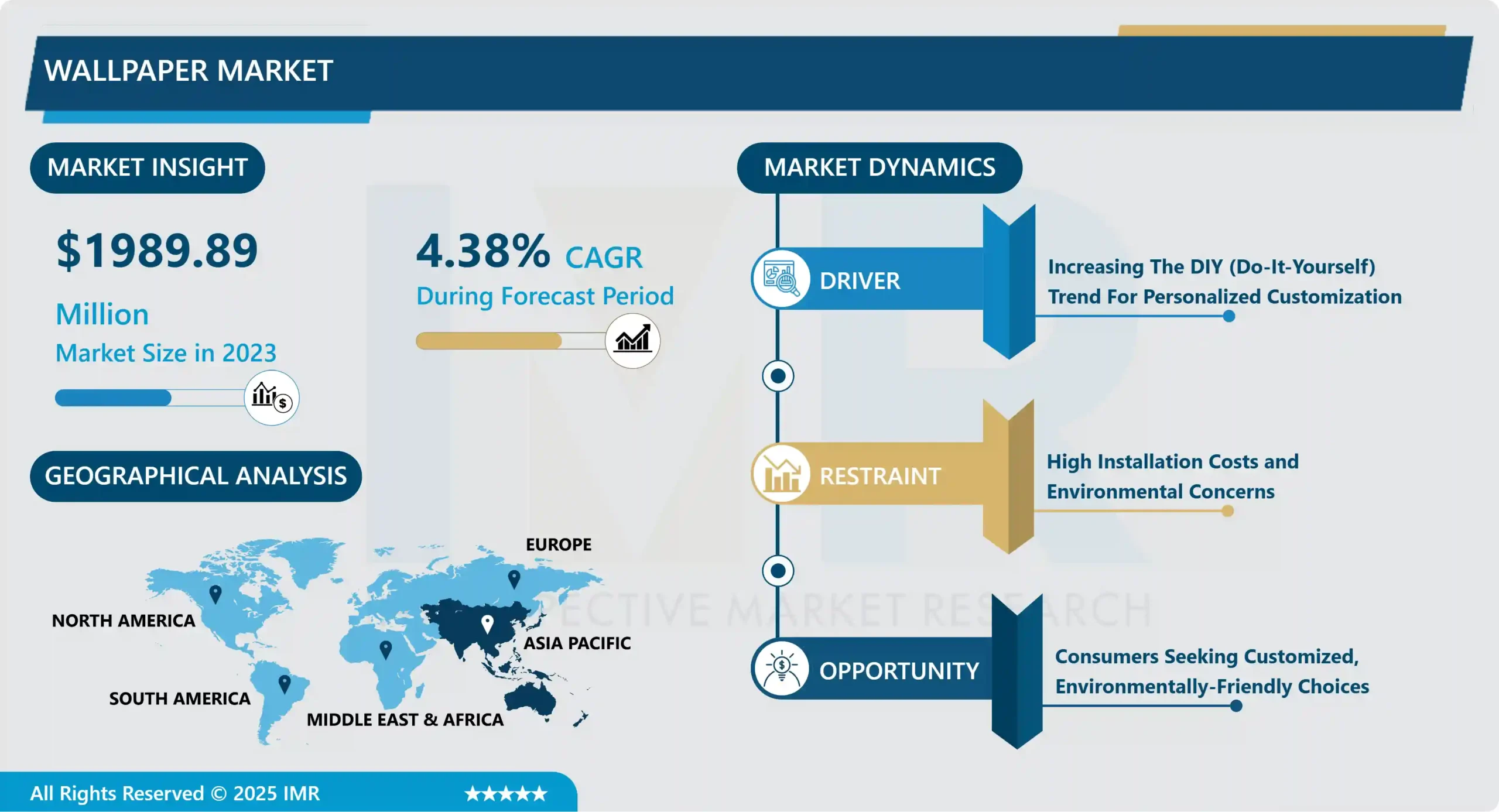
Wallpaper Market – Overview and Outlook by Potential Growth 2024- 2032
Wallpaper Market Size Was Valued at USD 1989.89 Million in 2023, and is Projected to Reach USD 2926.74 Million by 2032, Growing at a CAGR of 4.38% From 2024-2032.

IMR Group
Description
Wallpaper Market Synopsis
Wallpaper Market Size Was Valued at USD 1989.89 Million in 2023, and is Projected to Reach USD 2926.74 Million by 2032, Growing at a CAGR of 4.38% From 2024-2032.
Wallpaper is a material used in interior decoration to decorate the interior walls of domestic and public buildings. It is usually sold in rolls and is applied onto a wall using wallpaper paste. Wallpapers can come plain as “lining paper” (so that it can be painted or used to help cover uneven surfaces and minor wall defects thus giving a better surface), textured (such as Anaglypta), with a regular repeating pattern design, or, much less commonly today, with a single non-repeating large design carried over a set of sheets.
The smallest rectangle that can be tiled to form the whole pattern is known as the pattern repeat. Wallpaper printing techniques include surface printing, gravure printing, silk screen-printing, rotary printing, and digital printing. Wallpaper is made in long rolls which are hung vertically on a wall. Patterned wallpapers are designed so that the pattern “repeats”, and thus pieces cut from the same roll can be hung next to each other so as to continue the pattern without it being easy to see where the join between two pieces occurs. In the case of large complex patterns of images this is normally achieved by starting the second piece halfway into the length of the repeat, so that if the pattern going down the roll repeats after 24 inches, the next piece sideways is cut from the roll to begin 12 inches down the pattern from the first. The number of times the pattern repeats horizontally across a roll does not matter for this purpose. A single pattern can be issued in several different colorway.
Wallpaper Market Trend Analysis
Increasing The DIY (Do-It-Yourself) Trend For Personalized Customization
More and more homeowners are embracing the DIY (Do-It-Yourself) trend in home improvement and decoration as a way to save money by completing the projects on their own. DIY fans appreciate having creative authority in projects for customization. The feeling of achievement derives from finishing DIY tasks. Online tutorials and resources simplify the process of learning and engaging in home improvement tasks. DIY enables personalized customization for one-of-a-kind decorations.
3D wallpaper has become trendy for adding depth and dimension to walls, creating a visually appealing space. Several important factors to consider for the same. Enhances walls with depth and texture, creating a more dynamic atmosphere in rooms. Offered in a variety of designs to cater to a wide range of preferences and fashion choices. Top-notch and sturdy materials are utilized for lasting outcomes. Appropriate for homes and businesses, can enhance walls or completely change the look of a room.
3D peel-and-stick wallpapers are a design element that can easily transform a room’s appearance with minimal effort, making them perfect for temporary changes and appropriate for those who rent their living space. These wallpapers provide flexibility and simple updates with minimal investment or time, revolutionizing the home decor industry. The rise of DIY projects and the trend of 3D designs are offering consumers affordable and innovative ways to customize their living spaces, attracting a diverse group of customers including both renters and homeowners looking for easy and stylish decor choices.
Consumers Seeking Customized, Environmentally-Friendly Choices.
The wallpaper market is influenced by economic, social, technological, and environmental factors which drive consumer demand and industry dynamics. The increase in demand for wallpapers in the home renovation and interior decoration sector is driven by a growing desire for personalized and aesthetically pleasing home interiors, as well as by higher disposable incomes and the preference for modern living spaces. Advancements in digital printing technology produce top-notch, personalized designs for manufacturers to cater to various consumer tastes. Modern interiors appeal to tech-savvy consumers thanks to smart wallpapers featuring LED integration.
Increasing environmental consciousness is pushing customers to seek sustainable wallpapers manufactured from recycled paper, natural materials, and safe inks. Government rules and standards encourage manufacturers to adopt environmentally-friendly practices. Fast urban growth leads to increased need for interior decor items such as wallpapers, fueled by the desire for modern living spaces in developing nations experiencing modernization and urban expansion.
Developing economies see a rise in expendable incomes, resulting in an uptick in consumer expenditure on high-end wallpaper items for home renovations. Health-conscious individuals favor non-toxic wallpapers without harmful chemicals and VOCs for healthier living spaces. Moreover, wallpapers containing antibacterial and antifungal elements address worries about cleanliness and protection, particularly in areas that are humid or experience heavy foot traffic.
Wallpaper Market Segment Analysis:
Wallpaper Market Segmented on the basis of Material, Design, Application, Finish, Printing Technique, And Colorway.
By Material Type, Vinyl Segment Is Expected to Dominate the Market During the Forecast Period
Vinyl wallpaper is a top-selling product internationally, capturing a large portion of the market thanks to its distinct features and benefits. It is very sturdy and appropriate for places that have a lot of foot traffic such as schools, hospitals, and commercial areas. Vinyl wallpaper is durable, easy to clean, and retains its good looks. Its ability to withstand impacts makes it perfect for high-traffic areas. Vinyl wallpapers are simple to care for due to easy cleaning and stain resistance. They are able to be cleaned with a damp cloth or gentle detergent, which makes them appropriate for healthcare facilities. If there is damage like tears or scratches, vinyl wallpapers can be easily repaired without having to replace the whole section, saving on maintenance costs and making them last longer.
Vinyl wallpapers are commonly chosen for public buildings because of their ability to resist fires. They are available in a variety of styles, textures, and coatings to accommodate different interior design preferences. Peel-and-stick options are in high demand for their simple application and removal, particularly among those who enjoy do-it-yourself projects and individuals who are renting their living spaces. Nonetheless, conventional vinyl wallpapers might include VOCs, prompting the emergence of eco-friendly alternatives with lower VOC levels to tackle environmental worries. In general, vinyl wallpapers offer a combination of safety, flexibility in design, and versatility in application that caters to various spaces and individuals.
The rising popularity of vinyl wallpapers can be attributed to their practical advantages and aesthetic flexibility. Progress in printing technology is improving design options, resulting in more complex patterns and textures. Putting emphasis on safety and environmental regulations will encourage the creation of more secure and eco-friendly alternatives. Manufacturers are broadening their product offerings to cater to a variety of consumer demands. Vinyl wallpapers are popular in the market due to their long-lasting nature, simple upkeep, fire resistance, and wide variety of design choices, making them perfect for challenging spaces.
By Application, Residential Segment Held the Largest Share In 2023
Wallpaper is a flexible and commonly chosen option in home construction, providing a range of uses from building new homes to renovating apartments. It increases the visual attractiveness of houses and condos, enabling customization with different styles, hues, and textures. Wallpaper is utilized in renovation projects to refresh interior design affordably and without significant structural modifications, converting out-of-date rooms into contemporary areas. In old houses, wallpaper helps maintain traditional patterns and aids in safeguarding architectural legacy. In general, wallpaper is a convenient and adaptable choice for improving the look of homes in both new builds and remodeling jobs.
In homes, wallpaper provides useful advantages including sound insulation, thermal insulation, moisture resistance, durability, and versatile design options. Some kinds of wallpaper are able to soak up sound waves and lower noise levels, improving acoustic comfort in bedrooms, home offices, and living spaces. Wallpaper that has thermal insulation attributes can help control indoor temperatures, resulting in energy efficiency and enhanced comfort. Waterproof wallpaper is ideal for damp places such as bathrooms and kitchens, stopping mold development and preserving the structure of walls. Durable and easy-to-clean wallpapers, like vinyl-based ones, are perfect for busy homes due to their high quality. Moreover, wallpaper offers countless design options, enabling individuals to customize their living areas with distinct patterns, colors, and designs.
Current trends in the wallpaper industry show an increase in popularity of environmentally friendly choices and the incorporation of technology for personalized designs. The DIY market is expanding as peel-and-stick wallpapers gain popularity among homeowners wanting effortless application and removal. Wallpaper is popular for its aesthetic flexibility, insulation advantages, and ease of maintenance, making it a favored option for enhancing indoor areas. Future developments will concentrate on advancements in sustainable materials, personalization, and technology to cater to the demands of customers.
Wallpaper Market Regional Insights:
Asia Pacific is Expected to Dominate the Market Over the Forecast Period
The global wallpaper market is mainly controlled by the Asia-Pacific region because of factors such as its role as a manufacturing center with production capabilities in countries like China, India, and South Korea, cost-effectiveness, fast urbanization, and a surge in construction projects. These elements play a role in the competitiveness of Asia-Pacific in providing affordable wallpaper products for both local and global markets, as well as in meeting the growing need for interior design in various sectors through construction driven by urban growth.
Rising incomes in China, India, and Southeast Asia have boosted the middle class, resulting in greater expenditures on home decor such as wallpapers. Consumers are impacted by worldwide design trends and look for customized living environments. Manufacturers in the Asia-Pacific region create wallpaper designs based on the diverse cultural preferences of the region. Local innovation responds to market needs, like humidity-resistant wallpapers for tropical regions and designs showcasing cultural heritage.
The rapid growth of e-commerce platforms in Asia-Pacific is helping to expand distribution channels and retail infrastructure, making a variety of wallpaper products more accessible to consumers in both urban and rural areas. Well-developed retail systems and distribution channels guarantee that wallpapers are easily accessible in many locations, helping to expand market presence and reach more consumers. Government policies and trade agreements encourage the expansion of the manufacturing sector and the global trading of wallpaper products. Industry groups work together to improve knowledge sharing, develop standards, and increase market competitiveness in the area.
Manufacturers are able to create personalized wallpapers of excellent quality to cater to a wide range of consumer tastes thanks to technological advancements in digital printing. Sustainability efforts meet customer desire for environmentally friendly items, as investments in infrastructure drive the need for interior design solutions. The rise of urbanization and economic growth in Asia-Pacific is anticipated to drive up the need for cutting-edge wallpapers, creating potential for industry players from both domestic and international markets. Continued focus on technology, sustainability, and market expansion will strengthen Asia-Pacific’s role as a leading global player in the wallpaper market.
Wallpaper Market Active Players
York Wallpapers (USA)
Lilycolor Co Ltd (Japan)
Marburg (Germany)
Shin Han Wall Covering (South Korea)
Tapetenfabrik Gebr (Germany)
Rasch GmbH & Co. KG (Germany)
Sanderson Design Group (UK)
Peggy-Betty Designs (Country not specified)
Walker Greenbank Group (UK)
AS Creation (Germany)
Asian Paints Ltd (India)
Sangetsu Corporation (Japan)
Brewster Wallpaper Corporation (USA)
F. Schumacher & Co. (USA)
AS Creation Tapeten AG (Germany)
Osborne & Little (UK)
The Romo Group (UK)
Grandeco (Belgium)
4walls (USA)
Marshalls Wallcoverings (India)
Excel Wallcoverings (India)
ATCO Interiors Private Limited (India)
Ultra Walls (Sonu Art) (India)
Cole & Son (UK)
Chapter 1: Introduction
1.1 Scope and Coverage
Chapter 2:Executive Summary
Chapter 3: Market Landscape
3.1 Market Dynamics
3.1.1 Drivers
3.1.2 Restraints
3.1.3 Opportunities
3.1.4 Challenges
3.2 Market Trend Analysis
3.3 PESTLE Analysis
3.4 Porter’s Five Forces Analysis
3.5 Industry Value Chain Analysis
3.6 Ecosystem
3.7 Regulatory Landscape
3.8 Price Trend Analysis
3.9 Patent Analysis
3.10 Technology Evolution
3.11 Investment Pockets
3.12 Import-Export Analysis
Chapter 4: Wallpaper Market by Material (2018-2032)
4.1 Wallpaper Market Snapshot and Growth Engine
4.2 Market Overview
4.3 Paper
4.3.1 Introduction and Market Overview
4.3.2 Historic and Forecasted Market Size in Value USD and Volume Units
4.3.3 Key Market Trends, Growth Factors, and Opportunities
4.3.4 Geographic Segmentation Analysis
4.4 Vinyl
4.5 Fabric
4.6 Non-woven
4.7 Fiberglass
4.8 Metallic
Chapter 5: Wallpaper Market by Design (2018-2032)
5.1 Wallpaper Market Snapshot and Growth Engine
5.2 Market Overview
5.3 Plain/Lining
5.3.1 Introduction and Market Overview
5.3.2 Historic and Forecasted Market Size in Value USD and Volume Units
5.3.3 Key Market Trends, Growth Factors, and Opportunities
5.3.4 Geographic Segmentation Analysis
5.4 Textured
5.5 Patterned
5.6 Mural/Panoramic
5.7 3D Wallpaper
Chapter 6: Wallpaper Market by Application (2018-2032)
6.1 Wallpaper Market Snapshot and Growth Engine
6.2 Market Overview
6.3 Residential
6.3.1 Introduction and Market Overview
6.3.2 Historic and Forecasted Market Size in Value USD and Volume Units
6.3.3 Key Market Trends, Growth Factors, and Opportunities
6.3.4 Geographic Segmentation Analysis
6.4 Commercial
Chapter 7: Wallpaper Market by Finish (2018-2032)
7.1 Wallpaper Market Snapshot and Growth Engine
7.2 Market Overview
7.3 Matte
7.3.1 Introduction and Market Overview
7.3.2 Historic and Forecasted Market Size in Value USD and Volume Units
7.3.3 Key Market Trends, Growth Factors, and Opportunities
7.3.4 Geographic Segmentation Analysis
7.4 Glossy
7.5 Satin/Silk
7.6 Embossed
7.7 Metallic
Chapter 8: Wallpaper Market by Printing Technique (2018-2032)
8.1 Wallpaper Market Snapshot and Growth Engine
8.2 Market Overview
8.3 Surface Printing
8.3.1 Introduction and Market Overview
8.3.2 Historic and Forecasted Market Size in Value USD and Volume Units
8.3.3 Key Market Trends, Growth Factors, and Opportunities
8.3.4 Geographic Segmentation Analysis
8.4 Gravure Printing
8.5 Screen Printing
8.6 Rotary Printing
8.7 Digital Printing
Chapter 9: Wallpaper Market by Colorway (2018-2032)
9.1 Wallpaper Market Snapshot and Growth Engine
9.2 Market Overview
9.3 Monochromatic
9.3.1 Introduction and Market Overview
9.3.2 Historic and Forecasted Market Size in Value USD and Volume Units
9.3.3 Key Market Trends, Growth Factors, and Opportunities
9.3.4 Geographic Segmentation Analysis
9.4 Multicoloured
Chapter 10: Company Profiles and Competitive Analysis
10.1 Competitive Landscape
10.1.1 Competitive Benchmarking
10.1.2 Wallpaper Market Share by Manufacturer (2024)
10.1.3 Industry BCG Matrix
10.1.4 Heat Map Analysis
10.1.5 Mergers and Acquisitions
10.2 YORK WALLPAPERS (USA)
10.2.1 Company Overview
10.2.2 Key Executives
10.2.3 Company Snapshot
10.2.4 Role of the Company in the Market
10.2.5 Sustainability and Social Responsibility
10.2.6 Operating Business Segments
10.2.7 Product Portfolio
10.2.8 Business Performance
10.2.9 Key Strategic Moves and Recent Developments
10.2.10 SWOT Analysis
10.3 LILYCOLOR CO LTD (JAPAN)
10.4 MARBURG (GERMANY)
10.5 SHIN HAN WALL COVERING (SOUTH KOREA)
10.6 TAPETENFABRIK GEBR (GERMANY)
10.7 RASCH GMBH & CO. KG (GERMANY)
10.8 SANDERSON DESIGN GROUP (UK)
10.9 PEGGY-BETTY DESIGNS (COUNTRY NOT SPECIFIED)
10.10 WALKER GREENBANK GROUP (UK)
10.11 AS CREATION (GERMANY)
10.12 ASIAN PAINTS LTD (INDIA)
10.13 SANGETSU CORPORATION (JAPAN)
10.14 BREWSTER WALLPAPER CORPORATION (USA)
10.15 F. SCHUMACHER & CO. (USA)
10.16 AS CREATION TAPETEN AG (GERMANY)
10.17 OSBORNE & LITTLE (UK)
10.18 THE ROMO GROUP (UK)
10.19 GRANDECO (BELGIUM)
10.20 4WALLS (USA)
10.21 MARSHALLS WALLCOVERINGS (INDIA)
10.22 EXCEL WALLCOVERINGS (INDIA)
10.23 ATCO INTERIORS PRIVATE LIMITED (INDIA)
10.24 ULTRA WALLS (SONU ART) (INDIA)
10.25 COLE & SON (UK)
10.26 VERSACE HOME (ITALY)
10.27 EIJFFINGER (NETHERLANDS)
10.28 GRAHAM & BROWN (UK)
10.29 ANAGLYPTA (UK)
10.30 THIBAUT (USA)
10.31 ARTE (BELGIUM)
10.32 DESIGNER WALLCOVERINGS (USA)
10.33 BN WALLCOVERINGS (NETHERLANDS)
10.34 CASADECO (FRANCE)
Chapter 11: Global Wallpaper Market By Region
11.1 Overview
11.2. North America Wallpaper Market
11.2.1 Key Market Trends, Growth Factors and Opportunities
11.2.2 Top Key Companies
11.2.3 Historic and Forecasted Market Size by Segments
11.2.4 Historic and Forecasted Market Size by Material
11.2.4.1 Paper
11.2.4.2 Vinyl
11.2.4.3 Fabric
11.2.4.4 Non-woven
11.2.4.5 Fiberglass
11.2.4.6 Metallic
11.2.5 Historic and Forecasted Market Size by Design
11.2.5.1 Plain/Lining
11.2.5.2 Textured
11.2.5.3 Patterned
11.2.5.4 Mural/Panoramic
11.2.5.5 3D Wallpaper
11.2.6 Historic and Forecasted Market Size by Application
11.2.6.1 Residential
11.2.6.2 Commercial
11.2.7 Historic and Forecasted Market Size by Finish
11.2.7.1 Matte
11.2.7.2 Glossy
11.2.7.3 Satin/Silk
11.2.7.4 Embossed
11.2.7.5 Metallic
11.2.8 Historic and Forecasted Market Size by Printing Technique
11.2.8.1 Surface Printing
11.2.8.2 Gravure Printing
11.2.8.3 Screen Printing
11.2.8.4 Rotary Printing
11.2.8.5 Digital Printing
11.2.9 Historic and Forecasted Market Size by Colorway
11.2.9.1 Monochromatic
11.2.9.2 Multicoloured
11.2.10 Historic and Forecast Market Size by Country
11.2.10.1 US
11.2.10.2 Canada
11.2.10.3 Mexico
11.3. Eastern Europe Wallpaper Market
11.3.1 Key Market Trends, Growth Factors and Opportunities
11.3.2 Top Key Companies
11.3.3 Historic and Forecasted Market Size by Segments
11.3.4 Historic and Forecasted Market Size by Material
11.3.4.1 Paper
11.3.4.2 Vinyl
11.3.4.3 Fabric
11.3.4.4 Non-woven
11.3.4.5 Fiberglass
11.3.4.6 Metallic
11.3.5 Historic and Forecasted Market Size by Design
11.3.5.1 Plain/Lining
11.3.5.2 Textured
11.3.5.3 Patterned
11.3.5.4 Mural/Panoramic
11.3.5.5 3D Wallpaper
11.3.6 Historic and Forecasted Market Size by Application
11.3.6.1 Residential
11.3.6.2 Commercial
11.3.7 Historic and Forecasted Market Size by Finish
11.3.7.1 Matte
11.3.7.2 Glossy
11.3.7.3 Satin/Silk
11.3.7.4 Embossed
11.3.7.5 Metallic
11.3.8 Historic and Forecasted Market Size by Printing Technique
11.3.8.1 Surface Printing
11.3.8.2 Gravure Printing
11.3.8.3 Screen Printing
11.3.8.4 Rotary Printing
11.3.8.5 Digital Printing
11.3.9 Historic and Forecasted Market Size by Colorway
11.3.9.1 Monochromatic
11.3.9.2 Multicoloured
11.3.10 Historic and Forecast Market Size by Country
11.3.10.1 Russia
11.3.10.2 Bulgaria
11.3.10.3 The Czech Republic
11.3.10.4 Hungary
11.3.10.5 Poland
11.3.10.6 Romania
11.3.10.7 Rest of Eastern Europe
11.4. Western Europe Wallpaper Market
11.4.1 Key Market Trends, Growth Factors and Opportunities
11.4.2 Top Key Companies
11.4.3 Historic and Forecasted Market Size by Segments
11.4.4 Historic and Forecasted Market Size by Material
11.4.4.1 Paper
11.4.4.2 Vinyl
11.4.4.3 Fabric
11.4.4.4 Non-woven
11.4.4.5 Fiberglass
11.4.4.6 Metallic
11.4.5 Historic and Forecasted Market Size by Design
11.4.5.1 Plain/Lining
11.4.5.2 Textured
11.4.5.3 Patterned
11.4.5.4 Mural/Panoramic
11.4.5.5 3D Wallpaper
11.4.6 Historic and Forecasted Market Size by Application
11.4.6.1 Residential
11.4.6.2 Commercial
11.4.7 Historic and Forecasted Market Size by Finish
11.4.7.1 Matte
11.4.7.2 Glossy
11.4.7.3 Satin/Silk
11.4.7.4 Embossed
11.4.7.5 Metallic
11.4.8 Historic and Forecasted Market Size by Printing Technique
11.4.8.1 Surface Printing
11.4.8.2 Gravure Printing
11.4.8.3 Screen Printing
11.4.8.4 Rotary Printing
11.4.8.5 Digital Printing
11.4.9 Historic and Forecasted Market Size by Colorway
11.4.9.1 Monochromatic
11.4.9.2 Multicoloured
11.4.10 Historic and Forecast Market Size by Country
11.4.10.1 Germany
11.4.10.2 UK
11.4.10.3 France
11.4.10.4 The Netherlands
11.4.10.5 Italy
11.4.10.6 Spain
11.4.10.7 Rest of Western Europe
11.5. Asia Pacific Wallpaper Market
11.5.1 Key Market Trends, Growth Factors and Opportunities
11.5.2 Top Key Companies
11.5.3 Historic and Forecasted Market Size by Segments
11.5.4 Historic and Forecasted Market Size by Material
11.5.4.1 Paper
11.5.4.2 Vinyl
11.5.4.3 Fabric
11.5.4.4 Non-woven
11.5.4.5 Fiberglass
11.5.4.6 Metallic
11.5.5 Historic and Forecasted Market Size by Design
11.5.5.1 Plain/Lining
11.5.5.2 Textured
11.5.5.3 Patterned
11.5.5.4 Mural/Panoramic
11.5.5.5 3D Wallpaper
11.5.6 Historic and Forecasted Market Size by Application
11.5.6.1 Residential
11.5.6.2 Commercial
11.5.7 Historic and Forecasted Market Size by Finish
11.5.7.1 Matte
11.5.7.2 Glossy
11.5.7.3 Satin/Silk
11.5.7.4 Embossed
11.5.7.5 Metallic
11.5.8 Historic and Forecasted Market Size by Printing Technique
11.5.8.1 Surface Printing
11.5.8.2 Gravure Printing
11.5.8.3 Screen Printing
11.5.8.4 Rotary Printing
11.5.8.5 Digital Printing
11.5.9 Historic and Forecasted Market Size by Colorway
11.5.9.1 Monochromatic
11.5.9.2 Multicoloured
11.5.10 Historic and Forecast Market Size by Country
11.5.10.1 China
11.5.10.2 India
11.5.10.3 Japan
11.5.10.4 South Korea
11.5.10.5 Malaysia
11.5.10.6 Thailand
11.5.10.7 Vietnam
11.5.10.8 The Philippines
11.5.10.9 Australia
11.5.10.10 New Zealand
11.5.10.11 Rest of APAC
11.6. Middle East & Africa Wallpaper Market
11.6.1 Key Market Trends, Growth Factors and Opportunities
11.6.2 Top Key Companies
11.6.3 Historic and Forecasted Market Size by Segments
11.6.4 Historic and Forecasted Market Size by Material
11.6.4.1 Paper
11.6.4.2 Vinyl
11.6.4.3 Fabric
11.6.4.4 Non-woven
11.6.4.5 Fiberglass
11.6.4.6 Metallic
11.6.5 Historic and Forecasted Market Size by Design
11.6.5.1 Plain/Lining
11.6.5.2 Textured
11.6.5.3 Patterned
11.6.5.4 Mural/Panoramic
11.6.5.5 3D Wallpaper
11.6.6 Historic and Forecasted Market Size by Application
11.6.6.1 Residential
11.6.6.2 Commercial
11.6.7 Historic and Forecasted Market Size by Finish
11.6.7.1 Matte
11.6.7.2 Glossy
11.6.7.3 Satin/Silk
11.6.7.4 Embossed
11.6.7.5 Metallic
11.6.8 Historic and Forecasted Market Size by Printing Technique
11.6.8.1 Surface Printing
11.6.8.2 Gravure Printing
11.6.8.3 Screen Printing
11.6.8.4 Rotary Printing
11.6.8.5 Digital Printing
11.6.9 Historic and Forecasted Market Size by Colorway
11.6.9.1 Monochromatic
11.6.9.2 Multicoloured
11.6.10 Historic and Forecast Market Size by Country
11.6.10.1 Turkiye
11.6.10.2 Bahrain
11.6.10.3 Kuwait
11.6.10.4 Saudi Arabia
11.6.10.5 Qatar
11.6.10.6 UAE
11.6.10.7 Israel
11.6.10.8 South Africa
11.7. South America Wallpaper Market
11.7.1 Key Market Trends, Growth Factors and Opportunities
11.7.2 Top Key Companies
11.7.3 Historic and Forecasted Market Size by Segments
11.7.4 Historic and Forecasted Market Size by Material
11.7.4.1 Paper
11.7.4.2 Vinyl
11.7.4.3 Fabric
11.7.4.4 Non-woven
11.7.4.5 Fiberglass
11.7.4.6 Metallic
11.7.5 Historic and Forecasted Market Size by Design
11.7.5.1 Plain/Lining
11.7.5.2 Textured
11.7.5.3 Patterned
11.7.5.4 Mural/Panoramic
11.7.5.5 3D Wallpaper
11.7.6 Historic and Forecasted Market Size by Application
11.7.6.1 Residential
11.7.6.2 Commercial
11.7.7 Historic and Forecasted Market Size by Finish
11.7.7.1 Matte
11.7.7.2 Glossy
11.7.7.3 Satin/Silk
11.7.7.4 Embossed
11.7.7.5 Metallic
11.7.8 Historic and Forecasted Market Size by Printing Technique
11.7.8.1 Surface Printing
11.7.8.2 Gravure Printing
11.7.8.3 Screen Printing
11.7.8.4 Rotary Printing
11.7.8.5 Digital Printing
11.7.9 Historic and Forecasted Market Size by Colorway
11.7.9.1 Monochromatic
11.7.9.2 Multicoloured
11.7.10 Historic and Forecast Market Size by Country
11.7.10.1 Brazil
11.7.10.2 Argentina
11.7.10.3 Rest of SA
Chapter 12 Analyst Viewpoint and Conclusion
12.1 Recommendations and Concluding Analysis
12.2 Potential Market Strategies
Chapter 13 Research Methodology
13.1 Research Process
13.2 Primary Research
13.3 Secondary Research
Q1: What would be the forecast period in the Wallpaper Market research report?
A1: The forecast period in the Wallpaper Market research report is 2024-2032.
Q2: Who are the key players in the Wallpaper Market?
A2: York Wallpapers (USA), Lilycolor Co Ltd (Japan), Marburg (Germany), Shin Han Wall Covering (South Korea), Tapetenfabrik Gebr (Germany), Rasch GmbH & Co. KG (Germany), Sanderson Design Group (UK), Peggy-Betty Designs (Country not specified), Walker Greenbank Group (UK), AS Creation (Germany), Asian Paints Ltd (India), Sangetsu Corporation (Japan), Brewster Wallpaper Corporation (USA), F. Schumacher & Co. (USA), AS Creation Tapeten AG (Germany), Osborne & Little (UK), The Romo Group (UK), Grandeco (Belgium), 4walls (USA), Marshalls Wallcoverings (India), Excel Wallcoverings (India), ATCO Interiors Private Limited (India), Ultra Walls (Sonu Art) (India), Cole & Son (UK), Versace Home (Italy), Eijffinger (Netherlands), Graham & Brown (UK), Anaglypta (UK), Thibaut (USA), Arte (Belgium), Designer Wallcoverings (USA), BN Wallcoverings (Netherlands), Casadeco (France) and Other Active Players.
Q3: What are the segments of the Wallpaper Market?
A3: The Wallpaper Market is segmented into Material, Design, Application, Finish, Printing Technique, Colorway, and region. By Material, the market is categorized into Paper, Vinyl, Fabric, Non-woven, Fiberglass, And Metallic. By Design, the market is categorized into Plain/Lining, Textured, Patterned, Mural/Panoramic, 3D Wallpaper. By Application, the market is categorized into Residential, Commercial. By Finish, the market is categorized into Matte, Glossy, Satin/Silk, Embossed, Metallic. By Printing Technique, The Market Is Categorized Into Surface Printing, Gravure Printing, Screen Printing, Rotary Printing, Digital Printing. By Colorway, the market is categorized into Monochromatic, Multicolored96. By region, it is analyzed across North America (U.S.; Canada; Mexico), Eastern Europe (Bulgaria; The Czech Republic; Hungary; Poland; Romania; Rest of Eastern Europe), Western Europe (Germany; UK; France; Netherlands; Italy; Russia; Spain; Rest of Western Europe), Asia-Pacific (China; India; Japan; Southeast Asia, etc.), South America (Brazil; Argentina, etc.), Middle East & Africa (Saudi Arabia; South Africa, etc.).
Q4: What is the Wallpaper Market?
A4: Wallpaper is a material used in interior decoration to decorate the interior walls of domestic and public buildings. It is usually sold in rolls and is applied onto a wall using wallpaper paste.
Q5: How big is the Wallpaper Market?
A5: Wallpaper Market Size Was Valued at USD 1989.89 Million in 2023, and is Projected to Reach USD 2926.74 Million by 2032, Growing at a CAGR of 4.38% From 2024-2032.
How to Buy a Report from eminsights.jp
On the product page, choose the license you want: Single-User License, Multi-User License or Enterprise License.
If you required report in your native language, then you can click on Translated Report button and fill out the form with report name and language you want, then our team will contact you as soon as possible.
Click the Buy Now button.
You will be redirected to the checkout page. Enter your company details and payment information.
Click Place Order to complete the purchase.
Confirmation: You’ll receive an order confirmation and our team will contact you shortly with your ordered report.
If you have any questions, fill out the contact form below or email us at bizdev@eminsights.net.
Thank you for choosing eminsights.jp!