Stay Ahead in Fast-Growing Economies.
Browse Reports Now
VLSI Semiconductors Market Share, Trends & Market Forecast (2024-2032)
The VLSI (Very Large-Scale Integration) Semiconductors Market deals with the designing and fabrication of ICs with thousands to millions of transistors concentrated on a single chip. VLSI semiconductors are important in the development of high skill electronic devices for computing, energy efficient storage and consumption.

IMR Group
Description
VLSI Semiconductors Market Synopsis:
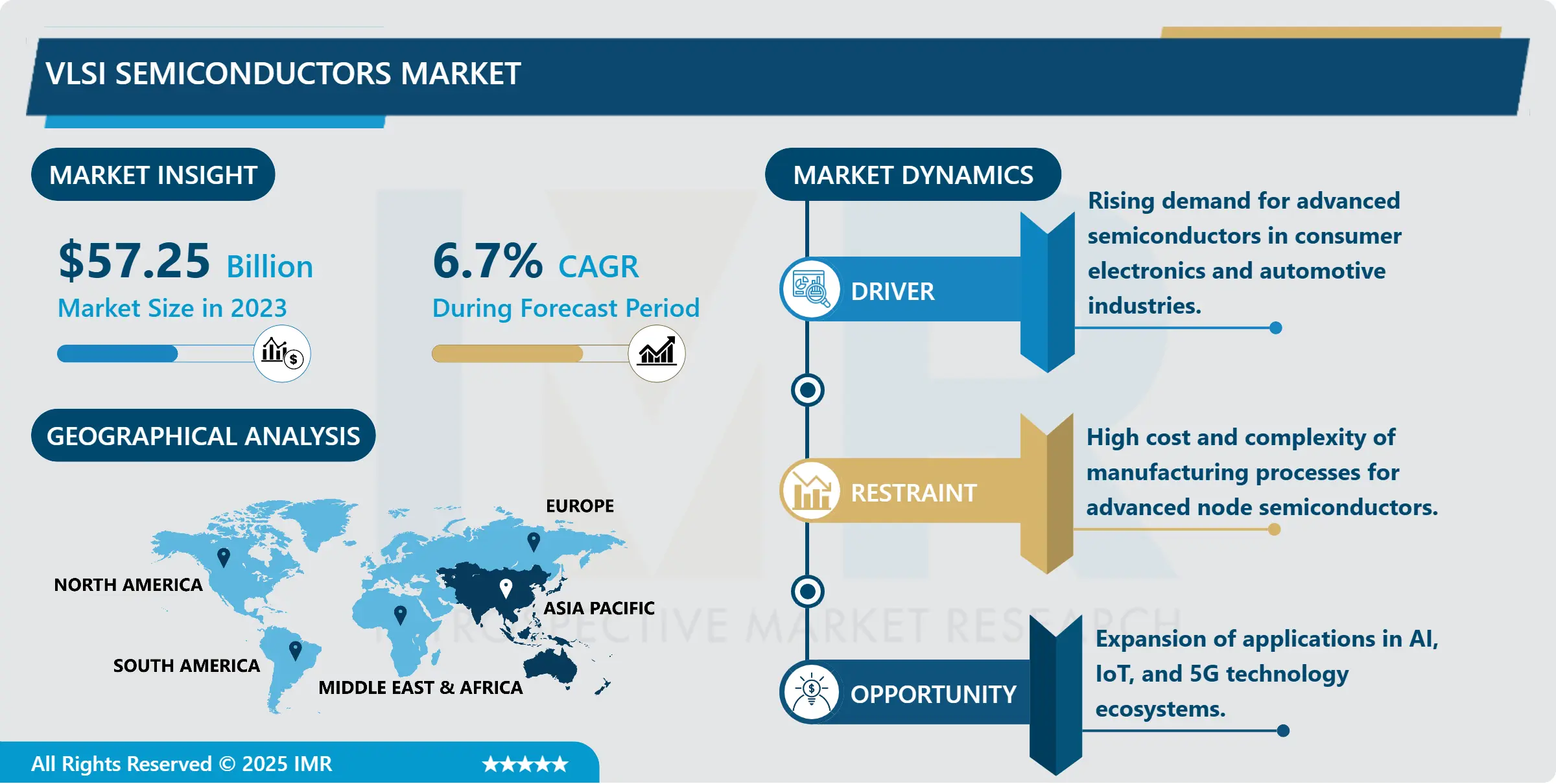
VLSI Semiconductors Market Size Was Valued at USD 57.25 Billion in 2023, and is Projected to Reach USD 102.63 Billion by 2032, Growing at a CAGR of 6.7% From 2024-2032.
The VLSI (Very Large-Scale Integration) Semiconductors Market deals with the designing and fabrication of ICs with thousands to millions of transistors concentrated on a single chip. VLSI semiconductors are important in the development of high skill electronic devices for computing, energy efficient storage and consumption. This market covers various industries including consumer electronics, telecommunication, automotive, as well as industrial segments.
The VLSI Semiconductors Market is enjoying rapid expansion due to the increasing need for electronic devices and improved semiconductor industry. Advancements that the Silicon Valley business organization elaborated that such solutions as artificial intelligence, the emerging fifth generation networks, and various IoT devices have rendered have made significant demands of improved semiconductor solutions. VLSI technology helps to develop faster and more energy efficient components as the devices become smarter and more compact thus placing this market for continual growth.
Additionally, the reforms put in place by various governments that seek to promote semiconductor manufacturing and development has prompted investors to increase their spending across semiconductors, including in countries such as the United States, South Korea and China. It is also as a result of shocks in the supply chain and has forced the increase on local manufacturing. The growing application of VLSI technology in areas such as healthcare, automobile and defense is creating a wider market horizon for the products.
VLSI Semiconductors Market Trend Analysis:
Rising Adoption of AI and ML in VLSI Design
The growing integration of artificial intelligence (AI) and machine learning (ML) in Very-Large-Scale Integration (VLSI) design is reshaping the landscape of the VLSI semiconductors market. AI and ML technologies enable the optimization of chip design processes, improving both speed and accuracy. These advancements help reduce time-to-market and enhance the performance of semiconductor devices. As a result, companies are increasingly adopting AI and ML to stay competitive in a rapidly evolving market.
AI and ML are streamlining various aspects of VLSI design, such as automated layout planning, defect detection, and circuit optimization. This transformation leads to more efficient designs, lower costs, and improved product reliability. As AI and ML applications continue to expand, they are expected to play a pivotal role in meeting the demands of next-generation semiconductor technologies, including those for 5G, automotive electronics, and IoT devices. This shift is positioning AI and ML as key enablers for future growth in the VLSI semiconductor sector..
Growth in Automotive and Industrial Applications
The VLSI (Very Large Scale Integration) Semiconductors Market is poised for growth as automotive and industrial applications continue to expand. In the automotive sector, the demand for advanced driver assistance systems (ADAS), electric vehicles (EVs), and autonomous technologies is increasing, requiring high-performance VLSI chips for efficient processing and functionality. These developments create substantial opportunities for semiconductor manufacturers to supply integrated solutions that meet the rising demands of vehicle electronics.
In industrial applications, the proliferation of smart manufacturing, automation, and Internet of Things (IoT) devices enhances the need for advanced semiconductors capable of supporting complex systems. VLSI technology plays a key role in enabling these innovations by offering high integration, energy efficiency, and processing power. As industries increasingly adopt automated and connected solutions, the market for VLSI semiconductors is expected to expand, creating a favorable environment for stakeholders involved in the production and application of these semiconductors across various sectors.
VLSI Semiconductors Market Segment Analysis:
VLSI Semiconductors Market is Segmented on the basis of Type, Application, End User, and Region
By Type, Semiconductor equipment segment is expected to dominate the market during the forecast period
The VLSI (Very Large Scale Integration) semiconductors market is experiencing robust momentum, with the semiconductor equipment segment expected to hold the leading share during the forecast period. Rising investments in fabrication plants and technology upgrades have reinforced demand for advanced manufacturing tools. As integrated circuit complexity grows, equipment capable of supporting smaller nodes and higher efficiency processes becomes central to production strategies. Manufacturers across Asia-Pacific, North America, and Europe are prioritizing capital expenditure on precision tools to maintain competitive edge and meet the evolving needs of AI, IoT, and cloud computing sectors.
Semiconductor equipment vendors continue to benefit from expanding foundry capacities and the shift toward more energy-efficient chip architectures. The deployment of EUV lithography, advanced packaging solutions, and automated wafer inspection systems is shaping procurement trends among major players. Equipment innovation remains critical to enabling scale, cost control, and yield optimization in high-performance VLSI chip production. Industry stakeholders are closely aligning R&D investments with market adoption cycles to support next-generation product rollouts.
By Application, Integrated circuits segment expected to held the largest share
The integrated circuits (ICs) segment is poised to capture the largest market share in the VLSI semiconductors sector throughout the forecast period. As the demand for miniaturization, efficiency, and high-performance functionality increases across industries, ICs provide essential solutions for applications in telecommunications, consumer electronics, automotive, and industrial automation. Their ability to integrate multiple functions on a single chip makes them indispensable for modern electronic devices.
The expansion of the ICs segment is influenced by the continuous evolution of technology, with industries requiring more compact, powerful, and cost-effective solutions. VLSI technology plays a crucial role in meeting these needs by enabling the development of smaller and more efficient semiconductor devices. As companies continue to innovate and push the boundaries of performance, the growing adoption of ICs will remain a key contributor to the overall growth in the VLSI semiconductors market.
VLSI Semiconductors Market Regional Insights:
Asia Pacific is Expected to Dominate the Market Over the Forecast period
The Asia Pacific region is poised to lead the VLSI semiconductors market over the forecast period, backed by a strong manufacturing base and the presence of major electronics and semiconductor hubs. Countries like China, South Korea, Japan, and Taiwan continue to invest in expanding fabrication capacities, supported by favorable government initiatives and public-private partnerships. The region remains a key supplier of advanced semiconductor technologies used in computing, automotive, consumer electronics, and communication systems. Local players, along with global manufacturers operating in the region, contribute to high output volumes and competitive pricing structures.
The adoption of 5G, AI, and IoT across industrial and consumer applications is pushing demand for more advanced and compact chip designs, which VLSI technology enables. Asia Pacific’s skilled engineering workforce and focus on R&D allow the region to remain agile in addressing emerging trends and customizing solutions for global markets. The concentration of end-use industries also supports localized supply chains, reducing time to market for new innovations.
Active Key Players in the VLSI Semiconductors Market
Advanced Micro Devices (AMD) (USA)
Analog Devices, Inc. (USA)
Broadcom Inc. (USA)
Infineon Technologies AG (Germany)
Intel Corporation (USA)
MediaTek Inc. (Taiwan)
Micron Technology, Inc. (USA)
NVIDIA Corporation (USA)
Qualcomm Incorporated (USA)
Samsung Electronics Co., Ltd. (South Korea)
SK Hynix Inc. (South Korea)
STMicroelectronics (Switzerland)
Taiwan Semiconductor Manufacturing Company Limited (Taiwan)
Texas Instruments Incorporated (USA)
Toshiba Corporation (Japan)
Other Active Players
Chapter 1: Introduction
1.1 Scope and Coverage
Chapter 2:Executive Summary
Chapter 3: Market Landscape
3.1 Market Dynamics
3.1.1 Drivers
3.1.2 Restraints
3.1.3 Opportunities
3.1.4 Challenges
3.2 Market Trend Analysis
3.3 PESTLE Analysis
3.4 Porter’s Five Forces Analysis
3.5 Industry Value Chain Analysis
3.6 Ecosystem
3.7 Regulatory Landscape
3.8 Price Trend Analysis
3.9 Patent Analysis
3.10 Technology Evolution
3.11 Investment Pockets
3.12 Import-Export Analysis
Chapter 4: VLSI Semiconductors Market by Type
4.1 VLSI Semiconductors Market Snapshot and Growth Engine
4.2 VLSI Semiconductors Market Overview
4.3 Semiconductor Front-end Equipment Semiconductor Back-end Equipment
4.3.1 Introduction and Market Overview
4.3.2 Historic and Forecasted Market Size in Value USD and Volume Units (2017-2032F)
4.3.3 Key Market Trends, Growth Factors and Opportunities
4.3.4 Semiconductor Front-end Equipment Semiconductor Back-end Equipment: Geographic Segmentation Analysis
Chapter 5: VLSI Semiconductors Market by Application
5.1 VLSI Semiconductors Market Snapshot and Growth Engine
5.2 VLSI Semiconductors Market Overview
5.3 Discrete Semiconductor Optoelectronic Device Sensors Integrated Circuits
5.3.1 Introduction and Market Overview
5.3.2 Historic and Forecasted Market Size in Value USD and Volume Units (2017-2032F)
5.3.3 Key Market Trends, Growth Factors and Opportunities
5.3.4 Discrete Semiconductor Optoelectronic Device Sensors Integrated Circuits: Geographic Segmentation Analysis
Chapter 6: VLSI Semiconductors Market by End User
6.1 VLSI Semiconductors Market Snapshot and Growth Engine
6.2 VLSI Semiconductors Market Overview
6.3 PCs Mobile Handsets Televisions Assembly & Packaging
6.3.1 Introduction and Market Overview
6.3.2 Historic and Forecasted Market Size in Value USD and Volume Units (2017-2032F)
6.3.3 Key Market Trends, Growth Factors and Opportunities
6.3.4 PCs Mobile Handsets Televisions Assembly & Packaging: Geographic Segmentation Analysis
Chapter 7: Company Profiles and Competitive Analysis
7.1 Competitive Landscape
7.1.1 Competitive Benchmarking
7.1.2 VLSI Semiconductors Market Share by Manufacturer (2023)
7.1.3 Industry BCG Matrix
7.1.4 Heat Map Analysis
7.1.5 Mergers and Acquisitions
7.2 MICRO DEVICES (AMD) (USA)
7.2.1 Company Overview
7.2.2 Key Executives
7.2.3 Company Snapshot
7.2.4 Role of the Company in the Market
7.2.5 Sustainability and Social Responsibility
7.2.6 Operating Business Segments
7.2.7 Product Portfolio
7.2.8 Business Performance
7.2.9 Key Strategic Moves and Recent Developments
7.2.10 SWOT Analysis
7.3 ANALOG DEVICES INC. (USA)
7.4 BROADCOM INC. (USA)
7.5 INFINEON TECHNOLOGIES AG (GERMANY)
7.6 INTEL CORPORATION (USA)
7.7 MEDIATEK INC. (TAIWAN)
7.8 MICRON TECHNOLOGY INC. (USA)
7.9 NVIDIA CORPORATION (USA)
7.10 QUALCOMM INCORPORATED (USA)
7.11 SAMSUNG ELECTRONICS CO. LTD. (SOUTH KOREA)
7.12 SK HYNIX INC. (SOUTH KOREA)
7.13 STMICROELECTRONICS (SWITZERLAND)
7.14 TAIWAN SEMICONDUCTOR MANUFACTURING COMPANY LIMITED (TAIWAN)
7.15 TEXAS INSTRUMENTS INCORPORATED (USA)
7.16 TOSHIBA CORPORATION (JAPAN)
7.17 OTHER ACTIVE PLAYERS
Chapter 8: Global VLSI Semiconductors Market By Region
8.1 Overview
8.2. North America VLSI Semiconductors Market
8.2.1 Key Market Trends, Growth Factors and Opportunities
8.2.2 Top Key Companies
8.2.3 Historic and Forecasted Market Size by Segments
8.2.4 Historic and Forecasted Market Size By Type
8.2.4.1 Semiconductor Front-end Equipment Semiconductor Back-end Equipment
8.2.5 Historic and Forecasted Market Size By Application
8.2.5.1 Discrete Semiconductor Optoelectronic Device Sensors Integrated Circuits
8.2.6 Historic and Forecasted Market Size By End User
8.2.6.1 PCs Mobile Handsets Televisions Assembly & Packaging
8.2.7 Historic and Forecast Market Size by Country
8.2.7.1 US
8.2.7.2 Canada
8.2.7.3 Mexico
8.3. Eastern Europe VLSI Semiconductors Market
8.3.1 Key Market Trends, Growth Factors and Opportunities
8.3.2 Top Key Companies
8.3.3 Historic and Forecasted Market Size by Segments
8.3.4 Historic and Forecasted Market Size By Type
8.3.4.1 Semiconductor Front-end Equipment Semiconductor Back-end Equipment
8.3.5 Historic and Forecasted Market Size By Application
8.3.5.1 Discrete Semiconductor Optoelectronic Device Sensors Integrated Circuits
8.3.6 Historic and Forecasted Market Size By End User
8.3.6.1 PCs Mobile Handsets Televisions Assembly & Packaging
8.3.7 Historic and Forecast Market Size by Country
8.3.7.1 Russia
8.3.7.2 Bulgaria
8.3.7.3 The Czech Republic
8.3.7.4 Hungary
8.3.7.5 Poland
8.3.7.6 Romania
8.3.7.7 Rest of Eastern Europe
8.4. Western Europe VLSI Semiconductors Market
8.4.1 Key Market Trends, Growth Factors and Opportunities
8.4.2 Top Key Companies
8.4.3 Historic and Forecasted Market Size by Segments
8.4.4 Historic and Forecasted Market Size By Type
8.4.4.1 Semiconductor Front-end Equipment Semiconductor Back-end Equipment
8.4.5 Historic and Forecasted Market Size By Application
8.4.5.1 Discrete Semiconductor Optoelectronic Device Sensors Integrated Circuits
8.4.6 Historic and Forecasted Market Size By End User
8.4.6.1 PCs Mobile Handsets Televisions Assembly & Packaging
8.4.7 Historic and Forecast Market Size by Country
8.4.7.1 Germany
8.4.7.2 UK
8.4.7.3 France
8.4.7.4 The Netherlands
8.4.7.5 Italy
8.4.7.6 Spain
8.4.7.7 Rest of Western Europe
8.5. Asia Pacific VLSI Semiconductors Market
8.5.1 Key Market Trends, Growth Factors and Opportunities
8.5.2 Top Key Companies
8.5.3 Historic and Forecasted Market Size by Segments
8.5.4 Historic and Forecasted Market Size By Type
8.5.4.1 Semiconductor Front-end Equipment Semiconductor Back-end Equipment
8.5.5 Historic and Forecasted Market Size By Application
8.5.5.1 Discrete Semiconductor Optoelectronic Device Sensors Integrated Circuits
8.5.6 Historic and Forecasted Market Size By End User
8.5.6.1 PCs Mobile Handsets Televisions Assembly & Packaging
8.5.7 Historic and Forecast Market Size by Country
8.5.7.1 China
8.5.7.2 India
8.5.7.3 Japan
8.5.7.4 South Korea
8.5.7.5 Malaysia
8.5.7.6 Thailand
8.5.7.7 Vietnam
8.5.7.8 The Philippines
8.5.7.9 Australia
8.5.7.10 New Zealand
8.5.7.11 Rest of APAC
8.6. Middle East & Africa VLSI Semiconductors Market
8.6.1 Key Market Trends, Growth Factors and Opportunities
8.6.2 Top Key Companies
8.6.3 Historic and Forecasted Market Size by Segments
8.6.4 Historic and Forecasted Market Size By Type
8.6.4.1 Semiconductor Front-end Equipment Semiconductor Back-end Equipment
8.6.5 Historic and Forecasted Market Size By Application
8.6.5.1 Discrete Semiconductor Optoelectronic Device Sensors Integrated Circuits
8.6.6 Historic and Forecasted Market Size By End User
8.6.6.1 PCs Mobile Handsets Televisions Assembly & Packaging
8.6.7 Historic and Forecast Market Size by Country
8.6.7.1 Turkiye
8.6.7.2 Bahrain
8.6.7.3 Kuwait
8.6.7.4 Saudi Arabia
8.6.7.5 Qatar
8.6.7.6 UAE
8.6.7.7 Israel
8.6.7.8 South Africa
8.7. South America VLSI Semiconductors Market
8.7.1 Key Market Trends, Growth Factors and Opportunities
8.7.2 Top Key Companies
8.7.3 Historic and Forecasted Market Size by Segments
8.7.4 Historic and Forecasted Market Size By Type
8.7.4.1 Semiconductor Front-end Equipment Semiconductor Back-end Equipment
8.7.5 Historic and Forecasted Market Size By Application
8.7.5.1 Discrete Semiconductor Optoelectronic Device Sensors Integrated Circuits
8.7.6 Historic and Forecasted Market Size By End User
8.7.6.1 PCs Mobile Handsets Televisions Assembly & Packaging
8.7.7 Historic and Forecast Market Size by Country
8.7.7.1 Brazil
8.7.7.2 Argentina
8.7.7.3 Rest of SA
Chapter 9 Analyst Viewpoint and Conclusion
9.1 Recommendations and Concluding Analysis
9.2 Potential Market Strategies
Chapter 10 Research Methodology
10.1 Research Process
10.2 Primary Research
10.3 Secondary Research
Q1: What would be the forecast period in the VLSI Semiconductors Market research report?
A1: The forecast period in the VLSI Semiconductors Market research report is 2024-2032.
Q2: Who are the key players in the VLSI Semiconductors Market?
A2: Advanced Micro Devices (AMD) (USA),Analog Devices, Inc. (USA),Broadcom Inc. (USA),Infineon Technologies AG (Germany),Intel Corporation (USA),MediaTek Inc. (Taiwan),Micron Technology, Inc. (USA),NVIDIA Corporation (USA),Qualcomm Incorporated (USA),Samsung Electronics Co., Ltd. (South Korea),SK Hynix Inc. (South Korea),STMicroelectronics (Switzerland),Taiwan Semiconductor Manufacturing Company Limited (Taiwan),Texas Instruments Incorporated (USA),Toshiba Corporation (Japan), and Other Active Players
Q3: What are the segments of the VLSI Semiconductors Market?
A3: The VLSI Semiconductors Market is segmented into Type, Application, End User and region. By Type, the market is categorized into Semiconductor Front-end Equipment and Semiconductor Back-end Equipment. By Application, the market is categorized into Discrete Semiconductor Optoelectronic Device Sensors Integrated Circuits. By End User, the market is categorized into PCs Mobile Handsets Televisions Assembly & Packaging. By Region, it is analyzed across North America (U.S., Canada, Mexico), Eastern Europe (Russia, Bulgaria, The Czech Republic, Hungary, Poland, Romania, Rest of Eastern Europe), Western Europe (Germany, UK, France, Netherlands, Italy, Spain, Rest of Western Europe), Asia Pacific (China, India, Japan, South Korea, Malaysia, Thailand, Vietnam, The Philippines, Australia, New-Zealand, Rest of APAC), Middle East & Africa (Turkiye, Bahrain, Kuwait, Saudi Arabia, Qatar, UAE, Israel, South Africa), South America (Brazil, Argentina, Rest of SA).
Q4: What is the VLSI Semiconductors Market?
A4: The VLSI (Very Large-Scale Integration) Semiconductors Market deals with the designing and fabrication of ICs with thousands to millions of transistors concentrated on a single chip. VLSI semiconductors are important in the development of high skill electronic devices for computing, energy efficient storage and consumption. This market covers various industries including consumer electronics, telecommunication, automotive, as well as industrial segments.
Q5: How big is the VLSI Semiconductors Market?
A5: VLSI Semiconductors Market Size Was Valued at USD 57.25 Billion in 2023, and is Projected to Reach USD 102.63 Billion by 2032, Growing at a CAGR of 6.7 % From 2024-2032.
How to Buy a Report from eminsights.jp
On the product page, choose the license you want: Single-User License, Multi-User License or Enterprise License.
If you required report in your native language, then you can click on Translated Report button and fill out the form with report name and language you want, then our team will contact you as soon as possible.
Click the Buy Now button.
You will be redirected to the checkout page. Enter your company details and payment information.
Click Place Order to complete the purchase.
Confirmation: You’ll receive an order confirmation and our team will contact you shortly with your ordered report.
If you have any questions, fill out the contact form below or email us at bizdev@eminsights.net.
Thank you for choosing eminsights.jp!