Stay Ahead in Fast-Growing Economies.
Browse Reports Now




Ventilator Market – In-Deep Analysis on Market Share, Size
The ventilator market refers to the business that concerns the manufacturing, selling, and distribution of mechanical ventilators: specialty devices used to help patients breathe, or to breathe for them, when they cannot do so for themselves. These medical devices are vital in special care which comprises the Intensive Care Unit (ICU), emergency departments, and surgeries; they are used to support the breathing of those patients with severe respiratory diseases or those under anesthesia.

IMR Group
Description
Ventilator Market Synopsis
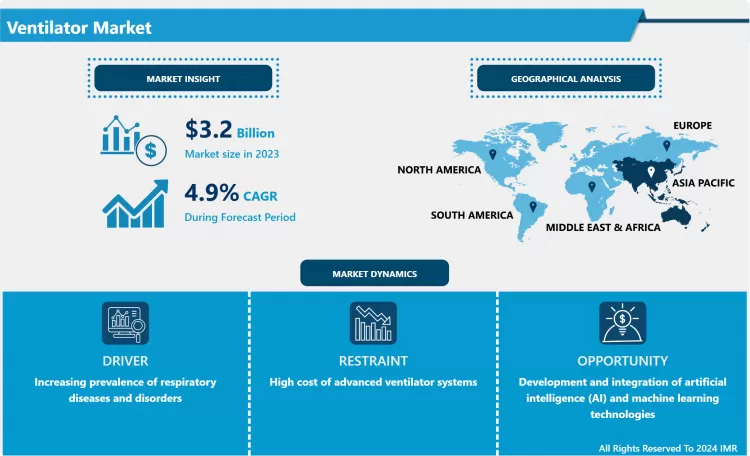
Ventilator Market Size Was Valued at USD 3.2 Billion in 2023, and is Projected to Reach USD 4.8 Billion by 2032, Growing at a CAGR of 4.9% From 2024-2032.
The ventilator market refers to the business that concerns the manufacturing, selling, and distribution of mechanical ventilators: specialty devices used to help patients breathe, or to breathe for them, when they cannot do so for themselves. These medical devices are vital in special care which comprises the Intensive Care Unit (ICU), emergency departments, and surgeries; they are used to support the breathing of those patients with severe respiratory diseases or those under anesthesia. The market can be segmented by the invasive, non-invasive specific categories of ventilators for meeting patient’s requirements or requirements of clinics and hospitals. Drivers that have an influence over the market growth are technological developments, hiking incidences of respiratory diseases, and demand for a better standard of healthcare system.
Ventilators are a subcategory of the overall medical devices industry which can be described as a constantly developing market mainly comprising devices needed for supporting acute/chronic respiratory failure. There are invasive and non-invasive ventilators, portable and home care ventilators, meant to fulfill various requisites of the clinical sector and patient needs. Technological advancement is found to have an enormous impact on the development of ventilators in which the integration of AI, smart sensors and improved monitoring techniques have greatly influenced the improvement of the ventilator’s performance and functionality. COVID-19 had a strong positive impact on the market as people realized the indispensability of quality ventilators and the unprecedented enhancement of the respiratory support devices innovation process.
With the development in medical industry the requirement for ventilators has increased with the rates of respiratory diseases, aging population as well as improved and innovative technology. Such measures include government investments in healthcare facilities and the growing awareness of respiratory diseases also propel the market. Also, portable and home care ventilators are increasing in demand due to extending the concept of point-of-care to home care. In total, the prospects of the ventilator market as long as it keeps developing and, on average, is intensifying on the idea of enhancing the quality of life of patients with respiratory diseases and other severe health conditions.
Ventilator Market Trend Analysis
Increasing adoption of portable and home care ventilators
Another movement that was main in the ventilator market is portable and home care ventilators. These ventilators developed due to technological improvements and a focus on patient-centered care; they are intended for non-hospital usage, enabling clients with Chronic Obstructive Pulmonary Disease to obtain high-quality care at their homes. B: They are transportable equipments; hence allow for flexibility in their usage because they can be moved from one place to the other depending on the need for respiratory support.
This is because the healthcare expenditure is on the rise, the population is aging and respiratory diseases are becoming more prevalent significantly leading to a demand for convenient and easy to use respiratory support systems. Also, trends in telemedicine and remote monitoring are improving the performance and suitability of home care ventilators, thus advancing at an even faster rate.
Development and integration of artificial intelligence (AI) and machine learning technologies
A new trend in the ventilator market is related to the introduction and use of artificial intelligence and machine learning. These advancements can be helpful in improving capabilities and deliverance of ventilators since they offer improved and flexible respiratory help. AI integrated ventilators can provide accurate data analysis of the patient, prognosis of the problem, and customization to make it appropriate to the patient’s conditions. This opportunity is especially important as healthcare organizations strive to increase patients’ satisfaction and quality of care, enhance efficiency and efficacy of the given resources, and relieve the stress on healthcare workers. Thus, manufacturers can create modern ventilators with the use of AI that will not only make the work of a healthcare provider easier but will also progress the essential critical care equipment.
Ventilator Market Segment Analysis:
Ventilator Market Segmented on the basis of type, Ventilation Mode and end user.
By Type, Transport & portable segment is expected to dominate the market during the forecast period
It is projected that the transport and portable category will continue to lead throughout the forecast timeframe owing to the rising need for versatile as well as mobile ventilatory support systems. The need to decentralize basic healthcare, with pressure on ambulatory ventilation, as a movable piece of equipment has become indispensable given the changed focus of health care systems towards the patients and home care. These devices are mobile with easy maneuverability and can be used in emergency responses, and daily use since they are versatile.
Thus, their capability to deliver respiratory support in quite a number of settings – transport, emergency, home – corresponds well with the trend toward more general-purpose, or multi-function medical technologies. Also, portable ventilators are fuelled by technological innovations such as light-weight or small sized and longer battery life which has made this segment to be a key growth segment in the market.
By Ventilation Mode, Non-invasive segment expected to held the largest share
The non-invasive ventilation segment is anticipated to dominate the ventilator market by having less invasiveness for the patients, which is very important enhancing the comfort of the patients. Ventilators that are not invasive, use facial masks or nasal prongs and therefore, provide required ventilation without the necessity of invasive mechanical intubation. Thus, this intervention reduces discomfort, reduces the likelihood of acquiring infections, and has fewer hospital days and quicker recovery.
With healthcare now shifting to the patient’s side and focusing on increasing the quality of life for people with such ailments as respiratory diseases, non-invasive ventilation is chosen over invasive ones. This segment’s growth is also backed by trends defining the development of non-invasive devices with the capability to serve a critical role in modern respiratory management made possible due to improvements in technologies that make the equipment as effective and easy to use as possible.
Ventilator Market Regional Insights:
Asia Pacific is Expected to Dominate the Market Over the Forecast period
Asia Pacific is expected to have the largest market share over the forecast period owing to some influentially contributing factors that are contributing the region’s growth. The increased expenditure on healthcare sector, increased incidences of respiratory diseases and an ageing population of the region are the drivers for the enhanced respiratory support products. Growth in the urban populace, a rising trend towards health-care spending, and healthy government policies that promote greater accessibility of health care contribute to the market’s growth.
Besides, the continued technology enhancements on the life-supporting medical devices and increasing demand for the portable & home care ventilators further supplement the growth of this region’s market. The region’s largest healthcare facilities situated in countries such as China, India, and Japan are constantly incorporating advanced medical technologies and enhancing their healthcare infrastructures and thereby Asia Pacific is set to dominate the global ventilators market in the future.
Active Key Players in the Ventilator Market
Air Liquide (France)
Becton, Dickinson and Company (BD) (United States)
Drägerwerk AG (Germany)
Fisher & Paykel Healthcare (New Zealand)
GE Healthcare (United States)
Getinge AB (Sweden)
Hamilton Medical (Switzerland)
Jiangsu Yuyue Medical Equipment & Supply Co., Ltd. (China)
Medtronic (Ireland)
Mindray (China)
Nihon Kohden Corporation (Japan)
Philips Respironics (Netherlands)
ResMed (Australia)
SLE Ltd. (United Kingdom)
Smiths Medical (United Kingdom)
Other key Players
Key Industry Developments in the Ventilator Market:
In August 2023, U.S. FDA clearance was granted to Getinge for its Servo-air Lite, a non-invasive mechanical ventilator that is independent of wall gas.
Chapter 1: Introduction
1.1 Scope and Coverage
Chapter 2:Executive Summary
Chapter 3: Market Landscape
3.1 Market Dynamics
3.1.1 Drivers
3.1.2 Restraints
3.1.3 Opportunities
3.1.4 Challenges
3.2 Market Trend Analysis
3.3 PESTLE Analysis
3.4 Porter’s Five Forces Analysis
3.5 Industry Value Chain Analysis
3.6 Ecosystem
3.7 Regulatory Landscape
3.8 Price Trend Analysis
3.9 Patent Analysis
3.10 Technology Evolution
3.11 Investment Pockets
3.12 Import-Export Analysis
Chapter 4: Ventilator Market by Type (2018-2032)
4.1 Ventilator Market Snapshot and Growth Engine
4.2 Market Overview
4.3 Critical care
4.3.1 Introduction and Market Overview
4.3.2 Historic and Forecasted Market Size in Value USD and Volume Units
4.3.3 Key Market Trends, Growth Factors, and Opportunities
4.3.4 Geographic Segmentation Analysis
4.4 Neonatal
4.5 Transport & portable
4.6 Other
Chapter 5: Ventilator Market by Ventilation Mode (2018-2032)
5.1 Ventilator Market Snapshot and Growth Engine
5.2 Market Overview
5.3 Invasive
5.3.1 Introduction and Market Overview
5.3.2 Historic and Forecasted Market Size in Value USD and Volume Units
5.3.3 Key Market Trends, Growth Factors, and Opportunities
5.3.4 Geographic Segmentation Analysis
5.4 Non-invasive
Chapter 6: Ventilator Market by End Use (2018-2032)
6.1 Ventilator Market Snapshot and Growth Engine
6.2 Market Overview
6.3 Mechanical Ventilator Hospitals
6.3.1 Introduction and Market Overview
6.3.2 Historic and Forecasted Market Size in Value USD and Volume Units
6.3.3 Key Market Trends, Growth Factors, and Opportunities
6.3.4 Geographic Segmentation Analysis
6.4 Home healthcare
6.5 Others
Chapter 7: Company Profiles and Competitive Analysis
7.1 Competitive Landscape
7.1.1 Competitive Benchmarking
7.1.2 Ventilator Market Share by Manufacturer (2024)
7.1.3 Industry BCG Matrix
7.1.4 Heat Map Analysis
7.1.5 Mergers and Acquisitions
7.2 AIR LIQUIDE (FRANCE)
7.2.1 Company Overview
7.2.2 Key Executives
7.2.3 Company Snapshot
7.2.4 Role of the Company in the Market
7.2.5 Sustainability and Social Responsibility
7.2.6 Operating Business Segments
7.2.7 Product Portfolio
7.2.8 Business Performance
7.2.9 Key Strategic Moves and Recent Developments
7.2.10 SWOT Analysis
7.3 BECTON
7.4 DICKINSON AND COMPANY (BD) (UNITED STATES)
7.5 DRÄGERWERK AG (GERMANY)
7.6 FISHER & PAYKEL HEALTHCARE (NEW ZEALAND)
7.7 GE HEALTHCARE (UNITED STATES)
7.8 GETINGE AB (SWEDEN)
7.9 HAMILTON MEDICAL (SWITZERLAND)
7.10 JIANGSU YUYUE MEDICAL EQUIPMENT & SUPPLY COLTD. (CHINA)
7.11 MEDTRONIC (IRELAND)
7.12 MINDRAY (CHINA)
7.13 NIHON KOHDEN CORPORATION (JAPAN)
7.14 PHILIPS RESPIRONICS (NETHERLANDS)
7.15 RESMED (AUSTRALIA)
7.16 SLE LTD. (UNITED KINGDOM)
7.17 SMITHS MEDICAL (UNITED KINGDOM)
7.18 OTHER KEY PLAYERS
Chapter 8: Global Ventilator Market By Region
8.1 Overview
8.2. North America Ventilator Market
8.2.1 Key Market Trends, Growth Factors and Opportunities
8.2.2 Top Key Companies
8.2.3 Historic and Forecasted Market Size by Segments
8.2.4 Historic and Forecasted Market Size by Type
8.2.4.1 Critical care
8.2.4.2 Neonatal
8.2.4.3 Transport & portable
8.2.4.4 Other
8.2.5 Historic and Forecasted Market Size by Ventilation Mode
8.2.5.1 Invasive
8.2.5.2 Non-invasive
8.2.6 Historic and Forecasted Market Size by End Use
8.2.6.1 Mechanical Ventilator Hospitals
8.2.6.2 Home healthcare
8.2.6.3 Others
8.2.7 Historic and Forecast Market Size by Country
8.2.7.1 US
8.2.7.2 Canada
8.2.7.3 Mexico
8.3. Eastern Europe Ventilator Market
8.3.1 Key Market Trends, Growth Factors and Opportunities
8.3.2 Top Key Companies
8.3.3 Historic and Forecasted Market Size by Segments
8.3.4 Historic and Forecasted Market Size by Type
8.3.4.1 Critical care
8.3.4.2 Neonatal
8.3.4.3 Transport & portable
8.3.4.4 Other
8.3.5 Historic and Forecasted Market Size by Ventilation Mode
8.3.5.1 Invasive
8.3.5.2 Non-invasive
8.3.6 Historic and Forecasted Market Size by End Use
8.3.6.1 Mechanical Ventilator Hospitals
8.3.6.2 Home healthcare
8.3.6.3 Others
8.3.7 Historic and Forecast Market Size by Country
8.3.7.1 Russia
8.3.7.2 Bulgaria
8.3.7.3 The Czech Republic
8.3.7.4 Hungary
8.3.7.5 Poland
8.3.7.6 Romania
8.3.7.7 Rest of Eastern Europe
8.4. Western Europe Ventilator Market
8.4.1 Key Market Trends, Growth Factors and Opportunities
8.4.2 Top Key Companies
8.4.3 Historic and Forecasted Market Size by Segments
8.4.4 Historic and Forecasted Market Size by Type
8.4.4.1 Critical care
8.4.4.2 Neonatal
8.4.4.3 Transport & portable
8.4.4.4 Other
8.4.5 Historic and Forecasted Market Size by Ventilation Mode
8.4.5.1 Invasive
8.4.5.2 Non-invasive
8.4.6 Historic and Forecasted Market Size by End Use
8.4.6.1 Mechanical Ventilator Hospitals
8.4.6.2 Home healthcare
8.4.6.3 Others
8.4.7 Historic and Forecast Market Size by Country
8.4.7.1 Germany
8.4.7.2 UK
8.4.7.3 France
8.4.7.4 The Netherlands
8.4.7.5 Italy
8.4.7.6 Spain
8.4.7.7 Rest of Western Europe
8.5. Asia Pacific Ventilator Market
8.5.1 Key Market Trends, Growth Factors and Opportunities
8.5.2 Top Key Companies
8.5.3 Historic and Forecasted Market Size by Segments
8.5.4 Historic and Forecasted Market Size by Type
8.5.4.1 Critical care
8.5.4.2 Neonatal
8.5.4.3 Transport & portable
8.5.4.4 Other
8.5.5 Historic and Forecasted Market Size by Ventilation Mode
8.5.5.1 Invasive
8.5.5.2 Non-invasive
8.5.6 Historic and Forecasted Market Size by End Use
8.5.6.1 Mechanical Ventilator Hospitals
8.5.6.2 Home healthcare
8.5.6.3 Others
8.5.7 Historic and Forecast Market Size by Country
8.5.7.1 China
8.5.7.2 India
8.5.7.3 Japan
8.5.7.4 South Korea
8.5.7.5 Malaysia
8.5.7.6 Thailand
8.5.7.7 Vietnam
8.5.7.8 The Philippines
8.5.7.9 Australia
8.5.7.10 New Zealand
8.5.7.11 Rest of APAC
8.6. Middle East & Africa Ventilator Market
8.6.1 Key Market Trends, Growth Factors and Opportunities
8.6.2 Top Key Companies
8.6.3 Historic and Forecasted Market Size by Segments
8.6.4 Historic and Forecasted Market Size by Type
8.6.4.1 Critical care
8.6.4.2 Neonatal
8.6.4.3 Transport & portable
8.6.4.4 Other
8.6.5 Historic and Forecasted Market Size by Ventilation Mode
8.6.5.1 Invasive
8.6.5.2 Non-invasive
8.6.6 Historic and Forecasted Market Size by End Use
8.6.6.1 Mechanical Ventilator Hospitals
8.6.6.2 Home healthcare
8.6.6.3 Others
8.6.7 Historic and Forecast Market Size by Country
8.6.7.1 Turkiye
8.6.7.2 Bahrain
8.6.7.3 Kuwait
8.6.7.4 Saudi Arabia
8.6.7.5 Qatar
8.6.7.6 UAE
8.6.7.7 Israel
8.6.7.8 South Africa
8.7. South America Ventilator Market
8.7.1 Key Market Trends, Growth Factors and Opportunities
8.7.2 Top Key Companies
8.7.3 Historic and Forecasted Market Size by Segments
8.7.4 Historic and Forecasted Market Size by Type
8.7.4.1 Critical care
8.7.4.2 Neonatal
8.7.4.3 Transport & portable
8.7.4.4 Other
8.7.5 Historic and Forecasted Market Size by Ventilation Mode
8.7.5.1 Invasive
8.7.5.2 Non-invasive
8.7.6 Historic and Forecasted Market Size by End Use
8.7.6.1 Mechanical Ventilator Hospitals
8.7.6.2 Home healthcare
8.7.6.3 Others
8.7.7 Historic and Forecast Market Size by Country
8.7.7.1 Brazil
8.7.7.2 Argentina
8.7.7.3 Rest of SA
Chapter 9 Analyst Viewpoint and Conclusion
9.1 Recommendations and Concluding Analysis
9.2 Potential Market Strategies
Chapter 10 Research Methodology
10.1 Research Process
10.2 Primary Research
10.3 Secondary Research
Q1: What would be the forecast period in the Ventilator Market research report?
A1: The forecast period in the Ventilator Market research report is 2024-2032.
Q2: Who are the key players in the Ventilator Market?
A2: Air Liquide (France), Becton, Dickinson and Company (BD) (United States), Drägerwerk AG (Germany), Fisher & Paykel Healthcare (New Zealand), GE Healthcare (United States) and Other Major Players.
Q3: What are the segments of the Ventilator Market?
A3: The Ventilator Market is segmented into Type, Ventilation Mode, End User and region. By Type, the market is categorized into Critical care, Neonatal, Transport & portable, Other. By Ventilation Mode, the market is categorized into Invasive, Non-invasive. By End User, the market is categorized into Mechanical Ventilator Hospitals, Home healthcare, Others. By region, it is analyzed across North America (U.S.; Canada; Mexico), Eastern Europe (Bulgaria; The Czech Republic; Hungary; Poland; Romania; Rest of Eastern Europe), Western Europe (Germany; UK; France; Netherlands; Italy; Russia; Spain; Rest of Western Europe), Asia-Pacific (China; India; Japan; Southeast Asia, etc.), South America (Brazil; Argentina, etc.), Middle East & Africa (Saudi Arabia; South Africa, etc.).
Q4: What is the Ventilator Market?
A4: The ventilator market refers to the business that concerns the manufacturing, selling, and distribution of mechanical ventilators: specialty devices used to help patients breathe, or to breathe for them, when they cannot do so for themselves. These medical devices are vital in special care which comprises the Intensive Care Unit (ICU), emergency departments, and surgeries; they are used to support the breathing of those patients with severe respiratory diseases or those under anesthesia. The market can be segmented by the invasive, non-invasive specific categories of ventilators for meeting patient’s requirements or requirements of clinics and hospitals. Drivers that have an influence over the market growth are technological developments, hiking incidences of respiratory diseases, and demand for a better standard of healthcare system.
Q5: How big is the Ventilator Market?
A5: Ventilator Market Size Was Valued at USD 3.2 Billion in 2023, and is Projected to Reach USD 4.8 Billion by 2032, Growing at a CAGR of 4.9% From 2024-2032.
How to Buy a Report from eminsights.jp
On the product page, choose the license you want: Single-User License, Multi-User License or Enterprise License.
If you required report in your native language, then you can click on Translated Report button and fill out the form with report name and language you want, then our team will contact you as soon as possible.
Click the Buy Now button.
You will be redirected to the checkout page. Enter your company details and payment information.
Click Place Order to complete the purchase.
Confirmation: You’ll receive an order confirmation and our team will contact you shortly with your ordered report.
If you have any questions, fill out the contact form below or email us at bizdev@eminsights.net.
Thank you for choosing eminsights.jp!