Stay Ahead in Fast-Growing Economies.
Browse Reports Now
Vehicle to vehicle V2V communication Market Growth Insights & Forecast Report to 2032
Applies to Vehicle-to-Vehicle (V2V) communication that defines the wireless transfer of data between vehicles in order to help increase the safety of roads, smooth the flow of traffic, and support self-driving automobile systems.

IMR Group
Description
Vehicle to vehicle V2V communication Market Synopsis
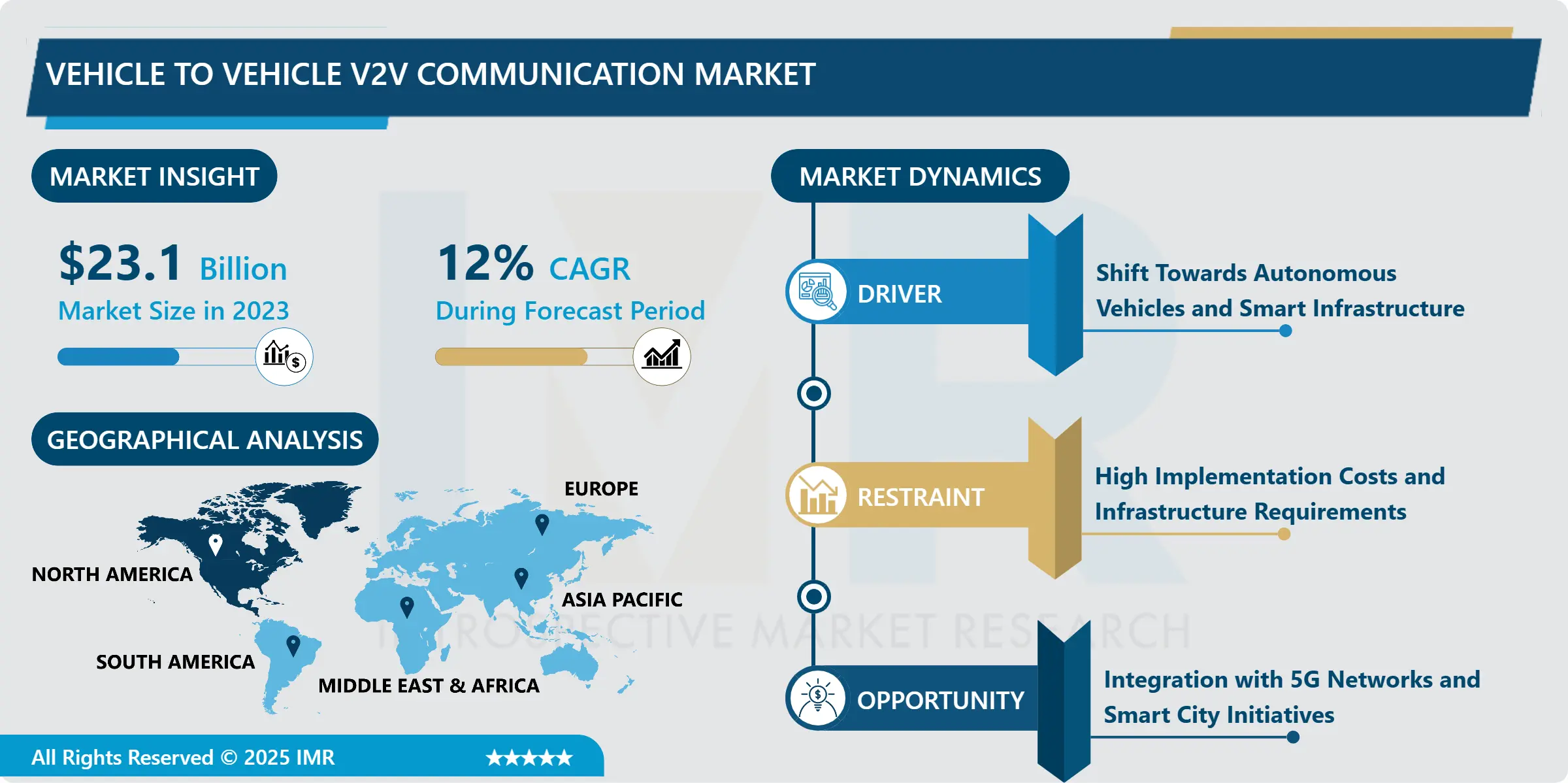
Vehicle-to-Vehicle V2V Communication Market Size Was Valued at USD 23.10 Billion in 2023, and is Projected to Reach USD 64.05 Billion by 2032, Growing at a CAGR of 12.00 % From 2024-2032.
Applies to Vehicle-to-Vehicle (V2V) communication that defines the wireless transfer of data between vehicles in order to help increase the safety of roads, smooth the flow of traffic, and support self-driving automobile systems. Since V2V systems need to communicate various types of information, including location, speed, braking status, etc., various technologies such as Dedicated Short-Range Communication (DSRC) and Cellular Vehicle-to-Everything (C-V2X) are used. Under this communication, accidents that would otherwise have occurred can be averted, better control of collision, and better control of traffic flow implies better control of traffic density contributing to better traffic control for safer and efficient traffic environments.
Technological advancement or promoting desperately needed road safety can be regarded as the primary driver for this market. A rising global tally of road accidents has prompted governments and other regulatory agencies to advocate for sophisticated safety features including V2V communication. This technology is viewed as critical for tackling congestion, enhancing response to risk and cutting back on the last and intersection incidences of mishaps. Furthermore, continuing market introduction of ADAS [Advanced Driver Assistance Systems] in automobiles make a large requirement to incorporate V2V communication system as these are used in cars to make the technologies in them complementary in that they need to receive data all the time
The last one is to cover the trend towards autonomous driving is another key driver. With the evolution towards fully autonomous cars, V2V is an integral platform to support the automobiles in warning, informing, communicating, and coordinating with other vehicles in a network. V2V technology lets vehicles share information with other automobiles to prevent congestion, human error, and to help devise wholly self-powered automobiles. Also, for the public V2V technologies are being supported by government rules and regulations like those of U.S Department of Transportation and European Union adding on demand for it.
Vehicle to vehicle V2V communication Market Trend Analysis:
Trend
One of the trends which may significantly develop the V2V communication systems is the evolution of 5G technology. Due to the ultra-low latency, high speed data transmission and enormous connectivity possibilities 5G improves the efficacy and reliability of V2V communication. This technology will provide continuous information exchange between vehicles at nearly the blink of an eye and help reduce accidents due to passing hazards. These articles are projected as the 5G networks increase globally and the impact increases exceptionally at urban areas due congestion and safety of vehicles.
A third important trend is linked with the increasing connection of V2V communication with smart city initiatives. Most large cities around the globe are implementing advanced traffic control and nearly autonomous auto-mobile systems that can interact with vehicles on the road for better traffic flow without jams. This trend aligns well with the overall picture of vehicle-to-vehicle, vehicle-to-infrastructure and pedestrian communication in a real-time environment to enhance safety traffic flow in the urban environment. Intelligent traffic signals, roads signs and many others integrate this vision and V2V technology is central to it since vehicles have to communicate with infrastructure and other vehicles.
Increased rates of the car usage and population density
Perhaps, the most promising trend in the V2V communication market is the ability to introduce these systems to new markets. The areas such as Asia-Pacific and the Latin American countries with increased rates of the car usage and population density, urbanization, and the increasing number of accidents offer great potential for the application of V2V technology for the improvement of safety and traffic conditions. Since many governments of these regions are directing efforts toward transportation, infrastructure, together with smart city advancements, V2V systems are likely to be implemented in new vehicles and current fleets. This growth becomes both a threat and a potential for carmakers, telecommunications companies, and infrastructure implementers to co-create the connected vehicles in those regions.
The two-wheelers and commercial fleets communication is a yet unexplored area which can also be developed using V2V technology. Leveraging on the increasing need for safety and connectivity across the various forms of transportation, V2V solutions can be fitted on motorcycles, trucks and every other form of transportation. The move can easily expand market size and also speed up the addition of V2V systems additional to the conventional type of passenger cars. Moreover, extending the idea of V2V communication with V2I and V2P systems will expand the opportunities of using this technology and make the whole transportation system safer.
Vehicle to vehicle V2V communication Market Segment Analysis:
Vehicle to vehicle V2V communication Market Segmented on the basis of Communication Technology, Application, End-User, and Region.
By Communication Technology, DSRC (Dedicated Short-Range Communication) segment is expected to dominate the market during the forecast period
The V2V communication market has mainly three categories, namely DSRC (Dedicated Short-Range Communication), Cellular V2X (C-V2X) and other technologies. DSRC is one of the most common communication standards widely applied for short-range vehicular communication to reduce latency. It transmits and receives signals on a fixed frequency and is mainly used in safety related functions such as collision detection. C-V2X, in contrast, built on the cellular system of 4G or even the 5G, providing wider range of connectivity for V2V communication with benefits concerning to the range, scalability, data rates. C-V2X is a novel technology that forms a less reliant solution, as it can be integrated with both cellular and non-cellular systems for future connected vehicles.
By Application, Safety segment expected to held the largest share
The V2V communication market is divided on the basis of application into Safety and Traffic Management, Infotainment, Autonomous vehicles and others. However, the most important use of V2V communication at this time is in safety, where many systems such as the collision avoidance system and the emergency brake system depend on information shared between vehicles. Another large application of the V2V communication is traffic management because it helps correctly coordinate the movements of automobiles and other objects, thus effectively prevent traffic jams. Since V2V communication can send information rapidly and effectively, infotainment applications like in-car entertainment and real-time update of the route can be enhanced by the system. V2V technology is also strongly interconnected with the adaption of autonomous vehicles since these systems allow making better decisions for such automobiles.
Vehicle to vehicle V2V communication Market Regional Insights:
North America is Expected to Dominate the Market Over the Forecast period
The V2V communication market is currently quite regionalized with North America taking the lion’s share due to the availability of positive legislation, major automakers, as well as developed infrastructure. Currently, the U.S. occupies the leading position in the application of V2V technologies, which is symbolic, given that there are several pilot programs and regulatory initiatives in the field of connected vehicle systems.
The National Highway Traffic Safety Administration (NHTSA) has been very supportive of the use of V2V technology and several auto makers in the region are commencing use of V2V communication in their automobiles. Also, the rising use of the ASI/ADAS technology in North American countries fosters the development of V2V communication systems.
Active Key Players in the Vehicle-to-vehicle V2V communication Market:
Qualcomm (USA)
Toyota (Japan)
Audi (Germany)
BMW (Germany)
Ericsson (Sweden)
Intel (USA)
NXP Semiconductors (Netherlands)
Ford (USA)
Huawei (China)
Continental AG (Germany)
Other Active Players
Chapter 1: Introduction
1.1 Scope and Coverage
Chapter 2:Executive Summary
Chapter 3: Market Landscape
3.1 Market Dynamics
3.1.1 Drivers
3.1.2 Restraints
3.1.3 Opportunities
3.1.4 Challenges
3.2 Market Trend Analysis
3.3 PESTLE Analysis
3.4 Porter’s Five Forces Analysis
3.5 Industry Value Chain Analysis
3.6 Ecosystem
3.7 Regulatory Landscape
3.8 Price Trend Analysis
3.9 Patent Analysis
3.10 Technology Evolution
3.11 Investment Pockets
3.12 Import-Export Analysis
Chapter 4: Vehicle to vehicle V2V communication Market by Type
4.1 Vehicle to vehicle V2V communication Market Snapshot and Growth Engine
4.2 Vehicle to vehicle V2V communication Market Overview
4.3 Active Vehicle Tracking System
4.3.1 Introduction and Market Overview
4.3.2 Historic and Forecasted Market Size in Value USD and Volume Units (2017-2032F)
4.3.3 Key Market Trends, Growth Factors and Opportunities
4.3.4 Active Vehicle Tracking System: Geographic Segmentation Analysis
4.4 Passive Vehicle Tracking System
4.4.1 Introduction and Market Overview
4.4.2 Historic and Forecasted Market Size in Value USD and Volume Units (2017-2032F)
4.4.3 Key Market Trends, Growth Factors and Opportunities
4.4.4 Passive Vehicle Tracking System: Geographic Segmentation Analysis
Chapter 5: Vehicle to vehicle V2V communication Market by Technology
5.1 Vehicle to vehicle V2V communication Market Snapshot and Growth Engine
5.2 Vehicle to vehicle V2V communication Market Overview
5.3 GPS-based
5.3.1 Introduction and Market Overview
5.3.2 Historic and Forecasted Market Size in Value USD and Volume Units (2017-2032F)
5.3.3 Key Market Trends, Growth Factors and Opportunities
5.3.4 GPS-based: Geographic Segmentation Analysis
5.4 GSM-based
5.4.1 Introduction and Market Overview
5.4.2 Historic and Forecasted Market Size in Value USD and Volume Units (2017-2032F)
5.4.3 Key Market Trends, Growth Factors and Opportunities
5.4.4 GSM-based: Geographic Segmentation Analysis
5.5 RFID-based
5.5.1 Introduction and Market Overview
5.5.2 Historic and Forecasted Market Size in Value USD and Volume Units (2017-2032F)
5.5.3 Key Market Trends, Growth Factors and Opportunities
5.5.4 RFID-based: Geographic Segmentation Analysis
5.6 Others
5.6.1 Introduction and Market Overview
5.6.2 Historic and Forecasted Market Size in Value USD and Volume Units (2017-2032F)
5.6.3 Key Market Trends, Growth Factors and Opportunities
5.6.4 Others: Geographic Segmentation Analysis
Chapter 6: Vehicle to vehicle V2V communication Market by End-User
6.1 Vehicle to vehicle V2V communication Market Snapshot and Growth Engine
6.2 Vehicle to vehicle V2V communication Market Overview
6.3 Automotive
6.3.1 Introduction and Market Overview
6.3.2 Historic and Forecasted Market Size in Value USD and Volume Units (2017-2032F)
6.3.3 Key Market Trends, Growth Factors and Opportunities
6.3.4 Automotive: Geographic Segmentation Analysis
6.4 Logistics and Transportation
6.4.1 Introduction and Market Overview
6.4.2 Historic and Forecasted Market Size in Value USD and Volume Units (2017-2032F)
6.4.3 Key Market Trends, Growth Factors and Opportunities
6.4.4 Logistics and Transportation: Geographic Segmentation Analysis
6.5 Government
6.5.1 Introduction and Market Overview
6.5.2 Historic and Forecasted Market Size in Value USD and Volume Units (2017-2032F)
6.5.3 Key Market Trends, Growth Factors and Opportunities
6.5.4 Government: Geographic Segmentation Analysis
6.6 Healthcare
6.6.1 Introduction and Market Overview
6.6.2 Historic and Forecasted Market Size in Value USD and Volume Units (2017-2032F)
6.6.3 Key Market Trends, Growth Factors and Opportunities
6.6.4 Healthcare: Geographic Segmentation Analysis
6.7 Others
6.7.1 Introduction and Market Overview
6.7.2 Historic and Forecasted Market Size in Value USD and Volume Units (2017-2032F)
6.7.3 Key Market Trends, Growth Factors and Opportunities
6.7.4 Others: Geographic Segmentation Analysis
Chapter 7: Company Profiles and Competitive Analysis
7.1 Competitive Landscape
7.1.1 Competitive Benchmarking
7.1.2 Vehicle to vehicle V2V communication Market Share by Manufacturer (2023)
7.1.3 Industry BCG Matrix
7.1.4 Heat Map Analysis
7.1.5 Mergers and Acquisitions
7.2 QUALCOMM (USA)
7.2.1 Company Overview
7.2.2 Key Executives
7.2.3 Company Snapshot
7.2.4 Role of the Company in the Market
7.2.5 Sustainability and Social Responsibility
7.2.6 Operating Business Segments
7.2.7 Product Portfolio
7.2.8 Business Performance
7.2.9 Key Strategic Moves and Recent Developments
7.2.10 SWOT Analysis
7.3 TOYOTA (JAPAN)
7.4 AUDI (GERMANY)
7.5 BMW (GERMANY)
7.6 ERICSSON (SWEDEN)
7.7 INTEL (USA)
7.8 NXP SEMICONDUCTORS (NETHERLANDS)
7.9 FORD (USA)
7.10 HUAWEI (CHINA)
7.11 CONTINENTAL AG (GERMANY)
7.12 OTHER ACTIVE PLAYERS
Chapter 8: Global Vehicle to vehicle V2V communication Market By Region
8.1 Overview
8.2. North America Vehicle to vehicle V2V communication Market
8.2.1 Key Market Trends, Growth Factors and Opportunities
8.2.2 Top Key Companies
8.2.3 Historic and Forecasted Market Size by Segments
8.2.4 Historic and Forecasted Market Size By Type
8.2.4.1 Active Vehicle Tracking System
8.2.4.2 Passive Vehicle Tracking System
8.2.5 Historic and Forecasted Market Size By Technology
8.2.5.1 GPS-based
8.2.5.2 GSM-based
8.2.5.3 RFID-based
8.2.5.4 Others
8.2.6 Historic and Forecasted Market Size By End-User
8.2.6.1 Automotive
8.2.6.2 Logistics and Transportation
8.2.6.3 Government
8.2.6.4 Healthcare
8.2.6.5 Others
8.2.7 Historic and Forecast Market Size by Country
8.2.7.1 US
8.2.7.2 Canada
8.2.7.3 Mexico
8.3. Eastern Europe Vehicle to vehicle V2V communication Market
8.3.1 Key Market Trends, Growth Factors and Opportunities
8.3.2 Top Key Companies
8.3.3 Historic and Forecasted Market Size by Segments
8.3.4 Historic and Forecasted Market Size By Type
8.3.4.1 Active Vehicle Tracking System
8.3.4.2 Passive Vehicle Tracking System
8.3.5 Historic and Forecasted Market Size By Technology
8.3.5.1 GPS-based
8.3.5.2 GSM-based
8.3.5.3 RFID-based
8.3.5.4 Others
8.3.6 Historic and Forecasted Market Size By End-User
8.3.6.1 Automotive
8.3.6.2 Logistics and Transportation
8.3.6.3 Government
8.3.6.4 Healthcare
8.3.6.5 Others
8.3.7 Historic and Forecast Market Size by Country
8.3.7.1 Russia
8.3.7.2 Bulgaria
8.3.7.3 The Czech Republic
8.3.7.4 Hungary
8.3.7.5 Poland
8.3.7.6 Romania
8.3.7.7 Rest of Eastern Europe
8.4. Western Europe Vehicle to vehicle V2V communication Market
8.4.1 Key Market Trends, Growth Factors and Opportunities
8.4.2 Top Key Companies
8.4.3 Historic and Forecasted Market Size by Segments
8.4.4 Historic and Forecasted Market Size By Type
8.4.4.1 Active Vehicle Tracking System
8.4.4.2 Passive Vehicle Tracking System
8.4.5 Historic and Forecasted Market Size By Technology
8.4.5.1 GPS-based
8.4.5.2 GSM-based
8.4.5.3 RFID-based
8.4.5.4 Others
8.4.6 Historic and Forecasted Market Size By End-User
8.4.6.1 Automotive
8.4.6.2 Logistics and Transportation
8.4.6.3 Government
8.4.6.4 Healthcare
8.4.6.5 Others
8.4.7 Historic and Forecast Market Size by Country
8.4.7.1 Germany
8.4.7.2 UK
8.4.7.3 France
8.4.7.4 The Netherlands
8.4.7.5 Italy
8.4.7.6 Spain
8.4.7.7 Rest of Western Europe
8.5. Asia Pacific Vehicle to vehicle V2V communication Market
8.5.1 Key Market Trends, Growth Factors and Opportunities
8.5.2 Top Key Companies
8.5.3 Historic and Forecasted Market Size by Segments
8.5.4 Historic and Forecasted Market Size By Type
8.5.4.1 Active Vehicle Tracking System
8.5.4.2 Passive Vehicle Tracking System
8.5.5 Historic and Forecasted Market Size By Technology
8.5.5.1 GPS-based
8.5.5.2 GSM-based
8.5.5.3 RFID-based
8.5.5.4 Others
8.5.6 Historic and Forecasted Market Size By End-User
8.5.6.1 Automotive
8.5.6.2 Logistics and Transportation
8.5.6.3 Government
8.5.6.4 Healthcare
8.5.6.5 Others
8.5.7 Historic and Forecast Market Size by Country
8.5.7.1 China
8.5.7.2 India
8.5.7.3 Japan
8.5.7.4 South Korea
8.5.7.5 Malaysia
8.5.7.6 Thailand
8.5.7.7 Vietnam
8.5.7.8 The Philippines
8.5.7.9 Australia
8.5.7.10 New Zealand
8.5.7.11 Rest of APAC
8.6. Middle East & Africa Vehicle to vehicle V2V communication Market
8.6.1 Key Market Trends, Growth Factors and Opportunities
8.6.2 Top Key Companies
8.6.3 Historic and Forecasted Market Size by Segments
8.6.4 Historic and Forecasted Market Size By Type
8.6.4.1 Active Vehicle Tracking System
8.6.4.2 Passive Vehicle Tracking System
8.6.5 Historic and Forecasted Market Size By Technology
8.6.5.1 GPS-based
8.6.5.2 GSM-based
8.6.5.3 RFID-based
8.6.5.4 Others
8.6.6 Historic and Forecasted Market Size By End-User
8.6.6.1 Automotive
8.6.6.2 Logistics and Transportation
8.6.6.3 Government
8.6.6.4 Healthcare
8.6.6.5 Others
8.6.7 Historic and Forecast Market Size by Country
8.6.7.1 Turkiye
8.6.7.2 Bahrain
8.6.7.3 Kuwait
8.6.7.4 Saudi Arabia
8.6.7.5 Qatar
8.6.7.6 UAE
8.6.7.7 Israel
8.6.7.8 South Africa
8.7. South America Vehicle to vehicle V2V communication Market
8.7.1 Key Market Trends, Growth Factors and Opportunities
8.7.2 Top Key Companies
8.7.3 Historic and Forecasted Market Size by Segments
8.7.4 Historic and Forecasted Market Size By Type
8.7.4.1 Active Vehicle Tracking System
8.7.4.2 Passive Vehicle Tracking System
8.7.5 Historic and Forecasted Market Size By Technology
8.7.5.1 GPS-based
8.7.5.2 GSM-based
8.7.5.3 RFID-based
8.7.5.4 Others
8.7.6 Historic and Forecasted Market Size By End-User
8.7.6.1 Automotive
8.7.6.2 Logistics and Transportation
8.7.6.3 Government
8.7.6.4 Healthcare
8.7.6.5 Others
8.7.7 Historic and Forecast Market Size by Country
8.7.7.1 Brazil
8.7.7.2 Argentina
8.7.7.3 Rest of SA
Chapter 9 Analyst Viewpoint and Conclusion
9.1 Recommendations and Concluding Analysis
9.2 Potential Market Strategies
Chapter 10 Research Methodology
10.1 Research Process
10.2 Primary Research
10.3 Secondary Research
Q1: What would be the forecast period in the Vehicle-to-vehicle V2V communication Market research report?
A1: The forecast period in the Vehicle-to-vehicle V2V communication Market research report is 2024-2032.
Q2: Who are the key players in the Vehicle-to-vehicle V2V communication Market?
A2: Qualcomm (USA), Toyota (Japan), Audi (Germany), BMW (Germany), Ericsson (Sweden), Intel (USA), NXP Semiconductors (Netherlands), Ford (USA), Huawei (China), Continental AG (Germany). and Other Active Players.
Q3: What are the segments of the Vehicle-to-vehicle V2V communication Market?
A3: The Vehicle-to-vehicle V2V communication Market is segmented into By Communication Technology, By Application, By End-User and region. By Communication Technology, the market is categorized into DSRC (Dedicated Short-Range Communication), Cellular V2X (C-V2X), Others. By Application, the market is categorized into Safety, Traffic Management, Infotainment, Autonomous Vehicles, Others. By End-User, the market is categorized into OEMs (Original Equipment Manufacturers), Aftermarket. By region, it is analyzed across North America (U.S., Canada, Mexico), Eastern Europe (Russia, Bulgaria, The Czech Republic, Hungary, Poland, Romania, Rest of Eastern Europe), Western Europe (Germany, UK, France, The Netherlands, Italy, Spain, Rest of Western Europe), Asia Pacific (China, India, Japan, South Korea, Malaysia, Thailand, Vietnam, The Philippines, Australia, New-Zealand, Rest of APAC), Middle East & Africa (Turkiye, Bahrain, Kuwait, Saudi Arabia, Qatar, UAE, Israel, South Africa), South America (Brazil, Argentina, Rest of SA).
Q4: What is the Vehicle-to-vehicle V2V communication Market?
A4: Applies to Vehicle-to-Vehicle (V2V) communication that defines the wireless transfer of data between vehicles in order to help increase the safety of roads, smooth the flow of traffic and support self-driving automobile systems. Since V2V systems need to communicate various types of information including location, speed, braking status, etc., various technologies such as Dedicated Short-Range Communication (DSRC) and Cellular Vehicle-to-Everything (C-V2X) are used. Under this communication, accidents that would otherwise have occurred can be averted, better control of collision, and better control of traffic flow implies better control of traffic density contributing to better traffic control for safer and efficient traffic environments.
Q5: How big is the Vehicle-to-vehicle V2V communication Market?
A5: Vehicle to vehicle V2V communication Market Size Was Valued at USD 23.10 Billion in 2023, and is Projected to Reach USD 64.05 Billion by 2032, Growing at a CAGR of 12.00 % From 2024-2032.
How to Buy a Report from eminsights.jp
On the product page, choose the license you want: Single-User License, Multi-User License or Enterprise License.
If you required report in your native language, then you can click on Translated Report button and fill out the form with report name and language you want, then our team will contact you as soon as possible.
Click the Buy Now button.
You will be redirected to the checkout page. Enter your company details and payment information.
Click Place Order to complete the purchase.
Confirmation: You’ll receive an order confirmation and our team will contact you shortly with your ordered report.
If you have any questions, fill out the contact form below or email us at bizdev@eminsights.net.
Thank you for choosing eminsights.jp!