Stay Ahead in Fast-Growing Economies.
Browse Reports Now




Vegan Fashion Market Current Scenario & Forecast Growth Report (2024-2032)
The vegan fashion market concerns the part of the fashion industry that entertains non-leather, non-silk, non-wool, or feather products clothing, shoes, and accessories.

IMR Group
Description
Vegan Fashion Market Synopsis:
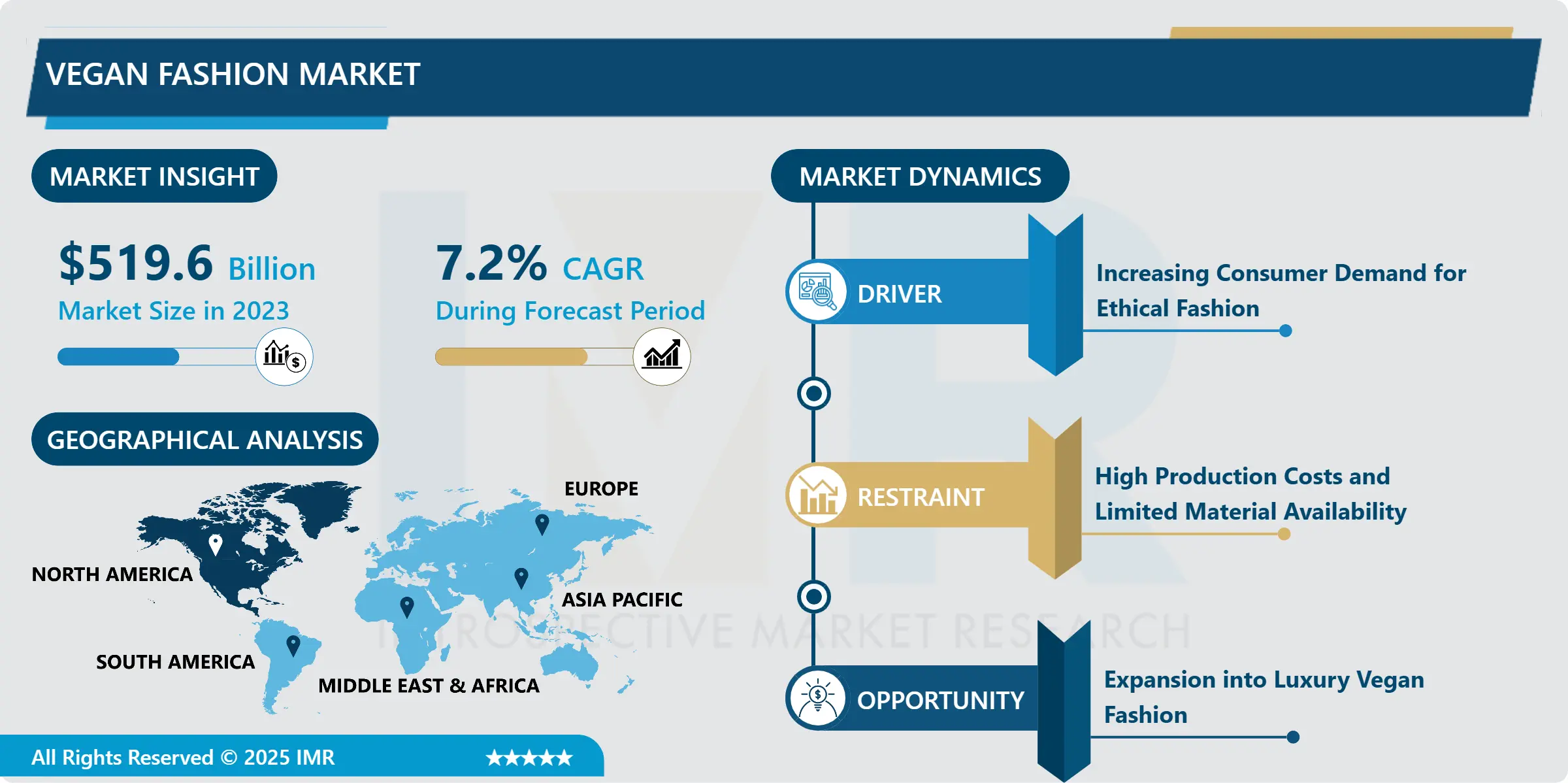
Vegan Fashion Market Size Was Valued at USD 519.6 Billion in 2023, and is Projected to Reach USD 971.5 Billion by 2032, Growing at a CAGR of 7.2% From 2024-2032.
The vegan fashion market concerns the part of the fashion industry that entertains non-leather, non-silk, non-wool, or feather products clothing, shoes, and accessories. Rather such products are manufactured from non animal originating materials as well as synthetic materials with no issues of ill treating animals, animal skin and fur usage as well as effects on the environment. Due to the increasing concern of consumers to opt for the vegan products the Vegan fashion market has experienced a hike and several business houses are bringing in the ETHICAL & SUSTAINABLE fashion clothing.
The specialty market related to vegan fashion has been gradually developing throughout the years due to people’s growing concern with animal suffering, environmental problems, and the impact that textile production has on the planet. Prompted by increasing vegan activism and concerns for animal rights, more and more people want their clothes and accessories not to incorporate traits of animal misery. The market is growing due to new materials like Piñatex: leather substitute made from the pineapple fiber and other plant derived materials including hemp, cotton and bamboo. These innovations do not only serve as products for vegans-only but also for persons who wish to be environmentally friendly and do not have the option of the conventional materials used in fashion and textile industries.
For vegan fashion on the global market it is possible to predict the further increase due to trends for sustainable products as the customers’ priorities. Current trends indicated that many popular fashion brands and retailers are gradually emerging with vegan products. Vegan fashion has also benefited from social media in that, people have embraced change by volunteering on social media to support veganism while fashion designers have been encouraged to produce vegan clothing. In addition, there are efforts to merge vegan fashion brands with high-end designers, these collaborations are trying to knock down the divide between high-quality fashion and non-cruelty fashion.
However, the vegan fashion market is not without its problems, which include inadequate material supply, high costs of production, and market unfamiliarity. However, the burgeoning interest from brands to incorporate sustainable material usage into their products and the on-going innovations in affordable vegan fabrics are fueling market growth. Fashion business is also observing new certification and badges for vegan and non-cruelty products that help the ongoing segment of ethical clothing.
Vegan Fashion Market Trend Analysis
Rise of Sustainable Materials
The trend of the vegan fashion market is also observed by the fact of active involvement and search for new solutions in the direction of sustainable material production and use. This change is about the environmental sustainability of conventional garments textiles particularly leather, wool, and silk. It is also possible to see companies are shifting to environment-friendly and vegan materials includes Piñatex, mushroom leather, recycled plastics, etc. They make these products which not only have less impact on the environment but also allow the consumer to have a wider choice of appealing and long-lasting materials. Sustainability is the new norm in consumer market demands, and the fashion industry is also growing close to matching the sustainable innovation and inclusion in the products.
That is why such inventions in textile science contribute to the production of vegan fabric which has the same characteristics as and or is similar to leather and suede materials. This trend is in harmony with the rising consumer consciousness of the need to buy products that are both appropriately certified and eco-friendly. As a result of the heightened need for ethical fashion and greener materials, consumers have more environmentally friendly clothing material at their disposal, and as brands keep embracing the materials, the future of ethical materials appears to be bright.
Expansion into Luxury Vegan Fashion
The identification of the vegan fashion market indicates that the luxury fashion business has an untapped chance to increase its supply of responsible clothing. Classically, luxury fashion products imply the usage of animal-derived materials, however, now more and more famous designers and brands experiment with vegan ones. It means that introducing cruelty-free fabrics, utilization of environmental resources in production and using green packaging luxury fashion brands can reach out to a new generation consumer who are demanding more than just luxury but ethical luxury. With this market opportunity, luxury brands can further expand their market segment and also establish themselves as pioneers of the change toward sustainable fashion.
The invasion of vegan fashion to the luxury market has already commenced thru collaborations with famous designers and vegan fashion companies. All of these partnerships can contribute to the legitimation of vegan fashion in the luxury segment as well as to raise awareness among the new wealthy generation, which is more and more conscious of sustainability. The luxury vegan fashion market will also proceed to expand for the same reason, new-generation wealthy individuals is open to spending their money on quality, eco-friendly, and non-leather articles. This creates a great opportunity for luxury fashion merchants to take the lead role in providing a cheaper and socially transformed product portfolio.
Vegan Fashion Market Segment Analysis:
Vegan Fashion Market Segmented on the basis of Product Type, Material Type, Distribution Channel, Price Range, Application, End User, and Region.
By Product Type, Apparel segment is expected to dominate the market during the forecast period
Apparel: Vegan clothes okay, cloaks, and wraps are already the biggest segment of the vegan fashion market. It encompasses those produced from organic natural fabrics or synthetic fabrics or those that are produced from new age fabrics such as Pinatex or Mushroom leather. Since the importance of eco-friendly and animal-friendly clothing is rising steadily, vegan clothing brands are gradually becoming popular, and they sell products that include jackets, trousers, shirts, dresses, etc. Such products are popular among consumers who are in search of the ethical fashion products different from those wellofashioned clothes. Footwear: The vegan population reached the footwear industry and animal-free leather and other synthetic materials’ demand. There are now quality vegan shoes, boots, and sandals, which are designed with recycled plastics, plant leather, and non-hazardous dye. The vegan shoes not only appeals the animal sensitive customers but also to those who seek for long lasting quality shoes with minimal impacts on environment.
Accessories (Bags, Belts, etc.): Vegan products such as hand bags, belts and wallets are also quickly growing within the market space. These products are developed using substitutes like cork, recycled materials, as well as plant base leathers meaning that consumers have style and animal friendly merchandise. Increasing use of vegan accessories is an addition to the general trends toward the use of sustainable and ethically-sourced products in fashion. Others: This category covers other vegan fashion accessories like the vegan jewelries, vegan caps, vegan scarfs and other accessories. These products are emerging as shoppers start to focus on ethical and sustainable solutions for all purchasing regions related to fashion.
By Application, Casual Wear segment expected to held the largest share
asual Wear: Vegan casual wear refers to attainable and wearable items such as t-shirts, jeans, sweatshirts, and leggings that are made from eco-friendly materials. Due to the increasing consumer awareness of ethical fashion casual vegan wear is experiencing a boost. These products fit the current need for easy wear, animal-friendly, and sustainable fashion items. Formal Wear: A variety of brands are already starting to incorporate selections of vegan formal wear as more choices for formal wear are becoming available. This includes vegan suits, vegan dresses, and vegan blouses that are made from new materials such as organic cotton, hemp or recycled synthetic fibers. Since ethical fashion is slowly gaining appositive response, vegan formal wear is also set to rise as people wish to continue being vegN in formal events as well.
Sportswear: Other rising segments within the scope concern vegan sportswear performance. Such products include fashionable sports wears such as leggings, and sports bras and shoes for runners manufactured from sustainable materials without the use of animal materials. Since more and more people start to lead an active and ethical life, the consumption of vegan sportswear is likely to be in demand.Outerwear: Jackets, coats, and sweaters in vegan materials or LYCRA contributes to an important segment of the vegan fashion industry. Today there are hundreds of aesthetic and practical outerwear designs that have been made from vegan materials such as fake leather, down, and innovative synthetics. Since cold-weather clothing has long depended on animal-related elements, vegan jackets offer consumer options that are moral and sassy, to boot.
Vegan Fashion Market Regional Insights:
North America is Expected to Dominate the Market Over the Forecast period
North America currently leads the vegan fashion market majorly due to increasing customer consciousness of integrity and ethic amenities such as animal rights. Among the growing trends, the inhabitants of the U.S. and Canada expand the consumption of ethical and vegan products since lots of consumers switched to plant-based diets and similar lifestyles. New York, Los Angeles and Toronto are particularly popular in vegan fashion, primarily because there is an increasing number of vegan brands whose influence is being increasingly keenly felt in the market. With a strong retail presence and a large target populace, apprehensions for the environment also put North America on the global map as the primary market for vegan fashion.
And the fact of the growth of the number of fashion brands in North America is also putting on the region’s advantage. Big designers are now incorporating vegan materials in their collections, while new emerging brands are focusing on sustainability and a no-leather policy, and social media personalities support these causes. Furthermore, more North American fashion weeks and events showcase vegan collections; the place is securely on top of the vegan fashion market. The region is envisaged to sustain its position as consumer switch to more ethical and sustainable fashion products and styles.
Active Key Players in the Vegan Fashion Market:
Stella McCartney (UK)
Matt & Nat (Canada)
Vaute Couture (USA)
Peta (USA)
Bourgeois Boheme (UK)
Toms (USA)
Adidas (Germany)
Nike (USA)
Reebok (USA)
Allbirds (USA)
Nanushka (Hungary)
Dr. Martens (UK)
Other Active Players
Key Industry Developments in the Vegan Fashion Market:
In May 2024, Hylo Athletics and BLOOM Paris are at the forefront of sustainable and vegan footwear offerings, catering to consumers who prioritize eco-conscious and cruelty-free fashion choices. Hylo Athletics distinguishes itself by crafting sneakers from renewable materials sourced from sustainable origins. These materials may include recycled plastics, organic cotton, natural rubber, and innovative plant- based alternatives like pineapple leaf fibers or mushroom leather.
Chapter 1: Introduction
1.1 Scope and Coverage
Chapter 2:Executive Summary
Chapter 3: Market Landscape
3.1 Market Dynamics
3.1.1 Drivers
3.1.2 Restraints
3.1.3 Opportunities
3.1.4 Challenges
3.2 Market Trend Analysis
3.3 PESTLE Analysis
3.4 Porter’s Five Forces Analysis
3.5 Industry Value Chain Analysis
3.6 Ecosystem
3.7 Regulatory Landscape
3.8 Price Trend Analysis
3.9 Patent Analysis
3.10 Technology Evolution
3.11 Investment Pockets
3.12 Import-Export Analysis
Chapter 4: Vegan Fashion Market by Service Type
4.1 Vegan Fashion Market Snapshot and Growth Engine
4.2 Vegan Fashion Market Overview
4.3 Towing
4.3.1 Introduction and Market Overview
4.3.2 Historic and Forecasted Market Size in Value USD and Volume Units (2017-2032F)
4.3.3 Key Market Trends, Growth Factors and Opportunities
4.3.4 Towing: Geographic Segmentation Analysis
4.4 Tire Change
4.4.1 Introduction and Market Overview
4.4.2 Historic and Forecasted Market Size in Value USD and Volume Units (2017-2032F)
4.4.3 Key Market Trends, Growth Factors and Opportunities
4.4.4 Tire Change: Geographic Segmentation Analysis
4.5 Fuel Delivery
4.5.1 Introduction and Market Overview
4.5.2 Historic and Forecasted Market Size in Value USD and Volume Units (2017-2032F)
4.5.3 Key Market Trends, Growth Factors and Opportunities
4.5.4 Fuel Delivery: Geographic Segmentation Analysis
4.6 Lockout Assistance
4.6.1 Introduction and Market Overview
4.6.2 Historic and Forecasted Market Size in Value USD and Volume Units (2017-2032F)
4.6.3 Key Market Trends, Growth Factors and Opportunities
4.6.4 Lockout Assistance: Geographic Segmentation Analysis
4.7 Battery Assistance
4.7.1 Introduction and Market Overview
4.7.2 Historic and Forecasted Market Size in Value USD and Volume Units (2017-2032F)
4.7.3 Key Market Trends, Growth Factors and Opportunities
4.7.4 Battery Assistance: Geographic Segmentation Analysis
4.8 Others
4.8.1 Introduction and Market Overview
4.8.2 Historic and Forecasted Market Size in Value USD and Volume Units (2017-2032F)
4.8.3 Key Market Trends, Growth Factors and Opportunities
4.8.4 Others: Geographic Segmentation Analysis
Chapter 5: Vegan Fashion Market by Provider Type
5.1 Vegan Fashion Market Snapshot and Growth Engine
5.2 Vegan Fashion Market Overview
5.3 In-house
5.3.1 Introduction and Market Overview
5.3.2 Historic and Forecasted Market Size in Value USD and Volume Units (2017-2032F)
5.3.3 Key Market Trends, Growth Factors and Opportunities
5.3.4 In-house: Geographic Segmentation Analysis
5.4 Outsourced
5.4.1 Introduction and Market Overview
5.4.2 Historic and Forecasted Market Size in Value USD and Volume Units (2017-2032F)
5.4.3 Key Market Trends, Growth Factors and Opportunities
5.4.4 Outsourced: Geographic Segmentation Analysis
Chapter 6: Vegan Fashion Market by End-User
6.1 Vegan Fashion Market Snapshot and Growth Engine
6.2 Vegan Fashion Market Overview
6.3 Individual
6.3.1 Introduction and Market Overview
6.3.2 Historic and Forecasted Market Size in Value USD and Volume Units (2017-2032F)
6.3.3 Key Market Trends, Growth Factors and Opportunities
6.3.4 Individual: Geographic Segmentation Analysis
6.4 Fleet Owners
6.4.1 Introduction and Market Overview
6.4.2 Historic and Forecasted Market Size in Value USD and Volume Units (2017-2032F)
6.4.3 Key Market Trends, Growth Factors and Opportunities
6.4.4 Fleet Owners: Geographic Segmentation Analysis
6.5 Insurance Companies
6.5.1 Introduction and Market Overview
6.5.2 Historic and Forecasted Market Size in Value USD and Volume Units (2017-2032F)
6.5.3 Key Market Trends, Growth Factors and Opportunities
6.5.4 Insurance Companies: Geographic Segmentation Analysis
Chapter 7: Company Profiles and Competitive Analysis
7.1 Competitive Landscape
7.1.1 Competitive Benchmarking
7.1.2 Vegan Fashion Market Share by Manufacturer (2023)
7.1.3 Industry BCG Matrix
7.1.4 Heat Map Analysis
7.1.5 Mergers and Acquisitions
7.2 STELLA MCCARTNEY (UK)
7.2.1 Company Overview
7.2.2 Key Executives
7.2.3 Company Snapshot
7.2.4 Role of the Company in the Market
7.2.5 Sustainability and Social Responsibility
7.2.6 Operating Business Segments
7.2.7 Product Portfolio
7.2.8 Business Performance
7.2.9 Key Strategic Moves and Recent Developments
7.2.10 SWOT Analysis
7.3 MATT & NAT (CANADA)
7.4 VAUTE COUTURE (USA)
7.5 PETA (USA)
7.6 BOURGEOIS BOHEME (UK)
7.7 TOMS (USA)
7.8 ADIDAS (GERMANY)
7.9 NIKE (USA)
7.10 REEBOK (USA)
7.11 ALLBIRDS (USA)
7.12 NANUSHKA (HUNGARY)
7.13 DR. MARTENS (UK)
7.14 OTHER ACTIVE PLAYERS
Chapter 8: Global Vegan Fashion Market By Region
8.1 Overview
8.2. North America Vegan Fashion Market
8.2.1 Key Market Trends, Growth Factors and Opportunities
8.2.2 Top Key Companies
8.2.3 Historic and Forecasted Market Size by Segments
8.2.4 Historic and Forecasted Market Size By Service Type
8.2.4.1 Towing
8.2.4.2 Tire Change
8.2.4.3 Fuel Delivery
8.2.4.4 Lockout Assistance
8.2.4.5 Battery Assistance
8.2.4.6 Others
8.2.5 Historic and Forecasted Market Size By Provider Type
8.2.5.1 In-house
8.2.5.2 Outsourced
8.2.6 Historic and Forecasted Market Size By End-User
8.2.6.1 Individual
8.2.6.2 Fleet Owners
8.2.6.3 Insurance Companies
8.2.7 Historic and Forecast Market Size by Country
8.2.7.1 US
8.2.7.2 Canada
8.2.7.3 Mexico
8.3. Eastern Europe Vegan Fashion Market
8.3.1 Key Market Trends, Growth Factors and Opportunities
8.3.2 Top Key Companies
8.3.3 Historic and Forecasted Market Size by Segments
8.3.4 Historic and Forecasted Market Size By Service Type
8.3.4.1 Towing
8.3.4.2 Tire Change
8.3.4.3 Fuel Delivery
8.3.4.4 Lockout Assistance
8.3.4.5 Battery Assistance
8.3.4.6 Others
8.3.5 Historic and Forecasted Market Size By Provider Type
8.3.5.1 In-house
8.3.5.2 Outsourced
8.3.6 Historic and Forecasted Market Size By End-User
8.3.6.1 Individual
8.3.6.2 Fleet Owners
8.3.6.3 Insurance Companies
8.3.7 Historic and Forecast Market Size by Country
8.3.7.1 Russia
8.3.7.2 Bulgaria
8.3.7.3 The Czech Republic
8.3.7.4 Hungary
8.3.7.5 Poland
8.3.7.6 Romania
8.3.7.7 Rest of Eastern Europe
8.4. Western Europe Vegan Fashion Market
8.4.1 Key Market Trends, Growth Factors and Opportunities
8.4.2 Top Key Companies
8.4.3 Historic and Forecasted Market Size by Segments
8.4.4 Historic and Forecasted Market Size By Service Type
8.4.4.1 Towing
8.4.4.2 Tire Change
8.4.4.3 Fuel Delivery
8.4.4.4 Lockout Assistance
8.4.4.5 Battery Assistance
8.4.4.6 Others
8.4.5 Historic and Forecasted Market Size By Provider Type
8.4.5.1 In-house
8.4.5.2 Outsourced
8.4.6 Historic and Forecasted Market Size By End-User
8.4.6.1 Individual
8.4.6.2 Fleet Owners
8.4.6.3 Insurance Companies
8.4.7 Historic and Forecast Market Size by Country
8.4.7.1 Germany
8.4.7.2 UK
8.4.7.3 France
8.4.7.4 The Netherlands
8.4.7.5 Italy
8.4.7.6 Spain
8.4.7.7 Rest of Western Europe
8.5. Asia Pacific Vegan Fashion Market
8.5.1 Key Market Trends, Growth Factors and Opportunities
8.5.2 Top Key Companies
8.5.3 Historic and Forecasted Market Size by Segments
8.5.4 Historic and Forecasted Market Size By Service Type
8.5.4.1 Towing
8.5.4.2 Tire Change
8.5.4.3 Fuel Delivery
8.5.4.4 Lockout Assistance
8.5.4.5 Battery Assistance
8.5.4.6 Others
8.5.5 Historic and Forecasted Market Size By Provider Type
8.5.5.1 In-house
8.5.5.2 Outsourced
8.5.6 Historic and Forecasted Market Size By End-User
8.5.6.1 Individual
8.5.6.2 Fleet Owners
8.5.6.3 Insurance Companies
8.5.7 Historic and Forecast Market Size by Country
8.5.7.1 China
8.5.7.2 India
8.5.7.3 Japan
8.5.7.4 South Korea
8.5.7.5 Malaysia
8.5.7.6 Thailand
8.5.7.7 Vietnam
8.5.7.8 The Philippines
8.5.7.9 Australia
8.5.7.10 New Zealand
8.5.7.11 Rest of APAC
8.6. Middle East & Africa Vegan Fashion Market
8.6.1 Key Market Trends, Growth Factors and Opportunities
8.6.2 Top Key Companies
8.6.3 Historic and Forecasted Market Size by Segments
8.6.4 Historic and Forecasted Market Size By Service Type
8.6.4.1 Towing
8.6.4.2 Tire Change
8.6.4.3 Fuel Delivery
8.6.4.4 Lockout Assistance
8.6.4.5 Battery Assistance
8.6.4.6 Others
8.6.5 Historic and Forecasted Market Size By Provider Type
8.6.5.1 In-house
8.6.5.2 Outsourced
8.6.6 Historic and Forecasted Market Size By End-User
8.6.6.1 Individual
8.6.6.2 Fleet Owners
8.6.6.3 Insurance Companies
8.6.7 Historic and Forecast Market Size by Country
8.6.7.1 Turkiye
8.6.7.2 Bahrain
8.6.7.3 Kuwait
8.6.7.4 Saudi Arabia
8.6.7.5 Qatar
8.6.7.6 UAE
8.6.7.7 Israel
8.6.7.8 South Africa
8.7. South America Vegan Fashion Market
8.7.1 Key Market Trends, Growth Factors and Opportunities
8.7.2 Top Key Companies
8.7.3 Historic and Forecasted Market Size by Segments
8.7.4 Historic and Forecasted Market Size By Service Type
8.7.4.1 Towing
8.7.4.2 Tire Change
8.7.4.3 Fuel Delivery
8.7.4.4 Lockout Assistance
8.7.4.5 Battery Assistance
8.7.4.6 Others
8.7.5 Historic and Forecasted Market Size By Provider Type
8.7.5.1 In-house
8.7.5.2 Outsourced
8.7.6 Historic and Forecasted Market Size By End-User
8.7.6.1 Individual
8.7.6.2 Fleet Owners
8.7.6.3 Insurance Companies
8.7.7 Historic and Forecast Market Size by Country
8.7.7.1 Brazil
8.7.7.2 Argentina
8.7.7.3 Rest of SA
Chapter 9 Analyst Viewpoint and Conclusion
9.1 Recommendations and Concluding Analysis
9.2 Potential Market Strategies
Chapter 10 Research Methodology
10.1 Research Process
10.2 Primary Research
10.3 Secondary Research
Q1: What would be the forecast period in the Vegan Fashion Market research report?
A1: The forecast period in the Vegan Fashion Market research report is 2024-2032.
Q2: Who are the key players in the Vegan Fashion Market?
A2: Stella McCartney (UK), Matt & Nat (Canada), Vaute Couture (USA), PETA (USA), Bourgeois Boheme (UK), Toms (USA), and Other Major Players.
Q3: What are the segments of the Vegan Fashion Market?
A3: The Vegan Fashion Market is segmented into Type, Material Type, Distribution Channel, Price Range, Application, End User and region. By Product Type, the market is categorized into Apparel, Footwear, Accessories (Bags, Belts, etc.), and Others (Hats, Jewelry, etc.). By Material Type, the market is categorized into Vegan Leather, Organic Cotton, Hemp, Recycled Fabrics, Tencel, and Other. By End-User, the market is categorized into Men, Women, Unisex. By Distribution Channel, the market is categorized into Online Retail, Offline Retail (Physical Stores), Direct-to-Consumer. By Price Range, the market is categorized into Premium, Mid-range, Economy. By Application, the market is categorized into Casual Wear, Formal Wear, Sportswear, Outerwear, Other. By region, it is analyzed across North America (U.S., Canada, Mexico), Eastern Europe (Russia, Bulgaria, The Czech Republic, Hungary, Poland, Romania, Rest of Eastern Europe), Western Europe (Germany, UK, France, The Netherlands, Italy, Spain, Rest of Western Europe), Asia Pacific (China, India, Japan, South Korea, Malaysia, Thailand, Vietnam, The Philippines, Australia, New-Zealand, Rest of APAC), Middle East & Africa (Turkiye, Bahrain, Kuwait, Saudi Arabia, Qatar, UAE, Israel, South Africa), South America (Brazil, Argentina, Rest of SA).
Q4: What is the Vegan Fashion Market?
A4: The vegan fashion market concerns the part of the fashion industry that entertains non-leather, non-silk, non-wool, or feather products clothing, shoes, and accessories. Rather such products are manufactured from non-animal originating materials as well as synthetic materials with no issues of ill-treating animals, animal skin and fur usage as well as effects on the environment. Due to the increasing concern of consumers to opt for vegan products, the Vegan fashion market has experienced a hike, and several business houses are bringing in the ETHICAL & SUSTAINABLE fashion clothing.
Q5: How big is the Vegan Fashion Market?
A5: Vegan Fashion Market Size Was Valued at USD 519.6 Billion in 2023, and is Projected to Reach USD 971.5 Billion by 2032, Growing at a CAGR of 7.2% From 2024-2032.
How to Buy a Report from eminsights.jp
On the product page, choose the license you want: Single-User License, Multi-User License or Enterprise License.
If you required report in your native language, then you can click on Translated Report button and fill out the form with report name and language you want, then our team will contact you as soon as possible.
Click the Buy Now button.
You will be redirected to the checkout page. Enter your company details and payment information.
Click Place Order to complete the purchase.
Confirmation: You’ll receive an order confirmation and our team will contact you shortly with your ordered report.
If you have any questions, fill out the contact form below or email us at bizdev@eminsights.net.
Thank you for choosing eminsights.jp!