Stay Ahead in Fast-Growing Economies.
Browse Reports Now
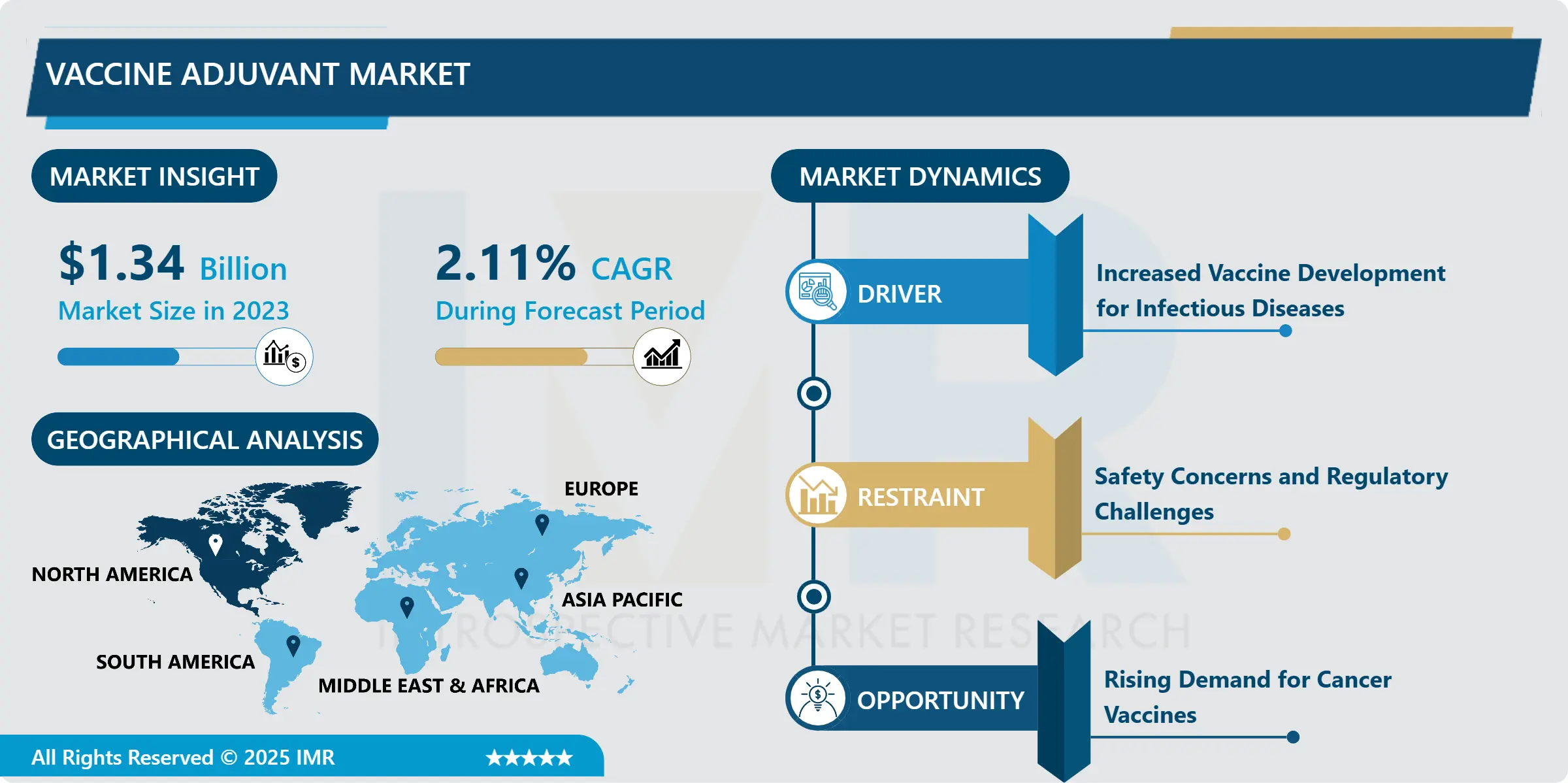
Vaccine Adjuvant Market Growth Analysis & Forecast (2024-2032)
The global vaccine adjuvant market is now growing steadily as one of key contributors in vaccine formulation, majorly due to a desire for improved vaccine efficacy, especially against new emerging diseases and increasing global vaccine utilization. Cosubstances are employed widely in vacinne preventives as well as the treatment vaccines in order to improve outcomes and effectiveness of vaccines per unit antigen employed.

IMR Group
Description
Vaccine Adjuvant Market Synopsis:
Vaccine Adjuvant Market Size Was Valued at USD 1.34 Billion in 2023, and is Projected to Reach USD 1.62 Billion by 2032, Growing at a CAGR of 2.11% From 2024-2032.
An adjuvant is a component added to vaccines to boost the immune response to the antigen offered to the body. They enhance the intensity, breadth and sustainability of the immune response, if the administration of the antigen alone does not present an effective response for the immune system. co-solvents are important in enhancing the effectiveness of vaccines and especially in special groups of people like the elderly and the compromised.
The global vaccine adjuvant market is now growing steadily as one of key contributors in vaccine formulation, majorly due to a desire for improved vaccine efficacy, especially against new emerging diseases and increasing global vaccine utilization. Cosubstances are employed widely in vacinne preventives as well as the treatment vaccines in order to improve outcomes and effectiveness of vaccines per unit antigen employed. By using adjuvants like aluminum salt, oil emulsion, liposomes, muramyl dipeptides, and saponins are attached more to satisfy some qualities provided by the different types of vaccines and the type of disease control desired.
Factors that have led to this demand include increased global rate in infectious diseases, including the COVID-19, the need to have better vaccines for diseases like malaria, tuberculosis and cancers, among others. In addition as more players enter this market they are preferring to launch the adjuvants which are safer and which are less likely to cause side effects. The idea of using adjuvants is specifically important as the development of biotechnology and the tendency towards the usage of personalized medicine in the market.
The vaccinum adjuvant market is also influenced by the regulatory standard that are in placed in respective countries. National ministries of health, and international agencies such as WHO have reassured the public and are constantly providing new protocols for safe exploitation of adjuvants in the vaccine production process. A large part of the growth comes from the government’s funding in research and development, combined with funding from the private sector. Nonetheless, issues about safety, toxicity or the technical natured of synthesizing some of the adjuvants remain some of the biggest obstacles in large scale application of some of the adjuvants.
Vaccine Adjuvant Market Trend Analysis:
Advancements in Adjuvant Development
There is a strong and increasing tendency towards the further improvement of new adjuvants in the market of vaccine adjuvants. Scientists are searching for enhanced scientific solutions for a higher rate of immunization, including in conditions of high-risk diseases. For example, the use of nanoparticle, lipid nanoparticle, micro and nano emulsion-based adjuvants drawn attention due to their ability to preserve and stimulate the stability and immunogenicity of the vaccines respectively. These developments make it possible to deliver precise immune stimuli that will reduce the amount of antigen required and may also decrease side effects.
Also, there is a general movement toward the creation of universal adjuvants that can apply not only to infectious diseases, but to cancer and other diseases as well. These adjuvants are being designed to act in a certain manner upon the immune system and hold promise as better weapons in the worldwide crusade against cancer, autoimmune diseases, and other chronic illnesses. The fact that product development and research on new adjuvant technologies remain active and ongoing; we shall continue to see them driving the growth of the market in the years to come.
Rising Demand for Cancer Vaccines
Another promising trend in the vaccine adjuvant markets is the development of the market of cancer vaccines. Due to the continuous increase in the spread of cancer all over the world it becomes more and more important to create vaccines that could protect against or treat different forms of cancer. There is a necessity to use adjuvants in cancer vaccines so that the immune reaction of the organism which occurs with the help of cancer vaccines can work effectively in distinguishing cancer cells and destroying them. Its innovative concepts such as combination with adjuvants of popularly individualized cancer vaccines which work at the antigens regarded as characteristic of given tumor cell line are considered to be prospective for market development.
Opportunities for adjuvants in cancer vaccines have been inspired due to the progress in Immunotherapy and the emergent popularity of personalized medicine. Most of the prospective vaccines are already in different phases of clinical trials such as therapeutic cancer vaccines and adjuvants play an important role in getting the best results from these vaccines. This opportunity is further substantiated by the rising tendency of private businesses as well as government bodies to support and invest in cancer vaccine production that should help the vaccine adjuvant market grow.
Vaccine Adjuvant Market Segment Analysis:
Vaccine Adjuvant Market is Segmented on the basis of Type, Technology, Rout of Administration, Application, End User, and Region.
By Type, Aluminum Salts segment is expected to dominate the market during the forecast period
The market for vaccines adjuvants is divided according to the type of adjuvant coupled with the vaccine. The most commonly used aluminum salts in the manufacture of vaccines are aluminum hydroxide and aluminum phosphate and are preferred for use in pediatric vaccines. These adjuvants tend to have been found to improve the immune response since they act on the innate immunity system. Aluminium containing adjuvants are very effective in initiating humoral response and are incorporated in many vaccines used to control diseases such as hepatitis B and diphtheria.
Oil based emulsions are another widely used class of adjuvants including MF59 and AS03, which provide boost to both types of immunity. These adjuvants are most effective in vaccines for influenza and other viral diseases. Liposomes which are lipid vesicles are or value also because they enhance the stability and transports of the vaccines mainly the lipid soluble antigens. Muramyl dipeptides, extracted from bacterial cell walls, and saponin, which are plant products, are processed into various vaccines and used because of their immuno-stimulating properties that preferentially induce certain cytokine profiles.
By Application, Infectious Diseases segment expected to held the largest share
When it comes to application, the vaccine adjuvant market is greatly dominated by the application used in infectious disease vaccines. Flu, COVID 19 and Hepatitis are some of the most targeted viral infections in the development of a vaccine. These adjuvants encourage an adequate immune response to the disease in the vaccines hence they are very important for people with weaker immunity such as the old and those with diseases such as diabetes and HIV/AIDS. COVID has especially brought us to realize the efficacy of adjuvants in responding to emergent pathogens in the development of vaccines.
Cancer is another important domain in the usage of Vaccine adjuvants. In therapeutic cancer vaccines adjuvants are employed to enhance an immune response that can identify cancer cells and kill them. Cancer vaccines are still at this stage considered to be in their infancy, but promising results, particularly with integrating the concept of personalized medicine, can help to greatly advance the field. Other uses of this vaccine adjuvants are in creation of vaccines for allergy, auto-immune diseases as well as other diseases, that are not infectious in nature, where adjuvants can enhance the performance as well as safety of treatment.
Vaccine Adjuvant Market Regional Insights:
North America is Expected to Dominate the Market Over the Forecast period
North America is the largest consumer of the vaccine adjuvant market owing to well-developed healthcare sector, high funding on the pharmaceuticals research and development, and favourable regulatory policies. The United States, for instance has many vaccines, major brands, and research facilities working on developing new vaccines and adjuvants. The decision to include new vaccine adjuvants in preventive vaccines is made by the respective national bodies, helped by the international regulatory agencies like the Food and Drug Administration (FDA).
Hence, the growing concern of using vaccines due to infectious diseases and cancer immunotherapies also drives the growth of the Vaccine Adjuvant market in North America. Quality research funding by the government through initiatives such as vaccine development and pandamic prevention, coupled by adequate partnership between the public and the private sectors provides favorable market for expansion. With the continuous advancements in the vaccine production North America is set to retain its dominating position in the global Vaccine Adjuvant market.
Active Key Players in the Vaccine Adjuvant Market
Adjuvance Technologies (USA)
Astellas Pharma Inc. (Japan)
Baxter International Inc. (USA)
GSK (UK)
Hapten Pharmaceuticals (USA)
MedImmune (USA)
Merck & Co. (USA)
Novavax (USA)
Pfizer Inc. (USA)
Sanofi (France)
Sigma-Aldrich (USA)
Valneva SE (France)
Other Active Players.
Chapter 1: Introduction
1.1 Scope and Coverage
Chapter 2:Executive Summary
Chapter 3: Market Landscape
3.1 Market Dynamics
3.1.1 Drivers
3.1.2 Restraints
3.1.3 Opportunities
3.1.4 Challenges
3.2 Market Trend Analysis
3.3 PESTLE Analysis
3.4 Porter’s Five Forces Analysis
3.5 Industry Value Chain Analysis
3.6 Ecosystem
3.7 Regulatory Landscape
3.8 Price Trend Analysis
3.9 Patent Analysis
3.10 Technology Evolution
3.11 Investment Pockets
3.12 Import-Export Analysis
Chapter 4: Vaccine Adjuvant Market by Technology Type
4.1 Vaccine Adjuvant Market Snapshot and Growth Engine
4.2 Vaccine Adjuvant Market Overview
4.3 Conventional Vaccine Technology
4.3.1 Introduction and Market Overview
4.3.2 Historic and Forecasted Market Size in Value USD and Volume Units (2017-2032F)
4.3.3 Key Market Trends, Growth Factors and Opportunities
4.3.4 Conventional Vaccine Technology: Geographic Segmentation Analysis
4.4 Recombinant Vaccine Technology
4.4.1 Introduction and Market Overview
4.4.2 Historic and Forecasted Market Size in Value USD and Volume Units (2017-2032F)
4.4.3 Key Market Trends, Growth Factors and Opportunities
4.4.4 Recombinant Vaccine Technology: Geographic Segmentation Analysis
4.5 DNA and RNA Vaccine Technology
4.5.1 Introduction and Market Overview
4.5.2 Historic and Forecasted Market Size in Value USD and Volume Units (2017-2032F)
4.5.3 Key Market Trends, Growth Factors and Opportunities
4.5.4 DNA and RNA Vaccine Technology: Geographic Segmentation Analysis
4.6 Viral Vector Vaccine Technology
4.6.1 Introduction and Market Overview
4.6.2 Historic and Forecasted Market Size in Value USD and Volume Units (2017-2032F)
4.6.3 Key Market Trends, Growth Factors and Opportunities
4.6.4 Viral Vector Vaccine Technology: Geographic Segmentation Analysis
4.7 Protein Subunit
4.7.1 Introduction and Market Overview
4.7.2 Historic and Forecasted Market Size in Value USD and Volume Units (2017-2032F)
4.7.3 Key Market Trends, Growth Factors and Opportunities
4.7.4 Protein Subunit: Geographic Segmentation Analysis
4.8 Vaccine Technology
4.8.1 Introduction and Market Overview
4.8.2 Historic and Forecasted Market Size in Value USD and Volume Units (2017-2032F)
4.8.3 Key Market Trends, Growth Factors and Opportunities
4.8.4 Vaccine Technology: Geographic Segmentation Analysis
4.9 Others
4.9.1 Introduction and Market Overview
4.9.2 Historic and Forecasted Market Size in Value USD and Volume Units (2017-2032F)
4.9.3 Key Market Trends, Growth Factors and Opportunities
4.9.4 Others: Geographic Segmentation Analysis
Chapter 5: Vaccine Adjuvant Market by Application
5.1 Vaccine Adjuvant Market Snapshot and Growth Engine
5.2 Vaccine Adjuvant Market Overview
5.3 Infectious Diseases
5.3.1 Introduction and Market Overview
5.3.2 Historic and Forecasted Market Size in Value USD and Volume Units (2017-2032F)
5.3.3 Key Market Trends, Growth Factors and Opportunities
5.3.4 Infectious Diseases: Geographic Segmentation Analysis
5.4 Cancer
5.4.1 Introduction and Market Overview
5.4.2 Historic and Forecasted Market Size in Value USD and Volume Units (2017-2032F)
5.4.3 Key Market Trends, Growth Factors and Opportunities
5.4.4 Cancer: Geographic Segmentation Analysis
5.5 Others
5.5.1 Introduction and Market Overview
5.5.2 Historic and Forecasted Market Size in Value USD and Volume Units (2017-2032F)
5.5.3 Key Market Trends, Growth Factors and Opportunities
5.5.4 Others: Geographic Segmentation Analysis
Chapter 6: Vaccine Adjuvant Market by End-User
6.1 Vaccine Adjuvant Market Snapshot and Growth Engine
6.2 Vaccine Adjuvant Market Overview
6.3 Hospitals
6.3.1 Introduction and Market Overview
6.3.2 Historic and Forecasted Market Size in Value USD and Volume Units (2017-2032F)
6.3.3 Key Market Trends, Growth Factors and Opportunities
6.3.4 Hospitals: Geographic Segmentation Analysis
6.4 Research Institutes
6.4.1 Introduction and Market Overview
6.4.2 Historic and Forecasted Market Size in Value USD and Volume Units (2017-2032F)
6.4.3 Key Market Trends, Growth Factors and Opportunities
6.4.4 Research Institutes: Geographic Segmentation Analysis
6.5 Government Organizations
6.5.1 Introduction and Market Overview
6.5.2 Historic and Forecasted Market Size in Value USD and Volume Units (2017-2032F)
6.5.3 Key Market Trends, Growth Factors and Opportunities
6.5.4 Government Organizations: Geographic Segmentation Analysis
6.6 Pharmaceutical & Biotechnology Companies
6.6.1 Introduction and Market Overview
6.6.2 Historic and Forecasted Market Size in Value USD and Volume Units (2017-2032F)
6.6.3 Key Market Trends, Growth Factors and Opportunities
6.6.4 Pharmaceutical & Biotechnology Companies: Geographic Segmentation Analysis
Chapter 7: Company Profiles and Competitive Analysis
7.1 Competitive Landscape
7.1.1 Competitive Benchmarking
7.1.2 Vaccine Adjuvant Market Share by Manufacturer (2023)
7.1.3 Industry BCG Matrix
7.1.4 Heat Map Analysis
7.1.5 Mergers and Acquisitions
7.2 NOVAVAX (USA)
7.2.1 Company Overview
7.2.2 Key Executives
7.2.3 Company Snapshot
7.2.4 Role of the Company in the Market
7.2.5 Sustainability and Social Responsibility
7.2.6 Operating Business Segments
7.2.7 Product Portfolio
7.2.8 Business Performance
7.2.9 Key Strategic Moves and Recent Developments
7.2.10 SWOT Analysis
7.3 GSK (UK)
7.4 SANOFI (FRANCE)
7.5 MERCK & CO. (USA)
7.6 PFIZER INC. (USA)
7.7 ASTELLAS PHARMA INC. (JAPAN)
7.8 BAXTER INTERNATIONAL INC. (USA)
7.9 ADJUVANCE TECHNOLOGIES (USA)
7.10 VALNEVA SE (FRANCE)
7.11 HAPTEN PHARMACEUTICALS (USA)
7.12 SIGMA-ALDRICH (USA)
7.13 MEDIMMUNE (USA)
7.14 OTHER ACTIVE PLAYERS
Chapter 8: Global Vaccine Adjuvant Market By Region
8.1 Overview
8.2. North America Vaccine Adjuvant Market
8.2.1 Key Market Trends, Growth Factors and Opportunities
8.2.2 Top Key Companies
8.2.3 Historic and Forecasted Market Size by Segments
8.2.4 Historic and Forecasted Market Size By Technology Type
8.2.4.1 Conventional Vaccine Technology
8.2.4.2 Recombinant Vaccine Technology
8.2.4.3 DNA and RNA Vaccine Technology
8.2.4.4 Viral Vector Vaccine Technology
8.2.4.5 Protein Subunit
8.2.4.6 Vaccine Technology
8.2.4.7 Others
8.2.5 Historic and Forecasted Market Size By Application
8.2.5.1 Infectious Diseases
8.2.5.2 Cancer
8.2.5.3 Others
8.2.6 Historic and Forecasted Market Size By End-User
8.2.6.1 Hospitals
8.2.6.2 Research Institutes
8.2.6.3 Government Organizations
8.2.6.4 Pharmaceutical & Biotechnology Companies
8.2.7 Historic and Forecast Market Size by Country
8.2.7.1 US
8.2.7.2 Canada
8.2.7.3 Mexico
8.3. Eastern Europe Vaccine Adjuvant Market
8.3.1 Key Market Trends, Growth Factors and Opportunities
8.3.2 Top Key Companies
8.3.3 Historic and Forecasted Market Size by Segments
8.3.4 Historic and Forecasted Market Size By Technology Type
8.3.4.1 Conventional Vaccine Technology
8.3.4.2 Recombinant Vaccine Technology
8.3.4.3 DNA and RNA Vaccine Technology
8.3.4.4 Viral Vector Vaccine Technology
8.3.4.5 Protein Subunit
8.3.4.6 Vaccine Technology
8.3.4.7 Others
8.3.5 Historic and Forecasted Market Size By Application
8.3.5.1 Infectious Diseases
8.3.5.2 Cancer
8.3.5.3 Others
8.3.6 Historic and Forecasted Market Size By End-User
8.3.6.1 Hospitals
8.3.6.2 Research Institutes
8.3.6.3 Government Organizations
8.3.6.4 Pharmaceutical & Biotechnology Companies
8.3.7 Historic and Forecast Market Size by Country
8.3.7.1 Russia
8.3.7.2 Bulgaria
8.3.7.3 The Czech Republic
8.3.7.4 Hungary
8.3.7.5 Poland
8.3.7.6 Romania
8.3.7.7 Rest of Eastern Europe
8.4. Western Europe Vaccine Adjuvant Market
8.4.1 Key Market Trends, Growth Factors and Opportunities
8.4.2 Top Key Companies
8.4.3 Historic and Forecasted Market Size by Segments
8.4.4 Historic and Forecasted Market Size By Technology Type
8.4.4.1 Conventional Vaccine Technology
8.4.4.2 Recombinant Vaccine Technology
8.4.4.3 DNA and RNA Vaccine Technology
8.4.4.4 Viral Vector Vaccine Technology
8.4.4.5 Protein Subunit
8.4.4.6 Vaccine Technology
8.4.4.7 Others
8.4.5 Historic and Forecasted Market Size By Application
8.4.5.1 Infectious Diseases
8.4.5.2 Cancer
8.4.5.3 Others
8.4.6 Historic and Forecasted Market Size By End-User
8.4.6.1 Hospitals
8.4.6.2 Research Institutes
8.4.6.3 Government Organizations
8.4.6.4 Pharmaceutical & Biotechnology Companies
8.4.7 Historic and Forecast Market Size by Country
8.4.7.1 Germany
8.4.7.2 UK
8.4.7.3 France
8.4.7.4 The Netherlands
8.4.7.5 Italy
8.4.7.6 Spain
8.4.7.7 Rest of Western Europe
8.5. Asia Pacific Vaccine Adjuvant Market
8.5.1 Key Market Trends, Growth Factors and Opportunities
8.5.2 Top Key Companies
8.5.3 Historic and Forecasted Market Size by Segments
8.5.4 Historic and Forecasted Market Size By Technology Type
8.5.4.1 Conventional Vaccine Technology
8.5.4.2 Recombinant Vaccine Technology
8.5.4.3 DNA and RNA Vaccine Technology
8.5.4.4 Viral Vector Vaccine Technology
8.5.4.5 Protein Subunit
8.5.4.6 Vaccine Technology
8.5.4.7 Others
8.5.5 Historic and Forecasted Market Size By Application
8.5.5.1 Infectious Diseases
8.5.5.2 Cancer
8.5.5.3 Others
8.5.6 Historic and Forecasted Market Size By End-User
8.5.6.1 Hospitals
8.5.6.2 Research Institutes
8.5.6.3 Government Organizations
8.5.6.4 Pharmaceutical & Biotechnology Companies
8.5.7 Historic and Forecast Market Size by Country
8.5.7.1 China
8.5.7.2 India
8.5.7.3 Japan
8.5.7.4 South Korea
8.5.7.5 Malaysia
8.5.7.6 Thailand
8.5.7.7 Vietnam
8.5.7.8 The Philippines
8.5.7.9 Australia
8.5.7.10 New Zealand
8.5.7.11 Rest of APAC
8.6. Middle East & Africa Vaccine Adjuvant Market
8.6.1 Key Market Trends, Growth Factors and Opportunities
8.6.2 Top Key Companies
8.6.3 Historic and Forecasted Market Size by Segments
8.6.4 Historic and Forecasted Market Size By Technology Type
8.6.4.1 Conventional Vaccine Technology
8.6.4.2 Recombinant Vaccine Technology
8.6.4.3 DNA and RNA Vaccine Technology
8.6.4.4 Viral Vector Vaccine Technology
8.6.4.5 Protein Subunit
8.6.4.6 Vaccine Technology
8.6.4.7 Others
8.6.5 Historic and Forecasted Market Size By Application
8.6.5.1 Infectious Diseases
8.6.5.2 Cancer
8.6.5.3 Others
8.6.6 Historic and Forecasted Market Size By End-User
8.6.6.1 Hospitals
8.6.6.2 Research Institutes
8.6.6.3 Government Organizations
8.6.6.4 Pharmaceutical & Biotechnology Companies
8.6.7 Historic and Forecast Market Size by Country
8.6.7.1 Turkiye
8.6.7.2 Bahrain
8.6.7.3 Kuwait
8.6.7.4 Saudi Arabia
8.6.7.5 Qatar
8.6.7.6 UAE
8.6.7.7 Israel
8.6.7.8 South Africa
8.7. South America Vaccine Adjuvant Market
8.7.1 Key Market Trends, Growth Factors and Opportunities
8.7.2 Top Key Companies
8.7.3 Historic and Forecasted Market Size by Segments
8.7.4 Historic and Forecasted Market Size By Technology Type
8.7.4.1 Conventional Vaccine Technology
8.7.4.2 Recombinant Vaccine Technology
8.7.4.3 DNA and RNA Vaccine Technology
8.7.4.4 Viral Vector Vaccine Technology
8.7.4.5 Protein Subunit
8.7.4.6 Vaccine Technology
8.7.4.7 Others
8.7.5 Historic and Forecasted Market Size By Application
8.7.5.1 Infectious Diseases
8.7.5.2 Cancer
8.7.5.3 Others
8.7.6 Historic and Forecasted Market Size By End-User
8.7.6.1 Hospitals
8.7.6.2 Research Institutes
8.7.6.3 Government Organizations
8.7.6.4 Pharmaceutical & Biotechnology Companies
8.7.7 Historic and Forecast Market Size by Country
8.7.7.1 Brazil
8.7.7.2 Argentina
8.7.7.3 Rest of SA
Chapter 9 Analyst Viewpoint and Conclusion
9.1 Recommendations and Concluding Analysis
9.2 Potential Market Strategies
Chapter 10 Research Methodology
10.1 Research Process
10.2 Primary Research
10.3 Secondary Research
Q1: What would be the forecast period in the Vaccine Adjuvant Market research report?
A1: The forecast period in the Vaccine Adjuvant Market research report is 2024-2032.
Q2: Who are the key players in the Vaccine Adjuvant Market?
A2: Novavax (USA), GSK (UK), Sanofi (France), Merck & Co. (USA), Pfizer Inc. (USA), Astellas Pharma Inc. (Japan), Baxter International Inc. (USA), and Other Active Players.
Q3: What are the segments of the Vaccine Adjuvant Market?
A3: The Vaccine Adjuvant Market is segmented into Type, Technology, Rout of Administration, Application, End User and region. By Type, the market is categorized into Aluminum Salts, Oil Emulsions, Liposomes, Muramyl Dipeptides, Saponins, Others. By Application, the market is categorized into Infectious Diseases, Cancer, Others. By Technology, the market is categorized into Emulsion-Based Adjuvants, Lipid-Based Adjuvants, Particulate-Based Adjuvants, Molecular-Based Adjuvants. By Route of Administration, the market is categorized into Injectable, Oral, Nasal, Others. By End-User, the market is categorized into Pharmaceutical Companies, Research Institutes, Others. By region, it is analyzed across North America (U.S., Canada, Mexico), Eastern Europe (Russia, Bulgaria, The Czech Republic, Hungary, Poland, Romania, Rest of Eastern Europe), Western Europe (Germany, UK, France, The Netherlands, Italy, Russia, Spain, Rest of Western Europe), Asia Pacific (China, India, Japan, South Korea, Malaysia, Thailand, Vietnam, The Philippines, Australia, New-Zealand, Rest of APAC), Middle East & Africa (Turkiye, Bahrain, Kuwait, Saudi Arabia, Qatar, UAE, Israel, South Africa), South America (Brazil, Argentina, Rest of SA).
Q4: What is the Vaccine Adjuvant Market?
A4: An adjuvant is a component added to vaccines to boost the immune response to the antigen offered to the body. They enhance the intensity, breadth and sustainability of the immune response, if the administration of the antigen alone does not present an effective response for the immune system. co-solvents are important in enhancing the effectiveness of vaccines and especially in special groups of people like the elderly and the compromised.
Q5: How big is the Vaccine Adjuvant Market?
A5: Vaccine Adjuvant Market Size Was Valued at USD 1.34 Billion in 2023, and is Projected to Reach USD 1.62 Billion by 2032, Growing at a CAGR of 2.11% From 2024-2032.
How to Buy a Report from eminsights.jp
On the product page, choose the license you want: Single-User License, Multi-User License or Enterprise License.
If you required report in your native language, then you can click on Translated Report button and fill out the form with report name and language you want, then our team will contact you as soon as possible.
Click the Buy Now button.
You will be redirected to the checkout page. Enter your company details and payment information.
Click Place Order to complete the purchase.
Confirmation: You’ll receive an order confirmation and our team will contact you shortly with your ordered report.
If you have any questions, fill out the contact form below or email us at bizdev@eminsights.net.
Thank you for choosing eminsights.jp!