Stay Ahead in Fast-Growing Economies.
Browse Reports Now




Uterine Fibroid Treatment Market Driven Growth & Industry Forecast (2024–2032)
Uterine fibroid treatment market addresses the medical therapies and management methods – medicinal, surgical and non-pharmacological – that seek to cure or mitigate the effects of uterine fibroids.

IMR Group
Description
Uterine Fibroid Treatment Market Synopsis:
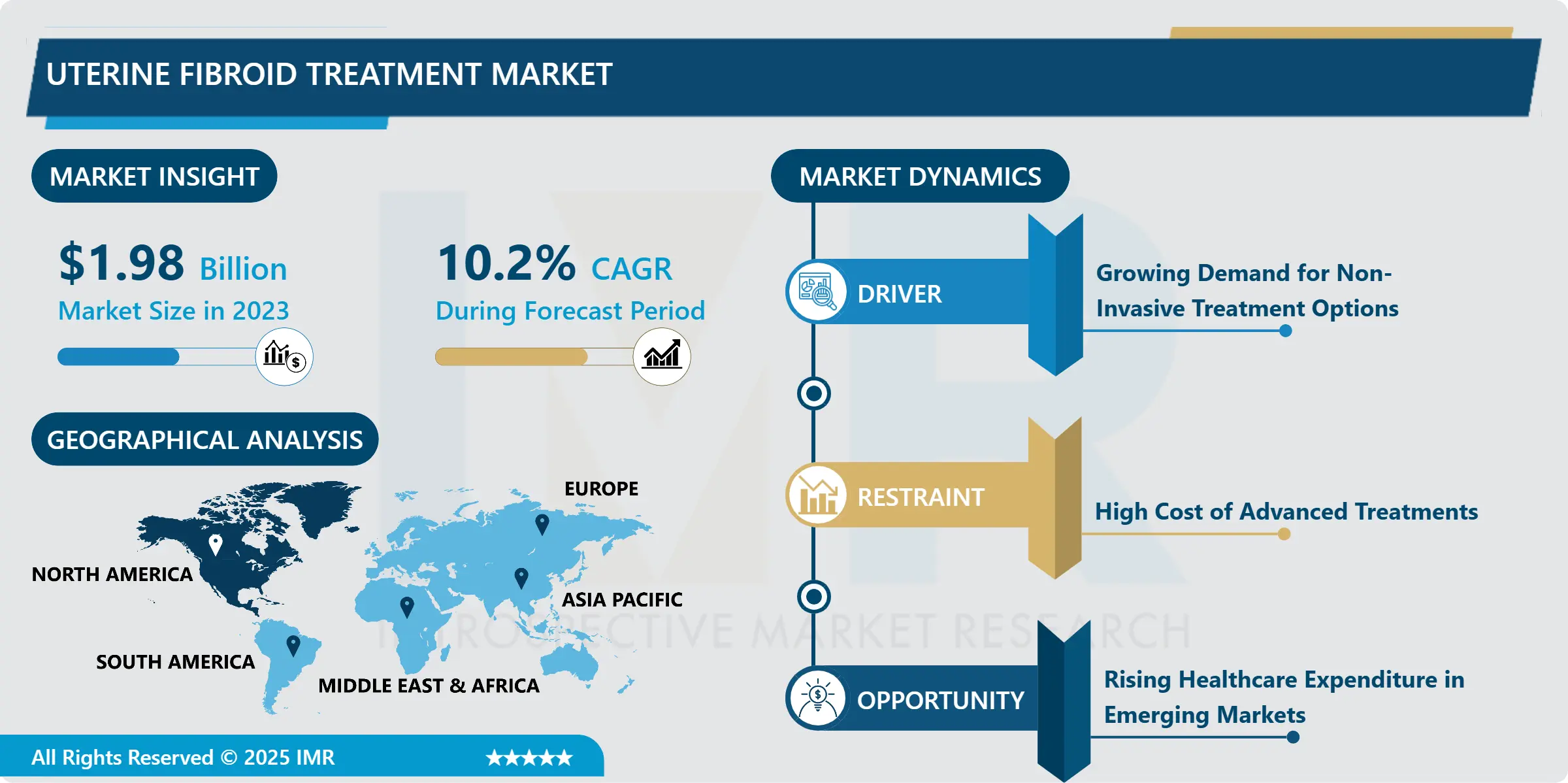
Uterine Fibroid Treatment Market Size Was Valued at USD 1.98 Billion in 2023, and is Projected to Reach USD 4.75 Billion by 2032, Growing at a CAGR of 10.20% From 2024-2032.
Uterine fibroid treatment market addresses the medical therapies and management methods – medicinal, surgical and non-pharmacological – that seek to cure or mitigate the effects of uterine fibroids. Uterine fibroids are benign tumours originating from the smooth muscle cells of the uterus affecting a large number of women of child bearing age. The available treatments of LE include hormonal therapy, myomectomy, hysterectomy, radiofrequency ablation and MRI-guided focused ultrasound among others. This market is anchored on such factors as high incidence of uterine fibroids, increased adoption of minimally invasive surgical procedures, and the emerging need for tailored care services for women.
The market for uterine fibroid treatment has been rapidly developing within the last years, mainly because of the high percentage of women diagnosed with the disease worldwide. It is estimated that as many as three in every four women over the age of 35 have had a uterine fibroid which causes symptoms such as excessive menstrual bleeding, pelvic pain and subfertility. Greater enlightenment among female patients regarding the available treatments and the innovations in non-invasive and minimal invasive treatments are anticipated to spur the market on. It encompasses drugs, surgery and others; many people now prefer hormonal therapies, UAE and RF ablation and so on than surgeries.
Also, greater spending on languages to medical services, especially in the emerging countries has a direct effect on the uterine fibroid treatment market. Advancements made through basic research and funding of development have yielded improved therapies that are noninvasive and have a faster recovery period than patients desire, as well as virtually no post-procedure complications. They have established more investments for future research to bring new therapies in the market which leads to competitive innovation in this sector among various pharma and medical device manufacturers. Further, a transition in developed countries toward minimally invasive surgeries and increasing government concerns toward women’s health across the world will also pave the way for future growth for the market.
Uterine Fibroid Treatment Market Trend Analysis:
Growing Popularity of Minimally Invasive Procedures
The market for uterine fibroid’s treatment tends to be highly invasive particularly due to the improved medical technology. Some of the methods used in choice from a conventional open surgery include laparoscopic myomectomy and also robotic assisted surgeries. The least invasive management methods offer significant advantages such as, reduced recovery time, diminished hospitalization, and less insurgence of complications. They are much effective in young female patients who desire to conceive a child and those patient who have shown unwillingness to under go a major surgery. This change is done in consonance with the new trend within the healthcare fraternity to address patient needs while seeking to provide efficient solutions to fulfil their needs.
Also, the need for accurate treatments such as MRI-FUS and RFA will continue to grow. These technologies offer an option of selective fragmentation and coagulation of fibroids, thus has a low associated risk and invasion to the surrounding tissue thus suitable to patients who do not want to undergo surgery. Increased concern with patient quality of life stems from a shift toward less invasive uterine fibroid treatments which is characteristic of the overall market. Hailed as a means of shortening recovery time and providing less invasive forms of treatment, minimally invasive procedures have emerged as a critical demand generator based on a shift toward efficacious yet less invasive treatment solutions.
Expansion in Emerging Markets
New opportunities for the development of the uterine fibroid treatment market are expected to be observed in the context of the growing healthcare spending, increasing demand for innovative solutions, and the expanding base of middle-income countries in regions such as Asia-Pacific, Latin America and the Middle East. These regions have higher rates of uterine fibroids and give promise to a growing market for effective management strategies. Expanded availability of diagnostics in these situations has made it possible to identify fibroids at an earlier stage, for their treatment to have a positive influence on women’s bodies and minds alike. Increased concern on women’s health also adds on this by governments’ health care policies targeted to address issues like maternal and reproductive health, therefore helping create chances for uterine fibroid treatments.
Therefore, the uterine fibroid treatment market is expected to expand in the Asia-Pacific and European countries due to increasing demand for affordable and easy approaches to treatments mainly in the least invasive procedure category. The future for international medical companies lies in partnering with domestic healthcare players as well as expanding the market in the emerging economies. Such actions could increase the likelihood of better access to latest treatment solutions to give women the best luck at handling fibroids. With the progress of healthcare systems in these regions, the growth of uterine fibroid treatment market will greatly promote for patients and enterprises who grasp these emerging business opportunities.
Uterine Fibroid Treatment Market Segment Analysis:
Uterine Fibroid Treatment Market Segmented on the basis of Product Type, Treatment Type End User, and Region.
By Product Type, the medical devices segment is expected to dominate the market during the forecast period
The uterine fibroid treatment market is mainly categorized based on the product type into drugs and devices. Pharmaceutical drugs are categorized and they including agonists and progestin which are mostly used to treat the symptoms and to cause the shrinking of fibroids. These drugs also have the effect of lowering the levels of estrogenic and of progesterone, resulting in the shrinking of the fibroids as well as stemmas which will control bleeding that is caused by the fibroids. Some drugs that may be prescribed for the medical treatment of uterine fibroids are anti-inflammatory drugs and hormones for curbing pain and other symptoms and hence there are many ways of dealing with uterine fibroids through medication.
Besides medications, medical devices are an essential component of uterine fibroids management and treatment. Surgical devices required for myomectomy, hysterectomy, and other related processes that are basic to the current fibroid treatment procedures also form part of the market. Furthermore, complimentary instruments including, ultrasound and MRI, used in diagnosing and managing fibroids would also be necessary. Other conservative procedures also depend on medical devices such as catheters and those used in imaging diagnosis like UAE and RFA. These devices are accurate and less invasive than conventional surgery; therefore, consumers prefer technologically enhanced uterine fibroid products.
By Treatment, Surgical Treatment segment expected to held the largest share
The uterine fibroid treatment market is categorized by various treatment forms, but the first choice is pharmacological therapy. Surgical procedures entail the use of gonadotropin-releasing hormone agonists, progestogens and other agents that attempt to reduce the size of fibroids or relieve such symptoms as menstrual bleeding and pain. These medications offer an opportunity for non-surgical management for subjects who may not need surgery or those that would wish to avoid surgical intervention as long as possible. Hysterectomy or myomectomy are also characteristic for patients with larger fibroids or severe pain or pressure. Myomectomy is the surgery of removal of fibroids but leaving behind the uterus and is usually preferred by women who have child bearing desires. Hysterectomy or removal of the uterus completely is usually recommended to women who have no intention of bearing children again owing to the recurrence of fibroid symptoms.
Conservative procedures have received much attention from patients and surgical practices because of effectiveness and reduced downtime. Uterine Artery embolization (UAE) is a minimally invasive procedure that aims at occluding the blood flow to the fibroids and subsequently causes the formation of the fibroids to reduce. Radiofrequency Ablation (RFA) is one such treatment use heat to burn fibroid tissue, and it is less invasive compare to surgery. MRgFUS is a state-of-art minimally invasive method that utilizes ultrasound therapy to ablate fibroids with out surgery. Such AS perspectives of minimally invasive treatments have become popular among patients who tend to experience reduced recovery time and fewer risks of post-treatment complications, which reflects a shift in the uterine fibroid treatment market. Other forms of treatment, such as lifestyle and other non-pharmacological therapies might also help in controlling the manifestations of fibroids but they are not main line treatments.
Uterine Fibroid Treatment Market Regional Insights:
North America is Expected to Dominate the Market Over the Forecast period
North America has the highest market share for uterine fibroid treatment market share in 2023. This dominance is attributable to the fact that: A large population of women of childbearing age in the United States and Canada suffer from uterine fibroids. The area has the advanced medical facilities, the access to the high tech medical equipment’s and devices, and the strong governmental machineries in support of women health. Similarly a rise in demand of non surgical procedures such as MRI-guided focused ultrasound and radiofrequency ablation treatment has been observed in the U.S and this increase has put further fuel in to the growth of the market. Further, improved insurance and reimbursement of such treatments has provided increased accessibility to this market thus driving the market growth.
Other countries of Europe such as Germany France, and the UK also have relatively large markets in the uterine fibroid treatment due to aging population and increased expenditure on health care. Uterine fibroids are becoming more and more common, plus women’s health is increasingly being prioritized, resulting in persistent demand for solutions in this part of the world. Nevertheless, the fastest growth is expected to occur in the Asia-Pacific region only. The growing patient populace, consistent enhancements in health care framework, and the rising consciousness of accessible treatment are some more factors that are going to create high demand for the treatments of uterine fibroids in the countries like China, India and Japan. Therefore there are grounds to assume that this area will experience a rather fast growth in the future, as the systems of healthcare are developing and becoming more extensive, thus providing great prospects for market participants.
Active Key Players in the Uterine Fibroid Treatment Market:
AbbVie Inc. (United States)
Bayer AG (Germany)
Boston Scientific Corporation (United States)
Cooper Surgical Inc. (United States)
Ferring Pharmaceuticals (Switzerland)
Gynesonics Inc. (United States)
Hologic Inc. (United States)
Johnson & Johnson (United States)
Karl Storz GmbH & Co. KG (Germany)
Medtronic PLC (Ireland)
Merit Medical Systems, Inc. (United States)
Olympus Corporation (Japan)
Richard Wolf GmbH (Germany)
Siemens Healthiness AG (Germany)
Other Active Players
Chapter 1: Introduction
1.1 Scope and Coverage
Chapter 2:Executive Summary
Chapter 3: Market Landscape
3.1 Market Dynamics
3.1.1 Drivers
3.1.2 Restraints
3.1.3 Opportunities
3.1.4 Challenges
3.2 Market Trend Analysis
3.3 PESTLE Analysis
3.4 Porter’s Five Forces Analysis
3.5 Industry Value Chain Analysis
3.6 Ecosystem
3.7 Regulatory Landscape
3.8 Price Trend Analysis
3.9 Patent Analysis
3.10 Technology Evolution
3.11 Investment Pockets
3.12 Import-Export Analysis
Chapter 4: Uterine Fibroid Treatment Market by Product Type
4.1 Uterine Fibroid Treatment Market Snapshot and Growth Engine
4.2 Uterine Fibroid Treatment Market Overview
4.3 Pharmaceutical Drugs
4.3.1 Introduction and Market Overview
4.3.2 Historic and Forecasted Market Size in Value USD and Volume Units (2017-2032F)
4.3.3 Key Market Trends, Growth Factors and Opportunities
4.3.4 Pharmaceutical Drugs: Geographic Segmentation Analysis
4.4 Medical Devices)
4.4.1 Introduction and Market Overview
4.4.2 Historic and Forecasted Market Size in Value USD and Volume Units (2017-2032F)
4.4.3 Key Market Trends, Growth Factors and Opportunities
4.4.4 Medical Devices): Geographic Segmentation Analysis
4.5 Treatment Type
4.5.1 Introduction and Market Overview
4.5.2 Historic and Forecasted Market Size in Value USD and Volume Units (2017-2032F)
4.5.3 Key Market Trends, Growth Factors and Opportunities
4.5.4 Treatment Type: Geographic Segmentation Analysis
Chapter 5: Uterine Fibroid Treatment Market by End User
5.1 Uterine Fibroid Treatment Market Snapshot and Growth Engine
5.2 Uterine Fibroid Treatment Market Overview
5.3 Hospitals
5.3.1 Introduction and Market Overview
5.3.2 Historic and Forecasted Market Size in Value USD and Volume Units (2017-2032F)
5.3.3 Key Market Trends, Growth Factors and Opportunities
5.3.4 Hospitals: Geographic Segmentation Analysis
5.4 Ambulatory Surgical Centers (ASCs)
5.4.1 Introduction and Market Overview
5.4.2 Historic and Forecasted Market Size in Value USD and Volume Units (2017-2032F)
5.4.3 Key Market Trends, Growth Factors and Opportunities
5.4.4 Ambulatory Surgical Centers (ASCs): Geographic Segmentation Analysis
5.5 Specialty Clinics)
5.5.1 Introduction and Market Overview
5.5.2 Historic and Forecasted Market Size in Value USD and Volume Units (2017-2032F)
5.5.3 Key Market Trends, Growth Factors and Opportunities
5.5.4 Specialty Clinics) : Geographic Segmentation Analysis
Chapter 6: Company Profiles and Competitive Analysis
6.1 Competitive Landscape
6.1.1 Competitive Benchmarking
6.1.2 Uterine Fibroid Treatment Market Share by Manufacturer (2023)
6.1.3 Industry BCG Matrix
6.1.4 Heat Map Analysis
6.1.5 Mergers and Acquisitions
6.2 ABBVIE INC.
6.2.1 Company Overview
6.2.2 Key Executives
6.2.3 Company Snapshot
6.2.4 Role of the Company in the Market
6.2.5 Sustainability and Social Responsibility
6.2.6 Operating Business Segments
6.2.7 Product Portfolio
6.2.8 Business Performance
6.2.9 Key Strategic Moves and Recent Developments
6.2.10 SWOT Analysis
6.3 BAYER AG
6.4 BOSTON SCIENTIFIC CORPORATION
6.5 HOLOGIC INC.
6.6 JOHNSON & JOHNSON
6.7 OTHER ACTIVE PLAYERS
Chapter 7: Global Uterine Fibroid Treatment Market By Region
7.1 Overview
7.2. North America Uterine Fibroid Treatment Market
7.2.1 Key Market Trends, Growth Factors and Opportunities
7.2.2 Top Key Companies
7.2.3 Historic and Forecasted Market Size by Segments
7.2.4 Historic and Forecasted Market Size By Product Type
7.2.4.1 Pharmaceutical Drugs
7.2.4.2 Medical Devices)
7.2.4.3 Treatment Type
7.2.5 Historic and Forecasted Market Size By End User
7.2.5.1 Hospitals
7.2.5.2 Ambulatory Surgical Centers (ASCs)
7.2.5.3 Specialty Clinics)
7.2.6 Historic and Forecast Market Size by Country
7.2.6.1 US
7.2.6.2 Canada
7.2.6.3 Mexico
7.3. Eastern Europe Uterine Fibroid Treatment Market
7.3.1 Key Market Trends, Growth Factors and Opportunities
7.3.2 Top Key Companies
7.3.3 Historic and Forecasted Market Size by Segments
7.3.4 Historic and Forecasted Market Size By Product Type
7.3.4.1 Pharmaceutical Drugs
7.3.4.2 Medical Devices)
7.3.4.3 Treatment Type
7.3.5 Historic and Forecasted Market Size By End User
7.3.5.1 Hospitals
7.3.5.2 Ambulatory Surgical Centers (ASCs)
7.3.5.3 Specialty Clinics)
7.3.6 Historic and Forecast Market Size by Country
7.3.6.1 Russia
7.3.6.2 Bulgaria
7.3.6.3 The Czech Republic
7.3.6.4 Hungary
7.3.6.5 Poland
7.3.6.6 Romania
7.3.6.7 Rest of Eastern Europe
7.4. Western Europe Uterine Fibroid Treatment Market
7.4.1 Key Market Trends, Growth Factors and Opportunities
7.4.2 Top Key Companies
7.4.3 Historic and Forecasted Market Size by Segments
7.4.4 Historic and Forecasted Market Size By Product Type
7.4.4.1 Pharmaceutical Drugs
7.4.4.2 Medical Devices)
7.4.4.3 Treatment Type
7.4.5 Historic and Forecasted Market Size By End User
7.4.5.1 Hospitals
7.4.5.2 Ambulatory Surgical Centers (ASCs)
7.4.5.3 Specialty Clinics)
7.4.6 Historic and Forecast Market Size by Country
7.4.6.1 Germany
7.4.6.2 UK
7.4.6.3 France
7.4.6.4 The Netherlands
7.4.6.5 Italy
7.4.6.6 Spain
7.4.6.7 Rest of Western Europe
7.5. Asia Pacific Uterine Fibroid Treatment Market
7.5.1 Key Market Trends, Growth Factors and Opportunities
7.5.2 Top Key Companies
7.5.3 Historic and Forecasted Market Size by Segments
7.5.4 Historic and Forecasted Market Size By Product Type
7.5.4.1 Pharmaceutical Drugs
7.5.4.2 Medical Devices)
7.5.4.3 Treatment Type
7.5.5 Historic and Forecasted Market Size By End User
7.5.5.1 Hospitals
7.5.5.2 Ambulatory Surgical Centers (ASCs)
7.5.5.3 Specialty Clinics)
7.5.6 Historic and Forecast Market Size by Country
7.5.6.1 China
7.5.6.2 India
7.5.6.3 Japan
7.5.6.4 South Korea
7.5.6.5 Malaysia
7.5.6.6 Thailand
7.5.6.7 Vietnam
7.5.6.8 The Philippines
7.5.6.9 Australia
7.5.6.10 New Zealand
7.5.6.11 Rest of APAC
7.6. Middle East & Africa Uterine Fibroid Treatment Market
7.6.1 Key Market Trends, Growth Factors and Opportunities
7.6.2 Top Key Companies
7.6.3 Historic and Forecasted Market Size by Segments
7.6.4 Historic and Forecasted Market Size By Product Type
7.6.4.1 Pharmaceutical Drugs
7.6.4.2 Medical Devices)
7.6.4.3 Treatment Type
7.6.5 Historic and Forecasted Market Size By End User
7.6.5.1 Hospitals
7.6.5.2 Ambulatory Surgical Centers (ASCs)
7.6.5.3 Specialty Clinics)
7.6.6 Historic and Forecast Market Size by Country
7.6.6.1 Turkiye
7.6.6.2 Bahrain
7.6.6.3 Kuwait
7.6.6.4 Saudi Arabia
7.6.6.5 Qatar
7.6.6.6 UAE
7.6.6.7 Israel
7.6.6.8 South Africa
7.7. South America Uterine Fibroid Treatment Market
7.7.1 Key Market Trends, Growth Factors and Opportunities
7.7.2 Top Key Companies
7.7.3 Historic and Forecasted Market Size by Segments
7.7.4 Historic and Forecasted Market Size By Product Type
7.7.4.1 Pharmaceutical Drugs
7.7.4.2 Medical Devices)
7.7.4.3 Treatment Type
7.7.5 Historic and Forecasted Market Size By End User
7.7.5.1 Hospitals
7.7.5.2 Ambulatory Surgical Centers (ASCs)
7.7.5.3 Specialty Clinics)
7.7.6 Historic and Forecast Market Size by Country
7.7.6.1 Brazil
7.7.6.2 Argentina
7.7.6.3 Rest of SA
Chapter 8 Analyst Viewpoint and Conclusion
8.1 Recommendations and Concluding Analysis
8.2 Potential Market Strategies
Chapter 9 Research Methodology
9.1 Research Process
9.2 Primary Research
9.3 Secondary Research
Q1: What would be the forecast period in the Uterine Fibroid Treatment Market research report?
A1: The forecast period in the Uterine Fibroid Treatment Market research report is 2024-2032.
Q2: Who are the key players in the Uterine Fibroid Treatment Market?
A2: AbbVie Inc., Bayer AG, Boston Scientific Corporation, Hologic Inc., Johnson & Johnson and Other Active Players.
Q3: What are the segments of the Uterine Fibroid Treatment Market?
A3: The Uterine Fibroid Treatment Market is segmented into Product Type, Treatment Type, End User and region. By Product Type, the market is categorized into Pharmaceutical Drugs, Medical Devices. By Treatment Type, the market is categorized into Pharmacological Treatment, Surgical Treatment, Myomectomy, Hysterectomy, Minimally Invasive Treatment, Uterine Artery Embolization (UAE), Radiofrequency Ablation (RFA), MRI-guided Focused Ultrasound. By End User, the market is categorized into Hospitals, Ambulatory Surgical Centers (ASCs), Specialty Clinics. By region, it is analyzed across North America (U.S., Canada, Mexico), Eastern Europe (Russia, Bulgaria, The Czech Republic, Hungary, Poland, Romania, Rest of Eastern Europe), Western Europe (Germany, UK, France, The Netherlands, Italy, Spain, Rest of Western Europe), Asia Pacific (China, India, Japan, South Korea, Malaysia, Thailand, Vietnam, The Philippines, Australia, New-Zealand, Rest of APAC), Middle East & Africa (Turkiye, Bahrain, Kuwait, Saudi Arabia, Qatar, UAE, Israel, South Africa), South America (Brazil, Argentina, Rest of SA).
Q4: What is the Uterine Fibroid Treatment Market?
A4: Uterine fibroid treatment market addresses the medical therapies and management methods – medicinal, surgical and non-pharmacological – that seek to cure or mitigate the effects of uterine fibroids. Uterine fibroids are benign tumors originating from the smooth muscle cells of the uterus affecting a large number of women of child bearing age. The available treatments of LE include hormonal therapy, myomectomy, hysterectomy, radiofrequency ablation and MRI-guided focused ultrasound among others. This market is anchored on such factors as high incidence of uterine fibroids, increased adoption of minimally invasive surgical procedures, and the emerging need for tailored care services for women.
Q5: How big is the Uterine Fibroid Treatment Market?
A5: Uterine Fibroid Treatment Market Size Was Valued at USD 1.98 Billion in 2023, and is Projected to Reach USD 4.75 Billion by 2032, Growing at a CAGR of 10.20% From 2024-2032.
How to Buy a Report from eminsights.jp
On the product page, choose the license you want: Single-User License, Multi-User License or Enterprise License.
If you required report in your native language, then you can click on Translated Report button and fill out the form with report name and language you want, then our team will contact you as soon as possible.
Click the Buy Now button.
You will be redirected to the checkout page. Enter your company details and payment information.
Click Place Order to complete the purchase.
Confirmation: You’ll receive an order confirmation and our team will contact you shortly with your ordered report.
If you have any questions, fill out the contact form below or email us at bizdev@eminsights.net.
Thank you for choosing eminsights.jp!