Stay Ahead in Fast-Growing Economies.
Browse Reports Now
US Satellite Manufacturing Market-Overview and Outlook by Potential Growth By 2032
The US satellite manufacturing market holds a crucial position within the broader ecosystem of the aerospace industry, serving pivotal roles across various sectors including communications, defense, weather forecasting, scientific research, and more. As a leader in satellite technology, the United States not only manufactures satellites for domestic use but also exports a significant portion globally, thereby influencing the global satellite market dynamics. This market’s significance stems from its ability to drive technological advancements, enhance national security through advanced reconnaissance and communication capabilities, and enable scientific discoveries through space exploration missions.

IMR Group
Description
US Satellite Manufacturing Market Synopsis
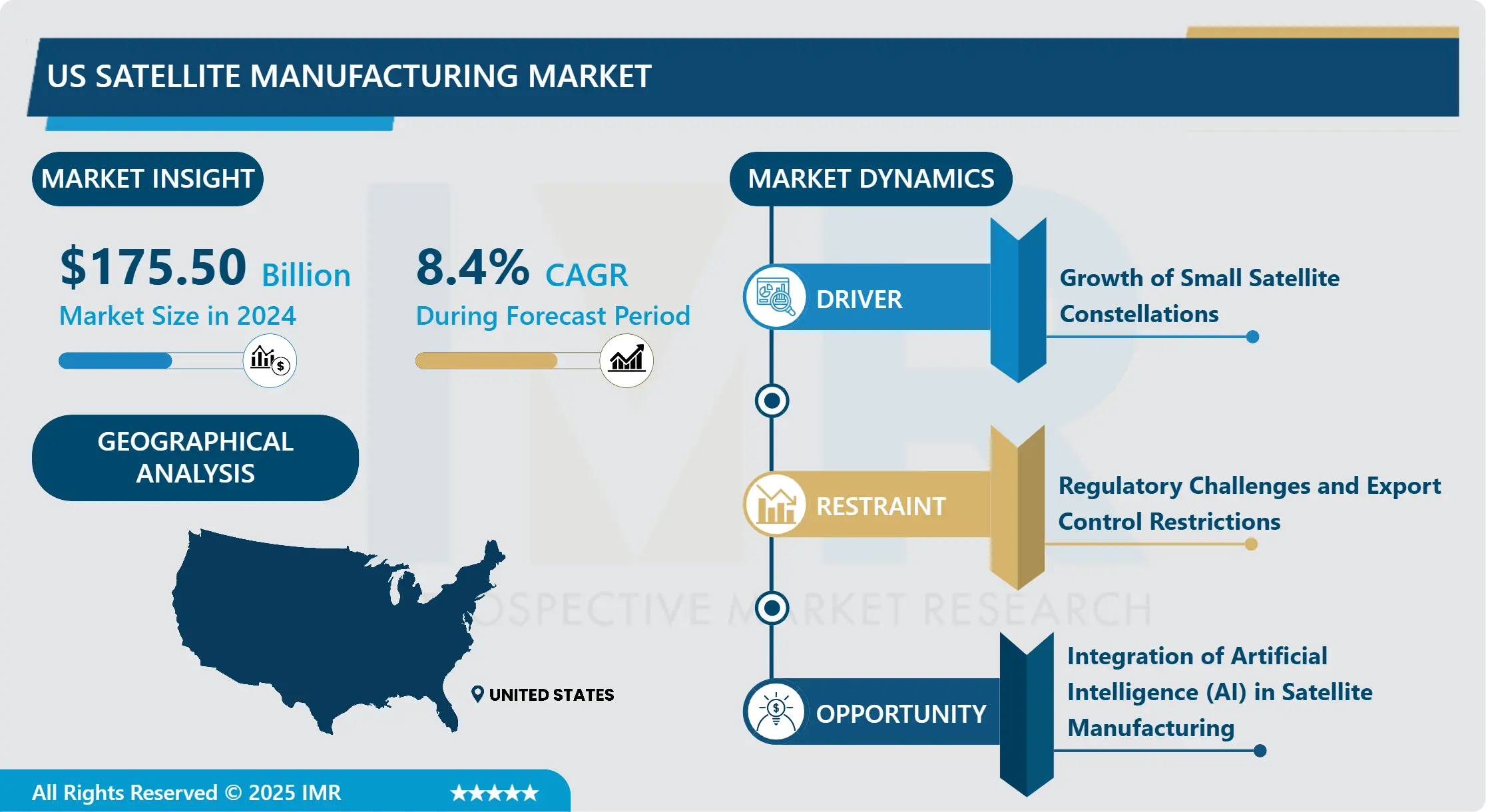
US Satellite Manufacturing Market Size Was Valued at USD 175.50 Billion in 2024, and is Projected to Reach USD 334.59 Billion by 2032, Growing at a CAGR of 8.4% from 2025-2032.
The US satellite manufacturing market holds a crucial position within the broader ecosystem of the aerospace industry, serving pivotal roles across various sectors including communications, defense, weather forecasting, scientific research, and more. As a leader in satellite technology, the United States not only manufactures satellites for domestic use but also exports a significant portion globally, thereby influencing the global satellite market dynamics. This market’s significance stems from its ability to drive technological advancements, enhance national security through advanced reconnaissance and communication capabilities, and enable scientific discoveries through space exploration missions.
From an economic standpoint, the satellite manufacturing sector contributes substantially to the US economy by generating high-value jobs in engineering, manufacturing, and related fields. Companies involved in satellite manufacturing often collaborate with government agencies such as NASA and the Department of Defense, as well as private sector entities, fostering innovation and driving competitiveness in the global marketplace. Moreover, advancements in satellite technology have spurred the development of ancillary industries such as satellite servicing, space tourism, and satellite data analytics, creating a diverse ecosystem that supports economic growth and technological leadership.
In terms of innovation, the US satellite manufacturing market plays a critical role in pushing the boundaries of what is possible in space exploration and communication. Cutting-edge developments in miniaturization, propulsion systems, and sensor technologies continually redefine the capabilities of satellites, enabling them to perform tasks more efficiently and reliably than ever before. This innovation cycle not only benefits satellite operators by improving service quality and reducing costs but also opens up new opportunities for commercial applications such as broadband internet delivery to remote regions and real-time Earth observation for environmental monitoring and disaster response.
Furthermore, the US satellite manufacturing sector contributes to national security by providing essential assets for military communication, surveillance, and navigation purposes. These satellites enhance situational awareness, support strategic defense initiatives, and facilitate rapid response capabilities during crises. In conclusion, the US satellite manufacturing market’s multifaceted contributions to technology, economy, and national security underscore its vital role within the global aerospace ecosystem, driving innovation, economic growth, and maintaining strategic leadership in space-based technologies.
US Satellite Manufacturing Market Trend Analysis
US Satellite Manufacturing Market Growth Driver- Growth of Small Satellite Constellations
The US satellite manufacturing market is witnessing a significant trend towards the growth of small satellite constellations. Small satellites, typically weighing less than 500 kilograms, are increasingly favoured due to their lower manufacturing costs, quicker deployment times, and their ability to offer high-resolution imaging and communications capabilities. This trend is driven by advancements in miniaturization technology, which have enabled manufacturers to pack sophisticated functionalities into smaller spacecraft. Moreover, the demand for continuous global connectivity, earth observation, and disaster monitoring services has spurred the deployment of constellations comprising hundreds or even thousands of these small satellites.
One notable aspect of this trend is the diversification of satellite applications. Small satellites are not only being used for traditional Earth observation and communication purposes but also for emerging applications such as IoT connectivity and space-based internet services. Companies like SpaceX’s Starlink and OneWeb are prime examples of leveraging small satellite constellations to deliver broadband internet services globally. This diversification is expanding the market opportunities for satellite manufacturers in the US, encouraging innovation in satellite design, propulsion systems, and on-board electronics.
Furthermore, the economics of small satellite constellations are reshaping the industry. Lower launch costs, facilitated by reusable rockets like SpaceX’s Falcon 9, are making it more cost-effective to deploy and maintain large constellations in low Earth orbit (LEO). This has led to increased competition among satellite manufacturers to produce reliable, high-performance small satellites that can meet the stringent requirements of constellations, driving further advancements in manufacturing processes and satellite technology.
US Satellite Manufacturing Market Opportunity- Integration of Artificial Intelligence (AI) in Satellite Manufacturing
Another significant trend in the US satellite manufacturing market is the integration of artificial intelligence (AI) across the satellite lifecycle—from design and manufacturing to operation and maintenance. AI technologies such as machine learning algorithms and computer vision systems are being employed to optimize satellite design, improve manufacturing processes, enhance on-orbit operations, and extend satellite lifespan through predictive maintenance.
In satellite design, AI algorithms analyse vast datasets to optimize the configuration of spacecraft components, ensuring efficient use of space and weight while maximizing performance. This iterative design process reduces development cycles and improves the overall reliability of satellites. Moreover, AI-driven simulations enable manufacturers to test different scenarios virtually, predicting potential failures and optimizing performance under various environmental conditions before physical production begins.
During satellite manufacturing, AI plays a crucial role in quality control and assembly processes. Computer vision systems equipped with AI can inspect components with high precision, identifying defects that may not be visible to the human eye. This enhances manufacturing efficiency and reduces the likelihood of errors, thereby improving overall satellite reliability. Additionally, AI-powered robotics are increasingly used in the assembly of satellites, automating repetitive tasks and speeding up production timelines.
In satellite operations, AI technologies enable autonomous decision-making and real-time data analysis on-board spacecraft. This capability is crucial for missions requiring rapid response times, such as disaster monitoring or space weather forecasting. AI algorithms can detect anomalies in satellite telemetry data, autonomously reconfigure spacecraft operations, and even predict potential failures before they occur, thereby enhancing mission success rates and extending satellite operational lifetimes.
Overall, the integration of AI in satellite manufacturing is driving innovation and efficiency across the industry. As AI technologies continue to evolve, satellite manufacturers in the US are poised to leverage these advancements to develop more capable, reliable, and cost-effective spacecraft that meet the growing demands of commercial and government customers alike.
US Satellite Manufacturing Market Segment Analysis:
US Satellite Manufacturing Market Segmented based on Satellite, Application, and Size
By Satellite Type, LEO Segment is Expected to Dominate the US Satellite Manufacturing Market
In the US satellite manufacturing market, the LEO (Low Earth Orbit) segment is anticipated to dominate during the forecast period. This dominance can be attributed to several factors. Firstly, LEO satellites are increasingly favored for their closer proximity to Earth, which enables lower latency and better coverage for communication and Earth observation applications. These satellites are crucial for emerging technologies such as global broadband internet coverage, where companies like SpaceX and OneWeb are deploying massive constellations of LEO satellites. Moreover, advancements in miniaturization and cost-efficiency have made LEO satellites more attractive, enabling quicker deployment and replacement cycles compared to their GEO (Geostationary Orbit) counterparts. As a result, LEO satellites are not only enhancing communication capabilities but also revolutionizing Earth observation, offering high-resolution imagery and real-time monitoring capabilities.
Furthermore, the regulatory environment and international partnerships are increasingly favorable towards LEO satellite projects, fostering innovation and investment in this segment. Government initiatives aimed at promoting LEO satellite constellations for global connectivity are also driving market growth. Overall, with ongoing technological advancements and strategic investments, the LEO segment is poised to maintain its dominance in the US satellite manufacturing market, catering to a wide range of commercial, scientific, and defense applications.
By Application, Communication Segment Holds the Largest Share in the US Satellite Manufacturing Market
Within the US satellite manufacturing market, the communication segment holds the largest share. This dominance stems from the critical role that satellites play in enabling global communication networks. Satellites in GEO and MEO orbits are particularly essential for providing broadband internet services, telecommunication infrastructure, and mobile network connectivity across vast areas, including remote and underserved regions. The demand for high-speed internet and seamless connectivity continues to grow, driven by increasing consumer expectations and the proliferation of connected devices worldwide. As a result, satellite operators and manufacturers are focusing on expanding their communication satellite fleets to meet these demands effectively.
Moreover, the versatility of communication satellites extends beyond traditional telecommunications to include emergency communication services during natural disasters or crises, further underscoring their importance in maintaining global connectivity and resilience. Technological advancements such as software-defined satellites and electric propulsion systems are enhancing the capabilities and operational efficiency of communication satellites, making them more competitive in the market. With ongoing innovations and strategic partnerships between satellite operators and telecommunications providers, the communication segment is expected to maintain its leadership position in the US satellite manufacturing market, driving significant revenue growth in the foreseeable future.
By Size, Small Satellite Segment is Poised to Lead the US Satellite Manufacturing Market
In the segment categorized by satellite size, the small satellite segment is poised to lead the US satellite manufacturing market. Small satellites, including nanosatellites and microsatellites, have gained popularity due to their lower costs, faster development cycles, and increasing capabilities in recent years. These satellites are particularly favored for applications such as Earth observation, scientific research, and technology demonstration missions. Advances in miniaturization of electronics and propulsion systems have enabled small satellites to perform tasks traditionally reserved for larger, more expensive satellites, thereby democratizing access to space for a broader range of organizations, including startups, universities, and government agencies.
Furthermore, the ability of small satellites to be deployed in constellations offers advantages in terms of global coverage, resilience, and redundancy in services like Earth imaging and remote sensing. The US government’s support for small satellite initiatives through funding programs and streamlined regulatory frameworks has also bolstered market growth. Companies specializing in small satellite manufacturing are leveraging these advantages to capture significant market share, particularly in emerging markets such as Internet of Things (IoT) connectivity and environmental monitoring. As technological innovations continue to enhance the capabilities and cost-effectiveness of small satellites, this segment is expected to expand its dominance in the US satellite manufacturing market, driving innovation and competition across various applications and industries.
Active Key Players in the US Satellite Manufacturing Market
Boeing
Lockheed Martin
Northrop Grumman
SpaceX
SSL – Maxar Technologies
Ball Aerospace
Harris Corporation
NovaWurks
Raytheon Technologies
Orbital Sciences Corporation – Northrop Grumman Innovation Systems
Blue Origin
Other Active Players
Chapter 1: Introduction
1.1 Scope and Coverage
Chapter 2:Executive Summary
Chapter 3: Market Landscape
3.1 Market Dynamics
3.1.1 Drivers
3.1.2 Restraints
3.1.3 Opportunities
3.1.4 Challenges
3.2 Market Trend Analysis
3.3 PESTLE Analysis
3.4 Porter’s Five Forces Analysis
3.5 Industry Value Chain Analysis
3.6 Ecosystem
3.7 Regulatory Landscape
3.8 Price Trend Analysis
3.9 Patent Analysis
3.10 Technology Evolution
3.11 Investment Pockets
3.12 Import-Export Analysis
Chapter 4: U.S. Satellite Manufacturing Market by Satellite (2018-2032)
4.1 U.S. Satellite Manufacturing Market Snapshot and Growth Engine
4.2 Market Overview
4.3 LEO
4.3.1 Introduction and Market Overview
4.3.2 Historic and Forecasted Market Size in Value USD and Volume Units
4.3.3 Key Market Trends, Growth Factors, and Opportunities
4.3.4 Geographic Segmentation Analysis
4.4 MEO
4.5 GEO
4.6 Others
Chapter 5: U.S. Satellite Manufacturing Market by Application (2018-2032)
5.1 U.S. Satellite Manufacturing Market Snapshot and Growth Engine
5.2 Market Overview
5.3 Communication
5.3.1 Introduction and Market Overview
5.3.2 Historic and Forecasted Market Size in Value USD and Volume Units
5.3.3 Key Market Trends, Growth Factors, and Opportunities
5.3.4 Geographic Segmentation Analysis
5.4 Earth Observation
5.5 Navigation
5.6 Space Observation
5.7 Others
Chapter 6: U.S. Satellite Manufacturing Market by Size (2018-2032)
6.1 U.S. Satellite Manufacturing Market Snapshot and Growth Engine
6.2 Market Overview
6.3 Small
6.3.1 Introduction and Market Overview
6.3.2 Historic and Forecasted Market Size in Value USD and Volume Units
6.3.3 Key Market Trends, Growth Factors, and Opportunities
6.3.4 Geographic Segmentation Analysis
6.4 Medium
6.5 Large
Chapter 7: Company Profiles and Competitive Analysis
7.1 Competitive Landscape
7.1.1 Competitive Benchmarking
7.1.2 U.S. Satellite Manufacturing Market Share by Manufacturer (2023)
7.1.3 Industry BCG Matrix
7.1.4 Heat Map Analysis
7.1.5 Mergers and Acquisitions
7.2 BOEING
7.2.1 Company Overview
7.2.2 Key Executives
7.2.3 Company Snapshot
7.2.4 Role of the Company in the Market
7.2.5 Sustainability and Social Responsibility
7.2.6 Operating Business Segments
7.2.7 Product Portfolio
7.2.8 Business Performance
7.2.9 Key Strategic Moves and Recent Developments
7.2.10 SWOT Analysis
7.3 LOCKHEED MARTIN
7.4 NORTHROP GRUMMAN
7.5 SPACEX
7.6 SSL – MAXAR TECHNOLOGIES
7.7 BALL AEROSPACE
7.8 HARRIS CORPORATION
7.9 NOVAWURKS
7.10 RAYTHEON TECHNOLOGIES
7.11 ORBITAL SCIENCES CORPORATION – NORTHROP GRUMMAN INNOVATION SYSTEMS
7.12 BLUE ORIGIN
7.13 OTHER KEY PLAYERS
7.14
Chapter 8 Analyst Viewpoint and Conclusion
8.1 Recommendations and Concluding Analysis
8.2 Potential Market Strategies
Chapter 9 Research Methodology
9.1 Research Process
9.2 Primary Research
9.3 Secondary Research
Q1: What would be the forecast period in the US Satellite Manufacturing Market research report?
A1: The forecast period in the US Satellite Manufacturing Market research report is 2025-2032.
Q2: Who are the key players in the US Satellite Manufacturing Market?
A2: Boeing, Lockheed Martin, Northrop Grumman, SpaceX, SSL – Maxar Technologies, Ball Aerospace, Harris Corporation, NovaWurks, Raytheon Technologies, Orbital Sciences Corporation – Northrop Grumman Innovation Systems, Blue Origin and Other Active Players.
Q3: What are the segments of the US Satellite Manufacturing Market?
A3: The satellite market is segmented into Orbit Type, Application, Size, and Region. By Orbit Type, the market is categorized into LEO (Low Earth Orbit), MEO (Medium Earth Orbit), GEO (Geostationary Orbit), and Others. By Application, the market includes Communication, Earth Observation, Navigation, Space Observation, and Others. By Size, satellites are classified as Small, Medium, and Large.
Q4: What is the US Satellite Manufacturing Market?
A4: The satellite manufacturing market encompasses the design, development, assembly, integration, and testing of satellites for various applications such as communications, remote sensing, navigation, and scientific research. It involves the construction of both commercial and government satellites, ranging from small CubeSats to large geostationary platforms. Key activities include payload integration, propulsion system installation, thermal control, and structural assembly, all adhering to stringent regulatory and performance standards. The market is driven by advancements in technology, increasing demand for satellite-based services, and efforts to enhance satellite lifespan and performance while reducing costs.
Q5: How big is the US Satellite Manufacturing Market?
A5: US Satellite Manufacturing Market Size Was Valued at USD 175.50 Billion in 2024, and is Projected to Reach USD 334.59 Billion by 2032, Growing at a CAGR of 8.4% from 2025-2032.
How to Buy a Report from eminsights.jp
On the product page, choose the license you want: Single-User License, Multi-User License or Enterprise License.
If you required report in your native language, then you can click on Translated Report button and fill out the form with report name and language you want, then our team will contact you as soon as possible.
Click the Buy Now button.
You will be redirected to the checkout page. Enter your company details and payment information.
Click Place Order to complete the purchase.
Confirmation: You’ll receive an order confirmation and our team will contact you shortly with your ordered report.
If you have any questions, fill out the contact form below or email us at bizdev@eminsights.net.
Thank you for choosing eminsights.jp!