Stay Ahead in Fast-Growing Economies.
Browse Reports Now
Urinary Catheters Market Analysis and Forecast (2024-2032)
The urinary catheters market mostly covers products that are used to drain urine from the bladder when a patient is unable to do it naturally, facilitated by medical condition, operations, or other conditions. Such catheters are applied in different clinical conditions that affect the female and male urinary tracts, urological surgeries, neuropathic as well as neurovascular and incontinence problems in hospitals, clinics, and via homecare delivery systems.

IMR Group
Description
Urinary Catheters Market Synopsis:
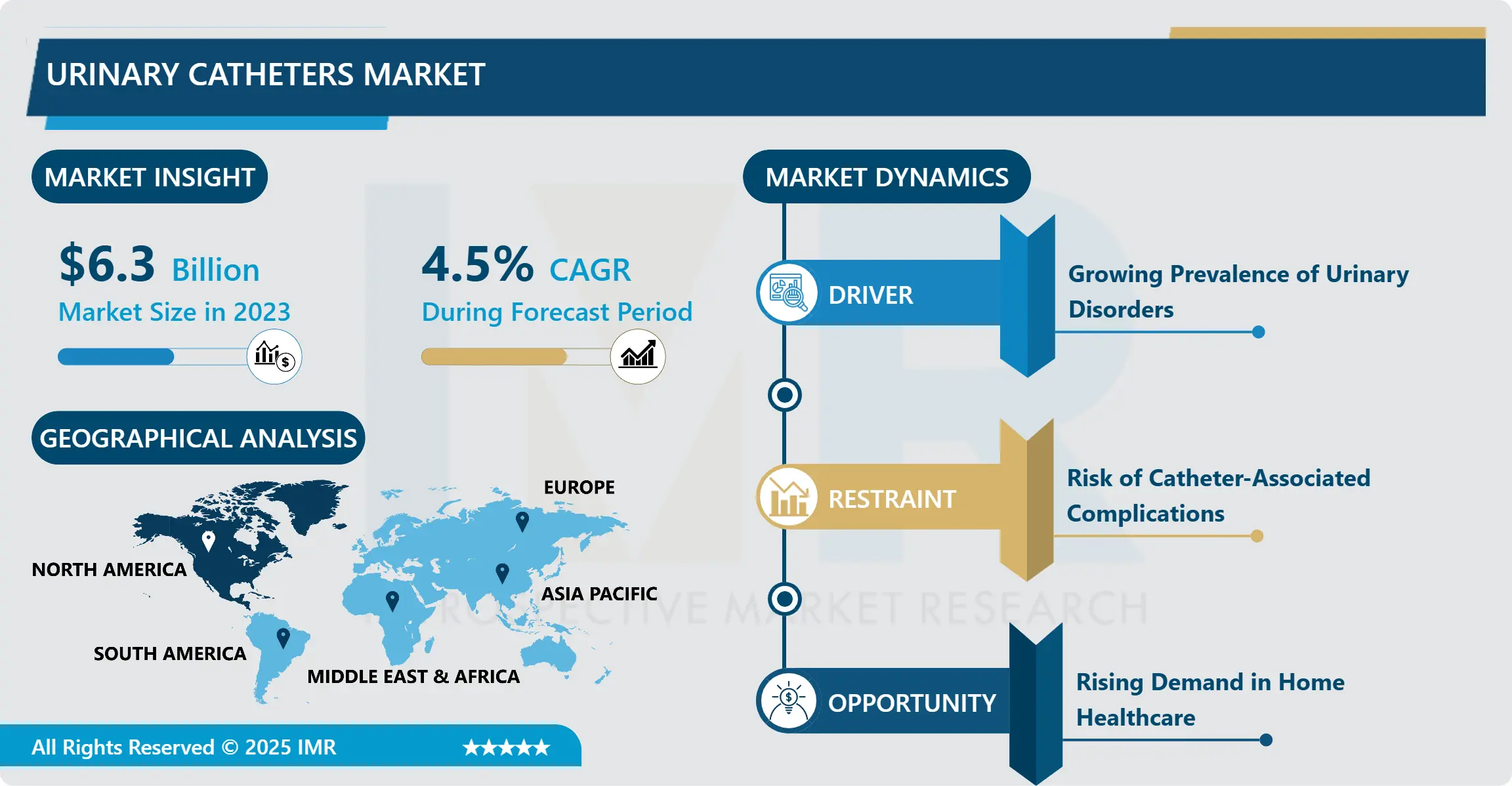
Urinary Catheters Market Size Was Valued at USD 6.3 Billion in 2023, and is Projected to Reach USD 9.4 Billion by 2032, Growing at a CAGR of 4.5% From 2024-2032.
The urinary catheters market mostly covers products that are used to drain urine from the bladder when a patient is unable to do it naturally, facilitated by medical condition, operations, or other conditions. Such catheters are applied in different clinical conditions that affect the female and male urinary tracts, urological surgeries, neuropathic as well as neurovascular and incontinence problems in hospitals, clinics, and via homecare delivery systems.
Urinary catheter is important medical product for the people with temporary or permanent urinary incontinence desires. This market has been on the rise for some time now, through expansion in the number of people suffering from urological conditions, as well as improvements in technology, increased emphasis on healthcare, and the aging population particularly those prone to incontinence and similar diseases. Urinary catheters are of diverse nature, and the general distinctions include the following; Intermittent catheters, Foley or indwelling catheters, external catheters. Each of them meets certain patient requirements, the differences among which are the frequency of their application, method of insertion, and the material they are made of. Thus, while intermittent catheters are used occasionally by those patients, who do not like injections, some other types of catheters are intended for long-term usage, frequently in such hospitals.
This market represents innovations that address the infection controls, comfort to the patient and catheter durability. Health care givers are paying more attention to producing and recommending catheters with longer lasting antimicrobial agents and better design to avoid complications such as UTIs and catheter blockage. Regionally market experience a significant boost in locations that are oriented extremely on more enhanced healthcare services especially in the Americas and Europe where users will be more familiar with catheterization processes of some urological complications. The Asia-Pacific is also having emerging markets for urological products because of improving availability of healthcare and education on urological health.
Urinary Catheters Market Trend Analysis:
Increasing Demand for Antimicrobial Catheters
Since complications such as urinary tract infections are typical of catheter use, the market has prompted the development of catheters with antimicrobial properties. These antimicrobial catheters which have positioning in lowering bacterial colonization and infection significance have taken a preference in hospitals as well as home healthcare. This trend is factored by increased focus on patient safety and measures to prevent infections associated with catheter use since infections that originate from catheter usage are associated with longer hospital stay, more treatment and high costs associated with treatment.
Manufacturers have sought to find ways of coming up with catheters that are safe, efficient but comes with an added feature of being antimicrobial all-through at an affordable price. These products are recording high demands in active markets within North America and Europe where hospital hygiene and related measures are paramount. As this kind of catheter is introduced into the market and HM grows by being used by healthcare providers and patients, antimicrobial catheters will continually be one of the most relevant markets within urinary catheters.
Rising Demand in Home Healthcare
The home healthcare segment holds a major potential for growth in the urinary catheters market. Because more patients with chronic diseases are opting for home care, the market calls for point-of-use catheters that are simple to use. It is especially important for the growing elderly population who suffer from problems with incontinence, after-surgery needs, or neurological disorders that affect bladder control. Catheters used in home health care are non-implanted or temporary catheters that are easily managed by patients or their careers.
The above-shift to the home healthcare sector has been further pushed by the healthcare policies that promote home care and cost efficiency of taking care of patients who do not require hospitalization. As more patients gain knowledge and convenience of performing urinary catheterization at home, companies targeteasy-to-use, safe, and comfortable catheters for home-use patients. This trend is expected to open up attractive business opportunities, particularly, in the countries with an increased percentage of the aging population and the well-developed home health care market, like North America and parts of Europe.
Urinary Catheters Market Segment Analysis:
Urinary Catheters Market is Segmented on the basis of Product type, Material, Application, End User, and Region.
By Product Type, Intermittent Catheters segment is expected to dominate the market during the forecast period
The urinary catheters market includes three primary product types: Temporary catheters include intermittent catheters, Foley or indwelling catheters and external catheters. Temporary catheters are used at intervals and are removed after use for patient that needs catheterization in several times in a day. These are liked by patients who take their care at home because control is offered and risk of infections when used wrongly eliminated. Foley or indwelling catheters are used for intermittent drainage and used commonly in hospitals for catheterization that will take for a long period. It has a balloon that holds the catheter in place in the bladder, but monitoring is applicable due to a higher risk of infection on the long use.
There is an outer catheter that mainly used in male patients, these catheters are placed outside the urethral opening, and mainly used where the chances of getting infected are high. These catheters are particularly suited to patients with low bladder control and to home use. It ensures that depending on the specific requirements of each case, opportunities for health professionals and patients to choose the right catheter model according to individual parameters, lifestyle and possible pathogen entering risk.
By Application, Urinary Incontinence segment expected to held the largest share
Urinary catheterization has been used across several niches, such as incontinence, benign prostatic hyperplasia (BHP), spinal cord injury, and other situations. First, urinary incontinence, which is quite common among aged persons is one of the main user populations for catheters since millions of people are suffering from inability to control bladder. Another condition, benign prostatic hyperplasia is also prevalent in the geriatric population for which clients may need catheters for urinary flow obstruction and need Foley catheter for a long time.
Patients with spinal cord injuries are present in huge numbers due to neurogenic bladder problems, with the requirement for using either catheters on an interval basis or catheters used at all times. The range of applications guarantees a stable consumption of various kinds of catheters, at the same time each application sector has its unique characteristics that manufacturers try to address offering their products.
Urinary Catheters Market Regional Insights:
North America is Expected to Dominate the Market Over the Forecast period
North America owns the largest share in the Urinary Catheters Market mainly due to an increase in healthcare facilities, appropriate diagnosis of urinary issues, and acceptance toward better technological Urinary Catheters. The reimbursement system in this region is well developed and patients can afford different types of catheters starting from the most expensive and innovative products such as antimicrobial coated ones. This coupled with the high incidences of such diseases as BPH and other urinary incontinence diseases especially in the elder patronize the market in the region.
Moreover, not to mention the well-developed home healthcare industry in North America: many patients with chronic illnesses are treated at home with easily removable catheters. Concerns toward infection control have catalyzed innovations within the region making North America among the most dominant markets for superior quality and improved urinary catheter products.
Active Key Players in the Urinary Catheters Market
B. Braun Melsungen AG (Germany)
Boston Scientific Corporation (USA)
C. R. Bard, Inc. (USA)
Cardinal Health (USA)
Coloplast A/S (Denmark)
ConvaTec Group plc (UK)
Cook Medical (USA)
Hollister Incorporated (USA)
Medtronic plc (Ireland)
Teleflex Incorporated (USA)
Terumo Corporation (Japan)
Wellspect HealthCare (Sweden)
Other Active Players.
Key Industry Developments in the Urinary Catheters Market:
In April 2024, Medline expanded its catheter portfolio by entering into an exclusive distribution agreement with Consure Medical to distribute the QiVi MEC male external urine management device. This strategy is expected to enhance the company’s customer base and its market reach in the market.
In February 2023, Coloplast launched the Luja male catheter, which is specifically designed to reduce the risk of urinary tract infections (UTIs) for people using intermittent catheters. It features 80+ micro-holes and aims to address important UTI risk factors associated with intermittent catheterization. This launch improved the company’s portfolio and expanded its market presence.
Chapter 1: Introduction
1.1 Scope and Coverage
Chapter 2:Executive Summary
Chapter 3: Market Landscape
3.1 Market Dynamics
3.1.1 Drivers
3.1.2 Restraints
3.1.3 Opportunities
3.1.4 Challenges
3.2 Market Trend Analysis
3.3 PESTLE Analysis
3.4 Porter’s Five Forces Analysis
3.5 Industry Value Chain Analysis
3.6 Ecosystem
3.7 Regulatory Landscape
3.8 Price Trend Analysis
3.9 Patent Analysis
3.10 Technology Evolution
3.11 Investment Pockets
3.12 Import-Export Analysis
Chapter 4: Urinary Catheters Market by Product Type
4.1 Urinary Catheters Market Snapshot and Growth Engine
4.2 Urinary Catheters Market Overview
4.3 Intermittent Catheters
4.3.1 Introduction and Market Overview
4.3.2 Historic and Forecasted Market Size in Value USD and Volume Units (2017-2032F)
4.3.3 Key Market Trends, Growth Factors and Opportunities
4.3.4 Intermittent Catheters: Geographic Segmentation Analysis
4.4 Foley/Indwelling Catheters
4.4.1 Introduction and Market Overview
4.4.2 Historic and Forecasted Market Size in Value USD and Volume Units (2017-2032F)
4.4.3 Key Market Trends, Growth Factors and Opportunities
4.4.4 Foley/Indwelling Catheters: Geographic Segmentation Analysis
4.5 External Catheters
4.5.1 Introduction and Market Overview
4.5.2 Historic and Forecasted Market Size in Value USD and Volume Units (2017-2032F)
4.5.3 Key Market Trends, Growth Factors and Opportunities
4.5.4 External Catheters: Geographic Segmentation Analysis
Chapter 5: Urinary Catheters Market by Material
5.1 Urinary Catheters Market Snapshot and Growth Engine
5.2 Urinary Catheters Market Overview
5.3 Latex
5.3.1 Introduction and Market Overview
5.3.2 Historic and Forecasted Market Size in Value USD and Volume Units (2017-2032F)
5.3.3 Key Market Trends, Growth Factors and Opportunities
5.3.4 Latex: Geographic Segmentation Analysis
5.4 Silicone
5.4.1 Introduction and Market Overview
5.4.2 Historic and Forecasted Market Size in Value USD and Volume Units (2017-2032F)
5.4.3 Key Market Trends, Growth Factors and Opportunities
5.4.4 Silicone: Geographic Segmentation Analysis
5.5 Others
5.5.1 Introduction and Market Overview
5.5.2 Historic and Forecasted Market Size in Value USD and Volume Units (2017-2032F)
5.5.3 Key Market Trends, Growth Factors and Opportunities
5.5.4 Others: Geographic Segmentation Analysis
Chapter 6: Urinary Catheters Market by Application
6.1 Urinary Catheters Market Snapshot and Growth Engine
6.2 Urinary Catheters Market Overview
6.3 Urinary Incontinence
6.3.1 Introduction and Market Overview
6.3.2 Historic and Forecasted Market Size in Value USD and Volume Units (2017-2032F)
6.3.3 Key Market Trends, Growth Factors and Opportunities
6.3.4 Urinary Incontinence: Geographic Segmentation Analysis
6.4 Benign Prostatic Hyperplasia BPH Spinal Cord Injuries
6.4.1 Introduction and Market Overview
6.4.2 Historic and Forecasted Market Size in Value USD and Volume Units (2017-2032F)
6.4.3 Key Market Trends, Growth Factors and Opportunities
6.4.4 Benign Prostatic Hyperplasia BPH Spinal Cord Injuries: Geographic Segmentation Analysis
6.5 Others
6.5.1 Introduction and Market Overview
6.5.2 Historic and Forecasted Market Size in Value USD and Volume Units (2017-2032F)
6.5.3 Key Market Trends, Growth Factors and Opportunities
6.5.4 Others: Geographic Segmentation Analysis
Chapter 7: Urinary Catheters Market by End User
7.1 Urinary Catheters Market Snapshot and Growth Engine
7.2 Urinary Catheters Market Overview
7.3 Hospitals
7.3.1 Introduction and Market Overview
7.3.2 Historic and Forecasted Market Size in Value USD and Volume Units (2017-2032F)
7.3.3 Key Market Trends, Growth Factors and Opportunities
7.3.4 Hospitals: Geographic Segmentation Analysis
7.4 Long-Term Care Facilities
7.4.1 Introduction and Market Overview
7.4.2 Historic and Forecasted Market Size in Value USD and Volume Units (2017-2032F)
7.4.3 Key Market Trends, Growth Factors and Opportunities
7.4.4 Long-Term Care Facilities: Geographic Segmentation Analysis
7.5 Clinics
7.5.1 Introduction and Market Overview
7.5.2 Historic and Forecasted Market Size in Value USD and Volume Units (2017-2032F)
7.5.3 Key Market Trends, Growth Factors and Opportunities
7.5.4 Clinics: Geographic Segmentation Analysis
7.6 Home Care Settings)
7.6.1 Introduction and Market Overview
7.6.2 Historic and Forecasted Market Size in Value USD and Volume Units (2017-2032F)
7.6.3 Key Market Trends, Growth Factors and Opportunities
7.6.4 Home Care Settings) : Geographic Segmentation Analysis
Chapter 8: Company Profiles and Competitive Analysis
8.1 Competitive Landscape
8.1.1 Competitive Benchmarking
8.1.2 Urinary Catheters Market Share by Manufacturer (2023)
8.1.3 Industry BCG Matrix
8.1.4 Heat Map Analysis
8.1.5 Mergers and Acquisitions
8.2 B. BRAUN MELSUNGEN AG (GERMANY)
8.2.1 Company Overview
8.2.2 Key Executives
8.2.3 Company Snapshot
8.2.4 Role of the Company in the Market
8.2.5 Sustainability and Social Responsibility
8.2.6 Operating Business Segments
8.2.7 Product Portfolio
8.2.8 Business Performance
8.2.9 Key Strategic Moves and Recent Developments
8.2.10 SWOT Analysis
8.3 COLOPLAST A/S (DENMARK)
8.4 HOLLISTER INCORPORATED (USA)
8.5 TELEFLEX INCORPORATED (USA)
8.6 MEDTRONIC PLC (IRELAND)
8.7 C. R. BARD INC. (USA)
8.8 BOSTON SCIENTIFIC CORPORATION (USA)
8.9 COOK MEDICAL (USA)
8.10 OTHER ACTIVE PLAYERS
Chapter 9: Global Urinary Catheters Market By Region
9.1 Overview
9.2. North America Urinary Catheters Market
9.2.1 Key Market Trends, Growth Factors and Opportunities
9.2.2 Top Key Companies
9.2.3 Historic and Forecasted Market Size by Segments
9.2.4 Historic and Forecasted Market Size By Product Type
9.2.4.1 Intermittent Catheters
9.2.4.2 Foley/Indwelling Catheters
9.2.4.3 External Catheters
9.2.5 Historic and Forecasted Market Size By Material
9.2.5.1 Latex
9.2.5.2 Silicone
9.2.5.3 Others
9.2.6 Historic and Forecasted Market Size By Application
9.2.6.1 Urinary Incontinence
9.2.6.2 Benign Prostatic Hyperplasia BPH Spinal Cord Injuries
9.2.6.3 Others
9.2.7 Historic and Forecasted Market Size By End User
9.2.7.1 Hospitals
9.2.7.2 Long-Term Care Facilities
9.2.7.3 Clinics
9.2.7.4 Home Care Settings)
9.2.8 Historic and Forecast Market Size by Country
9.2.8.1 US
9.2.8.2 Canada
9.2.8.3 Mexico
9.3. Eastern Europe Urinary Catheters Market
9.3.1 Key Market Trends, Growth Factors and Opportunities
9.3.2 Top Key Companies
9.3.3 Historic and Forecasted Market Size by Segments
9.3.4 Historic and Forecasted Market Size By Product Type
9.3.4.1 Intermittent Catheters
9.3.4.2 Foley/Indwelling Catheters
9.3.4.3 External Catheters
9.3.5 Historic and Forecasted Market Size By Material
9.3.5.1 Latex
9.3.5.2 Silicone
9.3.5.3 Others
9.3.6 Historic and Forecasted Market Size By Application
9.3.6.1 Urinary Incontinence
9.3.6.2 Benign Prostatic Hyperplasia BPH Spinal Cord Injuries
9.3.6.3 Others
9.3.7 Historic and Forecasted Market Size By End User
9.3.7.1 Hospitals
9.3.7.2 Long-Term Care Facilities
9.3.7.3 Clinics
9.3.7.4 Home Care Settings)
9.3.8 Historic and Forecast Market Size by Country
9.3.8.1 Russia
9.3.8.2 Bulgaria
9.3.8.3 The Czech Republic
9.3.8.4 Hungary
9.3.8.5 Poland
9.3.8.6 Romania
9.3.8.7 Rest of Eastern Europe
9.4. Western Europe Urinary Catheters Market
9.4.1 Key Market Trends, Growth Factors and Opportunities
9.4.2 Top Key Companies
9.4.3 Historic and Forecasted Market Size by Segments
9.4.4 Historic and Forecasted Market Size By Product Type
9.4.4.1 Intermittent Catheters
9.4.4.2 Foley/Indwelling Catheters
9.4.4.3 External Catheters
9.4.5 Historic and Forecasted Market Size By Material
9.4.5.1 Latex
9.4.5.2 Silicone
9.4.5.3 Others
9.4.6 Historic and Forecasted Market Size By Application
9.4.6.1 Urinary Incontinence
9.4.6.2 Benign Prostatic Hyperplasia BPH Spinal Cord Injuries
9.4.6.3 Others
9.4.7 Historic and Forecasted Market Size By End User
9.4.7.1 Hospitals
9.4.7.2 Long-Term Care Facilities
9.4.7.3 Clinics
9.4.7.4 Home Care Settings)
9.4.8 Historic and Forecast Market Size by Country
9.4.8.1 Germany
9.4.8.2 UK
9.4.8.3 France
9.4.8.4 The Netherlands
9.4.8.5 Italy
9.4.8.6 Spain
9.4.8.7 Rest of Western Europe
9.5. Asia Pacific Urinary Catheters Market
9.5.1 Key Market Trends, Growth Factors and Opportunities
9.5.2 Top Key Companies
9.5.3 Historic and Forecasted Market Size by Segments
9.5.4 Historic and Forecasted Market Size By Product Type
9.5.4.1 Intermittent Catheters
9.5.4.2 Foley/Indwelling Catheters
9.5.4.3 External Catheters
9.5.5 Historic and Forecasted Market Size By Material
9.5.5.1 Latex
9.5.5.2 Silicone
9.5.5.3 Others
9.5.6 Historic and Forecasted Market Size By Application
9.5.6.1 Urinary Incontinence
9.5.6.2 Benign Prostatic Hyperplasia BPH Spinal Cord Injuries
9.5.6.3 Others
9.5.7 Historic and Forecasted Market Size By End User
9.5.7.1 Hospitals
9.5.7.2 Long-Term Care Facilities
9.5.7.3 Clinics
9.5.7.4 Home Care Settings)
9.5.8 Historic and Forecast Market Size by Country
9.5.8.1 China
9.5.8.2 India
9.5.8.3 Japan
9.5.8.4 South Korea
9.5.8.5 Malaysia
9.5.8.6 Thailand
9.5.8.7 Vietnam
9.5.8.8 The Philippines
9.5.8.9 Australia
9.5.8.10 New Zealand
9.5.8.11 Rest of APAC
9.6. Middle East & Africa Urinary Catheters Market
9.6.1 Key Market Trends, Growth Factors and Opportunities
9.6.2 Top Key Companies
9.6.3 Historic and Forecasted Market Size by Segments
9.6.4 Historic and Forecasted Market Size By Product Type
9.6.4.1 Intermittent Catheters
9.6.4.2 Foley/Indwelling Catheters
9.6.4.3 External Catheters
9.6.5 Historic and Forecasted Market Size By Material
9.6.5.1 Latex
9.6.5.2 Silicone
9.6.5.3 Others
9.6.6 Historic and Forecasted Market Size By Application
9.6.6.1 Urinary Incontinence
9.6.6.2 Benign Prostatic Hyperplasia BPH Spinal Cord Injuries
9.6.6.3 Others
9.6.7 Historic and Forecasted Market Size By End User
9.6.7.1 Hospitals
9.6.7.2 Long-Term Care Facilities
9.6.7.3 Clinics
9.6.7.4 Home Care Settings)
9.6.8 Historic and Forecast Market Size by Country
9.6.8.1 Turkiye
9.6.8.2 Bahrain
9.6.8.3 Kuwait
9.6.8.4 Saudi Arabia
9.6.8.5 Qatar
9.6.8.6 UAE
9.6.8.7 Israel
9.6.8.8 South Africa
9.7. South America Urinary Catheters Market
9.7.1 Key Market Trends, Growth Factors and Opportunities
9.7.2 Top Key Companies
9.7.3 Historic and Forecasted Market Size by Segments
9.7.4 Historic and Forecasted Market Size By Product Type
9.7.4.1 Intermittent Catheters
9.7.4.2 Foley/Indwelling Catheters
9.7.4.3 External Catheters
9.7.5 Historic and Forecasted Market Size By Material
9.7.5.1 Latex
9.7.5.2 Silicone
9.7.5.3 Others
9.7.6 Historic and Forecasted Market Size By Application
9.7.6.1 Urinary Incontinence
9.7.6.2 Benign Prostatic Hyperplasia BPH Spinal Cord Injuries
9.7.6.3 Others
9.7.7 Historic and Forecasted Market Size By End User
9.7.7.1 Hospitals
9.7.7.2 Long-Term Care Facilities
9.7.7.3 Clinics
9.7.7.4 Home Care Settings)
9.7.8 Historic and Forecast Market Size by Country
9.7.8.1 Brazil
9.7.8.2 Argentina
9.7.8.3 Rest of SA
Chapter 10 Analyst Viewpoint and Conclusion
10.1 Recommendations and Concluding Analysis
10.2 Potential Market Strategies
Chapter 11 Research Methodology
11.1 Research Process
11.2 Primary Research
11.3 Secondary Research
Q1: What would be the forecast period in the Urinary Catheters Market research report?
A1: The forecast period in the Urinary Catheters Market research report is 2024-2032.
Q2: Who are the key players in the Urinary Catheters Market?
A2: B. Braun Melsungen AG (Germany), Coloplast A/S (Denmark), Hollister Incorporated (USA), Teleflex Incorporated (USA), Medtronic plc (Ireland), C. R. Bard, Inc. (USA), Boston Scientific Corporation (USA), Cook Medical (USA), and Other Active Players.
Q3: What are the segments of the Urinary Catheters Market?
A3: The Urinary Catheters Market is segmented into Product Type, Material, Application, End User and region. By Product Type, the market is categorized into Intermittent Catheters, Foley/Indwelling Catheters, External Catheters. By Material, the market is categorized into Latex, Silicone, Others. By Application, the market is categorized into Urinary Incontinence, Benign Prostatic Hyperplasia (BPH), Spinal Cord Injuries, Others. By End User, the market is categorized into Hospitals, Long-Term Care Facilities, Clinics, Home Care Settings. By region, it is analyzed across North America (U.S., Canada, Mexico), Eastern Europe (Russia, Bulgaria, The Czech Republic, Hungary, Poland, Romania, Rest of Eastern Europe), Western Europe (Germany, UK, France, The Netherlands, Italy, Russia, Spain, Rest of Western Europe), Asia Pacific (China, India, Japan, South Korea, Malaysia, Thailand, Vietnam, The Philippines, Australia, New-Zealand, Rest of APAC), Middle East & Africa (Turkiye, Bahrain, Kuwait, Saudi Arabia, Qatar, UAE, Israel, South Africa), South America (Brazil, Argentina, Rest of SA).
Q4: What is the Urinary Catheters Market?
A4: The urinary catheters market mostly covers products that are used to drain urine from the bladder when a patient is unable to do it naturally, facilitated by medical condition, operations, or other conditions. Such catheters are applied in different clinical conditions that affect the female and male urinary tracts, urological surgeries, neuropathic as well as neurovascular and incontinence problems in hospitals, clinics, and via homecare delivery systems.
Q5: How big is the Urinary Catheters Market?
A5: Urinary Catheters Market Size Was Valued at USD 6.3 Billion in 2023, and is Projected to Reach USD 9.4 Billion by 2032, Growing at a CAGR of 4.5% From 2024-2032.
How to Buy a Report from eminsights.jp
On the product page, choose the license you want: Single-User License, Multi-User License or Enterprise License.
If you required report in your native language, then you can click on Translated Report button and fill out the form with report name and language you want, then our team will contact you as soon as possible.
Click the Buy Now button.
You will be redirected to the checkout page. Enter your company details and payment information.
Click Place Order to complete the purchase.
Confirmation: You’ll receive an order confirmation and our team will contact you shortly with your ordered report.
If you have any questions, fill out the contact form below or email us at bizdev@eminsights.net.
Thank you for choosing eminsights.jp!