Stay Ahead in Fast-Growing Economies.
Browse Reports Now




Trichlorosilane Market : Global Outlook & Market Dynamics
The trichlorosilane market, which is arguably one of the most important segments of the silicones market has been growing as the end product silicones finds more applications in silicones sector. Trichlorosilane is mainly utilised as a reagent in polysilicone production to be employed in industrial electronics semiconductors application and solar ( photovoltaic ) equipment.

IMR Group
Description
Trichlorosilane Market Synopsis
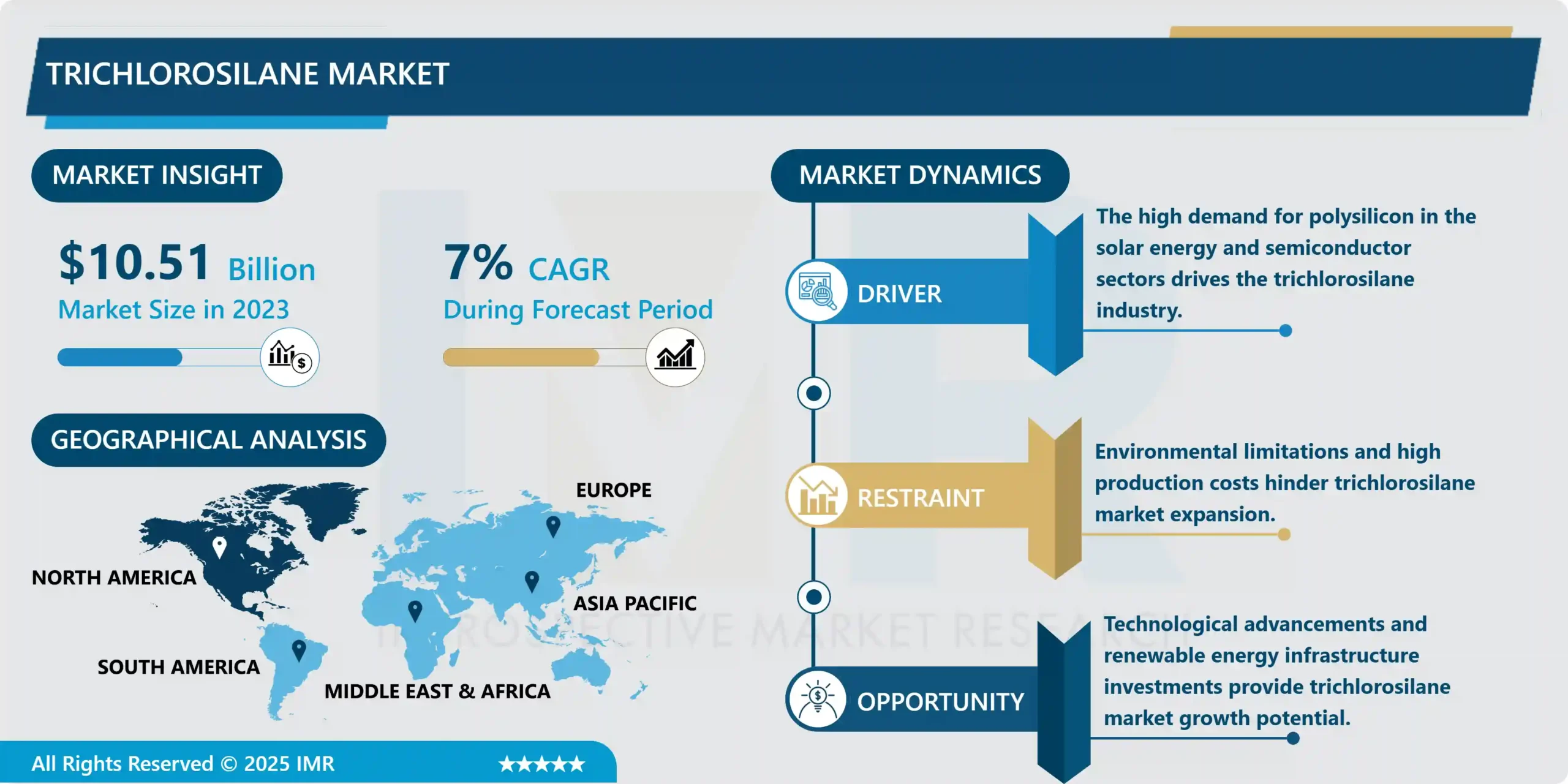
Trichlorosilane Market Size is Valued at USD 10.51 Billion in 2023, and is Projected to Reach USD 18.07 Billion by 2032, Growing at a CAGR of 7% From 2024-2032.
The trichlorosilane market, which is arguably one of the most important segments of the silicones market has been growing as the end product silicones finds more applications in silicones sector. Trichlorosilane is mainly utilised as a reagent in polysilicone production to be employed in industrial electronics semiconductors application and solar ( photovoltaic ) equipment. Moreover, the enhancement of demand for renewable energy particularly in power generation and expanded use of electrical equipment, polysilicon and trichlorosilane demand shall rise rapidly in the future.
Asia-Pacific is the biggest consumer of trichlorosilane because technological development has been complemented by enhancement of industrial outputs in South Korea, Japan, and China among others. As one of the most active companies that operate in the sphere of the Solar energy industry, china has rather stable background of domestic manufacture of the polysilicon product. The usability of manufacturing industry, high investment in installations of renewable energy market share and visibility of future market prospects is seen in this region.
As compared to Asia-Pacific other regions, North America and European also contribute to the market but at a slower pace. Development in the electronics sector and the uptake of solar energy systems in different applications support advancement in these regions. The fact that there are several giant companies in the photovoltaic and electronics industry and the rising number of environmental laws benefiting renewable energy also boosts the consumption of trichlorosilane in these industries.
Trichlorosilane Market Trend Analysis
Demand for Solar Panels
Through the market trend of utilizing solar energy, specifically the photovoltaic cells, the market has experienced a demand of polysilicon which is produced through trichlorosilane, the basic material.. The solar energy sector has developed so well due to increased global deployment of commitments to green and clean energy in addition to higher targets on solar power.
This demand is due to the rising number of solar energy projects and investment in clean energy all over the world. Therefore, the market of trichlorosilane has diverse development, key manufacturers focus on upgrading the technologies, equipment and capacity in the solar energy application field.
High Demand for Advanced Materials
The demand for trichlorosilane is steadily rising due to rising applications in focus industries, such as renewable energy and electronics. New chemical products which use trichlorosilane such as polysilicon used in semiconductors and photovoltaic cells are crucial in producing high purity silicon.
The demand for solar panels has risen as energy producers across the global seek alternatives to conventional energy sources, which has created a demand for polysilicon and its essential raw material, trichlorosilane. Accordingly, the electronics sector increases the pace of growth, particularly in the manufacture of microchips and circuits, which in turn stimulates the market for trichlorosilane and contributes to the growth of a demand for high-purity silicon.
Trichlorosilane Market Segment Analysis:
Trichlorosilane Market Segmented on the basis of By Production Process, and Application
By Production Process, Hydrochlorination segment is expected to dominate the market during the forecast period
Based on major production processes, the global trichlorosilane market is divided into hydrochlorination and direct chlorination.. The most commonly used process is hydrochlorination, wherein pure silicon reacts with hydrogen chloride at high temperature to form trichlorosilane.
This technique is much favored by the semiconductor and solar industries due to its relative efficiency and ability to produce high-purity trichlorosilane, an essential element in the production of polysilicon. Hydrochlorination has been on the rise due to the growing demand of advanced electronics and renewable energy sources; the two industries that cannot do without high purity TCS.
By Application, Silane Coupling Agent segment held the largest share in 2024
Trichlorosilane in particular is a silane coupling agent used in its most important application in the market. Trichlorosilane-derived silanes impart improvements in performance and degradation resistance to composites, paints and sealants used in automotive, construction and coating industries which makes this application valuable.
Trichlorosilane has also a prominent use for the manufacture of polycrystalline silicon also known as polysilicon or silicon used widely in the manufacturing of solar panels and semiconductors. The growth in the solar energy industry worldwide due to efforts of going green that help to reduce reliance on fossil sources have created a strong relationship between the market demand for polysilicon.
Trichlorosilane Market Regional Insights:
Asia-Pacific is expected to dominate the trichlorosilane Market
We expect the Asia-Pacific region to emerge as the largest consumer for trichlorosilane as a result of a large industrial activity in the region, and the increased pace of development in the renewable energy industry. It is observed that increasing the production of polysilicon is closely related to the developing solar energy industry, and the main players are Japan, South Korea, and China.
The Asia-Pacific region is another region that is also formed by supportive government policies for technological advancement and sustainable energy sources for the trichlorosilane market. Sure enough, as carbon emission reductions become a global trend, polysilicon in solar panels will increase thus boosting demand for trichlorosilane even further. We anticipate that Asia-Pacific region will further strengthen its position in the years to come despite advance in renewable energy and electronics.
Active Key Players in the Trichlorosilane Market
Evonik Industries AG (Germany)
GELEST, INC. (U.S.)
Wacker Chemie AG (Germany)
PCC SE (Germany)
Schill+Seilacher “Struktol” GmbH (Germany)
Nanjing Shuguang Chemical Group Co., Ltd. (China)
Momentive (U.S.)
Shin-Etsu Chemical Co., Ltd. (Japan)
Dow (U.S.)
SiVance, LLC (U.S.)
CHT Group (Germany)
China National Bluestar (Group) Co, Ltd. (China)
Silar (U.S.)
Anabond (India)
3M (U.S.)
PanGu Chemical Group Ltd. (China)
Others
Chapter 1: Introduction
1.1 Scope and Coverage
Chapter 2:Executive Summary
Chapter 3: Market Landscape
3.1 Market Dynamics
3.1.1 Drivers
3.1.2 Restraints
3.1.3 Opportunities
3.1.4 Challenges
3.2 Market Trend Analysis
3.3 PESTLE Analysis
3.4 Porter’s Five Forces Analysis
3.5 Industry Value Chain Analysis
3.6 Ecosystem
3.7 Regulatory Landscape
3.8 Price Trend Analysis
3.9 Patent Analysis
3.10 Technology Evolution
3.11 Investment Pockets
3.12 Import-Export Analysis
Chapter 4: Trichlorosilane Market by Production Process (2018-2032)
4.1 Trichlorosilane Market Snapshot and Growth Engine
4.2 Market Overview
4.3 Hydrochlorination
4.3.1 Introduction and Market Overview
4.3.2 Historic and Forecasted Market Size in Value USD and Volume Units
4.3.3 Key Market Trends, Growth Factors, and Opportunities
4.3.4 Geographic Segmentation Analysis
4.4 Direct Chlorination
Chapter 5: Trichlorosilane Market by Application (2018-2032)
5.1 Trichlorosilane Market Snapshot and Growth Engine
5.2 Market Overview
5.3 Silane Coupling Agent
5.3.1 Introduction and Market Overview
5.3.2 Historic and Forecasted Market Size in Value USD and Volume Units
5.3.3 Key Market Trends, Growth Factors, and Opportunities
5.3.4 Geographic Segmentation Analysis
5.4 Polycrystalline Silicon
Chapter 6: Company Profiles and Competitive Analysis
6.1 Competitive Landscape
6.1.1 Competitive Benchmarking
6.1.2 Trichlorosilane Market Share by Manufacturer (2024)
6.1.3 Industry BCG Matrix
6.1.4 Heat Map Analysis
6.1.5 Mergers and Acquisitions
6.2 EVONIK INDUSTRIES AG (GERMANY)
6.2.1 Company Overview
6.2.2 Key Executives
6.2.3 Company Snapshot
6.2.4 Role of the Company in the Market
6.2.5 Sustainability and Social Responsibility
6.2.6 Operating Business Segments
6.2.7 Product Portfolio
6.2.8 Business Performance
6.2.9 Key Strategic Moves and Recent Developments
6.2.10 SWOT Analysis
6.3 GELEST INC. (U.S.)
6.4 WACKER CHEMIE AG (GERMANY)
6.5 PCC SE (GERMANY)
6.6 SCHILL+SEILACHER STRUKTOL” GMBH (GERMANY)
6.7 NANJING SHUGUANG CHEMICAL GROUP COLTD. (CHINA)
6.8 MOMENTIVE (U.S.)
6.9 SHIN-ETSU CHEMICAL COLTD. (JAPAN)
6.10 DOW (U.S.)
6.11 SIVANCE
6.12 LLC (U.S.)
6.13 CHT GROUP (GERMANY)
6.14 CHINA NATIONAL BLUESTAR (GROUP) CO LTD. (CHINA)
6.15 SILAR (U.S.)
6.16 ANABOND (INDIA)
6.17 3M (U.S.)
6.18 PANGU CHEMICAL GROUP LTD. (CHINA)
6.19 OTHERS
6.20
Chapter 7: Global Trichlorosilane Market By Region
7.1 Overview
7.2. North America Trichlorosilane Market
7.2.1 Key Market Trends, Growth Factors and Opportunities
7.2.2 Top Key Companies
7.2.3 Historic and Forecasted Market Size by Segments
7.2.4 Historic and Forecasted Market Size by Production Process
7.2.4.1 Hydrochlorination
7.2.4.2 Direct Chlorination
7.2.5 Historic and Forecasted Market Size by Application
7.2.5.1 Silane Coupling Agent
7.2.5.2 Polycrystalline Silicon
7.2.6 Historic and Forecast Market Size by Country
7.2.6.1 US
7.2.6.2 Canada
7.2.6.3 Mexico
7.3. Eastern Europe Trichlorosilane Market
7.3.1 Key Market Trends, Growth Factors and Opportunities
7.3.2 Top Key Companies
7.3.3 Historic and Forecasted Market Size by Segments
7.3.4 Historic and Forecasted Market Size by Production Process
7.3.4.1 Hydrochlorination
7.3.4.2 Direct Chlorination
7.3.5 Historic and Forecasted Market Size by Application
7.3.5.1 Silane Coupling Agent
7.3.5.2 Polycrystalline Silicon
7.3.6 Historic and Forecast Market Size by Country
7.3.6.1 Russia
7.3.6.2 Bulgaria
7.3.6.3 The Czech Republic
7.3.6.4 Hungary
7.3.6.5 Poland
7.3.6.6 Romania
7.3.6.7 Rest of Eastern Europe
7.4. Western Europe Trichlorosilane Market
7.4.1 Key Market Trends, Growth Factors and Opportunities
7.4.2 Top Key Companies
7.4.3 Historic and Forecasted Market Size by Segments
7.4.4 Historic and Forecasted Market Size by Production Process
7.4.4.1 Hydrochlorination
7.4.4.2 Direct Chlorination
7.4.5 Historic and Forecasted Market Size by Application
7.4.5.1 Silane Coupling Agent
7.4.5.2 Polycrystalline Silicon
7.4.6 Historic and Forecast Market Size by Country
7.4.6.1 Germany
7.4.6.2 UK
7.4.6.3 France
7.4.6.4 The Netherlands
7.4.6.5 Italy
7.4.6.6 Spain
7.4.6.7 Rest of Western Europe
7.5. Asia Pacific Trichlorosilane Market
7.5.1 Key Market Trends, Growth Factors and Opportunities
7.5.2 Top Key Companies
7.5.3 Historic and Forecasted Market Size by Segments
7.5.4 Historic and Forecasted Market Size by Production Process
7.5.4.1 Hydrochlorination
7.5.4.2 Direct Chlorination
7.5.5 Historic and Forecasted Market Size by Application
7.5.5.1 Silane Coupling Agent
7.5.5.2 Polycrystalline Silicon
7.5.6 Historic and Forecast Market Size by Country
7.5.6.1 China
7.5.6.2 India
7.5.6.3 Japan
7.5.6.4 South Korea
7.5.6.5 Malaysia
7.5.6.6 Thailand
7.5.6.7 Vietnam
7.5.6.8 The Philippines
7.5.6.9 Australia
7.5.6.10 New Zealand
7.5.6.11 Rest of APAC
7.6. Middle East & Africa Trichlorosilane Market
7.6.1 Key Market Trends, Growth Factors and Opportunities
7.6.2 Top Key Companies
7.6.3 Historic and Forecasted Market Size by Segments
7.6.4 Historic and Forecasted Market Size by Production Process
7.6.4.1 Hydrochlorination
7.6.4.2 Direct Chlorination
7.6.5 Historic and Forecasted Market Size by Application
7.6.5.1 Silane Coupling Agent
7.6.5.2 Polycrystalline Silicon
7.6.6 Historic and Forecast Market Size by Country
7.6.6.1 Turkiye
7.6.6.2 Bahrain
7.6.6.3 Kuwait
7.6.6.4 Saudi Arabia
7.6.6.5 Qatar
7.6.6.6 UAE
7.6.6.7 Israel
7.6.6.8 South Africa
7.7. South America Trichlorosilane Market
7.7.1 Key Market Trends, Growth Factors and Opportunities
7.7.2 Top Key Companies
7.7.3 Historic and Forecasted Market Size by Segments
7.7.4 Historic and Forecasted Market Size by Production Process
7.7.4.1 Hydrochlorination
7.7.4.2 Direct Chlorination
7.7.5 Historic and Forecasted Market Size by Application
7.7.5.1 Silane Coupling Agent
7.7.5.2 Polycrystalline Silicon
7.7.6 Historic and Forecast Market Size by Country
7.7.6.1 Brazil
7.7.6.2 Argentina
7.7.6.3 Rest of SA
Chapter 8 Analyst Viewpoint and Conclusion
8.1 Recommendations and Concluding Analysis
8.2 Potential Market Strategies
Chapter 9 Research Methodology
9.1 Research Process
9.2 Primary Research
9.3 Secondary Research
“
Q1: What would be the forecast period in the Trichlorosilane Market research report?
A1: The forecast period in the Trichlorosilane Market research report is 2024-2032.
Q2: Who are the key players in the Trichlorosilane Market?
A2: Evonik Industries AG (Germany), GELEST, INC. (U.S.), Wacker Chemie AG (Germany), PCC SE (Germany), Schill+Seilacher "Struktol" GmbH (Germany), Nanjing Shuguang Chemical Group Co., Ltd. (China), Momentive (U.S.), Shin-Etsu Chemical Co., Ltd. (Japan), Dow (U.S.), SiVance, LLC (U.S.), CHT Group (Germany), China National Bluestar (Group) Co, Ltd. (China), Silar (U.S.), Anabond (India), 3M (U.S.), PanGu Chemical Group Ltd. (China), Others.
Q3: What are the segments of the Trichlorosilane Market?
A3: The Trichlorosilane Market is segmented into By Production Process (Hydrochlorination and Direct Chlorination), Application (Silane Coupling Agent and Polycrystalline Silicon).By region, it is analyzed across North America (U.S.; Canada; Mexico), Eastern Europe (Bulgaria; The Czech Republic; Hungary; Poland; Romania; Rest of Eastern Europe), Western Europe (Germany; UK; France; Netherlands; Italy; Russia; Spain; Rest of Western Europe), Asia-Pacific (China; India; Japan; Southeast Asia, etc.), South America (Brazil; Argentina, etc.), Middle East & Africa (Saudi Arabia; South Africa, etc.).
Q4: What is the Trichlorosilane Market?
A4: Trichlorosilane (SiHCl?) is a chemical compound composed of silicon, hydrogen, and chlorine. It is a colorless, volatile liquid widely used as an intermediate in the production of high-purity silicon for the electronics and photovoltaic industries, particularly in the manufacture of polysilicon for semiconductors and solar cells. Trichlorosilane is highly reactive with moisture, forming hydrogen chloride gas and silicon dioxide, and requires careful handling due to its flammability and potential health hazards. It plays a crucial role in the production of silicones, a versatile material used in various industrial applications.
Q5: How big is the Trichlorosilane Market?
A5: Trichlorosilane Market Size is Valued at USD 10.51 Billion in 2023, and is Projected to Reach USD 18.07 Billion by 2032, Growing at a CAGR of 7% From 2024-2032.
How to Buy a Report from eminsights.jp
On the product page, choose the license you want: Single-User License, Multi-User License or Enterprise License.
If you required report in your native language, then you can click on Translated Report button and fill out the form with report name and language you want, then our team will contact you as soon as possible.
Click the Buy Now button.
You will be redirected to the checkout page. Enter your company details and payment information.
Click Place Order to complete the purchase.
Confirmation: You’ll receive an order confirmation and our team will contact you shortly with your ordered report.
If you have any questions, fill out the contact form below or email us at bizdev@eminsights.net.
Thank you for choosing eminsights.jp!