Stay Ahead in Fast-Growing Economies.
Browse Reports Now




Travel Technology Market- Global Size, Share & Industry Trends (2024- 2032)
Technology has revolutionized almost every element of travel. Using technology during the planning of traveling helps in studying, arranging, buying, and interacting with their travels like extraordinary from booking and planning to navigating and sharing experiences. Because of technological developments, the travel industry gives the end-to-end travel experience to the customers.

IMR Group
Description
Travel Technology Market Synopsis
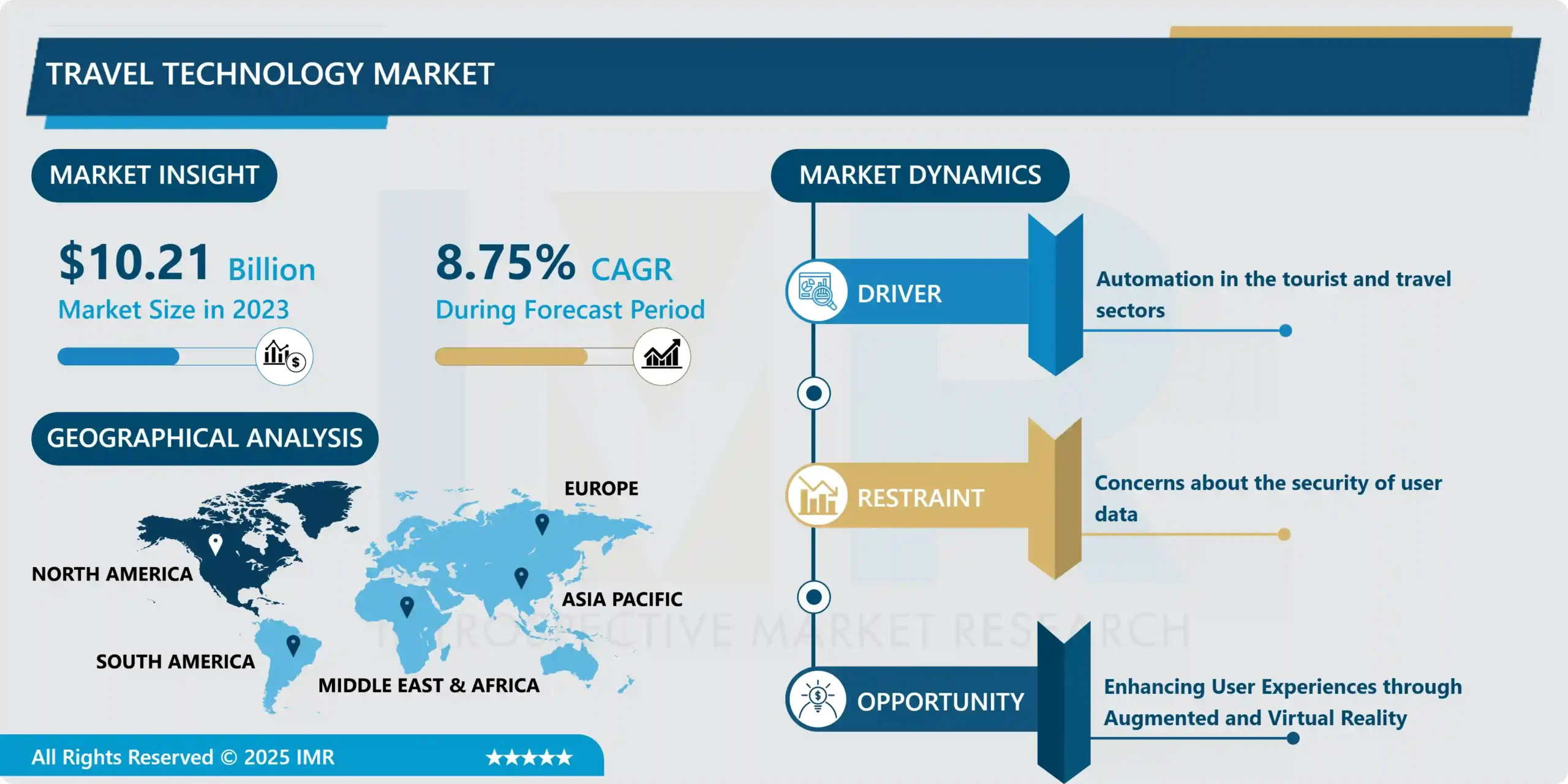
Travel Technology Market Size Was Valued at USD 10.21 Billion in 2023 and is Projected to Reach USD 21.72 Billion by 2032, Growing at a CAGR of 8.75% From 2024-2032.
Travel Technology includes making use of technology to arrange trips and streamline journey-related obligations which include bookings, stock control, payments, scheduling, and lower back-workplace operations for tour corporations and groups. This allows clients e-book their trips online, improving reservation strategies and developing revenues.
Technology has revolutionized almost every element of travel. Using technology during the planning of traveling helps in studying, arranging, buying, and interacting with their travels like extraordinary from booking and planning to navigating and sharing experiences. Because of technological developments, the travel industry gives the end-to-end travel experience to the customers.
This covers Digital payments, IoT devices, chatbots, digital facts, trip-hailing apps, overview websites, online reserving structures, and more. Travelers may additionally now plan, arrange, book, navigate, and discuss their vacations without difficulty because of this technology. They also make it viable for tourism-associated enterprises to more correctly reach, assist, and carrier vacationers.
According to the World Travel and Tourism Council, the tour and tourism industry contributed 9.1% of worldwide GDP in 2023, which increased by 23.2% in comparison to 2022 and is just four.1% lower than in 2019. As multiplied by the integration of technological improvements in the tour and tourism enterprise as a consequence, the marketplace is developing in the forecast time frame.
Travel Technology Market Trend Analysis
Automation in the tourist and travel sectors
The travel zone has visible a transformation due to digitalization. In the beyond, scheduling an experience required a telephone name or an in-person verbal exchange with a provider company. By 2023, all reservations may be made online, enabling tourists to set up their journeys from the comfort of their favorite gadgets. Indeed, cell reservations have the energy to essentially alter the journey enterprise. The comfort and accessibility of online reserving will revolutionize the manner people plan their vacations.
Also, actual-time modifications and notifications can be sent using mobile reserving systems to clients and agencies, enhancing performance and conversation. All matters considered the usage of generation inside the journey sector can bring about a more efficient and handy booking method for all parties.
Automation controls inventories, optimizes routes, and even forecasts call. This lowers fees and boosts productivity for journey organizations. Hospitality to cut labor costs and improve performance, the inn business has started deploying robots for delivery, cleaning, and house responsibilities.
Enhancing User Experiences Through Augmented and Virtual Reality
Among exciting advancements, Augmented Reality (AR) and Virtual Reality (VR) have emerged as sport-changers, supplying guests with an excellent manner to discover destinations even before stepping foot outdoors their houses.
One of the maximum full-size impacts of AR and VR in travel planning is their ability to offer a sneak peek into locations, empowering travelers to make nicely-knowledgeable selections. With AR, travelers can overlay digital data onto the physical international use of their smartphones. They can view motel rooms or discover neighborhood attractions interactively. On the opposite hand, VR creates fully simulated environments that allow users to immerse themselves in a vacation spot through 360-degree enjoyment.
As AR/VR retains to adapt unexpectedly, their applications in journey planning will surely amplify. Imagine a future wherein travelers can use AR-powered devices for immediate translations of overseas signs or menus during the time interacting with locals – fostering significant cultural exchanges. Similarly, VR may want to revolutionize tour schooling, permitting students to embark on digital subject trips and advantage of first-hand knowledge of historic websites and numerous cultures, no matter their geographical vicinity.
Travel Technology Market Segment Analysis:
Travel Technology Market is Segmented based on type, deployment model, technology, application, and Region.
By Type, Global Distribution System (GDS) segment is expected to dominate the market during the forecast duration
GDS (Global Distribution System) is a platform that connects tour shops with airlines, lodges, and car rental agencies, making it smooth to book travel. It simplifies the booking technique for tour businesses and companies using presenting real-time stock and facilitating transactions. GDS is mainly beneficial for company tours, where travel companies negotiate unique charges with airlines.
The emergence of online travel agencies (OTAs) and direct booking via hotel and airline websites is posing a challenge to GDSs. Airlines and hospitality, IT solutions agencies are increasingly investing in their online reserving systems, letting them capture a larger proportion of booking costs and doubtlessly offer more competitive prices immediately to clients. Travel-centered IT solution carriers are growing new technologies that customize the travel experience, integrate diverse tour services, and leverage cellular platforms for bookings and experience control.
By Deployment Model, Cloud-based segment is expected to dominate the market during the forecast period
Cloud offerings often have a lower upfront price in comparison to on-premise answers. With the cloud, travelers generally pay for what they use, putting off the need for costly hardware investments and an IT body of workers for preservation. Cloud-based totally systems are noticeably scalable. Businesses can easily increase or decrease their useful resource utilization based totally on their wishes, averting the need to purchase additional hardware or software program licenses.
Cloud programs are handled from anywhere with a web connection, allowing for more flexibility and far-flung work abilities. Updates and maintenance are dealt with by way of the cloud provider, releasing internal IT resources. Cloud provider carriers typically make investments closely in security features to defend user facts. While protection issues exist in each model, a few businesses find cloud providers provide a far better protection posture than they may manage themselves.
By Technology, the Artificial Intelligence (AI) segment is expected to dominate the market during the forecast period
AI is a key aspect of the tourism industry’s improvement in lots of areas. Artificial intelligence-pushed technology improves the entire journey enjoyed using streamlining approaches and providing actual-time language translation further enhancing flight bookings. Predictive analytics is used by structures like Hopper to identify when is the most excellent time to shop for airline tickets, even as AI-powered chatbots offer 24/7 customer service to offer seamless help for tourists.
AI additionally facilitates lodge bookings, sorting via a plethora of opportunities to locate an appropriate suit primarily based on private tastes and monetary boundaries. The excursion planning system is similarly more suitable through AI’s potential to construct individualized suggestions and itineraries based totally on vacationers’ pastimes.
Additionally, by prioritizing the safety of vacationers, AI improves tour safety by giving actual-time updates on climate conditions and advisories. AI also makes it viable for immersive digital excursions of locations through virtual fact generation, letting tourists discover and engage with new locations from the comfort of their own houses. In widespread, the adoption of AI within the journey quarter heralds an alternative towards greater effective, custom-designed, and seamless travel reviews for clients all over the world.
Travel Technology Market Regional Insights:
North America is Expected to Dominate the Market Over the Forecast Period
North America leads the travel technology market, attributed to its superior technological infrastructure, high internet penetration, and the presence of key market players. The region showcases a sturdy adoption of tour and hospitality software program solutions, along with online booking engines, patron dating management (CRM) structures, and mobile travel applications. This marketplace dominance is similarly reinforced by a subculture of innovation and a strong emphasis on improving consumer enjoyment through personalized journey solutions. The integration of synthetic intelligence, device learning, and large facts analytics is in particular suggested in North America, supplying advanced structures for tour groups, airways, and hoteliers to optimize operations and deliver customized offerings.
The Asia Pacific vicinity is witnessing a fast boom within the travel generation marketplace, driven by growing net penetration, growing middle-class populations, and an increase in mobile tool utilization. This location is characterized by a diverse variety of rising and set-up tour markets, with countries like China and India leading in virtual innovation and adoption. The upward push of online travel corporations (OTAs), nearby start-ups supplying travel and hospitality solutions, and the inclusion of cellular systems for journey bookings are key factors contributing to the enlargement of this market in Asia Pacific. The location’s recognition of mobile generation displays the choices of its travelers, an increasing number rely upon smartphones for travel-associated activities.
Active Key Players in the Travel Technology Market
Expedia Group (US)
Agilysys (US)
Oracle (US)
Navitaire (US)
Sabre (US)
Dohop (Iceland)
Travelport (UK)
Traveltek (UK)
Trip Solutions (UK)
Amadeus IT Group (Spain)
GP Solutions (Germany)
DIGITRIPS (France)
Travelopro (India)
Trawex (India)
Travel buddy (India)
Qtech Software Pvt. Ltd. (India)
Avani Cimcon Technologies (India)
WebCRSTravel Technologies Pvt. Ltd (India)
Qtech Software (India)
mTrip (China)
SiteMinder (Australia)
Tramada Systems (Australia)
Tramada Systems Pvt. Ltd. (Australia)
Techno Heaven (UAE)
Global Travel Tech (Belgium)
Other Active Players
Chapter 1: Introduction
1.1 Scope and Coverage
Chapter 2:Executive Summary
Chapter 3: Market Landscape
3.1 Market Dynamics
3.1.1 Drivers
3.1.2 Restraints
3.1.3 Opportunities
3.1.4 Challenges
3.2 Market Trend Analysis
3.3 PESTLE Analysis
3.4 Porter’s Five Forces Analysis
3.5 Industry Value Chain Analysis
3.6 Ecosystem
3.7 Regulatory Landscape
3.8 Price Trend Analysis
3.9 Patent Analysis
3.10 Technology Evolution
3.11 Investment Pockets
3.12 Import-Export Analysis
Chapter 4: Travel Technology Market by Type (2018-2032)
4.1 Travel Technology Market Snapshot and Growth Engine
4.2 Market Overview
4.3 Airline & Hospitality
4.3.1 Introduction and Market Overview
4.3.2 Historic and Forecasted Market Size in Value USD and Volume Units
4.3.3 Key Market Trends, Growth Factors, and Opportunities
4.3.4 Geographic Segmentation Analysis
4.4 IT Solutions
4.5 Global Distribution System (GDS)
Chapter 5: Travel Technology Market by Deployment Model (2018-2032)
5.1 Travel Technology Market Snapshot and Growth Engine
5.2 Market Overview
5.3 On-Premise
5.3.1 Introduction and Market Overview
5.3.2 Historic and Forecasted Market Size in Value USD and Volume Units
5.3.3 Key Market Trends, Growth Factors, and Opportunities
5.3.4 Geographic Segmentation Analysis
5.4 Cloud-Based
Chapter 6: Travel Technology Market by Technology (2018-2032)
6.1 Travel Technology Market Snapshot and Growth Engine
6.2 Market Overview
6.3 Artificial Intelligence (AI)
6.3.1 Introduction and Market Overview
6.3.2 Historic and Forecasted Market Size in Value USD and Volume Units
6.3.3 Key Market Trends, Growth Factors, and Opportunities
6.3.4 Geographic Segmentation Analysis
6.4 Augmented Reality (AR) and Virtual Reality (VR)
6.5 Internet of Things (IoT)
Chapter 7: Company Profiles and Competitive Analysis
7.1 Competitive Landscape
7.1.1 Competitive Benchmarking
7.1.2 Travel Technology Market Share by Manufacturer (2024)
7.1.3 Industry BCG Matrix
7.1.4 Heat Map Analysis
7.1.5 Mergers and Acquisitions
7.2 MATRIX SCIENTIFIC (UNITED STATES)
7.2.1 Company Overview
7.2.2 Key Executives
7.2.3 Company Snapshot
7.2.4 Role of the Company in the Market
7.2.5 Sustainability and Social Responsibility
7.2.6 Operating Business Segments
7.2.7 Product Portfolio
7.2.8 Business Performance
7.2.9 Key Strategic Moves and Recent Developments
7.2.10 SWOT Analysis
7.3 AK SCIENTIFIC INC. (UNITED STATES)
7.4 COVACHEM (UNITED STATES)
7.5 FISHER SCIENTIFIC (UNITED STATES)
7.6 ALFA AESAR (UNITED STATES)
7.7 TORONTO RESEARCH CHEMICALS (CANADA)
7.8 APOLLO SCIENTIFIC LTD (UNITED KINGDOM)
7.9 MERCK KGAA (GERMANY)
7.10 BASF (GERMANY)
7.11 TCI CHEMICALS (JAPAN)
7.12 TOKYO CHEMICAL INDUSTRY (JAPAN)
7.13 J&K SCIENTIFIC (CHINA)
7.14 ANGENE INTERNATIONAL LIMITED (CHINA)
7.15
Chapter 8: Global Travel Technology Market By Region
8.1 Overview
8.2. North America Travel Technology Market
8.2.1 Key Market Trends, Growth Factors and Opportunities
8.2.2 Top Key Companies
8.2.3 Historic and Forecasted Market Size by Segments
8.2.4 Historic and Forecasted Market Size by Type
8.2.4.1 Airline & Hospitality
8.2.4.2 IT Solutions
8.2.4.3 Global Distribution System (GDS)
8.2.5 Historic and Forecasted Market Size by Deployment Model
8.2.5.1 On-Premise
8.2.5.2 Cloud-Based
8.2.6 Historic and Forecasted Market Size by Technology
8.2.6.1 Artificial Intelligence (AI)
8.2.6.2 Augmented Reality (AR) and Virtual Reality (VR)
8.2.6.3 Internet of Things (IoT)
8.2.7 Historic and Forecast Market Size by Country
8.2.7.1 US
8.2.7.2 Canada
8.2.7.3 Mexico
8.3. Eastern Europe Travel Technology Market
8.3.1 Key Market Trends, Growth Factors and Opportunities
8.3.2 Top Key Companies
8.3.3 Historic and Forecasted Market Size by Segments
8.3.4 Historic and Forecasted Market Size by Type
8.3.4.1 Airline & Hospitality
8.3.4.2 IT Solutions
8.3.4.3 Global Distribution System (GDS)
8.3.5 Historic and Forecasted Market Size by Deployment Model
8.3.5.1 On-Premise
8.3.5.2 Cloud-Based
8.3.6 Historic and Forecasted Market Size by Technology
8.3.6.1 Artificial Intelligence (AI)
8.3.6.2 Augmented Reality (AR) and Virtual Reality (VR)
8.3.6.3 Internet of Things (IoT)
8.3.7 Historic and Forecast Market Size by Country
8.3.7.1 Russia
8.3.7.2 Bulgaria
8.3.7.3 The Czech Republic
8.3.7.4 Hungary
8.3.7.5 Poland
8.3.7.6 Romania
8.3.7.7 Rest of Eastern Europe
8.4. Western Europe Travel Technology Market
8.4.1 Key Market Trends, Growth Factors and Opportunities
8.4.2 Top Key Companies
8.4.3 Historic and Forecasted Market Size by Segments
8.4.4 Historic and Forecasted Market Size by Type
8.4.4.1 Airline & Hospitality
8.4.4.2 IT Solutions
8.4.4.3 Global Distribution System (GDS)
8.4.5 Historic and Forecasted Market Size by Deployment Model
8.4.5.1 On-Premise
8.4.5.2 Cloud-Based
8.4.6 Historic and Forecasted Market Size by Technology
8.4.6.1 Artificial Intelligence (AI)
8.4.6.2 Augmented Reality (AR) and Virtual Reality (VR)
8.4.6.3 Internet of Things (IoT)
8.4.7 Historic and Forecast Market Size by Country
8.4.7.1 Germany
8.4.7.2 UK
8.4.7.3 France
8.4.7.4 The Netherlands
8.4.7.5 Italy
8.4.7.6 Spain
8.4.7.7 Rest of Western Europe
8.5. Asia Pacific Travel Technology Market
8.5.1 Key Market Trends, Growth Factors and Opportunities
8.5.2 Top Key Companies
8.5.3 Historic and Forecasted Market Size by Segments
8.5.4 Historic and Forecasted Market Size by Type
8.5.4.1 Airline & Hospitality
8.5.4.2 IT Solutions
8.5.4.3 Global Distribution System (GDS)
8.5.5 Historic and Forecasted Market Size by Deployment Model
8.5.5.1 On-Premise
8.5.5.2 Cloud-Based
8.5.6 Historic and Forecasted Market Size by Technology
8.5.6.1 Artificial Intelligence (AI)
8.5.6.2 Augmented Reality (AR) and Virtual Reality (VR)
8.5.6.3 Internet of Things (IoT)
8.5.7 Historic and Forecast Market Size by Country
8.5.7.1 China
8.5.7.2 India
8.5.7.3 Japan
8.5.7.4 South Korea
8.5.7.5 Malaysia
8.5.7.6 Thailand
8.5.7.7 Vietnam
8.5.7.8 The Philippines
8.5.7.9 Australia
8.5.7.10 New Zealand
8.5.7.11 Rest of APAC
8.6. Middle East & Africa Travel Technology Market
8.6.1 Key Market Trends, Growth Factors and Opportunities
8.6.2 Top Key Companies
8.6.3 Historic and Forecasted Market Size by Segments
8.6.4 Historic and Forecasted Market Size by Type
8.6.4.1 Airline & Hospitality
8.6.4.2 IT Solutions
8.6.4.3 Global Distribution System (GDS)
8.6.5 Historic and Forecasted Market Size by Deployment Model
8.6.5.1 On-Premise
8.6.5.2 Cloud-Based
8.6.6 Historic and Forecasted Market Size by Technology
8.6.6.1 Artificial Intelligence (AI)
8.6.6.2 Augmented Reality (AR) and Virtual Reality (VR)
8.6.6.3 Internet of Things (IoT)
8.6.7 Historic and Forecast Market Size by Country
8.6.7.1 Turkiye
8.6.7.2 Bahrain
8.6.7.3 Kuwait
8.6.7.4 Saudi Arabia
8.6.7.5 Qatar
8.6.7.6 UAE
8.6.7.7 Israel
8.6.7.8 South Africa
8.7. South America Travel Technology Market
8.7.1 Key Market Trends, Growth Factors and Opportunities
8.7.2 Top Key Companies
8.7.3 Historic and Forecasted Market Size by Segments
8.7.4 Historic and Forecasted Market Size by Type
8.7.4.1 Airline & Hospitality
8.7.4.2 IT Solutions
8.7.4.3 Global Distribution System (GDS)
8.7.5 Historic and Forecasted Market Size by Deployment Model
8.7.5.1 On-Premise
8.7.5.2 Cloud-Based
8.7.6 Historic and Forecasted Market Size by Technology
8.7.6.1 Artificial Intelligence (AI)
8.7.6.2 Augmented Reality (AR) and Virtual Reality (VR)
8.7.6.3 Internet of Things (IoT)
8.7.7 Historic and Forecast Market Size by Country
8.7.7.1 Brazil
8.7.7.2 Argentina
8.7.7.3 Rest of SA
Chapter 9 Analyst Viewpoint and Conclusion
9.1 Recommendations and Concluding Analysis
9.2 Potential Market Strategies
Chapter 10 Research Methodology
10.1 Research Process
10.2 Primary Research
10.3 Secondary Research
Q1: What would be the forecast period in the Travel Technology Market research report?
A1: The forecast period in the Travel Technology Market research report is 2023-2032.
Q2: Who are the key players in the Travel Technology Market?
A2: Expedia Group (US), Agilysys (US), Oracle (US), Navitaire (US), Sabre (US), Dohop (Iceland), Travelport (UK), Traveltek (UK), Trip Solutions (UK), Amadeus IT Group (Spain), GP Solutions (Germany), DIGITRIPS (France), Travelopro (India), Trawex (India), Travel buddy (India), Qtech Software Pvt. Ltd. (India), Avani Cimcon Technologies (India), WebCRSTravel Technologies Pvt. Ltd (India), Qtech Software (India), mTrip (China), SiteMinder (Australia), Tramada Systems (Australia), Tramada Systems Pvt. Ltd. (Australia), Techno Heaven (UAE), Global Travel Tech (Belgium), and Other Active Players.
Q3: What are the segments of the Travel Technology Market?
A3: The Travel Technology Market is segmented into Type, Nature, Application, and region. By Type, the market is categorized into Airline & Hospitality, IT Solutions, and Global Distribution System (GDS). By Deployment Model, the market is categorized into On-Premise and Cloud-Based. By Technology, the market is categorized into Artificial Intelligence (AI), Augmented Reality (AR) & Virtual Reality (VR), and Internet of Things (IoT). By region, it is analyzed across North America (U.S.; Canada; Mexico), Eastern Europe (Bulgaria; The Czech Republic; Hungary; Poland; Romania; Rest of Eastern Europe), Western Europe (Germany; UK; France; Netherlands; Italy; Russia; Spain; Rest of Western Europe), Asia-Pacific (China; India; Japan; Southeast Asia, etc.), South America (Brazil; Argentina, etc.), Middle East & Africa (Saudi Arabia; South Africa, etc.).
Q4: What is the Travel Technology Market?
A4: Travel Technology involves utilizing technology to organize trips and streamline travel-related tasks such as bookings, inventory management, payments, scheduling, and back-office operations for travel agencies and companies. This enables customers to book their trips online, enhancing reservation processes and increasing revenues.
Q5: How big is the Travel Technology Market?
A5: Travel Technology Market Size Was Valued at USD 10.21 Billion in 2023 and is Projected to Reach USD 21.72 Billion by 2032, Growing at a CAGR of 8.75% From 2024-2032.
How to Buy a Report from eminsights.jp
On the product page, choose the license you want: Single-User License, Multi-User License or Enterprise License.
If you required report in your native language, then you can click on Translated Report button and fill out the form with report name and language you want, then our team will contact you as soon as possible.
Click the Buy Now button.
You will be redirected to the checkout page. Enter your company details and payment information.
Click Place Order to complete the purchase.
Confirmation: You’ll receive an order confirmation and our team will contact you shortly with your ordered report.
If you have any questions, fill out the contact form below or email us at bizdev@eminsights.net.
Thank you for choosing eminsights.jp!