Stay Ahead in Fast-Growing Economies.
Browse Reports Now
Transport Management System Market – Size, Share & Industry Trends
A transportation management system (TMS) is a logistics platform that uses technology to help businesses plan, execute, and optimize the physical movement of goods, both incoming and outgoing, and make sure the shipment is compliant, proper documentation is available.

IMR Group
Description
Transport Management System Market Synopsis
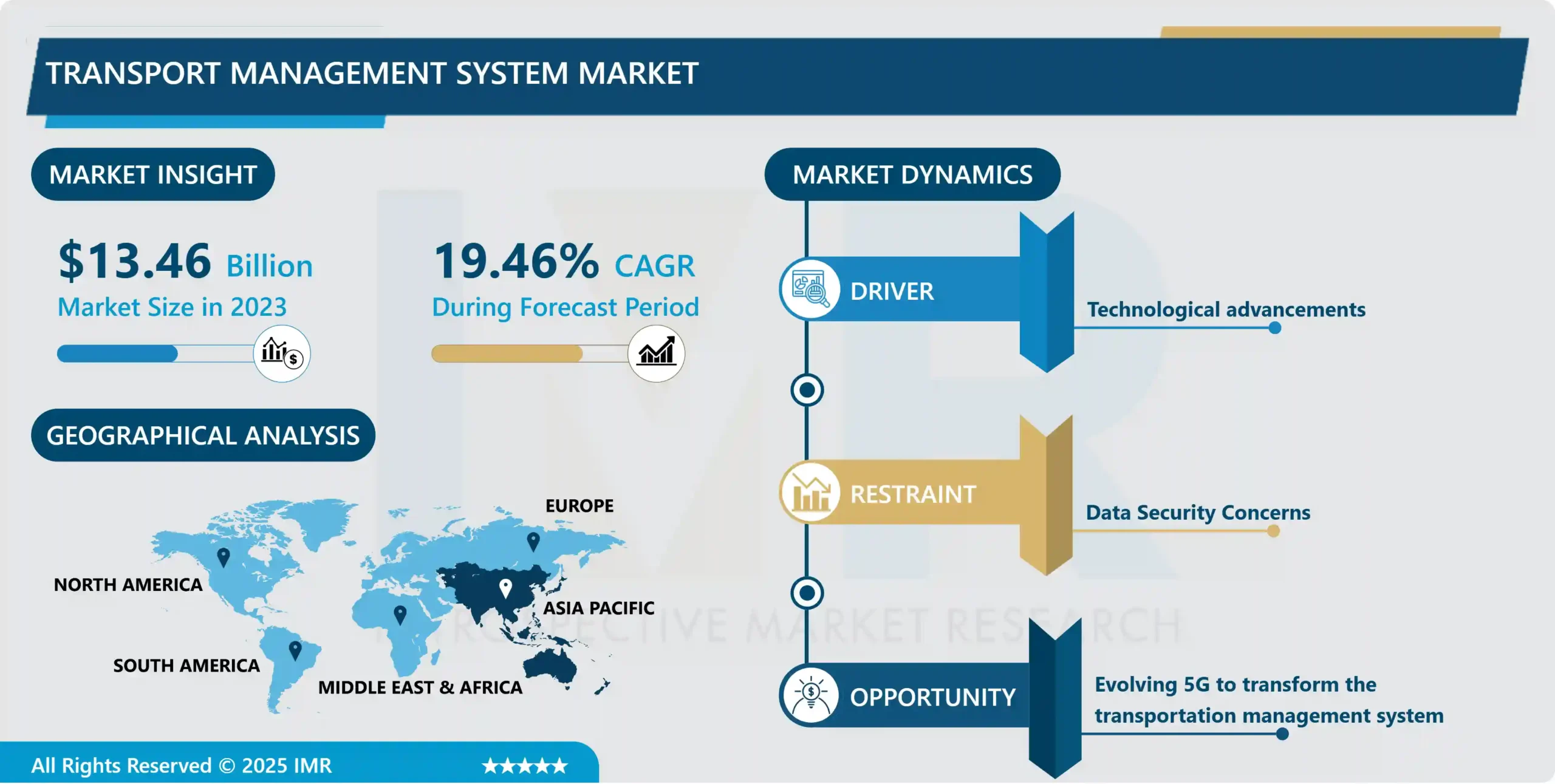
The Transport Management System Market was valued at USD 13.46 billion in 2023 and is projected to reach USD 66.69 billion by 2032, registering a CAGR of 19.46 % from 2024 to 2032.
A transportation management system (TMS) is a logistics platform that uses technology to help businesses plan, execute, and optimize the physical movement of goods, both incoming and outgoing, and make sure the shipment is compliant, proper documentation is available. This kind of system is often part of a larger supply chain management (SCM) system.
Transportation Management System used to Streamline procurement and freight shipment with automated carrier rate comparison and booking. Choose the mode of shipment – air, ocean, truck, or rail freight – and plan the most efficient route for the transport of goods. Optimize loads and take advantage of real-time track and trace capabilities to monitor progress.
A Transportation Management System offers significant cost savings for both the enterprise and the end customer in several important ways. It reduces administrative costs. TMS makes it easy to compare carrier rates to find the best option. It also automates the booking process, replacing time-consuming phone calls with efficient digital booking. The software streamlines integrate, and automates processes, including auditing, contract, payment, and order scheduling, for greater efficiency and fewer errors.
transportation and logistics industries in emerging countries have come under significant pressure from growing consumer demands, rising competition from start-ups and rival logistics operators, and changing customer expectations. Most logistics companies in countries in the APAC region utilize advanced IoT technologies to localized inventory and manage orders instead of supply chains, fleets, and assets.
For instance, Here Technologies, a location platform solution provider based in the Netherlands, conducted an “APAC on the Move 2023 Survey” to offer insights on the current trends in the supply chain, logistics, and fleet management. The survey offered insights on robotics, drones, machine learning, and artificial intelligence, which are the most likely investments among logistics companies in APAC.
Transport Management System Market Trend Analysis
Technological advancements
Advances in technology, such as cloud computing, Internet of Things (IoT), artificial intelligence (AI), and machine learning, have significantly enhanced the capabilities of TMS solutions. These technologies enable real-time tracking, predictive analytics, and automation, empowering companies to streamline their transportation operations and make data-driven decisions.
The accessibility offered by cloud-based TMS systems has democratized their usage, enabling a broader range of companies to adopt these solutions. This accessibility, coupled with enhanced capabilities and flexibility, is expanding the TMS market’s reach and appeal.
The Internet of Things (IoT) has revolutionized TMS by enabling the integration of sensors and devices in vehicles, infrastructure, and cargo. This allows for real-time monitoring of vehicle conditions, cargo status, and traffic conditions, leading to improved decision-making and enhanced fleet management, this technology boosts the transportation management system market.
Cloud-based TMS solutions offer scalability, flexibility, and accessibility from anywhere with an internet connection. This allows transportation companies to easily deploy and manage their TMS without significant upfront investment in infrastructure. Cloud computing also facilitates data sharing and collaboration among stakeholders in the supply chain, technological advancements continue to drive innovation and growth in the Transport Management System market
Evolving 5G to transform the transportation management system
The emergence of 5G technology brings forth a range of possibilities for the Transportation Management System (TMS) market. These opportunities include improved connectivity, real-time communication, and data exchange between vehicles and TMS platforms. With 5G, vehicles can share information about road conditions, traffic, and accidents, enabling better route planning and optimization.
TMS platforms can also benefit from 5G by gathering real-time data from vehicles and using advanced analytics for proactive decision-making, efficient fleet management, and predictive maintenance. Additionally, 5G facilitates seamless integration between TMS platforms and supply chain stakeholders, enabling real-time visibility, inventory management, and responsive coordination.
The deployment of autonomous vehicles and platooning systems can also leverage 5G’s high-speed, low-latency connectivity. Also, 5G-powered TMS platforms can contribute to intelligent traffic management, optimizing traffic flow, reducing congestion, and enhancing road safety through real-time data analysis and dynamic adjustments. Overall, 5G presents significant prospects for the TMS market, offering enhanced operational efficiency, improved resource allocation, and safer transportation management system solutions.
Transport Management System Market Segment Analysis:
The Transport Management System Market is Segmented into Solutions, deployment mode applications, and end-users.
By Solution, the freight & order management segment is expected to dominate the market during the forecast period
Transport management systems are vital for optimizing the movement of goods from one place to another efficiently and cost-effectively. Within this market, the freight and order management segment focus on streamlining the processes related to managing freight transportation and order fulfillment.
The growing customer-centric offerings require more intelligent solutions to engage customers and provide the right product through the right channel with significant speed and convenience based on customer requirements. Organizations are looking for advanced transportation management, logistics, and supply chain solutions that can manage the freight and order management processes, helping businesses to adapt and scale faster by ensuring a seamless customer experience from onboarding to delivery and support.
Fright & order management allows businesses to estimate orders, inventory availability, real-time delivery status, and fulfillment, allowing them to gain a competitive advantage and deliver enhanced customer experience are the key factors expected to drive the market growth.
By Mode Of Transportation, the roadways segment held the largest share of 41.76% in 2022
Transport Management System software analyses various factors like traffic conditions, weather, road closures, and vehicle capabilities to determine the most efficient routes for transportation by the use of GPS, and minimizing fuel consumption and delivery time.
By optimizing routes, improving vehicle utilization, and reducing empty miles, TMS helps in lowering transportation costs, which can have a significant impact on overall supply chain expenses.
TMS helps in managing the entire fleet of vehicles, including tracking their locations, monitoring fuel usage, scheduling maintenance, and ensuring compliance with regulations such as driver hours of service.
TMS can optimize the loading of vehicles by considering factors such as weight distribution, capacity utilization, and delivery schedules, thereby reducing the number of trips needed and maximizing the efficiency of each journey.
With GPS and telematics integration, TMS provides real-time tracking of vehicles, allowing shippers and carriers to monitor the movement of goods, anticipate delays, and provide accurate delivery ETAs to customers.
Transport Management System Market Regional Insights:
Asia Pacific is Expected to Dominate the Market Over the Forecast period
The North American region is known for its fast-paced adoption of roadways as the key mode of transportation for moving freight and delivering goods. The rising spending by local municipalities on connected infrastructure is aimed at creating a favorable and smooth transit environment. It is among the key factors driving the growth of the North American TMS market.
Moreover, the presence of various leading TMS vendors, including IBM Corporation, JDA Software Group Inc., Manhattan Associates, and MercuryGate International Inc., among others, providing numerous solutions to the consumers is also expected to strengthen the regional market growth.
The market for transportation management systems in this region will hold to show significant growth as a result of factors such as favorable government initiatives and regulations that are driving the expansion of the transportation sector. Due to escalating global rivalry, an increase in the adoption of smart, connected machines, and rising investments in smart cities, North America is currently seeing rapid growth.
A rapid outpouring of enormous volumes of data has resulted from the rise of connected solutions that use sensors and RFID tags in developing nations like the US and Canada. Also, many organizations are focused on developing innovative TMS solutions integrated with technological advancements, such as analytics, AI, and ML. As a result, TMS is already a well-known element of this area’s expanding transportation and logistics industry.
Transport Management System Market Top Key Players:
Oracle (US)
Manhattan Associates (US)
C.H. Robinson (US)
Trimble (US)
MercuryGate (US)
Blue Yonder (US)
Uber Freight (US)
Ratelinx (US)
IBM (US)
JDA Software Group Inc (US)
Worldwide Express (US)
Infor (US)
3Gtms (US)
Shipwell (US)
E2open (US)
Elemica (US)
Descartes (Canada)
Generix Group (France)
DDS Logistics (France)
SAP (Germany)
Alpega Group (Belgium)
3T Logistics & Technology Group (UK)
BlueRock Logistics (Netherlands)
TESISQUARE (Italy)
WiseTech Global (Australia), and Other Major Players
Key Industry Developments in the Transport Management System Market:
In May 2023, Manhattan Associates announced its Manhattan Active Yard Management solution. It redesigned yard management to work seamlessly with its warehouse and transportation management solutions on a single cloud-native platform.
In April 2023, Trimble announced it completed the acquisition of its previously announced acquisition of Transporeon. Transporeon’s software platform provides modular applications that power a global network for 145,000 carriers and 1,400 shippers and load recipients with integrated sourcing, planning, execution, monitoring, and settlement tools.
Chapter 1: Introduction
1.1 Scope and Coverage
Chapter 2:Executive Summary
Chapter 3: Market Landscape
3.1 Market Dynamics
3.1.1 Drivers
3.1.2 Restraints
3.1.3 Opportunities
3.1.4 Challenges
3.2 Market Trend Analysis
3.3 PESTLE Analysis
3.4 Porter’s Five Forces Analysis
3.5 Industry Value Chain Analysis
3.6 Ecosystem
3.7 Regulatory Landscape
3.8 Price Trend Analysis
3.9 Patent Analysis
3.10 Technology Evolution
3.11 Investment Pockets
3.12 Import-Export Analysis
Chapter 4: Transport Management System Market by Solution (2018-2032)
4.1 Transport Management System Market Snapshot and Growth Engine
4.2 Market Overview
4.3 Planning and Execution
4.3.1 Introduction and Market Overview
4.3.2 Historic and Forecasted Market Size in Value USD and Volume Units
4.3.3 Key Market Trends, Growth Factors, and Opportunities
4.3.4 Geographic Segmentation Analysis
4.4 Fright and Order Management
4.5 Audit
4.6 Payment and Claims
4.7 Analytics and Reporting
4.8 Routing and Tracking
Chapter 5: Transport Management System Market by Deployment (2018-2032)
5.1 Transport Management System Market Snapshot and Growth Engine
5.2 Market Overview
5.3 On-premise
5.3.1 Introduction and Market Overview
5.3.2 Historic and Forecasted Market Size in Value USD and Volume Units
5.3.3 Key Market Trends, Growth Factors, and Opportunities
5.3.4 Geographic Segmentation Analysis
5.4 Cloud-based
Chapter 6: Transport Management System Market by Transportation Mode (2018-2032)
6.1 Transport Management System Market Snapshot and Growth Engine
6.2 Market Overview
6.3 Roadways
6.3.1 Introduction and Market Overview
6.3.2 Historic and Forecasted Market Size in Value USD and Volume Units
6.3.3 Key Market Trends, Growth Factors, and Opportunities
6.3.4 Geographic Segmentation Analysis
6.4 Railways
6.5 Airways
6.6 Maritime
Chapter 7: Transport Management System Market by End-User (2018-2032)
7.1 Transport Management System Market Snapshot and Growth Engine
7.2 Market Overview
7.3 Retail
7.3.1 Introduction and Market Overview
7.3.2 Historic and Forecasted Market Size in Value USD and Volume Units
7.3.3 Key Market Trends, Growth Factors, and Opportunities
7.3.4 Geographic Segmentation Analysis
7.4 Healthcare and Pharmaceutical
7.5 Manufacturing
7.6 Transportation and Logistics
7.7 Energy and Utilities
7.8 Government
Chapter 8: Company Profiles and Competitive Analysis
8.1 Competitive Landscape
8.1.1 Competitive Benchmarking
8.1.2 Transport Management System Market Share by Manufacturer (2024)
8.1.3 Industry BCG Matrix
8.1.4 Heat Map Analysis
8.1.5 Mergers and Acquisitions
8.2 BASF CORPORATION (US)
8.2.1 Company Overview
8.2.2 Key Executives
8.2.3 Company Snapshot
8.2.4 Role of the Company in the Market
8.2.5 Sustainability and Social Responsibility
8.2.6 Operating Business Segments
8.2.7 Product Portfolio
8.2.8 Business Performance
8.2.9 Key Strategic Moves and Recent Developments
8.2.10 SWOT Analysis
8.3 DOW CHEMICAL COMPANY (US)
8.4 LYONDELLBASELL INDUSTRIES (US)
8.5 CELANESE CORPORATION (US)
8.6 E.I. DU PONT DE NEMOURS (US)
8.7 WESTLAKE CHEMICAL CORPORATION (US)
8.8 UNIVAR SOLUTIONS INC (US)
8.9 PRAXAIR INC (US)
8.10 A&R LOGISTICS (US)
8.11 AIR PRODUCTS AND CHEMICALS INC (US)
8.12 NALCO HOLDING COMPANY (US)
8.13 EVONIK INDUSTRIES AG(US)
8.14 INVISTA S.À R.L (US)
8.15 SOLVAY SA(EUROPE)
8.16 LINDE AG(GERMANY)
8.17 BAYER AG(GERMANY)
8.18 MERCK KGAA (GERMANY)
8.19 DSM (NETHERLANDS)
8.20 SABIC (SAUDI ARABIA)
8.21 SINOPEC CORP (CHINA)
8.22 CHINA NATIONAL CHEMICAL CORPORATION (CHINA)
8.23 MITSUBISHI CHEMICAL CORPORATION (JAPAN)
8.24 TORAY INDUSTRIES INC (JAPAN)
8.25 SUMITOMO CHEMICAL COLTD. (JAPAN)
8.26 LG CHEM (SOUTH KOREA)
8.27
Chapter 9: Global Transport Management System Market By Region
9.1 Overview
9.2. North America Transport Management System Market
9.2.1 Key Market Trends, Growth Factors and Opportunities
9.2.2 Top Key Companies
9.2.3 Historic and Forecasted Market Size by Segments
9.2.4 Historic and Forecasted Market Size by Solution
9.2.4.1 Planning and Execution
9.2.4.2 Fright and Order Management
9.2.4.3 Audit
9.2.4.4 Payment and Claims
9.2.4.5 Analytics and Reporting
9.2.4.6 Routing and Tracking
9.2.5 Historic and Forecasted Market Size by Deployment
9.2.5.1 On-premise
9.2.5.2 Cloud-based
9.2.6 Historic and Forecasted Market Size by Transportation Mode
9.2.6.1 Roadways
9.2.6.2 Railways
9.2.6.3 Airways
9.2.6.4 Maritime
9.2.7 Historic and Forecasted Market Size by End-User
9.2.7.1 Retail
9.2.7.2 Healthcare and Pharmaceutical
9.2.7.3 Manufacturing
9.2.7.4 Transportation and Logistics
9.2.7.5 Energy and Utilities
9.2.7.6 Government
9.2.8 Historic and Forecast Market Size by Country
9.2.8.1 US
9.2.8.2 Canada
9.2.8.3 Mexico
9.3. Eastern Europe Transport Management System Market
9.3.1 Key Market Trends, Growth Factors and Opportunities
9.3.2 Top Key Companies
9.3.3 Historic and Forecasted Market Size by Segments
9.3.4 Historic and Forecasted Market Size by Solution
9.3.4.1 Planning and Execution
9.3.4.2 Fright and Order Management
9.3.4.3 Audit
9.3.4.4 Payment and Claims
9.3.4.5 Analytics and Reporting
9.3.4.6 Routing and Tracking
9.3.5 Historic and Forecasted Market Size by Deployment
9.3.5.1 On-premise
9.3.5.2 Cloud-based
9.3.6 Historic and Forecasted Market Size by Transportation Mode
9.3.6.1 Roadways
9.3.6.2 Railways
9.3.6.3 Airways
9.3.6.4 Maritime
9.3.7 Historic and Forecasted Market Size by End-User
9.3.7.1 Retail
9.3.7.2 Healthcare and Pharmaceutical
9.3.7.3 Manufacturing
9.3.7.4 Transportation and Logistics
9.3.7.5 Energy and Utilities
9.3.7.6 Government
9.3.8 Historic and Forecast Market Size by Country
9.3.8.1 Russia
9.3.8.2 Bulgaria
9.3.8.3 The Czech Republic
9.3.8.4 Hungary
9.3.8.5 Poland
9.3.8.6 Romania
9.3.8.7 Rest of Eastern Europe
9.4. Western Europe Transport Management System Market
9.4.1 Key Market Trends, Growth Factors and Opportunities
9.4.2 Top Key Companies
9.4.3 Historic and Forecasted Market Size by Segments
9.4.4 Historic and Forecasted Market Size by Solution
9.4.4.1 Planning and Execution
9.4.4.2 Fright and Order Management
9.4.4.3 Audit
9.4.4.4 Payment and Claims
9.4.4.5 Analytics and Reporting
9.4.4.6 Routing and Tracking
9.4.5 Historic and Forecasted Market Size by Deployment
9.4.5.1 On-premise
9.4.5.2 Cloud-based
9.4.6 Historic and Forecasted Market Size by Transportation Mode
9.4.6.1 Roadways
9.4.6.2 Railways
9.4.6.3 Airways
9.4.6.4 Maritime
9.4.7 Historic and Forecasted Market Size by End-User
9.4.7.1 Retail
9.4.7.2 Healthcare and Pharmaceutical
9.4.7.3 Manufacturing
9.4.7.4 Transportation and Logistics
9.4.7.5 Energy and Utilities
9.4.7.6 Government
9.4.8 Historic and Forecast Market Size by Country
9.4.8.1 Germany
9.4.8.2 UK
9.4.8.3 France
9.4.8.4 The Netherlands
9.4.8.5 Italy
9.4.8.6 Spain
9.4.8.7 Rest of Western Europe
9.5. Asia Pacific Transport Management System Market
9.5.1 Key Market Trends, Growth Factors and Opportunities
9.5.2 Top Key Companies
9.5.3 Historic and Forecasted Market Size by Segments
9.5.4 Historic and Forecasted Market Size by Solution
9.5.4.1 Planning and Execution
9.5.4.2 Fright and Order Management
9.5.4.3 Audit
9.5.4.4 Payment and Claims
9.5.4.5 Analytics and Reporting
9.5.4.6 Routing and Tracking
9.5.5 Historic and Forecasted Market Size by Deployment
9.5.5.1 On-premise
9.5.5.2 Cloud-based
9.5.6 Historic and Forecasted Market Size by Transportation Mode
9.5.6.1 Roadways
9.5.6.2 Railways
9.5.6.3 Airways
9.5.6.4 Maritime
9.5.7 Historic and Forecasted Market Size by End-User
9.5.7.1 Retail
9.5.7.2 Healthcare and Pharmaceutical
9.5.7.3 Manufacturing
9.5.7.4 Transportation and Logistics
9.5.7.5 Energy and Utilities
9.5.7.6 Government
9.5.8 Historic and Forecast Market Size by Country
9.5.8.1 China
9.5.8.2 India
9.5.8.3 Japan
9.5.8.4 South Korea
9.5.8.5 Malaysia
9.5.8.6 Thailand
9.5.8.7 Vietnam
9.5.8.8 The Philippines
9.5.8.9 Australia
9.5.8.10 New Zealand
9.5.8.11 Rest of APAC
9.6. Middle East & Africa Transport Management System Market
9.6.1 Key Market Trends, Growth Factors and Opportunities
9.6.2 Top Key Companies
9.6.3 Historic and Forecasted Market Size by Segments
9.6.4 Historic and Forecasted Market Size by Solution
9.6.4.1 Planning and Execution
9.6.4.2 Fright and Order Management
9.6.4.3 Audit
9.6.4.4 Payment and Claims
9.6.4.5 Analytics and Reporting
9.6.4.6 Routing and Tracking
9.6.5 Historic and Forecasted Market Size by Deployment
9.6.5.1 On-premise
9.6.5.2 Cloud-based
9.6.6 Historic and Forecasted Market Size by Transportation Mode
9.6.6.1 Roadways
9.6.6.2 Railways
9.6.6.3 Airways
9.6.6.4 Maritime
9.6.7 Historic and Forecasted Market Size by End-User
9.6.7.1 Retail
9.6.7.2 Healthcare and Pharmaceutical
9.6.7.3 Manufacturing
9.6.7.4 Transportation and Logistics
9.6.7.5 Energy and Utilities
9.6.7.6 Government
9.6.8 Historic and Forecast Market Size by Country
9.6.8.1 Turkiye
9.6.8.2 Bahrain
9.6.8.3 Kuwait
9.6.8.4 Saudi Arabia
9.6.8.5 Qatar
9.6.8.6 UAE
9.6.8.7 Israel
9.6.8.8 South Africa
9.7. South America Transport Management System Market
9.7.1 Key Market Trends, Growth Factors and Opportunities
9.7.2 Top Key Companies
9.7.3 Historic and Forecasted Market Size by Segments
9.7.4 Historic and Forecasted Market Size by Solution
9.7.4.1 Planning and Execution
9.7.4.2 Fright and Order Management
9.7.4.3 Audit
9.7.4.4 Payment and Claims
9.7.4.5 Analytics and Reporting
9.7.4.6 Routing and Tracking
9.7.5 Historic and Forecasted Market Size by Deployment
9.7.5.1 On-premise
9.7.5.2 Cloud-based
9.7.6 Historic and Forecasted Market Size by Transportation Mode
9.7.6.1 Roadways
9.7.6.2 Railways
9.7.6.3 Airways
9.7.6.4 Maritime
9.7.7 Historic and Forecasted Market Size by End-User
9.7.7.1 Retail
9.7.7.2 Healthcare and Pharmaceutical
9.7.7.3 Manufacturing
9.7.7.4 Transportation and Logistics
9.7.7.5 Energy and Utilities
9.7.7.6 Government
9.7.8 Historic and Forecast Market Size by Country
9.7.8.1 Brazil
9.7.8.2 Argentina
9.7.8.3 Rest of SA
Chapter 10 Analyst Viewpoint and Conclusion
10.1 Recommendations and Concluding Analysis
10.2 Potential Market Strategies
Chapter 11 Research Methodology
11.1 Research Process
11.2 Primary Research
11.3 Secondary Research
Q1: What would be the forecast period in the Transport Management System Market research report?
A1: The forecast period in the Transport Management System Market research report is 2024-2032.
Q2: Who are the key players in the Transport Management System Market?
A2: Oracle (US), Manhattan Associates (US), C.H. Robinson (US), Trimble (US), MercuryGate (US), Blue Yonder (US), Uber Freight (US), Ratelinx (US), IBM (US), JDA Software Group Inc (US), Worldwide Express (US), Infor (US), 3Gtms (US), Shipwell (US), E2open (US), Elemica (US), Descartes (Canada), Generix Group (France), DDS Logistics (France), SAP (Germany), Alpega Group (Belgium), 3T Logistics & Technology Group (UK), BlueRock Logistics (Netherlands), TESISQUARE (Italy), WiseTech Global (Australia), and Other Major Player.
Q3: What are the segments of the Transport Management System Market?
A3: The Transport Management System Market is segmented into Solution, Deployment, Transportation Mode, End User, and region. By Solution, the market is categorized into Planning and Execution, Fright and Order Management, Audit, Payment and Claims, Analytics and Reporting, Routing and Tracking. By Deployment, the market is categorized into On-premise and cloud-based. By Transportation Mode, the market is categorized into Roadways, Railways, Airways, Maritime. By End-User, the market is categorized into Retail, Healthcare and Pharmaceutical, Manufacturing, Transportation and Logistics, Energy and Utilities, Government. By region, it is analyzed across North America (U.S.; Canada; Mexico), Eastern Europe (Bulgaria; The Czech Republic; Hungary; Poland; Romania; Rest of Eastern Europe), Western Europe (Germany; UK; France; Netherlands; Italy; Russia; Spain; Rest of Western Europe), Asia-Pacific (China; India; Japan; Southeast Asia, etc.), South America (Brazil; Argentina, etc.), Middle East & Africa (Saudi Arabia; South Africa, etc.).
Q4: What is the Transport Management System Market?
A4: A transportation management system (TMS) is a logistics platform that uses technology to help businesses plan, execute, and optimize the physical movement of goods, both incoming and outgoing, and making sure the shipment is compliant, proper documentation is available. This kind of system is often part of a larger supply chain management (SCM) system.
Q5: How big is the Transport Management System Market?
A5: The Transport Management System Market was valued at USD 13.46 billion in 2023 and is projected to reach USD 66.69 billion by 2032, registering a CAGR of 19.46 % from 2024 to 2032.
How to Buy a Report from eminsights.jp
On the product page, choose the license you want: Single-User License, Multi-User License or Enterprise License.
If you required report in your native language, then you can click on Translated Report button and fill out the form with report name and language you want, then our team will contact you as soon as possible.
Click the Buy Now button.
You will be redirected to the checkout page. Enter your company details and payment information.
Click Place Order to complete the purchase.
Confirmation: You’ll receive an order confirmation and our team will contact you shortly with your ordered report.
If you have any questions, fill out the contact form below or email us at bizdev@eminsights.net.
Thank you for choosing eminsights.jp!