Stay Ahead in Fast-Growing Economies.
Browse Reports Now




Tongue Retaining Device Market – Overview & Growth Outlook
The market scope for the Tongue Retaining Device (TRD) is at the level of therapy devices for sleep apnea, which are used to manage obstructive sleep apnea (OSA). It works by keeping the tongue back and preventing airway obstruction at night. Unlike the standard mandibular advancement device that moves the jaw forward, TRDs target the tongue; hence they are suitable for a portion of patients with OSA, in whom other treatments may be ineffective. They are mainly used as alternative or adjunct therapies for patients who find less invasive solutions to CPAP therapy

IMR Group
Description
Tongue Retaining Device Market Synopsis:
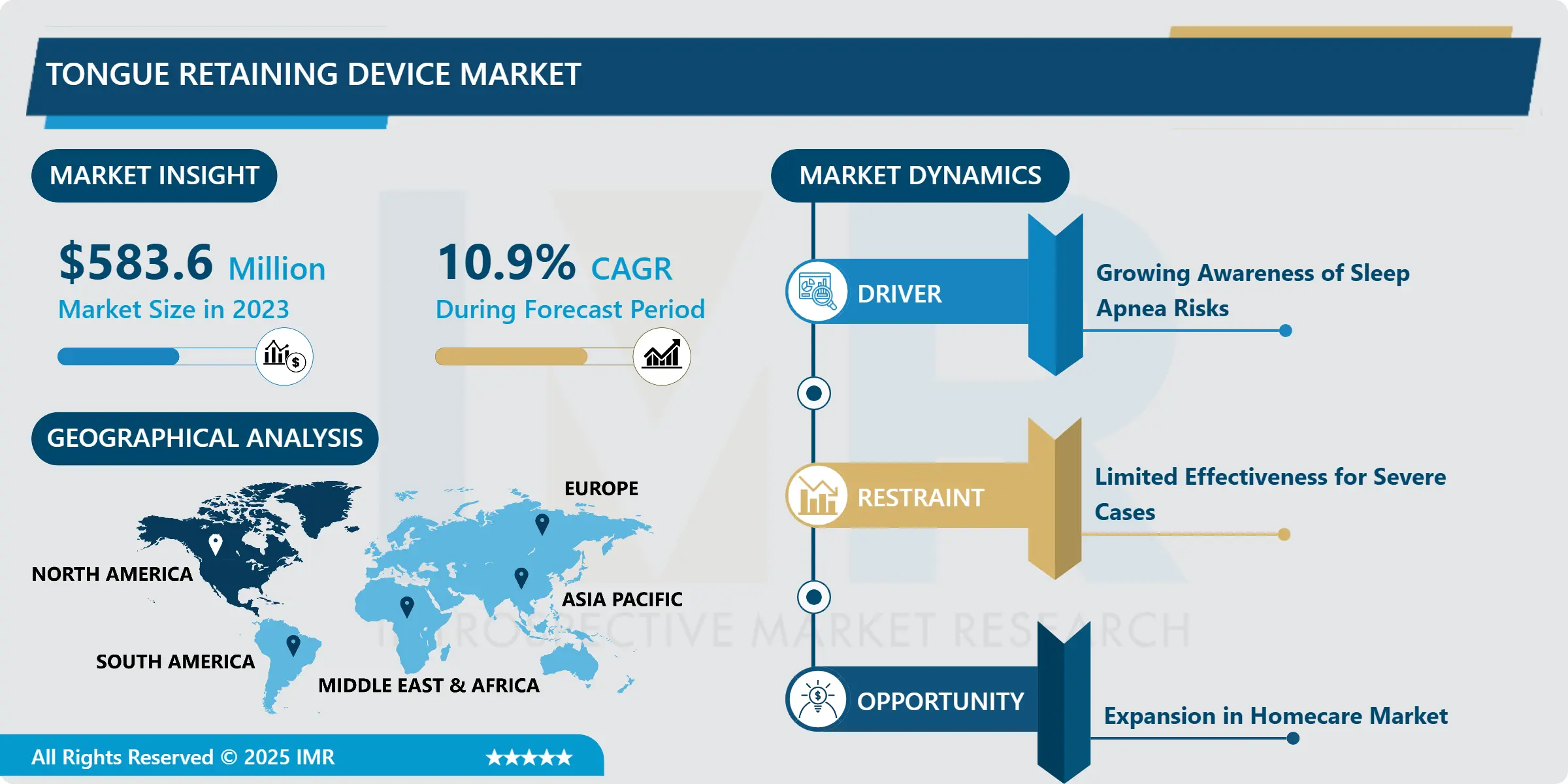
Tongue Retaining Device Market Size Was Valued at USD 583.60 Million in 2023, and is Projected to Reach USD 1480.81 Million by 2032, Growing at a CAGR of 10.9% From 2024-2032.
The market scope for the Tongue Retaining Device (TRD) is at the level of therapy devices for sleep apnea, which are used to manage obstructive sleep apnea (OSA). It works by keeping the tongue back and preventing airway obstruction at night. Unlike the standard mandibular advancement device that moves the jaw forward, TRDs target the tongue; hence they are suitable for a portion of patients with OSA, in whom other treatments may be ineffective. They are mainly used as alternative or adjunct therapies for patients who find less invasive solutions to CPAP therapy.
The Tongue Retaining Device market has seen a rise in awareness regarding sleep apnea and associated conditions globally. OSA is a significant public health issue affecting millions in the quality of their sleep, thereby leading to other health problems such as cardiovascular diseases, obesity, and diabetes. TRDs thus emerge as an option for those who can’t tolerate CPAP or mandibular advancement devices because of discomfort or portability issues or for anatomical reasons. Major drivers of the market include growing demand for better and more portable sleep apnea devices, advancement in design and increased acceptance by healthcare professionals.
TRDs are used as a first line of treatment for patients with certain oral and anatomical conditions wherein mandibular devices are not effective. For instance, the TRD is most beneficial to patients with jaw problems or missing teeth that might be contraindicated for other oral appliances. TRDs can fit with other industry trends related to the emerging trends of non-invasive and home-based treatments, which enables its compact size and easy-to-use nature to expand in the market in responding to a better option to handle sleep.
Tongue Retaining Device Market Trend Analysis:
Increasing Demand for Custom-Fit Devices
Especially custom-fit products are one of the most dominant trends in the Tongue Retaining Device market today. As more patients become aware of the sleep apnea solutions available to them, they are starting to seek comfortable as well as effective devices. Customization in a TRD ensures a far better fit if possible, thereby potentially improving comfort, retention, and finally treatment outcomes. By changing the shape and material of the device to suit every user, manufacturers eliminate complains attributed to one size fits all models, which include discomfort and poor efficacy.
It mirrors the larger movements in the health sector towards personal medicine wherein treatment options are steered specifically by patient-specific characteristics. When this trend becomes more accessible, patients with specific oral or anatomical needs, for example, the edentulous patient, can profit from improvements in comfort and functionality. Big companies, being leaders in their field, invest in digital scanning technologies for the production of customized devices, which presents many more options for personalized and effective treatments for sleep apnea.
Expansion in Homecare Market
Home care holds the highest potential for Tongue Retaining Device. As healthcare systems worldwide face immense pressure and patients seek comfort and bedside or at-home treatment, this is highly in demand for portability as well as efficacy outside of a clinical environment. TRDs are non-invasive, easy to use, and are less expensive than CPAP machines, therefore highly suitable for home care.
As health systems continue to decentralize the management of patients increasingly, the growth of the market for TRDs in homecare settings is likely to be driven at a more rapid rate, especially in those populations that face difficulty in accessing sleep clinics and elderly populations for whom traditional sleep apnea treatments are rather uncomfortable. The trend of telemedicine and digital health tools is increasing the opportunity, through which healthcare providers can monitor and support home-based treatment, thereby increasing the TRD market as a viable solution for home-based management of sleep apnea.
Tongue Retaining Device Market Segment Analysis:
Tongue Retaining Device Market Segmented on the basis of product Type, Material, Application, End User, and Region.
By Product Type, Mandibular Advancement Devices segment is expected to dominate the market during the forecast period
Mandibular Advancement Devices and Tongue Retaining Devices are the two leaders in product type segment, each targeting a specific requirement by the patient. It is the case that Mandibular devices rule because they have a flexibility to handle various levels of OSA as the mandible advances to the forward position, hence the passage of air left open. Tongue Retaining Devices are used by patients who have certain oral anatomical features that may limit their use for the mandibular ones, such as those that do not have teeth.
Other types emerge as a combination of both mandibular and tongue positioner features to achieve better results. The devices, combined together, are also being seen because they provide an all-rounded approach to airway management especially for those who require dual support. This category is on the increase because innovation through the development of hybrid devices, which target anatomical differences, is now needed.
By End User, Hospitals segment expected to held the largest share
The end user segment is broadly classified into Hospitals, Home Care Settings, Sleep Clinics, and Others. Hospitals and sleep clinics lead due to increased attention towards the diagnosis and treatment of OSA, where TRD devices are usually prescribed by the health care professionals of these settings as an alternative for certain patients who cannot use CPAP. However, the vital element of prescribing the device will always be the sleep clinic, who possess specialist knowledge in the field of sleep disorders.
Home care settings are increasingly becoming popular because most patients wish to care for themselves and hold the high demand for easy-to-use devices, while TRDs are useful in-home care settings due to their simplicity of use, comfort, and possibility of long-term management out of clinical environments.
Tongue Retaining Device Market Regional Insights:
North America is Expected to Dominate the Market Over the Forecast period
North American region, especially the United States, now dominates the Tongue Retaining Device market. This mainly contributed to the fact that sleep apnea is highly prevalent in this region, with a well-structured healthcare infrastructure and a strong emphasis on the early diagnosis and treatment of the said condition. Health consciousness among the people along with an ageing population has consequently led to a surge in demand for non-invasive patient-friendly sleep apnea solutions, such as TRDs.
Medical devices used in North America are highly regulated, keeping the encouragement for innovation as well as patient-centric solutions for sleep disorders in check. Increasing health care expenses and coverage due to insurance make North America a leader in the adoption and growth of the TRD market.
Active Key Players in the Tongue Retaining Device Market
Airway Management Inc. (USA)
Apnea Sciences Corporation (USA)
Fisher & Paykel Healthcare (New Zealand)
Glidewell (USA)
Koninklijke Philips N.V. (Netherlands)
Panthera Dental (Canada)
ProSomnus Sleep Technologies (USA)
ResMed Inc. (USA)
SomnoMed Ltd (Australia)
The Pure Sleep Company (USA)
Vivos Therapeutics, Inc. (USA)
ZYPPAH, Inc. (USA)
Other Active Players.
Chapter 1: Introduction
1.1 Scope and Coverage
Chapter 2:Executive Summary
Chapter 3: Market Landscape
3.1 Industry Dynamics and Opportunity Analysis
3.1.1 Growth Drivers
3.1.2 Limiting Factors
3.1.3 Growth Opportunities
3.1.4 Challenges and Risks
3.2 Market Trend Analysis
3.3 Strategic Pestle Overview
3.4 Porter’s Five Forces Analysis
3.5 Industry Value Chain Mapping
3.6 Regulatory Framework
3.7 Princing Trend Analysis
3.8 Patent Analysis
3.9 Technology Evolution
3.10 Investment Pockets
3.11 Import-Export Analysis
Chapter 4: Tongue Retaining Device Market by Product Type
4.1 Tongue Retaining Device Market Snapshot and Growth Engine
4.2 Tongue Retaining Device Market Overview
4.3 Mandibular Advancement Devices
4.3.1 Introduction and Market Overview
4.3.2 Historic and Forecasted Market Size in Value USD and Volume Units (2017-2032F)
4.3.3 Mandibular Advancement Devices: Geographic Segmentation Analysis
4.4 Tongue Retaining Devices
4.4.1 Introduction and Market Overview
4.4.2 Historic and Forecasted Market Size in Value USD and Volume Units (2017-2032F)
4.4.3 Tongue Retaining Devices: Geographic Segmentation Analysis
4.5 Others
4.5.1 Introduction and Market Overview
4.5.2 Historic and Forecasted Market Size in Value USD and Volume Units (2017-2032F)
4.5.3 Others: Geographic Segmentation Analysis
Chapter 5: Tongue Retaining Device Market by Material
5.1 Tongue Retaining Device Market Snapshot and Growth Engine
5.2 Tongue Retaining Device Market Overview
5.3 Thermoplastic
5.3.1 Introduction and Market Overview
5.3.2 Historic and Forecasted Market Size in Value USD and Volume Units (2017-2032F)
5.3.3 Thermoplastic: Geographic Segmentation Analysis
5.4 Silicone
5.4.1 Introduction and Market Overview
5.4.2 Historic and Forecasted Market Size in Value USD and Volume Units (2017-2032F)
5.4.3 Silicone: Geographic Segmentation Analysis
5.5 Others
5.5.1 Introduction and Market Overview
5.5.2 Historic and Forecasted Market Size in Value USD and Volume Units (2017-2032F)
5.5.3 Others: Geographic Segmentation Analysis
Chapter 6: Tongue Retaining Device Market by End-User
6.1 Tongue Retaining Device Market Snapshot and Growth Engine
6.2 Tongue Retaining Device Market Overview
6.3 Hospitals
6.3.1 Introduction and Market Overview
6.3.2 Historic and Forecasted Market Size in Value USD and Volume Units (2017-2032F)
6.3.3 Hospitals: Geographic Segmentation Analysis
6.4 Home Care Settings
6.4.1 Introduction and Market Overview
6.4.2 Historic and Forecasted Market Size in Value USD and Volume Units (2017-2032F)
6.4.3 Home Care Settings: Geographic Segmentation Analysis
6.5 Sleep Clinics
6.5.1 Introduction and Market Overview
6.5.2 Historic and Forecasted Market Size in Value USD and Volume Units (2017-2032F)
6.5.3 Sleep Clinics: Geographic Segmentation Analysis
6.6 Others
6.6.1 Introduction and Market Overview
6.6.2 Historic and Forecasted Market Size in Value USD and Volume Units (2017-2032F)
6.6.3 Others: Geographic Segmentation Analysis
Chapter 7: Tongue Retaining Device Market by Distribution channel
7.1 Tongue Retaining Device Market Snapshot and Growth Engine
7.2 Tongue Retaining Device Market Overview
7.3 Online
7.3.1 Introduction and Market Overview
7.3.2 Historic and Forecasted Market Size in Value USD and Volume Units (2017-2032F)
7.3.3 Online: Geographic Segmentation Analysis
7.4 Offline)
7.4.1 Introduction and Market Overview
7.4.2 Historic and Forecasted Market Size in Value USD and Volume Units (2017-2032F)
7.4.3 Offline) : Geographic Segmentation Analysis
Chapter 8: Company Profiles and Competitive Analysis
8.1 Competitive Landscape
8.1.1 Competitive Benchmarking
8.1.2 Tongue Retaining Device Market Share by Manufacturer (2023)
8.1.3 Concentration Ratio(CR5)
8.1.4 Heat Map Analysis
8.1.5 Mergers and Acquisitions
8.2 APNEA SCIENCES CORPORATION (USA)
8.2.1 Company Overview
8.2.2 Key Executives
8.2.3 Company Snapshot
8.2.4 Operating Business Segments
8.2.5 Product Portfolio
8.2.6 Business Performance
8.2.7 Key Strategic Moves and Recent Developments
8.3 GLIDEWELL (USA)
8.4 FISHER & PAYKEL HEALTHCARE (NEW ZEALAND)
8.5 SOMNOMED LTD (AUSTRALIA)
8.6 PROSOMNUS SLEEP TECHNOLOGIES (USA)
8.7 PANTHERA DENTAL (CANADA)
8.8 AIRWAY MANAGEMENT INC. (USA)
8.9 ZYPPAH INC. (USA)
8.10 THE PURE SLEEP COMPANY (USA)
8.11 OTHER ACTIVE PLAYERS
Chapter 9: Global Tongue Retaining Device Market By Region
9.1 Overview
9.2. North America Tongue Retaining Device Market
9.2.1 Historic and Forecasted Market Size by Segments
9.2.2 Historic and Forecasted Market Size By Product Type
9.2.2.1 Mandibular Advancement Devices
9.2.2.2 Tongue Retaining Devices
9.2.2.3 Others
9.2.3 Historic and Forecasted Market Size By Material
9.2.3.1 Thermoplastic
9.2.3.2 Silicone
9.2.3.3 Others
9.2.4 Historic and Forecasted Market Size By End-User
9.2.4.1 Hospitals
9.2.4.2 Home Care Settings
9.2.4.3 Sleep Clinics
9.2.4.4 Others
9.2.5 Historic and Forecasted Market Size By Distribution channel
9.2.5.1 Online
9.2.5.2 Offline)
9.2.6 Historic and Forecast Market Size by Country
9.2.6.1 US
9.2.6.2 Canada
9.2.6.3 Mexico
9.3. Eastern Europe Tongue Retaining Device Market
9.3.1 Historic and Forecasted Market Size by Segments
9.3.2 Historic and Forecasted Market Size By Product Type
9.3.2.1 Mandibular Advancement Devices
9.3.2.2 Tongue Retaining Devices
9.3.2.3 Others
9.3.3 Historic and Forecasted Market Size By Material
9.3.3.1 Thermoplastic
9.3.3.2 Silicone
9.3.3.3 Others
9.3.4 Historic and Forecasted Market Size By End-User
9.3.4.1 Hospitals
9.3.4.2 Home Care Settings
9.3.4.3 Sleep Clinics
9.3.4.4 Others
9.3.5 Historic and Forecasted Market Size By Distribution channel
9.3.5.1 Online
9.3.5.2 Offline)
9.3.6 Historic and Forecast Market Size by Country
9.3.6.1 Bulgaria
9.3.6.2 The Czech Republic
9.3.6.3 Hungary
9.3.6.4 Poland
9.3.6.5 Romania
9.3.6.6 Rest of Eastern Europe
9.4. Western Europe Tongue Retaining Device Market
9.4.1 Historic and Forecasted Market Size by Segments
9.4.2 Historic and Forecasted Market Size By Product Type
9.4.2.1 Mandibular Advancement Devices
9.4.2.2 Tongue Retaining Devices
9.4.2.3 Others
9.4.3 Historic and Forecasted Market Size By Material
9.4.3.1 Thermoplastic
9.4.3.2 Silicone
9.4.3.3 Others
9.4.4 Historic and Forecasted Market Size By End-User
9.4.4.1 Hospitals
9.4.4.2 Home Care Settings
9.4.4.3 Sleep Clinics
9.4.4.4 Others
9.4.5 Historic and Forecasted Market Size By Distribution channel
9.4.5.1 Online
9.4.5.2 Offline)
9.4.6 Historic and Forecast Market Size by Country
9.4.6.1 Germany
9.4.6.2 UK
9.4.6.3 France
9.4.6.4 Netherlands
9.4.6.5 Italy
9.4.6.6 Russia
9.4.6.7 Spain
9.4.6.8 Rest of Western Europe
9.5. Asia Pacific Tongue Retaining Device Market
9.5.1 Historic and Forecasted Market Size by Segments
9.5.2 Historic and Forecasted Market Size By Product Type
9.5.2.1 Mandibular Advancement Devices
9.5.2.2 Tongue Retaining Devices
9.5.2.3 Others
9.5.3 Historic and Forecasted Market Size By Material
9.5.3.1 Thermoplastic
9.5.3.2 Silicone
9.5.3.3 Others
9.5.4 Historic and Forecasted Market Size By End-User
9.5.4.1 Hospitals
9.5.4.2 Home Care Settings
9.5.4.3 Sleep Clinics
9.5.4.4 Others
9.5.5 Historic and Forecasted Market Size By Distribution channel
9.5.5.1 Online
9.5.5.2 Offline)
9.5.6 Historic and Forecast Market Size by Country
9.5.6.1 China
9.5.6.2 India
9.5.6.3 Japan
9.5.6.4 South Korea
9.5.6.5 Malaysia
9.5.6.6 Thailand
9.5.6.7 Vietnam
9.5.6.8 The Philippines
9.5.6.9 Australia
9.5.6.10 New Zealand
9.5.6.11 Rest of APAC
9.6. Middle East & Africa Tongue Retaining Device Market
9.6.1 Historic and Forecasted Market Size by Segments
9.6.2 Historic and Forecasted Market Size By Product Type
9.6.2.1 Mandibular Advancement Devices
9.6.2.2 Tongue Retaining Devices
9.6.2.3 Others
9.6.3 Historic and Forecasted Market Size By Material
9.6.3.1 Thermoplastic
9.6.3.2 Silicone
9.6.3.3 Others
9.6.4 Historic and Forecasted Market Size By End-User
9.6.4.1 Hospitals
9.6.4.2 Home Care Settings
9.6.4.3 Sleep Clinics
9.6.4.4 Others
9.6.5 Historic and Forecasted Market Size By Distribution channel
9.6.5.1 Online
9.6.5.2 Offline)
9.6.6 Historic and Forecast Market Size by Country
9.6.6.1 Turkey
9.6.6.2 Bahrain
9.6.6.3 Kuwait
9.6.6.4 Saudi Arabia
9.6.6.5 Qatar
9.6.6.6 UAE
9.6.6.7 Israel
9.6.6.8 South Africa
9.7. South America Tongue Retaining Device Market
9.7.1 Historic and Forecasted Market Size by Segments
9.7.2 Historic and Forecasted Market Size By Product Type
9.7.2.1 Mandibular Advancement Devices
9.7.2.2 Tongue Retaining Devices
9.7.2.3 Others
9.7.3 Historic and Forecasted Market Size By Material
9.7.3.1 Thermoplastic
9.7.3.2 Silicone
9.7.3.3 Others
9.7.4 Historic and Forecasted Market Size By End-User
9.7.4.1 Hospitals
9.7.4.2 Home Care Settings
9.7.4.3 Sleep Clinics
9.7.4.4 Others
9.7.5 Historic and Forecasted Market Size By Distribution channel
9.7.5.1 Online
9.7.5.2 Offline)
9.7.6 Historic and Forecast Market Size by Country
9.7.6.1 Brazil
9.7.6.2 Argentina
9.7.6.3 Rest of SA
Chapter 10 Analyst Viewpoint and Conclusion
10.1 Recommendations and Concluding Analysis
10.2 Potential Market Strategies
Chapter 11 Research Methodology
11.1 Research Process
11.2 Primary Research
11.3 Secondary Research
Q1: What would be the forecast period in the Tongue Retaining Device Market research report?
A1: The forecast period in the Tongue Retaining Device Market research report is 2024-2032.
Q2: Who are the key players in the Tongue Retaining Device Market?
A2: Apnea Sciences Corporation (USA), Glidewell (USA), Fisher & Paykel Healthcare (New Zealand), SomnoMed Ltd (Australia), ProSomnus Sleep Technologies (USA), Panthera Dental (Canada), Airway Management Inc. (USA), ZYPPAH, Inc. (USA), The Pure Sleep Company (USA), and Other Active Players.
Q3: What are the segments of the Tongue Retaining Device Market?
A3: The Tongue Retaining Device Market is segmented into Product Type, Material, Distribution Channel, End User and region. By Product Type, the market is categorized into Mandibular Advancement Devices, Tongue Retaining Devices, Others. By Material, the market is categorized into Thermoplastic, Silicone, Others. By End-User, the market is categorized into Hospitals, Home Care Settings, Sleep Clinics, Others. By Distribution Channel, the market is categorized into Online, Offline. By region, it is analyzed across North America (U.S., Canada, Mexico), Eastern Europe (Russia, Bulgaria, The Czech Republic, Hungary, Poland, Romania, Rest of Eastern Europe), Western Europe (Germany, UK, France, The Netherlands, Italy, Russia, Spain, Rest of Western Europe), Asia Pacific (China, India, Japan, South Korea, Malaysia, Thailand, Vietnam, The Philippines, Australia, New-Zealand, Rest of APAC), Middle East & Africa (Turkiye, Bahrain, Kuwait, Saudi Arabia, Qatar, UAE, Israel, South Africa), South America (Brazil, Argentina, Rest of SA).
Q4: What is the Tongue Retaining Device Market?
A4: The market scope for the Tongue Retaining Device (TRD) is at the level of therapy devices for sleep apnea, which are used to manage obstructive sleep apnea (OSA). It works by keeping the tongue back and preventing airway obstruction at night. Unlike the standard mandibular advancement device that moves the jaw forward, TRDs target the tongue; hence they are suitable for a portion of patients with OSA, in whom other treatments may be ineffective. They are mainly used as alternative or adjunct therapies for patients who find less invasive solutions to CPAP therapy.
Q5: How big is the Tongue Retaining Device Market?
A5: Tongue Retaining Device Market Size Was Valued at USD 583.60 Million in 2023, and is Projected to Reach USD 1480.81 Million by 2032, Growing at a CAGR of 10.9% From 2024-2032.
How to Buy a Report from eminsights.jp
On the product page, choose the license you want: Single-User License, Multi-User License or Enterprise License.
If you required report in your native language, then you can click on Translated Report button and fill out the form with report name and language you want, then our team will contact you as soon as possible.
Click the Buy Now button.
You will be redirected to the checkout page. Enter your company details and payment information.
Click Place Order to complete the purchase.
Confirmation: You’ll receive an order confirmation and our team will contact you shortly with your ordered report.
If you have any questions, fill out the contact form below or email us at bizdev@eminsights.net.
Thank you for choosing eminsights.jp!