Stay Ahead in Fast-Growing Economies.
Browse Reports Now




Tissue Plasminogen Activator Market – Size & Emerging Trends (2024–2032)
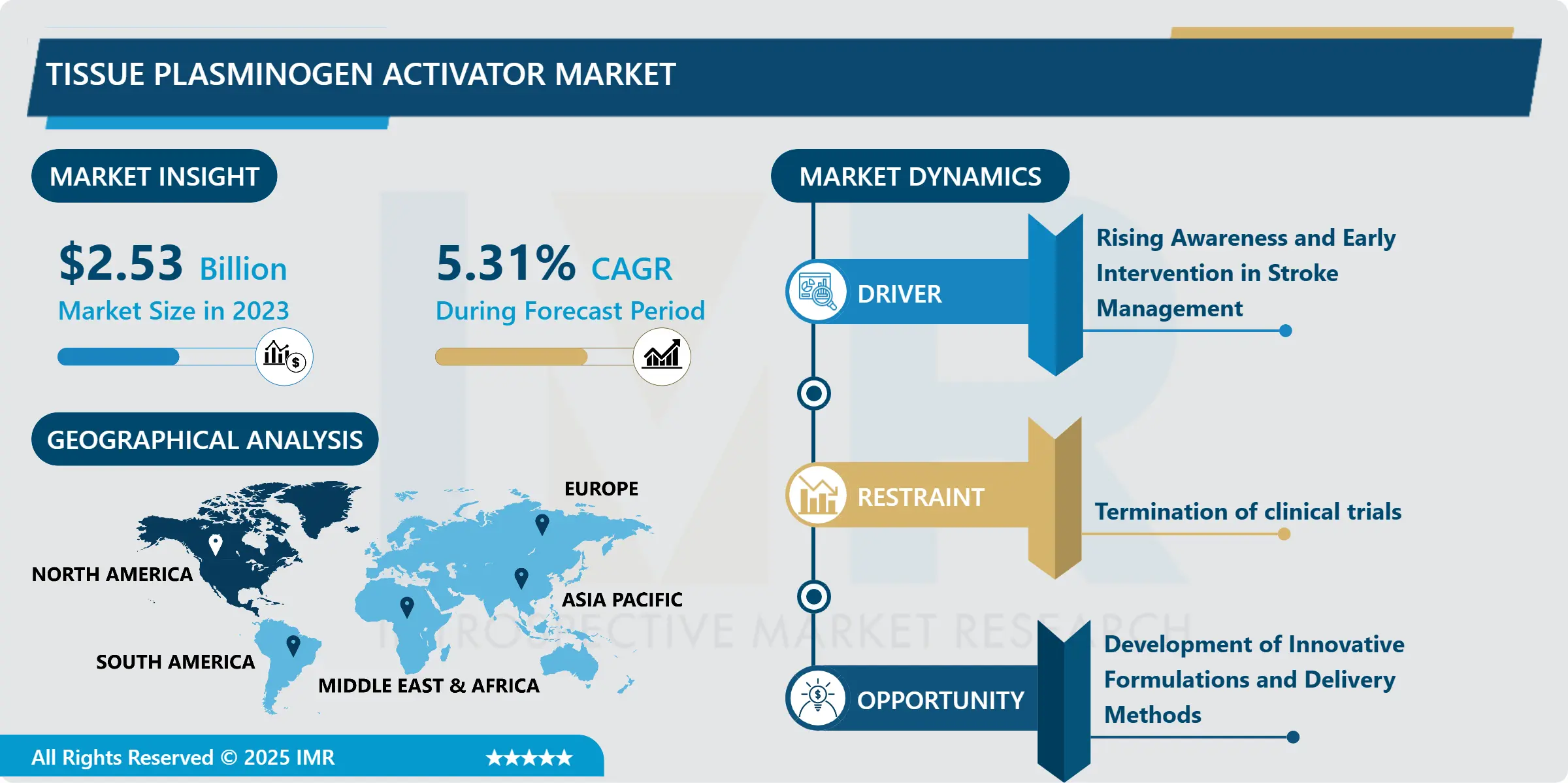
Tissue Plasminogen Activator Market Size Was Valued at USD 2.53 Billion in 2023, and is Projected to Reach USD 4.03 Billion by 2032, Growing at a CAGR of 5.31% from 2024-2032.

IMR Group
Description
Tissue Plasminogen Activator Market Synopsis:
Tissue Plasminogen Activator Market Size Was Valued at USD 2.53 Billion in 2023, and is Projected to Reach USD 4.03 Billion by 2032, Growing at a CAGR of 5.31% from 2024-2032.
The Tissue Plasminogen Activator (tPA) Market is experiencing significant growth, driven by the increasing prevalence of cardiovascular diseases, particularly acute ischemic stroke and myocardial infarction. tPA is a critical thrombolytic agent used to dissolve blood clots, thus restoring blood flow to affected areas in the body. As awareness about stroke symptoms and the importance of timely intervention grows, the demand for tPA is rising in emergency medical settings and hospitals. Additionally, advancements in healthcare infrastructure and increased funding for research are facilitating the broader adoption of tPA therapies.
Technological advancements and ongoing clinical research are also propelling the tPA market forward. The development of new formulations and delivery methods, such as intra-arterial tPA administration, aims to enhance the effectiveness and safety profiles of existing tPA products. Furthermore, studies exploring the use of tPA for conditions beyond its traditional applications, such as in treating pulmonary embolism or peripheral artery disease, are expanding the potential market for these therapies. The introduction of biosimilars is expected to further increase competition and accessibility within the market, benefiting healthcare providers and patients alike.
Regionally, North America holds a dominant position in the tissue plasminogen activator market due to its advanced healthcare systems, extensive research initiatives, and high prevalence of cardiovascular diseases. However, the Asia-Pacific region is emerging as a key market, driven by increasing healthcare expenditure, rising awareness of stroke management, and improvements in medical facilities. As the global focus on improving outcomes for cardiovascular patients continues to intensify, the tPA market is anticipated to experience sustained growth, with ongoing innovations and expanding applications playing a crucial role in its evolution.
Tissue Plasminogen Activator Market Trend Analysis:
Rising Awareness and Early Intervention in Stroke Management
The rising awareness of stroke symptoms and the importance of early intervention is significantly impacting the Tissue Plasminogen Activator (tPA) Market. As educational campaigns and public health initiatives promote knowledge about the signs of stroke, such as sudden numbness, confusion, and difficulty speaking, more patients are seeking immediate medical attention. This shift is leading to increased usage of tPA in emergency settings, as timely administration of the drug can significantly improve patient outcomes. Furthermore, healthcare providers are implementing protocols to expedite treatment processes, further enhancing the role of tPA in stroke management and increasing its market demand.
Development of Innovative Formulations and Delivery Methods
Innovation in the formulations and delivery methods of tissue plasminogen activators is another notable trend shaping the market. Researchers are exploring alternative delivery routes, such as intra-arterial administration, to enhance the efficacy of tPA while reducing the risk of complications. Additionally, the development of modified tPA agents with improved safety profiles is gaining traction, aiming to minimize adverse effects associated with traditional tPA therapies. These advancements not only aim to expand the therapeutic applications of tPA but also enhance its market potential by improving patient compliance and broadening treatment options for various thrombotic conditions.
Tissue Plasminogen Activator Market Segment Analysis:
Tissue Plasminogen Activator Market Segmented on the basis of By Drug Type, Application, and Region.
By Drug Type, Reteplase segment is expected to dominate the market during the forecast period
In the Tissue Plasminogen Activator (tPA) Market, the segmentation by drug type includes Alteplase, Reteplase, and Tenecteplase, each playing a crucial role in thrombolytic therapy. Alteplase is the most widely used tPA and is often the first-line treatment for acute ischemic stroke, making it a significant contributor to market revenue. Reteplase, with its rapid onset of action, is primarily utilized for managing acute myocardial infarction and is favored for its ease of administration in emergency settings. Tenecteplase, a newer formulation, offers a longer half-life and allows for a single-bolus administration, making it a convenient option for both acute coronary syndromes and stroke treatments. The ongoing research into the efficacy and safety of these tPA variants is expected to drive their market presence and provide healthcare providers with a range of options to optimize patient outcomes in thrombotic disorders.
By Application, Myocardial Infarction segment expected to held the largest share
In the Tissue Plasminogen Activator (tPA) Market, the applications are primarily categorized into several key areas Like ischemic stroke, myocardial infarction, pulmonary embolism, thrombolysis, and others. Ischemic stroke accounts for the largest share, as tPA is widely recognized as a first-line treatment to dissolve blood clots and restore blood flow to the brain, significantly improving patient outcomes when administered promptly. Myocardial infarction, or heart attack, is another significant application where tPA plays a critical role in re-establishing coronary blood flow. Additionally, the use of tPA in treating pulmonary embolism is gaining traction as healthcare professionals recognize its effectiveness in managing this life-threatening condition. Thrombolysis, the general process of dissolving blood clots, represents a broader application of tPA in various clinical scenarios, further driving market growth. As research continues to unveil new therapeutic potentials, the application of tPA is expected to expand, influencing the overall dynamics of the market.
Tissue Plasminogen Activator Market Regional Insights:
North America is Expected to Dominate the Market Over the Forecast period
North America is expected to dominate the Tissue Plasminogen Activator (tPA) Market over the forecast period due to its robust healthcare infrastructure, high prevalence of cardiovascular diseases, and significant investments in research and development. The region boasts advanced medical facilities and a well-established emergency response system, enabling timely administration of tPA in acute stroke cases. Additionally, increasing awareness of stroke symptoms among healthcare professionals and the general public is driving the demand for effective thrombolytic therapies. The presence of key market players and ongoing clinical studies to enhance the efficacy and safety of tPA further solidify North America’s leading position in the market, making it a critical hub for innovation and treatment advancements in thrombolytic therapy.
Active Key Players in the Tissue Plasminogen Activator Market
Abbott Laboratories (U.S.)
Boehringer Ingelheim GmbH (Germany)
CHIESI Farmaceutici S.p.A. (Italy)
F. Hoffmann-La Roche AG (Switzerland)
Gennova Biopharmaceuticals Ltd (India)
Reliance Life Sciences (India)
Other Active players.
Chapter 1: Introduction
1.1 Scope and Coverage
Chapter 2:Executive Summary
Chapter 3: Market Landscape
3.1 Market Dynamics
3.1.1 Drivers
3.1.2 Restraints
3.1.3 Opportunities
3.1.4 Challenges
3.2 Market Trend Analysis
3.3 PESTLE Analysis
3.4 Porter’s Five Forces Analysis
3.5 Industry Value Chain Analysis
3.6 Ecosystem
3.7 Regulatory Landscape
3.8 Price Trend Analysis
3.9 Patent Analysis
3.10 Technology Evolution
3.11 Investment Pockets
3.12 Import-Export Analysis
Chapter 4: Tissue Plasminogen Activator Market by Drug Type
4.1 Tissue Plasminogen Activator Market Snapshot and Growth Engine
4.2 Tissue Plasminogen Activator Market Overview
4.3 Alteplase
4.3.1 Introduction and Market Overview
4.3.2 Historic and Forecasted Market Size in Value USD and Volume Units (2017-2032F)
4.3.3 Key Market Trends, Growth Factors and Opportunities
4.3.4 Alteplase: Geographic Segmentation Analysis
4.4 Reteplase
4.4.1 Introduction and Market Overview
4.4.2 Historic and Forecasted Market Size in Value USD and Volume Units (2017-2032F)
4.4.3 Key Market Trends, Growth Factors and Opportunities
4.4.4 Reteplase: Geographic Segmentation Analysis
4.5 Tenecteplase)
4.5.1 Introduction and Market Overview
4.5.2 Historic and Forecasted Market Size in Value USD and Volume Units (2017-2032F)
4.5.3 Key Market Trends, Growth Factors and Opportunities
4.5.4 Tenecteplase): Geographic Segmentation Analysis
4.6
4.6.1 Introduction and Market Overview
4.6.2 Historic and Forecasted Market Size in Value USD and Volume Units (2017-2032F)
4.6.3 Key Market Trends, Growth Factors and Opportunities
4.6.4 : Geographic Segmentation Analysis
Chapter 5: Tissue Plasminogen Activator Market by Application
5.1 Tissue Plasminogen Activator Market Snapshot and Growth Engine
5.2 Tissue Plasminogen Activator Market Overview
5.3 Ischemic Stroke
5.3.1 Introduction and Market Overview
5.3.2 Historic and Forecasted Market Size in Value USD and Volume Units (2017-2032F)
5.3.3 Key Market Trends, Growth Factors and Opportunities
5.3.4 Ischemic Stroke: Geographic Segmentation Analysis
5.4 Myocardial Infarction
5.4.1 Introduction and Market Overview
5.4.2 Historic and Forecasted Market Size in Value USD and Volume Units (2017-2032F)
5.4.3 Key Market Trends, Growth Factors and Opportunities
5.4.4 Myocardial Infarction: Geographic Segmentation Analysis
5.5 Pulmonary Embolism
5.5.1 Introduction and Market Overview
5.5.2 Historic and Forecasted Market Size in Value USD and Volume Units (2017-2032F)
5.5.3 Key Market Trends, Growth Factors and Opportunities
5.5.4 Pulmonary Embolism: Geographic Segmentation Analysis
5.6 Thrombolysis
5.6.1 Introduction and Market Overview
5.6.2 Historic and Forecasted Market Size in Value USD and Volume Units (2017-2032F)
5.6.3 Key Market Trends, Growth Factors and Opportunities
5.6.4 Thrombolysis: Geographic Segmentation Analysis
5.7 Others)
5.7.1 Introduction and Market Overview
5.7.2 Historic and Forecasted Market Size in Value USD and Volume Units (2017-2032F)
5.7.3 Key Market Trends, Growth Factors and Opportunities
5.7.4 Others): Geographic Segmentation Analysis
5.8
5.8.1 Introduction and Market Overview
5.8.2 Historic and Forecasted Market Size in Value USD and Volume Units (2017-2032F)
5.8.3 Key Market Trends, Growth Factors and Opportunities
5.8.4 : Geographic Segmentation Analysis
Chapter 6: Company Profiles and Competitive Analysis
6.1 Competitive Landscape
6.1.1 Competitive Benchmarking
6.1.2 Tissue Plasminogen Activator Market Share by Manufacturer (2023)
6.1.3 Industry BCG Matrix
6.1.4 Heat Map Analysis
6.1.5 Mergers and Acquisitions
6.2 F. HOFFMANN-LA ROCHE AG (SWITZERLAND)
6.2.1 Company Overview
6.2.2 Key Executives
6.2.3 Company Snapshot
6.2.4 Role of the Company in the Market
6.2.5 Sustainability and Social Responsibility
6.2.6 Operating Business Segments
6.2.7 Product Portfolio
6.2.8 Business Performance
6.2.9 Key Strategic Moves and Recent Developments
6.2.10 SWOT Analysis
6.3 BOEHRINGER INGELHEIM GMBH (GERMANY)
6.4 CHIESI FARMACEUTICI S.P.A. (ITALY)
6.5 GENNOVA BIOPHARMACEUTICALS LTD (INDIA)
6.6 ABBOTT LABORATORIES (U.S.)
6.7 RELIANCE LIFE SCIENCES (INDIA)
6.8 OTHER ACTIVE PLAYERS
Chapter 7: Global Tissue Plasminogen Activator Market By Region
7.1 Overview
7.2. North America Tissue Plasminogen Activator Market
7.2.1 Key Market Trends, Growth Factors and Opportunities
7.2.2 Top Key Companies
7.2.3 Historic and Forecasted Market Size by Segments
7.2.4 Historic and Forecasted Market Size By Drug Type
7.2.4.1 Alteplase
7.2.4.2 Reteplase
7.2.4.3 Tenecteplase)
7.2.4.4
7.2.5 Historic and Forecasted Market Size By Application
7.2.5.1 Ischemic Stroke
7.2.5.2 Myocardial Infarction
7.2.5.3 Pulmonary Embolism
7.2.5.4 Thrombolysis
7.2.5.5 Others)
7.2.5.6
7.2.6 Historic and Forecast Market Size by Country
7.2.6.1 US
7.2.6.2 Canada
7.2.6.3 Mexico
7.3. Eastern Europe Tissue Plasminogen Activator Market
7.3.1 Key Market Trends, Growth Factors and Opportunities
7.3.2 Top Key Companies
7.3.3 Historic and Forecasted Market Size by Segments
7.3.4 Historic and Forecasted Market Size By Drug Type
7.3.4.1 Alteplase
7.3.4.2 Reteplase
7.3.4.3 Tenecteplase)
7.3.4.4
7.3.5 Historic and Forecasted Market Size By Application
7.3.5.1 Ischemic Stroke
7.3.5.2 Myocardial Infarction
7.3.5.3 Pulmonary Embolism
7.3.5.4 Thrombolysis
7.3.5.5 Others)
7.3.5.6
7.3.6 Historic and Forecast Market Size by Country
7.3.6.1 Russia
7.3.6.2 Bulgaria
7.3.6.3 The Czech Republic
7.3.6.4 Hungary
7.3.6.5 Poland
7.3.6.6 Romania
7.3.6.7 Rest of Eastern Europe
7.4. Western Europe Tissue Plasminogen Activator Market
7.4.1 Key Market Trends, Growth Factors and Opportunities
7.4.2 Top Key Companies
7.4.3 Historic and Forecasted Market Size by Segments
7.4.4 Historic and Forecasted Market Size By Drug Type
7.4.4.1 Alteplase
7.4.4.2 Reteplase
7.4.4.3 Tenecteplase)
7.4.4.4
7.4.5 Historic and Forecasted Market Size By Application
7.4.5.1 Ischemic Stroke
7.4.5.2 Myocardial Infarction
7.4.5.3 Pulmonary Embolism
7.4.5.4 Thrombolysis
7.4.5.5 Others)
7.4.5.6
7.4.6 Historic and Forecast Market Size by Country
7.4.6.1 Germany
7.4.6.2 UK
7.4.6.3 France
7.4.6.4 The Netherlands
7.4.6.5 Italy
7.4.6.6 Spain
7.4.6.7 Rest of Western Europe
7.5. Asia Pacific Tissue Plasminogen Activator Market
7.5.1 Key Market Trends, Growth Factors and Opportunities
7.5.2 Top Key Companies
7.5.3 Historic and Forecasted Market Size by Segments
7.5.4 Historic and Forecasted Market Size By Drug Type
7.5.4.1 Alteplase
7.5.4.2 Reteplase
7.5.4.3 Tenecteplase)
7.5.4.4
7.5.5 Historic and Forecasted Market Size By Application
7.5.5.1 Ischemic Stroke
7.5.5.2 Myocardial Infarction
7.5.5.3 Pulmonary Embolism
7.5.5.4 Thrombolysis
7.5.5.5 Others)
7.5.5.6
7.5.6 Historic and Forecast Market Size by Country
7.5.6.1 China
7.5.6.2 India
7.5.6.3 Japan
7.5.6.4 South Korea
7.5.6.5 Malaysia
7.5.6.6 Thailand
7.5.6.7 Vietnam
7.5.6.8 The Philippines
7.5.6.9 Australia
7.5.6.10 New Zealand
7.5.6.11 Rest of APAC
7.6. Middle East & Africa Tissue Plasminogen Activator Market
7.6.1 Key Market Trends, Growth Factors and Opportunities
7.6.2 Top Key Companies
7.6.3 Historic and Forecasted Market Size by Segments
7.6.4 Historic and Forecasted Market Size By Drug Type
7.6.4.1 Alteplase
7.6.4.2 Reteplase
7.6.4.3 Tenecteplase)
7.6.4.4
7.6.5 Historic and Forecasted Market Size By Application
7.6.5.1 Ischemic Stroke
7.6.5.2 Myocardial Infarction
7.6.5.3 Pulmonary Embolism
7.6.5.4 Thrombolysis
7.6.5.5 Others)
7.6.5.6
7.6.6 Historic and Forecast Market Size by Country
7.6.6.1 Turkiye
7.6.6.2 Bahrain
7.6.6.3 Kuwait
7.6.6.4 Saudi Arabia
7.6.6.5 Qatar
7.6.6.6 UAE
7.6.6.7 Israel
7.6.6.8 South Africa
7.7. South America Tissue Plasminogen Activator Market
7.7.1 Key Market Trends, Growth Factors and Opportunities
7.7.2 Top Key Companies
7.7.3 Historic and Forecasted Market Size by Segments
7.7.4 Historic and Forecasted Market Size By Drug Type
7.7.4.1 Alteplase
7.7.4.2 Reteplase
7.7.4.3 Tenecteplase)
7.7.4.4
7.7.5 Historic and Forecasted Market Size By Application
7.7.5.1 Ischemic Stroke
7.7.5.2 Myocardial Infarction
7.7.5.3 Pulmonary Embolism
7.7.5.4 Thrombolysis
7.7.5.5 Others)
7.7.5.6
7.7.6 Historic and Forecast Market Size by Country
7.7.6.1 Brazil
7.7.6.2 Argentina
7.7.6.3 Rest of SA
Chapter 8 Analyst Viewpoint and Conclusion
8.1 Recommendations and Concluding Analysis
8.2 Potential Market Strategies
Chapter 9 Research Methodology
9.1 Research Process
9.2 Primary Research
9.3 Secondary Research
Q1: What would be the forecast period in the Tissue Plasminogen Activator Market research report?
A1: The forecast period in the Tissue Plasminogen Activator Market research report is 2024-2032.
Q2: Who are the key players in the Tissue Plasminogen Activator Market?
A2: F. Hoffmann-La Roche AG (Switzerland), Boehringer Ingelheim GmbH (Germany), CHIESI Farmaceutici S.p.A. (Italy), Gennova Biopharmaceuticals Ltd (India), Abbott Laboratories (U.S.), Reliance Life Sciences (India), other Active Players.
Q3: What are the segments of the Tissue Plasminogen Activator Market?
A3: The Tissue Plasminogen Activator Market is segmented into By Drug Type, By Application and region. By Drug Type (Alteplase, Reteplase, Tenecteplase), By Application (Ischemic Stroke, Myocardial Infarction, Pulmonary Embolism, Thrombolysis, Others). By region, it is analyzed across North America (U.S., Canada, Mexico), Eastern Europe (Russia, Bulgaria, The Czech Republic, Hungary, Poland, Romania, Rest of Eastern Europe), Western Europe (Germany, UK, France, The Netherlands, Italy, Russia, Spain, Rest of Western Europe), Asia Pacific (China, India, Japan, South Korea, Malaysia, Thailand, Vietnam, The Philippines, Australia, New-Zealand, Rest of APAC), Middle East & Africa (Turkiye, Bahrain, Kuwait, Saudi Arabia, Qatar, UAE, Israel, South Africa), South America (Brazil, Argentina, Rest of SA).
Q4: What is the Tissue Plasminogen Activator Market?
A4: Tissue Plasminogen Activator (tPA) is a thrombolytic agent naturally produced by the body that plays a crucial role in the breakdown of blood clots. It functions by converting plasminogen, an inactive precursor, into plasmin, which is an enzyme that dissolves fibrin, the protein that forms the structural framework of blood clots. tPA is primarily used in medical settings for the treatment of acute ischemic strokes and myocardial infarctions, where rapid restoration of blood flow is essential to minimize tissue damage. Due to its specificity and effectiveness in clot dissolution, tPA has become a standard therapeutic agent in emergency medicine and continues to be the subject of extensive clinical research to expand its applications in various thrombotic conditions.
Q5: How big is the Tissue Plasminogen Activator Market?
A5: Tissue Plasminogen Activator Market Size Was Valued at USD 2.53 Billion in 2023, and is Projected to Reach USD 4.03 Billion by 2032, Growing at a CAGR of 5.31% from 2024-2032.
How to Buy a Report from eminsights.jp
On the product page, choose the license you want: Single-User License, Multi-User License or Enterprise License.
If you required report in your native language, then you can click on Translated Report button and fill out the form with report name and language you want, then our team will contact you as soon as possible.
Click the Buy Now button.
You will be redirected to the checkout page. Enter your company details and payment information.
Click Place Order to complete the purchase.
Confirmation: You’ll receive an order confirmation and our team will contact you shortly with your ordered report.
If you have any questions, fill out the contact form below or email us at bizdev@eminsights.net.
Thank you for choosing eminsights.jp!