Stay Ahead in Fast-Growing Economies.
Browse Reports Now
Telerehabilitation Services Market – Latest Advancement & Future Trends (2024-2032)
Telerehabilitation services market describes the services of rehabilitation that are delivered through digital platforms for patients to be treated through teletherapy.

IMR Group
Description
Telerehabilitation Services Market Synopsis:
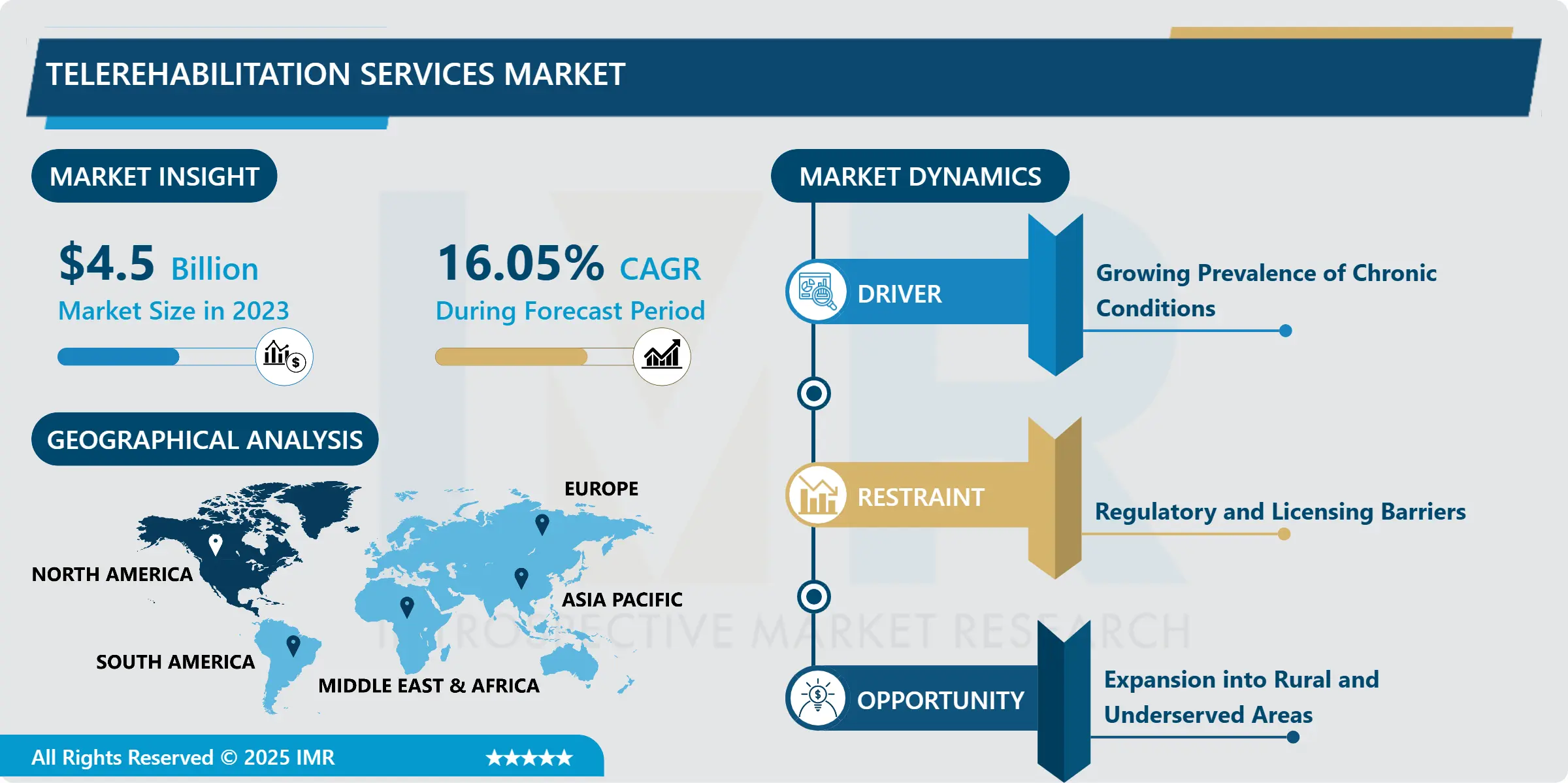
Telerehabilitation Services Market Size Was Valued at USD 4.50 Billion in 2023, and is Projected to Reach USD 17.18 Billion by 2032, Growing at a CAGR of 16.05% From 2024-2032.
Telerehabilitation services market describes the services of rehabilitation that are delivered through digital platforms for patients to be treated through teletherapy. These types of services help individuals with injuries, surgeries, or longstanding diseases regain their quality of life through telecommunication devices including video conference and mobile applications. Some of the available telerehabilitation services include physical therapy, occupational and cognitive therapy as well as speech therapy among others this helps with the rehab of clients who are in areas that cannot easily access a rehab center.
The telerehabilitation market has grown, over the years, especially due to the prominence of telemedicine and the ongoing care requirements post-pandemic. As with the improvement in communication technology telerehabilitation has helped patients to be treated at their homes not requiring regular physical visit by the doctors. There are now so many digital forms of healthcare that have made it possible for people who face some difficulties to access clinics for rehabilitation, or for other reasons, they cannot make it through.
The market for telerehabilitation will expand because of the increasing need for rehabilitation linked to chronic diseases and ageing as well as the need for early interventional cure to problems. Smart clothing, AI and VR integration in rehab have increased the impact of therapies and the treatments provided are mapped according to the requirements of the patient. Many health care facilities are implementing telerehabilitation to enhance efficiency, cost reduction, patient care and response to a society with a greater emphasis on sophisticated technology.
Telerehabilitation Services Market Trend Analysis:
Increasing Use of Wearable Devices in Telerehabilitation
Wearable devices remain among the primary market drivers in telerehabilitation since they enable continuous feedback throughout rehabilitation sessions. Them, including a pedometer, a heart rate monitor, and others that measure various physiological parameters help therapists control the patient’s progress and, if necessary, make corrections to their therapy. The incorporation of these devices with the telerehabilitation platforms improves the accuracy of information gathered to deliver much closer attention to the residents.
It remains an exciting area of growth and innovation and has seen development such as smart sensors which monitor the patient’s muscles, identifying patterns and feed back to the patient as well as therapists. This trend is also expected to rise in the future given the increasing number of patients who currently use remote monitoring processes of therapy sessions.
Expansion into Rural and Underserved Areas
In the case of the telerehabilitation market, one such opportunity is the possibility to cover rural and unscrewed regions. The evidences show that the traditional rehabilitation services are mostly provided in the urban settings, which delays the early implementation of rehabilitation services and ultimately, denies many patients even basic rehabilitation services needed. This gap can be closed by telerehabilitation through allowing patients in such regions access to specialists without needing to be physically transferred.
Such a shift in penetrating these unserved markets is a significant opportunity for both providers of healthcare services together with technology firms. By integrating district health facilities and governments, the providers can develop effective and long-term solutions for reaching those populations with telerehabilitation, thereby enhancing future equitable access to care from a distance.
Telerehabilitation Services Market Segment Analysis:
Telerehabilitation Services Market is Segmented on the basis of Service type, Delivery Mode, application, End User and Region.
By Service Type, Occupational Therapy segment is expected to dominate the market during the forecast period
The services provided under telerehabilitation are physical therapy, occupational therapy, speech therapy and cognitive rehabilitation, and other services. Physical therapy services take the biggest market share becauseitt is the most common type of rehabilitation for patients with musculoskeletal disorders. Surgical and injured patients may need frequent appointments, and telerehabilitation allows patients to attend sessions without physically coming to appointments hence increasing patient compliance.
Massage therapy is also a large category especially among patients who have neurological disorders or developmental disabilities who need occupational therapy or speech therapy services. The above therapies are influenced by telecommunication because a therapist does not need to be physically present and patients will receive standard care. As opposed to inpatient care, virtual sessions provide the patient and families with an opportunity to schedule a therapy session in a day and as such, have better progress.
By Application, Cardiovascular Rehabilitation segment expected to held the largest share
This intervention covers almost all disciplines including neurological, orthopedic, cardiovascular, pulmonary, pediatric and many other forms of rehabilitation. Neurological rehabilitation is arguably the biggest application of the technology, targeting patients with stroke, TBI as well as those diagnosed with multiple sclerosis. Telerehabilitation also remains instrumental in assisting patients regain their motor functions, and cognitive functions since this requires exercises, and constant check-ups personalized to the patient’s general conditions.
Orthopedic rehabilitation is yet another promising segment; the people, who have fractures, joint replacements or sports lesions /injuries/. Patients who undergo telerehabilitation are also able to complete exercise prescription and get instructions from therapists without physically visiting the hospital, clinic or health facility often for the required or recommended therapeutic management.
Telerehabilitation Services Market Regional Insights:
North America is Expected to Dominate the Market Over the Forecast period
North America constitutes the largest current market for telerehabilitation services because of the advanced health care system in the region, high acceptance of telemedicine, and favourable politico-legal environment. The U.S. and Canada particularly have pursued large investments in technology for health care, and the increasing need for telemedicine has spurred the use of telerehabilitation. Moreover, with the enhanced rates of lifestyle diseases especially affecting the elderly, these services have found a ready market.
The relatively high level of reimbursement policies across the region and government incentives for telehealth has also helped providers expand telerehabilitation services. Mainly due to technology advancement, North America will continue dominating this market since the demand for HLHS transcends physical barrier.
Active Key Players in the Telerehabilitation Services Market
Amwell (USA)
Doctor on Demand (USA)
EWellness Healthcare Corporation (USA)
Global TeleRehabilitation Inc. (Canada)
Hinge Health (USA)
Jintronix Inc. (Canada)
MediTouch (Israel)
Philips Healthcare (Netherlands)
Reflexion Health (USA)
Rehabtronics (Canada)
Simple Therapy (USA)
Teladoc Health (USA)
Other Active Players
Chapter 1: Introduction
1.1 Scope and Coverage
Chapter 2:Executive Summary
Chapter 3: Market Landscape
3.1 Market Dynamics
3.1.1 Drivers
3.1.2 Restraints
3.1.3 Opportunities
3.1.4 Challenges
3.2 Market Trend Analysis
3.3 PESTLE Analysis
3.4 Porter’s Five Forces Analysis
3.5 Industry Value Chain Analysis
3.6 Ecosystem
3.7 Regulatory Landscape
3.8 Price Trend Analysis
3.9 Patent Analysis
3.10 Technology Evolution
3.11 Investment Pockets
3.12 Import-Export Analysis
Chapter 4: Telerehabilitation Services Market by Service Type
4.1 Telerehabilitation Services Market Snapshot and Growth Engine
4.2 Telerehabilitation Services Market Overview
4.3 Physical Therapy
4.3.1 Introduction and Market Overview
4.3.2 Historic and Forecasted Market Size in Value USD and Volume Units (2017-2032F)
4.3.3 Key Market Trends, Growth Factors and Opportunities
4.3.4 Physical Therapy: Geographic Segmentation Analysis
4.4 Occupational Therapy
4.4.1 Introduction and Market Overview
4.4.2 Historic and Forecasted Market Size in Value USD and Volume Units (2017-2032F)
4.4.3 Key Market Trends, Growth Factors and Opportunities
4.4.4 Occupational Therapy: Geographic Segmentation Analysis
4.5 Speech Therapy
4.5.1 Introduction and Market Overview
4.5.2 Historic and Forecasted Market Size in Value USD and Volume Units (2017-2032F)
4.5.3 Key Market Trends, Growth Factors and Opportunities
4.5.4 Speech Therapy: Geographic Segmentation Analysis
4.6 Cognitive Rehabilitation
4.6.1 Introduction and Market Overview
4.6.2 Historic and Forecasted Market Size in Value USD and Volume Units (2017-2032F)
4.6.3 Key Market Trends, Growth Factors and Opportunities
4.6.4 Cognitive Rehabilitation: Geographic Segmentation Analysis
4.7 Others
4.7.1 Introduction and Market Overview
4.7.2 Historic and Forecasted Market Size in Value USD and Volume Units (2017-2032F)
4.7.3 Key Market Trends, Growth Factors and Opportunities
4.7.4 Others: Geographic Segmentation Analysis
Chapter 5: Telerehabilitation Services Market by Application
5.1 Telerehabilitation Services Market Snapshot and Growth Engine
5.2 Telerehabilitation Services Market Overview
5.3 Neurological Rehabilitation
5.3.1 Introduction and Market Overview
5.3.2 Historic and Forecasted Market Size in Value USD and Volume Units (2017-2032F)
5.3.3 Key Market Trends, Growth Factors and Opportunities
5.3.4 Neurological Rehabilitation: Geographic Segmentation Analysis
5.4 Orthopedic Rehabilitation
5.4.1 Introduction and Market Overview
5.4.2 Historic and Forecasted Market Size in Value USD and Volume Units (2017-2032F)
5.4.3 Key Market Trends, Growth Factors and Opportunities
5.4.4 Orthopedic Rehabilitation: Geographic Segmentation Analysis
5.5 Cardiovascular Rehabilitation
5.5.1 Introduction and Market Overview
5.5.2 Historic and Forecasted Market Size in Value USD and Volume Units (2017-2032F)
5.5.3 Key Market Trends, Growth Factors and Opportunities
5.5.4 Cardiovascular Rehabilitation: Geographic Segmentation Analysis
5.6 Pulmonary Rehabilitation
5.6.1 Introduction and Market Overview
5.6.2 Historic and Forecasted Market Size in Value USD and Volume Units (2017-2032F)
5.6.3 Key Market Trends, Growth Factors and Opportunities
5.6.4 Pulmonary Rehabilitation: Geographic Segmentation Analysis
5.7 Pediatric Rehabilitation
5.7.1 Introduction and Market Overview
5.7.2 Historic and Forecasted Market Size in Value USD and Volume Units (2017-2032F)
5.7.3 Key Market Trends, Growth Factors and Opportunities
5.7.4 Pediatric Rehabilitation: Geographic Segmentation Analysis
5.8 Others)
5.8.1 Introduction and Market Overview
5.8.2 Historic and Forecasted Market Size in Value USD and Volume Units (2017-2032F)
5.8.3 Key Market Trends, Growth Factors and Opportunities
5.8.4 Others): Geographic Segmentation Analysis
5.9 Delivery Mode
5.9.1 Introduction and Market Overview
5.9.2 Historic and Forecasted Market Size in Value USD and Volume Units (2017-2032F)
5.9.3 Key Market Trends, Growth Factors and Opportunities
5.9.4 Delivery Mode: Geographic Segmentation Analysis
Chapter 6: Company Profiles and Competitive Analysis
6.1 Competitive Landscape
6.1.1 Competitive Benchmarking
6.1.2 Telerehabilitation Services Market Share by Manufacturer (2023)
6.1.3 Industry BCG Matrix
6.1.4 Heat Map Analysis
6.1.5 Mergers and Acquisitions
6.2 AMWELL (USA)
6.2.1 Company Overview
6.2.2 Key Executives
6.2.3 Company Snapshot
6.2.4 Role of the Company in the Market
6.2.5 Sustainability and Social Responsibility
6.2.6 Operating Business Segments
6.2.7 Product Portfolio
6.2.8 Business Performance
6.2.9 Key Strategic Moves and Recent Developments
6.2.10 SWOT Analysis
6.3 MEDITOUCH (ISRAEL)
6.4 PHILIPS HEALTHCARE (NETHERLANDS)
6.5 DOCTOR ON DEMAND (USA)
6.6 TELADOC HEALTH (USA)
6.7 REHABTRONICS (CANADA)
6.8 EWELLNESS HEALTHCARE CORPORATION (USA)
6.9 SIMPLE THERAPY (USA)
6.10 OTHER ACTIVE PLAYERS
Chapter 7: Global Telerehabilitation Services Market By Region
7.1 Overview
7.2. North America Telerehabilitation Services Market
7.2.1 Key Market Trends, Growth Factors and Opportunities
7.2.2 Top Key Companies
7.2.3 Historic and Forecasted Market Size by Segments
7.2.4 Historic and Forecasted Market Size By Service Type
7.2.4.1 Physical Therapy
7.2.4.2 Occupational Therapy
7.2.4.3 Speech Therapy
7.2.4.4 Cognitive Rehabilitation
7.2.4.5 Others
7.2.5 Historic and Forecasted Market Size By Application
7.2.5.1 Neurological Rehabilitation
7.2.5.2 Orthopedic Rehabilitation
7.2.5.3 Cardiovascular Rehabilitation
7.2.5.4 Pulmonary Rehabilitation
7.2.5.5 Pediatric Rehabilitation
7.2.5.6 Others)
7.2.5.7 Delivery Mode
7.2.6 Historic and Forecast Market Size by Country
7.2.6.1 US
7.2.6.2 Canada
7.2.6.3 Mexico
7.3. Eastern Europe Telerehabilitation Services Market
7.3.1 Key Market Trends, Growth Factors and Opportunities
7.3.2 Top Key Companies
7.3.3 Historic and Forecasted Market Size by Segments
7.3.4 Historic and Forecasted Market Size By Service Type
7.3.4.1 Physical Therapy
7.3.4.2 Occupational Therapy
7.3.4.3 Speech Therapy
7.3.4.4 Cognitive Rehabilitation
7.3.4.5 Others
7.3.5 Historic and Forecasted Market Size By Application
7.3.5.1 Neurological Rehabilitation
7.3.5.2 Orthopedic Rehabilitation
7.3.5.3 Cardiovascular Rehabilitation
7.3.5.4 Pulmonary Rehabilitation
7.3.5.5 Pediatric Rehabilitation
7.3.5.6 Others)
7.3.5.7 Delivery Mode
7.3.6 Historic and Forecast Market Size by Country
7.3.6.1 Russia
7.3.6.2 Bulgaria
7.3.6.3 The Czech Republic
7.3.6.4 Hungary
7.3.6.5 Poland
7.3.6.6 Romania
7.3.6.7 Rest of Eastern Europe
7.4. Western Europe Telerehabilitation Services Market
7.4.1 Key Market Trends, Growth Factors and Opportunities
7.4.2 Top Key Companies
7.4.3 Historic and Forecasted Market Size by Segments
7.4.4 Historic and Forecasted Market Size By Service Type
7.4.4.1 Physical Therapy
7.4.4.2 Occupational Therapy
7.4.4.3 Speech Therapy
7.4.4.4 Cognitive Rehabilitation
7.4.4.5 Others
7.4.5 Historic and Forecasted Market Size By Application
7.4.5.1 Neurological Rehabilitation
7.4.5.2 Orthopedic Rehabilitation
7.4.5.3 Cardiovascular Rehabilitation
7.4.5.4 Pulmonary Rehabilitation
7.4.5.5 Pediatric Rehabilitation
7.4.5.6 Others)
7.4.5.7 Delivery Mode
7.4.6 Historic and Forecast Market Size by Country
7.4.6.1 Germany
7.4.6.2 UK
7.4.6.3 France
7.4.6.4 The Netherlands
7.4.6.5 Italy
7.4.6.6 Spain
7.4.6.7 Rest of Western Europe
7.5. Asia Pacific Telerehabilitation Services Market
7.5.1 Key Market Trends, Growth Factors and Opportunities
7.5.2 Top Key Companies
7.5.3 Historic and Forecasted Market Size by Segments
7.5.4 Historic and Forecasted Market Size By Service Type
7.5.4.1 Physical Therapy
7.5.4.2 Occupational Therapy
7.5.4.3 Speech Therapy
7.5.4.4 Cognitive Rehabilitation
7.5.4.5 Others
7.5.5 Historic and Forecasted Market Size By Application
7.5.5.1 Neurological Rehabilitation
7.5.5.2 Orthopedic Rehabilitation
7.5.5.3 Cardiovascular Rehabilitation
7.5.5.4 Pulmonary Rehabilitation
7.5.5.5 Pediatric Rehabilitation
7.5.5.6 Others)
7.5.5.7 Delivery Mode
7.5.6 Historic and Forecast Market Size by Country
7.5.6.1 China
7.5.6.2 India
7.5.6.3 Japan
7.5.6.4 South Korea
7.5.6.5 Malaysia
7.5.6.6 Thailand
7.5.6.7 Vietnam
7.5.6.8 The Philippines
7.5.6.9 Australia
7.5.6.10 New Zealand
7.5.6.11 Rest of APAC
7.6. Middle East & Africa Telerehabilitation Services Market
7.6.1 Key Market Trends, Growth Factors and Opportunities
7.6.2 Top Key Companies
7.6.3 Historic and Forecasted Market Size by Segments
7.6.4 Historic and Forecasted Market Size By Service Type
7.6.4.1 Physical Therapy
7.6.4.2 Occupational Therapy
7.6.4.3 Speech Therapy
7.6.4.4 Cognitive Rehabilitation
7.6.4.5 Others
7.6.5 Historic and Forecasted Market Size By Application
7.6.5.1 Neurological Rehabilitation
7.6.5.2 Orthopedic Rehabilitation
7.6.5.3 Cardiovascular Rehabilitation
7.6.5.4 Pulmonary Rehabilitation
7.6.5.5 Pediatric Rehabilitation
7.6.5.6 Others)
7.6.5.7 Delivery Mode
7.6.6 Historic and Forecast Market Size by Country
7.6.6.1 Turkiye
7.6.6.2 Bahrain
7.6.6.3 Kuwait
7.6.6.4 Saudi Arabia
7.6.6.5 Qatar
7.6.6.6 UAE
7.6.6.7 Israel
7.6.6.8 South Africa
7.7. South America Telerehabilitation Services Market
7.7.1 Key Market Trends, Growth Factors and Opportunities
7.7.2 Top Key Companies
7.7.3 Historic and Forecasted Market Size by Segments
7.7.4 Historic and Forecasted Market Size By Service Type
7.7.4.1 Physical Therapy
7.7.4.2 Occupational Therapy
7.7.4.3 Speech Therapy
7.7.4.4 Cognitive Rehabilitation
7.7.4.5 Others
7.7.5 Historic and Forecasted Market Size By Application
7.7.5.1 Neurological Rehabilitation
7.7.5.2 Orthopedic Rehabilitation
7.7.5.3 Cardiovascular Rehabilitation
7.7.5.4 Pulmonary Rehabilitation
7.7.5.5 Pediatric Rehabilitation
7.7.5.6 Others)
7.7.5.7 Delivery Mode
7.7.6 Historic and Forecast Market Size by Country
7.7.6.1 Brazil
7.7.6.2 Argentina
7.7.6.3 Rest of SA
Chapter 8 Analyst Viewpoint and Conclusion
8.1 Recommendations and Concluding Analysis
8.2 Potential Market Strategies
Chapter 9 Research Methodology
9.1 Research Process
9.2 Primary Research
9.3 Secondary Research
Q1: What would be the forecast period in the Telerehabilitation Services Market research report?
A1: The forecast period in the Telerehabilitation Services Market research report is 2024-2032.
Q2: Who are the key players in the Telerehabilitation Services Market?
A2: Amwell (USA), MediTouch (Israel), Philips Healthcare (Netherlands), Doctor on Demand (USA), Teladoc Health (USA), Rehabtronics (Canada), EWellness Healthcare Corporation (USA), Simple Therapy (USA), and Other Active Players.
Q3: What are the segments of the Telerehabilitation Services Market?
A3: The Telerehabilitation Services Market is segmented into Service Type, Application, Delivery Mode, End User and region. By Service Type, the market is categorized into Physical Therapy, Occupational Therapy, Speech Therapy, Cognitive Rehabilitation, Others. By Application, the market is categorized into Neurological Rehabilitation, Orthopedic Rehabilitation, Cardiovascular Rehabilitation, Pulmonary Rehabilitation, Pediatric Rehabilitation, Others. By Delivery Mode, the market is categorized into Web-Based, App-Based, Video Conferencing. By End User, the market is categorized into Hospitals & Clinics, Rehabilitation Centers, Homecare Settings, Others. By region, it is analyzed across North America (U.S., Canada, Mexico), Eastern Europe (Russia, Bulgaria, The Czech Republic, Hungary, Poland, Romania, Rest of Eastern Europe), Western Europe (Germany, UK, France, The Netherlands, Italy, Russia, Spain, Rest of Western Europe), Asia Pacific (China, India, Japan, South Korea, Malaysia, Thailand, Vietnam, The Philippines, Australia, New-Zealand, Rest of APAC), Middle East & Africa (Turkiye, Bahrain, Kuwait, Saudi Arabia, Qatar, UAE, Israel, South Africa), South America (Brazil, Argentina, Rest of SA).
Q4: What is the Telerehabilitation Services Market?
A4: Telerehabilitation services market describes the services of rehabilitation that are delivered through digital platforms for patients to be treated through teletherapy. These types of services help individuals with injuries, surgeries, or longstanding diseases regain their quality of life through telecommunication devices including video conference and mobile applications. Some of the available telerehabilitation services include physical therapy, occupational and cognitive therapy as well as speech therapy among others this helps with the rehab of clients who are in areas that cannot easily access a rehab center.
Q5: How big is the Telerehabilitation Services Market?
A5: Telerehabilitation Services Market Size Was Valued at USD 4.50 Billion in 2023, and is Projected to Reach USD 17.18 Billion by 2032, Growing at a CAGR of 16.05% From 2024-2032.
How to Buy a Report from eminsights.jp
On the product page, choose the license you want: Single-User License, Multi-User License or Enterprise License.
If you required report in your native language, then you can click on Translated Report button and fill out the form with report name and language you want, then our team will contact you as soon as possible.
Click the Buy Now button.
You will be redirected to the checkout page. Enter your company details and payment information.
Click Place Order to complete the purchase.
Confirmation: You’ll receive an order confirmation and our team will contact you shortly with your ordered report.
If you have any questions, fill out the contact form below or email us at bizdev@eminsights.net.
Thank you for choosing eminsights.jp!