Stay Ahead in Fast-Growing Economies.
Browse Reports Now



Surgical Retractors Market – Current Analysis by Market Share 2024-2032
Surgical retractors are basically the medical tools that are used in surgeries to ensure that the part that need operation remains exposed. In other words, the surgical retractors are used to expand the area of the injury and keep the incision site exposed during the operation.

IMR Group
Description
Surgical Retractors Market Synopsis:
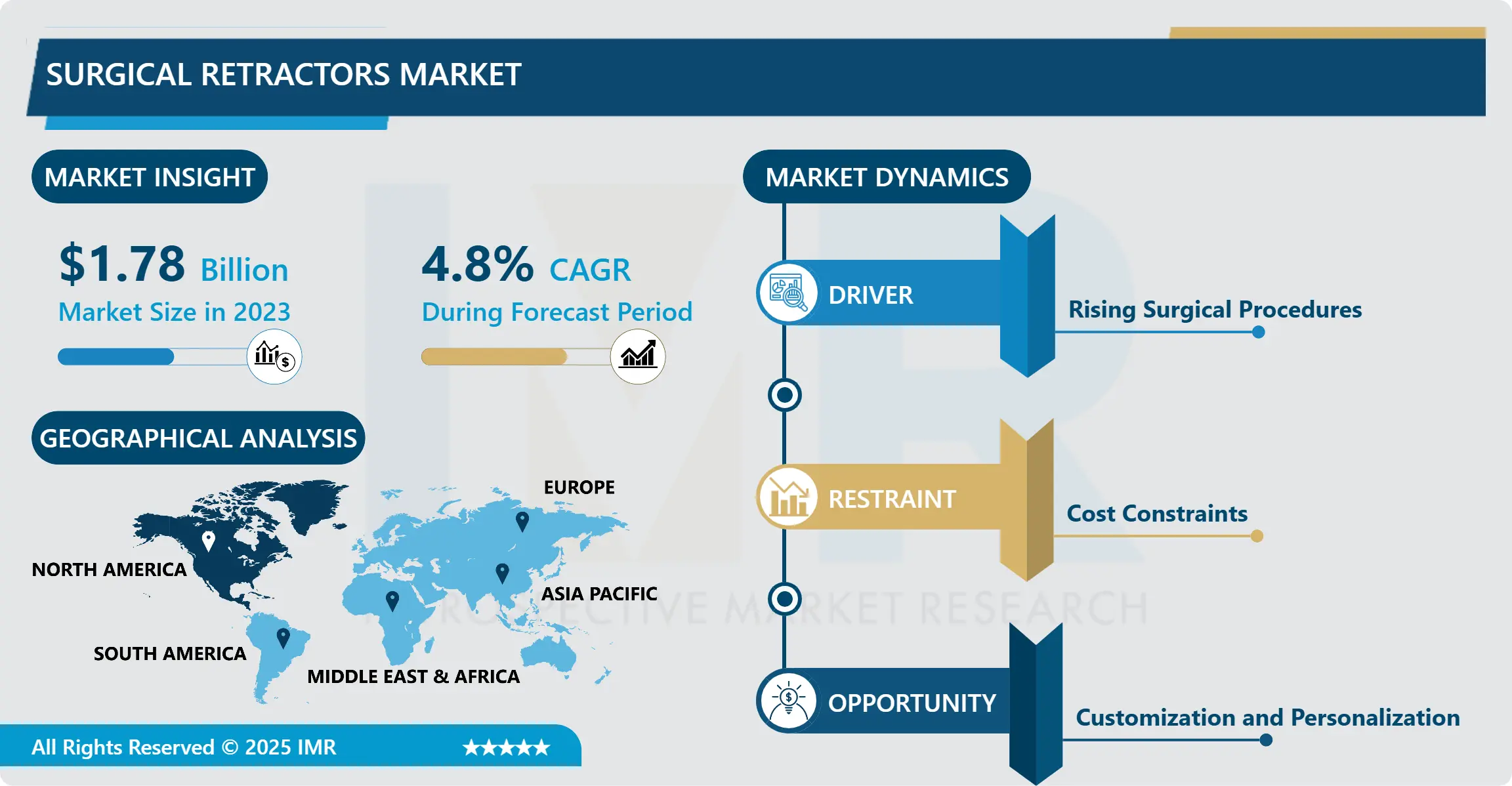
Surgical Retractors Market Size Was Valued at USD 1.78 Billion in 2023, and is Projected to Reach USD 2.72 Billion by 2032, Growing at a CAGR of 4.80% From 2024-2032.
Surgical retractors are basically the medical tools that are used in surgeries to ensure that the part that need operation remains exposed. In other words, the surgical retractors are used to expand the area of the injury and keep the incision site exposed during the operation. In surgery, surgical retractors are the objects that hold back the internal organs and tissues out from interfering with the surgery. The instrument thus enhances visibility making it easier to increase efficiency in undertaking of the surgery.
The surgical retractors market is growing rapidly as the latest research and developments are tied to surgical procedures requiring minimal invasions. Surgical retractors are important operation tools employed whenever the surgeon is required to pull away some tissues in order to ensure that the area to be operated on is visible and easily accessible. The increasing elderly population and increased prevalence of chronic diseases that necessitate surgery means an increasing demand for surgical retractors. The growth of the number of surgical operations in people, especially in such areas as orthopedic, cardiovascular, and neurosurgery, has stimulated the great demand for new generation retractors that act more effectively and improve the trajectory of the market’s development.
It is also the technological factors that are contributing significantly for the growth of global surgical retractors market. Smart retractors with visualization systems as well as adjustable characteristics are designed for new trends in the surgery field with high demands for accuracy and flexibility. The growing popularity of robotic surgeries is another factor which is advancing the market since such systems call for specific developing retractors that may improve operation performance. In addition, changing healthcare costs, better access to surgical facilities especially in the growing economies also will boost the demand of surgical retractors which will guarantee steady growth of the market in the future years.
In terms of geography, North America has the largest share in the surgical retractors market because of well-developed infrastructure of healthcare, and high surgical rates. The market of Asia Pacific region is expected to grow at a higher CAGR during the forecast period as there is higher investment made in healthcare industry, higher number of surgical patients and increasing number of modern hospitals equipped with related surgical technologies. Market and competitor dynamics that can be observed with key players include product developments and differentiation, partnership and alliances, as well as the acquisitions to gain a wider market share. The development of surgical retractors market has prompted manufactures to produce new products that can enhance the hospital efficiency while also reducing costs and increasing patient care.
Surgical Retractors Market Trend Analysis:
Innovations in Surgical Retractors Driven by Chronic Disease Prevalence and Personalized Medicine
The rising prevalence of chronic diseases such as cardiovascular conditions, diabetes, and obesity has led to increased demand for surgeries, driving the need for advanced surgical instruments. Innovative retractors have gained importance as they offer enhanced visibility during procedures while minimizing damage to surrounding tissues crucial for delicate surgeries. Recent advancements in ergonomic design and material innovation have improved safety and efficiency in surgical settings.
The emergence of personalized medicine has pushed retractor manufacturers to develop adaptable tools for diverse surgical needs and patient anatomies. Minimally invasive devices now feature thinner cross-sections and adjustable components to support less invasive procedures, aligning with the industry’s focus on improved outcomes, faster recovery, and patient-centered care. This evolution enhances the overall value of surgical interventions, addressing both clinical precision and the unique requirements of individual patients.
Advancements in the Surgical Retractors Market
The rising number of surgeries driven by chronic diseases such as cancer, cardiovascular, and orthopedic conditions presents a significant opportunity for manufacturers in the surgical retractors market. The global increase in surgical procedures, especially among the growing elderly population, is creating a demand for advanced and specialized retractors. Simultaneously, innovations in minimally invasive surgeries are transforming the design of surgical instruments.
These procedures require retractors that enhance visibility within limited surgical fields while supporting faster patient recovery. This shift offers manufacturers a chance to innovate with ergonomically designed, high-precision retractors made from advanced materials. By investing in research and development, companies can cater to diverse surgical specialties and establish themselves as industry leaders. The emphasis on surgical precision and tool efficiency highlights the vital role of retractor innovation in modern healthcare, aligning with evolving surgical techniques and rising global healthcare demands.
Surgical Retractors Market Segment Analysis:
Surgical Retractors Market is Segmented on the basis of By Product Type, Design, Product Usage, Application, End-User, Usage, and Region.
By Product Type, Hand Retractors segment is expected to dominate the market during the forecast period
Specimen graspers and hand retractors are essential surgical instruments used to apply direct force and maintain tissue positioning during procedures. Available in various forms and sizes, they enable surgeons to choose the most suitable tool for a specific operation or body site. Their flexibility allows precise tissue manipulation, especially important in microsurgeries, where careful retraction is needed to avoid damaging nearby structures.
Hand retractors, operated manually, offer real-time feedback on the force applied, enhancing surgical safety and allowing prompt adjustments. This tactile response is crucial during delicate procedures, contributing to patient safety and surgical success. Additionally, hand retractors can be easily interchanged with other tools in the operating theatre, supporting procedural efficiency. Overall, these instruments are valuable in providing surgeons with direct, adjustable control, thereby improving the effectiveness and safety of surgical interventions.
By Usage, Reusable segment expected to held the largest share
Reusable retractors are preferred in surgeries due to their durability and sustainability. Made from materials like stainless steel or metal alloys, they withstand repeated sterilization, enabling multiple uses and reducing the need for frequent replacements. This minimizes environmental impact and aligns with the healthcare sector’s sustainability goals. However, their use requires strict adherence to cleaning and sterilization protocols to prevent cross-infection.
Proper decontamination must be ensured in line with hospital standards and the nature of the surgery. Noncompliance with these procedures, as outlined in US NFPA guidelines, increases the risk of infection and poor patient outcomes. While reusable retractors offer environmental and cost benefits, maintaining their sterility through rigorous processes is essential to ensure safe and effective surgical performance.
Surgical Retractors Market Regional Insights:
North America is Expected to Dominate the Market Over the Forecast period
North America is Driven by high technological advancement of these appliances in the North America region, the market for surgical retractors has been promising. Technologies like surgical robots and benchmarks like the design for manufacturing and assembly (DfMA) prototype reposition common operations for improved accuracy and design.
Comorbid with increased incidence of chronic diseases such as obesity, cardiovascular diseases, and cancer are equally increasing numbers and rates of surgeries. This is because the United States has well developed health care systems and more so the country has well equipped hospitals, specialized surgical centers which would aid the use of advanced surgical instruments. Massive funding on research and development from both government and consumer sectors help to update surgical operating technologies consistently to meet the needs of the practicing surgeons.
Active Key Players in the Surgical Retractors Market
Arthrex, Inc. (U.S.)
B. Braun Melsungen AG (Germany)
BD (Becton, Dickinson and Company) (U.S.)
BR Surgical (U.S.)
CONMED Corporation (U.S.)
CooperSurgical, Inc. (U.S.)
DJO, LLC (U.S.)
Globus Medical (U.S.)
Henry Schein, Inc. (U.S.)
Integra LifeSciences Corporation (U.S.)
Johnson & Johnson Services, Inc. (U.S.)
Medtronic (Ireland)
MicroSurgical Technology (U.S.)
Olympus Corporation (Japan)
RTI Surgical (U.S.)
Sklar Surgical Instruments (U.S.)
Teleflex Incorporated (U.S.)
Terumo Corporation (Japan)
The Cooper Companies Inc. (U.S.)
Thompson Surgical (U.S.)
Other Active Players.
Chapter 1: Introduction
1.1 Scope and Coverage
Chapter 2:Executive Summary
Chapter 3: Market Landscape
3.1 Market Dynamics
3.1.1 Drivers
3.1.2 Restraints
3.1.3 Opportunities
3.1.4 Challenges
3.2 Market Trend Analysis
3.3 PESTLE Analysis
3.4 Porter’s Five Forces Analysis
3.5 Industry Value Chain Analysis
3.6 Ecosystem
3.7 Regulatory Landscape
3.8 Price Trend Analysis
3.9 Patent Analysis
3.10 Technology Evolution
3.11 Investment Pockets
3.12 Import-Export Analysis
Chapter 4: Surgical Retractors Market by Product Type
4.1 Surgical Retractors Market Snapshot and Growth Engine
4.2 Surgical Retractors Market Overview
4.3 Hand Retractors
4.3.1 Introduction and Market Overview
4.3.2 Historic and Forecasted Market Size in Value USD and Volume Units (2017-2032F)
4.3.3 Key Market Trends, Growth Factors and Opportunities
4.3.4 Hand Retractors: Geographic Segmentation Analysis
4.4 Self-Retaining Retractors
4.4.1 Introduction and Market Overview
4.4.2 Historic and Forecasted Market Size in Value USD and Volume Units (2017-2032F)
4.4.3 Key Market Trends, Growth Factors and Opportunities
4.4.4 Self-Retaining Retractors: Geographic Segmentation Analysis
4.5 Table-Mounted Retractor
4.5.1 Introduction and Market Overview
4.5.2 Historic and Forecasted Market Size in Value USD and Volume Units (2017-2032F)
4.5.3 Key Market Trends, Growth Factors and Opportunities
4.5.4 Table-Mounted Retractor: Geographic Segmentation Analysis
4.6 Wire Retractors
4.6.1 Introduction and Market Overview
4.6.2 Historic and Forecasted Market Size in Value USD and Volume Units (2017-2032F)
4.6.3 Key Market Trends, Growth Factors and Opportunities
4.6.4 Wire Retractors: Geographic Segmentation Analysis
4.7 Finger Retractor and Ribbon Retractor)
4.7.1 Introduction and Market Overview
4.7.2 Historic and Forecasted Market Size in Value USD and Volume Units (2017-2032F)
4.7.3 Key Market Trends, Growth Factors and Opportunities
4.7.4 Finger Retractor and Ribbon Retractor): Geographic Segmentation Analysis
4.8 Design (Fixed or Flat Frame Retractors
4.8.1 Introduction and Market Overview
4.8.2 Historic and Forecasted Market Size in Value USD and Volume Units (2017-2032F)
4.8.3 Key Market Trends, Growth Factors and Opportunities
4.8.4 Design (Fixed or Flat Frame Retractors: Geographic Segmentation Analysis
4.9 Angled or Curved Frame Retractors and Blade or Elevated-Tipped Retractors)
4.9.1 Introduction and Market Overview
4.9.2 Historic and Forecasted Market Size in Value USD and Volume Units (2017-2032F)
4.9.3 Key Market Trends, Growth Factors and Opportunities
4.9.4 Angled or Curved Frame Retractors and Blade or Elevated-Tipped Retractors): Geographic Segmentation Analysis
4.10 Product Usage (Tissue Handling and Dissection and Fluid Swabbing)
4.10.1 Introduction and Market Overview
4.10.2 Historic and Forecasted Market Size in Value USD and Volume Units (2017-2032F)
4.10.3 Key Market Trends, Growth Factors and Opportunities
4.10.4 Product Usage (Tissue Handling and Dissection and Fluid Swabbing): Geographic Segmentation Analysis
4.11
4.11.1 Introduction and Market Overview
4.11.2 Historic and Forecasted Market Size in Value USD and Volume Units (2017-2032F)
4.11.3 Key Market Trends, Growth Factors and Opportunities
4.11.4 : Geographic Segmentation Analysis
Chapter 5: Surgical Retractors Market by Application
5.1 Surgical Retractors Market Snapshot and Growth Engine
5.2 Surgical Retractors Market Overview
5.3 Abdominal Applications
5.3.1 Introduction and Market Overview
5.3.2 Historic and Forecasted Market Size in Value USD and Volume Units (2017-2032F)
5.3.3 Key Market Trends, Growth Factors and Opportunities
5.3.4 Abdominal Applications: Geographic Segmentation Analysis
5.4 Cardiothoracic Applications
5.4.1 Introduction and Market Overview
5.4.2 Historic and Forecasted Market Size in Value USD and Volume Units (2017-2032F)
5.4.3 Key Market Trends, Growth Factors and Opportunities
5.4.4 Cardiothoracic Applications: Geographic Segmentation Analysis
5.5 Orthopaedic Applications
5.5.1 Introduction and Market Overview
5.5.2 Historic and Forecasted Market Size in Value USD and Volume Units (2017-2032F)
5.5.3 Key Market Trends, Growth Factors and Opportunities
5.5.4 Orthopaedic Applications: Geographic Segmentation Analysis
5.6 Obstetric and Gynaecological Applications
5.6.1 Introduction and Market Overview
5.6.2 Historic and Forecasted Market Size in Value USD and Volume Units (2017-2032F)
5.6.3 Key Market Trends, Growth Factors and Opportunities
5.6.4 Obstetric and Gynaecological Applications: Geographic Segmentation Analysis
5.7 Urological Applications
5.7.1 Introduction and Market Overview
5.7.2 Historic and Forecasted Market Size in Value USD and Volume Units (2017-2032F)
5.7.3 Key Market Trends, Growth Factors and Opportunities
5.7.4 Urological Applications: Geographic Segmentation Analysis
5.8 Head
5.8.1 Introduction and Market Overview
5.8.2 Historic and Forecasted Market Size in Value USD and Volume Units (2017-2032F)
5.8.3 Key Market Trends, Growth Factors and Opportunities
5.8.4 Head: Geographic Segmentation Analysis
5.9 Neck and Spinal Applications
5.9.1 Introduction and Market Overview
5.9.2 Historic and Forecasted Market Size in Value USD and Volume Units (2017-2032F)
5.9.3 Key Market Trends, Growth Factors and Opportunities
5.9.4 Neck and Spinal Applications: Geographic Segmentation Analysis
5.10 Aesthetic Surgical Applications and Others)
5.10.1 Introduction and Market Overview
5.10.2 Historic and Forecasted Market Size in Value USD and Volume Units (2017-2032F)
5.10.3 Key Market Trends, Growth Factors and Opportunities
5.10.4 Aesthetic Surgical Applications and Others): Geographic Segmentation Analysis
5.11
5.11.1 Introduction and Market Overview
5.11.2 Historic and Forecasted Market Size in Value USD and Volume Units (2017-2032F)
5.11.3 Key Market Trends, Growth Factors and Opportunities
5.11.4 : Geographic Segmentation Analysis
Chapter 6: Surgical Retractors Market by End-User
6.1 Surgical Retractors Market Snapshot and Growth Engine
6.2 Surgical Retractors Market Overview
6.3 Hospitals
6.3.1 Introduction and Market Overview
6.3.2 Historic and Forecasted Market Size in Value USD and Volume Units (2017-2032F)
6.3.3 Key Market Trends, Growth Factors and Opportunities
6.3.4 Hospitals: Geographic Segmentation Analysis
6.4 Clinics and Surgical Centres
6.4.1 Introduction and Market Overview
6.4.2 Historic and Forecasted Market Size in Value USD and Volume Units (2017-2032F)
6.4.3 Key Market Trends, Growth Factors and Opportunities
6.4.4 Clinics and Surgical Centres: Geographic Segmentation Analysis
6.5 Ambulatory Care Centres and Maternity and Fertility Centres)
6.5.1 Introduction and Market Overview
6.5.2 Historic and Forecasted Market Size in Value USD and Volume Units (2017-2032F)
6.5.3 Key Market Trends, Growth Factors and Opportunities
6.5.4 Ambulatory Care Centres and Maternity and Fertility Centres): Geographic Segmentation Analysis
6.6 Usage (Reusable and Disposable)
6.6.1 Introduction and Market Overview
6.6.2 Historic and Forecasted Market Size in Value USD and Volume Units (2017-2032F)
6.6.3 Key Market Trends, Growth Factors and Opportunities
6.6.4 Usage (Reusable and Disposable) : Geographic Segmentation Analysis
Chapter 7: Company Profiles and Competitive Analysis
7.1 Competitive Landscape
7.1.1 Competitive Benchmarking
7.1.2 Surgical Retractors Market Share by Manufacturer (2023)
7.1.3 Industry BCG Matrix
7.1.4 Heat Map Analysis
7.1.5 Mergers and Acquisitions
7.2 JOHNSON & JOHNSON SERVICES INC. (U.S.)
7.2.1 Company Overview
7.2.2 Key Executives
7.2.3 Company Snapshot
7.2.4 Role of the Company in the Market
7.2.5 Sustainability and Social Responsibility
7.2.6 Operating Business Segments
7.2.7 Product Portfolio
7.2.8 Business Performance
7.2.9 Key Strategic Moves and Recent Developments
7.2.10 SWOT Analysis
7.3 CONMED CORPORATION (U.S.)
7.4 BD (BECTON
7.5 DICKINSON AND COMPANY) (U.S.)
7.6 SKLAR SURGICAL INSTRUMENTS (U.S.)
7.7 TELEFLEX INCORPORATED (U.S.)
7.8 BR SURGICAL (U.S.)
7.9 MEDTRONIC (IRELAND)
7.10 OLYMPUS CORPORATION (JAPAN)
7.11 COOPERSURGICAL INC. (U.S.)
7.12 DJO LLC (U.S.)
7.13 TERUMO CORPORATION (JAPAN)
7.14 HENRY SCHEIN INC. (U.S.)
7.15 B. BRAUN MELSUNGEN AG (GERMANY)
7.16 INTEGRA LIFESCIENCES CORPORATION (U.S.)
7.17 THE COOPER COMPANIES INC. (U.S.)
7.18 THOMPSON SURGICAL (U.S.)
7.19 GLOBUS MEDICAL (U.S.)
7.20 RTI SURGICAL (U.S.)
7.21 ARTHREX INC. (U.S.)
7.22 MICROSURGICAL TECHNOLOGY (U.S.)
7.23 AMONG OTHER ACTIVE PLAYERS
Chapter 8: Global Surgical Retractors Market By Region
8.1 Overview
8.2. North America Surgical Retractors Market
8.2.1 Key Market Trends, Growth Factors and Opportunities
8.2.2 Top Key Companies
8.2.3 Historic and Forecasted Market Size by Segments
8.2.4 Historic and Forecasted Market Size By Product Type
8.2.4.1 Hand Retractors
8.2.4.2 Self-Retaining Retractors
8.2.4.3 Table-Mounted Retractor
8.2.4.4 Wire Retractors
8.2.4.5 Finger Retractor and Ribbon Retractor)
8.2.4.6 Design (Fixed or Flat Frame Retractors
8.2.4.7 Angled or Curved Frame Retractors and Blade or Elevated-Tipped Retractors)
8.2.4.8 Product Usage (Tissue Handling and Dissection and Fluid Swabbing)
8.2.4.9
8.2.5 Historic and Forecasted Market Size By Application
8.2.5.1 Abdominal Applications
8.2.5.2 Cardiothoracic Applications
8.2.5.3 Orthopaedic Applications
8.2.5.4 Obstetric and Gynaecological Applications
8.2.5.5 Urological Applications
8.2.5.6 Head
8.2.5.7 Neck and Spinal Applications
8.2.5.8 Aesthetic Surgical Applications and Others)
8.2.5.9
8.2.6 Historic and Forecasted Market Size By End-User
8.2.6.1 Hospitals
8.2.6.2 Clinics and Surgical Centres
8.2.6.3 Ambulatory Care Centres and Maternity and Fertility Centres)
8.2.6.4 Usage (Reusable and Disposable)
8.2.7 Historic and Forecast Market Size by Country
8.2.7.1 US
8.2.7.2 Canada
8.2.7.3 Mexico
8.3. Eastern Europe Surgical Retractors Market
8.3.1 Key Market Trends, Growth Factors and Opportunities
8.3.2 Top Key Companies
8.3.3 Historic and Forecasted Market Size by Segments
8.3.4 Historic and Forecasted Market Size By Product Type
8.3.4.1 Hand Retractors
8.3.4.2 Self-Retaining Retractors
8.3.4.3 Table-Mounted Retractor
8.3.4.4 Wire Retractors
8.3.4.5 Finger Retractor and Ribbon Retractor)
8.3.4.6 Design (Fixed or Flat Frame Retractors
8.3.4.7 Angled or Curved Frame Retractors and Blade or Elevated-Tipped Retractors)
8.3.4.8 Product Usage (Tissue Handling and Dissection and Fluid Swabbing)
8.3.4.9
8.3.5 Historic and Forecasted Market Size By Application
8.3.5.1 Abdominal Applications
8.3.5.2 Cardiothoracic Applications
8.3.5.3 Orthopaedic Applications
8.3.5.4 Obstetric and Gynaecological Applications
8.3.5.5 Urological Applications
8.3.5.6 Head
8.3.5.7 Neck and Spinal Applications
8.3.5.8 Aesthetic Surgical Applications and Others)
8.3.5.9
8.3.6 Historic and Forecasted Market Size By End-User
8.3.6.1 Hospitals
8.3.6.2 Clinics and Surgical Centres
8.3.6.3 Ambulatory Care Centres and Maternity and Fertility Centres)
8.3.6.4 Usage (Reusable and Disposable)
8.3.7 Historic and Forecast Market Size by Country
8.3.7.1 Russia
8.3.7.2 Bulgaria
8.3.7.3 The Czech Republic
8.3.7.4 Hungary
8.3.7.5 Poland
8.3.7.6 Romania
8.3.7.7 Rest of Eastern Europe
8.4. Western Europe Surgical Retractors Market
8.4.1 Key Market Trends, Growth Factors and Opportunities
8.4.2 Top Key Companies
8.4.3 Historic and Forecasted Market Size by Segments
8.4.4 Historic and Forecasted Market Size By Product Type
8.4.4.1 Hand Retractors
8.4.4.2 Self-Retaining Retractors
8.4.4.3 Table-Mounted Retractor
8.4.4.4 Wire Retractors
8.4.4.5 Finger Retractor and Ribbon Retractor)
8.4.4.6 Design (Fixed or Flat Frame Retractors
8.4.4.7 Angled or Curved Frame Retractors and Blade or Elevated-Tipped Retractors)
8.4.4.8 Product Usage (Tissue Handling and Dissection and Fluid Swabbing)
8.4.4.9
8.4.5 Historic and Forecasted Market Size By Application
8.4.5.1 Abdominal Applications
8.4.5.2 Cardiothoracic Applications
8.4.5.3 Orthopaedic Applications
8.4.5.4 Obstetric and Gynaecological Applications
8.4.5.5 Urological Applications
8.4.5.6 Head
8.4.5.7 Neck and Spinal Applications
8.4.5.8 Aesthetic Surgical Applications and Others)
8.4.5.9
8.4.6 Historic and Forecasted Market Size By End-User
8.4.6.1 Hospitals
8.4.6.2 Clinics and Surgical Centres
8.4.6.3 Ambulatory Care Centres and Maternity and Fertility Centres)
8.4.6.4 Usage (Reusable and Disposable)
8.4.7 Historic and Forecast Market Size by Country
8.4.7.1 Germany
8.4.7.2 UK
8.4.7.3 France
8.4.7.4 The Netherlands
8.4.7.5 Italy
8.4.7.6 Spain
8.4.7.7 Rest of Western Europe
8.5. Asia Pacific Surgical Retractors Market
8.5.1 Key Market Trends, Growth Factors and Opportunities
8.5.2 Top Key Companies
8.5.3 Historic and Forecasted Market Size by Segments
8.5.4 Historic and Forecasted Market Size By Product Type
8.5.4.1 Hand Retractors
8.5.4.2 Self-Retaining Retractors
8.5.4.3 Table-Mounted Retractor
8.5.4.4 Wire Retractors
8.5.4.5 Finger Retractor and Ribbon Retractor)
8.5.4.6 Design (Fixed or Flat Frame Retractors
8.5.4.7 Angled or Curved Frame Retractors and Blade or Elevated-Tipped Retractors)
8.5.4.8 Product Usage (Tissue Handling and Dissection and Fluid Swabbing)
8.5.4.9
8.5.5 Historic and Forecasted Market Size By Application
8.5.5.1 Abdominal Applications
8.5.5.2 Cardiothoracic Applications
8.5.5.3 Orthopaedic Applications
8.5.5.4 Obstetric and Gynaecological Applications
8.5.5.5 Urological Applications
8.5.5.6 Head
8.5.5.7 Neck and Spinal Applications
8.5.5.8 Aesthetic Surgical Applications and Others)
8.5.5.9
8.5.6 Historic and Forecasted Market Size By End-User
8.5.6.1 Hospitals
8.5.6.2 Clinics and Surgical Centres
8.5.6.3 Ambulatory Care Centres and Maternity and Fertility Centres)
8.5.6.4 Usage (Reusable and Disposable)
8.5.7 Historic and Forecast Market Size by Country
8.5.7.1 China
8.5.7.2 India
8.5.7.3 Japan
8.5.7.4 South Korea
8.5.7.5 Malaysia
8.5.7.6 Thailand
8.5.7.7 Vietnam
8.5.7.8 The Philippines
8.5.7.9 Australia
8.5.7.10 New Zealand
8.5.7.11 Rest of APAC
8.6. Middle East & Africa Surgical Retractors Market
8.6.1 Key Market Trends, Growth Factors and Opportunities
8.6.2 Top Key Companies
8.6.3 Historic and Forecasted Market Size by Segments
8.6.4 Historic and Forecasted Market Size By Product Type
8.6.4.1 Hand Retractors
8.6.4.2 Self-Retaining Retractors
8.6.4.3 Table-Mounted Retractor
8.6.4.4 Wire Retractors
8.6.4.5 Finger Retractor and Ribbon Retractor)
8.6.4.6 Design (Fixed or Flat Frame Retractors
8.6.4.7 Angled or Curved Frame Retractors and Blade or Elevated-Tipped Retractors)
8.6.4.8 Product Usage (Tissue Handling and Dissection and Fluid Swabbing)
8.6.4.9
8.6.5 Historic and Forecasted Market Size By Application
8.6.5.1 Abdominal Applications
8.6.5.2 Cardiothoracic Applications
8.6.5.3 Orthopaedic Applications
8.6.5.4 Obstetric and Gynaecological Applications
8.6.5.5 Urological Applications
8.6.5.6 Head
8.6.5.7 Neck and Spinal Applications
8.6.5.8 Aesthetic Surgical Applications and Others)
8.6.5.9
8.6.6 Historic and Forecasted Market Size By End-User
8.6.6.1 Hospitals
8.6.6.2 Clinics and Surgical Centres
8.6.6.3 Ambulatory Care Centres and Maternity and Fertility Centres)
8.6.6.4 Usage (Reusable and Disposable)
8.6.7 Historic and Forecast Market Size by Country
8.6.7.1 Turkiye
8.6.7.2 Bahrain
8.6.7.3 Kuwait
8.6.7.4 Saudi Arabia
8.6.7.5 Qatar
8.6.7.6 UAE
8.6.7.7 Israel
8.6.7.8 South Africa
8.7. South America Surgical Retractors Market
8.7.1 Key Market Trends, Growth Factors and Opportunities
8.7.2 Top Key Companies
8.7.3 Historic and Forecasted Market Size by Segments
8.7.4 Historic and Forecasted Market Size By Product Type
8.7.4.1 Hand Retractors
8.7.4.2 Self-Retaining Retractors
8.7.4.3 Table-Mounted Retractor
8.7.4.4 Wire Retractors
8.7.4.5 Finger Retractor and Ribbon Retractor)
8.7.4.6 Design (Fixed or Flat Frame Retractors
8.7.4.7 Angled or Curved Frame Retractors and Blade or Elevated-Tipped Retractors)
8.7.4.8 Product Usage (Tissue Handling and Dissection and Fluid Swabbing)
8.7.4.9
8.7.5 Historic and Forecasted Market Size By Application
8.7.5.1 Abdominal Applications
8.7.5.2 Cardiothoracic Applications
8.7.5.3 Orthopaedic Applications
8.7.5.4 Obstetric and Gynaecological Applications
8.7.5.5 Urological Applications
8.7.5.6 Head
8.7.5.7 Neck and Spinal Applications
8.7.5.8 Aesthetic Surgical Applications and Others)
8.7.5.9
8.7.6 Historic and Forecasted Market Size By End-User
8.7.6.1 Hospitals
8.7.6.2 Clinics and Surgical Centres
8.7.6.3 Ambulatory Care Centres and Maternity and Fertility Centres)
8.7.6.4 Usage (Reusable and Disposable)
8.7.7 Historic and Forecast Market Size by Country
8.7.7.1 Brazil
8.7.7.2 Argentina
8.7.7.3 Rest of SA
Chapter 9 Analyst Viewpoint and Conclusion
9.1 Recommendations and Concluding Analysis
9.2 Potential Market Strategies
Chapter 10 Research Methodology
10.1 Research Process
10.2 Primary Research
10.3 Secondary Research
Q1: What would be the forecast period in the Surgical Retractors Market research report?
A1: The forecast period in the Surgical Retractors Market research report is 2024-2032.
Q2: Who are the key players in the Surgical Retractors Market?
A2: Johnson & Johnson Services, Inc. (U.S.), CONMED Corporation (U.S.), BD (Becton, Dickinson and Company) (U.S.), Sklar Surgical Instruments (U.S.), Teleflex Incorporated (U.S.), BR Surgical (U.S.), Medtronic (Ireland),Olympus Corporation (Japan), Cooper Surgical, Inc. (U.S.), DJO, LLC (U.S.), Terumo Corporation (Japan), Henry Schein, Inc. (U.S.), B. Braun Melsungen AG (Germany), Integra LifeSciences Corporation (U.S.), The Cooper Companies Inc. (U.S.), Thompson Surgical (U.S.), Globus Medical (U.S.), RTI Surgical (U.S.), Arthrex, Inc. (U.S.), MicroSurgical Technology (U.S.), and Other Active Players.
Q3: What are the segments of the Surgical Retractors Market?
A3: The Surgical Retractors Market is segmented into By Product Type, By Design, By Product Usage, By Application, By End-User, By Usage and region. By Product Type, the market is categorized into Hand Retractors, Self-Retaining Retractors, Table-Mounted Retractor, Wire Retractors, Finger Retractor and Ribbon Retractor. By Design, the market is categorized into Fixed or Flat Frame Retractors, Angled or Curved Frame Retractors and Blade or Elevated-Tipped Retractors. By Product Usage, the market is categorized into Tissue Handling and Dissection and Fluid Swabbing. By Application, the market is categorized into Abdominal Applications, Cardiothoracic Applications, Orthopaedic Applications, Obstetric and Gynaecological Applications, Urological Applications, Head, Neck and Spinal Applications, Aesthetic Surgical Applications and Others. By End-User, the market is categorized into Hospitals, Clinics and Surgical Centers, Ambulatory Care Centers and Maternity and Fertility Centers. By Usage, the market is categorized into Reusable and Disposable. By region, it is analyzed across North America (U.S., Canada, Mexico), Eastern Europe (Russia, Bulgaria, The Czech Republic, Hungary, Poland, Romania, Rest of Eastern Europe), Western Europe (Germany, UK, France, The Netherlands, Italy, Russia, Spain, Rest of Western Europe), Asia Pacific (China, India, Japan, South Korea, Malaysia, Thailand, Vietnam, The Philippines, Australia, New-Zealand, Rest of APAC), Middle East & Africa (Turkiye, Bahrain, Kuwait, Saudi Arabia, Qatar, UAE, Israel, South Africa), South America (Brazil, Argentina, Rest of SA).
Q4: What is the Surgical Retractors Market?
A4: Surgical retractors are the medical instruments that are used during a surgical procedure to keep the area of incision or surgery open. In other words, the surgical retractors are used to keep the wounded area open and hold the wound while the surgical procedure is being performed. Surgical retractors are used to keep the organs and tissues from coming in the way of a surgical procedure. The instrument thus provides better visibility and helps to improve the efficiency of undertaking a surgery.
Q5: How big is the Surgical Retractors Market?
A5: Surgical Retractors Market Size Was Valued at USD 1.78 Billion in 2023, and is Projected to Reach USD 2.72 Billion by 2032, Growing at a CAGR of 4.80% From 2024-2032.
How to Buy a Report from eminsights.jp
On the product page, choose the license you want: Single-User License, Multi-User License or Enterprise License.
If you required report in your native language, then you can click on Translated Report button and fill out the form with report name and language you want, then our team will contact you as soon as possible.
Click the Buy Now button.
You will be redirected to the checkout page. Enter your company details and payment information.
Click Place Order to complete the purchase.
Confirmation: You’ll receive an order confirmation and our team will contact you shortly with your ordered report.
If you have any questions, fill out the contact form below or email us at bizdev@eminsights.net.
Thank you for choosing eminsights.jp!