Stay Ahead in Fast-Growing Economies.
Browse Reports Now




Surgical Instrument Tracking Systems Market – Insights & Analysis
Surgical Instrument Tracking System is a digital solution used in healthcare facilities to monitor and manage the usage, location, and sterilization status of surgical instruments throughout their lifecycle. These systems typically utilize RFID (Radio Frequency Identification) or barcoding technology to track instruments, improve inventory management, enhance patient safety, and streamline surgical workflows.

IMR Group
Description
Surgical Instrument Tracking System Market Synopsis
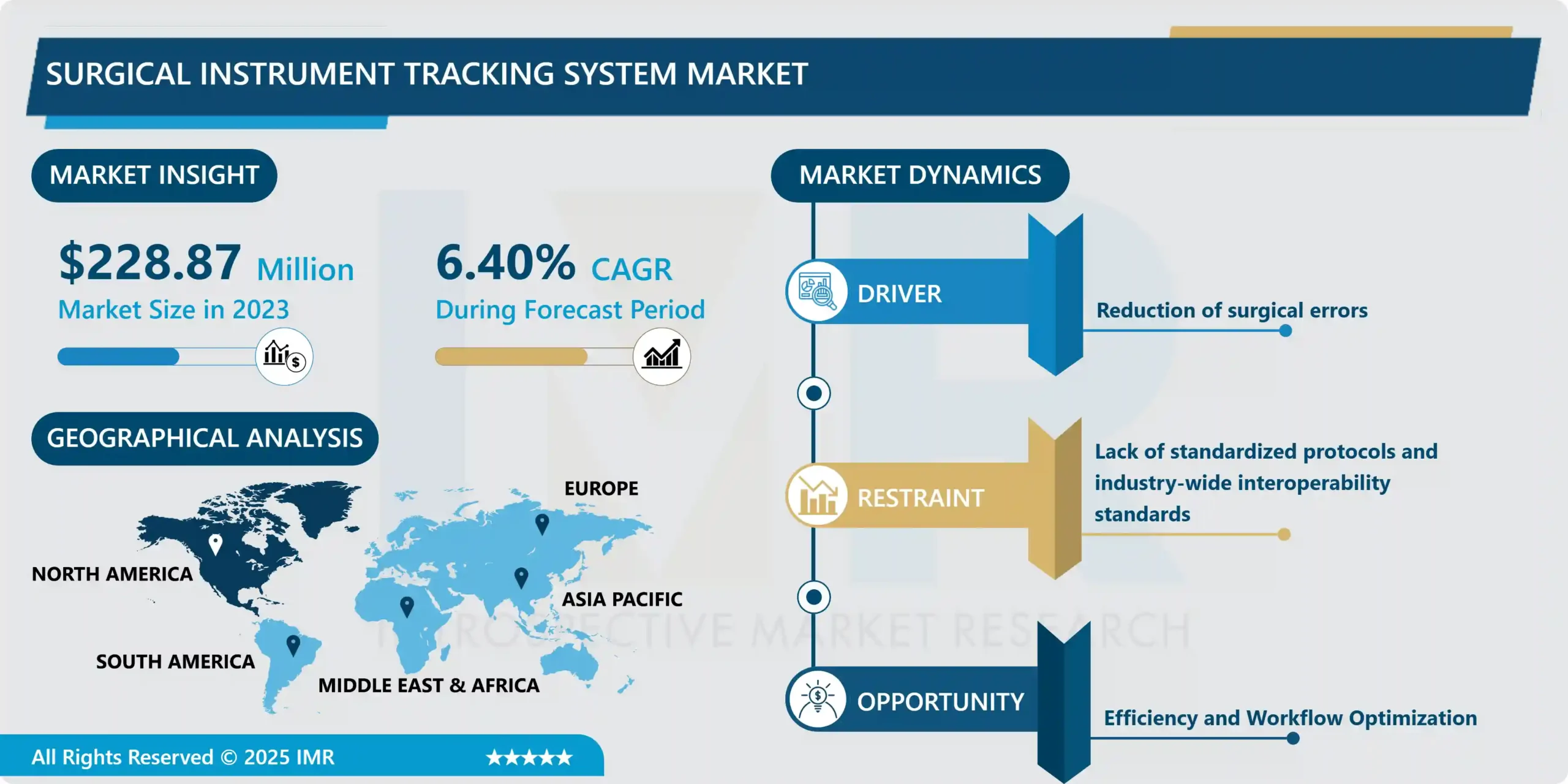
Surgical Instrument Tracking System Market Size Was Valued at USD 228.87 Million in 2023, and is Projected to Reach USD 400.01 Million by 2032, Growing at a CAGR of 6.40% From 2024-2032.
Surgical Instrument Tracking System is a digital solution used in healthcare facilities to monitor and manage the usage, location, and sterilization status of surgical instruments throughout their lifecycle. These systems typically utilize RFID (Radio Frequency Identification) or barcoding technology to track instruments, improve inventory management, enhance patient safety, and streamline surgical workflows. They help hospitals ensure that instruments are properly sterilized, readily available when needed, and efficiently utilized, ultimately contributing to better patient outcomes and operational efficiency.
Surgical Instrument Tracking Systems (SITS) are software solutions that track and manage surgical instruments throughout their lifecycle within a healthcare facility. They enable efficient inventory management by tracking location, usage history, and maintenance status in real-time, preventing loss or misplacement. SITS also optimizes instrument utilization by monitoring usage patterns, reducing unnecessary purchases and minimizing equipment redundancy. It also tracks sterilization history, ensuring instruments are properly sterilized before each use, reducing the risk of surgical site infections and patient safety.
Surgical Instrument Tracking Systems also schedules and tracks routine maintenance tasks, extending instrument lifespan and minimizing downtime. It also provides compliance and regulatory reporting capabilities, demonstrating adherence to industry regulations and guidelines. SITS enhances patient safety and risk management by ensuring the availability of properly sterilized and maintained instruments. It also streamlines workflow associated with surgical instrument management, improving operational efficiency and productivity. Overall, SITS provides real-time visibility and control over surgical instrument assets, ensuring quality patient care, operational excellence, and regulatory compliance.
Surgical instrument tracking systems are crucial for healthcare facilities to ensure proper sterilization and tracking of surgical instruments, reducing the risk of adverse outcomes. SITS helps healthcare facilities comply with strict sterilization protocols and streamline processes, such as inventory management and sterilization cycle monitoring. They also help reduce costs by reducing instrument loss, minimizing the need for instrument replacements, and optimizing inventory management.
Surgical instrument tracking systems also enhance patient experience by minimizing wait times, reducing procedure cancellations, and improving care quality. They also help mitigate risks associated with instrument mismanagement, such as cross-contamination, malfunctions, and surgical errors. By analyzing instrument utilization patterns and sterilization efficiency, SITS can identify opportunities for process improvement and enhance overall care quality. Overall, SITS contribute to a more efficient and effective surgical environment.
Surgical Instrument Tracking System Market Trend Analysis
Reduction of Surgical Errors
Surgical errors, including retained instruments, wrong-site surgery, and incorrect instrument usage, pose significant risks to patient safety. Implementing surgical instrument tracking systems can mitigate these risks by ensuring proper inventory management and tracking of instruments before, during, and after surgery. These systems also streamline surgical workflow by providing real-time visibility into the location and status of instruments, reducing time spent searching for equipment and minimizing disruptions during procedures.
Accurate tracking of surgical instruments can prevent complications like post-operative infections and injuries caused by inadvertently leaving instruments inside patients’ bodies. Regulatory compliance is also a key benefit of surgical instrument tracking systems, as they help healthcare facilities comply with regulatory requirements and accreditation standards related to surgical instrument management.
Cost reduction is another benefit, as surgical errors can result in additional surgeries, extended hospital stays, litigation, and reputational damage. Implementing surgical instrument tracking systems also enhances trust and reputation among patients, healthcare professionals, and the broader community. The reduction of surgical errors is a compelling driver of the Surgical Instrument Tracking System market.
Restraint
Lack of standardized protocols and industry-wide interoperability standards
Standardized protocols in surgical instrument tracking systems can lead to interoperability issues, limited data exchange, fragmented solutions, vendor lock-in, complex integration challenges, and compliance concerns. The lack of standardized protocols can cause proprietary technologies or data formats to be uncompatible, limiting data-sharing efficiency and potentially requiring manual entry. Healthcare facilities may invest in proprietary tracking solutions that are not interoperable, resulting in higher costs and redundant infrastructure.
Vendor lock-in can limit flexibility in future system upgrades. Complex integration challenges may arise in healthcare IT departments, requiring interface configuration, data security, and system reliability. Compliance concerns related to data privacy, security, and traceability may also impact the adoption of surgical instrument tracking systems in regulated healthcare environments.
Opportunity
Efficiency and Workflow Optimization
Surgical instrument tracking systems are a crucial tool in healthcare, providing real-time monitoring of instrument usage and location, reducing manual inventory management time and effort. These systems streamline sterilization processes by providing visibility into instrument usage history and sterilization status, ensuring instruments are properly sterilized and ready for use.
surgical instrument tracking systems also help prevent instrument loss and theft by assigning unique identifiers to each instrument and tracking their movement throughout the facility. These systems also enable healthcare facilities to analyze instrument usage data and identify opportunities for optimization, allowing for informed decisions to optimize resource allocation and operational efficiency.
surgical instrument tracking systems also streamline surgical workflows by providing healthcare staff with accurate information, reducing turnaround times, and improving patient care. surgical instrument tracking systems facilitate compliance with regulatory requirements and accreditation standards by automating documentation and record-keeping processes. This ensures compliance with industry regulations, mitigates risks and ensures patient safety.
Challenge
RFID Tagging Challenges
RFID tagging in the Surgical Instrument Tracking System market faces several challenges, including interference and signal loss due to metallic and electronic equipment in surgical environments, sterilization compatibility with common sterilization processes, tag durability and reliability, and tag size and placement. These issues can lead to signal loss or inaccuracies in instrument tracking.
Sterilization compatibility is crucial for RFID tags to withstand high temperatures, moisture, and chemical exposure without degradation or malfunction. Tag durability is essential for long-term tracking accuracy. Tag size and placement can pose challenges, especially for smaller or intricate instruments. Integration with existing systems, such as EHR or HIS, can be complex and require compatibility with diverse hardware and software platforms.
Cost and ROI considerations are important for healthcare facilities evaluating adoption. Data security and privacy concerns arise, particularly regarding the collection, storage, and transmission of sensitive information associated with tracked surgical instruments. Robust encryption, access controls, and data management protocols are essential for safeguarding patient data and complying with regulatory requirements.
Surgical Instrument Tracking System Market Segment Analysis:
Surgical Instrument Tracking System Market Segmented based on component, technology, and end-users.
By Component, Software segment is expected to dominate the market during the forecast period
Surgical instrument tracking software is a vital tool for healthcare facilities, enabling real-time tracking of instrument usage, location, maintenance history, and sterilization status. It streamlines manual processes, enhancing operational efficiency and minimizing the risk of misplaced or misused instruments.
The software offers real-time visibility and analytics, enabling data-driven decision-making and performance monitoring. It is customizable and scalable, allowing for the configuration of tracking parameters, alerts, and reports tailored to specific departments or regulatory requirements. It integrates seamlessly with existing systems, enabling data sharing and synchronization.
It also helps healthcare facilities comply with regulatory standards and accreditation requirements related to instrument traceability, sterilization monitoring, and patient safety. Moreover, it enhances patient safety by ensuring the availability of properly maintained, sterilized, and traceable surgical instruments, reducing the risk of surgical site infections and adverse events.
By Technology, Barcodes segment held the largest share of 55.4% in 2023
Barcoding technology is a cost-effective and easy-to-implement tracking method that is particularly beneficial for healthcare facilities, especially those with limited budgets. It is familiar and standardized, making it suitable for various industries, including inventory management and patient identification. Barcode technology offers scalability, allowing facilities to expand their tracking capabilities as needed.
It provides accurate and reliable identification of surgical instruments through unique barcode labels, ensuring proper inventory management and traceability. Barcoding technology also complies with regulatory requirements for tracking medical devices, such as surgical instruments.
It also offers interoperability with existing hospital systems and software applications, enhancing data exchange and information sharing across departments and stakeholders within the healthcare facility. Overall, barcoding technology is a popular choice for surgical instrument tracking due to its affordability, ease of implementation, and adherence to regulatory requirements.
Surgical Instrument Tracking System Market Regional Insights:
North America is Expected to Dominate the Market Over the Forecast period
North America’s advanced healthcare infrastructure, coupled with stringent regulatory standards, encourages the adoption of surgical instrument tracking systems to enhance patient safety, streamline operations, and improve efficiency. The high incidence of healthcare-associated infections (HAIs) in the region necessitates the use of these systems to monitor sterilization processes, track usage, and identify potential contamination sources.
Healthcare providers in North America prioritize patient safety and quality improvement, leading to the demand for innovative technologies like surgical instrument tracking systems. The region is a hub for technological innovation, with healthcare providers adopting advanced technologies like RFID, barcoding, and real-time tracking systems to optimize workflow efficiency, reduce costs, and improve patient care.
Leading manufacturers, vendors, and solution providers in the surgical instrument tracking system market drive market growth through product innovation, strategic partnerships, and customer-centric approaches. The reimbursement landscape in North America, particularly in the United States, incentivizes healthcare providers to invest in technologies that improve patient outcomes and operational efficiency.
Surgical Instrument Tracking System Market Top Key Players:
Censis Technologies (US)
Becton, Dickinson and Company (BD) (US)
Integra LifeSciences Corporation (US)
Microsystems (US)
Applied Logic (US)
Haldor (US)
Fortive Corporation (US)
STANLEY Healthcare (US)
Getinge Group (Sweden)
TGX Medical Systems (US)
STERIS Corporation (US)
Scanlan International (US)
Terso Solutions (US)
Intelligent InSites (US)
Infor (US)
SynMed (Canada)
Keir Surgical (Canada)
B. Braun Melsungen AG (Germany)
STERIS plc (UK)
SPAtrack Medical Limited (Ireland)
Haldor Advanced Technologies (Israel), and other major player
Key Industry Developments in the Surgical Instrument Tracking System Market:
In March 2023, Getinge announced the acquisition of Ultra Clean Systems Inc., a leading US manufacturer of ultrasonic cleaning technologies, used in hospitals and surgery centers to decontaminate surgical instruments. Ultrasonic cleaning is an integral part of best practices for reprocessing instruments, especially the most complex ones used for robotic surgery, to minimize the risk of hospital-acquired infections.
In August 2023, STERIS plc. announced that it had completed the previously announced acquisition of the surgical instrumentation, laparoscopic instrumentation, and sterilization container assets from Becton, Dickinson, and Company.
Chapter 1: Introduction
1.1 Scope and Coverage
Chapter 2:Executive Summary
Chapter 3: Market Landscape
3.1 Market Dynamics
3.1.1 Drivers
3.1.2 Restraints
3.1.3 Opportunities
3.1.4 Challenges
3.2 Market Trend Analysis
3.3 PESTLE Analysis
3.4 Porter’s Five Forces Analysis
3.5 Industry Value Chain Analysis
3.6 Ecosystem
3.7 Regulatory Landscape
3.8 Price Trend Analysis
3.9 Patent Analysis
3.10 Technology Evolution
3.11 Investment Pockets
3.12 Import-Export Analysis
Chapter 4: Surgical Instrument Tracking Systems Market by Component (2018-2032)
4.1 Surgical Instrument Tracking Systems Market Snapshot and Growth Engine
4.2 Market Overview
4.3 Hardware
4.3.1 Introduction and Market Overview
4.3.2 Historic and Forecasted Market Size in Value USD and Volume Units
4.3.3 Key Market Trends, Growth Factors, and Opportunities
4.3.4 Geographic Segmentation Analysis
4.4 Software
4.5 Services
Chapter 5: Surgical Instrument Tracking Systems Market by Technology (2018-2032)
5.1 Surgical Instrument Tracking Systems Market Snapshot and Growth Engine
5.2 Market Overview
5.3 Barcodes
5.3.1 Introduction and Market Overview
5.3.2 Historic and Forecasted Market Size in Value USD and Volume Units
5.3.3 Key Market Trends, Growth Factors, and Opportunities
5.3.4 Geographic Segmentation Analysis
5.4 RFID
Chapter 6: Surgical Instrument Tracking Systems Market by End-User (2018-2032)
6.1 Surgical Instrument Tracking Systems Market Snapshot and Growth Engine
6.2 Market Overview
6.3 Hospitals
6.3.1 Introduction and Market Overview
6.3.2 Historic and Forecasted Market Size in Value USD and Volume Units
6.3.3 Key Market Trends, Growth Factors, and Opportunities
6.3.4 Geographic Segmentation Analysis
6.4 Ambulatory Surgical Centers
Chapter 7: Company Profiles and Competitive Analysis
7.1 Competitive Landscape
7.1.1 Competitive Benchmarking
7.1.2 Surgical Instrument Tracking Systems Market Share by Manufacturer (2024)
7.1.3 Industry BCG Matrix
7.1.4 Heat Map Analysis
7.1.5 Mergers and Acquisitions
7.2 THERMO FISHER SCIENTIFIC (UNITED STATES)
7.2.1 Company Overview
7.2.2 Key Executives
7.2.3 Company Snapshot
7.2.4 Role of the Company in the Market
7.2.5 Sustainability and Social Responsibility
7.2.6 Operating Business Segments
7.2.7 Product Portfolio
7.2.8 Business Performance
7.2.9 Key Strategic Moves and Recent Developments
7.2.10 SWOT Analysis
7.3 PROMEGA CORPORATION (UNITED STATES)
7.4 AGILENT TECHNOLOGIES INC. (UNITED STATES)
7.5 NEW ENGLAND BIOLABS (UNITED STATES)
7.6 GENERAL ELECTRIC COMPANY (UNITED STATES)
7.7 ILLUMINA INC. (UNITED STATES)
7.8 SORENSON FORENSICS (UNITED STATES)
7.9 NMS LABS (UNITED STATES)
7.10 HAMILTON COMPANY (UNITED STATES)
7.11 PERKINELMER INC. (UNITED STATES)
7.12 BIO-RAD LABORATORIES INC. (UNITED STATES)
7.13 CIRO MANUFACTURING CORPORATION (UNITED STATES)
7.14 LGC LIMITED (UNITED KINGDOM)
7.15 QIAGEN (GERMANY)
7.16 EUROFINS SCIENTIFIC (LUXEMBOURG)
7.17 TEKAN TRADING AG (SWITZERLAND)
7.18 HITACHI HIGH-TECHNOLOGIES CORPORATION (JAPAN)
Chapter 8: Global Surgical Instrument Tracking Systems Market By Region
8.1 Overview
8.2. North America Surgical Instrument Tracking Systems Market
8.2.1 Key Market Trends, Growth Factors and Opportunities
8.2.2 Top Key Companies
8.2.3 Historic and Forecasted Market Size by Segments
8.2.4 Historic and Forecasted Market Size by Component
8.2.4.1 Hardware
8.2.4.2 Software
8.2.4.3 Services
8.2.5 Historic and Forecasted Market Size by Technology
8.2.5.1 Barcodes
8.2.5.2 RFID
8.2.6 Historic and Forecasted Market Size by End-User
8.2.6.1 Hospitals
8.2.6.2 Ambulatory Surgical Centers
8.2.7 Historic and Forecast Market Size by Country
8.2.7.1 US
8.2.7.2 Canada
8.2.7.3 Mexico
8.3. Eastern Europe Surgical Instrument Tracking Systems Market
8.3.1 Key Market Trends, Growth Factors and Opportunities
8.3.2 Top Key Companies
8.3.3 Historic and Forecasted Market Size by Segments
8.3.4 Historic and Forecasted Market Size by Component
8.3.4.1 Hardware
8.3.4.2 Software
8.3.4.3 Services
8.3.5 Historic and Forecasted Market Size by Technology
8.3.5.1 Barcodes
8.3.5.2 RFID
8.3.6 Historic and Forecasted Market Size by End-User
8.3.6.1 Hospitals
8.3.6.2 Ambulatory Surgical Centers
8.3.7 Historic and Forecast Market Size by Country
8.3.7.1 Russia
8.3.7.2 Bulgaria
8.3.7.3 The Czech Republic
8.3.7.4 Hungary
8.3.7.5 Poland
8.3.7.6 Romania
8.3.7.7 Rest of Eastern Europe
8.4. Western Europe Surgical Instrument Tracking Systems Market
8.4.1 Key Market Trends, Growth Factors and Opportunities
8.4.2 Top Key Companies
8.4.3 Historic and Forecasted Market Size by Segments
8.4.4 Historic and Forecasted Market Size by Component
8.4.4.1 Hardware
8.4.4.2 Software
8.4.4.3 Services
8.4.5 Historic and Forecasted Market Size by Technology
8.4.5.1 Barcodes
8.4.5.2 RFID
8.4.6 Historic and Forecasted Market Size by End-User
8.4.6.1 Hospitals
8.4.6.2 Ambulatory Surgical Centers
8.4.7 Historic and Forecast Market Size by Country
8.4.7.1 Germany
8.4.7.2 UK
8.4.7.3 France
8.4.7.4 The Netherlands
8.4.7.5 Italy
8.4.7.6 Spain
8.4.7.7 Rest of Western Europe
8.5. Asia Pacific Surgical Instrument Tracking Systems Market
8.5.1 Key Market Trends, Growth Factors and Opportunities
8.5.2 Top Key Companies
8.5.3 Historic and Forecasted Market Size by Segments
8.5.4 Historic and Forecasted Market Size by Component
8.5.4.1 Hardware
8.5.4.2 Software
8.5.4.3 Services
8.5.5 Historic and Forecasted Market Size by Technology
8.5.5.1 Barcodes
8.5.5.2 RFID
8.5.6 Historic and Forecasted Market Size by End-User
8.5.6.1 Hospitals
8.5.6.2 Ambulatory Surgical Centers
8.5.7 Historic and Forecast Market Size by Country
8.5.7.1 China
8.5.7.2 India
8.5.7.3 Japan
8.5.7.4 South Korea
8.5.7.5 Malaysia
8.5.7.6 Thailand
8.5.7.7 Vietnam
8.5.7.8 The Philippines
8.5.7.9 Australia
8.5.7.10 New Zealand
8.5.7.11 Rest of APAC
8.6. Middle East & Africa Surgical Instrument Tracking Systems Market
8.6.1 Key Market Trends, Growth Factors and Opportunities
8.6.2 Top Key Companies
8.6.3 Historic and Forecasted Market Size by Segments
8.6.4 Historic and Forecasted Market Size by Component
8.6.4.1 Hardware
8.6.4.2 Software
8.6.4.3 Services
8.6.5 Historic and Forecasted Market Size by Technology
8.6.5.1 Barcodes
8.6.5.2 RFID
8.6.6 Historic and Forecasted Market Size by End-User
8.6.6.1 Hospitals
8.6.6.2 Ambulatory Surgical Centers
8.6.7 Historic and Forecast Market Size by Country
8.6.7.1 Turkiye
8.6.7.2 Bahrain
8.6.7.3 Kuwait
8.6.7.4 Saudi Arabia
8.6.7.5 Qatar
8.6.7.6 UAE
8.6.7.7 Israel
8.6.7.8 South Africa
8.7. South America Surgical Instrument Tracking Systems Market
8.7.1 Key Market Trends, Growth Factors and Opportunities
8.7.2 Top Key Companies
8.7.3 Historic and Forecasted Market Size by Segments
8.7.4 Historic and Forecasted Market Size by Component
8.7.4.1 Hardware
8.7.4.2 Software
8.7.4.3 Services
8.7.5 Historic and Forecasted Market Size by Technology
8.7.5.1 Barcodes
8.7.5.2 RFID
8.7.6 Historic and Forecasted Market Size by End-User
8.7.6.1 Hospitals
8.7.6.2 Ambulatory Surgical Centers
8.7.7 Historic and Forecast Market Size by Country
8.7.7.1 Brazil
8.7.7.2 Argentina
8.7.7.3 Rest of SA
Chapter 9 Analyst Viewpoint and Conclusion
9.1 Recommendations and Concluding Analysis
9.2 Potential Market Strategies
Chapter 10 Research Methodology
10.1 Research Process
10.2 Primary Research
10.3 Secondary Research
Q1: What would be the forecast period in the Surgical Instrument Tracking System Market research report?
A1: The forecast period in the Surgical Instrument Tracking System Market research report is 2024-2032.
Q2: Who are the key players in the Surgical Instrument Tracking System Market?
A2: Censis Technologies (US), Becton, Dickinson, and Company (BD) (US), Integra LifeSciences Corporation (US), Materials Management Microsystems (US), Microsystems (US), Applied Logic (US), Haldor (US), Fortive Corporation (US), STANLEY Healthcare (US), Getinge Group (Sweden), TGX Medical Systems (US), STERIS Corporation (US), Scanlan International (US), Terso Solutions (US), Intelligent InSites (US), Infor (US), SynMed (Canada), Keir Surgical (Canada), B. Braun Melsungen AG (Germany), STERIS plc (UK), SPAtrack Medical Limited (Ireland), Haldor Advanced Technologies (Israel) and Other Major Players.
Q3: What are the segments of the Surgical Instrument Tracking System Market?
A3: The Surgical Instrument Tracking System Market is segmented into Component, Technology and End-User, and region. By Component, the market is categorized into Hardware, Software, and Services. By Technology, the market is categorized into Barcodes and RFID. By End-User, the market is categorized into Hospitals and ambulatory Surgical Centers. By region, it is analyzed across North America (U.S.; Canada; Mexico), Eastern Europe (Bulgaria; The Czech Republic; Hungary; Poland; Romania; Rest of Eastern Europe), Western Europe (Germany; UK; France; Netherlands; Italy; Russia; Spain; Rest of Western Europe), Asia-Pacific (China; India; Japan; Southeast Asia, etc.), South America (Brazil; Argentina, etc.), Middle East & Africa (Saudi Arabia; South Africa, etc.).
Q4: What is the Surgical Instrument Tracking System Market?
A4: The surgical instrument tracking system market refers to the global market for software and hardware solutions designed to track and manage surgical instruments throughout their lifecycle. These systems utilize technologies such as RFID, barcoding, and real-time location tracking to improve inventory management, enhance patient safety, streamline surgical workflows, and ensure compliance with regulatory requirements in healthcare settings.
Q5: How big is the Surgical Instrument Tracking System Market?
A5: Surgical Instrument Tracking System Market Size Was Valued at USD 228.87 Million in 2023, and is Projected to Reach USD 400.01 Million by 2032, Growing at a CAGR of 6.4% From 2024-2032.
How to Buy a Report from eminsights.jp
On the product page, choose the license you want: Single-User License, Multi-User License or Enterprise License.
If you required report in your native language, then you can click on Translated Report button and fill out the form with report name and language you want, then our team will contact you as soon as possible.
Click the Buy Now button.
You will be redirected to the checkout page. Enter your company details and payment information.
Click Place Order to complete the purchase.
Confirmation: You’ll receive an order confirmation and our team will contact you shortly with your ordered report.
If you have any questions, fill out the contact form below or email us at bizdev@eminsights.net.
Thank you for choosing eminsights.jp!