Stay Ahead in Fast-Growing Economies.
Browse Reports Now
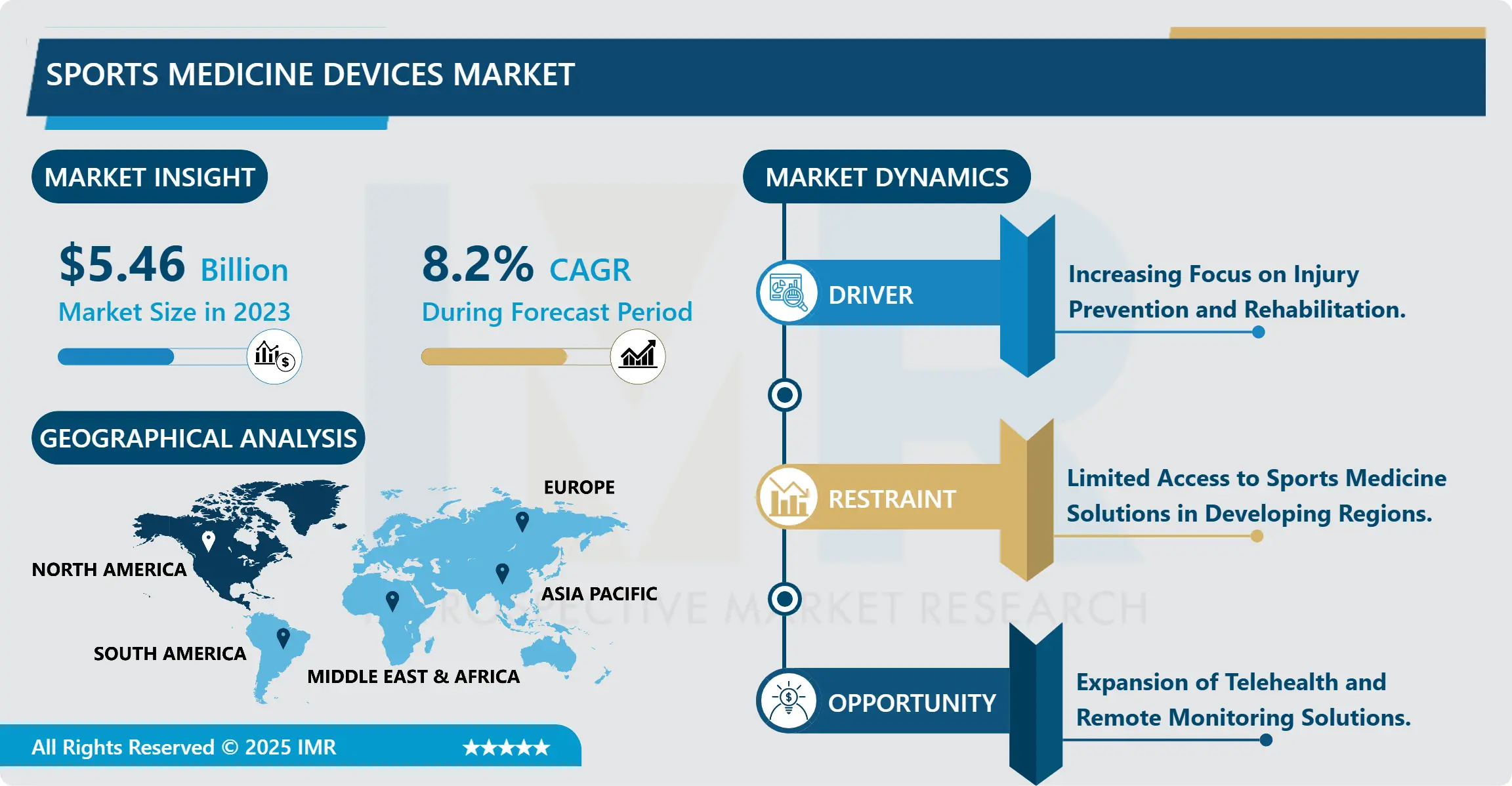
Sports Medicine Devices Market – Current Analysis by Market Share
The Sports Medicine Devices Market refers to a wide variety of products and systems that are used for curative, diagnosing and preventive purposes of injuries commonly related to sporting activities.

IMR Group
Description
Sports Medicine Devices Market Synopsis:
Sports Medicine Devices Market Size Was Valued at USD 5.46 Billion in 2023, and is Projected to Reach USD 11.09 Billion by 2032, Growing at a CAGR of 8.20% From 2024-2032.
The Sports Medicine Devices Market refers to a wide variety of products and systems that are used for curative, diagnosing and preventive purposes of injuries commonly related to sporting activities. This market consists of braces and supports, surgical devices and instruments, monitoring equipment’s, and rehabilitation apparatus. The main purpose of such tools is to optimize athletic activity, restore strength and prevent injuries, as well as promote general well-being of the human body. Sports are getting more popular in the global market and this increased popularity has led to rise in the number of specific health problems requiring medical attention in field of sports medicine.
The key driver to the growth of the Sports Medicine Devices Market is the increasing trend in sports and physical activities among young people and adults. Thus, with the steady growth of the knowledge of health and fitness among the population, more people are participating in sports and physic a list activity and consequently more participants sustain sports injuries. This trend requires health care providers to use effective and state of the art medical devices in managing these injuries and enhancing the rates of healing. Moreover, physical fitness and well-being with general and professional competitive athletes also leading to higher utilization of sports medicine solutions.
Advancements in the sports medicine devices is another factor that aids in the growth to the market. New technology and techniques in Personal Health Monitoring for sportsmen include the monitoring devices, smart braces for sportsmen, and minimally invasive surgical tools for treatment of athletes’ injuries. Beside boosting patients’ quality of care, these technologies provide athletes with more data and better information in their training and wellness. Since these devices are likely to grow more advanced and easier to use, athletes, and especially healthcare providers, will be more likely to use such devices.
Sports Medicine Devices Market Trend Analysis
The increasing integration of digital health technologies.
The growing digitalization of the healthcare sector is a significant trend in the Sports Medicine Devices Market. Smart clothing, equipped with sensors and connectivity, allows athletes to monitor their physiological data and performance in real-time. This data provides valuable insights that can enhance training programs, improve performance, and help prevent injuries. As athletes increasingly embrace technology to optimize their training and recovery, the demand for connected devices is expected to rise. In addition, regenerative medicine is emerging as a key development, with therapies like PRP (Platelet-Rich Plasma) and stem cell treatments gaining traction. These non-surgical methods promote tissue repair and recovery at the cellular level, offering faster and more effective solutions than traditional treatments. As regenerative medicine continues to evolve, it will play a larger role in the sports medicine landscape, expanding the variety and number of devices and therapies available, further shaping the future of athletic care and rehabilitation.
Increased Focus on Injury Prevention.
The challenge of making and marketing technology within the sports medicine devices market lies in the growing numbers of young athletes and casual fitness enthusiasts. Since youth sports developmental is increasing around the world and children are getting more involved into organized sports activities, protective gear and recovery accessories needs are increasing as well. This segment is also neglected in most cases and therefore is a good niche whereby companies can come up with equipment which are tailored to suit the young athletes hence improving and reducing on their chances of getting injured.
One such opportunity is what has to do with the increased focus on celebrating athletes and sports organizations on how they can prevent themselves from getting injured. As the magnitude of the secondary effects of sports injuries becomes clear, athletes, whether professional or novice, are beginning to look for ways to address these problems before they happen. Those organisations that will invent and sell protective equipment and training apparatuses that will work towards reducing injuries on the field stand to benefit from this factor and dominate the market.
Sports Medicine Devices Market Segment Analysis:
Sports Medicine Devices Market Segmented on the basis of Product type, application, end user and region.
By Product Type, Braces and Supports segment is expected to dominate the market during the forecast period
The Braces and Supports segment are expected to dominate the sports medicine market during the forecast period. Braces and supports are essential for stabilizing and protecting injured joints and muscles, enabling athletes to perform optimally during recovery. These devices provide critical support for common sports injuries, helping maintain mobility while preventing further damage. While surgical equipment and monitoring devices also play significant roles in treating athletes, braces and supports remain the most widely used product. The growing demand for injury prevention and rehabilitation, particularly in high-impact sports, continues to drive the dominance of this segment.
By Application, Knee Injuries segment expected to held the largest share
The Knee Injuries segment is expected to hold the largest share of the sports medicine devices market. Knee injuries, especially ligament ruptures and cartilage loss, are among the most common sports injuries, driving demand for specialized devices such as braces and surgical instruments. These devices help stabilize and support the knee during treatment and rehabilitation. While shoulder, ankle, and elbow injuries also require specific devices like slings and braces, knee injuries remain the most prevalent, fueling the largest share in the market. The rising incidence of knee-related sports injuries continues to drive growth in this segment.
Sports Medicine Devices Market Regional Insights:
North America is Expected to Dominate the Market Over the Forecast period
North America has been identified as the largest market in the current Sports Medicine Devices Market. This domination can be explained by high sport activity, highly developed health care, and large investments in sports medicine industry. The global systems market is already advanced in the United States, where there is a large number of athletes and focus on health and fitness. Furthermore, competition and innovations from the global manufacturer and key players boosting further make North America as the leading region.
The increased use of technologically enhanced sports medicine device also shifted North American market. Integrated digital health technologies that use remote devices, health wearables, and telemedicine concepts appear to be most popular in this area. These innovations are accepted slowly by athletes and healthcare providers and as awareness escalates the need for sports medicine devices is set to rise. This trend not only helps in developing the market needs but also best in class care provided to athletes which in turn forces North America to remain the global epicentre for the market in sports medicine.
Active Key Players in the Sports Medicine Devices Market
Arthrex, Inc. (United States)
Breg, Inc. (United States)
Conmed Corporation (United States)
DJO Global (United States)
Johnson & Johnson (United States)
Medtronic (United States)
Ottobock (Germany)
Smith & Nephew (United Kingdom)
Stryker Corporation (United States)
Zimmer Biomet (United States)
Other Active Players
Chapter 1: Introduction
1.1 Scope and Coverage
Chapter 2:Executive Summary
Chapter 3: Market Landscape
3.1 Market Dynamics
3.1.1 Drivers
3.1.2 Restraints
3.1.3 Opportunities
3.1.4 Challenges
3.2 Market Trend Analysis
3.3 PESTLE Analysis
3.4 Porter’s Five Forces Analysis
3.5 Industry Value Chain Analysis
3.6 Ecosystem
3.7 Regulatory Landscape
3.8 Price Trend Analysis
3.9 Patent Analysis
3.10 Technology Evolution
3.11 Investment Pockets
3.12 Import-Export Analysis
Chapter 4: Sports Medicine Devices Market by Product Type
4.1 Sports Medicine Devices Market Snapshot and Growth Engine
4.2 Sports Medicine Devices Market Overview
4.3 Braces and Supports
4.3.1 Introduction and Market Overview
4.3.2 Historic and Forecasted Market Size in Value USD and Volume Units (2017-2032F)
4.3.3 Key Market Trends, Growth Factors and Opportunities
4.3.4 Braces and Supports: Geographic Segmentation Analysis
4.4 Surgical Devices
4.4.1 Introduction and Market Overview
4.4.2 Historic and Forecasted Market Size in Value USD and Volume Units (2017-2032F)
4.4.3 Key Market Trends, Growth Factors and Opportunities
4.4.4 Surgical Devices: Geographic Segmentation Analysis
4.5 Monitoring Devices
4.5.1 Introduction and Market Overview
4.5.2 Historic and Forecasted Market Size in Value USD and Volume Units (2017-2032F)
4.5.3 Key Market Trends, Growth Factors and Opportunities
4.5.4 Monitoring Devices: Geographic Segmentation Analysis
4.6 Rehabilitation Equipment
4.6.1 Introduction and Market Overview
4.6.2 Historic and Forecasted Market Size in Value USD and Volume Units (2017-2032F)
4.6.3 Key Market Trends, Growth Factors and Opportunities
4.6.4 Rehabilitation Equipment: Geographic Segmentation Analysis
4.7 Other Devices)
4.7.1 Introduction and Market Overview
4.7.2 Historic and Forecasted Market Size in Value USD and Volume Units (2017-2032F)
4.7.3 Key Market Trends, Growth Factors and Opportunities
4.7.4 Other Devices): Geographic Segmentation Analysis
4.8
4.8.1 Introduction and Market Overview
4.8.2 Historic and Forecasted Market Size in Value USD and Volume Units (2017-2032F)
4.8.3 Key Market Trends, Growth Factors and Opportunities
4.8.4 : Geographic Segmentation Analysis
Chapter 5: Sports Medicine Devices Market by Application
5.1 Sports Medicine Devices Market Snapshot and Growth Engine
5.2 Sports Medicine Devices Market Overview
5.3 Knee Injuries
5.3.1 Introduction and Market Overview
5.3.2 Historic and Forecasted Market Size in Value USD and Volume Units (2017-2032F)
5.3.3 Key Market Trends, Growth Factors and Opportunities
5.3.4 Knee Injuries: Geographic Segmentation Analysis
5.4 Shoulder Injuries
5.4.1 Introduction and Market Overview
5.4.2 Historic and Forecasted Market Size in Value USD and Volume Units (2017-2032F)
5.4.3 Key Market Trends, Growth Factors and Opportunities
5.4.4 Shoulder Injuries: Geographic Segmentation Analysis
5.5 Ankle Injuries
5.5.1 Introduction and Market Overview
5.5.2 Historic and Forecasted Market Size in Value USD and Volume Units (2017-2032F)
5.5.3 Key Market Trends, Growth Factors and Opportunities
5.5.4 Ankle Injuries: Geographic Segmentation Analysis
5.6 Elbow Injuries
5.6.1 Introduction and Market Overview
5.6.2 Historic and Forecasted Market Size in Value USD and Volume Units (2017-2032F)
5.6.3 Key Market Trends, Growth Factors and Opportunities
5.6.4 Elbow Injuries: Geographic Segmentation Analysis
5.7 Other Injuries)
5.7.1 Introduction and Market Overview
5.7.2 Historic and Forecasted Market Size in Value USD and Volume Units (2017-2032F)
5.7.3 Key Market Trends, Growth Factors and Opportunities
5.7.4 Other Injuries): Geographic Segmentation Analysis
5.8
5.8.1 Introduction and Market Overview
5.8.2 Historic and Forecasted Market Size in Value USD and Volume Units (2017-2032F)
5.8.3 Key Market Trends, Growth Factors and Opportunities
5.8.4 : Geographic Segmentation Analysis
Chapter 6: Sports Medicine Devices Market by End User
6.1 Sports Medicine Devices Market Snapshot and Growth Engine
6.2 Sports Medicine Devices Market Overview
6.3 Hospitals
6.3.1 Introduction and Market Overview
6.3.2 Historic and Forecasted Market Size in Value USD and Volume Units (2017-2032F)
6.3.3 Key Market Trends, Growth Factors and Opportunities
6.3.4 Hospitals: Geographic Segmentation Analysis
6.4 Clinics
6.4.1 Introduction and Market Overview
6.4.2 Historic and Forecasted Market Size in Value USD and Volume Units (2017-2032F)
6.4.3 Key Market Trends, Growth Factors and Opportunities
6.4.4 Clinics: Geographic Segmentation Analysis
6.5 Home Healthcare
6.5.1 Introduction and Market Overview
6.5.2 Historic and Forecasted Market Size in Value USD and Volume Units (2017-2032F)
6.5.3 Key Market Trends, Growth Factors and Opportunities
6.5.4 Home Healthcare: Geographic Segmentation Analysis
6.6 Sports Academies)
6.6.1 Introduction and Market Overview
6.6.2 Historic and Forecasted Market Size in Value USD and Volume Units (2017-2032F)
6.6.3 Key Market Trends, Growth Factors and Opportunities
6.6.4 Sports Academies) : Geographic Segmentation Analysis
Chapter 7: Company Profiles and Competitive Analysis
7.1 Competitive Landscape
7.1.1 Competitive Benchmarking
7.1.2 Sports Medicine Devices Market Share by Manufacturer (2023)
7.1.3 Industry BCG Matrix
7.1.4 Heat Map Analysis
7.1.5 Mergers and Acquisitions
7.2 MEDTRONIC (UNITED STATES)
7.2.1 Company Overview
7.2.2 Key Executives
7.2.3 Company Snapshot
7.2.4 Role of the Company in the Market
7.2.5 Sustainability and Social Responsibility
7.2.6 Operating Business Segments
7.2.7 Product Portfolio
7.2.8 Business Performance
7.2.9 Key Strategic Moves and Recent Developments
7.2.10 SWOT Analysis
7.3 JOHNSON & JOHNSON (UNITED STATES)
7.4 STRYKER CORPORATION (UNITED STATES)
7.5 SMITH & NEPHEW (UNITED KINGDOM)
7.6 BREG INC. (UNITED STATES)
7.7 DJO GLOBAL (UNITED STATES)
7.8 ARTHREX INC. (UNITED STATES)
7.9 OTTOBOCK (GERMANY)
7.10 CONMED CORPORATION (UNITED STATES)
7.11 ZIMMER BIOMET (UNITED STATES)
7.12 OTHER ACTIVE PLAYERS
Chapter 8: Global Sports Medicine Devices Market By Region
8.1 Overview
8.2. North America Sports Medicine Devices Market
8.2.1 Key Market Trends, Growth Factors and Opportunities
8.2.2 Top Key Companies
8.2.3 Historic and Forecasted Market Size by Segments
8.2.4 Historic and Forecasted Market Size By Product Type
8.2.4.1 Braces and Supports
8.2.4.2 Surgical Devices
8.2.4.3 Monitoring Devices
8.2.4.4 Rehabilitation Equipment
8.2.4.5 Other Devices)
8.2.4.6
8.2.5 Historic and Forecasted Market Size By Application
8.2.5.1 Knee Injuries
8.2.5.2 Shoulder Injuries
8.2.5.3 Ankle Injuries
8.2.5.4 Elbow Injuries
8.2.5.5 Other Injuries)
8.2.5.6
8.2.6 Historic and Forecasted Market Size By End User
8.2.6.1 Hospitals
8.2.6.2 Clinics
8.2.6.3 Home Healthcare
8.2.6.4 Sports Academies)
8.2.7 Historic and Forecast Market Size by Country
8.2.7.1 US
8.2.7.2 Canada
8.2.7.3 Mexico
8.3. Eastern Europe Sports Medicine Devices Market
8.3.1 Key Market Trends, Growth Factors and Opportunities
8.3.2 Top Key Companies
8.3.3 Historic and Forecasted Market Size by Segments
8.3.4 Historic and Forecasted Market Size By Product Type
8.3.4.1 Braces and Supports
8.3.4.2 Surgical Devices
8.3.4.3 Monitoring Devices
8.3.4.4 Rehabilitation Equipment
8.3.4.5 Other Devices)
8.3.4.6
8.3.5 Historic and Forecasted Market Size By Application
8.3.5.1 Knee Injuries
8.3.5.2 Shoulder Injuries
8.3.5.3 Ankle Injuries
8.3.5.4 Elbow Injuries
8.3.5.5 Other Injuries)
8.3.5.6
8.3.6 Historic and Forecasted Market Size By End User
8.3.6.1 Hospitals
8.3.6.2 Clinics
8.3.6.3 Home Healthcare
8.3.6.4 Sports Academies)
8.3.7 Historic and Forecast Market Size by Country
8.3.7.1 Russia
8.3.7.2 Bulgaria
8.3.7.3 The Czech Republic
8.3.7.4 Hungary
8.3.7.5 Poland
8.3.7.6 Romania
8.3.7.7 Rest of Eastern Europe
8.4. Western Europe Sports Medicine Devices Market
8.4.1 Key Market Trends, Growth Factors and Opportunities
8.4.2 Top Key Companies
8.4.3 Historic and Forecasted Market Size by Segments
8.4.4 Historic and Forecasted Market Size By Product Type
8.4.4.1 Braces and Supports
8.4.4.2 Surgical Devices
8.4.4.3 Monitoring Devices
8.4.4.4 Rehabilitation Equipment
8.4.4.5 Other Devices)
8.4.4.6
8.4.5 Historic and Forecasted Market Size By Application
8.4.5.1 Knee Injuries
8.4.5.2 Shoulder Injuries
8.4.5.3 Ankle Injuries
8.4.5.4 Elbow Injuries
8.4.5.5 Other Injuries)
8.4.5.6
8.4.6 Historic and Forecasted Market Size By End User
8.4.6.1 Hospitals
8.4.6.2 Clinics
8.4.6.3 Home Healthcare
8.4.6.4 Sports Academies)
8.4.7 Historic and Forecast Market Size by Country
8.4.7.1 Germany
8.4.7.2 UK
8.4.7.3 France
8.4.7.4 The Netherlands
8.4.7.5 Italy
8.4.7.6 Spain
8.4.7.7 Rest of Western Europe
8.5. Asia Pacific Sports Medicine Devices Market
8.5.1 Key Market Trends, Growth Factors and Opportunities
8.5.2 Top Key Companies
8.5.3 Historic and Forecasted Market Size by Segments
8.5.4 Historic and Forecasted Market Size By Product Type
8.5.4.1 Braces and Supports
8.5.4.2 Surgical Devices
8.5.4.3 Monitoring Devices
8.5.4.4 Rehabilitation Equipment
8.5.4.5 Other Devices)
8.5.4.6
8.5.5 Historic and Forecasted Market Size By Application
8.5.5.1 Knee Injuries
8.5.5.2 Shoulder Injuries
8.5.5.3 Ankle Injuries
8.5.5.4 Elbow Injuries
8.5.5.5 Other Injuries)
8.5.5.6
8.5.6 Historic and Forecasted Market Size By End User
8.5.6.1 Hospitals
8.5.6.2 Clinics
8.5.6.3 Home Healthcare
8.5.6.4 Sports Academies)
8.5.7 Historic and Forecast Market Size by Country
8.5.7.1 China
8.5.7.2 India
8.5.7.3 Japan
8.5.7.4 South Korea
8.5.7.5 Malaysia
8.5.7.6 Thailand
8.5.7.7 Vietnam
8.5.7.8 The Philippines
8.5.7.9 Australia
8.5.7.10 New Zealand
8.5.7.11 Rest of APAC
8.6. Middle East & Africa Sports Medicine Devices Market
8.6.1 Key Market Trends, Growth Factors and Opportunities
8.6.2 Top Key Companies
8.6.3 Historic and Forecasted Market Size by Segments
8.6.4 Historic and Forecasted Market Size By Product Type
8.6.4.1 Braces and Supports
8.6.4.2 Surgical Devices
8.6.4.3 Monitoring Devices
8.6.4.4 Rehabilitation Equipment
8.6.4.5 Other Devices)
8.6.4.6
8.6.5 Historic and Forecasted Market Size By Application
8.6.5.1 Knee Injuries
8.6.5.2 Shoulder Injuries
8.6.5.3 Ankle Injuries
8.6.5.4 Elbow Injuries
8.6.5.5 Other Injuries)
8.6.5.6
8.6.6 Historic and Forecasted Market Size By End User
8.6.6.1 Hospitals
8.6.6.2 Clinics
8.6.6.3 Home Healthcare
8.6.6.4 Sports Academies)
8.6.7 Historic and Forecast Market Size by Country
8.6.7.1 Turkiye
8.6.7.2 Bahrain
8.6.7.3 Kuwait
8.6.7.4 Saudi Arabia
8.6.7.5 Qatar
8.6.7.6 UAE
8.6.7.7 Israel
8.6.7.8 South Africa
8.7. South America Sports Medicine Devices Market
8.7.1 Key Market Trends, Growth Factors and Opportunities
8.7.2 Top Key Companies
8.7.3 Historic and Forecasted Market Size by Segments
8.7.4 Historic and Forecasted Market Size By Product Type
8.7.4.1 Braces and Supports
8.7.4.2 Surgical Devices
8.7.4.3 Monitoring Devices
8.7.4.4 Rehabilitation Equipment
8.7.4.5 Other Devices)
8.7.4.6
8.7.5 Historic and Forecasted Market Size By Application
8.7.5.1 Knee Injuries
8.7.5.2 Shoulder Injuries
8.7.5.3 Ankle Injuries
8.7.5.4 Elbow Injuries
8.7.5.5 Other Injuries)
8.7.5.6
8.7.6 Historic and Forecasted Market Size By End User
8.7.6.1 Hospitals
8.7.6.2 Clinics
8.7.6.3 Home Healthcare
8.7.6.4 Sports Academies)
8.7.7 Historic and Forecast Market Size by Country
8.7.7.1 Brazil
8.7.7.2 Argentina
8.7.7.3 Rest of SA
Chapter 9 Analyst Viewpoint and Conclusion
9.1 Recommendations and Concluding Analysis
9.2 Potential Market Strategies
Chapter 10 Research Methodology
10.1 Research Process
10.2 Primary Research
10.3 Secondary Research
Q1: What would be the forecast period in the Sports Medicine Devices Market research report?
A1: The forecast period in the Sports Medicine Devices Market research report is 2024-2032.
Q2: Who are the key players in the Sports Medicine Devices Market?
A2: Medtronic (United States), Johnson & Johnson (United States), Stryker Corporation (United States), Smith & Nephew (United Kingdom), Breg, Inc. (United States), DJO Global (United States), Arthrex, Inc. (United States), Ottobock (Germany), Conmed Corporation (United States), Zimmer Biomet (United States), and Other Active Players.
Q3: What are the segments of the Sports Medicine Devices Market?
A3: The Sports Medicine Devices Market is segmented into by Product Type, the market is categorized into Braces and Supports, Surgical Devices, Monitoring Devices, Rehabilitation Equipment, Other Devices. By Application, the market is categorized into Knee Injuries, Shoulder Injuries, Ankle Injuries, Elbow Injuries, Other Injuries. By End User the market is categorized into Hospitals, Clinics, Home Healthcare, Sports Academies. By region, it is analyzed across North America (U.S.; Canada; Mexico), Eastern Europe (Russia; Bulgaria; The Czech Republic; Hungary; Poland; Romania; Rest of Eastern Europe), Western Europe (Germany; UK; France; Netherlands; Italy; Spain; Rest of Western Europe), Asia-Pacific (China; India; Japan; Southeast Asia, etc.), South America (Brazil; Argentina, etc.), Middle East & Africa (Saudi Arabia; South Africa, etc.).
Q4: What is the Sports Medicine Devices Market?
A4: The Sports Medicine Devices Market refers to a wide variety of products and systems that are used for curative, diagnosing and preventive purposes of injuries commonly related to sporting activities. This market consists of braces and supports, surgical devices and instruments, monitoring equipment’s, and rehabilitation apparatus.
Q5: How big is the Sports Medicine Devices Market?
A5: Sports Medicine Devices Market Size Was Valued at USD 5.46 Billion in 2023, and is Projected to Reach USD 11.09 Billion by 2032, Growing at a CAGR of 8.20% From 2024-2032.
How to Buy a Report from eminsights.jp
On the product page, choose the license you want: Single-User License, Multi-User License or Enterprise License.
If you required report in your native language, then you can click on Translated Report button and fill out the form with report name and language you want, then our team will contact you as soon as possible.
Click the Buy Now button.
You will be redirected to the checkout page. Enter your company details and payment information.
Click Place Order to complete the purchase.
Confirmation: You’ll receive an order confirmation and our team will contact you shortly with your ordered report.
If you have any questions, fill out the contact form below or email us at bizdev@eminsights.net.
Thank you for choosing eminsights.jp!