Stay Ahead in Fast-Growing Economies.
Browse Reports Now




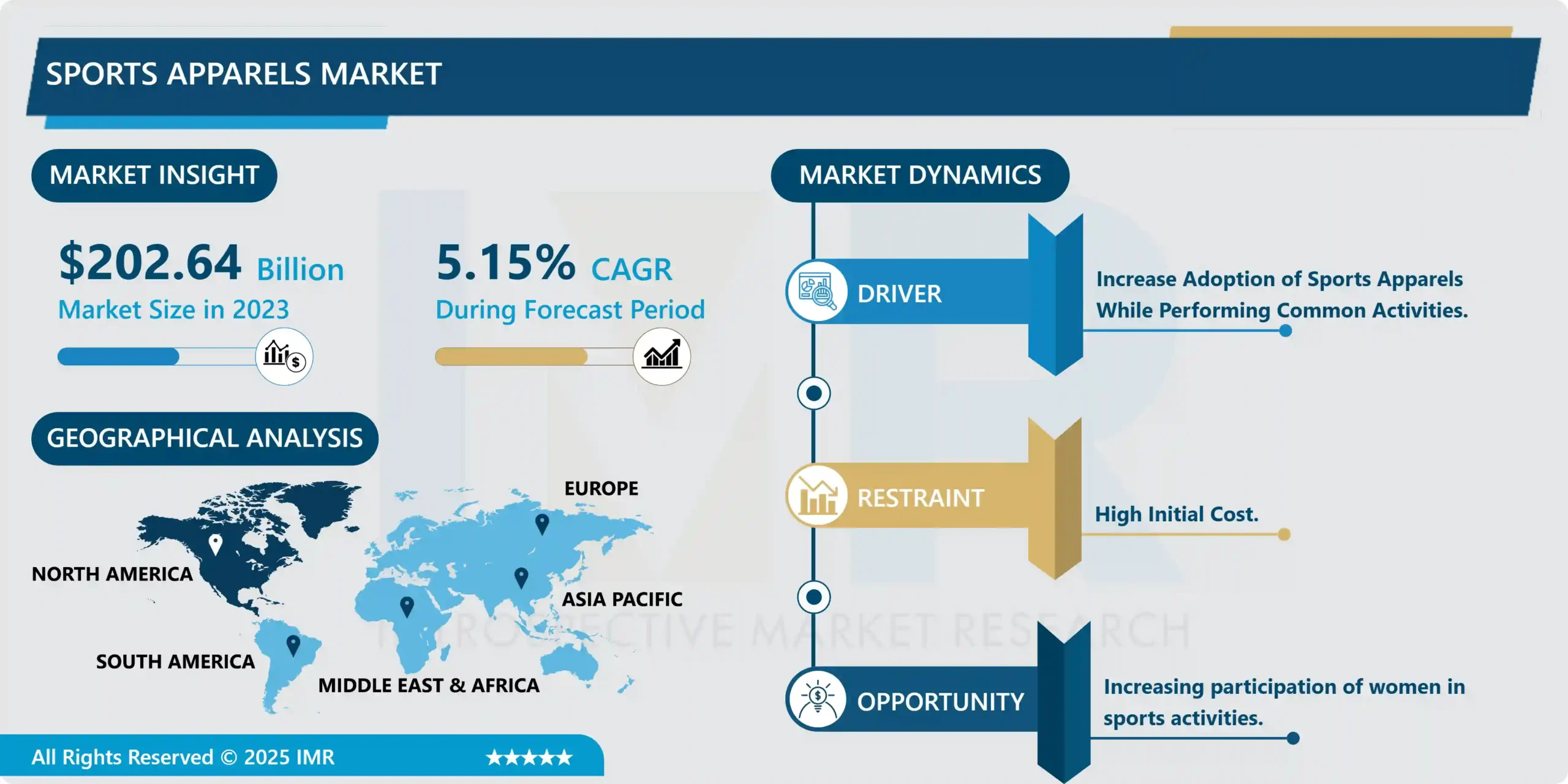
Sports Apparels Market Size, Share & Global Industry Analysis
Sports apparel is majorly used during physical or sporting activities like workouts and playing any sport. Sports apparel is designed in a way to provide comfort and flexibility while performing physical activities. Sports activities involve a lot of body movement that causes sweating to overcome form sweat sport apparel is manufactured by using breathable fabric that allows sweat to evaporate faster, helping the person to remain fresh for a long time.

IMR Group
Description
Global Sports Apparels Market Overview
The Global Sports Apparel Market size is expected to grow from USD 202.64 Billion in 2023 to USD 302.98 Billion by 2032, at a CAGR of 5.15% during the forecast period (2024-2032).
Sports apparel refers to clothing specifically designed for physical activity and sports performance. These garments are engineered to provide comfort, flexibility, and performance enhancement to athletes and sports enthusiasts during various activities. Sports apparel includes a wide range of clothing items such as jerseys, shorts, pants, jackets, socks, and shoes, each tailored to meet the specific demands of different sports and athletic pursuits. Materials used in sports apparel are often lightweight, breathable, moisture-wicking, and stretchable to optimize comfort and mobility while also offering support and durability.
There’s a growing health consciousness globally, with more people engaging in sports and fitness activities. This trend has led to an increased demand for specialized clothing that enhances performance and comfort during physical activities.
Furthermore, the rise of athleisure wear has blurred the lines between sportswear and casual wear, making sports apparel more versatile and appealing to a broader consumer base. Athleisure wear seamlessly transitions from the gym to daily activities, reflecting a more casual and active lifestyle embraced by many.
Furthermore, the rise of athleisure wear has blurred the lines between sportswear and casual wear, making sports apparel more versatile and appealing to a broader consumer base. Athleisure wear seamlessly transitions from the gym to daily activities, reflecting a more casual and active lifestyle embraced by many.
Market Dynamics And Factors For Sports Apparels Market
Trends:
Shift in Consumer Preference for Recreational Activities to Fuel Market Progress
One prominent factor driving this shift is the increasing emphasis on health and wellness among consumers. With growing awareness about the importance of staying active and maintaining a healthy lifestyle, more people are participating in various forms of recreational activities such as running, cycling, yoga, and hiking. As a result, there is a rising demand for sports apparel that offers comfort, functionality, and style, catering to the diverse needs of fitness enthusiasts.
Moreover, the rise of social media and digital platforms has played a pivotal role in shaping consumer preferences. Influencers and celebrities often showcase their active lifestyles on these platforms, inspiring their followers to adopt similar pursuits. This phenomenon has led to a surge in popularity for athleisure wear, which seamlessly blends performance-oriented features with fashionable designs, allowing individuals to transition effortlessly from the gym to other social settings.
Furthermore, the COVID-19 pandemic has accelerated the adoption of home-based fitness activities and outdoor recreational pursuits. With restrictions on indoor gatherings and gym closures, many people have turned to activities such as jogging, cycling, and outdoor workouts to maintain their physical and mental well-being. This shift has fueled demand for sports apparel that is versatile, weather-resistant, and suitable for various outdoor conditions.
Restraints:
High Initial Cost
The sports apparel market is projected to expand steadily by increasing awareness among people playing sports activities helps to maintain a healthy and fit body that increases the purchase rate of sports apparel. However, some factors, such as the high purchase cost of sports apples. The different brands provide sports appeals at different price ranges depending on the quality of the raw materials. Eventually, these products are not affordable for the low-income group population which is hampering the growth of the sports apparel market.
Opportunity:
Aggressive Advertisement and Celebrity Authorizations
Aggressive advertisements, characterized by bold messaging, captivating visuals, and strategic placement, serve as a powerful tool for brands to penetrate the market. These ads often employ high-energy tactics, showcasing the functionality, style, and performance of the apparel. Through aggressive marketing campaigns, brands can create a sense of urgency and desire among consumers, prompting them to make immediate purchasing decisions. Moreover, aggressive advertisements help in brand recall and recognition, ensuring that the brand remains top-of-mind when consumers consider sports apparel options.
Celebrity endorsements add another layer of influence to the marketing strategy of sports apparel brands. By partnering with athletes, fitness influencers, and celebrities, brands align themselves with individuals who embody the values of athleticism, excellence, and success. When these prominent figures endorse a particular brand or product, their endorsement lends credibility and aspirational appeal to the apparel line. Consumers often associate the endorsed products with the athleticism and achievements of their favorite celebrities, making them more inclined to purchase.
Segmentation Analysis Of Sports Apparels Market
By product type, shorts and tights are expected to have the maximum market share in the sports apparel market, during the projected period. Shorts and tight are used by men while performing many sports activities. Tights are wearable under the shorts. For instance, tights provide a barrier between the skin and the basketball court and support the skin of the wearer from a lot of painful rubs and burns. One benefit of wearing tights is it helps to increase blood flow. Increasing blood flow can get more oxygen to the muscles which is incredibly important for athletes. Muscles require a sufficient amount of oxygen to perform, so the more oxygen in the blood, the better individual can perform and tights play an important role. Additionally, tights are used while working out to support and stabilize muscles while training. It helps to speed up the muscle repair process and reduces muscle fatigue after workouts. Tights and shorts are used by individuals while performing different sports and gyms to boost the sports apparel market during the projected period.
By end-user, the men’s segment is expected to lead the sports apparel market during the forecast period. Participation of men in sports activities is comparatively high so this segment is grabbing maximum market share in the sports apparel market. In addition to this, the target market for sports apparel is the youth and adults between the age range of 15-36, and the number of men in this segment is greater than the number of women due to this high consumer base helping to increase the sales of men sports apparel and collect the large revenue. Moreover, a variety of products is available for the men’s segment in the market such as shorts, tights, t-shirts, pants, and jackets. The large range of products is available in different colors, designs, and price ranges according to the demand of the sport and the preference of the players. This propels the demand for the sports apparel market.
By platform, the offline segment is predicted to expand the most in the sports apparel market during the forecast year. The offline purchase rate of sports apparel is higher by comparing with online due to the availability of stores providing sports apparel. Supermarkets, hypermarkets, retail stores, brand outlets, and discounted stores are the most popular destinations for buyers to shop sports apparel. Offline distribution channels offer discounts and sales on various occasions to attract regular and new customers. In 2021, Nike operated a total of 1,048 retail stores throughout the entire world to provide effective services. It also provides physical trials and exchange offers for convenience that helps in the growth of the offline segment and ultimately the sports apparel market during the forecasted period.
Regional Analysis Of Sports Apparels Market
North America is expected to grow with a significant growth rate in the sports apparel market in the forecast period. In North America high disposable income allows people to spend more on personal care and materialistic products which helps in the growth of the sports apparel market in this region. High fashion standers and a higher presence of market leaders in this region provide growth to the sports apparel market. For instance, Nike, Inc. is a leader in sportswear and equipment suppliers based in the United States that was founded in January 1964. According to Statista Nike was the largest sporting goods company worldwide by revenue in 2021. Nike generated more than 44.5 billion U.S. dollars in revenue. This was followed by Adidas, whose revenue totaled approximately 24 billion U.S. dollars. In 2021, the sports apparel market value in the U.S. was approximately 103 billion euros.
The European region is expected to lead the sports apparel market during the forecast period. The market is growing in the European region due to the high spending on sports apparel. Changing consumer trends and customer demands have propelled the growth of the market in this region. In addition to this growing interest in health and wellbeing has led to increased participation in fitness activities that enhance the need for sports apparel and boost the sports apparel market during the projected period. The European population is more into the high fashion trends so there is a greater demand for clothes that are both stylish and comfortable which propels the growth of the market in this region.
The Asia Pacific is a region that is expected to lead the sports apparel market during the forecast period. The Asia Pacific region consists of a large young aged population which is the key consumer of sports apparel helps to enhance the business in this region. The countries like China and India contribute 36% of the world’s population showing a high consumer base and helping to increase the consumption rate for the sports apparel market in this region. Moreover, People are more aware of their health, looks, appearance, fitness, and sport which propel the growth of the sports apparel market in this region. Additionally, the increasing demand from both women and men for sports apparel like t-shirts, pants, joggers, and shorts is supporting the growth of the sports apparel market during the forecasted period.
Top Key Players Covered In Sports Apparels Market
Adidas (Germany)
Nike(US)
Puma (Germany)
Billabong (Australia)
Everlast Worldwide (US)
GAP Inc (US)
Fila Inc (South Korea)
Lululemon Athletica Incorporation (US)
New Balance Athletic Shoe, Inc (US)
Decathlon (France)
Amer Sports Corporation (France)
Under Armour, Inc (US)
Ralph Lauren Corporation (US)
Umbro Ltd. (UK)
Jockey International (US)
Lotto Sport (Italy)
Columbia Sportswear Company (US) and other major players.
Key Industry Developments In Sports Apparels Market
In January 2023, Lululemon announced the launch of its new e-commerce website ‘Lazada’ as the athletic wear brand moves to expand its presence across Asia Pacific. The launch is for the brand’s flagship store on Lazmall. In addition, this is the brand’s first e-commerce partnership in Asia.
In November 2022, Nike unveiled its new web3 platform called “SWOOSH”, which will be used to launch apparel and footwear for avatars. With the introduction of this new technology, the brand wanted to improve and expand its presence and reach amongst the younger generation.
Chapter 1: Introduction
1.1 Scope and Coverage
Chapter 2:Executive Summary
Chapter 3: Market Landscape
3.1 Market Dynamics
3.1.1 Drivers
3.1.2 Restraints
3.1.3 Opportunities
3.1.4 Challenges
3.2 Market Trend Analysis
3.3 PESTLE Analysis
3.4 Porter’s Five Forces Analysis
3.5 Industry Value Chain Analysis
3.6 Ecosystem
3.7 Regulatory Landscape
3.8 Price Trend Analysis
3.9 Patent Analysis
3.10 Technology Evolution
3.11 Investment Pockets
3.12 Import-Export Analysis
Chapter 4: Sports Apparels Market by Type (2018-2032)
4.1 Sports Apparels Market Snapshot and Growth Engine
4.2 Market Overview
4.3 Shorts & Tights
4.3.1 Introduction and Market Overview
4.3.2 Historic and Forecasted Market Size in Value USD and Volume Units
4.3.3 Key Market Trends, Growth Factors, and Opportunities
4.3.4 Geographic Segmentation Analysis
4.4 Tracksuits
4.5 T-Shirts
Chapter 5: Sports Apparels Market by End-User (2018-2032)
5.1 Sports Apparels Market Snapshot and Growth Engine
5.2 Market Overview
5.3 Men
5.3.1 Introduction and Market Overview
5.3.2 Historic and Forecasted Market Size in Value USD and Volume Units
5.3.3 Key Market Trends, Growth Factors, and Opportunities
5.3.4 Geographic Segmentation Analysis
5.4 Women
5.5 Children
Chapter 6: Sports Apparels Market by Platform (2018-2032)
6.1 Sports Apparels Market Snapshot and Growth Engine
6.2 Market Overview
6.3 Online Stores
6.3.1 Introduction and Market Overview
6.3.2 Historic and Forecasted Market Size in Value USD and Volume Units
6.3.3 Key Market Trends, Growth Factors, and Opportunities
6.3.4 Geographic Segmentation Analysis
6.4 Offline Stores
Chapter 7: Company Profiles and Competitive Analysis
7.1 Competitive Landscape
7.1.1 Competitive Benchmarking
7.1.2 Sports Apparels Market Share by Manufacturer (2024)
7.1.3 Industry BCG Matrix
7.1.4 Heat Map Analysis
7.1.5 Mergers and Acquisitions
7.2 NOMAD DUMPLINGS LLC
7.2.1 Company Overview
7.2.2 Key Executives
7.2.3 Company Snapshot
7.2.4 Role of the Company in the Market
7.2.5 Sustainability and Social Responsibility
7.2.6 Operating Business Segments
7.2.7 Product Portfolio
7.2.8 Business Performance
7.2.9 Key Strategic Moves and Recent Developments
7.2.10 SWOT Analysis
7.3 AJINOMOTO
7.4 FLY BY JING
7.5 SANQUAN FOOD
7.6 INNOVASIAN CUISINE
7.7 YUTAKA
7.8 WAY FONG
7.9 WEI CHUAN FOODS
7.10 CPF
7.11 SYNEAR
7.12 DAY-LEE FOODS
7.13 HAKKA PTY LTD
7.14 CJ CHEILJEDANG
7.15 GENERAL MILL AND OTHER MAJOR PLAYERS.
Chapter 8: Global Sports Apparels Market By Region
8.1 Overview
8.2. North America Sports Apparels Market
8.2.1 Key Market Trends, Growth Factors and Opportunities
8.2.2 Top Key Companies
8.2.3 Historic and Forecasted Market Size by Segments
8.2.4 Historic and Forecasted Market Size by Type
8.2.4.1 Shorts & Tights
8.2.4.2 Tracksuits
8.2.4.3 T-Shirts
8.2.5 Historic and Forecasted Market Size by End-User
8.2.5.1 Men
8.2.5.2 Women
8.2.5.3 Children
8.2.6 Historic and Forecasted Market Size by Platform
8.2.6.1 Online Stores
8.2.6.2 Offline Stores
8.2.7 Historic and Forecast Market Size by Country
8.2.7.1 US
8.2.7.2 Canada
8.2.7.3 Mexico
8.3. Eastern Europe Sports Apparels Market
8.3.1 Key Market Trends, Growth Factors and Opportunities
8.3.2 Top Key Companies
8.3.3 Historic and Forecasted Market Size by Segments
8.3.4 Historic and Forecasted Market Size by Type
8.3.4.1 Shorts & Tights
8.3.4.2 Tracksuits
8.3.4.3 T-Shirts
8.3.5 Historic and Forecasted Market Size by End-User
8.3.5.1 Men
8.3.5.2 Women
8.3.5.3 Children
8.3.6 Historic and Forecasted Market Size by Platform
8.3.6.1 Online Stores
8.3.6.2 Offline Stores
8.3.7 Historic and Forecast Market Size by Country
8.3.7.1 Russia
8.3.7.2 Bulgaria
8.3.7.3 The Czech Republic
8.3.7.4 Hungary
8.3.7.5 Poland
8.3.7.6 Romania
8.3.7.7 Rest of Eastern Europe
8.4. Western Europe Sports Apparels Market
8.4.1 Key Market Trends, Growth Factors and Opportunities
8.4.2 Top Key Companies
8.4.3 Historic and Forecasted Market Size by Segments
8.4.4 Historic and Forecasted Market Size by Type
8.4.4.1 Shorts & Tights
8.4.4.2 Tracksuits
8.4.4.3 T-Shirts
8.4.5 Historic and Forecasted Market Size by End-User
8.4.5.1 Men
8.4.5.2 Women
8.4.5.3 Children
8.4.6 Historic and Forecasted Market Size by Platform
8.4.6.1 Online Stores
8.4.6.2 Offline Stores
8.4.7 Historic and Forecast Market Size by Country
8.4.7.1 Germany
8.4.7.2 UK
8.4.7.3 France
8.4.7.4 The Netherlands
8.4.7.5 Italy
8.4.7.6 Spain
8.4.7.7 Rest of Western Europe
8.5. Asia Pacific Sports Apparels Market
8.5.1 Key Market Trends, Growth Factors and Opportunities
8.5.2 Top Key Companies
8.5.3 Historic and Forecasted Market Size by Segments
8.5.4 Historic and Forecasted Market Size by Type
8.5.4.1 Shorts & Tights
8.5.4.2 Tracksuits
8.5.4.3 T-Shirts
8.5.5 Historic and Forecasted Market Size by End-User
8.5.5.1 Men
8.5.5.2 Women
8.5.5.3 Children
8.5.6 Historic and Forecasted Market Size by Platform
8.5.6.1 Online Stores
8.5.6.2 Offline Stores
8.5.7 Historic and Forecast Market Size by Country
8.5.7.1 China
8.5.7.2 India
8.5.7.3 Japan
8.5.7.4 South Korea
8.5.7.5 Malaysia
8.5.7.6 Thailand
8.5.7.7 Vietnam
8.5.7.8 The Philippines
8.5.7.9 Australia
8.5.7.10 New Zealand
8.5.7.11 Rest of APAC
8.6. Middle East & Africa Sports Apparels Market
8.6.1 Key Market Trends, Growth Factors and Opportunities
8.6.2 Top Key Companies
8.6.3 Historic and Forecasted Market Size by Segments
8.6.4 Historic and Forecasted Market Size by Type
8.6.4.1 Shorts & Tights
8.6.4.2 Tracksuits
8.6.4.3 T-Shirts
8.6.5 Historic and Forecasted Market Size by End-User
8.6.5.1 Men
8.6.5.2 Women
8.6.5.3 Children
8.6.6 Historic and Forecasted Market Size by Platform
8.6.6.1 Online Stores
8.6.6.2 Offline Stores
8.6.7 Historic and Forecast Market Size by Country
8.6.7.1 Turkiye
8.6.7.2 Bahrain
8.6.7.3 Kuwait
8.6.7.4 Saudi Arabia
8.6.7.5 Qatar
8.6.7.6 UAE
8.6.7.7 Israel
8.6.7.8 South Africa
8.7. South America Sports Apparels Market
8.7.1 Key Market Trends, Growth Factors and Opportunities
8.7.2 Top Key Companies
8.7.3 Historic and Forecasted Market Size by Segments
8.7.4 Historic and Forecasted Market Size by Type
8.7.4.1 Shorts & Tights
8.7.4.2 Tracksuits
8.7.4.3 T-Shirts
8.7.5 Historic and Forecasted Market Size by End-User
8.7.5.1 Men
8.7.5.2 Women
8.7.5.3 Children
8.7.6 Historic and Forecasted Market Size by Platform
8.7.6.1 Online Stores
8.7.6.2 Offline Stores
8.7.7 Historic and Forecast Market Size by Country
8.7.7.1 Brazil
8.7.7.2 Argentina
8.7.7.3 Rest of SA
Chapter 9 Analyst Viewpoint and Conclusion
9.1 Recommendations and Concluding Analysis
9.2 Potential Market Strategies
Chapter 10 Research Methodology
10.1 Research Process
10.2 Primary Research
10.3 Secondary Research
Q1: What would be the forecast period in the Sports Apparels Market research report?
A1: The forecast period in the Sports Apparels Market research report is 2024-2032.
Q2: Who are the key players in Sports Apparels Market?
A2: Adidas (Germany), Nike (US), Puma (Germany), Billabong International Limited (Australia), Everlast Worldwide Inc (US), and Other major players.
Q3: What are the segments of the Sports Apparels Market?
A3: The Sports Apparels Market is segmented into product type, end-user, platform, and region. By Product Type, the market is categorized into Shorts & Tights, Tracksuits, T-Shirts, and Others. By End-user, the market is categorized into Men, Women, and Children. By Platform, the market is categorized into Online and Offline By region, it is analyzed across North America (U.S.; Canada; Mexico), Europe (Germany; U.K.; France; Italy; Russia; Spain, etc.), Asia-Pacific (China; India; Japan; Southeast Asia etc.), South America (Brazil; Argentina, etc.), Middle East & Africa (Saudi Arabia; South Africa etc.).
Q4: What is the Sports Apparels Market?
A4: Sports apparel is worn during performing physical or sporting activities like workouts and playing any sport. Sports apparel is designed in a way that provides comfort and agility while performing physical activities.
Q5: How big is the Sports Apparels Market?
A5: The Global Sports Apparel Market size is expected to grow from USD 202.64 Billion in 2023 to USD 302.98 Billion by 2034, at a CAGR of 5.2 % during the forecast period (2024-2032).
How to Buy a Report from eminsights.jp
On the product page, choose the license you want: Single-User License, Multi-User License or Enterprise License.
If you required report in your native language, then you can click on Translated Report button and fill out the form with report name and language you want, then our team will contact you as soon as possible.
Click the Buy Now button.
You will be redirected to the checkout page. Enter your company details and payment information.
Click Place Order to complete the purchase.
Confirmation: You’ll receive an order confirmation and our team will contact you shortly with your ordered report.
If you have any questions, fill out the contact form below or email us at bizdev@eminsights.net.
Thank you for choosing eminsights.jp!