Stay Ahead in Fast-Growing Economies.
Browse Reports Now
Sperm Count Test Market – Comprehensive Industry Analysis & Forecast
The sperm count test market can be regarded as one of the more specific segments of the global Reproductive health diagnostics market, concerning the assessment of fertility of the male factor, mainly, sperm concentration and quality.

IMR Group
Description
Sperm Count Test Market Synopsis:
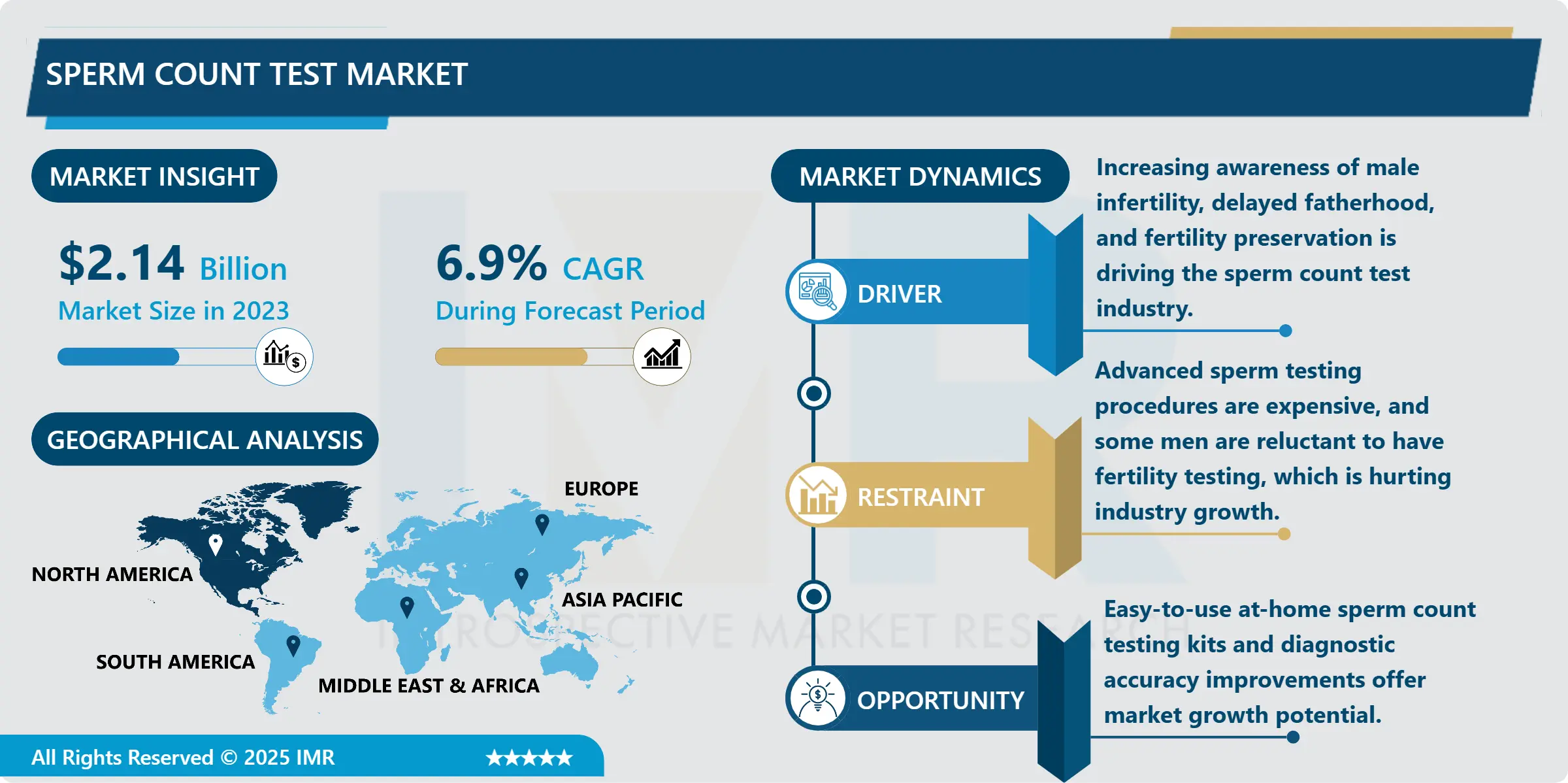
Sperm Count Test Market Size Was Valued at USD 2.14 Billion in 2023, and is Projected to Reach USD 4.42 Billion by 2032, Growing at a CAGR of 6.9% From 2024-2032.
The sperm count test market can be regarded as one of the more specific segments of the global Reproductive health diagnostics market, concerning the assessment of fertility of the male factor, mainly, sperm concentration and quality. These tests are mostly applied in fertility cases that involve males and in cases where males want to know more about fertility. Sperm count tests are usually part of the semen analysis that also includes tests on the appearance, the movement, and the shape of the sperm as well as the total volume of the semen. Market is expanding due to the rise in awareness regarding male infertility and male fertility and deferred child bearing.
An increase in infertility, especially male infertility, creates awareness of fertility issues giving market growth. Stress, poor diet, smoking, environmental pollutants, varicocele or infections; these factors put a big dint on sperm count and hence, fertility tests need to be taken to know the correct position. Likewise, a significant trend towards male fertility maintenance, especially among those who decided to wait for the child or those who have cancer, is also making alt the market grow. Sperm count testing is also likely to remain buoyant coupled with other fertility treatments including IVF due to the fact that the accuracy of sperms count influences major treatment decisions.
However, the market for sperm count test faces several challenges, including inadequate standardization of testing protocols, and poor awareness, which are likely to slow down its growth. Also, driving forces like the expensive techniques of diagnostic and the male’s hesitancy to undergo a checkup on fertility may limit the progress. However, there is growth that can be made on home sperm count testing kits especially since the exercise is private. With people giving much consideration to male reproductive health around the world, and new diagnostic technologies coming to the limelight, the sperm count test market will likely experience further growth in future years.
Sperm Count Test Market Trend Analysis:
Growth of At-Home Sperm Count Testing Kits
The self-testing sperm count kits are on the rise. These kits offer a one-stop-shop, more personal and less embarrassing manner for male subject to check on their fertility status without having to go to clinics. The kits are known to employ highly developed technology to determine sperm concentration and sometimes sperm motility, provided on one’s smartphone app/digital gadget. With more people becoming informed about male fertility problems, such tests are helping people to become more proactive about their reproductive health, as well as providing an option to those who may be anxious to talk to a health care professional.
Integration of Artificial Intelligence and Digital Platforms
The use of artificial intelligence based digital platforms, in the assessment of sperm count. Morphometric analysis based upon artificial intelligence algorithms is emerging as a useful tool for improving the parameters of sperm analysis and in the assessment of the true quality of sperm cells, including their motility and morphology. Also, test results analysis over a period through digital interfaces are also being developed more often. This trend is forcing a shift from sperm testing from diagnostics or one-off test check to an on-going health monitoring category for male fertility, which is more personalised and based on more data.
Sperm Count Test Market Segment Analysis:
Sperm Count Test Market Segmented on the basis of By Product Type, Technique, Age Group, End User, and Region.
By Product Type, Instrument segment is expected to dominate the market during the forecast period
The Instrument segment is expected to dominate the market during the forecast period. Instruments play a crucial role in providing accurate, reliable, and efficient results across a wide range of applications, including clinical diagnostics, pharmaceutical research, environmental testing, and food safety. Continuous technological advancements, such as automation, miniaturization, and improved sensitivity, are driving the demand for high-performance instruments. The growing need for precise analysis, faster turnaround times, and advanced research capabilities further supports the segment’s strong growth. As industries increasingly prioritize quality, accuracy, and efficiency, the demand for advanced instruments will continue to lead the market.
By End User, Fertility Centers segment expected to held the largest share
The Fertility Centers segment is expected to hold the largest share of the sperm count test market. Fertility centers play a crucial role in diagnosing male infertility and offering treatment options, such as IVF and other fertility therapies. These centers often provide first-line diagnostic services, including semen analysis tests, which are essential for male fertility assessments. Additionally, hospitals, diagnostic laboratories, and academic research institutions contribute to market growth through routine testing, research, and development of new diagnostic products. The increasing prevalence of male fertility issues and the growing demand for fertility treatments continue to drive this segment’s expansion.
Sperm Count Test Market Regional Insights:
North America is Expected to Dominate the Market Over the Forecast period
The Sperm count test market in North America is expected to possess the highest market revenue during the forecast period due to the factors like, well-developed healthcare industry, increased awareness regarding male infertility, and presence of some of the key diagnostic players. The regional need for the sperm counts test is driven by, improved focus on reproductive health, an increase in the infertility cases and as more individuals seeks fertility treatments. Nay, the increasing concern for personal privacy, and at-home sperm count testing, combined with the growth of the technology industry in diagnostics also fuels the market growth. Favorable support for R&D coupled with high disposable income for seeking better healthcare facilities will continue to drive the North America sperm count test market.
Active Key Players in the Sperm Count Test Market
bioMérieux SA (France)
ContraVac, Inc. (USA)
CooperSurgical, Inc. (USA)
DNA Diagnostics Center (USA)
Hamilton Thorne (USA)
Medical Electronic Systems (USA)
MICROPTIC (Spain),
Mojo (USA), Thermo Fisher Scientific Inc. (USA)
Ro (USA)
Sandstone Diagnostics (USA)
Other Active Players
Chapter 1: Introduction
1.1 Scope and Coverage
Chapter 2:Executive Summary
Chapter 3: Market Landscape
3.1 Market Dynamics
3.1.1 Drivers
3.1.2 Restraints
3.1.3 Opportunities
3.1.4 Challenges
3.2 Market Trend Analysis
3.3 PESTLE Analysis
3.4 Porter’s Five Forces Analysis
3.5 Industry Value Chain Analysis
3.6 Ecosystem
3.7 Regulatory Landscape
3.8 Price Trend Analysis
3.9 Patent Analysis
3.10 Technology Evolution
3.11 Investment Pockets
3.12 Import-Export Analysis
Chapter 4: Sperm Count Test Market by Product Type
4.1 Sperm Count Test Market Snapshot and Growth Engine
4.2 Sperm Count Test Market Overview
4.3 Instrument
4.3.1 Introduction and Market Overview
4.3.2 Historic and Forecasted Market Size in Value USD and Volume Units (2017-2032F)
4.3.3 Key Market Trends, Growth Factors and Opportunities
4.3.4 Instrument: Geographic Segmentation Analysis
4.4 Reagents and consumables
4.4.1 Introduction and Market Overview
4.4.2 Historic and Forecasted Market Size in Value USD and Volume Units (2017-2032F)
4.4.3 Key Market Trends, Growth Factors and Opportunities
4.4.4 Reagents and consumables: Geographic Segmentation Analysis
4.5 and Kits
4.5.1 Introduction and Market Overview
4.5.2 Historic and Forecasted Market Size in Value USD and Volume Units (2017-2032F)
4.5.3 Key Market Trends, Growth Factors and Opportunities
4.5.4 and Kits: Geographic Segmentation Analysis
Chapter 5: Sperm Count Test Market by Technique
5.1 Sperm Count Test Market Snapshot and Growth Engine
5.2 Sperm Count Test Market Overview
5.3 Microscopy
5.3.1 Introduction and Market Overview
5.3.2 Historic and Forecasted Market Size in Value USD and Volume Units (2017-2032F)
5.3.3 Key Market Trends, Growth Factors and Opportunities
5.3.4 Microscopy: Geographic Segmentation Analysis
5.4 Chromatographic Immunoassay and Colorimetric Reaction
5.4.1 Introduction and Market Overview
5.4.2 Historic and Forecasted Market Size in Value USD and Volume Units (2017-2032F)
5.4.3 Key Market Trends, Growth Factors and Opportunities
5.4.4 Chromatographic Immunoassay and Colorimetric Reaction: Geographic Segmentation Analysis
5.5 SmartphoneBased
5.5.1 Introduction and Market Overview
5.5.2 Historic and Forecasted Market Size in Value USD and Volume Units (2017-2032F)
5.5.3 Key Market Trends, Growth Factors and Opportunities
5.5.4 SmartphoneBased: Geographic Segmentation Analysis
5.6 and Others
5.6.1 Introduction and Market Overview
5.6.2 Historic and Forecasted Market Size in Value USD and Volume Units (2017-2032F)
5.6.3 Key Market Trends, Growth Factors and Opportunities
5.6.4 and Others: Geographic Segmentation Analysis
Chapter 6: Sperm Count Test Market by Age Group
6.1 Sperm Count Test Market Snapshot and Growth Engine
6.2 Sperm Count Test Market Overview
6.3 34 and Below 34 Years
6.3.1 Introduction and Market Overview
6.3.2 Historic and Forecasted Market Size in Value USD and Volume Units (2017-2032F)
6.3.3 Key Market Trends, Growth Factors and Opportunities
6.3.4 34 and Below 34 Years: Geographic Segmentation Analysis
6.4 35-40 Years
6.4.1 Introduction and Market Overview
6.4.2 Historic and Forecasted Market Size in Value USD and Volume Units (2017-2032F)
6.4.3 Key Market Trends, Growth Factors and Opportunities
6.4.4 35-40 Years: Geographic Segmentation Analysis
6.5 and 41 Years and Above)
6.5.1 Introduction and Market Overview
6.5.2 Historic and Forecasted Market Size in Value USD and Volume Units (2017-2032F)
6.5.3 Key Market Trends, Growth Factors and Opportunities
6.5.4 and 41 Years and Above): Geographic Segmentation Analysis
6.6
6.6.1 Introduction and Market Overview
6.6.2 Historic and Forecasted Market Size in Value USD and Volume Units (2017-2032F)
6.6.3 Key Market Trends, Growth Factors and Opportunities
6.6.4 : Geographic Segmentation Analysis
Chapter 7: Sperm Count Test Market by End User
7.1 Sperm Count Test Market Snapshot and Growth Engine
7.2 Sperm Count Test Market Overview
7.3 Hospitals
7.3.1 Introduction and Market Overview
7.3.2 Historic and Forecasted Market Size in Value USD and Volume Units (2017-2032F)
7.3.3 Key Market Trends, Growth Factors and Opportunities
7.3.4 Hospitals: Geographic Segmentation Analysis
7.4 Fertility Centers
7.4.1 Introduction and Market Overview
7.4.2 Historic and Forecasted Market Size in Value USD and Volume Units (2017-2032F)
7.4.3 Key Market Trends, Growth Factors and Opportunities
7.4.4 Fertility Centers: Geographic Segmentation Analysis
7.5 Diagnostic Laboratories
7.5.1 Introduction and Market Overview
7.5.2 Historic and Forecasted Market Size in Value USD and Volume Units (2017-2032F)
7.5.3 Key Market Trends, Growth Factors and Opportunities
7.5.4 Diagnostic Laboratories: Geographic Segmentation Analysis
7.6 and Others (Academic and Research Institutes)
7.6.1 Introduction and Market Overview
7.6.2 Historic and Forecasted Market Size in Value USD and Volume Units (2017-2032F)
7.6.3 Key Market Trends, Growth Factors and Opportunities
7.6.4 and Others (Academic and Research Institutes) : Geographic Segmentation Analysis
Chapter 8: Company Profiles and Competitive Analysis
8.1 Competitive Landscape
8.1.1 Competitive Benchmarking
8.1.2 Sperm Count Test Market Share by Manufacturer (2023)
8.1.3 Industry BCG Matrix
8.1.4 Heat Map Analysis
8.1.5 Mergers and Acquisitions
8.2 MEDICAL ELECTRONIC SYSTEMS (USA)
8.2.1 Company Overview
8.2.2 Key Executives
8.2.3 Company Snapshot
8.2.4 Role of the Company in the Market
8.2.5 Sustainability and Social Responsibility
8.2.6 Operating Business Segments
8.2.7 Product Portfolio
8.2.8 Business Performance
8.2.9 Key Strategic Moves and Recent Developments
8.2.10 SWOT Analysis
8.3 SANDSTONE DIAGNOSTICS (USA)
8.4 COOPERSURGICAL INC. (USA)
8.5 HAMILTON THORNE (USA)
8.6 MICROPTIC (SPAIN)
8.7 CONTRAVAC INC. (USA)
8.8 DNA DIAGNOSTICS CENTER (USA)
8.9 BIOMÉRIEUX SA (FRANCE)
8.10 MOJO (USA)
8.11 THERMO FISHER SCIENTIFIC INC. (USA)
8.12 RO (USA) AND OTHER ACTIVE PLAYERS
Chapter 9: Global Sperm Count Test Market By Region
9.1 Overview
9.2. North America Sperm Count Test Market
9.2.1 Key Market Trends, Growth Factors and Opportunities
9.2.2 Top Key Companies
9.2.3 Historic and Forecasted Market Size by Segments
9.2.4 Historic and Forecasted Market Size By Product Type
9.2.4.1 Instrument
9.2.4.2 Reagents and consumables
9.2.4.3 and Kits
9.2.5 Historic and Forecasted Market Size By Technique
9.2.5.1 Microscopy
9.2.5.2 Chromatographic Immunoassay and Colorimetric Reaction
9.2.5.3 SmartphoneBased
9.2.5.4 and Others
9.2.6 Historic and Forecasted Market Size By Age Group
9.2.6.1 34 and Below 34 Years
9.2.6.2 35-40 Years
9.2.6.3 and 41 Years and Above)
9.2.6.4
9.2.7 Historic and Forecasted Market Size By End User
9.2.7.1 Hospitals
9.2.7.2 Fertility Centers
9.2.7.3 Diagnostic Laboratories
9.2.7.4 and Others (Academic and Research Institutes)
9.2.8 Historic and Forecast Market Size by Country
9.2.8.1 US
9.2.8.2 Canada
9.2.8.3 Mexico
9.3. Eastern Europe Sperm Count Test Market
9.3.1 Key Market Trends, Growth Factors and Opportunities
9.3.2 Top Key Companies
9.3.3 Historic and Forecasted Market Size by Segments
9.3.4 Historic and Forecasted Market Size By Product Type
9.3.4.1 Instrument
9.3.4.2 Reagents and consumables
9.3.4.3 and Kits
9.3.5 Historic and Forecasted Market Size By Technique
9.3.5.1 Microscopy
9.3.5.2 Chromatographic Immunoassay and Colorimetric Reaction
9.3.5.3 SmartphoneBased
9.3.5.4 and Others
9.3.6 Historic and Forecasted Market Size By Age Group
9.3.6.1 34 and Below 34 Years
9.3.6.2 35-40 Years
9.3.6.3 and 41 Years and Above)
9.3.6.4
9.3.7 Historic and Forecasted Market Size By End User
9.3.7.1 Hospitals
9.3.7.2 Fertility Centers
9.3.7.3 Diagnostic Laboratories
9.3.7.4 and Others (Academic and Research Institutes)
9.3.8 Historic and Forecast Market Size by Country
9.3.8.1 Russia
9.3.8.2 Bulgaria
9.3.8.3 The Czech Republic
9.3.8.4 Hungary
9.3.8.5 Poland
9.3.8.6 Romania
9.3.8.7 Rest of Eastern Europe
9.4. Western Europe Sperm Count Test Market
9.4.1 Key Market Trends, Growth Factors and Opportunities
9.4.2 Top Key Companies
9.4.3 Historic and Forecasted Market Size by Segments
9.4.4 Historic and Forecasted Market Size By Product Type
9.4.4.1 Instrument
9.4.4.2 Reagents and consumables
9.4.4.3 and Kits
9.4.5 Historic and Forecasted Market Size By Technique
9.4.5.1 Microscopy
9.4.5.2 Chromatographic Immunoassay and Colorimetric Reaction
9.4.5.3 SmartphoneBased
9.4.5.4 and Others
9.4.6 Historic and Forecasted Market Size By Age Group
9.4.6.1 34 and Below 34 Years
9.4.6.2 35-40 Years
9.4.6.3 and 41 Years and Above)
9.4.6.4
9.4.7 Historic and Forecasted Market Size By End User
9.4.7.1 Hospitals
9.4.7.2 Fertility Centers
9.4.7.3 Diagnostic Laboratories
9.4.7.4 and Others (Academic and Research Institutes)
9.4.8 Historic and Forecast Market Size by Country
9.4.8.1 Germany
9.4.8.2 UK
9.4.8.3 France
9.4.8.4 The Netherlands
9.4.8.5 Italy
9.4.8.6 Spain
9.4.8.7 Rest of Western Europe
9.5. Asia Pacific Sperm Count Test Market
9.5.1 Key Market Trends, Growth Factors and Opportunities
9.5.2 Top Key Companies
9.5.3 Historic and Forecasted Market Size by Segments
9.5.4 Historic and Forecasted Market Size By Product Type
9.5.4.1 Instrument
9.5.4.2 Reagents and consumables
9.5.4.3 and Kits
9.5.5 Historic and Forecasted Market Size By Technique
9.5.5.1 Microscopy
9.5.5.2 Chromatographic Immunoassay and Colorimetric Reaction
9.5.5.3 SmartphoneBased
9.5.5.4 and Others
9.5.6 Historic and Forecasted Market Size By Age Group
9.5.6.1 34 and Below 34 Years
9.5.6.2 35-40 Years
9.5.6.3 and 41 Years and Above)
9.5.6.4
9.5.7 Historic and Forecasted Market Size By End User
9.5.7.1 Hospitals
9.5.7.2 Fertility Centers
9.5.7.3 Diagnostic Laboratories
9.5.7.4 and Others (Academic and Research Institutes)
9.5.8 Historic and Forecast Market Size by Country
9.5.8.1 China
9.5.8.2 India
9.5.8.3 Japan
9.5.8.4 South Korea
9.5.8.5 Malaysia
9.5.8.6 Thailand
9.5.8.7 Vietnam
9.5.8.8 The Philippines
9.5.8.9 Australia
9.5.8.10 New Zealand
9.5.8.11 Rest of APAC
9.6. Middle East & Africa Sperm Count Test Market
9.6.1 Key Market Trends, Growth Factors and Opportunities
9.6.2 Top Key Companies
9.6.3 Historic and Forecasted Market Size by Segments
9.6.4 Historic and Forecasted Market Size By Product Type
9.6.4.1 Instrument
9.6.4.2 Reagents and consumables
9.6.4.3 and Kits
9.6.5 Historic and Forecasted Market Size By Technique
9.6.5.1 Microscopy
9.6.5.2 Chromatographic Immunoassay and Colorimetric Reaction
9.6.5.3 SmartphoneBased
9.6.5.4 and Others
9.6.6 Historic and Forecasted Market Size By Age Group
9.6.6.1 34 and Below 34 Years
9.6.6.2 35-40 Years
9.6.6.3 and 41 Years and Above)
9.6.6.4
9.6.7 Historic and Forecasted Market Size By End User
9.6.7.1 Hospitals
9.6.7.2 Fertility Centers
9.6.7.3 Diagnostic Laboratories
9.6.7.4 and Others (Academic and Research Institutes)
9.6.8 Historic and Forecast Market Size by Country
9.6.8.1 Turkiye
9.6.8.2 Bahrain
9.6.8.3 Kuwait
9.6.8.4 Saudi Arabia
9.6.8.5 Qatar
9.6.8.6 UAE
9.6.8.7 Israel
9.6.8.8 South Africa
9.7. South America Sperm Count Test Market
9.7.1 Key Market Trends, Growth Factors and Opportunities
9.7.2 Top Key Companies
9.7.3 Historic and Forecasted Market Size by Segments
9.7.4 Historic and Forecasted Market Size By Product Type
9.7.4.1 Instrument
9.7.4.2 Reagents and consumables
9.7.4.3 and Kits
9.7.5 Historic and Forecasted Market Size By Technique
9.7.5.1 Microscopy
9.7.5.2 Chromatographic Immunoassay and Colorimetric Reaction
9.7.5.3 SmartphoneBased
9.7.5.4 and Others
9.7.6 Historic and Forecasted Market Size By Age Group
9.7.6.1 34 and Below 34 Years
9.7.6.2 35-40 Years
9.7.6.3 and 41 Years and Above)
9.7.6.4
9.7.7 Historic and Forecasted Market Size By End User
9.7.7.1 Hospitals
9.7.7.2 Fertility Centers
9.7.7.3 Diagnostic Laboratories
9.7.7.4 and Others (Academic and Research Institutes)
9.7.8 Historic and Forecast Market Size by Country
9.7.8.1 Brazil
9.7.8.2 Argentina
9.7.8.3 Rest of SA
Chapter 10 Analyst Viewpoint and Conclusion
10.1 Recommendations and Concluding Analysis
10.2 Potential Market Strategies
Chapter 11 Research Methodology
11.1 Research Process
11.2 Primary Research
11.3 Secondary Research
Q1: What would be the forecast period in the Sperm Count Test Market research report?
A1: The forecast period in the Sperm Count Test Market research report is 2024-2032.
Q2: Who are the key players in the Sperm Count Test Market?
A2: Medical Electronic Systems (USA), Sandstone Diagnostics (USA), CooperSurgical, Inc. (USA), Hamilton Thorne (USA), MICROPTIC (Spain), ContraVac, Inc. (USA), DNA Diagnostics Center (USA), bioMérieux SA (France), Mojo (USA), Thermo Fisher Scientific Inc. (USA), Ro (USA) and Others Active Players.
Q3: What are the segments of the Sperm Count Test Market?
A3: The Sperm Count Test Market is segmented into Product Type, Technique, Age Group, End User and region. By Product Type the market is categorized into Instrument, Reagents and consumables, and Kits. By Technique the market is categorized into Microscopy, Chromatographic Immunoassay and Colorimetric Reaction, Smartphone Based, and Others. By Age Group the market is categorized into 34 and Below 34 Years, 35-40 Years, and 41 Years and Above. By End User the market is categorized into Hospitals, Fertility Centers, Diagnostic Laboratories, and Others (Academic and Research Institutes). By region, it is analyzed across North America (U.S.; Canada; Mexico), Eastern Europe (Russia; Bulgaria; The Czech Republic; Hungary; Poland; Romania; Rest of Eastern Europe), Western Europe (Germany; UK; France; Netherlands; Italy; Spain; Rest of Western Europe), Asia-Pacific (China; India; Japan; Southeast Asia, etc.), South America (Brazil; Argentina, etc.), Middle East & Africa (Saudi Arabia; South Africa, etc.).
Q4: What is the Sperm Count Test Market?
A4: A sperm count test is a diagnostic procedure used to evaluate male fertility by measuring the number of sperms present in a semen sample. This test is typically part of a semen analysis and provides insights into sperm concentration, which is a key factor in male reproductive health. A low sperm count can indicate potential fertility issues and may require further investigation or treatment.
Q5: How big is the Sperm Count Test Market?
A5: Sperm Count Test Market Size Was Valued at USD 2.14 Billion in 2023, and is Projected to Reach USD 4.42 Billion by 2032, Growing at a CAGR of 6.9% From 2024-2032.
How to Buy a Report from eminsights.jp
On the product page, choose the license you want: Single-User License, Multi-User License or Enterprise License.
If you required report in your native language, then you can click on Translated Report button and fill out the form with report name and language you want, then our team will contact you as soon as possible.
Click the Buy Now button.
You will be redirected to the checkout page. Enter your company details and payment information.
Click Place Order to complete the purchase.
Confirmation: You’ll receive an order confirmation and our team will contact you shortly with your ordered report.
If you have any questions, fill out the contact form below or email us at bizdev@eminsights.net.
Thank you for choosing eminsights.jp!