Stay Ahead in Fast-Growing Economies.
Browse Reports Now




Solar Farms Market-Comprehensive Study Report & Recent Trends 2025-2032
Solar farm is a sizable array of photovoltaic (PV) solar panels that gather solar energy, transform it into electricity, and transmit the electricity to the power grid so that users such as yourself can use and distribute it. Solar farms, also known as solar parks or photovoltaic power plants, are generally installed on the ground rather than on rooftops and come in a variety of sizes and configurations.

IMR Group
Description
Solar Farms Market Synopsis
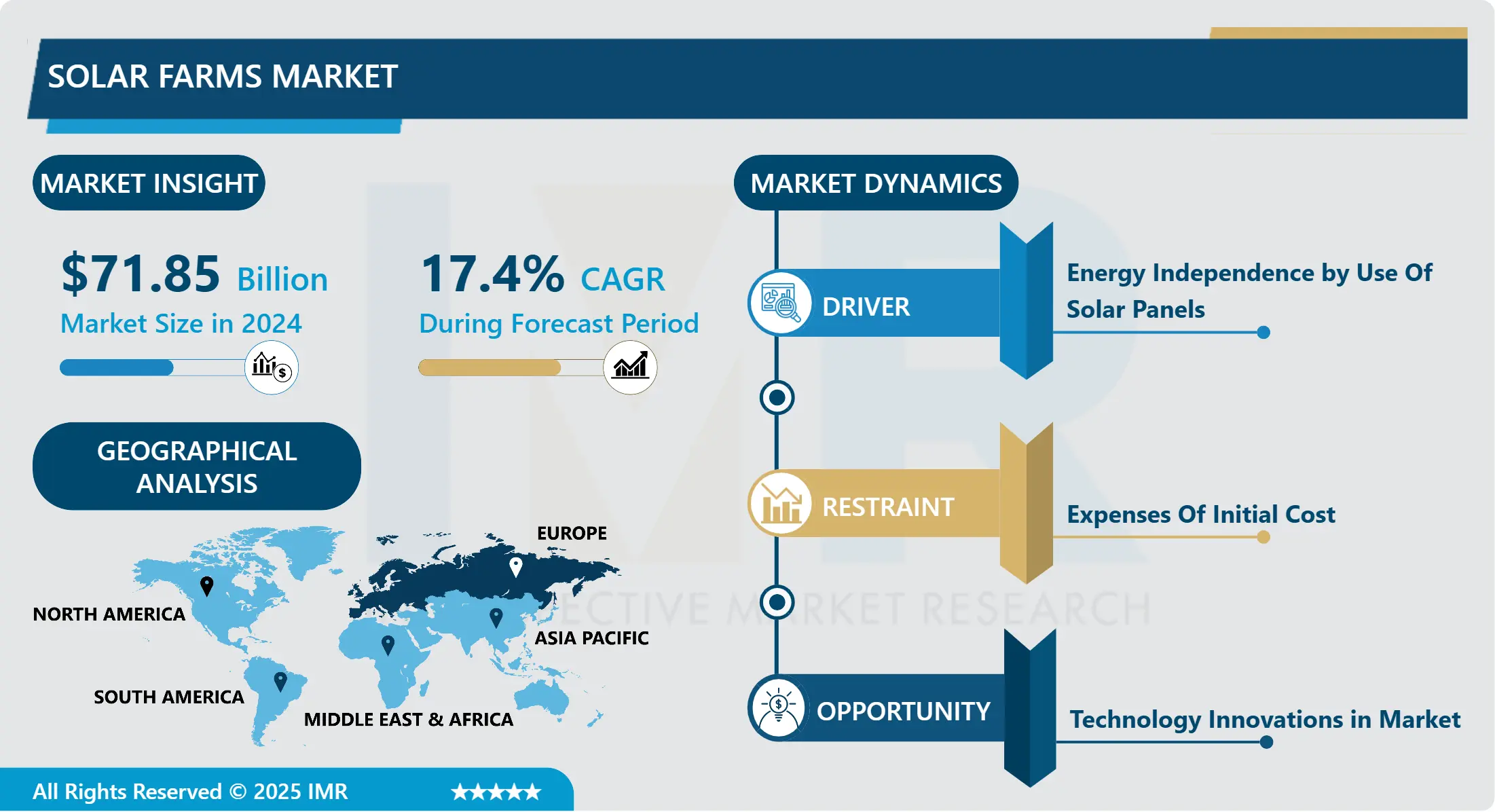
The global Solar Farms Market was valued at USD 71.85 Billion in 2024 and is likely to reach USD 259.28 billion by 2032, increasing at a CAGR of 17.4% from 2025 to 2032.
Solar farm is a sizable array of photovoltaic (PV) solar panels that gather solar energy, transform it into electricity, and transmit the electricity to the power grid so that users such as yourself can use and distribute it. Solar farms, also known as solar parks or photovoltaic power plants, are generally installed on the ground rather than on rooftops and come in a variety of sizes and configurations.
Solar farms are large areas covered with many solar panels, all working together to capture sunlight and turn it into electricity. Their primary objective is to maximize solar radiation in order to generate power in a sustainable manner. Solar energy has revolutionized the way that houses and municipalities get electricity. A major contributor to this transformation is solar farms, which offer clean energy that lowers pollution and advances the transition to a cleaner energy system.
Photovoltaic panels, which include solar cells that convert sunlight into energy, are specialized panels used in solar farms.
These panels generate power when sunlight strikes them. An inverter is a device that solar farms use to convert the power they produce into alternating current (AC), which is the kind of electricity used by most households and businesses.
To put it briefly, solar farms are a sustainable and clean source of energy. They don’t release any dangerous gasses.
Solar Farms Market Trend Analysis
Solar Farms Market Growth Driver- Energy Independence
In most parts of the world, solar energy is freely and abundantly available. Countries may lessen their dependency on imported fossil fuels such as oil, coal, and natural gas by using solar power as a domestic energy source.
If a country relies only on fossil fuels for energy, it may become more vulnerable to price fluctuations, supply disruptions, and geopolitical upheaval. Solar energy diversifies energy sources and reduces reliance on a single supply. Solar energy is a steady and predictable resource, unlike fossil fuels, which are subject to price volatility and supply constraints. The sun shines regularly over time, providing a dependable source of energy on which nations may rely for their electrical requirements.
Solar Farms Market Opportunity- Rural Development
In order to construct their facilities, solar farm developers frequently lease land from owners of rural properties. Landowners who enter into these lease agreements receive a consistent income stream that supplements their income without forcing them to engage in active farming. Solar farm leasing payments can considerably augment the revenue and stabilize the finances of many rural landowners, particularly those with marginal or underutilized land.
The planning, building, and maintenance of solar farms lead to job openings in rural areas. Workers are required to prepare the site, install the solar panels, and build the support infrastructure during the building phase. Once solar farms are up and running, they need constant upkeep and observation, which keeps jobs in the area stable. These job openings may contribute to a decrease in unemployment.
Solar Farms Market Segment Analysis:
Market Segmented based on Type, Technology, End- User, and region.
By Type, Utility Scale Solar Pannel to Dominate the Market During the Forecast Period
Most importantly, there is some deception involved in the term “utility-scale.” All solar energy projects, regardless of the size—a few rooftop panels or an acre of them—are technically “on the grid,” supplying the neighbourhood utility company with electricity generated by the sun.
When a solar energy project is not connected by a power line and is not in any way part of the grid, that is the only situation in which it is not genuinely utility-scale.
Though for the purposes of this discussion and most others of a similar kind, utility-scale solar farms are those enormous tracts of land on which solar panels extend into the distance. These installations are made up of hundreds of thousands of solar panels that collect solar radiation, turn it into an electric current, and then distribute that electricity at a high voltage.
By End-User, The Commercial Sector Held the Largest Share
Compared to houses, businesses—like offices and shopping centers—usually require more energy due to their bigger premises and more equipment that is used continuously. This implies that their power costs may be rather substantial. Many companies choose solar electricity because it’s more cost-effective and ecologically beneficial.
Commercial buildings often have enough rooftop land space for solar panels. This allows them to install larger solar panels, which can provide enough power to meet their needs. Businesses may install more panels and capture more sunshine since they have greater room to work with, increasing the quantity of energy produced.
Governments and local authorities often give financial incentives to enterprises investing in renewable energy, such as wind turbines. These incentives may include tax credits, rebates, or grants to assist cover the upfront expenses of acquiring or installing solar panels.
Solar Farms Market Regional Insights:
Europe is Expected to Dominate the Market Over the Forecast Period
Asia-Pacific is the largest market recorded in 2023, Europe is expected to dominate the market Policy Environment: When it comes to climate action and renewable energy policy, Europe has been leading the way.
The European Union aims to achieve high percentage of renewable energy. Incentives for renewable energy, feed-in tariffs, and carbon pricing are examples of favorable policies that encourage the expansion of solar farms in Europe.
A number of European countries are violently transitioning away from nuclear and fossil fuel energy and toward renewable energy sources like solar electricity. Governments and utilities in the Netherlands, Germany, Spain, and Italy have implemented plans to phase out coal-fired power plants and invest in renewable energy infrastructure, such as large solar farms. Europe has cutting-edge solar technology.
In 2023, net solar power generation in the United States reached its highest point yet at 164.5 terawatt hours of solar thermal and photovoltaic (PV) power. Solar power generation has increased drastically over the past two decades
Solar Farms Market Top Key Players:
First Solar (United States)
Jinkosolar (China)
Canadian Solar (Canada)
Trina Solar (China)
Hanwha Q Cells (South Korea)
Longi Solar (China)
Ja Solar (China)
Risen Energy (China)
Vikram Solar (India)
Sunpower Corporation (United States)
Tata Power Solar (India)
Azure Power (India)
Gcl-Poly Energy Holdings (China)
Adani Green Energy (India)
Enel Green Power (Italy)
Berkshire Hathaway Energy (United States)
Sungrow Power Supply (China)
Shunfeng International Clean Energy Limited (Sfce) (China)
Edf Renewables (France)
Nextera Energy Resources (United States)
Scatec (Norway)
Sma Solar Technology (Germany)
Renew Power (India)
Huawei Technologies (China)
Goldwind (China)
Yingli Green Energy (China)
Vestas (Denmark)
Borrego Solar (United States)
Solaredge Technologies (Israel)
Sunrun (United States)
Other active players.
Key Industry Developments in the Solar Farms Market:
In April 2024, On Tuesday, Juniper Green Energy Pvt Ltd, an independent renewable power producer based in Delhi NCR, announced the commissioning of its 105-MW Jalkot Solar Power Project in the Indian state of Maharashtra
In April 2024, Italian company to build huge Spanish solar project, The ceremony, attended by Badajoz Mayor Ignacio Gragera and Víctor del Moral Agundez from the Ministry of Agriculture, Livestock, and Sustainable Development, signalled the commencement of what is poised to be the company’s largest solar project worldwide
Chapter 1: Introduction
1.1 Scope and Coverage
Chapter 2:Executive Summary
Chapter 3: Market Landscape
3.1 Market Dynamics
3.1.1 Drivers
3.1.2 Restraints
3.1.3 Opportunities
3.1.4 Challenges
3.2 Market Trend Analysis
3.3 PESTLE Analysis
3.4 Porter’s Five Forces Analysis
3.5 Industry Value Chain Analysis
3.6 Ecosystem
3.7 Regulatory Landscape
3.8 Price Trend Analysis
3.9 Patent Analysis
3.10 Technology Evolution
3.11 Investment Pockets
3.12 Import-Export Analysis
Chapter 4: Solar Farms Market by Type (2018-2032)
4.1 Solar Farms Market Snapshot and Growth Engine
4.2 Market Overview
4.3 Utility-Scale
4.3.1 Introduction and Market Overview
4.3.2 Historic and Forecasted Market Size in Value USD and Volume Units
4.3.3 Key Market Trends, Growth Factors, and Opportunities
4.3.4 Geographic Segmentation Analysis
4.4 Surface Suction
4.5 Distributed Generation
4.6 Microgrids Others
Chapter 5: Solar Farms Market by Technology (2018-2032)
5.1 Solar Farms Market Snapshot and Growth Engine
5.2 Market Overview
5.3 Solar Photovoltaic
5.3.1 Introduction and Market Overview
5.3.2 Historic and Forecasted Market Size in Value USD and Volume Units
5.3.3 Key Market Trends, Growth Factors, and Opportunities
5.3.4 Geographic Segmentation Analysis
5.4 Mono-Si
5.5 Thin Film
5.6 Multi-Si
5.7 Other Technologies
Chapter 6: Solar Farms Market by End-User (2018-2032)
6.1 Solar Farms Market Snapshot and Growth Engine
6.2 Market Overview
6.3 Industrial
6.3.1 Introduction and Market Overview
6.3.2 Historic and Forecasted Market Size in Value USD and Volume Units
6.3.3 Key Market Trends, Growth Factors, and Opportunities
6.3.4 Geographic Segmentation Analysis
6.4 Commercial
6.5 Residential
Chapter 7: Company Profiles and Competitive Analysis
7.1 Competitive Landscape
7.1.1 Competitive Benchmarking
7.1.2 Solar Farms Market Share by Manufacturer (2024)
7.1.3 Industry BCG Matrix
7.1.4 Heat Map Analysis
7.1.5 Mergers and Acquisitions
7.2 FIRST SOLAR (UNITED STATES)
7.2.1 Company Overview
7.2.2 Key Executives
7.2.3 Company Snapshot
7.2.4 Role of the Company in the Market
7.2.5 Sustainability and Social Responsibility
7.2.6 Operating Business Segments
7.2.7 Product Portfolio
7.2.8 Business Performance
7.2.9 Key Strategic Moves and Recent Developments
7.2.10 SWOT Analysis
7.3 JINKOSOLAR (CHINA)
7.4 CANADIAN SOLAR (CANADA)
7.5 TRINA SOLAR (CHINA)
7.6 HANWHA Q CELLS (SOUTH KOREA)
7.7 LONGI SOLAR (CHINA)
7.8 JA SOLAR (CHINA)
7.9 RISEN ENERGY (CHINA)
7.10 VIKRAM SOLAR (INDIA)
7.11 SUNPOWER CORPORATION (UNITED STATES)
7.12 TATA POWER SOLAR (INDIA)
7.13 AZURE POWER (INDIA)
7.14 GCL-POLY ENERGY HOLDINGS (CHINA)
7.15 ADANI GREEN ENERGY (INDIA)
7.16 ENEL GREEN POWER (ITALY)
7.17 BERKSHIRE HATHAWAY ENERGY (UNITED STATES)
7.18 SUNGROW POWER SUPPLY (CHINA)
7.19 SHUNFENG INTERNATIONAL CLEAN ENERGY LIMITED (SFCE) (CHINA)
7.20 EDF RENEWABLES (FRANCE)
7.21 NEXTERA ENERGY RESOURCES (UNITED STATES)
7.22 SCATEC (NORWAY)
7.23 SMA SOLAR TECHNOLOGY (GERMANY)
7.24 RENEW POWER (INDIA)
7.25 HUAWEI TECHNOLOGIES (CHINA)
7.26 GOLDWIND (CHINA)
7.27 YINGLI GREEN ENERGY (CHINA)
7.28 VESTAS (DENMARK)
7.29 BORREGO SOLAR (UNITED STATES)
7.30 SOLAREDGE TECHNOLOGIES (ISRAEL)
7.31 SUNRUN (UNITED STATES)
Chapter 8: Global Solar Farms Market By Region
8.1 Overview
8.2. North America Solar Farms Market
8.2.1 Key Market Trends, Growth Factors and Opportunities
8.2.2 Top Key Companies
8.2.3 Historic and Forecasted Market Size by Segments
8.2.4 Historic and Forecasted Market Size by Type
8.2.4.1 Utility-Scale
8.2.4.2 Surface Suction
8.2.4.3 Distributed Generation
8.2.4.4 Microgrids Others
8.2.5 Historic and Forecasted Market Size by Technology
8.2.5.1 Solar Photovoltaic
8.2.5.2 Mono-Si
8.2.5.3 Thin Film
8.2.5.4 Multi-Si
8.2.5.5 Other Technologies
8.2.6 Historic and Forecasted Market Size by End-User
8.2.6.1 Industrial
8.2.6.2 Commercial
8.2.6.3 Residential
8.2.7 Historic and Forecast Market Size by Country
8.2.7.1 US
8.2.7.2 Canada
8.2.7.3 Mexico
8.3. Eastern Europe Solar Farms Market
8.3.1 Key Market Trends, Growth Factors and Opportunities
8.3.2 Top Key Companies
8.3.3 Historic and Forecasted Market Size by Segments
8.3.4 Historic and Forecasted Market Size by Type
8.3.4.1 Utility-Scale
8.3.4.2 Surface Suction
8.3.4.3 Distributed Generation
8.3.4.4 Microgrids Others
8.3.5 Historic and Forecasted Market Size by Technology
8.3.5.1 Solar Photovoltaic
8.3.5.2 Mono-Si
8.3.5.3 Thin Film
8.3.5.4 Multi-Si
8.3.5.5 Other Technologies
8.3.6 Historic and Forecasted Market Size by End-User
8.3.6.1 Industrial
8.3.6.2 Commercial
8.3.6.3 Residential
8.3.7 Historic and Forecast Market Size by Country
8.3.7.1 Russia
8.3.7.2 Bulgaria
8.3.7.3 The Czech Republic
8.3.7.4 Hungary
8.3.7.5 Poland
8.3.7.6 Romania
8.3.7.7 Rest of Eastern Europe
8.4. Western Europe Solar Farms Market
8.4.1 Key Market Trends, Growth Factors and Opportunities
8.4.2 Top Key Companies
8.4.3 Historic and Forecasted Market Size by Segments
8.4.4 Historic and Forecasted Market Size by Type
8.4.4.1 Utility-Scale
8.4.4.2 Surface Suction
8.4.4.3 Distributed Generation
8.4.4.4 Microgrids Others
8.4.5 Historic and Forecasted Market Size by Technology
8.4.5.1 Solar Photovoltaic
8.4.5.2 Mono-Si
8.4.5.3 Thin Film
8.4.5.4 Multi-Si
8.4.5.5 Other Technologies
8.4.6 Historic and Forecasted Market Size by End-User
8.4.6.1 Industrial
8.4.6.2 Commercial
8.4.6.3 Residential
8.4.7 Historic and Forecast Market Size by Country
8.4.7.1 Germany
8.4.7.2 UK
8.4.7.3 France
8.4.7.4 The Netherlands
8.4.7.5 Italy
8.4.7.6 Spain
8.4.7.7 Rest of Western Europe
8.5. Asia Pacific Solar Farms Market
8.5.1 Key Market Trends, Growth Factors and Opportunities
8.5.2 Top Key Companies
8.5.3 Historic and Forecasted Market Size by Segments
8.5.4 Historic and Forecasted Market Size by Type
8.5.4.1 Utility-Scale
8.5.4.2 Surface Suction
8.5.4.3 Distributed Generation
8.5.4.4 Microgrids Others
8.5.5 Historic and Forecasted Market Size by Technology
8.5.5.1 Solar Photovoltaic
8.5.5.2 Mono-Si
8.5.5.3 Thin Film
8.5.5.4 Multi-Si
8.5.5.5 Other Technologies
8.5.6 Historic and Forecasted Market Size by End-User
8.5.6.1 Industrial
8.5.6.2 Commercial
8.5.6.3 Residential
8.5.7 Historic and Forecast Market Size by Country
8.5.7.1 China
8.5.7.2 India
8.5.7.3 Japan
8.5.7.4 South Korea
8.5.7.5 Malaysia
8.5.7.6 Thailand
8.5.7.7 Vietnam
8.5.7.8 The Philippines
8.5.7.9 Australia
8.5.7.10 New Zealand
8.5.7.11 Rest of APAC
8.6. Middle East & Africa Solar Farms Market
8.6.1 Key Market Trends, Growth Factors and Opportunities
8.6.2 Top Key Companies
8.6.3 Historic and Forecasted Market Size by Segments
8.6.4 Historic and Forecasted Market Size by Type
8.6.4.1 Utility-Scale
8.6.4.2 Surface Suction
8.6.4.3 Distributed Generation
8.6.4.4 Microgrids Others
8.6.5 Historic and Forecasted Market Size by Technology
8.6.5.1 Solar Photovoltaic
8.6.5.2 Mono-Si
8.6.5.3 Thin Film
8.6.5.4 Multi-Si
8.6.5.5 Other Technologies
8.6.6 Historic and Forecasted Market Size by End-User
8.6.6.1 Industrial
8.6.6.2 Commercial
8.6.6.3 Residential
8.6.7 Historic and Forecast Market Size by Country
8.6.7.1 Turkiye
8.6.7.2 Bahrain
8.6.7.3 Kuwait
8.6.7.4 Saudi Arabia
8.6.7.5 Qatar
8.6.7.6 UAE
8.6.7.7 Israel
8.6.7.8 South Africa
8.7. South America Solar Farms Market
8.7.1 Key Market Trends, Growth Factors and Opportunities
8.7.2 Top Key Companies
8.7.3 Historic and Forecasted Market Size by Segments
8.7.4 Historic and Forecasted Market Size by Type
8.7.4.1 Utility-Scale
8.7.4.2 Surface Suction
8.7.4.3 Distributed Generation
8.7.4.4 Microgrids Others
8.7.5 Historic and Forecasted Market Size by Technology
8.7.5.1 Solar Photovoltaic
8.7.5.2 Mono-Si
8.7.5.3 Thin Film
8.7.5.4 Multi-Si
8.7.5.5 Other Technologies
8.7.6 Historic and Forecasted Market Size by End-User
8.7.6.1 Industrial
8.7.6.2 Commercial
8.7.6.3 Residential
8.7.7 Historic and Forecast Market Size by Country
8.7.7.1 Brazil
8.7.7.2 Argentina
8.7.7.3 Rest of SA
Chapter 9 Analyst Viewpoint and Conclusion
9.1 Recommendations and Concluding Analysis
9.2 Potential Market Strategies
Chapter 10 Research Methodology
10.1 Research Process
10.2 Primary Research
10.3 Secondary Research
Q1: What would be the forecast period in the Solar Farms Market research report?
A1: The forecast period in the Solar Farms Market research report is 2025-2032.
Q2: Who are the key players in the Solar Farms Market?
A2: First Solar (United States), Jinkosolar (China),Canadian Solar (Canada),Trina Solar (China),Hanwha Q Cells (South Korea),Longi Solar (China),Ja Solar (China),Risen Energy (China),Vikram Solar (India), Sunpower Corporation (United States),Tata Power Solar (India),Azure Power (India),Gcl-Poly Energy Holdings (China),Adani Green Energy (India),Enel Green Power (Italy),Berkshire Hathaway Energy (United States), Sungrow Power Supply (China), Shunfeng International Clean Energy Limited (Sfce) (China), Edf Renewables (France), Nextera Energy Resources (United States),Scatec (Norway),Sma Solar Technology (Germany),Renew Power (India),Huawei Technologies (China), Goldwind (China), Yingli Green Energy (China),Vestas (Denmark),Borrego Solar (United States), Solaredge Technologies (Israel),Sunrun (United States) and other active players.
Q3: What are the segments of the Solar Farms Market?
A3: The Solar Farms Market is segmented into Type, Technology, End-User and Regions. By Type (Utility-scale, Surface Suction, Distributed Generation, Microgrids Others), By Technology (Solar Photovoltaic, Mono-Si, Thin Film, Multi-Si, Other Technologies), By End-User (Industrial, Residential, Commercial). By Region, it is analyzed across North America (U.S.; Canada; Mexico), Eastern Europe (Russia; Bulgaria; The Czech Republic; Hungary; Poland; Romania; Rest of Eastern Europe), Western Europe (Germany; UK; France; The Netherlands; Italy; Spain; Rest of Western Europe), Asia-Pacific (China; India; Japan; South Korea; Malaysia; Thailand; Vietnam; The Philippines; Australia; New Zealand; Rest of APAC), Middle East & Africa (Türkiye; Bahrain; Kuwait; Saudi Arabia; Qatar; UAE; Israel; South Africa), South America (Brazil; Argentina; Rest of SA).
Q4: What is the Solar Farms Market?
A4: A solar farm is a sizable array of photovoltaic (PV) solar panels that gather solar energy, transform it into electricity, and transmit the electricity to the power grid so that users such as yourself can use and distribute it. Solar farms, also known as solar parks or photovoltaic power plants, are generally installed on the ground rather than on rooftops and come in a variety of sizes and configurations.
Q5: How big is the Solar Farms Market?
A5: The global Solar Farms Market was valued at USD 71.85 Billion in 2024 and is likely to reach USD 259.28 billion by 2032, increasing at a CAGR of 17.4% from 2025 to 2032.
How to Buy a Report from eminsights.jp
On the product page, choose the license you want: Single-User License, Multi-User License or Enterprise License.
If you required report in your native language, then you can click on Translated Report button and fill out the form with report name and language you want, then our team will contact you as soon as possible.
Click the Buy Now button.
You will be redirected to the checkout page. Enter your company details and payment information.
Click Place Order to complete the purchase.
Confirmation: You’ll receive an order confirmation and our team will contact you shortly with your ordered report.
If you have any questions, fill out the contact form below or email us at bizdev@eminsights.net.
Thank you for choosing eminsights.jp!