Stay Ahead in Fast-Growing Economies.
Browse Reports Now
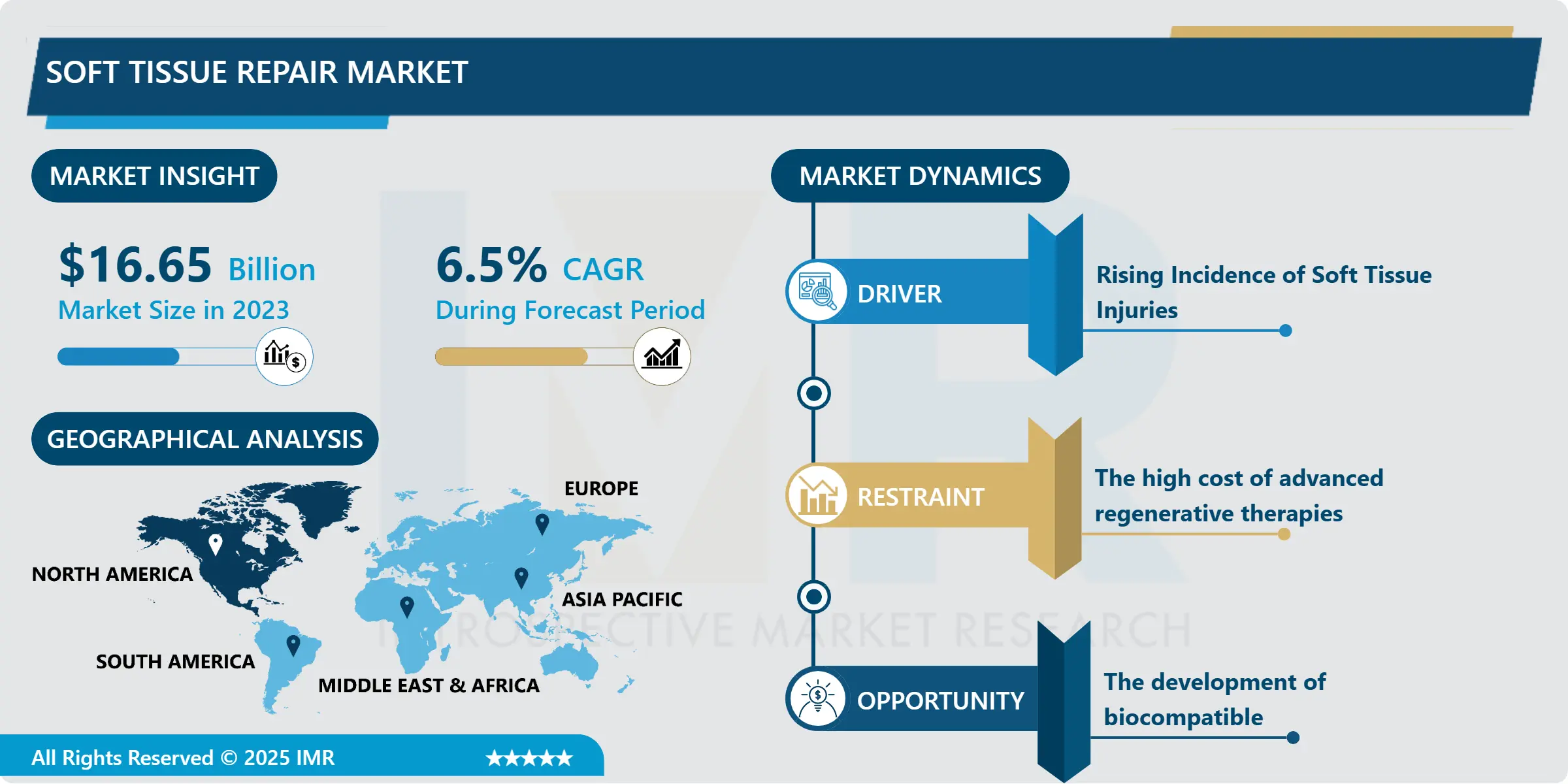
Soft Tissue Repair Market – Insights & Analysis
Soft Tissue Repair Market Size Was Valued at USD 16.65 Billion in 2023, and is Projected to Reach USD 29.06 Billion by 2032, Growing at a CAGR of 6.5 % from 2024-2032.

IMR Group
Description
Soft Tissue Repair Market Synopsis:
Soft Tissue Repair Market Size Was Valued at USD 16.65 Billion in 2023, and is Projected to Reach USD 29.06 Billion by 2032, Growing at a CAGR of 6.5 % from 2024-2032.
Soft Tissue Repair Market is an innovative and constantly growing industry that offers products and treatments to restore, reconstruct or replace damaged or injured soft tissues, muscular, tendons, ligaments, cartilage, and other fibres. This market includes many techniques which may be a biologic graft, synthetic grafts, suture, staples and scaffold along with the more evolved regenerative treatments including stem cell treatments and PRP. These products are useful when treating conditions arising from sports injuries, degenerative diseases, trauma or post-surgical operations. The increasing number of geriatric populations, increasing cases of musculoskeletal injuries, advancing sports activities and enhancing the body aesthetics through surgeries contribute to the growth of this market. Advancements in technology and trend towards minimally invasive technology and better biomaterials and tissue engineering has increased the range of applications, thereby increasing the application of the products and drawing the market forward.
The market for soft tissue repair is growing steadily due to the developmental surgical approaches, rising average age across the globe and rising tendencies for both reconstructive as well as aesthetic surgeries. Trauma, sports activities, aging, or degenerative diseases have caused a steady increase in soft tissue injuries, which in turn demands new repair technologies. It also enables the application of biologic grafts, synthetic materials, and regenerative treatments such as stem cell and PRP therapies all of which will have to foster the healing of damaged tissue and repair of function. An increasing incidence of osteoarthritis, tendinitis, and sports injuries is driving the market for soft tissue repair products; especially in the orthopaedic and sports medicine markets,
New trends, including the emergence and use of laparoscopic surgeries and various biomaterial-based scaffolds, are being introduced to protect the market as they entail minimized invasive procedures, faster recovery periods and better patient results. In addition, awareness of aesthetic surgery including cosmetic reconstructive procedures and dental restoration surgery is continuing to contribute toward the creation of more demand especially across the North American and European markets in later facelifts, breast augmentation and joint regeneration.
Soft Tissue Repair Market Trend Analysis:
Advancements in Regenerative Medicine
The advancement in regenerative medicine that appears to rely on activating the body’s own restorative mechanism to fix the injured soft tissues. Stem cell therapy, Platelet-rich plasma therapies, and growth factors are now being used because being invasive treatments they offer better success rates in solving soft tissue injuries and degenerative diseases. Biomimetic healing therapies help the body tissues to remodel it and have massive prospects of improving results, saving time and reducing surgeries. Many biological cells such as stem cells were useful in the sealant of many musculoskeletal injuries for instance ligament and tendon injuries since they have properties that cause the production of new tissues.
Another important innovation that is gradually picking up steam is the PRP therapy which has huge potential in the soft tissue repair area. PRP is mainly a process whereby platelets are isolated and then concentrated from a patient’s blood through spinning the blood after which they are reinstated in the affected area with a view of enhancing tissue repair by releasing growth factors that encourage repair. This non-invasive technique is gradually finding its application in orthopaedic therapies for tendinitis, ligament injuries, and muscle cramps as an effective treatment compared with surgical operations. Also, antigenic factors such as VEGF and TGF-β are also under consideration for enhancing the tissue remodelling and healing process for damage cartilage and tendon tissue.
Rising Demand for Sports Medicine and Orthopedic Soft Tissue Repair Solutions
The need for treatment through sports medicine and orthopaedic soft tissue repair is an area that is in high demand as more people develop sports injuries, musculoskeletal diseases, and joint degenerative diseases. More activities are carried out in modem sectors through recreation and professionalism in games and exercises, more incidents of tendon, ligament, muscle, and cartilaginous injuries are observed. Higher incidence of injuries- especially to athletes and the active population- are demanding enhanced repair technologies that can be surgical or other endoscopic techniques for soft tissue lesions. Most patients with rotator cuff tear, ACL defects, menisci defects, and tendonitis are treated through orthopaedic soft tissue repair, especially from young athletes to the elderly patients.
Besides this, other factors such as degenerative ailments, osteoarthritis particularly in regions like knee, shoulder and hip joints, hence implying an increasing need for soft tissue repair products. With an aging global population, muscle weakness, joint instability and ligament tears are more commonly seen creating a stronger demand for orthopaedic solutions. Stem cell treatments and Platelet-rich plasma (PRP) treatments have also greatly improved the soft tissue repair in orthopaedics improving the rate of recovery and functional outcome. Further, the use of skills in minimally invasive surgical procedures such as arthroscopy, has led to short hospitalizations, which in turn has reduced hospital days and enhanced the attractiveness of these therapies. Taken together, they point toward the existing and increasing need for innovative sports medicine and orthopaedic soft tissue repair offerings.
Soft Tissue Repair Market Segment Analysis:
Soft Tissue Repair Market Segmented on the basis of type, application, end user, and region.
By Type, Orthobiologics segment is expected to dominate the market during the forecast period
The Orthobiologics segment is forecasted to have the largest share of the Soft Tissue Repair Market within the time period of projection. Orthobiologics refer to focused musculoskeletal treatments that range from stem cell therapies younger stem cell, platelet-rich plasma treatment (PRP), growth factors, and genetic therapies that accelerate natural healing in the body. These therapies are useful in treatment of musculoskeletal injuries like lateral collateral ligament injury, tendon injury and chondrocytes activities. Orthobiologics save time and money by healing tissues quickly, eliminate surgeries when possible and provide durable solutions because they foster regeneration at the cellular level.
One of the main reasons behind the use of Orthobiologics in soft tissue repair has been growing interest in regenerative medicine. These therapies are expected become feature of more clinical centres’ treatment regimens for a range of soft tissue pathology as they become clinical established themselves further. Orthobiologics are also on the rise due to increased knowledge in stem cells and stem cells platelet rich plasma therapy in the field of sports medicine. The advances in segment are also complimented by transition to minimally invasive procedures, which have improved patient results, less adverse effects, and quicker rehabilitation than in conventional surgeries.
By Application, Orthopedic Soft Tissue Repair segment expected to held the largest share
The Orthopedic Soft Tissue Repair segment is anticipated to dominate the Market in the given period. This can be explained by the high incidence of musculoskeletal disorders, sports trauma and degenerative disorders that demand soft tissue reconstruction. Sprains, strains, tendinitis, rotator cuff injuries and ACL and other knee ligament injuries occur in athletes as well as in elderly persons. These conditions often need the more sophisticated orthopedic surgeries to correct function; therefore, orthopedic soft tissue repair is a crucial, emerging segment.
The availability of sport medicine is expected to grow in this segment because of the increased participation in sports and the emphasis on sports medicine. That are where arthroscopic surgeries complimented with regenerative medicine solutions ranging from stem cell therapies to platelet rich plasma (PRP) is making orthopedic soft tissue repair more effective. These treatments aid in the healing of body tissues, shorten recovery periods and prevent new complications making the treatments very suitable for athletes and those in active age. Furthermore, people of the aging group are inclined to musculoskeletal disorders such as osteoarthritis and tendon degeneration, which also increases the need for optimum orthopedic soft tissue repair techniques. Given these influences, the Orthopedic Soft Tissue Repair segment is bound to be the largest and the most profitable application segment in the soft tissue repair market.
Soft Tissue Repair Market Regional Insights:
North America is Expected to Dominate the Market Over the Forecast period
North America is likely to held the largest share in the Soft Tissue Repair Market over the forecast period due to increasing healthcare facilities, high health care expenditures, and rising inclination toward minimally invasive surgeries. The United States is a dominant market participant concentrating a large medical devices market, leadership in stem cell research, and extensive use of new orthopedic and soft tissue repair systems. The growing prevalence of musculoskeletal & ligament injuries, sport injuries & more life expectancy leading to degenerative diseases is also creating a need for soft tissue repair product & treatment in orthopedic surgery, sports medicine & reconstructive surgeries.
North America is experiencing a steady growth in the use of regenerative therapies which also encompass stem cells, platelet-rich plasma and growth factors. These therapies are arguably today used for soft tissue injuries especially in orthopedic and sports medicine. Other factors include high participation of people in the region in sports and the increasing population of the aging population in the region. Besides, proper reimbursement policies in healthcare sector across the globe along with favourable government policies to enhance the access of healthcare facilities are working in tandem to amplify the demand of soft tissue repair solutions in the given area.
Active Key Players in the Soft Tissue Repair Market:
Arthrex Inc. (United States)
B. Braun Melsungen AG (Germany)
Bioventus (United States)
Conmed Corporation (United States)
Cook Medical (United States)
DePuy Synthes (United States)
Integra LifeSciences (United States)
Johnson & Johnson (United States)
KCI (A part of Acelity) (United States)
LimaCorporate (Italy)
Medline Industries (United States)
Medtronic (Ireland)
Mitek Surgical Products (United States)
Orthofix International (United States)
RTI Surgical (United States)
Smith & Nephew (United Kingdom)
Stryker Corporation (United States)
Zimmer Biomet (United States)
Other Active Players
Chapter 1: Introduction
1.1 Scope and Coverage
Chapter 2:Executive Summary
Chapter 3: Market Landscape
3.1 Market Dynamics
3.1.1 Drivers
3.1.2 Restraints
3.1.3 Opportunities
3.1.4 Challenges
3.2 Market Trend Analysis
3.3 PESTLE Analysis
3.4 Porter’s Five Forces Analysis
3.5 Industry Value Chain Analysis
3.6 Ecosystem
3.7 Regulatory Landscape
3.8 Price Trend Analysis
3.9 Patent Analysis
3.10 Technology Evolution
3.11 Investment Pockets
3.12 Import-Export Analysis
Chapter 4: Soft Tissue Repair Market by Type
4.1 Soft Tissue Repair Market Snapshot and Growth Engine
4.2 Soft Tissue Repair Market Overview
4.3 Biologic Grafts
4.3.1 Introduction and Market Overview
4.3.2 Historic and Forecasted Market Size in Value USD and Volume Units (2017-2032F)
4.3.3 Key Market Trends, Growth Factors and Opportunities
4.3.4 Biologic Grafts: Geographic Segmentation Analysis
4.4 Synthetic Grafts
4.4.1 Introduction and Market Overview
4.4.2 Historic and Forecasted Market Size in Value USD and Volume Units (2017-2032F)
4.4.3 Key Market Trends, Growth Factors and Opportunities
4.4.4 Synthetic Grafts: Geographic Segmentation Analysis
4.5 Sutures and Staples
4.5.1 Introduction and Market Overview
4.5.2 Historic and Forecasted Market Size in Value USD and Volume Units (2017-2032F)
4.5.3 Key Market Trends, Growth Factors and Opportunities
4.5.4 Sutures and Staples: Geographic Segmentation Analysis
4.6 Orthobiologics
4.6.1 Introduction and Market Overview
4.6.2 Historic and Forecasted Market Size in Value USD and Volume Units (2017-2032F)
4.6.3 Key Market Trends, Growth Factors and Opportunities
4.6.4 Orthobiologics: Geographic Segmentation Analysis
4.7 Scaffolds for Tissue Engineering)
4.7.1 Introduction and Market Overview
4.7.2 Historic and Forecasted Market Size in Value USD and Volume Units (2017-2032F)
4.7.3 Key Market Trends, Growth Factors and Opportunities
4.7.4 Scaffolds for Tissue Engineering): Geographic Segmentation Analysis
4.8
4.8.1 Introduction and Market Overview
4.8.2 Historic and Forecasted Market Size in Value USD and Volume Units (2017-2032F)
4.8.3 Key Market Trends, Growth Factors and Opportunities
4.8.4 : Geographic Segmentation Analysis
Chapter 5: Soft Tissue Repair Market by Application
5.1 Soft Tissue Repair Market Snapshot and Growth Engine
5.2 Soft Tissue Repair Market Overview
5.3 Orthopedic Soft Tissue Repair
5.3.1 Introduction and Market Overview
5.3.2 Historic and Forecasted Market Size in Value USD and Volume Units (2017-2032F)
5.3.3 Key Market Trends, Growth Factors and Opportunities
5.3.4 Orthopedic Soft Tissue Repair: Geographic Segmentation Analysis
5.4 Cardiovascular Soft Tissue Repair
5.4.1 Introduction and Market Overview
5.4.2 Historic and Forecasted Market Size in Value USD and Volume Units (2017-2032F)
5.4.3 Key Market Trends, Growth Factors and Opportunities
5.4.4 Cardiovascular Soft Tissue Repair: Geographic Segmentation Analysis
5.5 Cosmetic and Reconstructive Soft Tissue Repair
5.5.1 Introduction and Market Overview
5.5.2 Historic and Forecasted Market Size in Value USD and Volume Units (2017-2032F)
5.5.3 Key Market Trends, Growth Factors and Opportunities
5.5.4 Cosmetic and Reconstructive Soft Tissue Repair: Geographic Segmentation Analysis
5.6 Dental Soft Tissue Repair)
5.6.1 Introduction and Market Overview
5.6.2 Historic and Forecasted Market Size in Value USD and Volume Units (2017-2032F)
5.6.3 Key Market Trends, Growth Factors and Opportunities
5.6.4 Dental Soft Tissue Repair): Geographic Segmentation Analysis
5.7
5.7.1 Introduction and Market Overview
5.7.2 Historic and Forecasted Market Size in Value USD and Volume Units (2017-2032F)
5.7.3 Key Market Trends, Growth Factors and Opportunities
5.7.4 : Geographic Segmentation Analysis
Chapter 6: Soft Tissue Repair Market by End User
6.1 Soft Tissue Repair Market Snapshot and Growth Engine
6.2 Soft Tissue Repair Market Overview
6.3 Hospitals
6.3.1 Introduction and Market Overview
6.3.2 Historic and Forecasted Market Size in Value USD and Volume Units (2017-2032F)
6.3.3 Key Market Trends, Growth Factors and Opportunities
6.3.4 Hospitals: Geographic Segmentation Analysis
6.4 Ambulatory Surgical Centres (ASCs)
6.4.1 Introduction and Market Overview
6.4.2 Historic and Forecasted Market Size in Value USD and Volume Units (2017-2032F)
6.4.3 Key Market Trends, Growth Factors and Opportunities
6.4.4 Ambulatory Surgical Centres (ASCs): Geographic Segmentation Analysis
6.5 Clinics and Paediatric Care Centres)
6.5.1 Introduction and Market Overview
6.5.2 Historic and Forecasted Market Size in Value USD and Volume Units (2017-2032F)
6.5.3 Key Market Trends, Growth Factors and Opportunities
6.5.4 Clinics and Paediatric Care Centres) : Geographic Segmentation Analysis
Chapter 7: Company Profiles and Competitive Analysis
7.1 Competitive Landscape
7.1.1 Competitive Benchmarking
7.1.2 Soft Tissue Repair Market Share by Manufacturer (2023)
7.1.3 Industry BCG Matrix
7.1.4 Heat Map Analysis
7.1.5 Mergers and Acquisitions
7.2 ARTHREX INC. (UNITED STATES)
7.2.1 Company Overview
7.2.2 Key Executives
7.2.3 Company Snapshot
7.2.4 Role of the Company in the Market
7.2.5 Sustainability and Social Responsibility
7.2.6 Operating Business Segments
7.2.7 Product Portfolio
7.2.8 Business Performance
7.2.9 Key Strategic Moves and Recent Developments
7.2.10 SWOT Analysis
7.3 B. BRAUN MELSUNGEN AG (GERMANY)
7.4 BIOVENTUS (UNITED STATES)
7.5 CONMED CORPORATION (UNITED STATES)
7.6 COOK MEDICAL (UNITED STATES)
7.7 DEPUY SYNTHES (UNITED STATES)
7.8 INTEGRA LIFESCIENCES (UNITED STATES)
7.9 JOHNSON & JOHNSON (UNITED STATES)
7.10 OTHER ACTIVE PLAYERS
Chapter 8: Global Soft Tissue Repair Market By Region
8.1 Overview
8.2. North America Soft Tissue Repair Market
8.2.1 Key Market Trends, Growth Factors and Opportunities
8.2.2 Top Key Companies
8.2.3 Historic and Forecasted Market Size by Segments
8.2.4 Historic and Forecasted Market Size By Type
8.2.4.1 Biologic Grafts
8.2.4.2 Synthetic Grafts
8.2.4.3 Sutures and Staples
8.2.4.4 Orthobiologics
8.2.4.5 Scaffolds for Tissue Engineering)
8.2.4.6
8.2.5 Historic and Forecasted Market Size By Application
8.2.5.1 Orthopedic Soft Tissue Repair
8.2.5.2 Cardiovascular Soft Tissue Repair
8.2.5.3 Cosmetic and Reconstructive Soft Tissue Repair
8.2.5.4 Dental Soft Tissue Repair)
8.2.5.5
8.2.6 Historic and Forecasted Market Size By End User
8.2.6.1 Hospitals
8.2.6.2 Ambulatory Surgical Centres (ASCs)
8.2.6.3 Clinics and Paediatric Care Centres)
8.2.7 Historic and Forecast Market Size by Country
8.2.7.1 US
8.2.7.2 Canada
8.2.7.3 Mexico
8.3. Eastern Europe Soft Tissue Repair Market
8.3.1 Key Market Trends, Growth Factors and Opportunities
8.3.2 Top Key Companies
8.3.3 Historic and Forecasted Market Size by Segments
8.3.4 Historic and Forecasted Market Size By Type
8.3.4.1 Biologic Grafts
8.3.4.2 Synthetic Grafts
8.3.4.3 Sutures and Staples
8.3.4.4 Orthobiologics
8.3.4.5 Scaffolds for Tissue Engineering)
8.3.4.6
8.3.5 Historic and Forecasted Market Size By Application
8.3.5.1 Orthopedic Soft Tissue Repair
8.3.5.2 Cardiovascular Soft Tissue Repair
8.3.5.3 Cosmetic and Reconstructive Soft Tissue Repair
8.3.5.4 Dental Soft Tissue Repair)
8.3.5.5
8.3.6 Historic and Forecasted Market Size By End User
8.3.6.1 Hospitals
8.3.6.2 Ambulatory Surgical Centres (ASCs)
8.3.6.3 Clinics and Paediatric Care Centres)
8.3.7 Historic and Forecast Market Size by Country
8.3.7.1 Russia
8.3.7.2 Bulgaria
8.3.7.3 The Czech Republic
8.3.7.4 Hungary
8.3.7.5 Poland
8.3.7.6 Romania
8.3.7.7 Rest of Eastern Europe
8.4. Western Europe Soft Tissue Repair Market
8.4.1 Key Market Trends, Growth Factors and Opportunities
8.4.2 Top Key Companies
8.4.3 Historic and Forecasted Market Size by Segments
8.4.4 Historic and Forecasted Market Size By Type
8.4.4.1 Biologic Grafts
8.4.4.2 Synthetic Grafts
8.4.4.3 Sutures and Staples
8.4.4.4 Orthobiologics
8.4.4.5 Scaffolds for Tissue Engineering)
8.4.4.6
8.4.5 Historic and Forecasted Market Size By Application
8.4.5.1 Orthopedic Soft Tissue Repair
8.4.5.2 Cardiovascular Soft Tissue Repair
8.4.5.3 Cosmetic and Reconstructive Soft Tissue Repair
8.4.5.4 Dental Soft Tissue Repair)
8.4.5.5
8.4.6 Historic and Forecasted Market Size By End User
8.4.6.1 Hospitals
8.4.6.2 Ambulatory Surgical Centres (ASCs)
8.4.6.3 Clinics and Paediatric Care Centres)
8.4.7 Historic and Forecast Market Size by Country
8.4.7.1 Germany
8.4.7.2 UK
8.4.7.3 France
8.4.7.4 The Netherlands
8.4.7.5 Italy
8.4.7.6 Spain
8.4.7.7 Rest of Western Europe
8.5. Asia Pacific Soft Tissue Repair Market
8.5.1 Key Market Trends, Growth Factors and Opportunities
8.5.2 Top Key Companies
8.5.3 Historic and Forecasted Market Size by Segments
8.5.4 Historic and Forecasted Market Size By Type
8.5.4.1 Biologic Grafts
8.5.4.2 Synthetic Grafts
8.5.4.3 Sutures and Staples
8.5.4.4 Orthobiologics
8.5.4.5 Scaffolds for Tissue Engineering)
8.5.4.6
8.5.5 Historic and Forecasted Market Size By Application
8.5.5.1 Orthopedic Soft Tissue Repair
8.5.5.2 Cardiovascular Soft Tissue Repair
8.5.5.3 Cosmetic and Reconstructive Soft Tissue Repair
8.5.5.4 Dental Soft Tissue Repair)
8.5.5.5
8.5.6 Historic and Forecasted Market Size By End User
8.5.6.1 Hospitals
8.5.6.2 Ambulatory Surgical Centres (ASCs)
8.5.6.3 Clinics and Paediatric Care Centres)
8.5.7 Historic and Forecast Market Size by Country
8.5.7.1 China
8.5.7.2 India
8.5.7.3 Japan
8.5.7.4 South Korea
8.5.7.5 Malaysia
8.5.7.6 Thailand
8.5.7.7 Vietnam
8.5.7.8 The Philippines
8.5.7.9 Australia
8.5.7.10 New Zealand
8.5.7.11 Rest of APAC
8.6. Middle East & Africa Soft Tissue Repair Market
8.6.1 Key Market Trends, Growth Factors and Opportunities
8.6.2 Top Key Companies
8.6.3 Historic and Forecasted Market Size by Segments
8.6.4 Historic and Forecasted Market Size By Type
8.6.4.1 Biologic Grafts
8.6.4.2 Synthetic Grafts
8.6.4.3 Sutures and Staples
8.6.4.4 Orthobiologics
8.6.4.5 Scaffolds for Tissue Engineering)
8.6.4.6
8.6.5 Historic and Forecasted Market Size By Application
8.6.5.1 Orthopedic Soft Tissue Repair
8.6.5.2 Cardiovascular Soft Tissue Repair
8.6.5.3 Cosmetic and Reconstructive Soft Tissue Repair
8.6.5.4 Dental Soft Tissue Repair)
8.6.5.5
8.6.6 Historic and Forecasted Market Size By End User
8.6.6.1 Hospitals
8.6.6.2 Ambulatory Surgical Centres (ASCs)
8.6.6.3 Clinics and Paediatric Care Centres)
8.6.7 Historic and Forecast Market Size by Country
8.6.7.1 Turkiye
8.6.7.2 Bahrain
8.6.7.3 Kuwait
8.6.7.4 Saudi Arabia
8.6.7.5 Qatar
8.6.7.6 UAE
8.6.7.7 Israel
8.6.7.8 South Africa
8.7. South America Soft Tissue Repair Market
8.7.1 Key Market Trends, Growth Factors and Opportunities
8.7.2 Top Key Companies
8.7.3 Historic and Forecasted Market Size by Segments
8.7.4 Historic and Forecasted Market Size By Type
8.7.4.1 Biologic Grafts
8.7.4.2 Synthetic Grafts
8.7.4.3 Sutures and Staples
8.7.4.4 Orthobiologics
8.7.4.5 Scaffolds for Tissue Engineering)
8.7.4.6
8.7.5 Historic and Forecasted Market Size By Application
8.7.5.1 Orthopedic Soft Tissue Repair
8.7.5.2 Cardiovascular Soft Tissue Repair
8.7.5.3 Cosmetic and Reconstructive Soft Tissue Repair
8.7.5.4 Dental Soft Tissue Repair)
8.7.5.5
8.7.6 Historic and Forecasted Market Size By End User
8.7.6.1 Hospitals
8.7.6.2 Ambulatory Surgical Centres (ASCs)
8.7.6.3 Clinics and Paediatric Care Centres)
8.7.7 Historic and Forecast Market Size by Country
8.7.7.1 Brazil
8.7.7.2 Argentina
8.7.7.3 Rest of SA
Chapter 9 Analyst Viewpoint and Conclusion
9.1 Recommendations and Concluding Analysis
9.2 Potential Market Strategies
Chapter 10 Research Methodology
10.1 Research Process
10.2 Primary Research
10.3 Secondary Research
Q1: What would be the forecast period in the Soft Tissue Repair Market research report?
A1: The forecast period in the Soft Tissue Repair Market research report is 2024-2032.
Q2: Who are the key players in the Soft Tissue Repair Market?
A2: Arthrex Inc. (United States), B. Braun Melsungen AG (Germany), Bioventus (United States), Conmed Corporation (United States), Cook Medical (United States), DePuy Synthes (United States), Integra LifeSciences (United States), Johnson & Johnson (United States) and Other Active Players.
Q3: What are the segments of the Soft Tissue Repair Market?
A3: The Soft Tissue Repair Market is segmented into Type, Application, End User and region. By Type, the market is categorized into Biologic Grafts, Synthetic Grafts, Sutures and Staples, Orthobiologics, Scaffolds for Tissue Engineering. By Application, the market is categorized into Orthopedic Soft Tissue Repair, Cardiovascular Soft Tissue Repair, Cosmetic and Reconstructive Soft Tissue Repair, Dental Soft Tissue Repair. By End User, the market is categorized into Hospitals, Ambulatory Surgical Centers (ASCs), Clinics and Pediatric Care Centers. By region, it is analyzed across North America (U.S.; Canada; Mexico), Eastern Europe (Russia; Bulgaria; The Czech Republic; Hungary; Poland; Romania; Rest of Eastern Europe), Western Europe (Germany; UK; France; Netherlands; Italy; Spain; Rest of Western Europe), Asia-Pacific (China; India; Japan; Southeast Asia, etc.), South America (Brazil; Argentina, etc.), Middle East & Africa (Saudi Arabia; South Africa, etc.).
Q4: What is the Soft Tissue Repair Market?
A4: Soft Tissue Repair Market is an innovative and constantly growing industry that offers products and treatments to restore, reconstruct or replace damaged or injured soft tissues, muscular, tendons, ligaments, cartilage, and other fibers.
Q5: How big is the Soft Tissue Repair Market?
A5: Soft Tissue Repair Market Size Was Valued at USD 16.65 Billion in 2023, and is Projected to Reach USD 29.06 Billion by 2032, Growing at a CAGR of 6.5 % From 2024-2032.
How to Buy a Report from eminsights.jp
On the product page, choose the license you want: Single-User License, Multi-User License or Enterprise License.
If you required report in your native language, then you can click on Translated Report button and fill out the form with report name and language you want, then our team will contact you as soon as possible.
Click the Buy Now button.
You will be redirected to the checkout page. Enter your company details and payment information.
Click Place Order to complete the purchase.
Confirmation: You’ll receive an order confirmation and our team will contact you shortly with your ordered report.
If you have any questions, fill out the contact form below or email us at bizdev@eminsights.net.
Thank you for choosing eminsights.jp!