Stay Ahead in Fast-Growing Economies.
Browse Reports Now
Smart Wearables Market-Global Industry Growth and Trend Analysis
The market for smart wearables has experienced significant expansion lately, fueled by technological advancements and a rising consumer interest in health monitoring, fitness tracking, and effortless connectivity. Intelligent wearables, commonly called

IMR Group
Description
Smart Wearables Market Synopsis
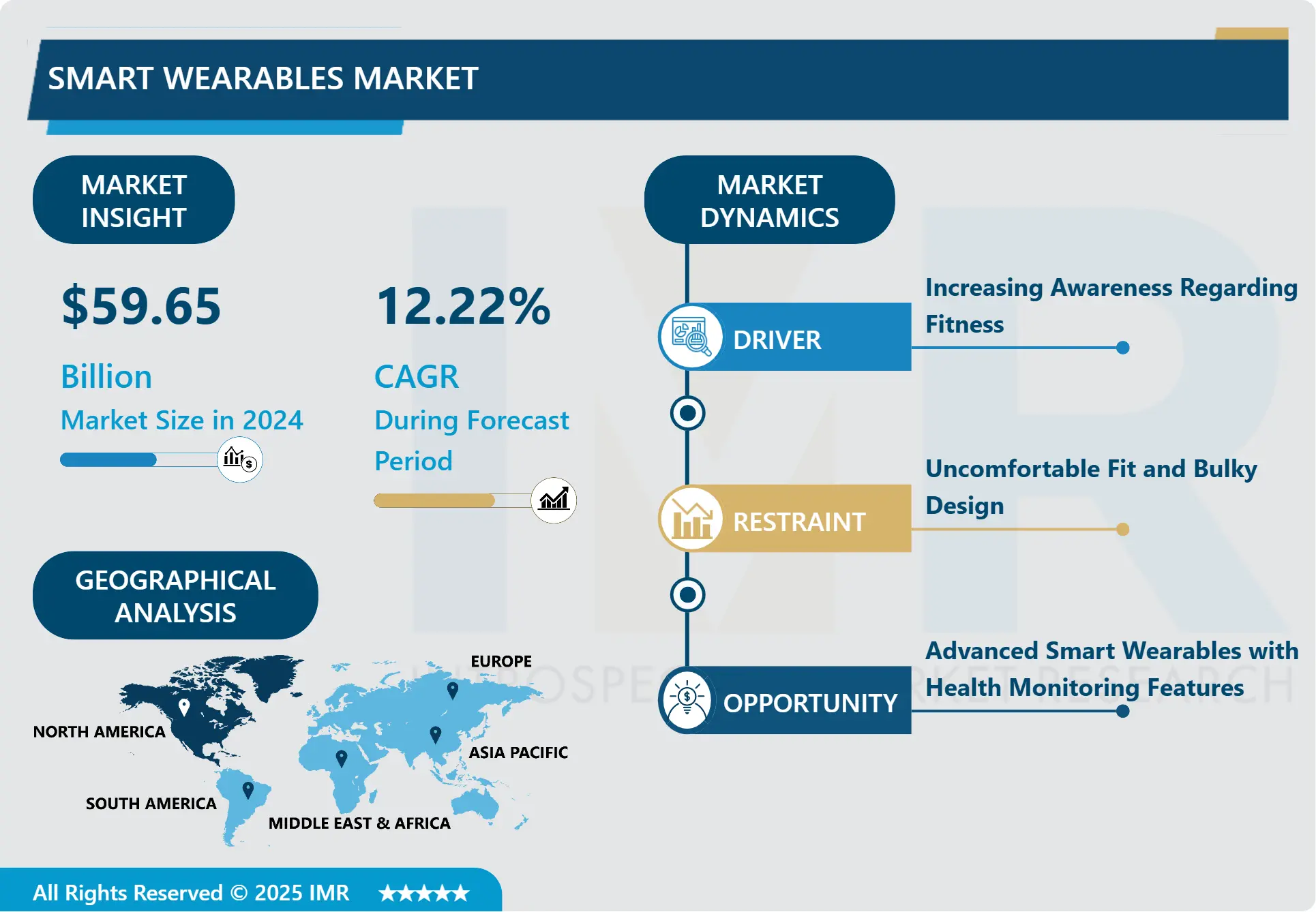
Smart Wearables Market Size Was Valued at USD 59.65 Billion in 2024 and is Projected to Reach USD 150.02 Billion by 2032, Growing at a CAGR of 12.22% From 2025-2032.
The market for smart wearables has experienced significant expansion lately, fueled by technological advancements and a rising consumer interest in health monitoring, fitness tracking, and effortless connectivity. Intelligent wearables, commonly called “wearables,” are electronic devices intended to be worn on or close to the skin. These gadgets utilize sensors to identify, examine, and send information concerning physical movement, biometric data, and environmental factors. Wearables have revolutionized consumer electronics, healthcare, and sectors such as fashion and gaming, thanks to their capacity to deliver real-time feedback and practical insights. The market includes a variety of gadgets like smartwatches, fitness trackers, smart rings, head-mounted displays, and smart apparel, each fulfilling different purposes. Intelligent wearables are battery-operated devices that incorporate sophisticated sensors, microprocessors, storage capabilities, and wireless connectivity options.
Smart Wearables such as the Garmin Venu 3 and Fitbit Charge 6 offer immediate insights on steps counted, distance covered, calories expended, and sleep quality. Enhanced health tracking functionalities, such as heart rate tracking, ECG features, and blood oxygen level assessments, enable users to manage their health effectively. This availability of information motivates individuals to embrace healthier habits. The healthcare sector greatly benefits from wearable technology. Intelligent wearables like smartwatches and fitness trackers permit the remote observation of vital signs, such as blood pressure, body temperature, and oxygen saturation levels.
Smart Wearables Market Trend Analysis
Smart Wearables Market Growth Driver- Increasing Awareness Regarding Fitness
The increasing consciousness about health and general wellness has emerged as a major catalyst for the smart wearables industry. As fitness increasingly becomes a focal point in consumers’ lives, smart wearables are advancing to fulfill the need for more tailored and thorough health monitoring options. This change is evident in the evolving reasons for exercising, with 40% of people currently utilizing exercise to enhance mental health and almost one-third emphasizing fitness to maintain long and healthy lives. The uptake of smart wearables is fueled by their capacity to function as personal health aides, offering immediate insights into users’ well-being.
Modern devices provide functionalities that extend well beyond merely counting steps, including monitoring heart rate variability and examining sleep stages. In regions such as the U.S., U.K., Spain, and Switzerland, unprecedented fitness participation and membership levels significantly enhance the industry of wearables.
The emergence of Millennials and Gen Z as significant wellness consumers strengthens this trend. Younger age groups are attracted to wearable devices that combine fitness, nutrition, mindfulness, and sleep monitoring, rendering them essential tools for comprehensive health management. Significantly, as three in four consumers view wellness as increasingly essential, and 65% place it above leisure spending, the readiness.
Smart Wearables Market Opportunity- Advanced Smart Wearables with Health Monitoring Features
The market for smart wearables is set for considerable expansion, fueled by progress in health tracking capabilities and new applications. By incorporating non-invasive health assessment technologies, including blood glucose monitoring, products like the JCRing Smart Health Ring represent the evolution of wearable technology. New developments in wearable technology, including smart apparel and smart accessories, demonstrate the industry’s possibilities. Intelligent garments embed sensors in fabrics to track vital signs, whereas smart accessories such as rings and necklaces monitor activity levels and heart rates. Applications of augmented and virtual reality for pain relief, surgical education, and mental health therapy are broadening the range of wearable healthcare options.
The influence of these technologies on the healthcare sector is significant. Wearable medical devices provide real-time health data that allows for remote monitoring, lessening hospital visits and avoiding readmissions. This ability improves diagnostic precision, speeds up treatment, and enhances patient results. Wearable devices enable early identification of health concerns, aiding in reducing expensive treatments and enhancing healthcare efficiency by automating regular tasks.
Smart Wearables Market Segment Analysis:
Smart Wearables Market is segmented on the basis of product type, connectivity application, distribution channel and end-users.
By Product Type, Smartwatches segment is expected to dominate the market during the forecast period
The smartwatch market presents extensive opportunities, with an anticipated penetration rate of 12.34% by 2032 and a global user base forecasted to hit 740.53 million. By 2024, around 180 million smartwatches are expected to be shipped, fueled by consumers placing greater emphasis on health and fitness monitoring capabilities. It is anticipated that 70% of consumers will focus on these features, highlighting how smartwatch capabilities resonate with the increasing health awareness among users. These trends reflect overall expansion in the smart wearables sector, highlighting a transition toward health-focused innovations. The combination of wearable tech and healthcare enables people to take charge of their health management and offers a chance for the smart wearables market to grow via improved data integration and user-focused features.
By Application, Fitness and Physical Activity segment held the largest share of 39.37% in 2024
The worldwide increase in inadequate physical activity has greatly amplified the importance of smart wearables in encouraging health and fitness. Devices like fitness trackers and smartwatches have turned into vital instruments for people looking to embrace healthier living. Smart wearables meet the increasing need for accessible and effective fitness solutions by allowing users to track their physical activity, establish attainable goals, and obtain tailored insights. The growing recognition of physical activity’s importance in preventing chronic diseases such as heart disease, diabetes, and depression has heightened the attractiveness of these devices.
Smart Wearables Market Regional Insights:
North America is Expected to Dominate the Market Over the Forecast period
The North American smart wearables market is growing rapidly, driven by growing consumer interest in health, fitness, and convenience. As of 2023, the U.S. will have 86.7 million users, or 26.4% of the population, with adoption rates particularly high among adults ages 35-44. Wearables are being used to track health metrics, with the introduction of the Apple Watch Series 9 highlighting innovation in the industry.
The smart wearable market mirrors the trends seen in the U.S., with 31% of Canadians adopting wearable devices by 2023. This widespread usage is fueled by the integration of wearables into Canada’s healthcare system, with devices like Abbott’s FreeStyle Libre glucose monitor becoming essential for diabetic patients..
Active Key Players in the Smart Wearables Market
Google Fitbit (USA)
Samsung (South Korea)
Omron Healthcare (Japan)
Zepp Inc. (China)
Garmin Ltd. (USA)
Imagine Marketing Limited (India)
Huawei Technologies Co., Ltd. (China)
Fossil Group Inc. (USA)
Xiaomi (China)
Diesel S.p.A. (Vicenza, Italy)
Puma (Germany)
Oura Health OY (Finland)
Shenzhen Starmax Technology Company Ltd (China)
Polar Electro (Finland)
Wellue (China)
Muse Wearables (Canada)
Oppo (China)
Realme (China)
Withings (France)
Whoop (USA)
Shenzhen Huafurui Technology Co., Ltd (Shenzhen, China)
CMF.TECH (China), and Other Active players
Key Industry Developments in the Smart Wearables Market:
In November 2024, Dexcom and ?URA announced a strategic partnership to enhance metabolic health management by integrating Dexcom glucose data with ?URA’s vital signs, sleep, stress, heart health, and activity metrics. This collaboration aimed to provide users with comprehensive health insights. Dexcom invested $75 million in ?URA’s Series D funding, valuing the company at over $5 billion. The first app integration was expected in 2025, with both companies co-marketing their products to attract new users.
In July 2024, Realme officially launched the Watch S2 in India, alongside the Realme 13 Pro series. Featuring a sleek metal design, IP68 water resistance, and a 380mAh battery offering up to 20 days of usage, the smartwatch introduced an AI voice assistant powered by ChatGPT technology, enhancing functionality and customization for users.
Chapter 1: Introduction
1.1 Scope and Coverage
Chapter 2:Executive Summary
Chapter 3: Market Landscape
3.1 Market Dynamics
3.1.1 Drivers
3.1.2 Restraints
3.1.3 Opportunities
3.1.4 Challenges
3.2 Market Trend Analysis
3.3 PESTLE Analysis
3.4 Porter’s Five Forces Analysis
3.5 Industry Value Chain Analysis
3.6 Ecosystem
3.7 Regulatory Landscape
3.8 Price Trend Analysis
3.9 Patent Analysis
3.10 Technology Evolution
3.11 Investment Pockets
3.12 Import-Export Analysis
Chapter 4: Smart Wearables Market by Product Type (2018-2032)
4.1 Smart Wearables Market Snapshot and Growth Engine
4.2 Market Overview
4.3 Smartwatches
4.3.1 Introduction and Market Overview
4.3.2 Historic and Forecasted Market Size in Value USD and Volume Units
4.3.3 Key Market Trends, Growth Factors, and Opportunities
4.3.4 Geographic Segmentation Analysis
4.4 Fitness Trackers
4.5 Smart Rings
4.6 Others
Chapter 5: Smart Wearables Market by Connectivity (2018-2032)
5.1 Smart Wearables Market Snapshot and Growth Engine
5.2 Market Overview
5.3 Wi-Fi
5.3.1 Introduction and Market Overview
5.3.2 Historic and Forecasted Market Size in Value USD and Volume Units
5.3.3 Key Market Trends, Growth Factors, and Opportunities
5.3.4 Geographic Segmentation Analysis
5.4 Cellular Data
5.5 Bluetooth
5.6 Near Field Communication
Chapter 6: Smart Wearables Market by Application (2018-2032)
6.1 Smart Wearables Market Snapshot and Growth Engine
6.2 Market Overview
6.3 Chronic Disease
6.3.1 Introduction and Market Overview
6.3.2 Historic and Forecasted Market Size in Value USD and Volume Units
6.3.3 Key Market Trends, Growth Factors, and Opportunities
6.3.4 Geographic Segmentation Analysis
6.4 Management
6.5 Fitness And Physical
6.6 Activity
6.7 Sleep Monitoring
6.8 Mental Health Monitoring
6.9 Women’s Health
6.10 Monitoring
6.11 Others
Chapter 7: Smart Wearables Market by Distribution Channel (2018-2032)
7.1 Smart Wearables Market Snapshot and Growth Engine
7.2 Market Overview
7.3 Specialty/ Conventional
7.3.1 Introduction and Market Overview
7.3.2 Historic and Forecasted Market Size in Value USD and Volume Units
7.3.3 Key Market Trends, Growth Factors, and Opportunities
7.3.4 Geographic Segmentation Analysis
7.4 Stores
7.5 Supermarkets/
7.6 Hypermarkets
7.7 Online
Chapter 8: Smart Wearables Market by End Users (2018-2032)
8.1 Smart Wearables Market Snapshot and Growth Engine
8.2 Market Overview
8.3 Individual Consumers
8.3.1 Introduction and Market Overview
8.3.2 Historic and Forecasted Market Size in Value USD and Volume Units
8.3.3 Key Market Trends, Growth Factors, and Opportunities
8.3.4 Geographic Segmentation Analysis
8.4 Healthcare
8.5 Sports And Fitness
8.6 Industry
8.7 Retirement Homes
8.8 Military
8.9 Others
Chapter 9: Company Profiles and Competitive Analysis
9.1 Competitive Landscape
9.1.1 Competitive Benchmarking
9.1.2 Smart Wearables Market Share by Manufacturer (2024)
9.1.3 Industry BCG Matrix
9.1.4 Heat Map Analysis
9.1.5 Mergers and Acquisitions
9.2 GOOGLE FITBIT (USA)
9.2.1 Company Overview
9.2.2 Key Executives
9.2.3 Company Snapshot
9.2.4 Role of the Company in the Market
9.2.5 Sustainability and Social Responsibility
9.2.6 Operating Business Segments
9.2.7 Product Portfolio
9.2.8 Business Performance
9.2.9 Key Strategic Moves and Recent Developments
9.2.10 SWOT Analysis
9.3 SAMSUNG (SOUTH KOREA)
9.4 OMRON HEALTHCARE (JAPAN)
9.5 ZEPP INC. (CHINA)
9.6 GARMIN LTD. (USA)
9.7 IMAGINE MARKETING LIMITED (INDIA)
9.8 HUAWEI TECHNOLOGIES COLTD. (CHINA)
9.9 FOSSIL GROUP INC. (USA)
9.10 XIAOMI (CHINA)
9.11 DIESEL S.P.A. (VICENZA
9.12 ITALY)
9.13 PUMA (GERMANY)
9.14 OURA HEALTH OY (FINLAND)
9.15 SHENZHEN STARMAX TECHNOLOGY COMPANY LTD (CHINA)
9.16 POLAR ELECTRO (FINLAND)
9.17 WELLUE (CHINA)
9.18 MUSE WEARABLES (CANADA)
9.19 OPPO (CHINA)
9.20 REALME (CHINA)
9.21 WITHINGS (FRANCE)
9.22 WHOOP (USA)
9.23 SHENZHEN HUAFURUI TECHNOLOGY COLTD (SHENZHEN
9.24 CHINA)
9.25 CMF.TECH (CHINA)
9.26 AND
Chapter 10: Global Smart Wearables Market By Region
10.1 Overview
10.2. North America Smart Wearables Market
10.2.1 Key Market Trends, Growth Factors and Opportunities
10.2.2 Top Key Companies
10.2.3 Historic and Forecasted Market Size by Segments
10.2.4 Historic and Forecasted Market Size by Product Type
10.2.4.1 Smartwatches
10.2.4.2 Fitness Trackers
10.2.4.3 Smart Rings
10.2.4.4 Others
10.2.5 Historic and Forecasted Market Size by Connectivity
10.2.5.1 Wi-Fi
10.2.5.2 Cellular Data
10.2.5.3 Bluetooth
10.2.5.4 Near Field Communication
10.2.6 Historic and Forecasted Market Size by Application
10.2.6.1 Chronic Disease
10.2.6.2 Management
10.2.6.3 Fitness And Physical
10.2.6.4 Activity
10.2.6.5 Sleep Monitoring
10.2.6.6 Mental Health Monitoring
10.2.6.7 Women’s Health
10.2.6.8 Monitoring
10.2.6.9 Others
10.2.7 Historic and Forecasted Market Size by Distribution Channel
10.2.7.1 Specialty/ Conventional
10.2.7.2 Stores
10.2.7.3 Supermarkets/
10.2.7.4 Hypermarkets
10.2.7.5 Online
10.2.8 Historic and Forecasted Market Size by End Users
10.2.8.1 Individual Consumers
10.2.8.2 Healthcare
10.2.8.3 Sports And Fitness
10.2.8.4 Industry
10.2.8.5 Retirement Homes
10.2.8.6 Military
10.2.8.7 Others
10.2.9 Historic and Forecast Market Size by Country
10.2.9.1 US
10.2.9.2 Canada
10.2.9.3 Mexico
10.3. Eastern Europe Smart Wearables Market
10.3.1 Key Market Trends, Growth Factors and Opportunities
10.3.2 Top Key Companies
10.3.3 Historic and Forecasted Market Size by Segments
10.3.4 Historic and Forecasted Market Size by Product Type
10.3.4.1 Smartwatches
10.3.4.2 Fitness Trackers
10.3.4.3 Smart Rings
10.3.4.4 Others
10.3.5 Historic and Forecasted Market Size by Connectivity
10.3.5.1 Wi-Fi
10.3.5.2 Cellular Data
10.3.5.3 Bluetooth
10.3.5.4 Near Field Communication
10.3.6 Historic and Forecasted Market Size by Application
10.3.6.1 Chronic Disease
10.3.6.2 Management
10.3.6.3 Fitness And Physical
10.3.6.4 Activity
10.3.6.5 Sleep Monitoring
10.3.6.6 Mental Health Monitoring
10.3.6.7 Women’s Health
10.3.6.8 Monitoring
10.3.6.9 Others
10.3.7 Historic and Forecasted Market Size by Distribution Channel
10.3.7.1 Specialty/ Conventional
10.3.7.2 Stores
10.3.7.3 Supermarkets/
10.3.7.4 Hypermarkets
10.3.7.5 Online
10.3.8 Historic and Forecasted Market Size by End Users
10.3.8.1 Individual Consumers
10.3.8.2 Healthcare
10.3.8.3 Sports And Fitness
10.3.8.4 Industry
10.3.8.5 Retirement Homes
10.3.8.6 Military
10.3.8.7 Others
10.3.9 Historic and Forecast Market Size by Country
10.3.9.1 Russia
10.3.9.2 Bulgaria
10.3.9.3 The Czech Republic
10.3.9.4 Hungary
10.3.9.5 Poland
10.3.9.6 Romania
10.3.9.7 Rest of Eastern Europe
10.4. Western Europe Smart Wearables Market
10.4.1 Key Market Trends, Growth Factors and Opportunities
10.4.2 Top Key Companies
10.4.3 Historic and Forecasted Market Size by Segments
10.4.4 Historic and Forecasted Market Size by Product Type
10.4.4.1 Smartwatches
10.4.4.2 Fitness Trackers
10.4.4.3 Smart Rings
10.4.4.4 Others
10.4.5 Historic and Forecasted Market Size by Connectivity
10.4.5.1 Wi-Fi
10.4.5.2 Cellular Data
10.4.5.3 Bluetooth
10.4.5.4 Near Field Communication
10.4.6 Historic and Forecasted Market Size by Application
10.4.6.1 Chronic Disease
10.4.6.2 Management
10.4.6.3 Fitness And Physical
10.4.6.4 Activity
10.4.6.5 Sleep Monitoring
10.4.6.6 Mental Health Monitoring
10.4.6.7 Women’s Health
10.4.6.8 Monitoring
10.4.6.9 Others
10.4.7 Historic and Forecasted Market Size by Distribution Channel
10.4.7.1 Specialty/ Conventional
10.4.7.2 Stores
10.4.7.3 Supermarkets/
10.4.7.4 Hypermarkets
10.4.7.5 Online
10.4.8 Historic and Forecasted Market Size by End Users
10.4.8.1 Individual Consumers
10.4.8.2 Healthcare
10.4.8.3 Sports And Fitness
10.4.8.4 Industry
10.4.8.5 Retirement Homes
10.4.8.6 Military
10.4.8.7 Others
10.4.9 Historic and Forecast Market Size by Country
10.4.9.1 Germany
10.4.9.2 UK
10.4.9.3 France
10.4.9.4 The Netherlands
10.4.9.5 Italy
10.4.9.6 Spain
10.4.9.7 Rest of Western Europe
10.5. Asia Pacific Smart Wearables Market
10.5.1 Key Market Trends, Growth Factors and Opportunities
10.5.2 Top Key Companies
10.5.3 Historic and Forecasted Market Size by Segments
10.5.4 Historic and Forecasted Market Size by Product Type
10.5.4.1 Smartwatches
10.5.4.2 Fitness Trackers
10.5.4.3 Smart Rings
10.5.4.4 Others
10.5.5 Historic and Forecasted Market Size by Connectivity
10.5.5.1 Wi-Fi
10.5.5.2 Cellular Data
10.5.5.3 Bluetooth
10.5.5.4 Near Field Communication
10.5.6 Historic and Forecasted Market Size by Application
10.5.6.1 Chronic Disease
10.5.6.2 Management
10.5.6.3 Fitness And Physical
10.5.6.4 Activity
10.5.6.5 Sleep Monitoring
10.5.6.6 Mental Health Monitoring
10.5.6.7 Women’s Health
10.5.6.8 Monitoring
10.5.6.9 Others
10.5.7 Historic and Forecasted Market Size by Distribution Channel
10.5.7.1 Specialty/ Conventional
10.5.7.2 Stores
10.5.7.3 Supermarkets/
10.5.7.4 Hypermarkets
10.5.7.5 Online
10.5.8 Historic and Forecasted Market Size by End Users
10.5.8.1 Individual Consumers
10.5.8.2 Healthcare
10.5.8.3 Sports And Fitness
10.5.8.4 Industry
10.5.8.5 Retirement Homes
10.5.8.6 Military
10.5.8.7 Others
10.5.9 Historic and Forecast Market Size by Country
10.5.9.1 China
10.5.9.2 India
10.5.9.3 Japan
10.5.9.4 South Korea
10.5.9.5 Malaysia
10.5.9.6 Thailand
10.5.9.7 Vietnam
10.5.9.8 The Philippines
10.5.9.9 Australia
10.5.9.10 New Zealand
10.5.9.11 Rest of APAC
10.6. Middle East & Africa Smart Wearables Market
10.6.1 Key Market Trends, Growth Factors and Opportunities
10.6.2 Top Key Companies
10.6.3 Historic and Forecasted Market Size by Segments
10.6.4 Historic and Forecasted Market Size by Product Type
10.6.4.1 Smartwatches
10.6.4.2 Fitness Trackers
10.6.4.3 Smart Rings
10.6.4.4 Others
10.6.5 Historic and Forecasted Market Size by Connectivity
10.6.5.1 Wi-Fi
10.6.5.2 Cellular Data
10.6.5.3 Bluetooth
10.6.5.4 Near Field Communication
10.6.6 Historic and Forecasted Market Size by Application
10.6.6.1 Chronic Disease
10.6.6.2 Management
10.6.6.3 Fitness And Physical
10.6.6.4 Activity
10.6.6.5 Sleep Monitoring
10.6.6.6 Mental Health Monitoring
10.6.6.7 Women’s Health
10.6.6.8 Monitoring
10.6.6.9 Others
10.6.7 Historic and Forecasted Market Size by Distribution Channel
10.6.7.1 Specialty/ Conventional
10.6.7.2 Stores
10.6.7.3 Supermarkets/
10.6.7.4 Hypermarkets
10.6.7.5 Online
10.6.8 Historic and Forecasted Market Size by End Users
10.6.8.1 Individual Consumers
10.6.8.2 Healthcare
10.6.8.3 Sports And Fitness
10.6.8.4 Industry
10.6.8.5 Retirement Homes
10.6.8.6 Military
10.6.8.7 Others
10.6.9 Historic and Forecast Market Size by Country
10.6.9.1 Turkiye
10.6.9.2 Bahrain
10.6.9.3 Kuwait
10.6.9.4 Saudi Arabia
10.6.9.5 Qatar
10.6.9.6 UAE
10.6.9.7 Israel
10.6.9.8 South Africa
10.7. South America Smart Wearables Market
10.7.1 Key Market Trends, Growth Factors and Opportunities
10.7.2 Top Key Companies
10.7.3 Historic and Forecasted Market Size by Segments
10.7.4 Historic and Forecasted Market Size by Product Type
10.7.4.1 Smartwatches
10.7.4.2 Fitness Trackers
10.7.4.3 Smart Rings
10.7.4.4 Others
10.7.5 Historic and Forecasted Market Size by Connectivity
10.7.5.1 Wi-Fi
10.7.5.2 Cellular Data
10.7.5.3 Bluetooth
10.7.5.4 Near Field Communication
10.7.6 Historic and Forecasted Market Size by Application
10.7.6.1 Chronic Disease
10.7.6.2 Management
10.7.6.3 Fitness And Physical
10.7.6.4 Activity
10.7.6.5 Sleep Monitoring
10.7.6.6 Mental Health Monitoring
10.7.6.7 Women’s Health
10.7.6.8 Monitoring
10.7.6.9 Others
10.7.7 Historic and Forecasted Market Size by Distribution Channel
10.7.7.1 Specialty/ Conventional
10.7.7.2 Stores
10.7.7.3 Supermarkets/
10.7.7.4 Hypermarkets
10.7.7.5 Online
10.7.8 Historic and Forecasted Market Size by End Users
10.7.8.1 Individual Consumers
10.7.8.2 Healthcare
10.7.8.3 Sports And Fitness
10.7.8.4 Industry
10.7.8.5 Retirement Homes
10.7.8.6 Military
10.7.8.7 Others
10.7.9 Historic and Forecast Market Size by Country
10.7.9.1 Brazil
10.7.9.2 Argentina
10.7.9.3 Rest of SA
Chapter 11 Analyst Viewpoint and Conclusion
11.1 Recommendations and Concluding Analysis
11.2 Potential Market Strategies
Chapter 12 Research Methodology
12.1 Research Process
12.2 Primary Research
12.3 Secondary Research
Q1: What would be the forecast period in the Smart Wearables Market research report?
A1: The forecast period in the Smart Wearables Market research report is 2025-2032.
Q2: Who are the key players in the Smart Wearables Market?
A2: Google Fitbit (USA), Samsung (South Korea), Omron Healthcare (Japan), Zepp Inc. (China), Garmin Ltd. (USA), Imagine Marketing Limited (India), Huawei Technologies Co., Ltd. (China), Fossil Group Inc. (USA), Xiaomi (China), Diesel S.p.A. (Breganze, Vicenza, Italy), Puma (Germany), Oura Health OY (Oulu, Finland), Shenzhen Starmax Technology Company Ltd (China), Polar Electro (Finland), Wellue (China), Muse Wearables (Canada), Oppo (China), Realme (China), Withings (France), Whoop (USA), Shenzhen Huafurui Technology Co., Ltd (China), CMF.TECH (China), and Other Active Players.
Q3: What are the segments of the Smart Wearables Market?
A3: The Smart Wearables Market is segmented into Product Type, Connectivity, Application, Distribution Channel, End-User and region. By Product Type, the market is categorized into Smartwatches, Fitness, Trackers, Smart Rings, Others. By Connectivity, the market is categorized into Wi-Fi, Cellular Data, Bluetooth, Near Field Communication. By Application, the market is categorized into Chronic Disease Management, Fitness and Physical Activity, Sleep Monitoring, Mental Health Monitoring, Women’s Health Monitoring, Others. By Distribution Channel, the market is categorized into Specialty/ Conventional Stores, Supermarkets/ Hypermarkets, Online. By End-User, the market is categorized into Individual Consumers, Healthcare, Sports And Fitness Industry, Retirement Homes, Military, Others. By region, it is analyzed across North America (U.S.; Canada; Mexico), Eastern Europe (Bulgaria; The Czech Republic; Hungary; Poland; Romania; Rest of Eastern Europe), Western Europe (Germany; UK; France; Netherlands; Italy; Russia; Spain; Rest of Western Europe), Asia-Pacific (China; India; Japan; Southeast Asia, etc.), South America (Brazil; Argentina, etc.), Middle East & Africa (Saudi Arabia; South Africa, etc.).
Q4: What is the Smart Wearables Market?
A4: The market for smart wearables has experienced significant expansion lately, fueled by technological advancements and a rising consumer interest in health monitoring, fitness tracking, and effortless connectivity. Intelligent wearables, commonly called "wearables," are electronic devices intended to be worn on or close to the skin. These gadgets utilize sensors to identify, examine, and send information concerning physical movement, biometric data, and environmental factors. Wearables have revolutionized consumer electronics, healthcare, and sectors such as fashion and gaming, thanks to their capacity to deliver real-time feedback and practical insights. The market includes a variety of gadgets like smartwatches, fitness trackers, smart rings, head-mounted displays, and smart apparel, each fulfilling different purposes. Intelligent wearables are battery-operated devices that incorporate sophisticated sensors, microprocessors, storage capabilities, and wireless connectivity options.
Q5: How big is the Smart Wearables Market?
A5: Smart Wearables Market Size Was Valued at USD 59.65 Billion in 2024 and is Projected to Reach USD 150.02 Billion by 2032, Growing at a CAGR of 12.22% From 2025-2032.
How to Buy a Report from eminsights.jp
On the product page, choose the license you want: Single-User License, Multi-User License or Enterprise License.
If you required report in your native language, then you can click on Translated Report button and fill out the form with report name and language you want, then our team will contact you as soon as possible.
Click the Buy Now button.
You will be redirected to the checkout page. Enter your company details and payment information.
Click Place Order to complete the purchase.
Confirmation: You’ll receive an order confirmation and our team will contact you shortly with your ordered report.
If you have any questions, fill out the contact form below or email us at bizdev@eminsights.net.
Thank you for choosing eminsights.jp!