Stay Ahead in Fast-Growing Economies.
Browse Reports Now
Smart Voice Translator Market – In-Deep Analysis Focusing on Market Share 2025-2032
The Smart Voice Translator market represents a rapidly evolving sector driven by advancements in artificial intelligence, natural language processing (NLP), and real-time machine learning algorithms. These technologies enable devices and software to translate spoken language into another language with high accuracy, often in both text and speech formats. Smart speech translator applications, in particular, detect a user’s voice and convert it into written text in the desired language, making them valuable tools for travel, business, education, and accessibility.

IMR Group
Description
Smart Voice Translator Market Synopsis:
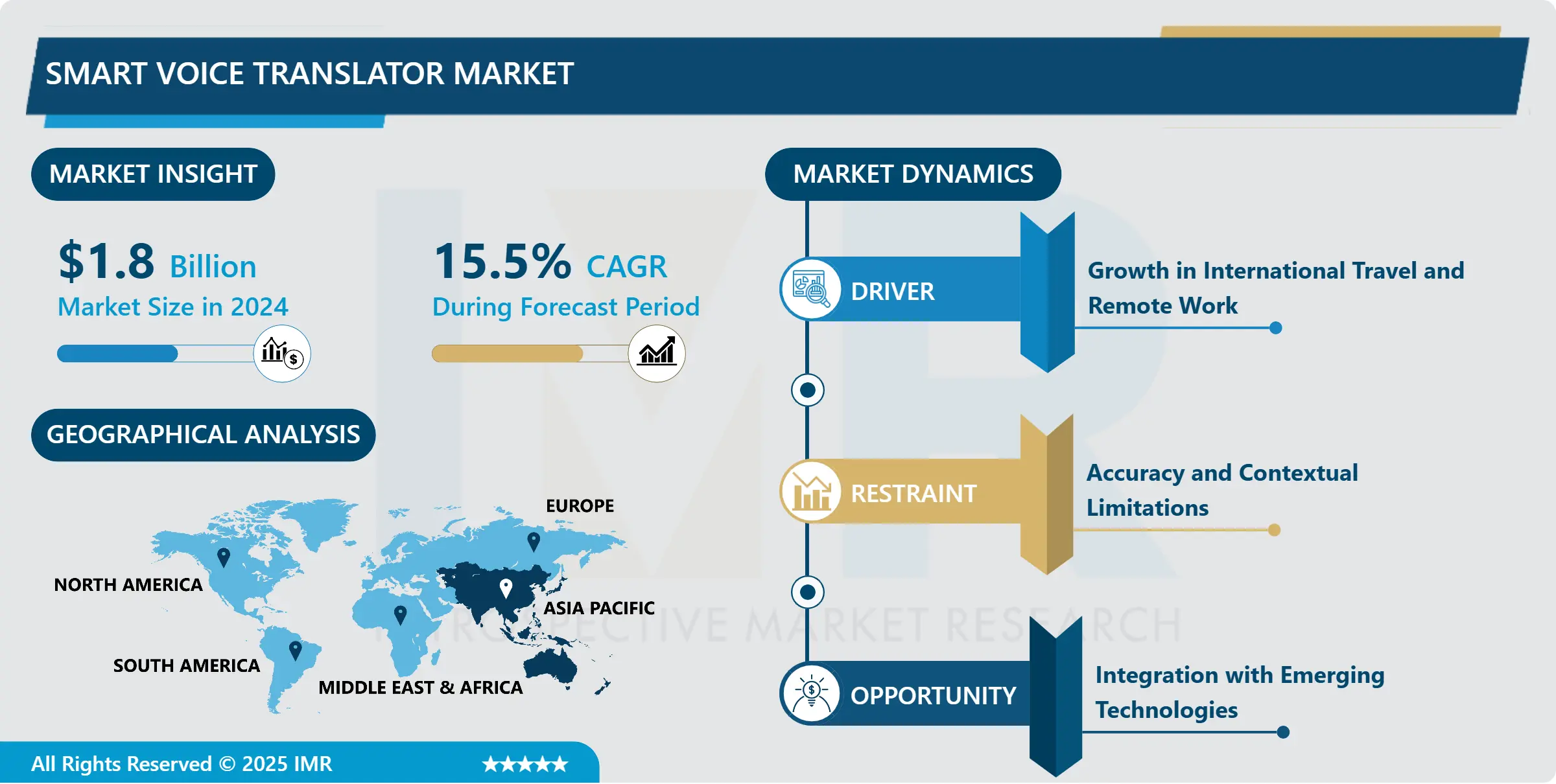
Smart Voice Translator Market Size Was Valued at USD 1.8 Billion in 2024, and is Projected to Reach USD 5.70 Billion by 2032, Growing at a CAGR of 15.5% from 2025-2032.
The Smart Voice Translator market represents a rapidly evolving sector driven by advancements in artificial intelligence, natural language processing (NLP), and real-time machine learning algorithms. These technologies enable devices and software to translate spoken language into another language with high accuracy, often in both text and speech formats. Smart speech translator applications, in particular, detect a user’s voice and convert it into written text in the desired language, making them valuable tools for travel, business, education, and accessibility.
This market is experiencing robust growth due to increasing globalization, international travel, and the need for seamless cross-cultural communication. Demand is fueled by both individual consumers such as tourists, students, and expatriates and enterprise users across healthcare, customer service, and multinational corporations. Devices range from handheld translators and mobile apps to wearable tech integrated with smart earbuds and watches, often featuring both online and offline functionality for added convenience.
Emerging trends include the integration of voice translators with augmented reality (AR), 5G connectivity for instant cloud processing, and enhanced privacy through offline translation options. As AI models improve in contextual understanding and localization, the smart voice translator market is set to become a key player in the future of real-time global communication.
Smart Voice Translator Market Growth and Trend Analysis:
Growth in International Travel and Remote Work
The surge in international travel, coupled with the rise of remote and hybrid work cultures, is significantly driving demand for smart voice translators. With more professionals and tourists engaging across language barriers, real-time translation has become a necessity rather than a luxury.
Freelancers, digital nomads, and multinational teams are increasingly relying on these tools for smoother communication during meetings, negotiations, or day-to-day interactions. This trend is reinforced by the accessibility of translation apps and devices on smartphones and wearables, making them an everyday utility. As language diversity becomes more common in both professional and social settings, smart voice translators are evolving into essential productivity and travel tools.
Smart Voice Translator Market Limiting Factor
Accuracy and Contextual Limitations
Despite advancements in AI and NLP, smart voice translators still struggle with contextual accuracy, slang, idiomatic expressions, and cultural nuances. These limitations become evident in dynamic or sensitive conversations especially in business, healthcare, or legal settings where precise translation is critical. Misinterpretations can lead to confusion, miscommunication, or even offense.
Additionally, regional dialects and low-resource languages remain a challenge, as many systems are trained on standardized or widely spoken languages. These accuracy gaps reduce user trust and adoption in certain use cases, making human translators or bilingual support still necessary in high-stakes environments.
Smart Voice Translator Market Expansion Opportunity
Integration with Emerging Technologies
There is significant opportunity in integrating smart voice translators with emerging technologies like augmented reality (AR), virtual reality (VR), and smart glasses. For instance, real-time subtitles or translated text overlaid through AR can enhance user experience during multilingual interactions, tours, or training sessions. Additionally, combining voice translation with AI-driven virtual assistants could enable personalized, multilingual customer support across industries.
As hardware capabilities expand and 5G networks reduce latency, voice translation can become more immersive and instantaneous. These innovations could transform education, tourism, and workplace collaboration, positioning smart translators as core components of future communication ecosystems.
Smart Voice Translator Market Challenge Barrier
Data Privacy and Ethical Concerns
One of the major challenges in the smart voice translator market is ensuring data privacy and ethical handling of voice inputs. Many voice translation apps rely on cloud-based processing, which involves transmitting and storing users’ spoken data. This raises concerns about unauthorized data access, surveillance, and compliance with privacy laws like GDPR or CCPA. Users are becoming more cautious about how their voice data is used, especially in sensitive conversations.
Ensuring transparency, offering offline capabilities, and adopting privacy-by-design principles are essential to building trust and driving adoption, particularly in sectors like healthcare and legal services where confidentiality is paramount.
Smart Voice Translator Market Segment Analysis:
Smart Voice Translator Market is segmented based on Type, Application, End-Users, and Region
By Type, Hybrid Segment is Expected to Dominate the Market During the Forecast Period
The Hybrid Translator driven by its unique blend of offline accessibility and online AI-powered accuracy. These devices offer the flexibility to function without internet access ideal for travel or remote use while leveraging advanced machine learning and cloud processing when connected to deliver more accurate, context-aware translations.
This dual capability addresses key limitations faced by standalone offline or online-only translators, making hybrids highly attractive to a wide range of users, from tourists and students to professionals in healthcare, business, and customer service. As AI continues to evolve and connectivity improves globally, hybrid translators will stand out for their reliability, adaptability, and enhanced user experience. Their growing integration into wearables and smart ecosystems further supports their dominance in a market that demands both convenience and performance.
By End-user, Individual Consumers Segment Held the Largest Share in 2024
The market for smart voice translators was dominated in 2024 by the Individual Consumers sector. The increasing need for real-time translation tools among tourists, students, foreigners, and language learners was the driving force behind this domination. The technology became more accessible to regular people thanks to the proliferation of reasonably priced handheld devices, smartphone apps, and wearable translators.
Additionally, the need for speech translation services grew as remote learning, cross-border communication, and international travel gained prominence. Customers preferred apps and gadgets that were portable and convenient, particularly hybrid models that functioned both online and offline. In the upcoming years, the consumer segment is anticipated to continue to be a major driver of growth in the smart voice translator market as people’s personal use of digital devices continues to increase.
Smart Voice Translator Market Regional Insights:
Asia-Pacific region is anticipated to lead the smart voice translator market throughout the forecast period
Increased cross-border corporate activity, a rise in international tourism, and a linguistically diverse landscape spanning nations like China, Japan, South Korea, and India are the main drivers of this increase. There is a high demand for real-time translation solutions in the region due to the quick adoption of smart devices, increased internet penetration, and a tech-savvy populace.
Government programs encouraging multilingual communication and digital education in fields like public services and healthcare also support industry growth. Asia-Pacific is positioned to lead in both consumer adoption and technology innovation throughout the course of the forecast period, thanks to major firms’ investments in localized language solutions and expansion of their presence in the region.
Smart Voice Translator Market Active Players:
Dosmono (China)
Ectaco (USA)
JoneR (China)
Langogo (China)
Logbar (USA)
Pulomi (India)
Sabertooth Tech Group, LLC (USA)
Shenzhen Beibo Intelligent Technology Co., Ltd. (China)
Shenzhen Timekettle Technologies Co., Ltd. China)
Sourcenext (Japan)
SSK Corporation (USA)
Travis (USA)
Vasco Electronics (Poland)
Vsoontech Electronics Co., Limited (China)
Other Active Players
Key Industry Developments in the Smart Voice Translator Market:
In January2025, At CES 2025, Timekettle launched its W4 Pro Earbuds featuring the new Babel OS, offering real-time two-way call translation across major communication platforms. The earbuds enabled seamless cross-lingual conversations with high accuracy and comfort, marking a significant advancement in AI-powered communication technology.
In October 2024, iFLYTEK unveiled its latest Smart Translator, highlighting advanced AI-powered speech and text translation capabilities. The company also introduced the AINOTE conference assistant to enhance multilingual collaboration and support seamless global communication.
In September2024, At the Meta Connect 2024 conference, Mark Zuckerberg launched AI-powered dubbing and real-time speech translation features. Meta began testing automatic dubbing with lip-syncing for Instagram and Facebook videos in English and Spanish, and introduced live translation for conversations via Ray-Ban Meta smart glasses.
Chapter 1: Introduction
1.1 Scope and Coverage
Chapter 2:Executive Summary
Chapter 3: Market Landscape
3.1 Market Dynamics and Opportunity Analysis
3.1.1 Growth Drivers
3.1.2 Limiting Factors
3.1.3 Growth Opportunities
3.1.4 Challenges and Risks
3.2 Market Trend Analysis
3.3 Industry Ecosystem
3.4 Industry Value Chain Mapping
3.5 Strategic PESTLE Overview
3.6 Porter’s Five Forces Framework
3.7 Regulatory Framework
3.8 Pricing Trend Analysis
3.9 Intellectual Property Review
3.10 Technology Evolution
3.11 Import-Export Analysis
3.12 Consumer Behavior Analysis
3.13 Investment Pocket Analysis
3.14 Go-To Market Strategy
Chapter 4: Smart Voice Translator Market by Type (2018-2032)
4.1 Smart Voice Translator Market Snapshot and Growth Engine
4.2 Market Overview
4.3 Offline Translator
4.3.1 Introduction and Market Overview
4.3.2 Historic and Forecasted Market Size in Value USD and Volume Units
4.3.3 Key Market Trends, Growth Factors, and Opportunities
4.3.4 Geographic Segmentation Analysis
4.4 Internet Translator
4.5 Hybrid
4.6 Wearables
Chapter 5: Smart Voice Translator Market by Application (2018-2032)
5.1 Smart Voice Translator Market Snapshot and Growth Engine
5.2 Market Overview
5.3 Travel
5.3.1 Introduction and Market Overview
5.3.2 Historic and Forecasted Market Size in Value USD and Volume Units
5.3.3 Key Market Trends, Growth Factors, and Opportunities
5.3.4 Geographic Segmentation Analysis
5.4 Financial Trade
5.5 Medical Industry
5.6 and Others
Chapter 6: Smart Voice Translator Market by End-User (2018-2032)
6.1 Smart Voice Translator Market Snapshot and Growth Engine
6.2 Market Overview
6.3 Individual Consumers
6.3.1 Introduction and Market Overview
6.3.2 Historic and Forecasted Market Size in Value USD and Volume Units
6.3.3 Key Market Trends, Growth Factors, and Opportunities
6.3.4 Geographic Segmentation Analysis
6.4 Businesses
6.5 Government & NGOs
Chapter 7: Company Profiles and Competitive Analysis
7.1 Competitive Landscape
7.1.1 Competitive Benchmarking
7.1.2 Smart Voice Translator Market Share by Manufacturer/Service Provider(2024)
7.1.3 Industry BCG Matrix
7.1.4 PArtnerships, Mergers & Acquisitions
7.2 DOSMONO (CHINA)
7.2.1 Company Overview
7.2.2 Key Executives
7.2.3 Company Snapshot
7.2.4 Role of the Company in the Market
7.2.5 Sustainability and Social Responsibility
7.2.6 Operating Business Segments
7.2.7 Product Portfolio
7.2.8 Business Performance
7.2.9 Recent News & Developments
7.2.10 SWOT Analysis
7.3 ECTACO (USA)
7.4 JONER (CHINA)
7.5 LANGOGO (CHINA)
7.6 LOGBAR (USA)
7.7 PULOMI (INDIA)
7.8 SABERTOOTH TECH GROUP
7.9 LLC (USA)
7.10 SHENZHEN BEIBO INTELLIGENT TECHNOLOGY CO.
7.11 LTD. (CHINA)
7.12 SHENZHEN TIMEKETTLE TECHNOLOGIES CO.
7.13 LTD. CHINA)
7.14 SOURCENEXT (JAPAN)
7.15 SSK CORPORATION (USA)
7.16 TRAVIS (USA)
7.17 VASCO ELECTRONICS (POLAND)
7.18 VSOONTECH ELECTRONICS CO.
7.19 LIMITED (CHINA)
7.20 OTHER ACTIVE PLAYERS
Chapter 8: Global Smart Voice Translator Market By Region
8.1 Overview
8.2. North America Smart Voice Translator Market
8.2.1 Key Market Trends, Growth Factors and Opportunities
8.2.2 Top Key Companies
8.2.3 Historic and Forecasted Market Size by Segments
8.2.4 Historic and Forecast Market Size by Country
8.2.4.1 US
8.2.4.2 Canada
8.2.4.3 Mexico
8.3. Eastern Europe Smart Voice Translator Market
8.3.1 Key Market Trends, Growth Factors and Opportunities
8.3.2 Top Key Companies
8.3.3 Historic and Forecasted Market Size by Segments
8.3.4 Historic and Forecast Market Size by Country
8.3.4.1 Russia
8.3.4.2 Bulgaria
8.3.4.3 The Czech Republic
8.3.4.4 Hungary
8.3.4.5 Poland
8.3.4.6 Romania
8.3.4.7 Rest of Eastern Europe
8.4. Western Europe Smart Voice Translator Market
8.4.1 Key Market Trends, Growth Factors and Opportunities
8.4.2 Top Key Companies
8.4.3 Historic and Forecasted Market Size by Segments
8.4.4 Historic and Forecast Market Size by Country
8.4.4.1 Germany
8.4.4.2 UK
8.4.4.3 France
8.4.4.4 The Netherlands
8.4.4.5 Italy
8.4.4.6 Spain
8.4.4.7 Rest of Western Europe
8.5. Asia Pacific Smart Voice Translator Market
8.5.1 Key Market Trends, Growth Factors and Opportunities
8.5.2 Top Key Companies
8.5.3 Historic and Forecasted Market Size by Segments
8.5.4 Historic and Forecast Market Size by Country
8.5.4.1 China
8.5.4.2 India
8.5.4.3 Japan
8.5.4.4 South Korea
8.5.4.5 Malaysia
8.5.4.6 Thailand
8.5.4.7 Vietnam
8.5.4.8 The Philippines
8.5.4.9 Australia
8.5.4.10 New Zealand
8.5.4.11 Rest of APAC
8.6. Middle East & Africa Smart Voice Translator Market
8.6.1 Key Market Trends, Growth Factors and Opportunities
8.6.2 Top Key Companies
8.6.3 Historic and Forecasted Market Size by Segments
8.6.4 Historic and Forecast Market Size by Country
8.6.4.1 Turkiye
8.6.4.2 Bahrain
8.6.4.3 Kuwait
8.6.4.4 Saudi Arabia
8.6.4.5 Qatar
8.6.4.6 UAE
8.6.4.7 Israel
8.6.4.8 South Africa
8.7. South America Smart Voice Translator Market
8.7.1 Key Market Trends, Growth Factors and Opportunities
8.7.2 Top Key Companies
8.7.3 Historic and Forecasted Market Size by Segments
8.7.4 Historic and Forecast Market Size by Country
8.7.4.1 Brazil
8.7.4.2 Argentina
8.7.4.3 Rest of SA
Chapter 9 Analyst Viewpoint and Conclusion
Chapter 10 Our Thematic Research Methodology
9.1 Research Process
9.2 Primary Research
9.3 Secondary Research
Chapter 11 Analyst Viewpoint and Conclusion
Chapter 12 Research Methodology
10.1 Research Process
10.2 Primary Research
10.3 Secondary Research
Chapter 13 Case Study
Chapter 14 Appendix
10.1 Sources
10.2 List of Tables and figures
10.3 Short Forms and Citations
10.4 Assumption and Conversion
10.5 Disclaimer
Q1: What is the Forecast Period Covered in the Smart Voice Translator Market Research Report?
A1: The projected forecast period for the Smart Voice Translator Market Research Report is 2025-2032.
Q2: Who are the Key Players in the Smart Voice Translator Market?
A2: Dosmono (China), Ectaco (USA), JoneR (China), Langogo (China), Logbar (USA), Pulomi (India), Sabertooth Tech Group, LLC (USA), Shenzhen Beibo Intelligent Technology Co., Ltd. (China), Shenzhen Timekettle Technologies Co., Ltd. China), Sourcenext (Japan), SSK Corporation (USA), Travis (USA), Vasco Electronics (Poland), Vsoontech Electronics Co., Limited (China), and Other Active Players.
Q3: How is the Smart Voice Translator Market segmented?
A3: The Smart Voice Translator Market is segmented into Type, Application, End-User, and Region. By Type, the market is categorized into Offline Translator, Internet Translator, Hybrid, and Wearables. By Application, the market is categorized into Travel, Financial Trade, Medical Industry, and Others. By End-User, the market is categorized into Individual Consumers, Businesses, and Government & NGOs. By Region, it is analyzed across North America (U.S.; Canada; Mexico), Eastern Europe (Russia; Bulgaria; The Czech Republic; Hungary; Poland; Romania; Rest of Eastern Europe), Western Europe (Germany; UK; France; The Netherlands; Italy; ; Spain; Rest of Western Europe), Asia-Pacific (China, India, Japan, South Korea, Malaysia, Thailand, Vietnam, The Philippines, Australia, New Zealand, Rest of APAC), Middle East & Africa (Türkiye, Bahrain, Kuwait, Saudi Arabia, Qatar, UAE, Israel, South Africa), South America (Brazil; Argentina, Rest of SA.).
Q4: What defines the Smart Voice Translator Market?
A4: The Smart Voice Translator market represents a rapidly evolving sector driven by advancements in artificial intelligence, natural language processing (NLP), and real-time machine learning algorithms. These technologies enable devices and software to translate spoken language into another language with high accuracy, often in both text and speech formats. Smart speech translator applications, in particular, detect a user's voice and convert it into written text in the desired language, making them valuable tools for travel, business, education, and accessibility.
Q5: What is the market size of the Smart Voice Translator Market?
A5: Smart Voice Translator Market Size Was Valued at USD 1.8 Billion in 2024, and is Projected to Reach USD 5.70 Billion by 2032, Growing at a CAGR of 15.5% from 2025-2032.
How to Buy a Report from eminsights.jp
On the product page, choose the license you want: Single-User License, Multi-User License or Enterprise License.
If you required report in your native language, then you can click on Translated Report button and fill out the form with report name and language you want, then our team will contact you as soon as possible.
Click the Buy Now button.
You will be redirected to the checkout page. Enter your company details and payment information.
Click Place Order to complete the purchase.
Confirmation: You’ll receive an order confirmation and our team will contact you shortly with your ordered report.
If you have any questions, fill out the contact form below or email us at bizdev@eminsights.net.
Thank you for choosing eminsights.jp!