Stay Ahead in Fast-Growing Economies.
Browse Reports Now




Smart Irrigation Market Report 2024-2032 | In-Deep Analysis Focusing on Market Share
The smart irrigation market is expanding rapidly as a result of the growing awareness of water conservation and the advancements in technology that facilitate more efficient water management for agriculture and landscaping. Smart irrigation systems employ sensors, automated controls, and weather data to optimize water consumption, minimize waste, and increase crop yields. The global water scarcity crisis and the increasing prevalence of precision agricultural techniques are the primary driving forces behind this market. As technology continues to evolve, we anticipate the integration of artificial intelligence and machine learning in smart irrigation solutions to further improve system efficiency and contribute to the market’s expansion.

IMR Group
Description
Smart Irrigation Market Synopsis
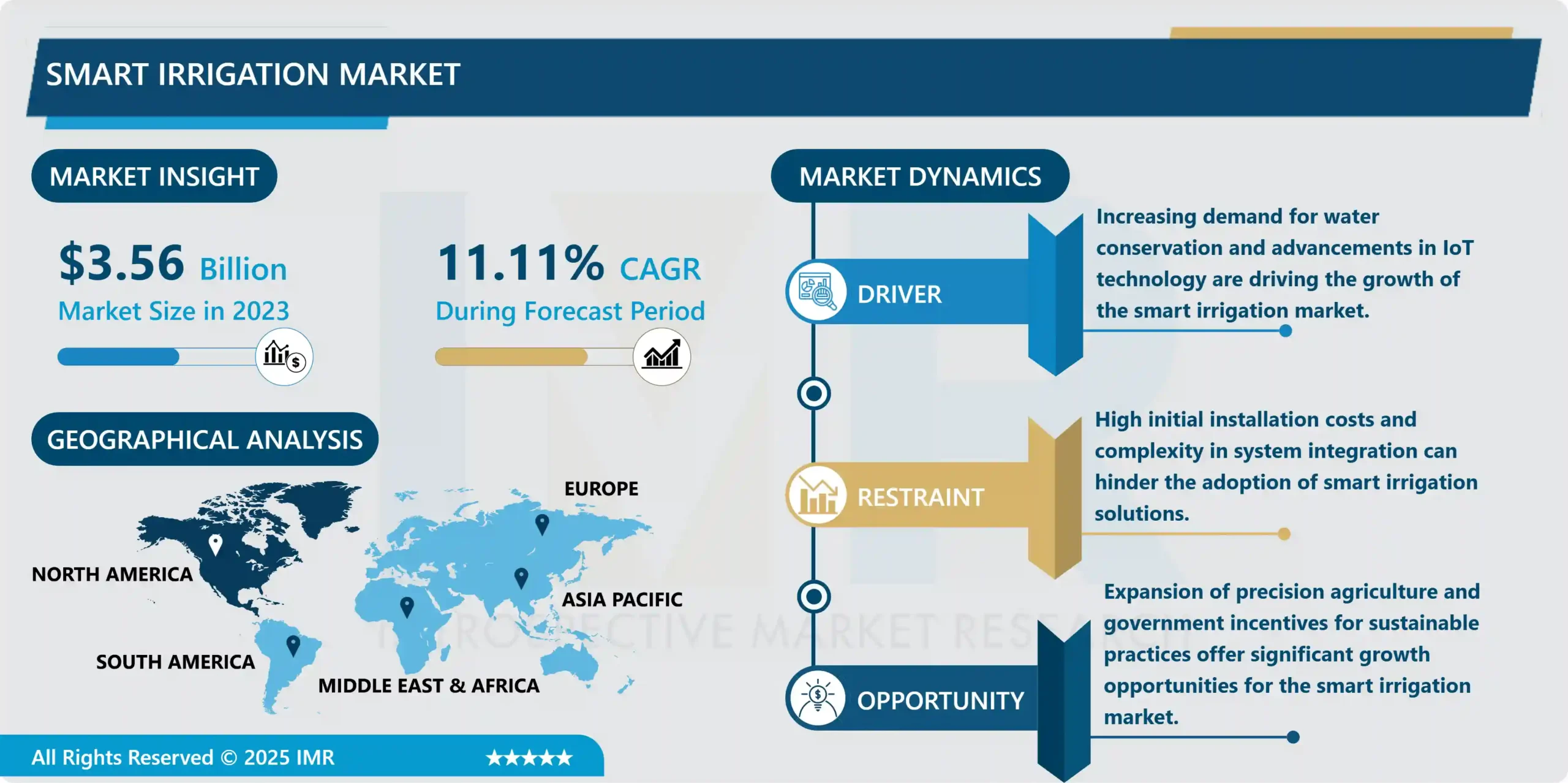
Smart Irrigation Market Size is Valued at USD 3.56 Billion in 2024 and is Projected to Reach USD 8.27 Billion by 2032, Growing at a CAGR of 11.11% From 2024-2032.
The smart irrigation market is expanding rapidly as a result of the growing awareness of water conservation and the advancements in technology that facilitate more efficient water management for agriculture and landscaping. Smart irrigation systems employ sensors, automated controls, and weather data to optimize water consumption, minimize waste, and increase crop yields. The global water scarcity crisis and the increasing prevalence of precision agricultural techniques are the primary driving forces behind this market. As technology continues to evolve, we anticipate the integration of artificial intelligence and machine learning in smart irrigation solutions to further improve system efficiency and contribute to the market’s expansion.
The smart irrigation market is expanding significantly due to the growing demand for efficient water management in agriculture. Advanced technologies, such as sensors, automated systems, and weather forecasting, are revolutionizing traditional irrigation methods by providing real-time data and precise water application.
The objective of this change is to reduce environmental impact, optimize water usage, and improve crop yields. The integration of AI and IoT technologies further improves the efficacy and scalability of smart irrigation solutions, rendering them highly appealing to both large-scale and small-scale farmers.
Rising water scarcity, stringent environmental regulations, and the increasing adoption of sustainable agricultural practices all influence market dynamics. Government initiatives and subsidies facilitate the market’s expansion by promoting contemporary agricultural practices.
As technology continues to advance and awareness of resource conservation increases, we anticipate the smart irrigation market to experience ongoing innovation and pervasive adoption, establishing itself as a critical element in the future of agriculture.
Smart Irrigation Market Trend Analysis
Integration of IoT and AI Technologies
The integration of AI and IoT technologies is transforming the smart irrigation market, enhancing the efficacy and precision of water management. IoT-enabled sensors collect real-time data on soil moisture levels, weather conditions, and crop health, enabling automated and data-driven irrigation decisions.
AI algorithms analyze this data to anticipate water requirements, optimize irrigation schedules, and minimize water waste. This technological synergy not only enhances crop yields but also reduces operational costs for producers, in addition to conserving water.
As smart irrigation systems become more sophisticated, we anticipate an increase in demand for integrated IoT and AI solutions. The capacity to remotely monitor and control irrigation systems through mobile applications or web platforms enhances scalability and convenience.
Furthermore, the ongoing developments in artificial intelligence (AI) and machine learning will further improve the predictive capabilities and adaptability of the system, rendering smart irrigation an increasingly appealing alternative for sustainable agriculture. We anticipate significant growth in the smart irrigation market due to this trend.
Sustainability and Water Conservation Focus
The smart irrigation market is expanding at a rapid pace, primarily due to the growing emphasis on water conservation and sustainability. As the scarcity of water resources and the intensification of climate change continue, there is an increasing demand for effective water management solutions.
Smart irrigation systems employ advanced technologies such as automated controls, weather forecasting, and sensors to optimize water consumption and minimize waste. These systems facilitate precision irrigation scheduling by utilizing real-time data, resulting in increased crop yields and reduced water consumption.
Additionally, the emphasis on environmental stewardship and sustainable agricultural practices is driving the adoption of clever irrigation technologies. Governments and organizations are increasingly supporting initiatives that aim to reduce the ecological impact of agricultural practices and increase water efficiency.
This trend is promoting innovation in the smart irrigation sector, with new developments designed to enhance efficiency and integration with other smart agricultural technologies. Consequently, both technological advancements and environmental concerns are fueling the upward trajectory of the smart irrigation market.
Smart Irrigation Market Segment Analysis:
Smart Irrigation Market Segmented on the basis of By Component, By System Type, and Application.
By Component, Water Flow Meters segment is expected to dominate the market during the forecast period
In the smart irrigation market, key components include controllers, sensors, and water flow meters, each playing a crucial role in enhancing irrigation efficiency and water management. Controllers are central to smart irrigation systems, enabling automated scheduling and real-time adjustments based on weather data and soil moisture levels.
Sensors measure soil moisture, temperature, and other environmental variables, providing critical information to optimize water usage and ensure crops receive the right amount of water. Water flow meters monitor the volume and rate of water flow, helping to detect leaks and inefficiencies in the irrigation system.
The integration of these components into smart irrigation solutions is driving market growth by addressing challenges such as water scarcity and the need for sustainable agricultural practices.
As technology advances, these components are becoming more sophisticated, offering improved accuracy and automation. This progression is expected to enhance irrigation practices, reduce water waste, and support efficient farming practices globally.
By Application, Agricultural segment held the largest share in 2024
Applications in the smart irrigation market typically fall into two categories: agricultural and non-agricultural. The agricultural application, which accounts for the majority of the market, is characterized by the use of sophisticated technologies such as sensors, IoT, and automated systems to optimize crop water consumption. The design of this application aims to enhance efficiency, minimize water waste, and boost crop yields, particularly in regions facing climate variability and water scarcity.
Residential, commercial, and municipal environments employ clever irrigation systems in the non-agricultural segment. Ensuring optimal irrigation and water conservation, these systems manage water distribution for public green spaces, parks, and landscaping. They employ clever technology. The increasing emphasis on sustainable urban development and water management is stimulating innovation and adoption in this sector. Both applications reflect the broader trend in the smart irrigation market towards more environmentally friendly and efficient water management practices.
Smart Irrigation Market Regional Insights:
Europe Smart Irrigation market is expected to grow at the fastest CAGR from 2024 to 2032.
The European smart irrigation market is on the brink of experiencing the quickest compound annual growth rate (CAGR) from 2024 to 2032, as a result of the increasing adoption of advanced agricultural technologies and the escalating concerns regarding water scarcity.
Supportive government initiatives, incentives for sustainable agricultural practices, and the rise in precision agriculture are driving the demand for smart irrigation systems. These systems are gaining popularity among European farmers who are interested in preserving water resources and improving crop yields by utilizing data-driven approaches to optimize water usage.
Furthermore, we anticipate further growth in the market due to the integration of real-time monitoring and control systems and the advancements in Internet of Things (IoT) technology. The European Union’s dedication to environmental sustainability and efficient resource management is likely to support the widespread implementation of smart irrigation solutions. Therefore, we anticipate substantial market growth, cementing Europe’s leadership in the smart irrigation sector.
Active Key Players in the Smart Irrigation Market
The Toro Company (US)
Netafim (Israel)
Hunter Industries (US)
Rain Bird Corporation (US)
HydroPoint (US)
Rachio (US)
Banyan Water (US)
Rain Machine (US)
ET Water (US)
Galcon (Israel)
Weathermatic (US)
Skydop (Spain)
Blossom (US)
Delta-T Devices (UK) and Other Major Players
Chapter 1: Introduction
1.1 Scope and Coverage
Chapter 2:Executive Summary
Chapter 3: Market Landscape
3.1 Market Dynamics
3.1.1 Drivers
3.1.2 Restraints
3.1.3 Opportunities
3.1.4 Challenges
3.2 Market Trend Analysis
3.3 PESTLE Analysis
3.4 Porter’s Five Forces Analysis
3.5 Industry Value Chain Analysis
3.6 Ecosystem
3.7 Regulatory Landscape
3.8 Price Trend Analysis
3.9 Patent Analysis
3.10 Technology Evolution
3.11 Investment Pockets
3.12 Import-Export Analysis
Chapter 4: Smart Irrigation Market by Component (2018-2032)
4.1 Smart Irrigation Market Snapshot and Growth Engine
4.2 Market Overview
4.3 Controllers
4.3.1 Introduction and Market Overview
4.3.2 Historic and Forecasted Market Size in Value USD and Volume Units
4.3.3 Key Market Trends, Growth Factors, and Opportunities
4.3.4 Geographic Segmentation Analysis
4.4 Sensors
4.5 Water Flow Meters
Chapter 5: Smart Irrigation Market by System Type (2018-2032)
5.1 Smart Irrigation Market Snapshot and Growth Engine
5.2 Market Overview
5.3 Weather-based Controller System
5.3.1 Introduction and Market Overview
5.3.2 Historic and Forecasted Market Size in Value USD and Volume Units
5.3.3 Key Market Trends, Growth Factors, and Opportunities
5.3.4 Geographic Segmentation Analysis
5.4 Sensor-based Controller System
Chapter 6: Smart Irrigation Market by Application (2018-2032)
6.1 Smart Irrigation Market Snapshot and Growth Engine
6.2 Market Overview
6.3 Agricultural
6.3.1 Introduction and Market Overview
6.3.2 Historic and Forecasted Market Size in Value USD and Volume Units
6.3.3 Key Market Trends, Growth Factors, and Opportunities
6.3.4 Geographic Segmentation Analysis
6.4 Non-Agricultural
Chapter 7: Company Profiles and Competitive Analysis
7.1 Competitive Landscape
7.1.1 Competitive Benchmarking
7.1.2 Smart Irrigation Market Share by Manufacturer (2024)
7.1.3 Industry BCG Matrix
7.1.4 Heat Map Analysis
7.1.5 Mergers and Acquisitions
7.2 CARGILL INCORPORATED (US)
7.2.1 Company Overview
7.2.2 Key Executives
7.2.3 Company Snapshot
7.2.4 Role of the Company in the Market
7.2.5 Sustainability and Social Responsibility
7.2.6 Operating Business Segments
7.2.7 Product Portfolio
7.2.8 Business Performance
7.2.9 Key Strategic Moves and Recent Developments
7.2.10 SWOT Analysis
7.3 INGREDION INCORPORATED (US)
7.4 PENFORD CORPORATION (US)
7.5 GRAIN PROCESSING CORPORATION (US)
7.6 NATIONAL STARCH & CHEMICAL CORPORATION (US)
7.7 COLORCON INC. (US)
7.8 AJINOMOTO CORN PRODUCTS INC. (US)
7.9 AVEBE U.A. (CANADA)
7.10 TATE & LYLE PLC (UK)
7.11 TEREOS SCA (FRANCE)
7.12 ROQUETTE FRÈRES (FRANCE)
7.13 AGRANA GROUP (AUSTRIA)
7.14 EMSLAND GROUP (GERMANY)
7.15 BENEO GMBH (GERMANY)
7.16 AMYLUM GROUP (BELGIUM)
7.17 SPAC STARCH PRODUCTS (INDIA LTD.) (INDIA)
7.18 CREST CELLULOSE PVT LTD. (INDIA)
7.19 SHUBHAM STARCH CHEM PVT. LTD. (INDIA)
7.20 ANGEL STARCH & FOOD PVT. LTD. (INDIA)
7.21 UNIVERSAL BIOPOLYMERS (INDIA)
7.22 BANPONG TAPIOCA FLOUR INDUSTRIAL CO. LTD. (THAILAND)
7.23 INGREDION THAILAND COLTD. (THAILAND)
7.24 ERAWAN STARCH COMPANY LIMITED (THAILAND)
7.25 AJINOMOTO COINC. (JAPAN)
7.26 SMS CORPORATION CO. LTD. (BRAZIL)
Chapter 8: Global Smart Irrigation Market By Region
8.1 Overview
8.2. North America Smart Irrigation Market
8.2.1 Key Market Trends, Growth Factors and Opportunities
8.2.2 Top Key Companies
8.2.3 Historic and Forecasted Market Size by Segments
8.2.4 Historic and Forecasted Market Size by Component
8.2.4.1 Controllers
8.2.4.2 Sensors
8.2.4.3 Water Flow Meters
8.2.5 Historic and Forecasted Market Size by System Type
8.2.5.1 Weather-based Controller System
8.2.5.2 Sensor-based Controller System
8.2.6 Historic and Forecasted Market Size by Application
8.2.6.1 Agricultural
8.2.6.2 Non-Agricultural
8.2.7 Historic and Forecast Market Size by Country
8.2.7.1 US
8.2.7.2 Canada
8.2.7.3 Mexico
8.3. Eastern Europe Smart Irrigation Market
8.3.1 Key Market Trends, Growth Factors and Opportunities
8.3.2 Top Key Companies
8.3.3 Historic and Forecasted Market Size by Segments
8.3.4 Historic and Forecasted Market Size by Component
8.3.4.1 Controllers
8.3.4.2 Sensors
8.3.4.3 Water Flow Meters
8.3.5 Historic and Forecasted Market Size by System Type
8.3.5.1 Weather-based Controller System
8.3.5.2 Sensor-based Controller System
8.3.6 Historic and Forecasted Market Size by Application
8.3.6.1 Agricultural
8.3.6.2 Non-Agricultural
8.3.7 Historic and Forecast Market Size by Country
8.3.7.1 Russia
8.3.7.2 Bulgaria
8.3.7.3 The Czech Republic
8.3.7.4 Hungary
8.3.7.5 Poland
8.3.7.6 Romania
8.3.7.7 Rest of Eastern Europe
8.4. Western Europe Smart Irrigation Market
8.4.1 Key Market Trends, Growth Factors and Opportunities
8.4.2 Top Key Companies
8.4.3 Historic and Forecasted Market Size by Segments
8.4.4 Historic and Forecasted Market Size by Component
8.4.4.1 Controllers
8.4.4.2 Sensors
8.4.4.3 Water Flow Meters
8.4.5 Historic and Forecasted Market Size by System Type
8.4.5.1 Weather-based Controller System
8.4.5.2 Sensor-based Controller System
8.4.6 Historic and Forecasted Market Size by Application
8.4.6.1 Agricultural
8.4.6.2 Non-Agricultural
8.4.7 Historic and Forecast Market Size by Country
8.4.7.1 Germany
8.4.7.2 UK
8.4.7.3 France
8.4.7.4 The Netherlands
8.4.7.5 Italy
8.4.7.6 Spain
8.4.7.7 Rest of Western Europe
8.5. Asia Pacific Smart Irrigation Market
8.5.1 Key Market Trends, Growth Factors and Opportunities
8.5.2 Top Key Companies
8.5.3 Historic and Forecasted Market Size by Segments
8.5.4 Historic and Forecasted Market Size by Component
8.5.4.1 Controllers
8.5.4.2 Sensors
8.5.4.3 Water Flow Meters
8.5.5 Historic and Forecasted Market Size by System Type
8.5.5.1 Weather-based Controller System
8.5.5.2 Sensor-based Controller System
8.5.6 Historic and Forecasted Market Size by Application
8.5.6.1 Agricultural
8.5.6.2 Non-Agricultural
8.5.7 Historic and Forecast Market Size by Country
8.5.7.1 China
8.5.7.2 India
8.5.7.3 Japan
8.5.7.4 South Korea
8.5.7.5 Malaysia
8.5.7.6 Thailand
8.5.7.7 Vietnam
8.5.7.8 The Philippines
8.5.7.9 Australia
8.5.7.10 New Zealand
8.5.7.11 Rest of APAC
8.6. Middle East & Africa Smart Irrigation Market
8.6.1 Key Market Trends, Growth Factors and Opportunities
8.6.2 Top Key Companies
8.6.3 Historic and Forecasted Market Size by Segments
8.6.4 Historic and Forecasted Market Size by Component
8.6.4.1 Controllers
8.6.4.2 Sensors
8.6.4.3 Water Flow Meters
8.6.5 Historic and Forecasted Market Size by System Type
8.6.5.1 Weather-based Controller System
8.6.5.2 Sensor-based Controller System
8.6.6 Historic and Forecasted Market Size by Application
8.6.6.1 Agricultural
8.6.6.2 Non-Agricultural
8.6.7 Historic and Forecast Market Size by Country
8.6.7.1 Turkiye
8.6.7.2 Bahrain
8.6.7.3 Kuwait
8.6.7.4 Saudi Arabia
8.6.7.5 Qatar
8.6.7.6 UAE
8.6.7.7 Israel
8.6.7.8 South Africa
8.7. South America Smart Irrigation Market
8.7.1 Key Market Trends, Growth Factors and Opportunities
8.7.2 Top Key Companies
8.7.3 Historic and Forecasted Market Size by Segments
8.7.4 Historic and Forecasted Market Size by Component
8.7.4.1 Controllers
8.7.4.2 Sensors
8.7.4.3 Water Flow Meters
8.7.5 Historic and Forecasted Market Size by System Type
8.7.5.1 Weather-based Controller System
8.7.5.2 Sensor-based Controller System
8.7.6 Historic and Forecasted Market Size by Application
8.7.6.1 Agricultural
8.7.6.2 Non-Agricultural
8.7.7 Historic and Forecast Market Size by Country
8.7.7.1 Brazil
8.7.7.2 Argentina
8.7.7.3 Rest of SA
Chapter 9 Analyst Viewpoint and Conclusion
9.1 Recommendations and Concluding Analysis
9.2 Potential Market Strategies
Chapter 10 Research Methodology
10.1 Research Process
10.2 Primary Research
10.3 Secondary Research
Q1: What would be the forecast period in the Smart Irrigation Market research report?
A1: The forecast period in the Smart Irrigation Market research report is 2024-2032.
Q2: Who are the key players in the Smart Irrigation Market?
A2: The Toro Company (US), Netafim (Israel), Hunter Industries (US), Rain Bird Corporation (US), HydroPoint (US), Rachio (US), Banyan Water (US), Rain Machine (US), ET Water (US), Galcon (Israel), Weathermatic (US), Skydop (Spain), Blossom (US), Delta-T Devices (UK), others
Q3: What are the segments of the Smart Irrigation Market?
A3: The Smart Irrigation Market is segmented into By Component (Controllers, Sensors, and Water Flow Meters), By System Type (Weather-based Controller System, and Sensor-based Controller System), By Application (Agricultural, and Non-Agricultural). By region, it is analyzed across North America (U.S.; Canada; Mexico), Eastern Europe (Bulgaria; The Czech Republic; Hungary; Poland; Romania; Rest of Eastern Europe), Western Europe (Germany; UK; France; Netherlands; Italy; Russia; Spain; Rest of Western Europe), Asia-Pacific (China; India; Japan; Southeast Asia, etc.), South America (Brazil; Argentina, etc.), Middle East & Africa (Saudi Arabia; South Africa, etc.).
Q4: What is the Global Smart Irrigation Market?
A4: The smart irrigation market is expanding rapidly as a result of the growing awareness of water conservation and the advancements in technology that facilitate more efficient water management for agriculture and landscaping. Smart irrigation systems employ sensors, automated controls, and weather data to optimize water consumption, minimize waste, and increase crop yields.
Q5: How big is the Global Smart Irrigation Market?
A5: Smart Irrigation Market Size is Valued at USD 3.56 Billion in 2024 and is Projected to Reach USD 8.27 Billion by 2032, Growing at a CAGR of 11.11% From 2024-2032.
How to Buy a Report from eminsights.jp
On the product page, choose the license you want: Single-User License, Multi-User License or Enterprise License.
If you required report in your native language, then you can click on Translated Report button and fill out the form with report name and language you want, then our team will contact you as soon as possible.
Click the Buy Now button.
You will be redirected to the checkout page. Enter your company details and payment information.
Click Place Order to complete the purchase.
Confirmation: You’ll receive an order confirmation and our team will contact you shortly with your ordered report.
If you have any questions, fill out the contact form below or email us at bizdev@eminsights.net.
Thank you for choosing eminsights.jp!