Stay Ahead in Fast-Growing Economies.
Browse Reports Now




Smart Home Market – Overview & Growth Outlook
A Smart Home can be defined as one packed with devices or systems that can be operated as well as regulated using a remote and can also be programmed to make the home experience convenient, safe, and energy-wise. Most of these devices are typically linked to a main hub or the network which could include a smartphone application or voice enabled virtual assistant as being seen with Alexa or Google Assistant. Smart home devices are for example smart thermostats, lighting systems, security cameras, door locks, home appliances, entertainment systems, all capable of talking to each other or the homeowner. The overall objective of smart home is to ensure affairs are holistic, coordinated and integrated with an aim of improving the quality of life of people in the dwelling place.

IMR Group
Description
Smart Home Market Synopsis
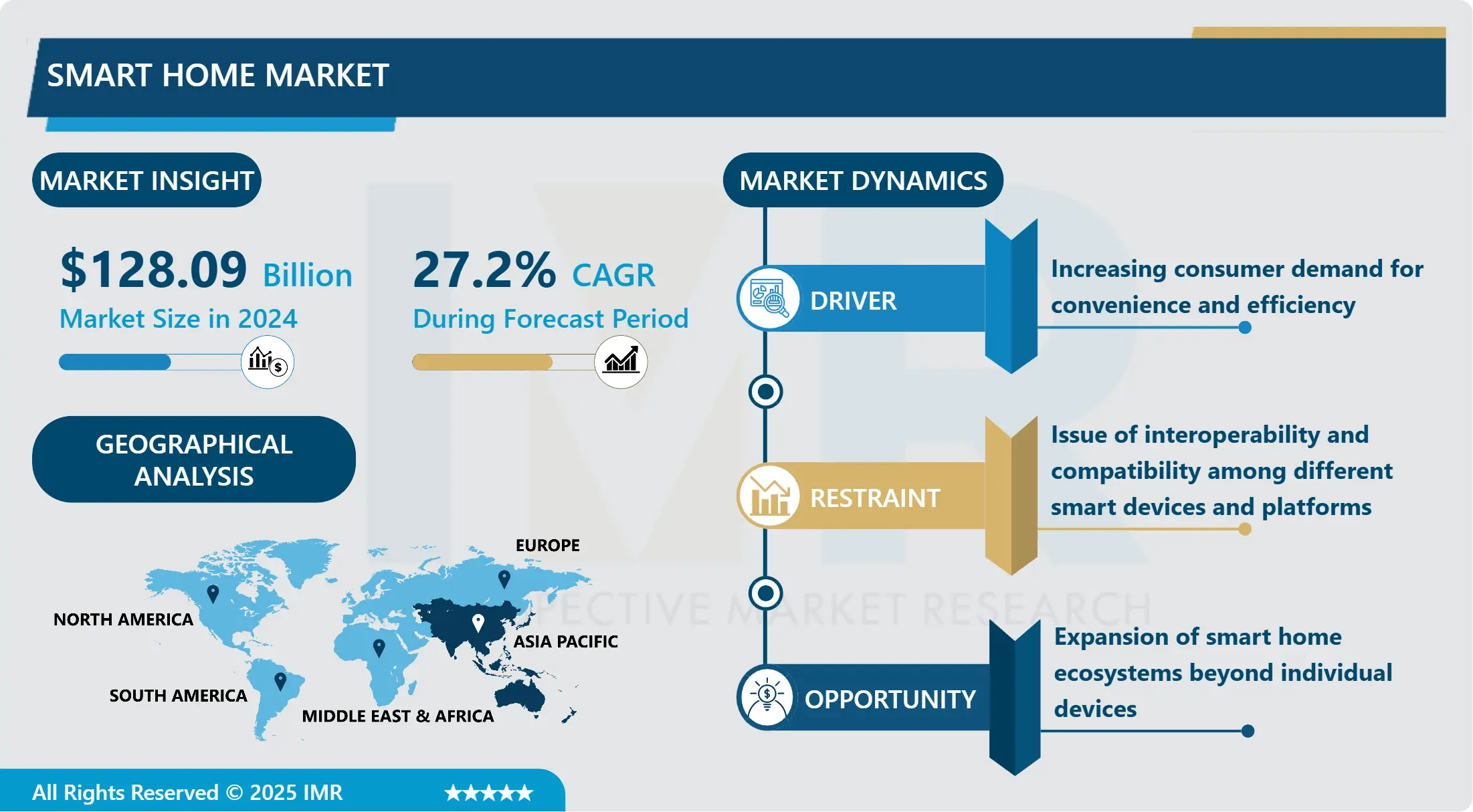
Smart Home Market Size Was Valued at USD 128.09 Billion in 2024 and is Projected to Reach USD 877.83 Billion by 2032, Growing at a CAGR of 27.2% From 2025-2032.
A Smart Home can be defined as one packed with devices or systems that can be operated as well as regulated using a remote and can also be programmed to make the home experience convenient, safe, and energy-wise. Most of these devices are typically linked to a main hub or the network which could include a smartphone application or voice enabled virtual assistant as being seen with Alexa or Google Assistant. Smart home devices are for example smart thermostats, lighting systems, security cameras, door locks, home appliances, entertainment systems, all capable of talking to each other or the homeowner. The overall objective of smart home is to ensure affairs are holistic, coordinated and integrated with an aim of improving the quality of life of people in the dwelling place.
The Smart Home Market is expanding at an enormous pace with the help of IoT (Internet of Things) integration and adopting customers. Smart homes basically connect the individual lighting and thermostat devices, security systems and entertainment devices and all are controlled with an elongated interface basically in the form of a smartphone, voice interfaces or touch interfaces. This environment makes it possible for the users to control their homes from a distance thereby improving comfort, energy and security.
Some of the major Players in the Smart Home Market are Google with Nest, Amazon with Alexa, Apple with HomeKit, and others which are the appliance manufacturers adding smart features to their products market. Emerging trends include increasing use of smart assistants, the popularity of protocols such as Zigbee and Z-Wave, the continual expansion of smart devices characterized by versatility within different markets ranging from large cities’ apartments to suburban houses. Recent technological advancements play a vital role in the growth of smart home systems; as the technology grows mature it will setup the market for an increase in sales bearing in mind that people are changing and are becoming aware of the importance of having a smart home.
Smart Home Market Trend Analysis
Smart Home Market Growth Driver-Integration of artificial intelligence (AI) and machine learning (ML) technologies
Regarding the trends in the smart home market, one fairly apparent fact is the growing use of AI and ML components. Such developments enable smart home devices to acquire more information on users’ preferences as well as their conduct in the long term hence improving on the intelligence of the automation system. Often, the technological assistants that are developed by Amazon, Google, and Apple are learning to understand natural language in interactions and anticipate the needs of their masters by analyzing patterns and data. Besides offering more convenience to the users, this trend constitutes for more effective control and usage of electricity and a higher level of home security by using more intelligent and anticipatory features.
Smart Home Market Expansion Opportunity-Expansion of smart home ecosystems beyond individual devices
This is summarized with one major opportunity: the transition from point solutions, meaning the individual smart home devices, to the home ecosystem that encompasses most or all areas of home life. Thanks to the ever increasing necessity of integrating smart devices in people’s lives, there is a growing need for compatibility across brands and smart devices types. Those firms that are capable of building via open source systems for smart devices or create standards for interoperability are likely to benefit from this opportunity by providing the solutions that make the disparate smart devices smart in unison. Moreover, there are numerous opportunities in deepening the security features of smart home devices and services regarding user data, which is a rapidly growing aspect considering the amount of smart devices being used today.
Smart Home Market Segment Analysis:
Smart Home Market Segmented on the basis of Products and application.
By Products, Security & Access Control segment is expected to dominate the market during the forecast period
Security & Access Control segment is expected to experience high demand or to contribute high percentage to the smart home market during the forecast period mainly because of the increasing concern of security and privacy in homes. More often today, people are experiencing either a probable cyber attack or a break-in into our homes, and thus are embracing smart solutions that will help to counter such acts. Those are useful for saving efforts and time allowing having an opportunity to control the security system remotely, to receive real-time information about the situation inside or outside of the house, and to connect it with the other smart systems for effective protection and surveillance.
On the same note, biometric authentication, facial recognition, and smart locks are other factors that enhance the prospects of smart access control solutions enabling convenience and security. The constant increase in consumers’ awareness and adoption of smart home systems due to the necessity of secure and comfortable living will ensure that the segment of Security & Access Control remains the most prominent in driving the market.
By Application, New Construction segment expected to held the largest share
Among them, New Construction segment is supposed to have the largest share by application in the smart home market. This is mainly informed by the rising incorporation of smart technologies at the construction stage of homes, offices, and other facilities. Housing contractors and real estate companies are putting smart home systems like smart lights, energy-saving gadgets, smart climate control, and smart security systems into new constructions. This is so because consumers’ desire for new, smart and efficient homes, ideally located and with built-in comfort that saves energy and gives initial protection has been on the rise.
Additionally, existing government policies on efficiency in energy consumption and adoption of more sustainable techniques in constructions extend the take-up of smart home technologies in new constructions. Therefore, the New Construction segment remains undoubtedly in the strong right to capture the largest portion of the smart home market and stimulate the market’s further progress.
Smart Home Market Regional Insights:
Asia Pacific is Expected to Dominate the Market Over the Forecast period
Over the coming period, it is predicted that Asia Pacific will be the largest user of smart home facilities and related products due to increased urbanization, higher disposable income levels, and the overall increased adoption of technology. Asian countries especially China, Japan, South Korea, and India are the most involved in integrating smart home technologies due to governmental encouragement of smart city project and environmental conservation. The continuing Infrastructure advancement in the region and the increasing consciousness of power usage and housing automation spur smart home devices’ demand. Furthermore, the key technology companies’ growing interest in solutions and services related to smart homes and expanding availability of affordable smart solutions contribute to Asia-Pacific’s trends for leading the development of connected living.
Active Key Players in the Smart Home Market
ABB Ltd. (Switzerland)
Amazon (USA)
Apple (USA)
Google (USA)
Honeywell International Inc. (USA)
Johnson Controls International plc (Ireland)
Lenovo Group Limited (China)
LG Electronics (South Korea)
Philips Lighting (Netherlands)
Samsung Electronics (South Korea)
Schneider Electric (France)
Siemens AG (Germany)
Sony Corporation (Japan)
TP-Link Technologies Co., Ltd. (China)
Xiaomi Corporation (China)
Other Active Players
Chapter 1: Introduction
1.1 Scope and Coverage
Chapter 2:Executive Summary
Chapter 3: Market Landscape
3.1 Market Dynamics
3.1.1 Drivers
3.1.2 Restraints
3.1.3 Opportunities
3.1.4 Challenges
3.2 Market Trend Analysis
3.3 PESTLE Analysis
3.4 Porter’s Five Forces Analysis
3.5 Industry Value Chain Analysis
3.6 Ecosystem
3.7 Regulatory Landscape
3.8 Price Trend Analysis
3.9 Patent Analysis
3.10 Technology Evolution
3.11 Investment Pockets
3.12 Import-Export Analysis
Chapter 4: Smart Home Market by Products (2018-2032)
4.1 Smart Home Market Snapshot and Growth Engine
4.2 Market Overview
4.3 Security & Access Controls
4.3.1 Introduction and Market Overview
4.3.2 Historic and Forecasted Market Size in Value USD and Volume Units
4.3.3 Key Market Trends, Growth Factors, and Opportunities
4.3.4 Geographic Segmentation Analysis
4.4 Lighting Control
4.5 Entertainment Devices
4.6 HVAC
4.7 Smart Kitchen Appliances
4.8 Home Appliances
4.9 Smart Furniture
4.10 Home Healthcare
4.11 Other Devices
Chapter 5: Smart Home Market by Application (2018-2032)
5.1 Smart Home Market Snapshot and Growth Engine
5.2 Market Overview
5.3 New Construction
5.3.1 Introduction and Market Overview
5.3.2 Historic and Forecasted Market Size in Value USD and Volume Units
5.3.3 Key Market Trends, Growth Factors, and Opportunities
5.3.4 Geographic Segmentation Analysis
5.4 Retrofit
Chapter 6: Company Profiles and Competitive Analysis
6.1 Competitive Landscape
6.1.1 Competitive Benchmarking
6.1.2 Smart Home Market Share by Manufacturer (2024)
6.1.3 Industry BCG Matrix
6.1.4 Heat Map Analysis
6.1.5 Mergers and Acquisitions
6.2 ABB LTD. (SWITZERLAND)
6.2.1 Company Overview
6.2.2 Key Executives
6.2.3 Company Snapshot
6.2.4 Role of the Company in the Market
6.2.5 Sustainability and Social Responsibility
6.2.6 Operating Business Segments
6.2.7 Product Portfolio
6.2.8 Business Performance
6.2.9 Key Strategic Moves and Recent Developments
6.2.10 SWOT Analysis
6.3 AMAZON (USA)
6.4 APPLE (USA)
6.5 GOOGLE (USA)
6.6 HONEYWELL INTERNATIONAL INC. (USA)
6.7 JOHNSON CONTROLS INTERNATIONAL PLC (IRELAND)
6.8 LENOVO GROUP LIMITED (CHINA)
6.9 LG ELECTRONICS (SOUTH KOREA)
6.10 PHILIPS LIGHTING (NETHERLANDS)
6.11 SAMSUNG ELECTRONICS (SOUTH KOREA)
6.12 SCHNEIDER ELECTRIC (FRANCE)
6.13 SIEMENS AG (GERMANY)
6.14 SONY CORPORATION (JAPAN)
6.15 TP-LINK TECHNOLOGIES COLTD. (CHINA)
6.16 XIAOMI CORPORATION (CHINA)
Chapter 7: Global Smart Home Market By Region
7.1 Overview
7.2. North America Smart Home Market
7.2.1 Key Market Trends, Growth Factors and Opportunities
7.2.2 Top Key Companies
7.2.3 Historic and Forecasted Market Size by Segments
7.2.4 Historic and Forecasted Market Size by Products
7.2.4.1 Security & Access Controls
7.2.4.2 Lighting Control
7.2.4.3 Entertainment Devices
7.2.4.4 HVAC
7.2.4.5 Smart Kitchen Appliances
7.2.4.6 Home Appliances
7.2.4.7 Smart Furniture
7.2.4.8 Home Healthcare
7.2.4.9 Other Devices
7.2.5 Historic and Forecasted Market Size by Application
7.2.5.1 New Construction
7.2.5.2 Retrofit
7.2.6 Historic and Forecast Market Size by Country
7.2.6.1 US
7.2.6.2 Canada
7.2.6.3 Mexico
7.3. Eastern Europe Smart Home Market
7.3.1 Key Market Trends, Growth Factors and Opportunities
7.3.2 Top Key Companies
7.3.3 Historic and Forecasted Market Size by Segments
7.3.4 Historic and Forecasted Market Size by Products
7.3.4.1 Security & Access Controls
7.3.4.2 Lighting Control
7.3.4.3 Entertainment Devices
7.3.4.4 HVAC
7.3.4.5 Smart Kitchen Appliances
7.3.4.6 Home Appliances
7.3.4.7 Smart Furniture
7.3.4.8 Home Healthcare
7.3.4.9 Other Devices
7.3.5 Historic and Forecasted Market Size by Application
7.3.5.1 New Construction
7.3.5.2 Retrofit
7.3.6 Historic and Forecast Market Size by Country
7.3.6.1 Russia
7.3.6.2 Bulgaria
7.3.6.3 The Czech Republic
7.3.6.4 Hungary
7.3.6.5 Poland
7.3.6.6 Romania
7.3.6.7 Rest of Eastern Europe
7.4. Western Europe Smart Home Market
7.4.1 Key Market Trends, Growth Factors and Opportunities
7.4.2 Top Key Companies
7.4.3 Historic and Forecasted Market Size by Segments
7.4.4 Historic and Forecasted Market Size by Products
7.4.4.1 Security & Access Controls
7.4.4.2 Lighting Control
7.4.4.3 Entertainment Devices
7.4.4.4 HVAC
7.4.4.5 Smart Kitchen Appliances
7.4.4.6 Home Appliances
7.4.4.7 Smart Furniture
7.4.4.8 Home Healthcare
7.4.4.9 Other Devices
7.4.5 Historic and Forecasted Market Size by Application
7.4.5.1 New Construction
7.4.5.2 Retrofit
7.4.6 Historic and Forecast Market Size by Country
7.4.6.1 Germany
7.4.6.2 UK
7.4.6.3 France
7.4.6.4 The Netherlands
7.4.6.5 Italy
7.4.6.6 Spain
7.4.6.7 Rest of Western Europe
7.5. Asia Pacific Smart Home Market
7.5.1 Key Market Trends, Growth Factors and Opportunities
7.5.2 Top Key Companies
7.5.3 Historic and Forecasted Market Size by Segments
7.5.4 Historic and Forecasted Market Size by Products
7.5.4.1 Security & Access Controls
7.5.4.2 Lighting Control
7.5.4.3 Entertainment Devices
7.5.4.4 HVAC
7.5.4.5 Smart Kitchen Appliances
7.5.4.6 Home Appliances
7.5.4.7 Smart Furniture
7.5.4.8 Home Healthcare
7.5.4.9 Other Devices
7.5.5 Historic and Forecasted Market Size by Application
7.5.5.1 New Construction
7.5.5.2 Retrofit
7.5.6 Historic and Forecast Market Size by Country
7.5.6.1 China
7.5.6.2 India
7.5.6.3 Japan
7.5.6.4 South Korea
7.5.6.5 Malaysia
7.5.6.6 Thailand
7.5.6.7 Vietnam
7.5.6.8 The Philippines
7.5.6.9 Australia
7.5.6.10 New Zealand
7.5.6.11 Rest of APAC
7.6. Middle East & Africa Smart Home Market
7.6.1 Key Market Trends, Growth Factors and Opportunities
7.6.2 Top Key Companies
7.6.3 Historic and Forecasted Market Size by Segments
7.6.4 Historic and Forecasted Market Size by Products
7.6.4.1 Security & Access Controls
7.6.4.2 Lighting Control
7.6.4.3 Entertainment Devices
7.6.4.4 HVAC
7.6.4.5 Smart Kitchen Appliances
7.6.4.6 Home Appliances
7.6.4.7 Smart Furniture
7.6.4.8 Home Healthcare
7.6.4.9 Other Devices
7.6.5 Historic and Forecasted Market Size by Application
7.6.5.1 New Construction
7.6.5.2 Retrofit
7.6.6 Historic and Forecast Market Size by Country
7.6.6.1 Turkiye
7.6.6.2 Bahrain
7.6.6.3 Kuwait
7.6.6.4 Saudi Arabia
7.6.6.5 Qatar
7.6.6.6 UAE
7.6.6.7 Israel
7.6.6.8 South Africa
7.7. South America Smart Home Market
7.7.1 Key Market Trends, Growth Factors and Opportunities
7.7.2 Top Key Companies
7.7.3 Historic and Forecasted Market Size by Segments
7.7.4 Historic and Forecasted Market Size by Products
7.7.4.1 Security & Access Controls
7.7.4.2 Lighting Control
7.7.4.3 Entertainment Devices
7.7.4.4 HVAC
7.7.4.5 Smart Kitchen Appliances
7.7.4.6 Home Appliances
7.7.4.7 Smart Furniture
7.7.4.8 Home Healthcare
7.7.4.9 Other Devices
7.7.5 Historic and Forecasted Market Size by Application
7.7.5.1 New Construction
7.7.5.2 Retrofit
7.7.6 Historic and Forecast Market Size by Country
7.7.6.1 Brazil
7.7.6.2 Argentina
7.7.6.3 Rest of SA
Chapter 8 Analyst Viewpoint and Conclusion
8.1 Recommendations and Concluding Analysis
8.2 Potential Market Strategies
Chapter 9 Research Methodology
9.1 Research Process
9.2 Primary Research
9.3 Secondary Research
Q1: What would be the forecast period in the Smart Home Market research report?
A1: The forecast period in the Smart Home Market research report is 2025-2032.
Q2: Who are the key players in the Smart Home Market?
A2: ABB Ltd. (Switzerland), Amazon (USA), Apple (USA), Google (USA) and Other Active Players.
Q3: What are the segments of the Smart Home Market?
A3: The Smart Home Market is segmented into Products, Application and region. By Products, the market is categorized into Security & Access Controls, Lighting Control, Entertainment Devices, HVAC, Smart Kitchen Appliances, Home Appliances, Smart Furniture, Home Healthcare, Other Devices. By Application, the market is categorized into New Construction, Retrofit. By region, it is analyzed across North America (U.S.; Canada; Mexico), Eastern Europe (Bulgaria; The Czech Republic; Hungary; Poland; Romania; Rest of Eastern Europe), Western Europe (Germany; UK; France; Netherlands; Italy; Russia; Spain; Rest of Western Europe), Asia-Pacific (China; India; Japan; Southeast Asia, etc.), South America (Brazil; Argentina, etc.), Middle East & Africa (Saudi Arabia; South Africa, etc.).
Q4: What is the Smart Home Market?
A4: A Smart Home can be defined as the one packed with devices or systems that can be operated as well as regulated using remote and can also be programmed to make the home experience convenient, safe, and energy-wise. Most of these devices are typically linked to a main hub or the network which could include a smartphone application or voice enabled virtual assistant as being seen with Alexa or Google Assistant. Smart home devices are for example smart thermostats, lighting systems, security cameras, door locks, home appliances, entertainment systems, all capable of talking to each other or the homeowner. The overall objective of smart home is to ensure affairs are holistic, coordinated and integrated with an aim of improving the quality of life of people in the dwelling place.
Q5: How big is the Smart Home Market?
A5: Smart Home Market Size Was Valued at USD 128.09 Billion in 2024 and is Projected to Reach USD 877.83 Billion by 2032, Growing at a CAGR of 27.2% From 2025-2032.
How to Buy a Report from eminsights.jp
On the product page, choose the license you want: Single-User License, Multi-User License or Enterprise License.
If you required report in your native language, then you can click on Translated Report button and fill out the form with report name and language you want, then our team will contact you as soon as possible.
Click the Buy Now button.
You will be redirected to the checkout page. Enter your company details and payment information.
Click Place Order to complete the purchase.
Confirmation: You’ll receive an order confirmation and our team will contact you shortly with your ordered report.
If you have any questions, fill out the contact form below or email us at bizdev@eminsights.net.
Thank you for choosing eminsights.jp!