Stay Ahead in Fast-Growing Economies.
Browse Reports Now




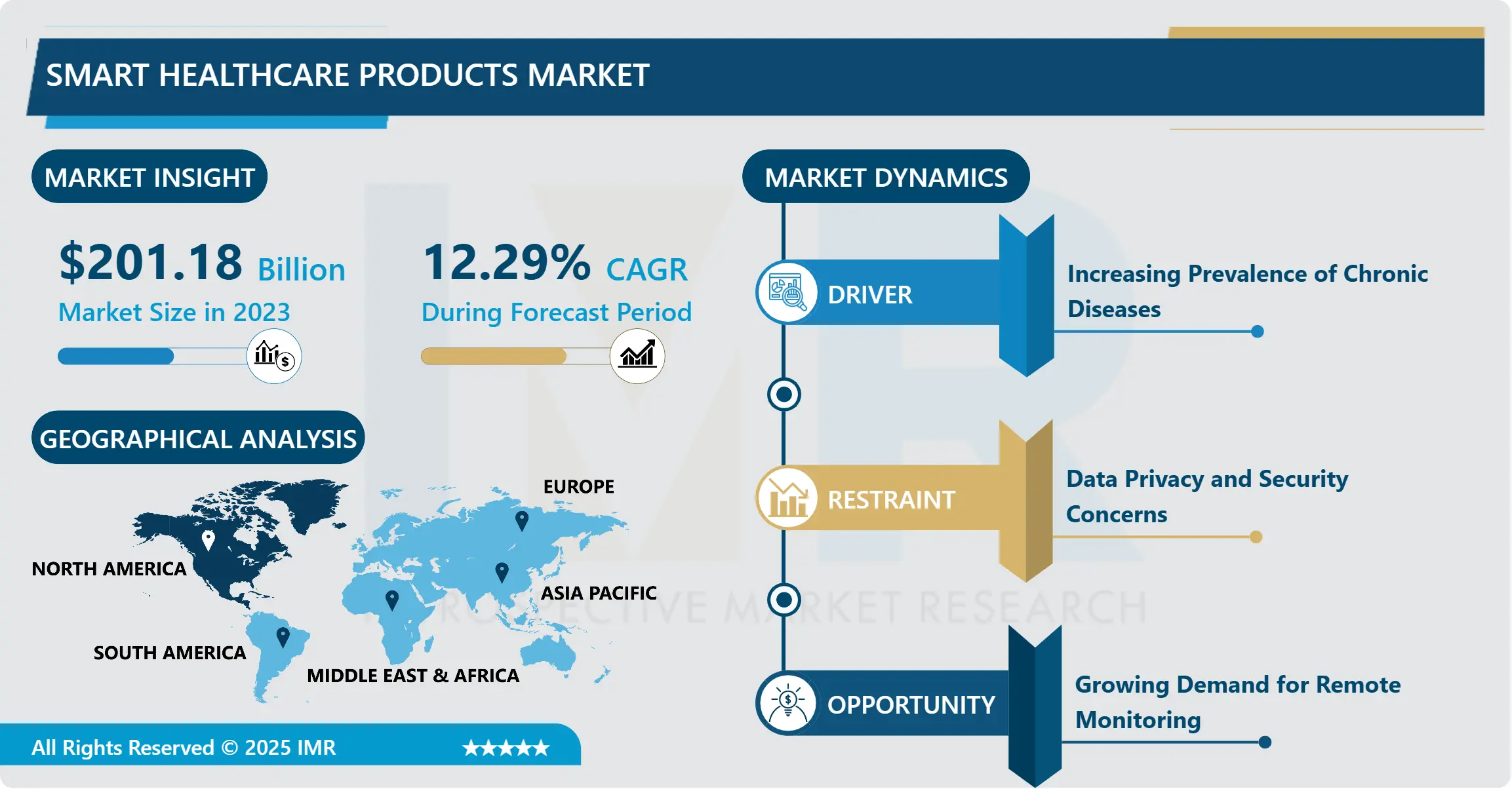
Smart Healthcare Products Market – Size, Share & In-Depth Industry Insights
Smart Healthcare Products Market Size Was Valued at USD 201.18 Billion in 2023, and is Projected to Reach USD 571.02 Billion by 2032, Growing at a CAGR of 12.29% From 2024-2032.

IMR Group
Description
Smart Healthcare Products Market Synopsis
Smart Healthcare Products Market Size Was Valued at USD 201.18 Billion in 2023, and is Projected to Reach USD 571.02 Billion by 2032, Growing at a CAGR of 12.29% From 2024-2032.
The Smart Healthcare Products Market defines a sector of the healthcare industry that consists of new innovations aimed at improving medical and health care services. These products often encompass wrist-worn devices, applications for smartphones that is often referred to as m-health, and remote surveillance systems that rely on connectivity together with analyzing information to give real-time health info that can enhance a patient’s condition, increase health care efficiency, and create individualized treatment plans.
The new emergence of high-risk population group referred to as ‘baby boomers’, increasing importance for telehealth /telemedicine. The emerging technologies like the IoT, AI and big data, it is possible for doctors to deliver higher standards of healthcare. Such products allow constant tracking of patients’ status and performing timely interventions or adjusting individual treatment regimens. Furthermore, the recent outbreaks of COVID -19 have increased the use of telemedicine and home care support which suggests the gap in innovative products that could patriate seize the possibility of innovation in healthcare environment different from the clinical one.
In the changing market, different actors – doctors, entrepreneurs, and users – are increasingly appreciating the value of smart health solutions. Venture capital investments are oriented to modern start-ups and successful enterprises working on creating unique technological services and solutions to enhance health and patient’s experience. AI and machine learning have quickly become integrated into healthcare products because it allows providers to analyse mass amounts of data to gain insight. In addition, government backing and subsidies for development are providing impetus to the birth of smart healthcare systems.
Smart Healthcare Products Market Trend Analysis
Integration of Artificial Intelligence
Smart healthcare product based on artificial intelligence (AI) integrate is one of the most important trends changing the current health industry. AI structures in turn have the capability to mine complex medical big data to improve diagnosis, treatment and patient care. For instance, wearable devices powered by artificial intelligence can identify and report to the user or a doctor, unsteady heartbeat, or elevated sugar levels, respectively, within a short lapse of time. This trend is not only making individual practices better for handling health but also supporting systems to handle the load and efficiency by applications of analytical and autonomous healthcare.
It can be assumed that the use of AI in smart healthcare products is also going to develop in the future. The technologies like virtual health assistants and even AI based diagnosis of patients will significantly redefine the patient contacts and clinical processes. Also, because of AI capacity to analyse expansive data sets, we can have something like customizable treatment where suits a particular patient depending on his/ her health status. This trend shows that health care is now deemed as a patient-health management, rather than a cure-for-illness managing activity, which will increase in the future.
Growing Demand for Remote Monitoring
A rising trend referring to the market is its prospect to grow as a result of the emerging demand for remotely operated monitoring systems. More patients require easily accessible healthcare services plus the effects of COVID-19 pandemic, practitioners are adopting remote monitoring tools to ensure patients do not come physically for check-ups. Smartwatches and smartphones that continue the health metrics of the patient like blood pressure, glucose level and extent of their activity, have therefore found their way into the market with many consumers being more than willing to monitor their chronic illnesses.
As most healthcare systems has now pivoted slightly toward value-based care models of delivering care, remote monitoring is particularly important in boosting patient consultations and their compliance to the care plans in place. Through data streaming patient status information, PCH can detect early signs of deterioration and act quickly to enhance patient health status and thereby minimize hospitalization. This possibility of progress in the Smart Healthcare Products Market is steering the investments and advancements of the distant healthcare checking strategies to make healthcare quicker and more available.
Smart Healthcare Products Market Segment Analysis:
Smart Healthcare Products Market is Segmented on the basis of Product, Distribution Channel, End User and Region.
By Product, Wearable Activity Trackers segment is expected to dominate the market during the forecast period
Wearable activity trackers and biosensors are also other potential products that can also play a massive role in the market. These devices encourage health and fitness to an extent of showing their daily activities, calories burned, and number of steps among other data on their operation. This is so especially because more people are paying attention to how they maintain their health and keep off diseases such as diabetes, kantharia et.al. In addition, self-contained biosensors that are worn on the body to facilitate tracking of different body features including blood sugar and pressure are gradually becoming important tools for patients with chronic diseases to monitor their health status more effectively.
By End User, Heart Disease Patients segment expected to held the largest share
Pre-diagnosed heart disease patients are also part of the target market owning to smart healthcare products that help to check on their state of health. Wearable that includes ECG and monitoring of heart rate give patients the ability to guide their cardiovascular health. Adding telehealth services takes patient satisfaction to the next level and also lets healthcare providers monitor the data they have collected to arrive at decisions regarding treatment. As the incidence of cardiovascular diseases increase in the future, thus the need for smart healthcare products for this end user will also increase.
Smart Healthcare Products Market Regional Insights:
North America is Expected to Dominate the Market Over the Forecast period
North America holds the largest market share in Smart Healthcare Products Market presently due to increase in healthcare spending, improved health care facilities, and leading technological companies. The two major countries of North America, the United States and Canada have been the pioneers of smart healthcare products. The rise in the number of chronic diseases that patients experience, and the growing per capita of the elderly in these nations has also advanced the need for smart health care solutions to improve the approach with which patient ailments can be managed and treated.
In addition, favourable government policies, and policies towards digital healthcare innovations are also driving market in North America. The region enjoys a large number of health care service providers and technology firms who work jointly to create and market smart health care products. Due to the technological advancement and the use of telehealth and remote monitoring especially during the COVID-19 outbreak the region has maintained leadership in the market. Over time, the focus in healthcare is shifting and North America is yet anticipated to remain on top driving the development of smart healthcare solutions.
Active Key Players in the Smart Healthcare Products Market:
Abbott Laboratories (United States)
Apple (United States)
Boston Scientific (United States)
Fitbit (United States)
Fitbit (United States)
Garmin (United States)
Honeywell (United States)
Medtronic (United States)
OMRON Corporation (Japan)
Philips (Netherlands)
Samsung (South Korea)
Siemens Healthineers (Germany)
Other Active Players
Key Industry Developments in the Smart Healthcare Products Market:
In January 2024, Samsung Electronics’ recent expansion of its Privileged Health Software Development Kit (SDK) program aims to enhance preventive healthcare solutions through partnerships. Leveraging Galaxy Watch’s advanced sensor technology, Samsung and its collaborators facilitate real-time vital sign monitoring, remote patient management, and immersive XR-based therapy for improved health outcomes. This initiative underscores Samsung’s commitment to building an integrated digital healthcare ecosystem, empowering users to proactively manage their health from home with comprehensive tools and insights.
In December 2023, Kroger Health and Soda Health introduced the Smart Benefits Program, merging Kroger’s healthcare services with Soda Health’s &more platforms. This collaboration aims to enhance access to personalized benefits, including food, health products, pharmacy, and nutrition services, catering to Medicare Advantage, Medicaid, and employer benefits program recipients. By leveraging Soda Health’s technology, the program provides convenient access to essential resources, empowering individuals to make healthier choices and improve overall well-being.
Chapter 1: Introduction
1.1 Scope and Coverage
Chapter 2:Executive Summary
Chapter 3: Market Landscape
3.1 Market Dynamics
3.1.1 Drivers
3.1.2 Restraints
3.1.3 Opportunities
3.1.4 Challenges
3.2 Market Trend Analysis
3.3 PESTLE Analysis
3.4 Porter’s Five Forces Analysis
3.5 Industry Value Chain Analysis
3.6 Ecosystem
3.7 Regulatory Landscape
3.8 Price Trend Analysis
3.9 Patent Analysis
3.10 Technology Evolution
3.11 Investment Pockets
3.12 Import-Export Analysis
Chapter 4: Smart Healthcare Products Market by Product
4.1 Smart Healthcare Products Market Snapshot and Growth Engine
4.2 Smart Healthcare Products Market Overview
4.3 ECG Wearable Devices
4.3.1 Introduction and Market Overview
4.3.2 Historic and Forecasted Market Size in Value USD and Volume Units (2017-2032F)
4.3.3 Key Market Trends, Growth Factors and Opportunities
4.3.4 ECG Wearable Devices: Geographic Segmentation Analysis
4.4 Wearable Activity Trackers
4.4.1 Introduction and Market Overview
4.4.2 Historic and Forecasted Market Size in Value USD and Volume Units (2017-2032F)
4.4.3 Key Market Trends, Growth Factors and Opportunities
4.4.4 Wearable Activity Trackers: Geographic Segmentation Analysis
4.5 Wearable Biosensor
4.5.1 Introduction and Market Overview
4.5.2 Historic and Forecasted Market Size in Value USD and Volume Units (2017-2032F)
4.5.3 Key Market Trends, Growth Factors and Opportunities
4.5.4 Wearable Biosensor: Geographic Segmentation Analysis
4.6 Others)
4.6.1 Introduction and Market Overview
4.6.2 Historic and Forecasted Market Size in Value USD and Volume Units (2017-2032F)
4.6.3 Key Market Trends, Growth Factors and Opportunities
4.6.4 Others): Geographic Segmentation Analysis
4.7
4.7.1 Introduction and Market Overview
4.7.2 Historic and Forecasted Market Size in Value USD and Volume Units (2017-2032F)
4.7.3 Key Market Trends, Growth Factors and Opportunities
4.7.4 : Geographic Segmentation Analysis
Chapter 5: Smart Healthcare Products Market by Distribution Channel
5.1 Smart Healthcare Products Market Snapshot and Growth Engine
5.2 Smart Healthcare Products Market Overview
5.3 Pharmacy Stores
5.3.1 Introduction and Market Overview
5.3.2 Historic and Forecasted Market Size in Value USD and Volume Units (2017-2032F)
5.3.3 Key Market Trends, Growth Factors and Opportunities
5.3.4 Pharmacy Stores: Geographic Segmentation Analysis
5.4 E-commerce
5.4.1 Introduction and Market Overview
5.4.2 Historic and Forecasted Market Size in Value USD and Volume Units (2017-2032F)
5.4.3 Key Market Trends, Growth Factors and Opportunities
5.4.4 E-commerce: Geographic Segmentation Analysis
5.5 Others)
5.5.1 Introduction and Market Overview
5.5.2 Historic and Forecasted Market Size in Value USD and Volume Units (2017-2032F)
5.5.3 Key Market Trends, Growth Factors and Opportunities
5.5.4 Others): Geographic Segmentation Analysis
5.6
5.6.1 Introduction and Market Overview
5.6.2 Historic and Forecasted Market Size in Value USD and Volume Units (2017-2032F)
5.6.3 Key Market Trends, Growth Factors and Opportunities
5.6.4 : Geographic Segmentation Analysis
Chapter 6: Smart Healthcare Products Market by End-User
6.1 Smart Healthcare Products Market Snapshot and Growth Engine
6.2 Smart Healthcare Products Market Overview
6.3 Diabetes Patient
6.3.1 Introduction and Market Overview
6.3.2 Historic and Forecasted Market Size in Value USD and Volume Units (2017-2032F)
6.3.3 Key Market Trends, Growth Factors and Opportunities
6.3.4 Diabetes Patient : Geographic Segmentation Analysis
6.4 Heart Disease Patients
6.4.1 Introduction and Market Overview
6.4.2 Historic and Forecasted Market Size in Value USD and Volume Units (2017-2032F)
6.4.3 Key Market Trends, Growth Factors and Opportunities
6.4.4 Heart Disease Patients: Geographic Segmentation Analysis
6.5 Chronic Renal Failure Patients
6.5.1 Introduction and Market Overview
6.5.2 Historic and Forecasted Market Size in Value USD and Volume Units (2017-2032F)
6.5.3 Key Market Trends, Growth Factors and Opportunities
6.5.4 Chronic Renal Failure Patients: Geographic Segmentation Analysis
6.6 Others)
6.6.1 Introduction and Market Overview
6.6.2 Historic and Forecasted Market Size in Value USD and Volume Units (2017-2032F)
6.6.3 Key Market Trends, Growth Factors and Opportunities
6.6.4 Others) : Geographic Segmentation Analysis
Chapter 7: Company Profiles and Competitive Analysis
7.1 Competitive Landscape
7.1.1 Competitive Benchmarking
7.1.2 Smart Healthcare Products Market Share by Manufacturer (2023)
7.1.3 Industry BCG Matrix
7.1.4 Heat Map Analysis
7.1.5 Mergers and Acquisitions
7.2 PHILIPS (NETHERLANDS)
7.2.1 Company Overview
7.2.2 Key Executives
7.2.3 Company Snapshot
7.2.4 Role of the Company in the Market
7.2.5 Sustainability and Social Responsibility
7.2.6 Operating Business Segments
7.2.7 Product Portfolio
7.2.8 Business Performance
7.2.9 Key Strategic Moves and Recent Developments
7.2.10 SWOT Analysis
7.3 FITBIT (UNITED STATES)
7.4 APPLE (UNITED STATES)
7.5 SAMSUNG (SOUTH KOREA)
7.6 GARMIN (UNITED STATES)
7.7 MEDTRONIC (UNITED STATES)
7.8 SIEMENS HEALTHINEERS (GERMANY)
7.9 ABBOTT LABORATORIES (UNITED STATES)
7.10 HONEYWELL (UNITED STATES)
7.11 OTHER ACTIVE PLAYERS
Chapter 8: Global Smart Healthcare Products Market By Region
8.1 Overview
8.2. North America Smart Healthcare Products Market
8.2.1 Key Market Trends, Growth Factors and Opportunities
8.2.2 Top Key Companies
8.2.3 Historic and Forecasted Market Size by Segments
8.2.4 Historic and Forecasted Market Size By Product
8.2.4.1 ECG Wearable Devices
8.2.4.2 Wearable Activity Trackers
8.2.4.3 Wearable Biosensor
8.2.4.4 Others)
8.2.4.5
8.2.5 Historic and Forecasted Market Size By Distribution Channel
8.2.5.1 Pharmacy Stores
8.2.5.2 E-commerce
8.2.5.3 Others)
8.2.5.4
8.2.6 Historic and Forecasted Market Size By End-User
8.2.6.1 Diabetes Patient
8.2.6.2 Heart Disease Patients
8.2.6.3 Chronic Renal Failure Patients
8.2.6.4 Others)
8.2.7 Historic and Forecast Market Size by Country
8.2.7.1 US
8.2.7.2 Canada
8.2.7.3 Mexico
8.3. Eastern Europe Smart Healthcare Products Market
8.3.1 Key Market Trends, Growth Factors and Opportunities
8.3.2 Top Key Companies
8.3.3 Historic and Forecasted Market Size by Segments
8.3.4 Historic and Forecasted Market Size By Product
8.3.4.1 ECG Wearable Devices
8.3.4.2 Wearable Activity Trackers
8.3.4.3 Wearable Biosensor
8.3.4.4 Others)
8.3.4.5
8.3.5 Historic and Forecasted Market Size By Distribution Channel
8.3.5.1 Pharmacy Stores
8.3.5.2 E-commerce
8.3.5.3 Others)
8.3.5.4
8.3.6 Historic and Forecasted Market Size By End-User
8.3.6.1 Diabetes Patient
8.3.6.2 Heart Disease Patients
8.3.6.3 Chronic Renal Failure Patients
8.3.6.4 Others)
8.3.7 Historic and Forecast Market Size by Country
8.3.7.1 Russia
8.3.7.2 Bulgaria
8.3.7.3 The Czech Republic
8.3.7.4 Hungary
8.3.7.5 Poland
8.3.7.6 Romania
8.3.7.7 Rest of Eastern Europe
8.4. Western Europe Smart Healthcare Products Market
8.4.1 Key Market Trends, Growth Factors and Opportunities
8.4.2 Top Key Companies
8.4.3 Historic and Forecasted Market Size by Segments
8.4.4 Historic and Forecasted Market Size By Product
8.4.4.1 ECG Wearable Devices
8.4.4.2 Wearable Activity Trackers
8.4.4.3 Wearable Biosensor
8.4.4.4 Others)
8.4.4.5
8.4.5 Historic and Forecasted Market Size By Distribution Channel
8.4.5.1 Pharmacy Stores
8.4.5.2 E-commerce
8.4.5.3 Others)
8.4.5.4
8.4.6 Historic and Forecasted Market Size By End-User
8.4.6.1 Diabetes Patient
8.4.6.2 Heart Disease Patients
8.4.6.3 Chronic Renal Failure Patients
8.4.6.4 Others)
8.4.7 Historic and Forecast Market Size by Country
8.4.7.1 Germany
8.4.7.2 UK
8.4.7.3 France
8.4.7.4 The Netherlands
8.4.7.5 Italy
8.4.7.6 Spain
8.4.7.7 Rest of Western Europe
8.5. Asia Pacific Smart Healthcare Products Market
8.5.1 Key Market Trends, Growth Factors and Opportunities
8.5.2 Top Key Companies
8.5.3 Historic and Forecasted Market Size by Segments
8.5.4 Historic and Forecasted Market Size By Product
8.5.4.1 ECG Wearable Devices
8.5.4.2 Wearable Activity Trackers
8.5.4.3 Wearable Biosensor
8.5.4.4 Others)
8.5.4.5
8.5.5 Historic and Forecasted Market Size By Distribution Channel
8.5.5.1 Pharmacy Stores
8.5.5.2 E-commerce
8.5.5.3 Others)
8.5.5.4
8.5.6 Historic and Forecasted Market Size By End-User
8.5.6.1 Diabetes Patient
8.5.6.2 Heart Disease Patients
8.5.6.3 Chronic Renal Failure Patients
8.5.6.4 Others)
8.5.7 Historic and Forecast Market Size by Country
8.5.7.1 China
8.5.7.2 India
8.5.7.3 Japan
8.5.7.4 South Korea
8.5.7.5 Malaysia
8.5.7.6 Thailand
8.5.7.7 Vietnam
8.5.7.8 The Philippines
8.5.7.9 Australia
8.5.7.10 New Zealand
8.5.7.11 Rest of APAC
8.6. Middle East & Africa Smart Healthcare Products Market
8.6.1 Key Market Trends, Growth Factors and Opportunities
8.6.2 Top Key Companies
8.6.3 Historic and Forecasted Market Size by Segments
8.6.4 Historic and Forecasted Market Size By Product
8.6.4.1 ECG Wearable Devices
8.6.4.2 Wearable Activity Trackers
8.6.4.3 Wearable Biosensor
8.6.4.4 Others)
8.6.4.5
8.6.5 Historic and Forecasted Market Size By Distribution Channel
8.6.5.1 Pharmacy Stores
8.6.5.2 E-commerce
8.6.5.3 Others)
8.6.5.4
8.6.6 Historic and Forecasted Market Size By End-User
8.6.6.1 Diabetes Patient
8.6.6.2 Heart Disease Patients
8.6.6.3 Chronic Renal Failure Patients
8.6.6.4 Others)
8.6.7 Historic and Forecast Market Size by Country
8.6.7.1 Turkiye
8.6.7.2 Bahrain
8.6.7.3 Kuwait
8.6.7.4 Saudi Arabia
8.6.7.5 Qatar
8.6.7.6 UAE
8.6.7.7 Israel
8.6.7.8 South Africa
8.7. South America Smart Healthcare Products Market
8.7.1 Key Market Trends, Growth Factors and Opportunities
8.7.2 Top Key Companies
8.7.3 Historic and Forecasted Market Size by Segments
8.7.4 Historic and Forecasted Market Size By Product
8.7.4.1 ECG Wearable Devices
8.7.4.2 Wearable Activity Trackers
8.7.4.3 Wearable Biosensor
8.7.4.4 Others)
8.7.4.5
8.7.5 Historic and Forecasted Market Size By Distribution Channel
8.7.5.1 Pharmacy Stores
8.7.5.2 E-commerce
8.7.5.3 Others)
8.7.5.4
8.7.6 Historic and Forecasted Market Size By End-User
8.7.6.1 Diabetes Patient
8.7.6.2 Heart Disease Patients
8.7.6.3 Chronic Renal Failure Patients
8.7.6.4 Others)
8.7.7 Historic and Forecast Market Size by Country
8.7.7.1 Brazil
8.7.7.2 Argentina
8.7.7.3 Rest of SA
Chapter 9 Analyst Viewpoint and Conclusion
9.1 Recommendations and Concluding Analysis
9.2 Potential Market Strategies
Chapter 10 Research Methodology
10.1 Research Process
10.2 Primary Research
10.3 Secondary Research
Q1: What would be the forecast period in the Smart Healthcare Products Market research report?
A1: The forecast period in the Smart Healthcare Products Market research report is 2024-2032.
Q2: Who are the key players in the Smart Healthcare Products Market?
A2: Philips (Netherlands), Fitbit (United States), Apple (United States), Samsung (South Korea), Garmin (United States), Medtronic (United States), Siemens Healthineers (Germany), Abbott Laboratories (United States), Honeywell (United States), and Other Active Players.
Q3: What are the segments of the Smart Healthcare Products Market?
A3: The Smart Healthcare Products Market is segmented into Product, Distribution Channel, End User and region. By Product, the market is categorized into ECG Wearable Devices, Wearable Activity Trackers, Wearable Biosensor, Others. By Distribution Channel, the market is categorized into Pharmacy Stores, E-commerce, Others. By End User, the market is categorized into Diabetes Patient, Heart Disease Patients, Chronic Renal Failure Patients, Others. By region, it is analyzed across North America (U.S.; Canada; Mexico), Eastern Europe (Russia; Bulgaria; The Czech Republic; Hungary; Poland; Romania; Rest of Eastern Europe), Western Europe (Germany; UK; France; Netherlands; Italy; Spain; Rest of Western Europe), Asia-Pacific (China; India; Japan; Southeast Asia, etc.), South America (Brazil; Argentina, etc.), Middle East & Africa (Saudi Arabia; South Africa, etc.).
Q4: What is the Smart Healthcare Products Market?
A4: The Smart Healthcare Products Market defines a sector of the healthcare industry that consists of new innovations aimed at improving medical and health care services.
Q5: How big is the Smart Healthcare Products Market?
A5: Smart Healthcare Products Market Size Was Valued at USD 201.18 Billion in 2023, and is Projected to Reach USD 571.02 Billion by 2032, Growing at a CAGR of 12.29% From 2024-2032
How to Buy a Report from eminsights.jp
On the product page, choose the license you want: Single-User License, Multi-User License or Enterprise License.
If you required report in your native language, then you can click on Translated Report button and fill out the form with report name and language you want, then our team will contact you as soon as possible.
Click the Buy Now button.
You will be redirected to the checkout page. Enter your company details and payment information.
Click Place Order to complete the purchase.
Confirmation: You’ll receive an order confirmation and our team will contact you shortly with your ordered report.
If you have any questions, fill out the contact form below or email us at bizdev@eminsights.net.
Thank you for choosing eminsights.jp!