Stay Ahead in Fast-Growing Economies.
Browse Reports Now
Small Animal Imaging Market – In-Depth Industry Insights 2025-2032
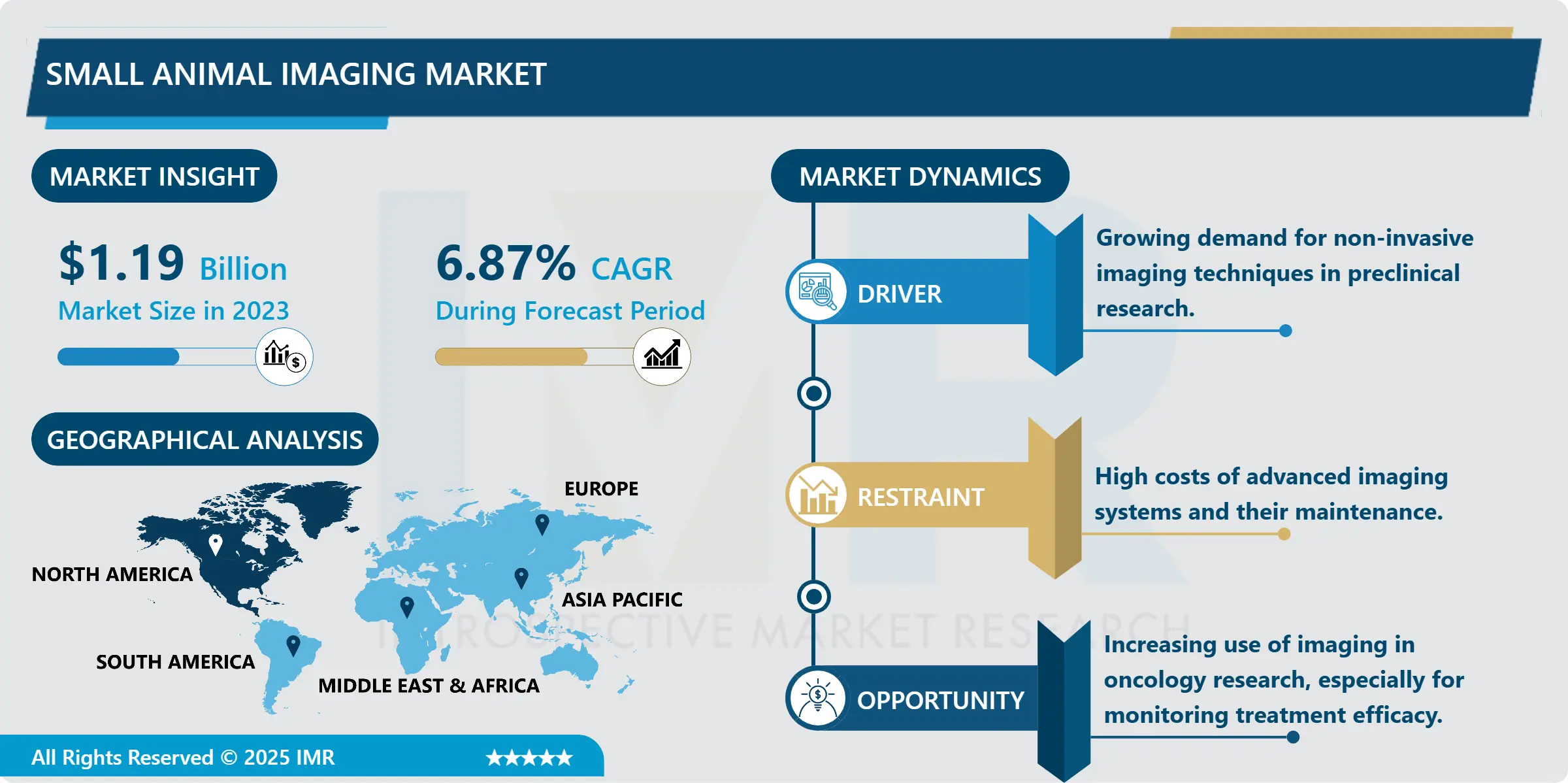
Small Animal Imaging Market Size Was Valued at USD 1.19 Billion in 2023, and is Projected to Reach USD 2.16 Billion by 2032, Growing at a CAGR of 6.87% From 2024-2032.

IMR Group
Description
Small Animal Imaging Market Synopsis:
Small Animal Imaging Market Size Was Valued at USD 1.19 Billion in 2023, and is Projected to Reach USD 2.16 Billion by 2032, Growing at a CAGR of 6.87% From 2024-2032.
The small animal imaging is defined here as the application of modern imaging techniques for visualizing and characterizing small animals, predominantly rodents. Such techniques include, MRI, PET, CT, US, optical imaging and SPECT. These technologies, therefore, enable non-invasive tracking of physiological, anatomical, and molecular changes in small animals making them valuable in drug development, modelling diseases, and developing targeted treatment. The market is influenced by the increasing requirement for high throughput imaging solutions to accelerate research, particularly in cancer, neuroscience, cardiovascular, and immunological research.
The global non-human small animal imaging market has been growing steadily for a while because of using less invasive imaging methods in experiments. As various imaging capabilities are developed, the researchers get better data and increased precision in finding the best medical products faster. The demand for small animal imaging investments comes from the pharmaceutical and biotechnology industries in which these imaging tools are applied for the assessment of drug effectiveness, development of disease models, and as well as toxicity studies. Moreover, the expansion of multimodal imaging solutions that integrate PET and other imaging technology like PET/CT and PET/MRI is projected to drive the market higher due to the better imaging facilities and improved understanding of the biological process of the disease.
With an increasing emphasis on individualised treatment of patients and disease, the role of small animal imaging is becoming more important in elucidating disease pathophysiology and evaluating treatment outcomes. The increasing use of less invasive methods to study the animal models other than euthanasia is also fuelling the market growth.
Small Animal Imaging Market Trend Analysis:
Advancements in Hybrid Imaging Systems
The small animal imaging market has been growing at a steady rate over the years because of the continually growing usage of non-invasive imaging in a preclinical research setting. As technology in imaging improves, researchers are therefore able to get much more accurate data thus improving efficiency in the drug development processes. Another field that has high demand of small animal imaging is pharmacological and biotechnological research where these imaging techniques are applied to drug evaluation, disease modelling and toxicity review. In addition, the expansion of more advanced imaging technologies, like PET/CT and PET/ MRI, is also expected to directly advance the market because of the significantly improved imaging quality and better understanding of disease processes.
Small animal imaging has become increasingly important as the need for targeting individuals medicine is continuously on an increase, in elucidating disease processes and evaluating the potentials of therapeutic procedures. The markets progress is also benefited by the growing tendency towards less invasive investigative procedures, meaning that scientists do not have to sacrifice animal models, in order to measure and observe their behaviour.
Increasing Use of Imaging in Oncology Research
Cancer research extensively employs small animals like rodents where preclinical test of new treatments and therapies is carried out. Imaging techniques afford the researchers opportunity to observe the growth of the tumour, evaluate the effectiveness of the antitumor treatments, and observe possible toxic effects of the treatments on the animals without having to kill the animal. However, remaining a key hall mark of Huntington’s disease, this ability to sp e model and observe real-time changes in tumour behaviours and responses to treatment could not be underestimated as critical to progressing our understanding and treatment portfolios for cancer.
Cancer is a life-threatening disease that is on the rise globally and in this regard the need for diagnostic and treatment- monitoring imaging increases the market potential of small animal imaging. Besides, the increasing preferential pharmacotherapies, immunotherapies and precision medicine compounded by cancer complex nature fuels the demand for advanced imaging solutions for the oncology drug development and clinical trials. Small animal imaging technologies play a central role in assessing the safety and efficacy of these innovative treatments and any firm that is able to provide high performance imaging systems that are appropriate to oncology applications will be well set for growth. It is believed that this trend will continue to fuel a need for higher resolution imaging systems and definitely solidify the notion that small animal imaging is critical to cancer research.
Small Animal Imaging Market Segment Analysis:
Small Animal Imaging Market is Segmented on the basis of technology, application, end user and region
By Technology, MRI (Magnetic Resonance Imaging) segment is expected to dominate the market during the forecast period
By technology, the MRI (Magnetic Resonance Imaging) segment is expected to dominate the small animal imaging market during the forecast period. MRI remains a preferred choice for generating high-resolution anatomical images of the nervous and cardiovascular systems, making it essential in preclinical research.
While other imaging techniques like PET/CT, fluorescence, and ultrasound offer unique benefits in functional imaging and real-time assessments, MRI’s ability to deliver detailed anatomical insights positions it as a critical tool in preclinical studies. The growing demand for advanced imaging to support research in oncology, neurology, and immunology further strengthens MRI’s market leadership.
By Application, cancer research segment expected to held the largest share
By application, the cancer research segment will have the highest share in the small animal imaging industry. Small animal imaging is essential for assessing drug efficacy and safety of emerging drug candidates through the tracking of real-time therapeutic effect. It is especially important in cancer research for tumor growth evaluation, therapy outcome, and molecular pathway understanding of different types of cancers to direct drug development.
Moreover, small animal imaging is also employed in cardiovascular research, neurological studies, and inflammation research. Increased usage of advanced imaging modalities in these applications is driving the growth of the market, enabling accurate drug testing and therapeutic assessment.
Small Animal Imaging Market Regional Insights:
North America is Expected to Dominate the Market Over the Forecast period
North America emerged as the market leader in the small animal imaging market and contributed a significantly large market share. Much of this can be attributed to a stronger and more equipped healthcare system, heavy investment in life sciences and a greater density in the number of pharmaceutical organisations and academic institutions. Small animal imaging systems have a particularly large market in the United States, and this region continues to lead the demand for systems of this type across the world. The region’s main driver is the biopharmaceutical industry with a large number of research institutes and universities as well as CROs using small animal imaging for disease modelling, compound testing and preclinical research. The prudent ecosystem of innovation and research promotes the uptake as well as growth of the enhanced imaging systems.
The need shall drive more recognition of small animal imaging importance and entrench North America as the leading market for the niche services given ever increasingly demands for high precision and quality data in biomedical sciences. Other factors which specially favours this region include the sound regulation in the region, and the growing trend in the field of personalized medicine which also makes this region to lead in small animal imaging.
Active Key Players in the Small Animal Imaging Market:
Bruker Corporation (USA)
Carestream Health (USA)
Codex DNA (USA)
FUJIFILM Holdings Corporation (Japan)
GE Healthcare (USA)
Halo Medical Technologies, Inc. (USA)
Histoindex Pte Ltd (Singapore)
Imalytics (Germany)
Mediso Ltd. (Hungary)
Miltenyi Biotec (Germany)
MR Solutions Ltd. (UK)
PerkinElmer, Inc. (USA)
Other Active Players
Chapter 1: Introduction
1.1 Scope and Coverage
Chapter 2:Executive Summary
Chapter 3: Market Landscape
3.1 Market Dynamics
3.1.1 Drivers
3.1.2 Restraints
3.1.3 Opportunities
3.1.4 Challenges
3.2 Market Trend Analysis
3.3 PESTLE Analysis
3.4 Porter’s Five Forces Analysis
3.5 Industry Value Chain Analysis
3.6 Ecosystem
3.7 Regulatory Landscape
3.8 Price Trend Analysis
3.9 Patent Analysis
3.10 Technology Evolution
3.11 Investment Pockets
3.12 Import-Export Analysis
Chapter 4: Small Animal Imaging Market by Technology
4.1 Small Animal Imaging Market Snapshot and Growth Engine
4.2 Small Animal Imaging Market Overview
4.3 MRI
4.3.1 Introduction and Market Overview
4.3.2 Historic and Forecasted Market Size in Value USD and Volume Units (2017-2032F)
4.3.3 Key Market Trends, Growth Factors and Opportunities
4.3.4 MRI : Geographic Segmentation Analysis
Chapter 5: Small Animal Imaging Market by PET
5.1 Small Animal Imaging Market Snapshot and Growth Engine
5.2 Small Animal Imaging Market Overview
5.3 Positron Emission Tomography
5.3.1 Introduction and Market Overview
5.3.2 Historic and Forecasted Market Size in Value USD and Volume Units (2017-2032F)
5.3.3 Key Market Trends, Growth Factors and Opportunities
5.3.4 Positron Emission Tomography: Geographic Segmentation Analysis
Chapter 6: Small Animal Imaging Market by CT
6.1 Small Animal Imaging Market Snapshot and Growth Engine
6.2 Small Animal Imaging Market Overview
6.3 Computed Tomography
6.3.1 Introduction and Market Overview
6.3.2 Historic and Forecasted Market Size in Value USD and Volume Units (2017-2032F)
6.3.3 Key Market Trends, Growth Factors and Opportunities
6.3.4 Computed Tomography: Geographic Segmentation Analysis
6.4 Optical Imaging
6.4.1 Introduction and Market Overview
6.4.2 Historic and Forecasted Market Size in Value USD and Volume Units (2017-2032F)
6.4.3 Key Market Trends, Growth Factors and Opportunities
6.4.4 Optical Imaging: Geographic Segmentation Analysis
6.5 Ultrasound Imaging
6.5.1 Introduction and Market Overview
6.5.2 Historic and Forecasted Market Size in Value USD and Volume Units (2017-2032F)
6.5.3 Key Market Trends, Growth Factors and Opportunities
6.5.4 Ultrasound Imaging: Geographic Segmentation Analysis
6.6 SPECT Single Photon Emission Computed Tomography
6.6.1 Introduction and Market Overview
6.6.2 Historic and Forecasted Market Size in Value USD and Volume Units (2017-2032F)
6.6.3 Key Market Trends, Growth Factors and Opportunities
6.6.4 SPECT Single Photon Emission Computed Tomography: Geographic Segmentation Analysis
6.7 Others
6.7.1 Introduction and Market Overview
6.7.2 Historic and Forecasted Market Size in Value USD and Volume Units (2017-2032F)
6.7.3 Key Market Trends, Growth Factors and Opportunities
6.7.4 Others: Geographic Segmentation Analysis
Chapter 7: Small Animal Imaging Market by Application
7.1 Small Animal Imaging Market Snapshot and Growth Engine
7.2 Small Animal Imaging Market Overview
7.3 Drug Discovery and Development
7.3.1 Introduction and Market Overview
7.3.2 Historic and Forecasted Market Size in Value USD and Volume Units (2017-2032F)
7.3.3 Key Market Trends, Growth Factors and Opportunities
7.3.4 Drug Discovery and Development: Geographic Segmentation Analysis
7.4 Cancer Research
7.4.1 Introduction and Market Overview
7.4.2 Historic and Forecasted Market Size in Value USD and Volume Units (2017-2032F)
7.4.3 Key Market Trends, Growth Factors and Opportunities
7.4.4 Cancer Research: Geographic Segmentation Analysis
7.5 Neurological Research
7.5.1 Introduction and Market Overview
7.5.2 Historic and Forecasted Market Size in Value USD and Volume Units (2017-2032F)
7.5.3 Key Market Trends, Growth Factors and Opportunities
7.5.4 Neurological Research: Geographic Segmentation Analysis
7.6 Cardiovascular Research
7.6.1 Introduction and Market Overview
7.6.2 Historic and Forecasted Market Size in Value USD and Volume Units (2017-2032F)
7.6.3 Key Market Trends, Growth Factors and Opportunities
7.6.4 Cardiovascular Research: Geographic Segmentation Analysis
7.7 Inflammation and Infectious Disease Research
7.7.1 Introduction and Market Overview
7.7.2 Historic and Forecasted Market Size in Value USD and Volume Units (2017-2032F)
7.7.3 Key Market Trends, Growth Factors and Opportunities
7.7.4 Inflammation and Infectious Disease Research: Geographic Segmentation Analysis
7.8 Toxicology Studies
7.8.1 Introduction and Market Overview
7.8.2 Historic and Forecasted Market Size in Value USD and Volume Units (2017-2032F)
7.8.3 Key Market Trends, Growth Factors and Opportunities
7.8.4 Toxicology Studies: Geographic Segmentation Analysis
7.9 Others
7.9.1 Introduction and Market Overview
7.9.2 Historic and Forecasted Market Size in Value USD and Volume Units (2017-2032F)
7.9.3 Key Market Trends, Growth Factors and Opportunities
7.9.4 Others: Geographic Segmentation Analysis
Chapter 8: Small Animal Imaging Market by End User
8.1 Small Animal Imaging Market Snapshot and Growth Engine
8.2 Small Animal Imaging Market Overview
8.3 Pharmaceutical and Biotechnology Companies
8.3.1 Introduction and Market Overview
8.3.2 Historic and Forecasted Market Size in Value USD and Volume Units (2017-2032F)
8.3.3 Key Market Trends, Growth Factors and Opportunities
8.3.4 Pharmaceutical and Biotechnology Companies: Geographic Segmentation Analysis
8.4 Contract Research Organizations CROs
8.4.1 Introduction and Market Overview
8.4.2 Historic and Forecasted Market Size in Value USD and Volume Units (2017-2032F)
8.4.3 Key Market Trends, Growth Factors and Opportunities
8.4.4 Contract Research Organizations CROs: Geographic Segmentation Analysis
8.5 Academic and Research Institutes
8.5.1 Introduction and Market Overview
8.5.2 Historic and Forecasted Market Size in Value USD and Volume Units (2017-2032F)
8.5.3 Key Market Trends, Growth Factors and Opportunities
8.5.4 Academic and Research Institutes: Geographic Segmentation Analysis
8.6 Others)
8.6.1 Introduction and Market Overview
8.6.2 Historic and Forecasted Market Size in Value USD and Volume Units (2017-2032F)
8.6.3 Key Market Trends, Growth Factors and Opportunities
8.6.4 Others): Geographic Segmentation Analysis
Chapter 9: Company Profiles and Competitive Analysis
9.1 Competitive Landscape
9.1.1 Competitive Benchmarking
9.1.2 Small Animal Imaging Market Share by Manufacturer (2023)
9.1.3 Industry BCG Matrix
9.1.4 Heat Map Analysis
9.1.5 Mergers and Acquisitions
9.2 BRUKER CORPORATION (USA)
9.2.1 Company Overview
9.2.2 Key Executives
9.2.3 Company Snapshot
9.2.4 Role of the Company in the Market
9.2.5 Sustainability and Social Responsibility
9.2.6 Operating Business Segments
9.2.7 Product Portfolio
9.2.8 Business Performance
9.2.9 Key Strategic Moves and Recent Developments
9.2.10 SWOT Analysis
9.3 CARESTREAM HEALTH (USA)
9.4 CODEX DNA (USA)
9.5 FUJIFILM HOLDINGS CORPORATION (JAPAN)
9.6 GE HEALTHCARE (USA)
9.7 OTHER ACTIVE PLAYERS
Chapter 10: Global Small Animal Imaging Market By Region
10.1 Overview
10.2. North America Small Animal Imaging Market
10.2.1 Key Market Trends, Growth Factors and Opportunities
10.2.2 Top Key Companies
10.2.3 Historic and Forecasted Market Size by Segments
10.2.4 Historic and Forecasted Market Size By Technology
10.2.4.1 MRI
10.2.5 Historic and Forecasted Market Size By PET
10.2.5.1 Positron Emission Tomography
10.2.6 Historic and Forecasted Market Size By CT
10.2.6.1 Computed Tomography
10.2.6.2 Optical Imaging
10.2.6.3 Ultrasound Imaging
10.2.6.4 SPECT Single Photon Emission Computed Tomography
10.2.6.5 Others
10.2.7 Historic and Forecasted Market Size By Application
10.2.7.1 Drug Discovery and Development
10.2.7.2 Cancer Research
10.2.7.3 Neurological Research
10.2.7.4 Cardiovascular Research
10.2.7.5 Inflammation and Infectious Disease Research
10.2.7.6 Toxicology Studies
10.2.7.7 Others
10.2.8 Historic and Forecasted Market Size By End User
10.2.8.1 Pharmaceutical and Biotechnology Companies
10.2.8.2 Contract Research Organizations CROs
10.2.8.3 Academic and Research Institutes
10.2.8.4 Others)
10.2.9 Historic and Forecast Market Size by Country
10.2.9.1 US
10.2.9.2 Canada
10.2.9.3 Mexico
10.3. Eastern Europe Small Animal Imaging Market
10.3.1 Key Market Trends, Growth Factors and Opportunities
10.3.2 Top Key Companies
10.3.3 Historic and Forecasted Market Size by Segments
10.3.4 Historic and Forecasted Market Size By Technology
10.3.4.1 MRI
10.3.5 Historic and Forecasted Market Size By PET
10.3.5.1 Positron Emission Tomography
10.3.6 Historic and Forecasted Market Size By CT
10.3.6.1 Computed Tomography
10.3.6.2 Optical Imaging
10.3.6.3 Ultrasound Imaging
10.3.6.4 SPECT Single Photon Emission Computed Tomography
10.3.6.5 Others
10.3.7 Historic and Forecasted Market Size By Application
10.3.7.1 Drug Discovery and Development
10.3.7.2 Cancer Research
10.3.7.3 Neurological Research
10.3.7.4 Cardiovascular Research
10.3.7.5 Inflammation and Infectious Disease Research
10.3.7.6 Toxicology Studies
10.3.7.7 Others
10.3.8 Historic and Forecasted Market Size By End User
10.3.8.1 Pharmaceutical and Biotechnology Companies
10.3.8.2 Contract Research Organizations CROs
10.3.8.3 Academic and Research Institutes
10.3.8.4 Others)
10.3.9 Historic and Forecast Market Size by Country
10.3.9.1 Russia
10.3.9.2 Bulgaria
10.3.9.3 The Czech Republic
10.3.9.4 Hungary
10.3.9.5 Poland
10.3.9.6 Romania
10.3.9.7 Rest of Eastern Europe
10.4. Western Europe Small Animal Imaging Market
10.4.1 Key Market Trends, Growth Factors and Opportunities
10.4.2 Top Key Companies
10.4.3 Historic and Forecasted Market Size by Segments
10.4.4 Historic and Forecasted Market Size By Technology
10.4.4.1 MRI
10.4.5 Historic and Forecasted Market Size By PET
10.4.5.1 Positron Emission Tomography
10.4.6 Historic and Forecasted Market Size By CT
10.4.6.1 Computed Tomography
10.4.6.2 Optical Imaging
10.4.6.3 Ultrasound Imaging
10.4.6.4 SPECT Single Photon Emission Computed Tomography
10.4.6.5 Others
10.4.7 Historic and Forecasted Market Size By Application
10.4.7.1 Drug Discovery and Development
10.4.7.2 Cancer Research
10.4.7.3 Neurological Research
10.4.7.4 Cardiovascular Research
10.4.7.5 Inflammation and Infectious Disease Research
10.4.7.6 Toxicology Studies
10.4.7.7 Others
10.4.8 Historic and Forecasted Market Size By End User
10.4.8.1 Pharmaceutical and Biotechnology Companies
10.4.8.2 Contract Research Organizations CROs
10.4.8.3 Academic and Research Institutes
10.4.8.4 Others)
10.4.9 Historic and Forecast Market Size by Country
10.4.9.1 Germany
10.4.9.2 UK
10.4.9.3 France
10.4.9.4 The Netherlands
10.4.9.5 Italy
10.4.9.6 Spain
10.4.9.7 Rest of Western Europe
10.5. Asia Pacific Small Animal Imaging Market
10.5.1 Key Market Trends, Growth Factors and Opportunities
10.5.2 Top Key Companies
10.5.3 Historic and Forecasted Market Size by Segments
10.5.4 Historic and Forecasted Market Size By Technology
10.5.4.1 MRI
10.5.5 Historic and Forecasted Market Size By PET
10.5.5.1 Positron Emission Tomography
10.5.6 Historic and Forecasted Market Size By CT
10.5.6.1 Computed Tomography
10.5.6.2 Optical Imaging
10.5.6.3 Ultrasound Imaging
10.5.6.4 SPECT Single Photon Emission Computed Tomography
10.5.6.5 Others
10.5.7 Historic and Forecasted Market Size By Application
10.5.7.1 Drug Discovery and Development
10.5.7.2 Cancer Research
10.5.7.3 Neurological Research
10.5.7.4 Cardiovascular Research
10.5.7.5 Inflammation and Infectious Disease Research
10.5.7.6 Toxicology Studies
10.5.7.7 Others
10.5.8 Historic and Forecasted Market Size By End User
10.5.8.1 Pharmaceutical and Biotechnology Companies
10.5.8.2 Contract Research Organizations CROs
10.5.8.3 Academic and Research Institutes
10.5.8.4 Others)
10.5.9 Historic and Forecast Market Size by Country
10.5.9.1 China
10.5.9.2 India
10.5.9.3 Japan
10.5.9.4 South Korea
10.5.9.5 Malaysia
10.5.9.6 Thailand
10.5.9.7 Vietnam
10.5.9.8 The Philippines
10.5.9.9 Australia
10.5.9.10 New Zealand
10.5.9.11 Rest of APAC
10.6. Middle East & Africa Small Animal Imaging Market
10.6.1 Key Market Trends, Growth Factors and Opportunities
10.6.2 Top Key Companies
10.6.3 Historic and Forecasted Market Size by Segments
10.6.4 Historic and Forecasted Market Size By Technology
10.6.4.1 MRI
10.6.5 Historic and Forecasted Market Size By PET
10.6.5.1 Positron Emission Tomography
10.6.6 Historic and Forecasted Market Size By CT
10.6.6.1 Computed Tomography
10.6.6.2 Optical Imaging
10.6.6.3 Ultrasound Imaging
10.6.6.4 SPECT Single Photon Emission Computed Tomography
10.6.6.5 Others
10.6.7 Historic and Forecasted Market Size By Application
10.6.7.1 Drug Discovery and Development
10.6.7.2 Cancer Research
10.6.7.3 Neurological Research
10.6.7.4 Cardiovascular Research
10.6.7.5 Inflammation and Infectious Disease Research
10.6.7.6 Toxicology Studies
10.6.7.7 Others
10.6.8 Historic and Forecasted Market Size By End User
10.6.8.1 Pharmaceutical and Biotechnology Companies
10.6.8.2 Contract Research Organizations CROs
10.6.8.3 Academic and Research Institutes
10.6.8.4 Others)
10.6.9 Historic and Forecast Market Size by Country
10.6.9.1 Turkiye
10.6.9.2 Bahrain
10.6.9.3 Kuwait
10.6.9.4 Saudi Arabia
10.6.9.5 Qatar
10.6.9.6 UAE
10.6.9.7 Israel
10.6.9.8 South Africa
10.7. South America Small Animal Imaging Market
10.7.1 Key Market Trends, Growth Factors and Opportunities
10.7.2 Top Key Companies
10.7.3 Historic and Forecasted Market Size by Segments
10.7.4 Historic and Forecasted Market Size By Technology
10.7.4.1 MRI
10.7.5 Historic and Forecasted Market Size By PET
10.7.5.1 Positron Emission Tomography
10.7.6 Historic and Forecasted Market Size By CT
10.7.6.1 Computed Tomography
10.7.6.2 Optical Imaging
10.7.6.3 Ultrasound Imaging
10.7.6.4 SPECT Single Photon Emission Computed Tomography
10.7.6.5 Others
10.7.7 Historic and Forecasted Market Size By Application
10.7.7.1 Drug Discovery and Development
10.7.7.2 Cancer Research
10.7.7.3 Neurological Research
10.7.7.4 Cardiovascular Research
10.7.7.5 Inflammation and Infectious Disease Research
10.7.7.6 Toxicology Studies
10.7.7.7 Others
10.7.8 Historic and Forecasted Market Size By End User
10.7.8.1 Pharmaceutical and Biotechnology Companies
10.7.8.2 Contract Research Organizations CROs
10.7.8.3 Academic and Research Institutes
10.7.8.4 Others)
10.7.9 Historic and Forecast Market Size by Country
10.7.9.1 Brazil
10.7.9.2 Argentina
10.7.9.3 Rest of SA
Chapter 11 Analyst Viewpoint and Conclusion
11.1 Recommendations and Concluding Analysis
11.2 Potential Market Strategies
Chapter 12 Research Methodology
12.1 Research Process
12.2 Primary Research
12.3 Secondary Research
Q1: What would be the forecast period in the Small Animal Imaging Market research report?
A1: The forecast period in the Small Animal Imaging Market research report is 2024-2032.
Q2: Who are the key players in the Small Animal Imaging Market?
A2: Bruker Corporation (USA), Carestream Health (USA), Codex DNA (USA), FUJIFILM Holdings Corporation (Japan), GE Healthcare (USA), Halo Medical Technologies, Inc. (USA), Histoindex Pte Ltd (Singapore), Imalytics (Germany), Mediso Ltd. (Hungary), Miltenyi Biotec (Germany), MR Solutions Ltd. (UK), PerkinElmer, Inc. (USA), Other Active Players.
Q3: What are the segments of the Small Animal Imaging Market?
A3: The Small Animal Imaging Market is segmented into Type, Application, End User and region. By Technology, the market is categorized into MRI (Magnetic Resonance Imaging), PET (Positron Emission Tomography), CT (Computed Tomography), Optical Imaging, Ultrasound Imaging, SPECT (Single Photon Emission Computed Tomography), Others. By Application, the market is categorized into Drug Discovery and Development, Cancer Research, Neurological Research, Cardiovascular Research, Inflammation and Infectious Disease Research, Toxicology Studies, Others. By End User, the market is categorized into (Pharmaceutical and Biotechnology Companies, Contract Research Organizations (CROs), Academic and Research Institutes, Others. By region, it is analyzed across North America (U.S.; Canada; Mexico), Eastern Europe (Russia; Bulgaria; The Czech Republic; Hungary; Poland; Romania; Rest of Eastern Europe), Western Europe (Germany; UK; France; Netherlands; Italy; Spain; Rest of Western Europe), Asia-Pacific (China; India; Japan; Southeast Asia, etc.), South America (Brazil; Argentina, etc.), Middle East & Africa (Saudi Arabia; South Africa, etc.).
Q4: What is the Small Animal Imaging Market?
A4: The small animal imaging is defined here as the application of modern imaging techniques for visualizing and characterizing small animals, predominantly rodents. Such techniques include, MRI, PET, CT, US, optical imaging and SPECT.
Q5: How big is the Small Animal Imaging Market?
A5: Small Animal Imaging Market Size Was Valued at USD 1.19 Billion in 2023, and is Projected to Reach USD 2.16 Billion by 2032, Growing at a CAGR of 6.87% From 2024-2032.
How to Buy a Report from eminsights.jp
On the product page, choose the license you want: Single-User License, Multi-User License or Enterprise License.
If you required report in your native language, then you can click on Translated Report button and fill out the form with report name and language you want, then our team will contact you as soon as possible.
Click the Buy Now button.
You will be redirected to the checkout page. Enter your company details and payment information.
Click Place Order to complete the purchase.
Confirmation: You’ll receive an order confirmation and our team will contact you shortly with your ordered report.
If you have any questions, fill out the contact form below or email us at bizdev@eminsights.net.
Thank you for choosing eminsights.jp!