Stay Ahead in Fast-Growing Economies.
Browse Reports Now




Sirolimus Market Global Size & Upcoming Industry Trends By 2032
The Sirolimus market on the other hand is more general referring to the global market in regard to the manufacture, distribution, and sales of the chemical compound sirolimus called rapamycin. Sirolimus is in the category of immunosuppressive drugs which are most commonly used in clients who have undergone transplantation and have organ rejection tendency and used in different types of cancer. It has involved stakeholder groups in the pharmaceutical industry including manufacturers and developers of sirolimus, investigation and research organizations, healthcare facilities and providers, and regulatory organizations. Limiting factors for this market include technological innovations, research and development projects, government dictates in health care, existing legislations, and the experience of organ transplantation and cancer across the globe.

IMR Group
Description
Sirolimus Market Synopsis
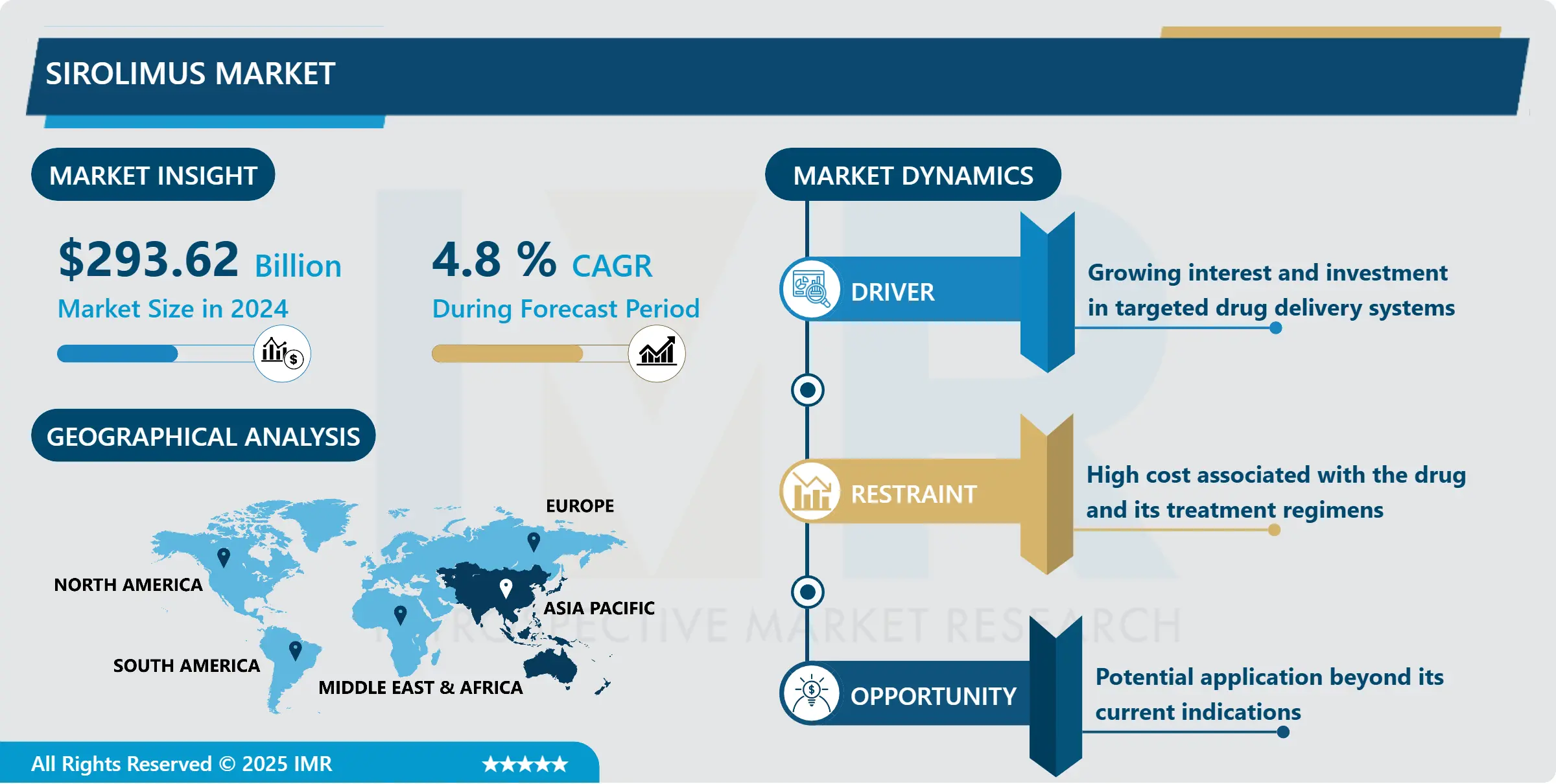
Sirolimus Market is Valued at USD 293.62 Billion in 2024, and is Projected to Reach USD 427.24 Billion by 2032, Growing at a CAGR of 4.8% From 2025-2032.
The Sirolimus market on the other hand is more general referring to the global market in regard to the manufacture, distribution, and sales of the chemical compound sirolimus called rapamycin. Sirolimus is in the category of immunosuppressive drugs which are most commonly used in clients who have undergone transplantation and have organ rejection tendency and used in different types of cancer. It has involved stakeholder groups in the pharmaceutical industry including manufacturers and developers of sirolimus, investigation and research organizations, healthcare facilities and providers, and regulatory organizations. Limiting factors for this market include technological innovations, research and development projects, government dictates in health care, existing legislations, and the experience of organ transplantation and cancer across the globe.
The demands for the commodity known as Sirolimus are rapidly increasing due to its versatility in the processes of organ transplantation and cancer treatment. Used as an immunosuppressive drug thus preventing the body from rejecting transplanted organs sirolimus has significant usage after transplants are done. The ability to lower the chances of rejection make it an essential drug in the field of transplant medicine, this ensures that its sales will continue to be constant as various facilities require the drug to manage their transplants. Furthermore, sirolimus is reported to posses therapeutic application in oncological diseases with researches evidencing the benefits of the drug in handling different kinds of carcinoma such as renal cell carcinoma and some types of breast carcinomas. The fact that it has been found useful both in transplantation and cancer treatment has acted as a booster for the market as pharmaceutical firms have conducted further research with the aim of extending its uses and finding other ways of using it.
However the sirolimus market has opportunities such as high growth rates, increasing prescribing rate and more demanding patients; there are threats like patent expiry, generic entrance and regulatory issues. Some of the potential threats include high competition resulting from the expiry of patents held on branded formulations which has seen the introduction of generic formulations into the market and as a result price pressure. Approval regulations for the drug and matters of safety also gives market players challenging as they must spend on clinical trials and on compliances.
Sirolimus Market Trend Analysis
Sirolimus Market Growth Drivers- Growing interest and investment in targeted drug delivery systems
Conventional methods of administering sirolimus whereby it is given orally in a tablet form or through intravenous infusion have a number of limitations in that they stimulate systemic side effects and an irregular release of the drug in the target tissues. This means that targeted drug delivery systems are mainly designed to deliver sirolimus specifically to the affected organ or tumor mass that has received the transplanted organ/tissue and/or to areas of the body containing cancerous or proliferative cells, thus avoiding most of the healthy tissue.
This trend includes a range of novel strategies, with nanoparticulate formulations, implantable drug delivery systems, and drug-coated stents among the key components. The loading on nanoparticles can bring sirolimus and achieve controlled release and sustained drug activity and lessen systemic side effects.
Sirolimus Market Opportunitites- Potential application beyond its current indications
Sirolimus is well known as antifungal medicine that is used in organ transplantation and cancer treatment studies, but recent studies indicate other potential applications for the medicine as a curative by dealing with several other medical conditions. For instance, although sirolimus has been used primarily for the management of organ transplant recipients, research has revealed that it can be used to manage autoimmune diseases like lupus nephritis and autoimmune hepatitis, as also other non-transplant renal disorders like FSGS.
For pharmaceutical companies seeking new opportunity for growth, this suggests a large potential to expand application of sirolimus into new therapeutic areas where rapamycin has not been used before. Based on the previous clinical data about the action mechanism and safety of sirolimus, the companies may avoid repetitive investigations to prove efficacy and safety of the drug in the new diseases, and to get approval of the new uses from the authorities. Moreover, disorders are becoming more differentiated and, therefore, it is also possible to discover new niches of patients who can have the greatest benefit from receiving sirolimus. In a broader view, there is potential for innovation and progression in the drug industry, and application of sirolimus for beyond mTOR targeting suggest this as a possibility.
Sirolimus Market Segment Analysis:
Sirolimus Market is segmented on the basis of strength, application, and end-users.
By Strength, 1 mg segment is expected to dominate the market during the forecast period
The role that the 1 mg segment plays in the total Sirolimus market in the forecast period can be influenced by several factors. First of all, the 1 mg strength proves to be a common dosage recommended for uses such as organ transplant and certain types of cancer. Standardization of the dosages also makes it easier for the healthcare providers to work with and there is a high likelihood that the treatment cycle will be constant, explaining why there is a high demand for the 1 mg sirolimus formulations.
Further, there is another field that may be useful to the 1 mg segment; the variety of dosing opportunity. The capsules containing sirolimus are not very appropriate for use in this regard since the healthcare provider cannot split doses of the drug into small quantities as it can be done with the tablets that contain 1 mg of sirolimus, making it easy to modify the dosage as would suit a particular patient. For the 1 mg segment, such flexibility makes it applicable for first-line treatment and follow-up treatment in patients with organ transplants or cancer patients.
By Application, Organ Transplant Rejection segment expected to held the largest share
The overall market of sirolimus is expected to highly grow in near future and organ transplant rejection segment is expected to dominate over the other segments. Some of the drugs such as Reopro, sirolimus have immunosuppressive effects and are used in suppression of the immune response thus making it difficult for the body to reject the foreign organ or tissue provided in the transplant process. This application is indeed inevitable with a rapidly growing number of organ transplant surgeries and the more vital need to ensure the survival and effectiveness of grafted organs. The increasing number of cases of organ rejection, prevalence of chronic diseases, and favorable patient outcomes post-implantation make sirolimus a favorite of health practitioners and this is therefore expected to fuel demand and market share in this segment. Further, the continuous research and development in the field of transplantation with proper improvement in the techniques also add to the strengthening of the foundation of relying only on sirolimus; this gives an added advantage to it and supports the existing dominant market share stated for controlling renal transplant rejection.
Sirolimus Market Regional Insights:
Asia Pacific is Expected to Dominate the Market Over the Forecast period
There is a high market potential for Sirolimus in Asia Pacific region and it is predicted that this market will command the international market over the coming years. These factors attributed the dominance primarily to population growth, newly emerging pharma sector, rising investments in healthcare facilities, and an ever-growing population suffering from chronic ailments which sometimes demand immunosuppressive therapy. Leading the biobank industry today are the Asian giants like China, India, and Japan because of the large pool of patients available, increasing biotech industry, and supportive government policies intended for augmenting medical research and development.
Moreover, the increasing prevalence of various diseases and the awareness and demand of the newer forms of therapeutics are driving the market, further contributing towards the growth of Asia Pacific as the global manufacturer and consumer of Sirolimus. This region has continued to shift its strategic focus towards innovation and co-operation with global pharmaceutical firms which firmly establishes this region in the Sirolimus market.
Active Key Players in the Sirolimus Market
Accord Healthcare (U.S.)
Apotex Inc. (Canada)
Amneal Pharmaceuticals LLC. (U.S.)
Pfizer Inc. (U.S.)
Zydus Cadila (India)
Dr. Reddy’s Laboratories Ltd. (India)
Torrent Pharmaceuticals Ltd. (India)
Biocon (India)
Concept Medical (U.S.)
Intas Pharmaceuticals Ltd (India)
Concord Biotech (India)
Livzon (China)
Actiza Pharmaceutical Private Limited (India)
Tiefenbacher API + Ingredients GmbH & Co. KG (Germany)
Delphis Pharmaceutical (India)
Other Active Players
Chapter 1: Introduction
1.1 Scope and Coverage
Chapter 2:Executive Summary
Chapter 3: Market Landscape
3.1 Market Dynamics
3.1.1 Drivers
3.1.2 Restraints
3.1.3 Opportunities
3.1.4 Challenges
3.2 Market Trend Analysis
3.3 PESTLE Analysis
3.4 Porter’s Five Forces Analysis
3.5 Industry Value Chain Analysis
3.6 Ecosystem
3.7 Regulatory Landscape
3.8 Price Trend Analysis
3.9 Patent Analysis
3.10 Technology Evolution
3.11 Investment Pockets
3.12 Import-Export Analysis
Chapter 4: Sirolimus Market by Strength (2018-2032)
4.1 Sirolimus Market Snapshot and Growth Engine
4.2 Market Overview
4.3 0.5mg
4.3.1 Introduction and Market Overview
4.3.2 Historic and Forecasted Market Size in Value USD and Volume Units
4.3.3 Key Market Trends, Growth Factors, and Opportunities
4.3.4 Geographic Segmentation Analysis
4.4 1mg
4.5 2mg
4.6 1mg/mL
Chapter 5: Sirolimus Market by Application (2018-2032)
5.1 Sirolimus Market Snapshot and Growth Engine
5.2 Market Overview
5.3 Organ Transplant Rejection
5.3.1 Introduction and Market Overview
5.3.2 Historic and Forecasted Market Size in Value USD and Volume Units
5.3.3 Key Market Trends, Growth Factors, and Opportunities
5.3.4 Geographic Segmentation Analysis
5.4 Sirolimus Catheter Device
5.5 Sirolimus Coated Balloons
5.6 Others
Chapter 6: Sirolimus Market by End User (2018-2032)
6.1 Sirolimus Market Snapshot and Growth Engine
6.2 Market Overview
6.3 Hospitals
6.3.1 Introduction and Market Overview
6.3.2 Historic and Forecasted Market Size in Value USD and Volume Units
6.3.3 Key Market Trends, Growth Factors, and Opportunities
6.3.4 Geographic Segmentation Analysis
6.4 Specialty Clinics
6.5 Homecare
6.6 Others
Chapter 7: Company Profiles and Competitive Analysis
7.1 Competitive Landscape
7.1.1 Competitive Benchmarking
7.1.2 Sirolimus Market Share by Manufacturer (2024)
7.1.3 Industry BCG Matrix
7.1.4 Heat Map Analysis
7.1.5 Mergers and Acquisitions
7.2 ACCORD HEALTHCARE (U.S.)
7.2.1 Company Overview
7.2.2 Key Executives
7.2.3 Company Snapshot
7.2.4 Role of the Company in the Market
7.2.5 Sustainability and Social Responsibility
7.2.6 Operating Business Segments
7.2.7 Product Portfolio
7.2.8 Business Performance
7.2.9 Key Strategic Moves and Recent Developments
7.2.10 SWOT Analysis
7.3 APOTEX INC. (CANADA)
7.4 AMNEAL PHARMACEUTICALS LLC. (U.S.)
7.5 PFIZER INC. (U.S.)
7.6 ZYDUS CADILA (INDIA)
7.7 DR. REDDY’S LABORATORIES LTD. (INDIA)
7.8 TORRENT PHARMACEUTICALS LTD. (INDIA)
7.9 BIOCON (INDIA)
7.10 CONCEPT MEDICAL (U.S.)
7.11 INTAS PHARMACEUTICALS LTD (INDIA)
7.12 CONCORD BIOTECH (INDIA)
7.13 LIVZON (CHINA)
7.14 ACTIZA PHARMACEUTICAL PRIVATE LIMITED (INDIA)
7.15 TIEFENBACHER API + INGREDIENTS GMBH & CO. KG (GERMANY)
7.16 DELPHIS PHARMACEUTICAL (INDIA)
7.17 OTHER KEY PLAYERS
7.18
Chapter 8: Global Sirolimus Market By Region
8.1 Overview
8.2. North America Sirolimus Market
8.2.1 Key Market Trends, Growth Factors and Opportunities
8.2.2 Top Key Companies
8.2.3 Historic and Forecasted Market Size by Segments
8.2.4 Historic and Forecasted Market Size by Strength
8.2.4.1 0.5mg
8.2.4.2 1mg
8.2.4.3 2mg
8.2.4.4 1mg/mL
8.2.5 Historic and Forecasted Market Size by Application
8.2.5.1 Organ Transplant Rejection
8.2.5.2 Sirolimus Catheter Device
8.2.5.3 Sirolimus Coated Balloons
8.2.5.4 Others
8.2.6 Historic and Forecasted Market Size by End User
8.2.6.1 Hospitals
8.2.6.2 Specialty Clinics
8.2.6.3 Homecare
8.2.6.4 Others
8.2.7 Historic and Forecast Market Size by Country
8.2.7.1 US
8.2.7.2 Canada
8.2.7.3 Mexico
8.3. Eastern Europe Sirolimus Market
8.3.1 Key Market Trends, Growth Factors and Opportunities
8.3.2 Top Key Companies
8.3.3 Historic and Forecasted Market Size by Segments
8.3.4 Historic and Forecasted Market Size by Strength
8.3.4.1 0.5mg
8.3.4.2 1mg
8.3.4.3 2mg
8.3.4.4 1mg/mL
8.3.5 Historic and Forecasted Market Size by Application
8.3.5.1 Organ Transplant Rejection
8.3.5.2 Sirolimus Catheter Device
8.3.5.3 Sirolimus Coated Balloons
8.3.5.4 Others
8.3.6 Historic and Forecasted Market Size by End User
8.3.6.1 Hospitals
8.3.6.2 Specialty Clinics
8.3.6.3 Homecare
8.3.6.4 Others
8.3.7 Historic and Forecast Market Size by Country
8.3.7.1 Russia
8.3.7.2 Bulgaria
8.3.7.3 The Czech Republic
8.3.7.4 Hungary
8.3.7.5 Poland
8.3.7.6 Romania
8.3.7.7 Rest of Eastern Europe
8.4. Western Europe Sirolimus Market
8.4.1 Key Market Trends, Growth Factors and Opportunities
8.4.2 Top Key Companies
8.4.3 Historic and Forecasted Market Size by Segments
8.4.4 Historic and Forecasted Market Size by Strength
8.4.4.1 0.5mg
8.4.4.2 1mg
8.4.4.3 2mg
8.4.4.4 1mg/mL
8.4.5 Historic and Forecasted Market Size by Application
8.4.5.1 Organ Transplant Rejection
8.4.5.2 Sirolimus Catheter Device
8.4.5.3 Sirolimus Coated Balloons
8.4.5.4 Others
8.4.6 Historic and Forecasted Market Size by End User
8.4.6.1 Hospitals
8.4.6.2 Specialty Clinics
8.4.6.3 Homecare
8.4.6.4 Others
8.4.7 Historic and Forecast Market Size by Country
8.4.7.1 Germany
8.4.7.2 UK
8.4.7.3 France
8.4.7.4 The Netherlands
8.4.7.5 Italy
8.4.7.6 Spain
8.4.7.7 Rest of Western Europe
8.5. Asia Pacific Sirolimus Market
8.5.1 Key Market Trends, Growth Factors and Opportunities
8.5.2 Top Key Companies
8.5.3 Historic and Forecasted Market Size by Segments
8.5.4 Historic and Forecasted Market Size by Strength
8.5.4.1 0.5mg
8.5.4.2 1mg
8.5.4.3 2mg
8.5.4.4 1mg/mL
8.5.5 Historic and Forecasted Market Size by Application
8.5.5.1 Organ Transplant Rejection
8.5.5.2 Sirolimus Catheter Device
8.5.5.3 Sirolimus Coated Balloons
8.5.5.4 Others
8.5.6 Historic and Forecasted Market Size by End User
8.5.6.1 Hospitals
8.5.6.2 Specialty Clinics
8.5.6.3 Homecare
8.5.6.4 Others
8.5.7 Historic and Forecast Market Size by Country
8.5.7.1 China
8.5.7.2 India
8.5.7.3 Japan
8.5.7.4 South Korea
8.5.7.5 Malaysia
8.5.7.6 Thailand
8.5.7.7 Vietnam
8.5.7.8 The Philippines
8.5.7.9 Australia
8.5.7.10 New Zealand
8.5.7.11 Rest of APAC
8.6. Middle East & Africa Sirolimus Market
8.6.1 Key Market Trends, Growth Factors and Opportunities
8.6.2 Top Key Companies
8.6.3 Historic and Forecasted Market Size by Segments
8.6.4 Historic and Forecasted Market Size by Strength
8.6.4.1 0.5mg
8.6.4.2 1mg
8.6.4.3 2mg
8.6.4.4 1mg/mL
8.6.5 Historic and Forecasted Market Size by Application
8.6.5.1 Organ Transplant Rejection
8.6.5.2 Sirolimus Catheter Device
8.6.5.3 Sirolimus Coated Balloons
8.6.5.4 Others
8.6.6 Historic and Forecasted Market Size by End User
8.6.6.1 Hospitals
8.6.6.2 Specialty Clinics
8.6.6.3 Homecare
8.6.6.4 Others
8.6.7 Historic and Forecast Market Size by Country
8.6.7.1 Turkiye
8.6.7.2 Bahrain
8.6.7.3 Kuwait
8.6.7.4 Saudi Arabia
8.6.7.5 Qatar
8.6.7.6 UAE
8.6.7.7 Israel
8.6.7.8 South Africa
8.7. South America Sirolimus Market
8.7.1 Key Market Trends, Growth Factors and Opportunities
8.7.2 Top Key Companies
8.7.3 Historic and Forecasted Market Size by Segments
8.7.4 Historic and Forecasted Market Size by Strength
8.7.4.1 0.5mg
8.7.4.2 1mg
8.7.4.3 2mg
8.7.4.4 1mg/mL
8.7.5 Historic and Forecasted Market Size by Application
8.7.5.1 Organ Transplant Rejection
8.7.5.2 Sirolimus Catheter Device
8.7.5.3 Sirolimus Coated Balloons
8.7.5.4 Others
8.7.6 Historic and Forecasted Market Size by End User
8.7.6.1 Hospitals
8.7.6.2 Specialty Clinics
8.7.6.3 Homecare
8.7.6.4 Others
8.7.7 Historic and Forecast Market Size by Country
8.7.7.1 Brazil
8.7.7.2 Argentina
8.7.7.3 Rest of SA
Chapter 9 Analyst Viewpoint and Conclusion
9.1 Recommendations and Concluding Analysis
9.2 Potential Market Strategies
Chapter 10 Research Methodology
10.1 Research Process
10.2 Primary Research
10.3 Secondary Research
Q1: What would be the forecast period in the Sirolimus Market research report?
A1: The forecast period in the Sirolimus Market research report is 2025-2032
Q2: Who are the key players in the Sirolimus Market?
A2: Accord Healthcare (U.S.), Apotex Inc. (Canada), Amneal Pharmaceuticals LLC. (U.S.), Pfizer Inc. (U.S.), Zydus Cadila (India), and Other Active Players.
Q3: What are the segments of the Sirolimus Market?
A3: The Sirolimus Market is segmented into Strength, Application, End User and region. By Strength, the market is categorized into 0.5mg, 1mg, 2mg, 1mg/mL. By Application, the market is categorized into Organ Transplant Rejection, Sirolimus Catheter Device, Sirolimus Coated Balloons, Others. By End User, the market is categorized into Hospitals, Specialty Clinics, Homecare, Others. By region, it is analyzed across• North America (U.S., Canada, Mexico) • Eastern Europe (Russia, Bulgaria, The Czech Republic, Hungary, Poland, Romania, Rest of Eastern Europe) • Western Europe (Germany, UK, France, The Netherlands, Italy, Spain, Rest of Western Europe) • Asia Pacific (China, India, Japan, South Korea, Malaysia, Thailand, Vietnam, The Philippines, Australia, New Zealand, Rest of APAC) • Middle East & Africa (Türkiye, Bahrain, Kuwait, Saudi Arabia, Qatar, UAE, Israel, South Africa) • South America (Brazil, Argentina, Rest of SA)
Q4: What is the Sirolimus Market?
A4: The Sirolimus market on the other hand is more general referring to the global market in regard to the manufacture, distribution, and sales of the chemical compound sirolimus called rapamycin. Sirolimus is in the category of immunosuppressive drugs which are most commonly used in clients who have undergone transplantation and have organ rejection tendency and used in different types of cancer. It has involved stakeholder groups in the pharmaceutical industry including manufacturers and developers of sirolimus, investigation and research organizations, healthcare facilities and providers, and regulatory organizations. Limiting factors for this market include technological innovations, research and development projects, government dictates in health care, existing legislations, and the experience of organ transplantation and cancer across the globe.
Q5: How big is the global sirolimus market?
A5: Sirolimus Market is Valued at USD 293.62 Billion in 2024, and is Projected to Reach USD 427.24 Billion by 2032, Growing at a CAGR of 4.8% From 2025-2032.
How to Buy a Report from eminsights.jp
On the product page, choose the license you want: Single-User License, Multi-User License or Enterprise License.
If you required report in your native language, then you can click on Translated Report button and fill out the form with report name and language you want, then our team will contact you as soon as possible.
Click the Buy Now button.
You will be redirected to the checkout page. Enter your company details and payment information.
Click Place Order to complete the purchase.
Confirmation: You’ll receive an order confirmation and our team will contact you shortly with your ordered report.
If you have any questions, fill out the contact form below or email us at bizdev@eminsights.net.
Thank you for choosing eminsights.jp!