Stay Ahead in Fast-Growing Economies.
Browse Reports Now




Sea Salt Market Report 2025-2032 | Insights & Analysis
Sea salt is salt that is produced by the evaporation of seawater. It is used as a seasoning in foods, cooking, cosmetics and for preserving food.

IMR Group
Description
Sea Salt Market Synopsis
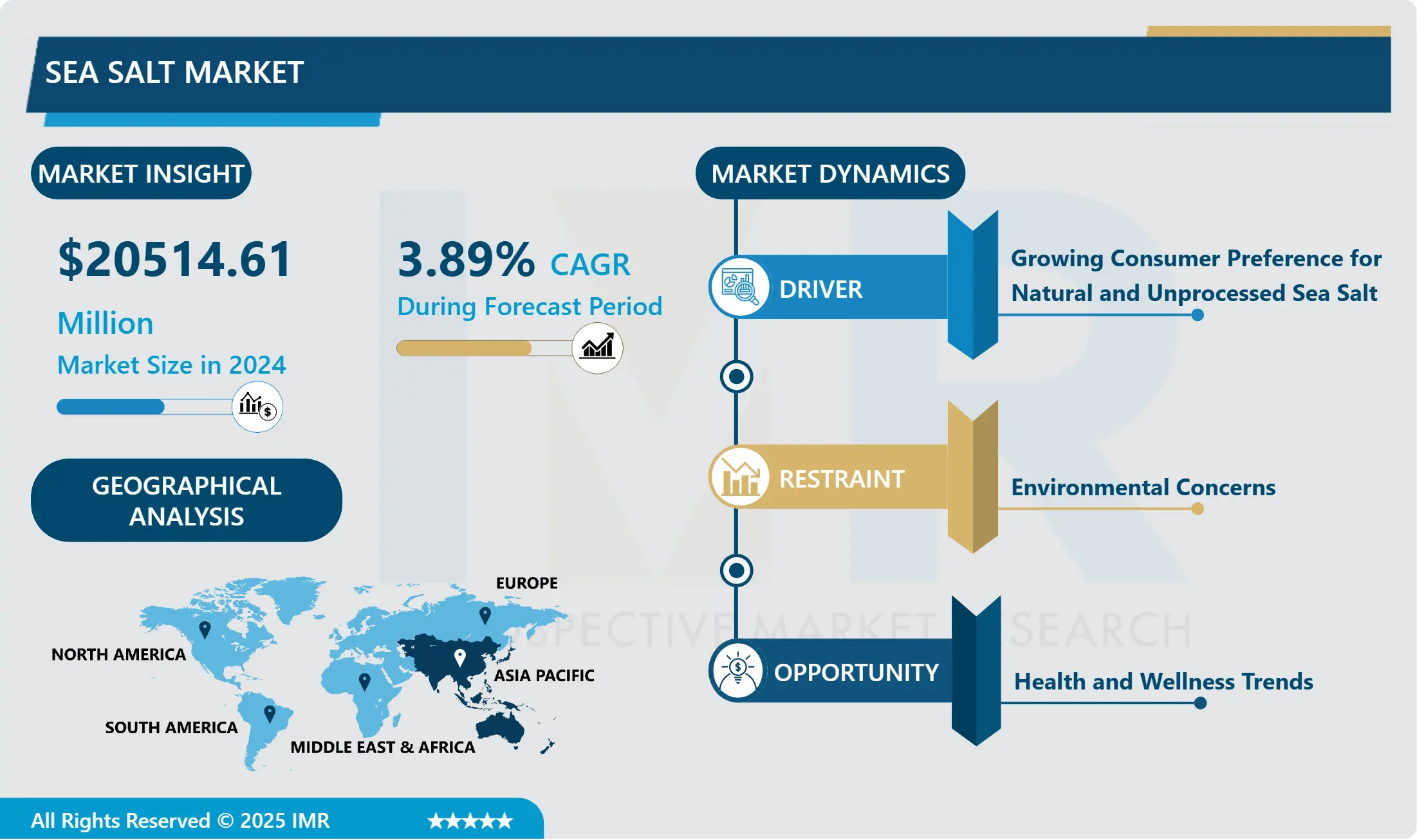
Sea Salt Market Size Was Valued at USD 20514.61 Million in 2024, and is Projected to Reach USD 27838.97 Million by 2032, Growing at a CAGR of 3.89% From 2025-2032.
Sea salt is salt that is produced by the evaporation of seawater. It is used as a seasoning in foods, cooking, cosmetics and for preserving food. It is also called bay salt, solar salt, or simply salt. Like mined rock salt, production of sea salt has been dated to prehistoric times.
The widespread use of sea salt in various fields like agriculture, animal feed, plant water treatment, and ice melting are crucial for driving market expansion. The product’s natural properties, along with its effectiveness in these uses, make it a favored option in multiple industries. The industry is greatly impacted by the rising demand from different sectors, such as food processing and chemical manufacturing. The demand is propelled by the inclusion of products as flavourings and preservatives in the food processing industry.
The increasing demand for sea salt is driven by its positive impacts on health and its versatility in multiple sectors. Nevertheless, the quality of sea salt can deteriorate when produced from contaminated sea water. Sophisticated extraction methods result in tiny salt grains, challenging the idea that bigger grains indicate better quality.
Sea salt possesses anti-inflammatory qualities for the skin, eliminates bacteria that causes bad breath, and helps with dandruff treatment. Utilized in beauty products such as exfoliating scrubs and cleansing soaps. Ingesting sea salt enhances brain and nervous system function, promotes muscle health, supplies electrolytes, and helps prevent dehydration. It is utilized for producing HOMARSEL included in seafood containers to simulate artificial seawater.
Need for sea salt is increased by shifts in lifestyle, growing interest in natural beauty products, and higher spending power among consumers. This contributes to the growth of the cosmetic industry, which often utilizes sea salt. The sea salt market is forecasted to keep expanding, even with challenges like pollution and processing problems.
Sea Salt Market Trend Analysis
Sea Salt Market Growth Driver- Growing Consumer Preference for Natural and Unprocessed Sea Salt
Sea salt has natural minerals such as magnesium, calcium, potassium, and iron that are absent in processed table salt. These minerals enhance the nutritional benefits of sea salt and are viewed as advantageous for one’s health. Consumers are opting for sea salt instead of regular salt due to its perceived health advantages. Consumers looking for less processed options are drawn to the natural composition of sea salt due to its minimal processing. The growing interest in sea salt is driven by the belief in the health advantages of natural foods.
Customers are choosing sea salt instead of table salt to reduce their sodium consumption, since the bigger crystals make it seem like there is less sodium per portion. Due to concerns about excessive sodium intake, the rough texture of sea salt is thought to assist in controlling and reducing sodium consumption for improved health results and lowered risk of conditions such as hypertension. The production of eco-friendly sea salt requires the natural evaporation of seawater, which is seen as a more sustainable alternative to extracting table salt from mines. Eco-aware consumers are drawn to sustainable methods such as solar evaporation due to their reduced carbon footprint.
Sea salt companies focus on being transparent and sourcing ethically by obtaining certifications for organic and sustainable methods, attracting consumers who care about ethics, establishing trust and loyalty. The trend of clean labelling, which promotes items containing basic, organic components, increases the desire for sea salt. The demand for high-end and handcrafted food items is increasing, highlighting the importance of quality and genuineness. Sea salt falls under this classification, attracting customers who are ready to spend extra for premium quality and natural origins.
Sea Salt Market Expansion Opportunity- Health and Wellness Trends
Increasing knowledge about health is causing consumers to seek out natural, unprocessed food items. Health-conscious consumers prefer sea salt over table salt because it is less refined and has larger crystals, leading to a perceived lower sodium content. Sea salt has beneficial trace minerals such as magnesium, calcium, and potassium which are good for those concerned about their health. Sea salt is considered a functional food because of its ability to provide benefits such as helping with electrolyte balance and improving bone health.
The taste of sea salt is highly valued in gourmet cuisine, and there is an increasing desire for flavored options such as herbs and spices. Culinary professionals and individuals who cook at home favor sea salt due to its distinct textures and high quality. Consumers are looking for openness in food production and prefer simple label ingredients such as sea salt that undergo little processing. The increase in sales of certified organic sea salt products mirrors the request for organic and non-GMO alternatives.
Sea salt’s therapeutic properties and mineral content make it a commonly used ingredient in skincare and wellness products such as exfoliants and bath salts. The growing popularity of wellness trends like spa treatments and self-care beauty routines has led to a higher need for sea salt in personal grooming products. Sea salt is utilized in health foods, snacks, and specialty diet products for its believed health advantages and improved flavour. Sea salt is becoming more popular in functional beverages, such as electrolyte drinks, due to its mineral content and natural source.
Sea Salt Market Segment Analysis:
Sea Salt Market is segmented on the basis of Type, Packaging, Distribution Channel, Application, End-User, and Region.
By Distribution Channel, Convenience Stores Segment Is Expected to Dominate the Market During the Forecast Period
Convenience stores are important in distributing sea salt products, providing easy access to snacks, packaged foods, and drinks with sea salt. While they may not have a stronghold in the market, they do enhance accessibility for customers. Convenience stores sell various snacks such as potato chips, pretzels, nuts, and jerky seasoned with sea salt. Sea salt enhances the flavour and appeals to customers looking for healthier alternatives to snacks seasoned with table salt.
Convenient stores located in busy areas offer fast and simple shopping experiences for customers. They provide a range of sea salt goods, encouraging spontaneous buys and sustaining a consistent need for such products. Customers are looking for healthier snack choices at convenience stores, with sea salt being preferred to highly processed snacks. Stores are increasing their supply of sea salt products to meet the needs of health-conscious customers.
Convenience stores around the globe demonstrate diversity by providing a wide range of products, such as imported snacks and specialty foods utilizing sea salt sourced from various areas. The availability of imported sea salt products gives consumers more options, emphasizing the wide popularity and market availability of sea salt. Retailers strategically place and advertise sea salt products in convenience stores to draw in consumers by emphasizing their natural, premium, or gourmet attributes. Sales are driven by promotions, discounts, and product placements as well as other food and beverage items.
By Application, Food & Beverages Industry Segment Held the Largest Share In 2024
Sea salt is an essential component in the manufacturing of food, utilized in baking, seasoning, meat processing, dairy items, snack foods, and prepared meals. Its inherent charm and flexibility make it a more favorable option than processed table salt. Sea salt is preferred for its distinct flavour and capacity to boost tastes without being overpowering. In the food industry, it is favored for its superior quality and more intense flavour than table salt.
There is a growing desire from consumers for natural, minimally processed foods. Sea salt, containing trace minerals, is considered a better choice than refined salt for health reasons. Companies are adding sea salt to their products in order to follow this trend. The trend of premiumization in the food industry encourages the utilization of sea salt in high-end and specialty products, increasing their worth and attractiveness. Sea salt is associated with high-quality and handcrafted items, leading to an increase in demand in the food and beverage industry.
Consumer demand for natural and healthy options has made sea salt a popular choice in retail products. Packaged snacks and convenience foods often contain this ingredient. Sea salt provides more than just flavour, with functional properties like texture enhancement and preservation. These properties are vital in food processing for better product stability, shelf life, and sensory appeal. The sea salt market is predominantly influenced by the food & beverages sector as it is extensively utilized for enhancing flavours, in line with health preferences, and necessary for high-quality goods.
Sea Salt Market Regional Insights:
Asia Pacific is Expected to Dominate the Market Over the Forecast Period
The Asia-Pacific area boasts an extensive coastline that is ideal for naturally evaporating sea salt production. Countries such as China, India, Australia, and Indonesia benefit from optimal weather conditions such as warm temperatures and minimal rainfall, which aid in the effective production of salt. China and India, both leading sea salt manufacturers, possess advanced infrastructure and technology that enable them to efficiently produce large amounts of sea salt to meet both domestic and international demand.
The huge population in the Asia-Pacific area, with over 4 billion individuals, especially in nations such as China and India, creates a substantial market for sea salt because of the traditional food choices in Asian cultures. Numerous nations in this region have efficient sea salt production because of reduced labor and production expenses, enabling them to participate in the international market effectively. They additionally concentrate on exporting premium sea salt to satisfy worldwide needs.
Advanced harvesting methods and machinery have enhanced the quality and efficiency of sea salt production. Advancements in processing and packaging improve market appeal. Asia-Pacific Sea salt reputation is enhanced by sustainable practices which attract environmentally conscious consumers globally. Government assistance for the sea salt sector consists of supporting policies, financial aid, and improving infrastructure. This aids producers in expanding their businesses and improving the quality of their products. Investing in research and development has also enhanced production methods and the range of products available.
From this graph it is shown that, China is the world leader in terms of salt production, with 53 million metric tons of salt produced in 2023. That same year, salt production in the United States, the second-largest salt producing country, amounted to 42 million metric tons. The greatest single use for salt is as a feedstock for the production of industrial chemicals.
Sea Salt Market Active Players
Cargill, Inc. (USA)
Tata Chemicals Limited (India)
Miwon Commercial Co., Ltd. (South Korea)
Jiangsu Salt Industry Group (China)
Nippon Chemical Industrial Co., Ltd. (Japan)
Cheetham Salt Limited (Australia)
PT Garam (Persero) (Indonesia)
K+S Asia Pacific Pte Ltd (Singapore)
Akzo Nobel N.V. (Japan)
Maldon Salt Company (China)
Morton Salt, Inc. (USA)
Dominion Salt Ltd (New Zealand)
Pacific Salt Pty Ltd (Australia)
Salins Group (France)
Esco – European Salt Company (Germany)
Salzgitter AG (Germany)
Salina Diamante S.R.L. (Italy)
Selina Naturally (USA)
Himalayan Salt Company (Germany)
Arabian Salts Company (Egypt)
Saudi Saline Water Conversion Corporation (SWCC) (Saudi Arabia)
Other Active Players.
Chapter 1: Introduction
1.1 Scope and Coverage
Chapter 2:Executive Summary
Chapter 3: Market Landscape
3.1 Market Dynamics
3.1.1 Drivers
3.1.2 Restraints
3.1.3 Opportunities
3.1.4 Challenges
3.2 Market Trend Analysis
3.3 PESTLE Analysis
3.4 Porter’s Five Forces Analysis
3.5 Industry Value Chain Analysis
3.6 Ecosystem
3.7 Regulatory Landscape
3.8 Price Trend Analysis
3.9 Patent Analysis
3.10 Technology Evolution
3.11 Investment Pockets
3.12 Import-Export Analysis
Chapter 4: Sea Salt Market by Type (2018-2032)
4.1 Sea Salt Market Snapshot and Growth Engine
4.2 Market Overview
4.3 Refined
4.3.1 Introduction and Market Overview
4.3.2 Historic and Forecasted Market Size in Value USD and Volume Units
4.3.3 Key Market Trends, Growth Factors, and Opportunities
4.3.4 Geographic Segmentation Analysis
4.4 Un-Refined
Chapter 5: Sea Salt Market by Packaging (2018-2032)
5.1 Sea Salt Market Snapshot and Growth Engine
5.2 Market Overview
5.3 Bags
5.3.1 Introduction and Market Overview
5.3.2 Historic and Forecasted Market Size in Value USD and Volume Units
5.3.3 Key Market Trends, Growth Factors, and Opportunities
5.3.4 Geographic Segmentation Analysis
5.4 Pouch
5.5 Jars
5.6 Bulk
5.7 Shakers
5.8 Sachets
Chapter 6: Sea Salt Market by Distribution Channel (2018-2032)
6.1 Sea Salt Market Snapshot and Growth Engine
6.2 Market Overview
6.3 Supermarkets/Hypermarkets
6.3.1 Introduction and Market Overview
6.3.2 Historic and Forecasted Market Size in Value USD and Volume Units
6.3.3 Key Market Trends, Growth Factors, and Opportunities
6.3.4 Geographic Segmentation Analysis
6.4 Convenience Stores
6.5 Specialty Stores
6.6 Foodservice centers
6.7 E-commerce Platform
Chapter 7: Sea Salt Market by Application (2018-2032)
7.1 Sea Salt Market Snapshot and Growth Engine
7.2 Market Overview
7.3 Regenerating Water Agent
7.3.1 Introduction and Market Overview
7.3.2 Historic and Forecasted Market Size in Value USD and Volume Units
7.3.3 Key Market Trends, Growth Factors, and Opportunities
7.3.4 Geographic Segmentation Analysis
7.4 De-Icing Agents
7.5 Detoxifying Agents
7.6 Food & Beverages Industry
Chapter 8: Sea Salt Market by End-User (2018-2032)
8.1 Sea Salt Market Snapshot and Growth Engine
8.2 Market Overview
8.3 Households
8.3.1 Introduction and Market Overview
8.3.2 Historic and Forecasted Market Size in Value USD and Volume Units
8.3.3 Key Market Trends, Growth Factors, and Opportunities
8.3.4 Geographic Segmentation Analysis
8.4 Restaurants & Foodservice
8.5 Food Manufacturers
8.6 Cosmetic Manufacturers
8.7 Pharmaceuticals
8.8 Others {Agriculture
8.9 Animal Feed}
Chapter 9: Company Profiles and Competitive Analysis
9.1 Competitive Landscape
9.1.1 Competitive Benchmarking
9.1.2 Sea Salt Market Share by Manufacturer (2024)
9.1.3 Industry BCG Matrix
9.1.4 Heat Map Analysis
9.1.5 Mergers and Acquisitions
9.2 CARGILL INC. (USA)
9.2.1 Company Overview
9.2.2 Key Executives
9.2.3 Company Snapshot
9.2.4 Role of the Company in the Market
9.2.5 Sustainability and Social Responsibility
9.2.6 Operating Business Segments
9.2.7 Product Portfolio
9.2.8 Business Performance
9.2.9 Key Strategic Moves and Recent Developments
9.2.10 SWOT Analysis
9.3 TATA CHEMICALS LIMITED (INDIA)
9.4 MIWON COMMERCIAL COLTD. (SOUTH KOREA)
9.5 JIANGSU SALT INDUSTRY GROUP (CHINA)
9.6 NIPPON CHEMICAL INDUSTRIAL COLTD. (JAPAN)
9.7 CHEETHAM SALT LIMITED (AUSTRALIA)
9.8 PT GARAM (PERSERO) (INDONESIA)
9.9 K+S ASIA PACIFIC PTE LTD (SINGAPORE)
9.10 AKZO NOBEL N.V. (JAPAN)
9.11 MALDON SALT COMPANY (CHINA)
9.12 MORTON SALT INC. (USA)
9.13 DOMINION SALT LTD (NEW ZEALAND)
9.14 PACIFIC SALT PTY LTD (AUSTRALIA)
9.15 SALINS GROUP (FRANCE)
9.16 ESCO – EUROPEAN SALT COMPANY (GERMANY)
9.17 SALZGITTER AG (GERMANY)
9.18 SALINA DIAMANTE S.R.L. (ITALY)
9.19 SELINA NATURALLY (USA)
9.20 HIMALAYAN SALT COMPANY (GERMANY)
9.21 ARABIAN SALTS COMPANY (EGYPT)
9.22 SAUDI SALINE WATER CONVERSION CORPORATION (SWCC) (SAUDI ARABIA)
9.23 SALT & CHEMICAL COMPLEX (KENYA)
9.24 UNITED SALT EGYPT (EGYPT)
9.25 COMPANIA MINERA WANDA S.A. (ARGENTINA)
Chapter 10: Global Sea Salt Market By Region
10.1 Overview
10.2. North America Sea Salt Market
10.2.1 Key Market Trends, Growth Factors and Opportunities
10.2.2 Top Key Companies
10.2.3 Historic and Forecasted Market Size by Segments
10.2.4 Historic and Forecasted Market Size by Type
10.2.4.1 Refined
10.2.4.2 Un-Refined
10.2.5 Historic and Forecasted Market Size by Packaging
10.2.5.1 Bags
10.2.5.2 Pouch
10.2.5.3 Jars
10.2.5.4 Bulk
10.2.5.5 Shakers
10.2.5.6 Sachets
10.2.6 Historic and Forecasted Market Size by Distribution Channel
10.2.6.1 Supermarkets/Hypermarkets
10.2.6.2 Convenience Stores
10.2.6.3 Specialty Stores
10.2.6.4 Foodservice centers
10.2.6.5 E-commerce Platform
10.2.7 Historic and Forecasted Market Size by Application
10.2.7.1 Regenerating Water Agent
10.2.7.2 De-Icing Agents
10.2.7.3 Detoxifying Agents
10.2.7.4 Food & Beverages Industry
10.2.8 Historic and Forecasted Market Size by End-User
10.2.8.1 Households
10.2.8.2 Restaurants & Foodservice
10.2.8.3 Food Manufacturers
10.2.8.4 Cosmetic Manufacturers
10.2.8.5 Pharmaceuticals
10.2.8.6 Others {Agriculture
10.2.8.7 Animal Feed}
10.2.9 Historic and Forecast Market Size by Country
10.2.9.1 US
10.2.9.2 Canada
10.2.9.3 Mexico
10.3. Eastern Europe Sea Salt Market
10.3.1 Key Market Trends, Growth Factors and Opportunities
10.3.2 Top Key Companies
10.3.3 Historic and Forecasted Market Size by Segments
10.3.4 Historic and Forecasted Market Size by Type
10.3.4.1 Refined
10.3.4.2 Un-Refined
10.3.5 Historic and Forecasted Market Size by Packaging
10.3.5.1 Bags
10.3.5.2 Pouch
10.3.5.3 Jars
10.3.5.4 Bulk
10.3.5.5 Shakers
10.3.5.6 Sachets
10.3.6 Historic and Forecasted Market Size by Distribution Channel
10.3.6.1 Supermarkets/Hypermarkets
10.3.6.2 Convenience Stores
10.3.6.3 Specialty Stores
10.3.6.4 Foodservice centers
10.3.6.5 E-commerce Platform
10.3.7 Historic and Forecasted Market Size by Application
10.3.7.1 Regenerating Water Agent
10.3.7.2 De-Icing Agents
10.3.7.3 Detoxifying Agents
10.3.7.4 Food & Beverages Industry
10.3.8 Historic and Forecasted Market Size by End-User
10.3.8.1 Households
10.3.8.2 Restaurants & Foodservice
10.3.8.3 Food Manufacturers
10.3.8.4 Cosmetic Manufacturers
10.3.8.5 Pharmaceuticals
10.3.8.6 Others {Agriculture
10.3.8.7 Animal Feed}
10.3.9 Historic and Forecast Market Size by Country
10.3.9.1 Russia
10.3.9.2 Bulgaria
10.3.9.3 The Czech Republic
10.3.9.4 Hungary
10.3.9.5 Poland
10.3.9.6 Romania
10.3.9.7 Rest of Eastern Europe
10.4. Western Europe Sea Salt Market
10.4.1 Key Market Trends, Growth Factors and Opportunities
10.4.2 Top Key Companies
10.4.3 Historic and Forecasted Market Size by Segments
10.4.4 Historic and Forecasted Market Size by Type
10.4.4.1 Refined
10.4.4.2 Un-Refined
10.4.5 Historic and Forecasted Market Size by Packaging
10.4.5.1 Bags
10.4.5.2 Pouch
10.4.5.3 Jars
10.4.5.4 Bulk
10.4.5.5 Shakers
10.4.5.6 Sachets
10.4.6 Historic and Forecasted Market Size by Distribution Channel
10.4.6.1 Supermarkets/Hypermarkets
10.4.6.2 Convenience Stores
10.4.6.3 Specialty Stores
10.4.6.4 Foodservice centers
10.4.6.5 E-commerce Platform
10.4.7 Historic and Forecasted Market Size by Application
10.4.7.1 Regenerating Water Agent
10.4.7.2 De-Icing Agents
10.4.7.3 Detoxifying Agents
10.4.7.4 Food & Beverages Industry
10.4.8 Historic and Forecasted Market Size by End-User
10.4.8.1 Households
10.4.8.2 Restaurants & Foodservice
10.4.8.3 Food Manufacturers
10.4.8.4 Cosmetic Manufacturers
10.4.8.5 Pharmaceuticals
10.4.8.6 Others {Agriculture
10.4.8.7 Animal Feed}
10.4.9 Historic and Forecast Market Size by Country
10.4.9.1 Germany
10.4.9.2 UK
10.4.9.3 France
10.4.9.4 The Netherlands
10.4.9.5 Italy
10.4.9.6 Spain
10.4.9.7 Rest of Western Europe
10.5. Asia Pacific Sea Salt Market
10.5.1 Key Market Trends, Growth Factors and Opportunities
10.5.2 Top Key Companies
10.5.3 Historic and Forecasted Market Size by Segments
10.5.4 Historic and Forecasted Market Size by Type
10.5.4.1 Refined
10.5.4.2 Un-Refined
10.5.5 Historic and Forecasted Market Size by Packaging
10.5.5.1 Bags
10.5.5.2 Pouch
10.5.5.3 Jars
10.5.5.4 Bulk
10.5.5.5 Shakers
10.5.5.6 Sachets
10.5.6 Historic and Forecasted Market Size by Distribution Channel
10.5.6.1 Supermarkets/Hypermarkets
10.5.6.2 Convenience Stores
10.5.6.3 Specialty Stores
10.5.6.4 Foodservice centers
10.5.6.5 E-commerce Platform
10.5.7 Historic and Forecasted Market Size by Application
10.5.7.1 Regenerating Water Agent
10.5.7.2 De-Icing Agents
10.5.7.3 Detoxifying Agents
10.5.7.4 Food & Beverages Industry
10.5.8 Historic and Forecasted Market Size by End-User
10.5.8.1 Households
10.5.8.2 Restaurants & Foodservice
10.5.8.3 Food Manufacturers
10.5.8.4 Cosmetic Manufacturers
10.5.8.5 Pharmaceuticals
10.5.8.6 Others {Agriculture
10.5.8.7 Animal Feed}
10.5.9 Historic and Forecast Market Size by Country
10.5.9.1 China
10.5.9.2 India
10.5.9.3 Japan
10.5.9.4 South Korea
10.5.9.5 Malaysia
10.5.9.6 Thailand
10.5.9.7 Vietnam
10.5.9.8 The Philippines
10.5.9.9 Australia
10.5.9.10 New Zealand
10.5.9.11 Rest of APAC
10.6. Middle East & Africa Sea Salt Market
10.6.1 Key Market Trends, Growth Factors and Opportunities
10.6.2 Top Key Companies
10.6.3 Historic and Forecasted Market Size by Segments
10.6.4 Historic and Forecasted Market Size by Type
10.6.4.1 Refined
10.6.4.2 Un-Refined
10.6.5 Historic and Forecasted Market Size by Packaging
10.6.5.1 Bags
10.6.5.2 Pouch
10.6.5.3 Jars
10.6.5.4 Bulk
10.6.5.5 Shakers
10.6.5.6 Sachets
10.6.6 Historic and Forecasted Market Size by Distribution Channel
10.6.6.1 Supermarkets/Hypermarkets
10.6.6.2 Convenience Stores
10.6.6.3 Specialty Stores
10.6.6.4 Foodservice centers
10.6.6.5 E-commerce Platform
10.6.7 Historic and Forecasted Market Size by Application
10.6.7.1 Regenerating Water Agent
10.6.7.2 De-Icing Agents
10.6.7.3 Detoxifying Agents
10.6.7.4 Food & Beverages Industry
10.6.8 Historic and Forecasted Market Size by End-User
10.6.8.1 Households
10.6.8.2 Restaurants & Foodservice
10.6.8.3 Food Manufacturers
10.6.8.4 Cosmetic Manufacturers
10.6.8.5 Pharmaceuticals
10.6.8.6 Others {Agriculture
10.6.8.7 Animal Feed}
10.6.9 Historic and Forecast Market Size by Country
10.6.9.1 Turkiye
10.6.9.2 Bahrain
10.6.9.3 Kuwait
10.6.9.4 Saudi Arabia
10.6.9.5 Qatar
10.6.9.6 UAE
10.6.9.7 Israel
10.6.9.8 South Africa
10.7. South America Sea Salt Market
10.7.1 Key Market Trends, Growth Factors and Opportunities
10.7.2 Top Key Companies
10.7.3 Historic and Forecasted Market Size by Segments
10.7.4 Historic and Forecasted Market Size by Type
10.7.4.1 Refined
10.7.4.2 Un-Refined
10.7.5 Historic and Forecasted Market Size by Packaging
10.7.5.1 Bags
10.7.5.2 Pouch
10.7.5.3 Jars
10.7.5.4 Bulk
10.7.5.5 Shakers
10.7.5.6 Sachets
10.7.6 Historic and Forecasted Market Size by Distribution Channel
10.7.6.1 Supermarkets/Hypermarkets
10.7.6.2 Convenience Stores
10.7.6.3 Specialty Stores
10.7.6.4 Foodservice centers
10.7.6.5 E-commerce Platform
10.7.7 Historic and Forecasted Market Size by Application
10.7.7.1 Regenerating Water Agent
10.7.7.2 De-Icing Agents
10.7.7.3 Detoxifying Agents
10.7.7.4 Food & Beverages Industry
10.7.8 Historic and Forecasted Market Size by End-User
10.7.8.1 Households
10.7.8.2 Restaurants & Foodservice
10.7.8.3 Food Manufacturers
10.7.8.4 Cosmetic Manufacturers
10.7.8.5 Pharmaceuticals
10.7.8.6 Others {Agriculture
10.7.8.7 Animal Feed}
10.7.9 Historic and Forecast Market Size by Country
10.7.9.1 Brazil
10.7.9.2 Argentina
10.7.9.3 Rest of SA
Chapter 11 Analyst Viewpoint and Conclusion
11.1 Recommendations and Concluding Analysis
11.2 Potential Market Strategies
Chapter 12 Research Methodology
12.1 Research Process
12.2 Primary Research
12.3 Secondary Research
Q1: What would be the forecast period in the Sea Salt Market research report?
A1: The forecast period in the Sea Salt Market research report is 2025-2032.
Q2: Who are the key players in the Sea Salt Market?
A2: China National Salt Industry Corporation (CNSIC) (China), Cargill, Inc. (USA), Tata Chemicals Limited (India), Miwon Commercial Co., Ltd. (South Korea), Jiangsu Salt Industry Group (China), Nippon Chemical Industrial Co., Ltd. (Japan), Cheetham Salt Limited (Australia), PT Garam (Persero) (Indonesia), K+S Asia Pacific Pte Ltd (Singapore), Akzo Nobel N.V. (Japan), Maldon Salt Company (China – Joint Venture), Morton Salt, Inc. (USA), Dominion Salt Ltd (New Zealand), Pacific Salt Pty Ltd (Australia), Salins Group (France), Esco – European Salt Company (Germany), Salzgitter AG (Germany), Salina Diamante S.R.L. (Italy), Selina Naturally (USA), Himalayan Salt Company (Germany), Arabian Salts Company (Egypt), Saudi Saline Water Conversion Corporation (SWCC) (Saudi Arabia), Salt & Chemical Complex (Kenya), United Salt Egypt (Egypt), Compania Minera Wanda S.A. (Argentina)and Other Active Players.
Q3: What are the segments of the Sea Salt Market?
A3: The Sea Salt Market is segmented into Type, Packaging, Distribution Channel, Application, End-User, and region. By Type, the market is categorized into Refined, Un-Refined. By Packaging, the market is categorized into Bags, Pouch, Jars, Bulk, Shakers, And Sachets. By Distribution Channel, the market is categorized into Supermarkets/Hypermarkets, Convenience Stores, Specialty Stores, Foodservice centers, E-commerce Platform. By Application, the market is categorized into Regenerating Water Agent, De-Icing Agents, Detoxifying Agents, Food & Beverages Industry. By End-User, The Market Is Categorized Into Households, Restaurants & Foodservice, Food Manufacturers, Cosmetic Manufacturers, Pharmaceuticals, And Others {Agriculture, Animal Feed}. By region, it is analyzed across North America (U.S.; Canada; Mexico), Eastern Europe (Bulgaria; The Czech Republic; Hungary; Poland; Romania; Rest of Eastern Europe), Western Europe (Germany; UK; France; Netherlands; Italy; Russia; Spain; Rest of Western Europe), Asia-Pacific (China; India; Japan; Southeast Asia, etc.), South America (Brazil; Argentina, etc.), Middle East & Africa (Saudi Arabia; South Africa, etc.).
Q4: What is the Sea Salt Market?
A4: Sea salt is salt that is produced by the evaporation of seawater. It is used as a seasoning in foods, cooking, cosmetics and for preserving food. It is also called bay salt, solar salt, or simply salt. Like mined rock salt, production of sea salt has been dated to prehistoric times.
Q5: How big is the Sea Salt Market?
A5: Sea Salt Market Size Was Valued at USD 20514.61 Million in 2024, and is Projected to Reach USD 27838.97 Million by 2032, Growing at a CAGR of 3.89% From 2025-2032.
How to Buy a Report from eminsights.jp
On the product page, choose the license you want: Single-User License, Multi-User License or Enterprise License.
If you required report in your native language, then you can click on Translated Report button and fill out the form with report name and language you want, then our team will contact you as soon as possible.
Click the Buy Now button.
You will be redirected to the checkout page. Enter your company details and payment information.
Click Place Order to complete the purchase.
Confirmation: You’ll receive an order confirmation and our team will contact you shortly with your ordered report.
If you have any questions, fill out the contact form below or email us at bizdev@eminsights.net.
Thank you for choosing eminsights.jp!