Stay Ahead in Fast-Growing Economies.
Browse Reports Now
Sandwich Panels Market-Global Industry Growth and Trend Analysis
Lightweight steel constructions made of sandwich panels are a common solution for roof and wall claddings. Due to the excellent weight-to-load ratio, their good heat insulation, their high load-bearing capacity as well as the economical manufacturing and erection process, sandwich panels are used frequently. Besides the aforementioned advantages the linear manufacturing process of sandwich panels normally limits the possible building cubature to rectangular shapes. Another construction form coming with an even lower ratio of weight to load is shell structures.

IMR Group
Description
Sandwich Panels Market Synopsis
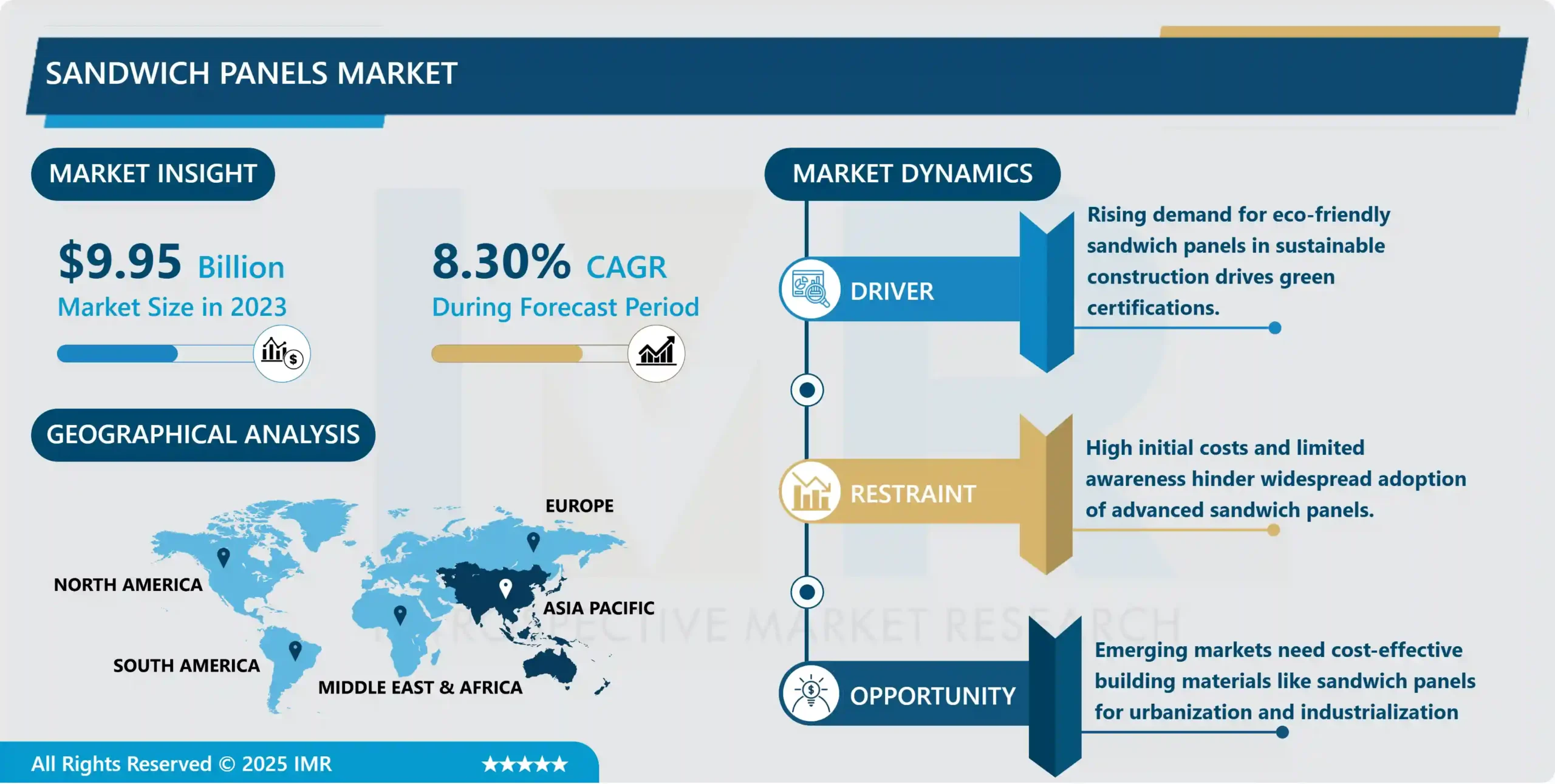
Sandwich Panels Market Size Was Valued at USD 9.95 Billion in 2023 and is Projected to Reach USD 20.39 Billion by 2032, Growing at a CAGR of 8.3% From 2024-2032.
Lightweight steel constructions made of sandwich panels are a common solution for roof and wall claddings. Due to the excellent weight-to-load ratio, their good heat insulation, their high load-bearing capacity as well as the economical manufacturing and erection process, sandwich panels are used frequently.
Besides the aforementioned advantages the linear manufacturing process of sandwich panels normally limits the possible building cubature to rectangular shapes. Another construction form coming with an even lower ratio of weight to load is shell structures. In the 20th century, many shell structures were built, following the technical and scientific progress of that time. In times of growing importance of construction time, the growing costs of construction site equipment, and wages, building an economical economically efficient structure requires high levels of prefabrication and short assembly times.
Sandwich Panels Market Trend Analysis
Rising demand for eco-friendly sandwich panels in sustainable construction drives green certifications.
The growing focus on sustainable construction and environmentally friendly building methods creates chances for manufacturers to promote eco-friendly sandwich panels. Products that fulfill or surpass environmental criteria and support green certifications can access the increasing demand.
Increasing need for energy-saving buildings is resulting in the utilization of sandwich panels with enhanced thermal insulation. The use of environmentally friendly materials in construction is being promoted by sustainability efforts to reduce environmental impact.
Automated tape laying and fiber placement technologies in manufacturing have enhanced accuracy and decreased production duration for sandwich panels. Sandwich panels are crucial for simplifying installation as prefabricated and modular construction techniques gain popularity. Demand from food processing and pharmaceutical industries is fueling growth in cold storage and refrigeration applications. Urbanization is on the rise and leading to more construction projects utilizing sandwich panels in infrastructure development.
Emerging markets need cost-effective building materials like sandwich panels for urbanization and industrialization.
Emerging markets present growth opportunities because of the process of urbanization and industrialization. There is a great need for cost-effective, energy-efficient building materials such as sandwich panels. Advancements in technology open up possibilities for improved performance.
Tailored sandwich panels can be designed for specific markets, such as soundproofing or fire protection. With the expansion of cold chain logistics, the need for panels in temperature-controlled environments is increasing.
Growing utilization of lightweight sandwich panels in automotive, aerospace, and railway sectors for improved fuel efficiency. Government efforts to encourage energy efficiency can generate interest in these materials.
Sandwich Panels Market Segment Analysis:
Sandwich Panels Market Segmented on the basis of Core Material, Skin Material, Application, Thickness, End-use, And Distribution Channel.
By Core Material, Polyurethane, Polyisocyanurate Segment Is Expected to Dominate the Market During the Forecast Period
Sandwich panels are commonly chosen for their superior thermal insulation and fire resistance, with PUR and PIR cores being the preferred options. They assist in preserving energy efficiency within buildings while also meeting strict fire safety regulations. PIR is preferred over PUR due to its superior fire performance, making it suitable for situations where fire safety is of utmost importance. The dominance of PIR in the market is driven by its regulatory compliance.
PUR and PIR cores, which are both lightweight and have high strength, make transportation and installation easier. Their ability to withstand wear and repel moisture help in the longevity of sandwich panels. Simplified operation and fast setup help cut down on construction time and expenses, particularly in extensive projects, while still ensuring long-lasting performance.
PUR and PIR cores are adaptable for various uses such as industrial buildings, warehouses, and cold storage facilities. They offer top-notch thermal insulation that is essential for preserving cold temperatures in refrigeration environments. Even with their affordable prices, these materials provide lasting advantages like energy efficiency and lower upkeep expenses, which make them the top pick for building projects. The increasing need for energy-efficient buildings coincides with the sustainability objectives of decreasing energy usage and meeting regulations.
By Skin Material, CFRT Segment Held the Largest Share
CFRT materials are becoming increasingly popular for use in sandwich panel skins because of their excellent mechanical properties, such as high strength-to-weight ratio and durability thanks to continuous fibers. They provide design versatility by customizing characteristics and shaping into intricate forms, suiting industries such as aerospace and automotive. CFRT’s advantageous properties are making it the top choice for a variety of high-performance sectors.
CFRT is perfect for sectors such as automotive and aerospace due to its combination of light weight and superior performance. Moreover, CFRT materials offer corrosion resistance and durability, making them beneficial for use in industries exposed to harsh conditions like construction and marine environments.
CFRT materials offer ease of manufacturing and processing through thermoplastic processing, leading to shorter cycle times and lower production costs compared to thermoset-based composites. The automation potential of CFRT allows for high-volume production with consistent quality, making it suitable for large-scale industrial applications. CFRT’s recyclability aligns with the growing focus on sustainability, and its lightweight nature contributes to energy efficiency in applications like transportation. The aerospace, automotive, construction, and renewable energy sectors are driving the growing demand for CFRT materials.
Sandwich Panels Market Regional Insights:
Asia Pacific is Expected to Dominate the Market Over the Forecast Period
The sandwich panel market is primarily led by Asia-Pacific because of fast urbanization, industrial expansion, and increasing infrastructure projects. China, India, and countries in Southeast Asia are fueling the need for sandwich panels in construction projects.
The demand has led to growth in the food processing and cold storage sectors in Asia-Pacific. Sandwich panels with thermal insulation are essential for maintaining temperature in cold storage facilities. Affordable housing is popular due to cost-effective construction methods such as sandwich panels. Initiatives focused on green construction are increasing the need for eco-friendly materials such as sandwich panels.
Improvements in manufacturing techniques and the availability of raw materials have boosted the local production of sandwich panels, leading to lower costs and improved accessibility. Increasing levels of disposable income and shifts in lifestyle preferences are fueling the need for higher quality structures that utilize energy-efficient sandwich panels. The growing automotive and aerospace sectors in Asia-Pacific are embracing sandwich panels for producing parts, further solidifying the region’s leading position in the market.
Sandwich Panels Market Active Players
Kingspan Group (Ireland)
NCI Building Systems, Inc. (USA)
ArcelorMittal Construction (Luxembourg)
Rautaruukki Corporation (Finland)
TATA Steel (India)
Metecno Group (Italy)
Isopan S.p.A. (Italy)
Assan Panel (Turkey)
Alubel S.p.A. (Italy)
Manni Group S.p.A. (Italy)
Dana Group (UAE)
Joris Ide (Belgium)
Paroc Group (Finland)
Zamil Steel (Saudi Arabia)
Italpannelli Srl (Italy)
Alfa-Panel (Russia)
Nucor Building Systems (USA)
Paneltech Ltd. (Poland)
Sintex Industries Ltd. (India)
BCOMS (Building Component Solutions LLC) (Saudi Arabia)
DANA Steel (UAE)
Lindab (Sweden)
Fischer Profil GmbH (Germany)
TSSC Group (UAE)
Hoesch Bausysteme GmbH (Germany)
Bluescope Steel Limited (Australia)
Izopanel Sp. z o.o. (Poland)
Zhongjie Group (China)
Romakowski GmbH & Co. KG (Germany)
Paneltech International LLC (USA), and Other Active Players.
Key Industry Developments in the Sandwich Panels Market:
In Mar 2024, BASF and Shandong Wiskind Architectural Steel Co., Ltd. (Wiskind) have expanded their strategic partnership with a sustainable polyurethanes (PU) sandwich panels for cold chain applications.
In Apr 2024, Sustainable lightweight thermoplastic honeycomb panel with flax fibre composites to replace glass and carbon fibre materials – innovation by EconCore & Flaxco (Division of Flipts & Dobbels NV) partnership.
Chapter 1: Introduction
1.1 Scope and Coverage
Chapter 2:Executive Summary
Chapter 3: Market Landscape
3.1 Market Dynamics
3.1.1 Drivers
3.1.2 Restraints
3.1.3 Opportunities
3.1.4 Challenges
3.2 Market Trend Analysis
3.3 PESTLE Analysis
3.4 Porter’s Five Forces Analysis
3.5 Industry Value Chain Analysis
3.6 Ecosystem
3.7 Regulatory Landscape
3.8 Price Trend Analysis
3.9 Patent Analysis
3.10 Technology Evolution
3.11 Investment Pockets
3.12 Import-Export Analysis
Chapter 4: Sandwich Panels Market by Core Material (2018-2032)
4.1 Sandwich Panels Market Snapshot and Growth Engine
4.2 Market Overview
4.3 Polyurethane
4.3.1 Introduction and Market Overview
4.3.2 Historic and Forecasted Market Size in Value USD and Volume Units
4.3.3 Key Market Trends, Growth Factors, and Opportunities
4.3.4 Geographic Segmentation Analysis
4.4 Polyisocyanurate
4.5 Mineral wool
4.6 Expanded Polystyrene
Chapter 5: Sandwich Panels Market by Skin Material (2018-2032)
5.1 Sandwich Panels Market Snapshot and Growth Engine
5.2 Market Overview
5.3 Continuous Fibre Reinforced Thermoplastics {CFRT}
5.3.1 Introduction and Market Overview
5.3.2 Historic and Forecasted Market Size in Value USD and Volume Units
5.3.3 Key Market Trends, Growth Factors, and Opportunities
5.3.4 Geographic Segmentation Analysis
5.4 Fiberglass Reinforced Panel {FRP}
5.5 Aluminium
5.6 Steel
Chapter 6: Sandwich Panels Market by Application (2018-2032)
6.1 Sandwich Panels Market Snapshot and Growth Engine
6.2 Market Overview
6.3 Wall Panels
6.3.1 Introduction and Market Overview
6.3.2 Historic and Forecasted Market Size in Value USD and Volume Units
6.3.3 Key Market Trends, Growth Factors, and Opportunities
6.3.4 Geographic Segmentation Analysis
6.4 Roof Panels
6.5 Insulated Panels
6.6 Floor Panels
Chapter 7: Sandwich Panels Market by Thickness (2018-2032)
7.1 Sandwich Panels Market Snapshot and Growth Engine
7.2 Market Overview
7.3 Below 60 mm
7.3.1 Introduction and Market Overview
7.3.2 Historic and Forecasted Market Size in Value USD and Volume Units
7.3.3 Key Market Trends, Growth Factors, and Opportunities
7.3.4 Geographic Segmentation Analysis
7.4 60 – 100 mm
7.5 100 – 140 mm
7.6 140 – 180 mm
7.7 Above 180 mm
Chapter 8: Sandwich Panels Market by End-use (2018-2032)
8.1 Sandwich Panels Market Snapshot and Growth Engine
8.2 Market Overview
8.3 Residential Buildings
8.3.1 Introduction and Market Overview
8.3.2 Historic and Forecasted Market Size in Value USD and Volume Units
8.3.3 Key Market Trends, Growth Factors, and Opportunities
8.3.4 Geographic Segmentation Analysis
8.4 Commercial Buildings
8.5 Industrial Buildings
8.6 Cold Storage
Chapter 9: Sandwich Panels Market by Distribution Channel (2018-2032)
9.1 Sandwich Panels Market Snapshot and Growth Engine
9.2 Market Overview
9.3 Direct Sales
9.3.1 Introduction and Market Overview
9.3.2 Historic and Forecasted Market Size in Value USD and Volume Units
9.3.3 Key Market Trends, Growth Factors, and Opportunities
9.3.4 Geographic Segmentation Analysis
9.4 Indirect Sales
Chapter 10: Company Profiles and Competitive Analysis
10.1 Competitive Landscape
10.1.1 Competitive Benchmarking
10.1.2 Sandwich Panels Market Share by Manufacturer (2024)
10.1.3 Industry BCG Matrix
10.1.4 Heat Map Analysis
10.1.5 Mergers and Acquisitions
10.2 KINGSPAN GROUP (IRELAND)
10.2.1 Company Overview
10.2.2 Key Executives
10.2.3 Company Snapshot
10.2.4 Role of the Company in the Market
10.2.5 Sustainability and Social Responsibility
10.2.6 Operating Business Segments
10.2.7 Product Portfolio
10.2.8 Business Performance
10.2.9 Key Strategic Moves and Recent Developments
10.2.10 SWOT Analysis
10.3 NCI BUILDING SYSTEMS INC. (USA)
10.4 ARCELORMITTAL CONSTRUCTION (LUXEMBOURG)
10.5 RAUTARUUKKI CORPORATION (FINLAND)
10.6 TATA STEEL (INDIA)
10.7 METECNO GROUP (ITALY)
10.8 ISOPAN S.P.A. (ITALY)
10.9 ASSAN PANEL (TURKEY)
10.10 ALUBEL S.P.A. (ITALY)
10.11 MANNI GROUP S.P.A. (ITALY)
10.12 DANA GROUP (UAE)
10.13 JORIS IDE (BELGIUM)
10.14 PAROC GROUP (FINLAND)
10.15 ZAMIL STEEL (SAUDI ARABIA)
10.16 ITALPANNELLI SRL (ITALY)
10.17 ALFA-PANEL (RUSSIA)
10.18 NUCOR BUILDING SYSTEMS (USA)
10.19 PANELTECH LTD. (POLAND)
10.20 SINTEX INDUSTRIES LTD. (INDIA)
10.21 BCOMS (BUILDING COMPONENT SOLUTIONS LLC) (SAUDI ARABIA)
10.22 DANA STEEL (UAE)
10.23 LINDAB (SWEDEN)
10.24 FISCHER PROFIL GMBH (GERMANY)
10.25 TSSC GROUP (UAE)
10.26 HOESCH BAUSYSTEME GMBH (GERMANY)
10.27 BLUESCOPE STEEL LIMITED (AUSTRALIA)
10.28 IZOPANEL SP. Z O.O. (POLAND)
10.29 ZHONGJIE GROUP (CHINA)
10.30 ROMAKOWSKI GMBH & CO. KG (GERMANY)
10.31 PANELTECH INTERNATIONAL LLC (USA)
10.32 AND
Chapter 11: Global Sandwich Panels Market By Region
11.1 Overview
11.2. North America Sandwich Panels Market
11.2.1 Key Market Trends, Growth Factors and Opportunities
11.2.2 Top Key Companies
11.2.3 Historic and Forecasted Market Size by Segments
11.2.4 Historic and Forecasted Market Size by Core Material
11.2.4.1 Polyurethane
11.2.4.2 Polyisocyanurate
11.2.4.3 Mineral wool
11.2.4.4 Expanded Polystyrene
11.2.5 Historic and Forecasted Market Size by Skin Material
11.2.5.1 Continuous Fibre Reinforced Thermoplastics {CFRT}
11.2.5.2 Fiberglass Reinforced Panel {FRP}
11.2.5.3 Aluminium
11.2.5.4 Steel
11.2.6 Historic and Forecasted Market Size by Application
11.2.6.1 Wall Panels
11.2.6.2 Roof Panels
11.2.6.3 Insulated Panels
11.2.6.4 Floor Panels
11.2.7 Historic and Forecasted Market Size by Thickness
11.2.7.1 Below 60 mm
11.2.7.2 60 – 100 mm
11.2.7.3 100 – 140 mm
11.2.7.4 140 – 180 mm
11.2.7.5 Above 180 mm
11.2.8 Historic and Forecasted Market Size by End-use
11.2.8.1 Residential Buildings
11.2.8.2 Commercial Buildings
11.2.8.3 Industrial Buildings
11.2.8.4 Cold Storage
11.2.9 Historic and Forecasted Market Size by Distribution Channel
11.2.9.1 Direct Sales
11.2.9.2 Indirect Sales
11.2.10 Historic and Forecast Market Size by Country
11.2.10.1 US
11.2.10.2 Canada
11.2.10.3 Mexico
11.3. Eastern Europe Sandwich Panels Market
11.3.1 Key Market Trends, Growth Factors and Opportunities
11.3.2 Top Key Companies
11.3.3 Historic and Forecasted Market Size by Segments
11.3.4 Historic and Forecasted Market Size by Core Material
11.3.4.1 Polyurethane
11.3.4.2 Polyisocyanurate
11.3.4.3 Mineral wool
11.3.4.4 Expanded Polystyrene
11.3.5 Historic and Forecasted Market Size by Skin Material
11.3.5.1 Continuous Fibre Reinforced Thermoplastics {CFRT}
11.3.5.2 Fiberglass Reinforced Panel {FRP}
11.3.5.3 Aluminium
11.3.5.4 Steel
11.3.6 Historic and Forecasted Market Size by Application
11.3.6.1 Wall Panels
11.3.6.2 Roof Panels
11.3.6.3 Insulated Panels
11.3.6.4 Floor Panels
11.3.7 Historic and Forecasted Market Size by Thickness
11.3.7.1 Below 60 mm
11.3.7.2 60 – 100 mm
11.3.7.3 100 – 140 mm
11.3.7.4 140 – 180 mm
11.3.7.5 Above 180 mm
11.3.8 Historic and Forecasted Market Size by End-use
11.3.8.1 Residential Buildings
11.3.8.2 Commercial Buildings
11.3.8.3 Industrial Buildings
11.3.8.4 Cold Storage
11.3.9 Historic and Forecasted Market Size by Distribution Channel
11.3.9.1 Direct Sales
11.3.9.2 Indirect Sales
11.3.10 Historic and Forecast Market Size by Country
11.3.10.1 Russia
11.3.10.2 Bulgaria
11.3.10.3 The Czech Republic
11.3.10.4 Hungary
11.3.10.5 Poland
11.3.10.6 Romania
11.3.10.7 Rest of Eastern Europe
11.4. Western Europe Sandwich Panels Market
11.4.1 Key Market Trends, Growth Factors and Opportunities
11.4.2 Top Key Companies
11.4.3 Historic and Forecasted Market Size by Segments
11.4.4 Historic and Forecasted Market Size by Core Material
11.4.4.1 Polyurethane
11.4.4.2 Polyisocyanurate
11.4.4.3 Mineral wool
11.4.4.4 Expanded Polystyrene
11.4.5 Historic and Forecasted Market Size by Skin Material
11.4.5.1 Continuous Fibre Reinforced Thermoplastics {CFRT}
11.4.5.2 Fiberglass Reinforced Panel {FRP}
11.4.5.3 Aluminium
11.4.5.4 Steel
11.4.6 Historic and Forecasted Market Size by Application
11.4.6.1 Wall Panels
11.4.6.2 Roof Panels
11.4.6.3 Insulated Panels
11.4.6.4 Floor Panels
11.4.7 Historic and Forecasted Market Size by Thickness
11.4.7.1 Below 60 mm
11.4.7.2 60 – 100 mm
11.4.7.3 100 – 140 mm
11.4.7.4 140 – 180 mm
11.4.7.5 Above 180 mm
11.4.8 Historic and Forecasted Market Size by End-use
11.4.8.1 Residential Buildings
11.4.8.2 Commercial Buildings
11.4.8.3 Industrial Buildings
11.4.8.4 Cold Storage
11.4.9 Historic and Forecasted Market Size by Distribution Channel
11.4.9.1 Direct Sales
11.4.9.2 Indirect Sales
11.4.10 Historic and Forecast Market Size by Country
11.4.10.1 Germany
11.4.10.2 UK
11.4.10.3 France
11.4.10.4 The Netherlands
11.4.10.5 Italy
11.4.10.6 Spain
11.4.10.7 Rest of Western Europe
11.5. Asia Pacific Sandwich Panels Market
11.5.1 Key Market Trends, Growth Factors and Opportunities
11.5.2 Top Key Companies
11.5.3 Historic and Forecasted Market Size by Segments
11.5.4 Historic and Forecasted Market Size by Core Material
11.5.4.1 Polyurethane
11.5.4.2 Polyisocyanurate
11.5.4.3 Mineral wool
11.5.4.4 Expanded Polystyrene
11.5.5 Historic and Forecasted Market Size by Skin Material
11.5.5.1 Continuous Fibre Reinforced Thermoplastics {CFRT}
11.5.5.2 Fiberglass Reinforced Panel {FRP}
11.5.5.3 Aluminium
11.5.5.4 Steel
11.5.6 Historic and Forecasted Market Size by Application
11.5.6.1 Wall Panels
11.5.6.2 Roof Panels
11.5.6.3 Insulated Panels
11.5.6.4 Floor Panels
11.5.7 Historic and Forecasted Market Size by Thickness
11.5.7.1 Below 60 mm
11.5.7.2 60 – 100 mm
11.5.7.3 100 – 140 mm
11.5.7.4 140 – 180 mm
11.5.7.5 Above 180 mm
11.5.8 Historic and Forecasted Market Size by End-use
11.5.8.1 Residential Buildings
11.5.8.2 Commercial Buildings
11.5.8.3 Industrial Buildings
11.5.8.4 Cold Storage
11.5.9 Historic and Forecasted Market Size by Distribution Channel
11.5.9.1 Direct Sales
11.5.9.2 Indirect Sales
11.5.10 Historic and Forecast Market Size by Country
11.5.10.1 China
11.5.10.2 India
11.5.10.3 Japan
11.5.10.4 South Korea
11.5.10.5 Malaysia
11.5.10.6 Thailand
11.5.10.7 Vietnam
11.5.10.8 The Philippines
11.5.10.9 Australia
11.5.10.10 New Zealand
11.5.10.11 Rest of APAC
11.6. Middle East & Africa Sandwich Panels Market
11.6.1 Key Market Trends, Growth Factors and Opportunities
11.6.2 Top Key Companies
11.6.3 Historic and Forecasted Market Size by Segments
11.6.4 Historic and Forecasted Market Size by Core Material
11.6.4.1 Polyurethane
11.6.4.2 Polyisocyanurate
11.6.4.3 Mineral wool
11.6.4.4 Expanded Polystyrene
11.6.5 Historic and Forecasted Market Size by Skin Material
11.6.5.1 Continuous Fibre Reinforced Thermoplastics {CFRT}
11.6.5.2 Fiberglass Reinforced Panel {FRP}
11.6.5.3 Aluminium
11.6.5.4 Steel
11.6.6 Historic and Forecasted Market Size by Application
11.6.6.1 Wall Panels
11.6.6.2 Roof Panels
11.6.6.3 Insulated Panels
11.6.6.4 Floor Panels
11.6.7 Historic and Forecasted Market Size by Thickness
11.6.7.1 Below 60 mm
11.6.7.2 60 – 100 mm
11.6.7.3 100 – 140 mm
11.6.7.4 140 – 180 mm
11.6.7.5 Above 180 mm
11.6.8 Historic and Forecasted Market Size by End-use
11.6.8.1 Residential Buildings
11.6.8.2 Commercial Buildings
11.6.8.3 Industrial Buildings
11.6.8.4 Cold Storage
11.6.9 Historic and Forecasted Market Size by Distribution Channel
11.6.9.1 Direct Sales
11.6.9.2 Indirect Sales
11.6.10 Historic and Forecast Market Size by Country
11.6.10.1 Turkiye
11.6.10.2 Bahrain
11.6.10.3 Kuwait
11.6.10.4 Saudi Arabia
11.6.10.5 Qatar
11.6.10.6 UAE
11.6.10.7 Israel
11.6.10.8 South Africa
11.7. South America Sandwich Panels Market
11.7.1 Key Market Trends, Growth Factors and Opportunities
11.7.2 Top Key Companies
11.7.3 Historic and Forecasted Market Size by Segments
11.7.4 Historic and Forecasted Market Size by Core Material
11.7.4.1 Polyurethane
11.7.4.2 Polyisocyanurate
11.7.4.3 Mineral wool
11.7.4.4 Expanded Polystyrene
11.7.5 Historic and Forecasted Market Size by Skin Material
11.7.5.1 Continuous Fibre Reinforced Thermoplastics {CFRT}
11.7.5.2 Fiberglass Reinforced Panel {FRP}
11.7.5.3 Aluminium
11.7.5.4 Steel
11.7.6 Historic and Forecasted Market Size by Application
11.7.6.1 Wall Panels
11.7.6.2 Roof Panels
11.7.6.3 Insulated Panels
11.7.6.4 Floor Panels
11.7.7 Historic and Forecasted Market Size by Thickness
11.7.7.1 Below 60 mm
11.7.7.2 60 – 100 mm
11.7.7.3 100 – 140 mm
11.7.7.4 140 – 180 mm
11.7.7.5 Above 180 mm
11.7.8 Historic and Forecasted Market Size by End-use
11.7.8.1 Residential Buildings
11.7.8.2 Commercial Buildings
11.7.8.3 Industrial Buildings
11.7.8.4 Cold Storage
11.7.9 Historic and Forecasted Market Size by Distribution Channel
11.7.9.1 Direct Sales
11.7.9.2 Indirect Sales
11.7.10 Historic and Forecast Market Size by Country
11.7.10.1 Brazil
11.7.10.2 Argentina
11.7.10.3 Rest of SA
Chapter 12 Analyst Viewpoint and Conclusion
12.1 Recommendations and Concluding Analysis
12.2 Potential Market Strategies
Chapter 13 Research Methodology
13.1 Research Process
13.2 Primary Research
13.3 Secondary Research
Q1: What would be the forecast period in the Sandwich Panels Market research report?
A1: The forecast period in the Sandwich Panels Market research report is 2024-2032.
Q2: Who are the key players in the Sandwich Panels Market?
A2: Kingspan Group (Ireland), NCI Building Systems, Inc. (USA), ArcelorMittal Construction (Luxembourg), Rautaruukki Corporation (Finland), TATA Steel (India), Metecno Group (Italy), Isopan S.p.A. (Italy), Assan Panel (Turkey), Alubel S.p.A. (Italy), Manni Group S.p.A. (Italy), Dana Group (UAE), Joris Ide (Belgium), Paroc Group (Finland), Zamil Steel (Saudi Arabia),Italpannelli Srl (Italy),Alfa-Panel (Russia),Nucor Building Systems (USA), Paneltech Ltd. (Poland), Sintex Industries Ltd. (India), BCOMS (Building Component Solutions LLC) (Saudi Arabia), DANA Steel (UAE), Lindab (Sweden), Fischer Profil GmbH (Germany), TSSC Group (UAE), Hoesch Bausysteme GmbH (Germany), Bluescope Steel Limited (Australia), Izopanel Sp. z o.o. (Poland),Zhongjie Group (China), Romakowski GmbH & Co. KG (Germany), Paneltech International LLC (USA) and Other Active Players.
Q3: What are the segments of the Sandwich Panels Market?
A3: The Sandwich Panels Market is segmented into Core Material, Skin Material, Application, Thickness, End-use, Distribution Channel, and region. By Core Material, the market is categorized into Polyurethane, Polyisocyanurate, Mineral wool, Expanded Polystyrene, Core Materiale, And Core Materialf. By Skin Material, the market is categorized into Continuous Fibre Reinforced Thermoplastics {CFRT}, Fiberglass Reinforced Panel {FRP}, Aluminum, Steel, Skin Materiale, And Skin Materialf. By Application, the market is categorized into Wall Panels, Roof Panels, Insulated Panels, Floor Panels, Applicatione, And Applicationf. By Thickness, the market is categorized into Below 60 mm, 60 – 100 mm, 100 – 140 mm, 140 – 180 mm, Above 180 mm, And Thicknessf. By End-use, The Market Is Categorized Into Residential Buildings, Commercial Buildings, Industrial Buildings, Cold Storage, End-usee, And End-usef. By Distribution Channel, the market is categorized into Direct Sales, Indirect Sales, Distribution Channelc, Distribution Channeld, Distribution Channele, And Distribution Channelf. By region, it is analyzed across North America (U.S.; Canada; Mexico), Eastern Europe (Bulgaria; The Czech Republic; Hungary; Poland; Romania; Rest of Eastern Europe), Western Europe (Germany; UK; France; Netherlands; Italy; Russia; Spain; Rest of Western Europe), Asia-Pacific (China; India; Japan; Southeast Asia, etc.), South America (Brazil; Argentina, etc.), Middle East & Africa (Saudi Arabia; South Africa, etc.).
Q4: What is the Sandwich Panels Market?
A4: The Sandwich Panels Market refers to the global industry involved in the production, distribution, and sale of sandwich panels. These panels are a type of composite material made up of two thin, strong outer layers (called skins) bonded to a lightweight, insulating core. The core material can vary but is often made from materials like polyurethane (PUR), polyisocyanurate (PIR), mineral wool, or expanded polystyrene (EPS). The outer layers are typically made of metal, such as steel or aluminum, but can also be other materials like fiberglass or plastic.
Q5: How big is the Sandwich Panels Market?
A5: Sandwich Panels Market Size Was Valued at USD 9.95 Billion in 2023, and is Projected to Reach USD 20.39 Billion by 2032, Growing at a CAGR of 8.3% From 2024-2032.
How to Buy a Report from eminsights.jp
On the product page, choose the license you want: Single-User License, Multi-User License or Enterprise License.
If you required report in your native language, then you can click on Translated Report button and fill out the form with report name and language you want, then our team will contact you as soon as possible.
Click the Buy Now button.
You will be redirected to the checkout page. Enter your company details and payment information.
Click Place Order to complete the purchase.
Confirmation: You’ll receive an order confirmation and our team will contact you shortly with your ordered report.
If you have any questions, fill out the contact form below or email us at bizdev@eminsights.net.
Thank you for choosing eminsights.jp!