Stay Ahead in Fast-Growing Economies.
Browse Reports Now




Respiratory Care Market – Overview and Outlook by Growth By 2032
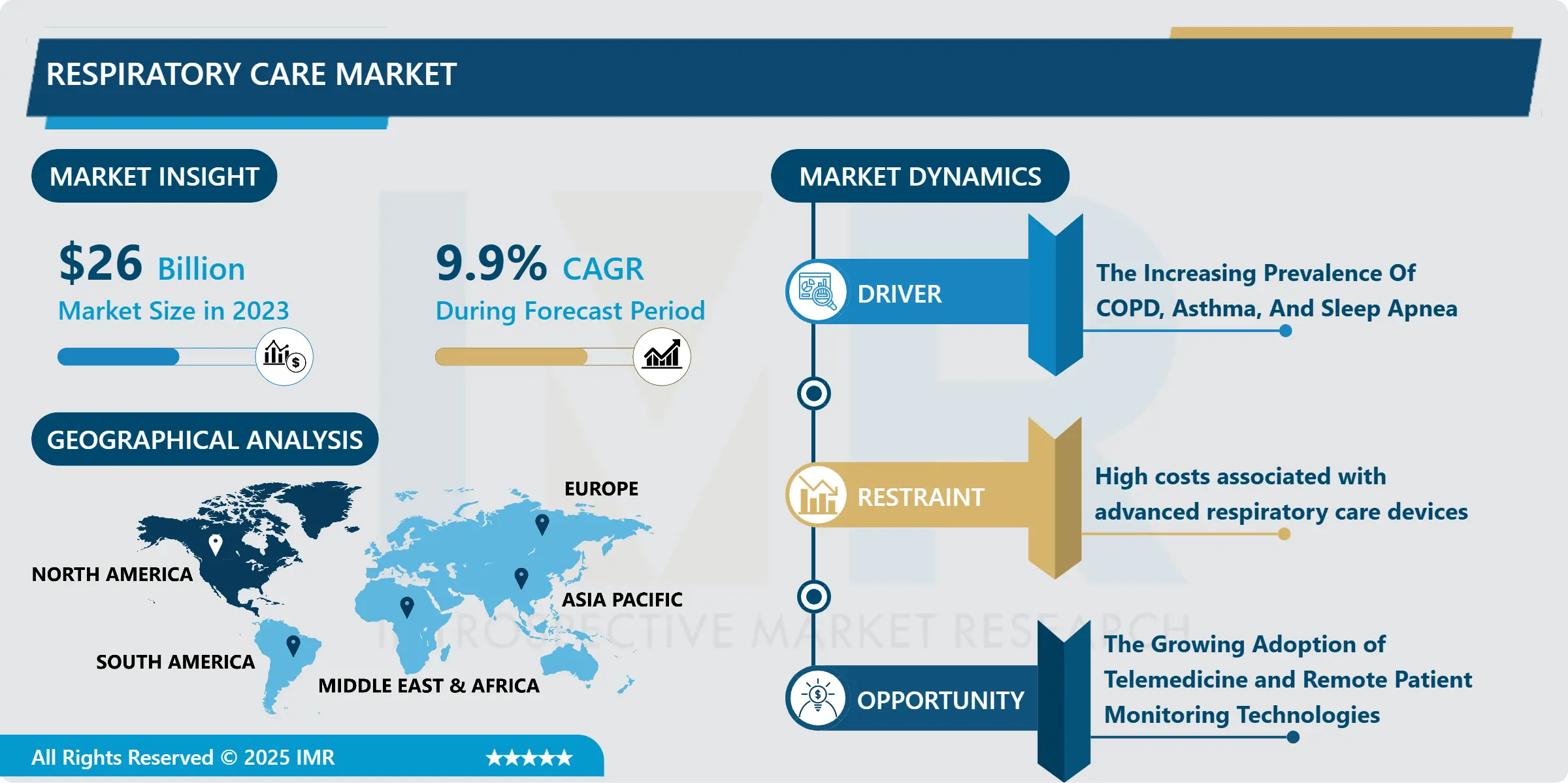
Respiratory Care Market Size Was Valued at USD 26 Billion in 2023, and is Projected to Reach USD 51 Billion by 2032, Growing at a CAGR of 9.9% From 2024-2032.

IMR Group
Description
Respiratory Care Market Synopsis
Respiratory Care Market Size Was Valued at USD 26 Billion in 2023, and is Projected to Reach USD 51 Billion by 2032, Growing at a CAGR of 9.9% From 2024-2032.
The respiratory care market is significant area of healthcare industry that is involved in diagnosing, treating, preventing and managing respiratory diseases and conditions including asthma, chronic obstructive lungs disease (COPD), sleep apnea, pneumonia, and other acute or chronic respiratory diseases. This market comprises various devices, technologies, and services aimed at enhancing respiratory health and illness treatment and management across continuous, intermittent, and emergency care settings, including oxygen delivery systems and therapy (oxygen concentrators and cylinders), PAP devices (CPAP, BiPAP), ventilators, nebulizers, spirometers diagnostic tools, as well as important therapeutic interventions. It also extend to hospital and home care where patients with chronic respiratory disorders can be treated with long term management, including mechanical ventilation, home oxygen therapy and telemonitoring services. Some of the drivers of the respiratory care market include; increasing incidence of respiratory disorders, growing population of elderly people, elevating level of pollution, development of novel technologically advanced equipment and persistent call for home care services. Also, the COVID-19 pandemic has affected market dramatically increasing the demand for ventilators oxygen therapy equipment, and sophisticated respiratory monitoring systems. It also enjoys advantages where digital health advancements such as smart devices and tele medicine plays a key role in treating chronic respiratory diseases, in specialty out of hospital settings.
This market represents one of the most promising and rapidly developing fields in the sphere of the global healthcare sector as the number of people with respiratory diseases such as COPD, asthma, sleep apnea, and pneumonia proceeds to rise steeply. The products in the market are related to different medical devices and services for patients with respiratory disorders and include oxygen therapy equipment, ventilators, nebulisers, PAP devices, spirometers, and others. They are applied in both the hospital and home care, and encompass emergency care and more chronic therapies and care as well. Due to growing incidences of respiratory disorders and an aging population coupled by effects of pollution, there is growing concern for efficient respiratory care solutions.
Technological developments and increased emphasis on home care are also changing the industry of respiratory care. About portable oxygen concentrators, smart CPAP machines, and other remote monitoring tools are helping patients to stay out of the hospitals and live a normal life. Also, the recent COVID-19 outbreak around the world brought that the advanced respiratory devices such as ventilators and oxygen delivery systems is the growing demand that will fuel the growth of the market. Using artificial intelligence (AI) and telemedicine, the increases of interest in digital health will also improve the managing of chronic respiratory diseases, including ease of remote patient observation and alteration in treatments. Increased healthcare spending and the people’s increasing awareness of respiratory health, plus the accessibility of modern treatments, forecast the respiratory care market to experience constant growth in the coming years.
Respiratory Care Market Trend Analysis:
Telemedicine and Remote Monitoring Transforming Respiratory Disease Management
The use of telemedicine and remote monitoring has a way of reducing the management of respiratory diseases through constant, real-time check up of the patient health status outside a health settings. New technologies in informatics are enabling integrated health applications, telemedicine approaches for delivering respiratory care and wearable devices that can monitor respiratory parameters, pulse oximetry, airflow and lung capacity among others. These technologies are used in COPD, asthma, and sleep apnea where patients have mobility issues, or face geographical barriers, and can’t be provided constant in-person follow-ups. With telemedicine, physicians can change the treatment regimen, prescribe medications, and get involved in case escalation which has a positive impact on the diseases themselves and the resulting outcomes for patients.
The incorporation of remote monitoring instruments into conventional respiratory care practices is also lowering the load on hospitals and healthcare units particularly in developing world. Equipment including portable spirometer, mobile-based pulse oximeters, and smart inhaler offer patients a convenient mean of managing their diseases at home, as well as relay important information to their care providers. Not only does this shift improve the relationship between the doctor and the patient and help patients to remember to adhere to the prescriptions given to them but also brings more responsibility and control of people’s respiratory wellbeing into their hands. As the use of technology advances, enhanced invention of artificial intelligence in diagnosis, big data in analysis and prognosis in modeling will enhance the prospective care to manage respiratory diseases more precisely and individually.
Rising Demand for Home Healthcare Drives Growth in Respiratory Care Market
New and emerging home healthcare solutions are seen to be fueling a large proportion of the respiratory care market. With Iton growing trend in patients with chronic respiratory disorders like COPD, asthma, and sleep apnea preferring home care management, home respiratory care equipment like portable oxygen concentrators, CPAP compliant machines, and home ventilation devices are rapidly developing. Such a shift is enabled by the innovation in the technology to develop respiratory equipment that is portable, easy to use, and affordable, and offer quality respiratory care outside hospitals. One of the biggest benefits of these solutions are the possibility of obtaining treatment in the comfort of home and the fact that it is usually cheaper than a hospital stay.
Home health is widely adopted for patients with chronic respiratory diseases because it increases patient satisfaction and decreases readmissions. These long term factors include population ageing and rise in prevalence of respiratory diseases which push more people looking for convenient and convenient home health care services. The COVID-19 pandemic has also increased this shift with the understanding that managing respiratory health is best done in the home. Therefore, the developments in technology have led to market dynamism as respiratory care manufacturers and HC providers seek to derive additional solutions from devices suitable for home use.
Respiratory Care Market Segment Analysis:
Respiratory Care Market is Segmented on the basis of Type, Application, End User, and Region.
By Type, Oxygen Therapy Equipment segment is expected to dominate the market during the forecast period
The Oxygen Therapy Equipment segment is the largest contributor to the respiratory care market and will continue to maintain its dominance over the indicated forecast period because of the constantly increasing rate of chronic obstructive pulmonary disease, asthma, pneumonia, and other diseases of the respiratory system all over the world. Oxygen therapy is crucial in the care of such conditions, especially because most of them require continuous long term oxygen therapy. Oxygen being an essential requirement for patients requires dependable means of delivery and that is why oxygen concentrators, oxygen cylinders and the portable oxygen concentrators are essential in home care. The need for such devices is however boosted by the following factors; The aging population, growth of home health care where patients can be treated in the comfort of their homes and at a cheaper price as compared to hospitals.
Innovation in oxygen therapy including portable oxygen equipment that discretionized oxygen therapy by enhancing the freedom of movement is also boosting the segment. The COVID-19 pandemic also unveiled the importance of oxygen therapy devices making the trend more popular. With the women population of the world suffering from respiratory diseases on the rise, the oxygen therapy equipment segment has adequate prospects for organic growth for use both in medical facilities and home care. The high importance of this segment in delivering of the life-saving therapy to a numerous patients define this segment as the leading category of the respiratory care market throughout the forecast period.
By Application, Chronic Respiratory Diseases segment expected to held the largest share
The Chronic Respiratory Diseases segment is likely to retain its dominance in the respiratory care market throughout the forecast period, attributable to an expanding incidence of disorders like COPD, asthma, pulmonary fibrosis, et cetera. Such diseases are chronic, degenerative, and require consistent treatment of the respiratory system to ensure sufficient and stable functioning; thus, these diseases are the main demand for respiratory care devices, including oxygen equipment, ventilators, inhalers, and nebulizers. Major causes of these chronic diseases include, increase elderly people, increased smoking habits, contact with polluted materials, and effect of urbanization.
Also, the increasing emphasis on home health care arrangements in treating chronic respiratory diseases is driving the use of devices for home care. The fact that patients with chronic diseases require constant observation and specialized support forms a constant demand for respiratory care devices. This application segment is expected to remain the largest in the respiratory care products and services market as the focus to decrease admission rates and provide long term care at homes gets prominent among the healthcare systems over the forecast period.
Respiratory Care Market Regional Insights:
North America is Expected to Dominate the Market Over the Forecast period
The major regional market of respiratory care is expected to be North America over the given period due to many factors such as Increase in healthcare expenditure, well-developed healthcare infrastructure, and rise in incidences of respiratory disorders including COPD, asthma, and sleep apnea. This location has highly developed health systems, advanced technological resources and defined reimbursement processes,which encourage the use of respiratory care products including oxygen delivery equipment, CPAP machines, ventilators and nebulizers.
The last factor is the ageing population in the United States and Canada because the elderly are more vulnerable to chronic respiratory diseases, and they require a constant supply of long-term respiratory products. Moreover, the enhanced focus on home healthcare services, and telemedicine that enables patients with chronic respiratory diseases to receive treatment at home, also drive market growth. The COVID-19 pandemic has increased the concern for respiratory devices such as ventilators, and oxygen concentrators which eventually boost the North American respiratory care market at an fastest pace. North America, dominated by the strong regulatory structure and a significant amount of investment in healthcare products, will be a prime growth ground for respiratory care solutions in the intimidating years of the forecast period.
Active Key Players in the Respiratory Care Market:
Apex Medical Corp. (Taiwan)
Becton, Dickinson and Company (BD) (United States)
CareFusion Corporation (Becton Dickinson) (United States)
Drägerwerk AG & Co. KGaA (Germany)
Drive DeVilbiss Healthcare (United States)
Fisher & Paykel Healthcare (New Zealand)
GE Healthcare (United States)
Hamilton Medical (Switzerland)
Invacare Corporation (United States)
Linde Healthcare (Germany)
Medline Industries (United States)
Medtronic PLC (Ireland)
Nidek Medical Products Inc. (Japan)
Omron Healthcare (Japan)
Philips Healthcare (Netherlands)
ResMed Inc. (United States)
Smiths Medical (United Kingdom)
Vyaire Medical (United States), and Other Active Players
Chapter 1: Introduction
1.1 Scope and Coverage
Chapter 2:Executive Summary
Chapter 3: Market Landscape
3.1 Market Dynamics
3.1.1 Drivers
3.1.2 Restraints
3.1.3 Opportunities
3.1.4 Challenges
3.2 Market Trend Analysis
3.3 PESTLE Analysis
3.4 Porter’s Five Forces Analysis
3.5 Industry Value Chain Analysis
3.6 Ecosystem
3.7 Regulatory Landscape
3.8 Price Trend Analysis
3.9 Patent Analysis
3.10 Technology Evolution
3.11 Investment Pockets
3.12 Import-Export Analysis
Chapter 4: Respiratory Care Market by Type
4.1 Respiratory Care Market Snapshot and Growth Engine
4.2 Respiratory Care Market Overview
4.3 Oxygen Therapy Equipment
4.3.1 Introduction and Market Overview
4.3.2 Historic and Forecasted Market Size in Value USD and Volume Units (2017-2032F)
4.3.3 Key Market Trends, Growth Factors and Opportunities
4.3.4 Oxygen Therapy Equipment: Geographic Segmentation Analysis
4.4 PAP Devices
4.4.1 Introduction and Market Overview
4.4.2 Historic and Forecasted Market Size in Value USD and Volume Units (2017-2032F)
4.4.3 Key Market Trends, Growth Factors and Opportunities
4.4.4 PAP Devices: Geographic Segmentation Analysis
4.5 Ventilators
4.5.1 Introduction and Market Overview
4.5.2 Historic and Forecasted Market Size in Value USD and Volume Units (2017-2032F)
4.5.3 Key Market Trends, Growth Factors and Opportunities
4.5.4 Ventilators: Geographic Segmentation Analysis
4.6 Nebulizers
4.6.1 Introduction and Market Overview
4.6.2 Historic and Forecasted Market Size in Value USD and Volume Units (2017-2032F)
4.6.3 Key Market Trends, Growth Factors and Opportunities
4.6.4 Nebulizers: Geographic Segmentation Analysis
4.7 Spirometers
4.7.1 Introduction and Market Overview
4.7.2 Historic and Forecasted Market Size in Value USD and Volume Units (2017-2032F)
4.7.3 Key Market Trends, Growth Factors and Opportunities
4.7.4 Spirometers: Geographic Segmentation Analysis
4.8 Other Devices;
4.8.1 Introduction and Market Overview
4.8.2 Historic and Forecasted Market Size in Value USD and Volume Units (2017-2032F)
4.8.3 Key Market Trends, Growth Factors and Opportunities
4.8.4 Other Devices;: Geographic Segmentation Analysis
Chapter 5: Respiratory Care Market by Application
5.1 Respiratory Care Market Snapshot and Growth Engine
5.2 Respiratory Care Market Overview
5.3 Chronic Respiratory Diseases
5.3.1 Introduction and Market Overview
5.3.2 Historic and Forecasted Market Size in Value USD and Volume Units (2017-2032F)
5.3.3 Key Market Trends, Growth Factors and Opportunities
5.3.4 Chronic Respiratory Diseases: Geographic Segmentation Analysis
5.4 Acute Respiratory Conditions
5.4.1 Introduction and Market Overview
5.4.2 Historic and Forecasted Market Size in Value USD and Volume Units (2017-2032F)
5.4.3 Key Market Trends, Growth Factors and Opportunities
5.4.4 Acute Respiratory Conditions: Geographic Segmentation Analysis
5.5 Sleep Apnea
5.5.1 Introduction and Market Overview
5.5.2 Historic and Forecasted Market Size in Value USD and Volume Units (2017-2032F)
5.5.3 Key Market Trends, Growth Factors and Opportunities
5.5.4 Sleep Apnea: Geographic Segmentation Analysis
5.6 Neonatal and Paediatric Respiratory Care
5.6.1 Introduction and Market Overview
5.6.2 Historic and Forecasted Market Size in Value USD and Volume Units (2017-2032F)
5.6.3 Key Market Trends, Growth Factors and Opportunities
5.6.4 Neonatal and Paediatric Respiratory Care: Geographic Segmentation Analysis
5.7 Other Applications
5.7.1 Introduction and Market Overview
5.7.2 Historic and Forecasted Market Size in Value USD and Volume Units (2017-2032F)
5.7.3 Key Market Trends, Growth Factors and Opportunities
5.7.4 Other Applications: Geographic Segmentation Analysis
Chapter 6: Respiratory Care Market by End User
6.1 Respiratory Care Market Snapshot and Growth Engine
6.2 Respiratory Care Market Overview
6.3 Hospitals and Clinics
6.3.1 Introduction and Market Overview
6.3.2 Historic and Forecasted Market Size in Value USD and Volume Units (2017-2032F)
6.3.3 Key Market Trends, Growth Factors and Opportunities
6.3.4 Hospitals and Clinics: Geographic Segmentation Analysis
6.4 Home Healthcare
6.4.1 Introduction and Market Overview
6.4.2 Historic and Forecasted Market Size in Value USD and Volume Units (2017-2032F)
6.4.3 Key Market Trends, Growth Factors and Opportunities
6.4.4 Home Healthcare: Geographic Segmentation Analysis
6.5 Long-term Care Centers
6.5.1 Introduction and Market Overview
6.5.2 Historic and Forecasted Market Size in Value USD and Volume Units (2017-2032F)
6.5.3 Key Market Trends, Growth Factors and Opportunities
6.5.4 Long-term Care Centers: Geographic Segmentation Analysis
6.6 Ambulatory Surgical Centers)
6.6.1 Introduction and Market Overview
6.6.2 Historic and Forecasted Market Size in Value USD and Volume Units (2017-2032F)
6.6.3 Key Market Trends, Growth Factors and Opportunities
6.6.4 Ambulatory Surgical Centers) : Geographic Segmentation Analysis
Chapter 7: Company Profiles and Competitive Analysis
7.1 Competitive Landscape
7.1.1 Competitive Benchmarking
7.1.2 Respiratory Care Market Share by Manufacturer (2023)
7.1.3 Industry BCG Matrix
7.1.4 Heat Map Analysis
7.1.5 Mergers and Acquisitions
7.2 APEX MEDICAL CORP. (TAIWAN)
7.2.1 Company Overview
7.2.2 Key Executives
7.2.3 Company Snapshot
7.2.4 Role of the Company in the Market
7.2.5 Sustainability and Social Responsibility
7.2.6 Operating Business Segments
7.2.7 Product Portfolio
7.2.8 Business Performance
7.2.9 Key Strategic Moves and Recent Developments
7.2.10 SWOT Analysis
7.3 BECTON
7.4 DICKINSON AND COMPANY (BD) (UNITED STATES)
7.5 CAREFUSION CORPORATION (BECTON DICKINSON) (UNITED STATES)
7.6 DRÄGERWERK AG & CO. KGAA (GERMANY)
7.7 DRIVE DEVILBISS HEALTHCARE (UNITED STATES)
7.8 FISHER & PAYKEL HEALTHCARE (NEW ZEALAND)
7.9 GE HEALTHCARE (UNITED STATES)
7.10 HAMILTON MEDICAL (SWITZERLAND)
7.11 INVACARE CORPORATION (UNITED STATES)
7.12 LINDE HEALTHCARE (GERMANY)
7.13 MEDLINE INDUSTRIES (UNITED STATES)
7.14 OTHER ACTIVE PLAYERS
Chapter 8: Global Respiratory Care Market By Region
8.1 Overview
8.2. North America Respiratory Care Market
8.2.1 Key Market Trends, Growth Factors and Opportunities
8.2.2 Top Key Companies
8.2.3 Historic and Forecasted Market Size by Segments
8.2.4 Historic and Forecasted Market Size By Type
8.2.4.1 Oxygen Therapy Equipment
8.2.4.2 PAP Devices
8.2.4.3 Ventilators
8.2.4.4 Nebulizers
8.2.4.5 Spirometers
8.2.4.6 Other Devices;
8.2.5 Historic and Forecasted Market Size By Application
8.2.5.1 Chronic Respiratory Diseases
8.2.5.2 Acute Respiratory Conditions
8.2.5.3 Sleep Apnea
8.2.5.4 Neonatal and Paediatric Respiratory Care
8.2.5.5 Other Applications
8.2.6 Historic and Forecasted Market Size By End User
8.2.6.1 Hospitals and Clinics
8.2.6.2 Home Healthcare
8.2.6.3 Long-term Care Centers
8.2.6.4 Ambulatory Surgical Centers)
8.2.7 Historic and Forecast Market Size by Country
8.2.7.1 US
8.2.7.2 Canada
8.2.7.3 Mexico
8.3. Eastern Europe Respiratory Care Market
8.3.1 Key Market Trends, Growth Factors and Opportunities
8.3.2 Top Key Companies
8.3.3 Historic and Forecasted Market Size by Segments
8.3.4 Historic and Forecasted Market Size By Type
8.3.4.1 Oxygen Therapy Equipment
8.3.4.2 PAP Devices
8.3.4.3 Ventilators
8.3.4.4 Nebulizers
8.3.4.5 Spirometers
8.3.4.6 Other Devices;
8.3.5 Historic and Forecasted Market Size By Application
8.3.5.1 Chronic Respiratory Diseases
8.3.5.2 Acute Respiratory Conditions
8.3.5.3 Sleep Apnea
8.3.5.4 Neonatal and Paediatric Respiratory Care
8.3.5.5 Other Applications
8.3.6 Historic and Forecasted Market Size By End User
8.3.6.1 Hospitals and Clinics
8.3.6.2 Home Healthcare
8.3.6.3 Long-term Care Centers
8.3.6.4 Ambulatory Surgical Centers)
8.3.7 Historic and Forecast Market Size by Country
8.3.7.1 Russia
8.3.7.2 Bulgaria
8.3.7.3 The Czech Republic
8.3.7.4 Hungary
8.3.7.5 Poland
8.3.7.6 Romania
8.3.7.7 Rest of Eastern Europe
8.4. Western Europe Respiratory Care Market
8.4.1 Key Market Trends, Growth Factors and Opportunities
8.4.2 Top Key Companies
8.4.3 Historic and Forecasted Market Size by Segments
8.4.4 Historic and Forecasted Market Size By Type
8.4.4.1 Oxygen Therapy Equipment
8.4.4.2 PAP Devices
8.4.4.3 Ventilators
8.4.4.4 Nebulizers
8.4.4.5 Spirometers
8.4.4.6 Other Devices;
8.4.5 Historic and Forecasted Market Size By Application
8.4.5.1 Chronic Respiratory Diseases
8.4.5.2 Acute Respiratory Conditions
8.4.5.3 Sleep Apnea
8.4.5.4 Neonatal and Paediatric Respiratory Care
8.4.5.5 Other Applications
8.4.6 Historic and Forecasted Market Size By End User
8.4.6.1 Hospitals and Clinics
8.4.6.2 Home Healthcare
8.4.6.3 Long-term Care Centers
8.4.6.4 Ambulatory Surgical Centers)
8.4.7 Historic and Forecast Market Size by Country
8.4.7.1 Germany
8.4.7.2 UK
8.4.7.3 France
8.4.7.4 The Netherlands
8.4.7.5 Italy
8.4.7.6 Spain
8.4.7.7 Rest of Western Europe
8.5. Asia Pacific Respiratory Care Market
8.5.1 Key Market Trends, Growth Factors and Opportunities
8.5.2 Top Key Companies
8.5.3 Historic and Forecasted Market Size by Segments
8.5.4 Historic and Forecasted Market Size By Type
8.5.4.1 Oxygen Therapy Equipment
8.5.4.2 PAP Devices
8.5.4.3 Ventilators
8.5.4.4 Nebulizers
8.5.4.5 Spirometers
8.5.4.6 Other Devices;
8.5.5 Historic and Forecasted Market Size By Application
8.5.5.1 Chronic Respiratory Diseases
8.5.5.2 Acute Respiratory Conditions
8.5.5.3 Sleep Apnea
8.5.5.4 Neonatal and Paediatric Respiratory Care
8.5.5.5 Other Applications
8.5.6 Historic and Forecasted Market Size By End User
8.5.6.1 Hospitals and Clinics
8.5.6.2 Home Healthcare
8.5.6.3 Long-term Care Centers
8.5.6.4 Ambulatory Surgical Centers)
8.5.7 Historic and Forecast Market Size by Country
8.5.7.1 China
8.5.7.2 India
8.5.7.3 Japan
8.5.7.4 South Korea
8.5.7.5 Malaysia
8.5.7.6 Thailand
8.5.7.7 Vietnam
8.5.7.8 The Philippines
8.5.7.9 Australia
8.5.7.10 New Zealand
8.5.7.11 Rest of APAC
8.6. Middle East & Africa Respiratory Care Market
8.6.1 Key Market Trends, Growth Factors and Opportunities
8.6.2 Top Key Companies
8.6.3 Historic and Forecasted Market Size by Segments
8.6.4 Historic and Forecasted Market Size By Type
8.6.4.1 Oxygen Therapy Equipment
8.6.4.2 PAP Devices
8.6.4.3 Ventilators
8.6.4.4 Nebulizers
8.6.4.5 Spirometers
8.6.4.6 Other Devices;
8.6.5 Historic and Forecasted Market Size By Application
8.6.5.1 Chronic Respiratory Diseases
8.6.5.2 Acute Respiratory Conditions
8.6.5.3 Sleep Apnea
8.6.5.4 Neonatal and Paediatric Respiratory Care
8.6.5.5 Other Applications
8.6.6 Historic and Forecasted Market Size By End User
8.6.6.1 Hospitals and Clinics
8.6.6.2 Home Healthcare
8.6.6.3 Long-term Care Centers
8.6.6.4 Ambulatory Surgical Centers)
8.6.7 Historic and Forecast Market Size by Country
8.6.7.1 Turkiye
8.6.7.2 Bahrain
8.6.7.3 Kuwait
8.6.7.4 Saudi Arabia
8.6.7.5 Qatar
8.6.7.6 UAE
8.6.7.7 Israel
8.6.7.8 South Africa
8.7. South America Respiratory Care Market
8.7.1 Key Market Trends, Growth Factors and Opportunities
8.7.2 Top Key Companies
8.7.3 Historic and Forecasted Market Size by Segments
8.7.4 Historic and Forecasted Market Size By Type
8.7.4.1 Oxygen Therapy Equipment
8.7.4.2 PAP Devices
8.7.4.3 Ventilators
8.7.4.4 Nebulizers
8.7.4.5 Spirometers
8.7.4.6 Other Devices;
8.7.5 Historic and Forecasted Market Size By Application
8.7.5.1 Chronic Respiratory Diseases
8.7.5.2 Acute Respiratory Conditions
8.7.5.3 Sleep Apnea
8.7.5.4 Neonatal and Paediatric Respiratory Care
8.7.5.5 Other Applications
8.7.6 Historic and Forecasted Market Size By End User
8.7.6.1 Hospitals and Clinics
8.7.6.2 Home Healthcare
8.7.6.3 Long-term Care Centers
8.7.6.4 Ambulatory Surgical Centers)
8.7.7 Historic and Forecast Market Size by Country
8.7.7.1 Brazil
8.7.7.2 Argentina
8.7.7.3 Rest of SA
Chapter 9 Analyst Viewpoint and Conclusion
9.1 Recommendations and Concluding Analysis
9.2 Potential Market Strategies
Chapter 10 Research Methodology
10.1 Research Process
10.2 Primary Research
10.3 Secondary Research
Q1: What would be the forecast period in the Respiratory Care Market research report?
A1: The forecast period in the Respiratory Care Market research report is 2024-2032.
Q2: Who are the key players in the Respiratory Care Market?
A2: Apex Medical Corp. (Taiwan), Becton, Dickinson and Company (BD) (United States), CareFusion Corporation (Becton Dickinson) (United States), Drägerwerk AG & Co. KGaA (Germany), Drive DeVilbiss Healthcare (United States), Fisher & Paykel Healthcare (New Zealand), GE Healthcare (United States), Hamilton Medical (Switzerland), Invacare Corporation (United States), Linde Healthcare (Germany), Medline Industries (United States), Medtronic PLC (Ireland), Nidek Medical Products Inc. (Japan), Omron Healthcare (Japan), Philips Healthcare (Netherlands), ResMed Inc. (United States), Smiths Medical (United Kingdom), Vyaire Medical (United States), and Other Active Players.
Q3: What are the segments of the Respiratory Care Market?
A3: The Respiratory Care Market is segmented into Type, Application, End User and Region. By Type, the market is categorized into Oxygen Therapy Equipment, PAP Devices, Ventilators, Nebulizers, Spirometers, and Other Devices. By Application, the market is categorized into Chronic Respiratory Diseases, Acute Respiratory Conditions, Sleep Apnea, Neonatal and Pediatric Respiratory Care, and Other Applications. By End User, the market is categorized into Hospitals and Clinics, Home Healthcare, Long-term Care Centers, Ambulatory Surgical Centers, and Others. By region, it is analyzed across North America (U.S., Canada, Mexico), Eastern Europe (Russia, Bulgaria, The Czech Republic, Hungary, Poland, Romania, Rest of Eastern Europe), Western Europe (Germany, UK, France, Netherlands, Italy, Spain, Rest of Western Europe), Asia Pacific (China, India, Japan, South Korea, Malaysia, Thailand, Vietnam, The Philippines, Australia, New Zealand, Rest of APAC), Middle East & Africa (Turkiye, Bahrain, Kuwait, Saudi Arabia, Qatar, UAE, Israel, South Africa), South America (Brazil, Argentina, Rest of SA).
Q4: What is the Respiratory Care Market?
A4: The respiratory care market is significant area of healthcare industry that is involved in diagnosing, treating, preventing and managing respiratory diseases and conditions including asthma, chronic obstructive lungs disease (COPD), sleep apnea, pneumonia, and other acute or chronic respiratory diseases.
Q5: How big is the Respiratory Care Market?
A5: Respiratory Care Market Size Was Valued at USD 26 Billion in 2023, and is Projected to Reach USD 51 Billion by 2032, Growing at a CAGR of 9.9% From 2024-2032.
How to Buy a Report from eminsights.jp
On the product page, choose the license you want: Single-User License, Multi-User License or Enterprise License.
If you required report in your native language, then you can click on Translated Report button and fill out the form with report name and language you want, then our team will contact you as soon as possible.
Click the Buy Now button.
You will be redirected to the checkout page. Enter your company details and payment information.
Click Place Order to complete the purchase.
Confirmation: You’ll receive an order confirmation and our team will contact you shortly with your ordered report.
If you have any questions, fill out the contact form below or email us at bizdev@eminsights.net.
Thank you for choosing eminsights.jp!