Stay Ahead in Fast-Growing Economies.
Browse Reports Now




Real Estate Property Management Market Size, Share & Forecast (2024-2032)
The Real Estate Property Management Market is experiencing steady growth driven by increasing demand from property owners and investors seeking efficient and professional management solutions.

IMR Group
Description
Real Estate Property Management Market Synopsis:
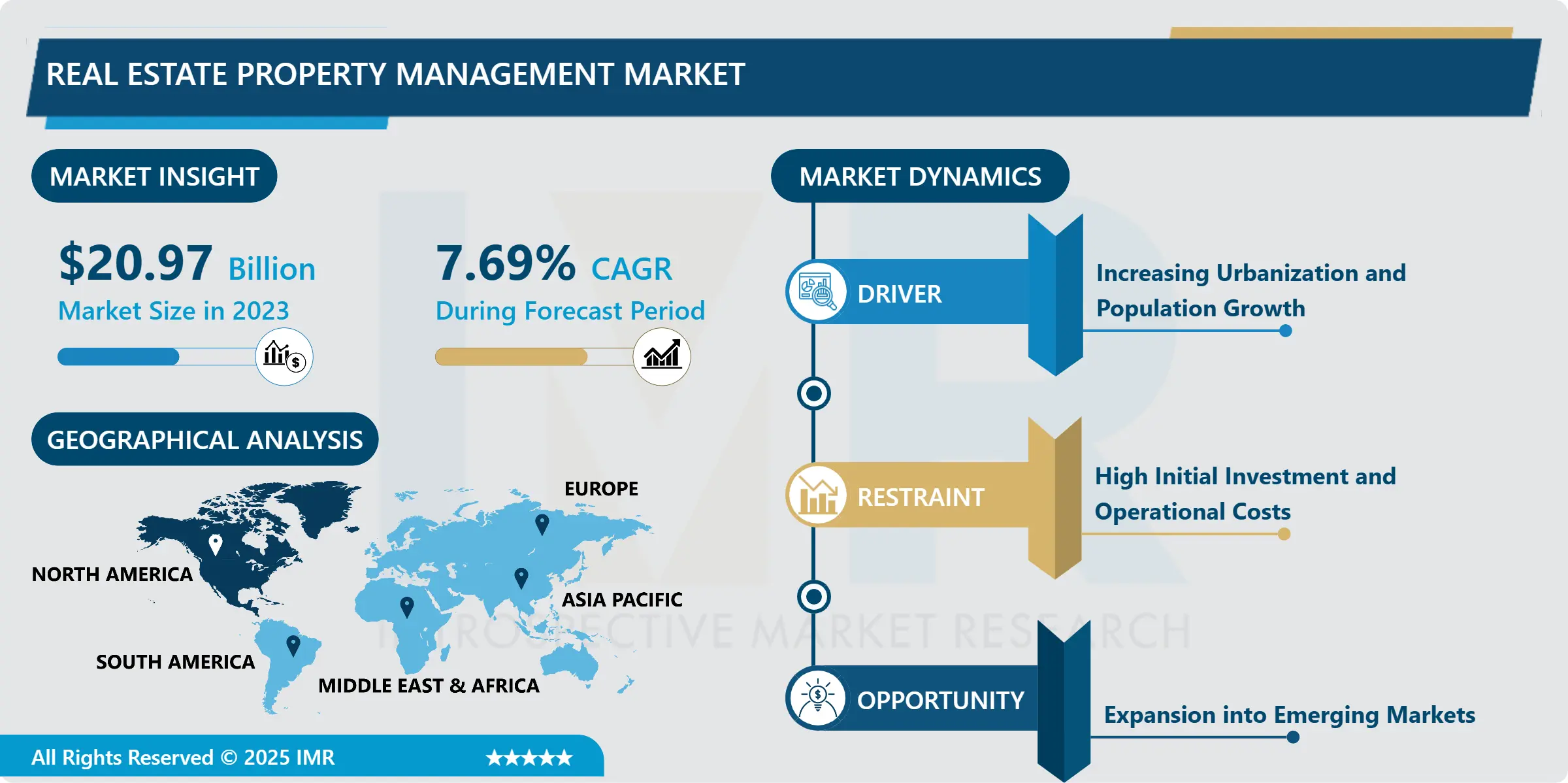
Real Estate Property Management Market Size Was Valued at USD 20.97 Billion in 2023, and is Projected to Reach USD 40.85 Billion by 2032, Growing at a CAGR of 7.69% From 2024-2032.
The Real Estate Property Management Market is experiencing steady growth driven by increasing demand from property owners and investors seeking efficient and professional management solutions. This market encompasses a wide range of services, including tenant management, property maintenance, rent collection, lease administration, financial bookkeeping, and compliance with legal requirements. The complexity of managing properties, particularly in urban centers, has led to a growing reliance on specialized property management firms to ensure high occupancy levels and optimal returns.
Technological advancements, notably in AI and IoT, are transforming the sector by enabling smarter maintenance, improved tenant interaction, and greater operational efficiency. These innovations allow property managers to reduce costs and enhance the value of real estate assets. Additionally, the rising demand for rental housing, particularly in large cities, is fueling the need for effective residential property management.
Regionally, North America and Europe are leading due to stringent regulatory environments and a mature real estate sector. The Asia-Pacific region is showing significant growth, driven by rapid urbanization, a rising middle class, and increasing demand for rental housing. The adoption of digital tools and cloud-based software is especially prominent, improving data management and decision-making processes.
Emerging economies are also witnessing market expansion due to urban development and foreign investment. However, challenges such as regulatory inconsistencies and local compliance issues persist. Despite these hurdles, the Real Estate Property Management Market is poised for continued growth as technology adoption and demand for professional services rise globally.
Real Estate Property Management Market Trend Analysis:
Adoption of Digital Tools and Sustainable Practices in Property Management
This is a great shift in how property managers continue to implement various methods that will help them with their operations to make the tenants satisfied and how they can handle the maintenance of the property in the best way possible. Focusing on application of AI and IoT systems that are already actively used, managers will be able to improve the schedules for maintenance and repair works, as well as to control the process of rent collection, and, most importantly, to receive updates concerning tenants’ satisfaction in real time. These technologies assist in cutting down on losses caused by property abandonment and subsequently improve tenant occupancy. The application of smart property management solutions also helps in implementing better and more efficient operation of emergency and maintenance that is essential in meet the standards of the property and tenant expectations.
However, out of all significant changes that took place in the property management sector, that which has to do with digital innovations is the upsurge of sustainable or green building practices. Real estate firms are incorporating the green features that a concerned tenant would want as they adapt to the market demands. This include installation of energy efficient system, using of sustainable material and also success implementation of waste management system. That way, one observes that such practices apart from being environmentally friendly also prove to be very marketable within the property sector. Housing consumers are no longer in search of accommodations, but rather, they want shares property that are dear to their hearts and foster healthier living or workplace.
Growth in the Real Estate Property Management Market
A primary reason why the real estate property management market is set to expand is enhanced by the need for skilled management since the owners wish to earn more from their tenanted property or have minimal unoccupied units. This demand is felt especially in the urban areas with high rental values that has placed rental housing as among the most secure investment opportunities. Both institutional and individual investors are now seeing rental properties as the safe-haven investments that they are; this means there is a new demand for professional property management, leasing and maintenance services. With rental housing emerging as a more important asset class, the property management companies that can deliver full-suite service offering that add value to both the properties and the occupants stand to benefit most.
However, the growing integration of management systems and technologies in property software also influence the market significantly. These innovations are making work more efficient, decreasing expenses of operation, and increasing tenants’ satisfaction. Technology in the current property management means there is enhanced communication with the tenant, easy means of making maintenance request, and easy means of making financial report. It also minimises the management complications and at the same time allows the management firm to remain relevant by offering quality services. With increased use of these technologies in different properties by the owners, the market for experienced property managers who can incorporate the technology to manage properties is likely to expand.
Real Estate Property Management Market Segment Analysis:
Real Estate Property Management Market is Segmented on the basis of Component, Deployment, Application, End User, and Region.
By Component, Solution segment is expected to dominate the market during the forecast period
The solution part of the smart property management market includes applications and systems that can be used for automating many tasks connected to the management of properties. These solutions include features like tenant management system, work order management system, lease management system financial reporting system which automate work flows and or reduce workload on property managers. These platforms use Internet of Things sensors, artificial intelligence and big data to allow for predictive maintenance in a way that allows property managers to manage issues before they become major. This automation is not only about increasing efficiency but also about making tenants happy due to prompt maintenance response and proper accounting. These solutions can be installed either on the site the property occupies or in a cloud depending on the specific demands of each property type residential, commercial, or government.
Platforms have the potential of liberating most of the property managers and owners from spending most of their time on repetitive work and offering good service to the clients. Software that is hosted on the cloud also has the added benefit of being easily accessible from a web browser anywhere in the world, meaning that they can be perfect for managing properties even when the people managing the properties are in different locations. These platforms allow clients to avoid huge initial investments in equipment and anticipated maintenance costs and are especially convenient for companies with average sizes of property management.
By End User, Property Manager/Agent segment expected to held the largest share
Both property managers and agents have a crucial role in the functioning of the smart property management environment. They are in charge of tend to daily management of a property and its tenants, such things as lease administration, tenant management, requests, financial management, and many others. By managing these processes through proper software, they can minimize these steps and allow the management software to automate it for them. Such tools generate live feedback on the performance of properties to help property managers determine when to schedule maintenance visits, when to collect rent and engage the tenants. Property managers can apply data analytics to manage tenant database with an aim of achieving the right tenant in the right premises at right time and cost, marketing strategies, and rent setting which determines occupancy levels and profitability. Their role leaves properties well placed to always be competitive within the market by increasing tenant satisfaction and occupancy.
One of the strengths of modern management software is the availably of information and facts for property managers and agents. It enables them monitor trends, recognize possible problems and prevent them right from the start. This approach of utilizing data results in not only increasing efficiency in operations, but also in expanding the general satisfaction of tenants. Since management and communication tools can be done remotely, it becomes easy for property management to attend to the maintenance issues promptly and also attend to other tenant grievances, hence improving the tenant’s welfare. Their work is crucial and entails mediating between tenants and property owners to meet the interests of the property’s users and owners.
Real Estate Property Management Market Regional Insights:
North America is Expected to Dominate the Market Over the Forecast period
The Real Estate Property management market in North America especially in the United States and Canada has been growing due to the sound Real estate sector and an increasing demand for rental services. The use of innovative technologies including property management software and smart building solutions is of great significance in the formation of the market. It’s these technological advancements that help property managers to better operate their businesses, deliver improved services to their tenants, and to work and accomplish tasks with greater efficiency. Today property management companies are providing a full-package service that includes lease, maintenance and even finance. This has shifted the focus towards integrated and technology-based solutions, in response to increasing demand for efficient, centralized property management services with focus on both residential and commercial sectors.
The North American market also gets significant investment along with development with the proactive involvement of property management companies involved in managing and in the process of developing most of the rental properties available in the region. With more and more investment in real estate, property managers are being expected to manage more diversified and sophisticated assets and provide great maintenance and tenant service. These are in addition to the ability of the market to sustain the growth of new firms, which has made it possible to observe firms trying to develop new value-added services to meet tenant demands. Using digital solutions and leveraging sustainability practices are important concepts in the market with organizations striving to fit the ever-developing needs of property owners, as well as tenants.
Active Key Players in the Real Estate Property Management Market
AppFolio, Inc. (U.S.)
Archibus, Inc. (U.S.)
Buildium
CORELOGIC (U.S.)
CoStar Group (U.S.)
Entrata, Inc. (U.S.)
IBM Corporation (U.S.)
MAISONETTE (UAE)
ManageCasa (U.S.)
MRI Software LLC (U.S.)
Oracle Corporation (U.S.)
RealPage Inc. (U.S.)
Re-Leased Software Company Ltd
Rosmiman Software Corporation
SAP SE (Germany)
Skyline Property Management
Trimble Inc
Yardi Systems, Inc. (U.S.)
Other Active Players.
Chapter 1: Introduction
1.1 Scope and Coverage
Chapter 2:Executive Summary
Chapter 3: Market Landscape
3.1 Market Dynamics
3.1.1 Drivers
3.1.2 Restraints
3.1.3 Opportunities
3.1.4 Challenges
3.2 Market Trend Analysis
3.3 PESTLE Analysis
3.4 Porter’s Five Forces Analysis
3.5 Industry Value Chain Analysis
3.6 Ecosystem
3.7 Regulatory Landscape
3.8 Price Trend Analysis
3.9 Patent Analysis
3.10 Technology Evolution
3.11 Investment Pockets
3.12 Import-Export Analysis
Chapter 4: Real Estate Property Management Market by Type
4.1 Real Estate Property Management Market Snapshot and Growth Engine
4.2 Real Estate Property Management Market Overview
4.3 Customer Relationship Management Software
4.3.1 Introduction and Market Overview
4.3.2 Historic and Forecasted Market Size in Value USD and Volume Units (2017-2032F)
4.3.3 Key Market Trends, Growth Factors and Opportunities
4.3.4 Customer Relationship Management Software: Geographic Segmentation Analysis
4.4 Enterprise Resource Planning Software
4.4.1 Introduction and Market Overview
4.4.2 Historic and Forecasted Market Size in Value USD and Volume Units (2017-2032F)
4.4.3 Key Market Trends, Growth Factors and Opportunities
4.4.4 Enterprise Resource Planning Software: Geographic Segmentation Analysis
4.5 Property Management Software
4.5.1 Introduction and Market Overview
4.5.2 Historic and Forecasted Market Size in Value USD and Volume Units (2017-2032F)
4.5.3 Key Market Trends, Growth Factors and Opportunities
4.5.4 Property Management Software: Geographic Segmentation Analysis
4.6 Contract Software and Others
4.6.1 Introduction and Market Overview
4.6.2 Historic and Forecasted Market Size in Value USD and Volume Units (2017-2032F)
4.6.3 Key Market Trends, Growth Factors and Opportunities
4.6.4 Contract Software and Others: Geographic Segmentation Analysis
Chapter 5: Real Estate Property Management Market by Deployment
5.1 Real Estate Property Management Market Snapshot and Growth Engine
5.2 Real Estate Property Management Market Overview
5.3 Cloud and On-premise
5.3.1 Introduction and Market Overview
5.3.2 Historic and Forecasted Market Size in Value USD and Volume Units (2017-2032F)
5.3.3 Key Market Trends, Growth Factors and Opportunities
5.3.4 Cloud and On-premise: Geographic Segmentation Analysis
Chapter 6: Real Estate Property Management Market by End-use
6.1 Real Estate Property Management Market Snapshot and Growth Engine
6.2 Real Estate Property Management Market Overview
6.3 Architects & Engineers
6.3.1 Introduction and Market Overview
6.3.2 Historic and Forecasted Market Size in Value USD and Volume Units (2017-2032F)
6.3.3 Key Market Trends, Growth Factors and Opportunities
6.3.4 Architects & Engineers: Geographic Segmentation Analysis
6.4 Project Managers
6.4.1 Introduction and Market Overview
6.4.2 Historic and Forecasted Market Size in Value USD and Volume Units (2017-2032F)
6.4.3 Key Market Trends, Growth Factors and Opportunities
6.4.4 Project Managers: Geographic Segmentation Analysis
6.5 Real Estate Agents and Others
6.5.1 Introduction and Market Overview
6.5.2 Historic and Forecasted Market Size in Value USD and Volume Units (2017-2032F)
6.5.3 Key Market Trends, Growth Factors and Opportunities
6.5.4 Real Estate Agents and Others: Geographic Segmentation Analysis
Chapter 7: Real Estate Property Management Market by Application
7.1 Real Estate Property Management Market Snapshot and Growth Engine
7.2 Real Estate Property Management Market Overview
7.3 Commercial and Residential
7.3.1 Introduction and Market Overview
7.3.2 Historic and Forecasted Market Size in Value USD and Volume Units (2017-2032F)
7.3.3 Key Market Trends, Growth Factors and Opportunities
7.3.4 Commercial and Residential: Geographic Segmentation Analysis
Chapter 8: Company Profiles and Competitive Analysis
8.1 Competitive Landscape
8.1.1 Competitive Benchmarking
8.1.2 Real Estate Property Management Market Share by Manufacturer (2023)
8.1.3 Industry BCG Matrix
8.1.4 Heat Map Analysis
8.1.5 Mergers and Acquisitions
8.2 APPFOLIO INC. (U.S.)
8.2.1 Company Overview
8.2.2 Key Executives
8.2.3 Company Snapshot
8.2.4 Role of the Company in the Market
8.2.5 Sustainability and Social Responsibility
8.2.6 Operating Business Segments
8.2.7 Product Portfolio
8.2.8 Business Performance
8.2.9 Key Strategic Moves and Recent Developments
8.2.10 SWOT Analysis
8.3 ARCHIBUS INC. (U.S.)
8.4 BUILDIUM
8.5 CORELOGIC (U.S.)
8.6 COSTAR GROUP (U.S.)
8.7 ENTRATA INC. (U.S.)
8.8 IBM CORPORATION (U.S.)
8.9 MAISONETTE (UAE)
8.10 MANAGECASA (U.S.)
8.11 MRI SOFTWARE LLC (U.S.)
8.12 ORACLE CORPORATION (U.S.)
8.13 REALPAGE INC. (U.S.)
8.14 RE-LEASED SOFTWARE COMPANY LTD
8.15 ROSMIMAN SOFTWARE CORPORATION
8.16 SAP SE (GERMANY)
8.17 SKYLINE PROPERTY MANAGEMENT
8.18 TRIMBLE INC
8.19 YARDI SYSTEMS INC. (U.S.)
8.20 OTHER ACTIVE PLAYERS
Chapter 9: Global Real Estate Property Management Market By Region
9.1 Overview
9.2. North America Real Estate Property Management Market
9.2.1 Key Market Trends, Growth Factors and Opportunities
9.2.2 Top Key Companies
9.2.3 Historic and Forecasted Market Size by Segments
9.2.4 Historic and Forecasted Market Size By Type
9.2.4.1 Customer Relationship Management Software
9.2.4.2 Enterprise Resource Planning Software
9.2.4.3 Property Management Software
9.2.4.4 Contract Software and Others
9.2.5 Historic and Forecasted Market Size By Deployment
9.2.5.1 Cloud and On-premise
9.2.6 Historic and Forecasted Market Size By End-use
9.2.6.1 Architects & Engineers
9.2.6.2 Project Managers
9.2.6.3 Real Estate Agents and Others
9.2.7 Historic and Forecasted Market Size By Application
9.2.7.1 Commercial and Residential
9.2.8 Historic and Forecast Market Size by Country
9.2.8.1 US
9.2.8.2 Canada
9.2.8.3 Mexico
9.3. Eastern Europe Real Estate Property Management Market
9.3.1 Key Market Trends, Growth Factors and Opportunities
9.3.2 Top Key Companies
9.3.3 Historic and Forecasted Market Size by Segments
9.3.4 Historic and Forecasted Market Size By Type
9.3.4.1 Customer Relationship Management Software
9.3.4.2 Enterprise Resource Planning Software
9.3.4.3 Property Management Software
9.3.4.4 Contract Software and Others
9.3.5 Historic and Forecasted Market Size By Deployment
9.3.5.1 Cloud and On-premise
9.3.6 Historic and Forecasted Market Size By End-use
9.3.6.1 Architects & Engineers
9.3.6.2 Project Managers
9.3.6.3 Real Estate Agents and Others
9.3.7 Historic and Forecasted Market Size By Application
9.3.7.1 Commercial and Residential
9.3.8 Historic and Forecast Market Size by Country
9.3.8.1 Russia
9.3.8.2 Bulgaria
9.3.8.3 The Czech Republic
9.3.8.4 Hungary
9.3.8.5 Poland
9.3.8.6 Romania
9.3.8.7 Rest of Eastern Europe
9.4. Western Europe Real Estate Property Management Market
9.4.1 Key Market Trends, Growth Factors and Opportunities
9.4.2 Top Key Companies
9.4.3 Historic and Forecasted Market Size by Segments
9.4.4 Historic and Forecasted Market Size By Type
9.4.4.1 Customer Relationship Management Software
9.4.4.2 Enterprise Resource Planning Software
9.4.4.3 Property Management Software
9.4.4.4 Contract Software and Others
9.4.5 Historic and Forecasted Market Size By Deployment
9.4.5.1 Cloud and On-premise
9.4.6 Historic and Forecasted Market Size By End-use
9.4.6.1 Architects & Engineers
9.4.6.2 Project Managers
9.4.6.3 Real Estate Agents and Others
9.4.7 Historic and Forecasted Market Size By Application
9.4.7.1 Commercial and Residential
9.4.8 Historic and Forecast Market Size by Country
9.4.8.1 Germany
9.4.8.2 UK
9.4.8.3 France
9.4.8.4 The Netherlands
9.4.8.5 Italy
9.4.8.6 Spain
9.4.8.7 Rest of Western Europe
9.5. Asia Pacific Real Estate Property Management Market
9.5.1 Key Market Trends, Growth Factors and Opportunities
9.5.2 Top Key Companies
9.5.3 Historic and Forecasted Market Size by Segments
9.5.4 Historic and Forecasted Market Size By Type
9.5.4.1 Customer Relationship Management Software
9.5.4.2 Enterprise Resource Planning Software
9.5.4.3 Property Management Software
9.5.4.4 Contract Software and Others
9.5.5 Historic and Forecasted Market Size By Deployment
9.5.5.1 Cloud and On-premise
9.5.6 Historic and Forecasted Market Size By End-use
9.5.6.1 Architects & Engineers
9.5.6.2 Project Managers
9.5.6.3 Real Estate Agents and Others
9.5.7 Historic and Forecasted Market Size By Application
9.5.7.1 Commercial and Residential
9.5.8 Historic and Forecast Market Size by Country
9.5.8.1 China
9.5.8.2 India
9.5.8.3 Japan
9.5.8.4 South Korea
9.5.8.5 Malaysia
9.5.8.6 Thailand
9.5.8.7 Vietnam
9.5.8.8 The Philippines
9.5.8.9 Australia
9.5.8.10 New Zealand
9.5.8.11 Rest of APAC
9.6. Middle East & Africa Real Estate Property Management Market
9.6.1 Key Market Trends, Growth Factors and Opportunities
9.6.2 Top Key Companies
9.6.3 Historic and Forecasted Market Size by Segments
9.6.4 Historic and Forecasted Market Size By Type
9.6.4.1 Customer Relationship Management Software
9.6.4.2 Enterprise Resource Planning Software
9.6.4.3 Property Management Software
9.6.4.4 Contract Software and Others
9.6.5 Historic and Forecasted Market Size By Deployment
9.6.5.1 Cloud and On-premise
9.6.6 Historic and Forecasted Market Size By End-use
9.6.6.1 Architects & Engineers
9.6.6.2 Project Managers
9.6.6.3 Real Estate Agents and Others
9.6.7 Historic and Forecasted Market Size By Application
9.6.7.1 Commercial and Residential
9.6.8 Historic and Forecast Market Size by Country
9.6.8.1 Turkiye
9.6.8.2 Bahrain
9.6.8.3 Kuwait
9.6.8.4 Saudi Arabia
9.6.8.5 Qatar
9.6.8.6 UAE
9.6.8.7 Israel
9.6.8.8 South Africa
9.7. South America Real Estate Property Management Market
9.7.1 Key Market Trends, Growth Factors and Opportunities
9.7.2 Top Key Companies
9.7.3 Historic and Forecasted Market Size by Segments
9.7.4 Historic and Forecasted Market Size By Type
9.7.4.1 Customer Relationship Management Software
9.7.4.2 Enterprise Resource Planning Software
9.7.4.3 Property Management Software
9.7.4.4 Contract Software and Others
9.7.5 Historic and Forecasted Market Size By Deployment
9.7.5.1 Cloud and On-premise
9.7.6 Historic and Forecasted Market Size By End-use
9.7.6.1 Architects & Engineers
9.7.6.2 Project Managers
9.7.6.3 Real Estate Agents and Others
9.7.7 Historic and Forecasted Market Size By Application
9.7.7.1 Commercial and Residential
9.7.8 Historic and Forecast Market Size by Country
9.7.8.1 Brazil
9.7.8.2 Argentina
9.7.8.3 Rest of SA
Chapter 10 Analyst Viewpoint and Conclusion
10.1 Recommendations and Concluding Analysis
10.2 Potential Market Strategies
Chapter 11 Research Methodology
11.1 Research Process
11.2 Primary Research
11.3 Secondary Research
Q1: What would be the forecast period in the Market research report?
A1: The forecast period in the Market research report is 2024-2032.
Q2: Who are the key players in the Real Estate Property Management Market?
A2: AppFolio, Inc. (U.S.), Archibus, Inc. (U.S.), Buildium, CORELOGIC (U.S.), CoStar Group (U.S.), Entrata, Inc. (U.S.), IBM Corporation (U.S.), MAISONETTE (UAE), ManageCasa (U.S.), MRI Software LLC (U.S.), Oracle Corporation (U.S.), RealPage Inc. (U.S.), Re-Leased Software Company Ltd, Rosmiman Software Corporation, SAP SE (Germany), Skyline Property Management, Trimble Inc, Yardi Systems, Inc. (U.S.) and Other Active Players.
Q3: What are the segments of the Real Estate Property Management Market?
A3: The Real Estate Property Management Market is segmented into By Component, By Deployment, By Application, By End User and region. By Component, the market is categorized into Solution and Services. By Deployment, the market is categorized into On-Premise and Cloud. By Application, the market is categorized into Residential, Commercial, Retail, Government, Construction and Real Estate, Others (Education, Industrial, and Hotel). By End User, the market is categorized into Property Manager/Agent Housing Association Real Estate Agents Others. By region, it is analyzed across North America (U.S., Canada, Mexico), Eastern Europe (Russia, Bulgaria, The Czech Republic, Hungary, Poland, Romania, Rest of Eastern Europe), Western Europe (Germany, UK, France, The Netherlands, Italy, Russia, Spain, Rest of Western Europe), Asia Pacific (China, India, Japan, South Korea, Malaysia, Thailand, Vietnam, The Philippines, Australia, New-Zealand, Rest of APAC), Middle East & Africa (Turkiye, Bahrain, Kuwait, Saudi Arabia, Qatar, UAE, Israel, South Africa), South America (Brazil, Argentina, Rest of SA).
Q4: What is the Real Estate Property Management Market?
A4: The Real Estate Property Management Market refers to the services and solutions provided to manage residential, commercial, and industrial properties on behalf of property owners. These services typically include maintenance, tenant screening, rent collection, lease management, property accounting, and financial reporting. The market encompasses a wide range of activities aimed at maximizing property value, ensuring compliance with regulations, and optimizing occupancy rates. It involves the use of software and technology to enhance efficiency and effectiveness in property management, catering to both individual property owners and large-scale real estate portfolios.
Q5: How big is the Real Estate Property Management Market?
A5: Real Estate Property Management Market Size Was Valued at USD 20.97 Billion in 2023, and is Projected to Reach USD 40.85 Billion by 2032, Growing at a CAGR of 7.69% From 2024-2032.
How to Buy a Report from eminsights.jp
On the product page, choose the license you want: Single-User License, Multi-User License or Enterprise License.
If you required report in your native language, then you can click on Translated Report button and fill out the form with report name and language you want, then our team will contact you as soon as possible.
Click the Buy Now button.
You will be redirected to the checkout page. Enter your company details and payment information.
Click Place Order to complete the purchase.
Confirmation: You’ll receive an order confirmation and our team will contact you shortly with your ordered report.
If you have any questions, fill out the contact form below or email us at bizdev@eminsights.net.
Thank you for choosing eminsights.jp!