Stay Ahead in Fast-Growing Economies.
Browse Reports Now
PV Inverter Market – Growth Report 2024-2032
Photovoltaic technology provides a mechanism in which solar modules are used to capture and convert solar energy from the sun into electric energy. In a PV energy system, PV modules can be linked to form arrays or solar panels (Figure 1). These modules contain semiconducting material that absorbs photons of sunlight, which in turn energize electrons in the material, freeing them from their atoms and consequently creating DC.

IMR Group
Description
PV Inverter Market Synopsis
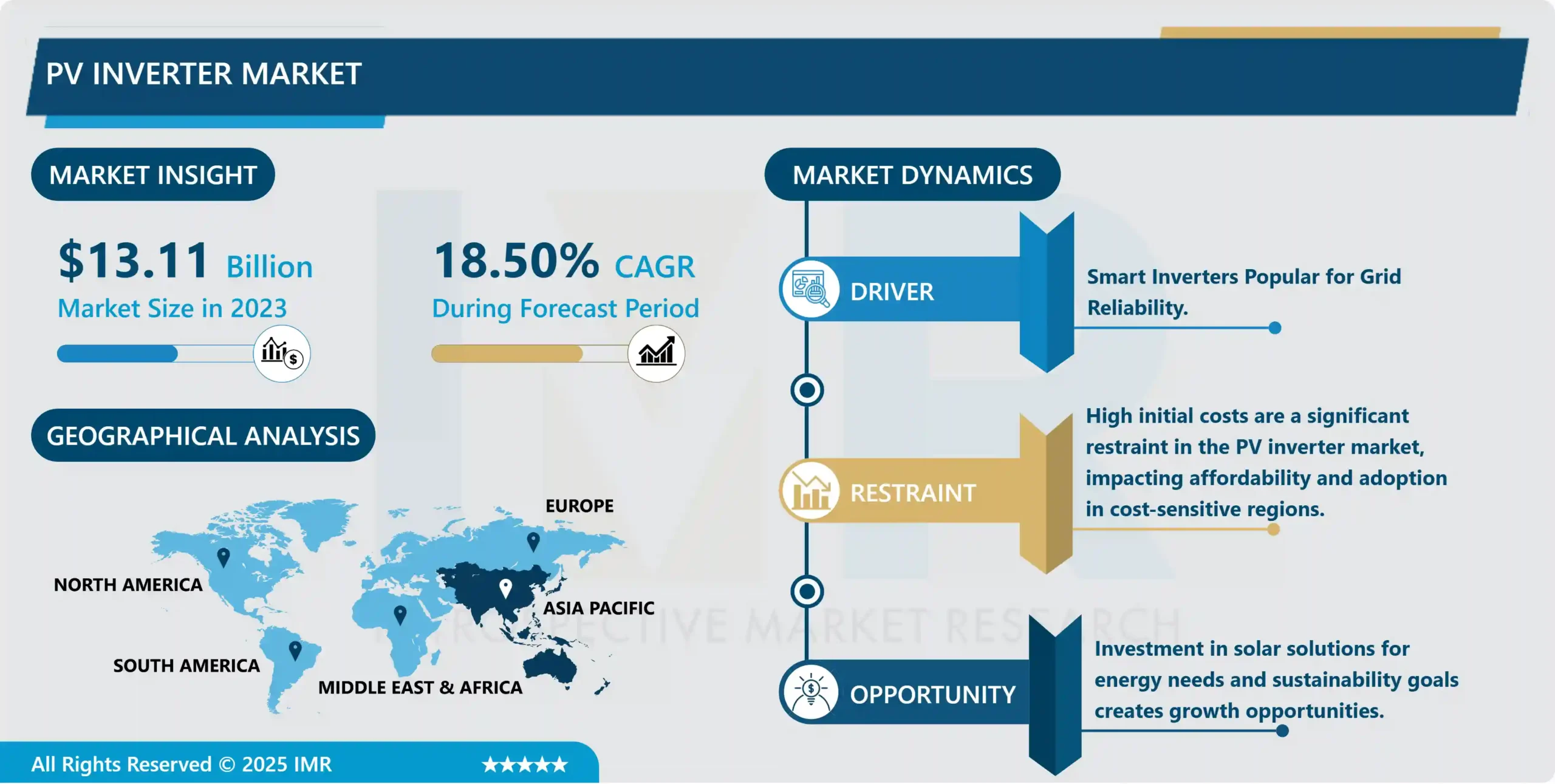
PV Inverter Market Size Was Valued at USD 13.11 Billion in 2023 and is Projected to Reach USD 60.40 Billion by 2032, Growing at a CAGR of 18.5% From 2024-2032.
Photovoltaic technology provides a mechanism in which solar modules are used to capture and convert solar energy from the sun into electric energy. In a PV energy system, PV modules can be linked to form arrays or solar panels (Figure 1). These modules contain semiconducting material that absorbs photons of sunlight, which in turn energize electrons in the material, freeing them from their atoms and consequently creating DC.
Unfortunately, the efficiency of converting solar to electrical energy in PV modules is very low (roughly 19%); consequently, the DC-to-AC power converter must be highly efficient (greater than 95%) to maximize the use of the harvested solar energy and minimize the footprint of the solar modules and the volume of the entire system.
PV systems come in two distinct configurations, based on their application. In one case, a system operates independently of the electric utility grid, referred to as an off-grid or a standalone system. Conversely, a system can be integrated with the utility grid so that energy can be shared between the PV system and the grid (surplus power can be sold back to the utility). Naturally, this later configuration introduces additional complexity.
PV Inverter Market Trend Analysis
Smart Inverters Popular for Grid Reliability.
The PV inverter market is experiencing rapid growth due to advancements in technology, market needs, and expansion possibilities. Smart inverters are becoming a popular trend due to their advanced capabilities such as real-time monitoring and grid support, which are required by regulations to ensure grid reliability and facilitate the integration of renewable energy sources.
With the increasing affordability of energy storage, there is a growing need for battery-powered inverters to control solar power generation and storage. These inverters are essential for off-grid systems and hybrid solutions, offering durability during grid outages in areas susceptible to natural disasters. Government incentives are additionally increasing the need for inverters for home solar setups.
Increasing utility-scale solar projects across Asia-Pacific and the Middle East are boosting the need for high-capacity central inverters. Cost-cutting and technological progress, such as the incorporation of IoT and AI, aid in driving growth. Hybrid inverters provide adaptable energy solutions to support market expansion.
Investment in solar solutions for energy needs and sustainability goals creates growth opportunities.
PV inverter manufacturers can seize growth opportunities by expanding into emerging markets in Africa and Latin America. These areas are looking for solar energy solutions to address rising energy needs, provide electricity to rural areas, and meet corporate sustainability targets, as part of worldwide initiatives to transition to cleaner energy sources.
Manufacturers can take advantage of increased efficiency and improved grid support by investing in research and development for next-generation inverters. It is possible to customize for niche applications such as specific climates or industrial uses. The increasing use of solar plus storage solutions is driven by lower battery prices, providing improved energy security and participation in grid services.
The rise in popularity of microgrids and off-grid solutions, particularly in distant or disaster-prone regions, is generating chances for standalone and hybrid inverters. Manufacturers of inverters can help with disaster recovery and preparedness by offering dependable power options. Technological advancements, such as AI and data analytics, are improving energy management to increase efficiency and optimize system performance.
PV Inverter Market Segment Analysis:
The PV Inverter Market is Segmented on the basis of Technology, Phase, Product Type, End-User, and Power Rating.
By Technology, String inverters Segment Is Expected to Dominate the Market During the Forecast Period.
String inverters are preferred in residential and commercial solar projects due to their affordability, effectiveness, and simple installation process. They have a strong presence in specific PV inverter markets because they are adaptable for small to medium-sized installations.
String inverters provide a cost-efficient solution for installations in residential and small commercial settings, striking a good balance between cost and efficiency. They exhibit greater effectiveness with limited shade or differences in panel direction.
In regions with high solar system usage, string inverters are commonly chosen, particularly in Europe and North America. Advances in monitoring and efficiency have bolstered their position in the market. The dominance fluctuates based on the segment and location, with central inverters being used in large-scale farms and microinverters being utilized on shaded roofs.
By Product Type, Standalone Inverters Segment Held the Largest Share
If specific circumstances increase the appeal of off-grid or self-sufficient energy systems, standalone inverters may become prevalent in the PV inverter market. Reasons for this situation involve regions lacking dependable grid connection, a need for self-sufficiency in energy, official backing for off-grid setups, and limitations on extending the grid. Standalone inverters are crucial for delivering electricity in remote or hard-to-reach areas where independent systems are more suitable.
Progress in battery storage technology and integrated energy solutions may increase the market need for off-grid options that are both reliable and sustainable, especially in areas prone to disasters. Isolated systems could become increasingly feasible and appealing to customers.
If independent solar systems become as affordable as grid-connected systems, they could take over the market. Sustainability objectives and efforts to improve energy access could also increase the need for stand-alone inverters, prompting a transition to fully sustainable energy solutions.
PV Inverter Market Regional Insights:
Asia Pacific is Expected to Dominate the Market Over the Forecast Period
If independent solar systems become as affordable as grid-connected systems, they could take over the market. Sustainability objectives and efforts to improve energy access could also increase the need for stand-alone inverters, prompting a transition to fully sustainable energy solutions.
Government policies and incentives in the Asia-Pacific region have increased the use of solar energy. Nations such as China and India are implementing ambitious solar programs at a national level, which is driving up the need for solar inverters. The area, especially China, is a center for solar technology production, boosting market expansion through cost reductions and technological advancements.
The Asia-Pacific region is at the forefront of major utility solar installations, initiatives to bring electricity to rural areas, and the expansion of solar markets for homes and businesses. Challenges arise from grid limitations, yet government support and technological advancements are creating opportunities for the growth of renewable energy awareness and adoption.
PV Inverter Market Active Players
Huawei Technologies Co., Ltd. (China)
Sungrow Power Supply Co., Ltd. (China)
ABB Ltd. (Switzerland)
Siemens AG (Germany)
SMA Solar Technology AG (Germany)
FIMER S.p.A. (Italy)
Delta Electronics, Inc. (Taiwan)
Power Electronics (Spain)
TMEIC (Toshiba Mitsubishi-Electric Industrial Systems Corporation) (Japan)
Schneider Electric SE (France)
Growatt New Energy Technology Co., Ltd. (China)
GoodWe Power Supply Technology Co., Ltd. (China)
SolarEdge Technologies Inc. (Israel)
Enphase Energy, Inc. (USA)
Fronius International GmbH (Austria)
Hitachi Hi-Rel Power Electronics Pvt. Ltd. (Japan)
KACO New Energy GmbH (Germany)
Ginlong Technologies (Solis) (China)
Ingeteam S.A. (Spain)
Eaton Corporation plc (Ireland/USA)
Advanced Energy Industries, Inc. (USA)
TBEA Co., Ltd. (China)
Delta Energy Systems (Germany) GmbH (Germany)
Huawei FusionSolar (China)
Yaskawa Solectria Solar (USA)
Chint Power Systems Co., Ltd. (China)
Bonfiglioli Riduttori S.p.A. (Italy)
KEHUA Tech (China)
Ingeteam Power Technology S.A. (Spain)
AE Solar Energy GmbH (Germany), and other Active Players.
Key Industry Developments in the PV Inverter Market:
In February 2024, SMA Solar Technology AG established a strategic partnership with ENGIE, a major energy corporation, to speed up the development and deployment of distributed solar and storage systems throughout Europe.
In February 2024, Sungrow Power Supply Co. Ltd. announced its latest string inverter series, the “SG iNext,” claiming considerable efficiency gains and improved grid support features.
Chapter 1: Introduction
1.1 Scope and Coverage
Chapter 2:Executive Summary
Chapter 3: Market Landscape
3.1 Market Dynamics
3.1.1 Drivers
3.1.2 Restraints
3.1.3 Opportunities
3.1.4 Challenges
3.2 Market Trend Analysis
3.3 PESTLE Analysis
3.4 Porter’s Five Forces Analysis
3.5 Industry Value Chain Analysis
3.6 Ecosystem
3.7 Regulatory Landscape
3.8 Price Trend Analysis
3.9 Patent Analysis
3.10 Technology Evolution
3.11 Investment Pockets
3.12 Import-Export Analysis
Chapter 4: PV Inverter Market by Technology (2018-2032)
4.1 PV Inverter Market Snapshot and Growth Engine
4.2 Market Overview
4.3 String
4.3.1 Introduction and Market Overview
4.3.2 Historic and Forecasted Market Size in Value USD and Volume Units
4.3.3 Key Market Trends, Growth Factors, and Opportunities
4.3.4 Geographic Segmentation Analysis
4.4 Micro
4.5 Central
4.6 Hybrid
Chapter 5: PV Inverter Market by Phase (2018-2032)
5.1 PV Inverter Market Snapshot and Growth Engine
5.2 Market Overview
5.3 Single
5.3.1 Introduction and Market Overview
5.3.2 Historic and Forecasted Market Size in Value USD and Volume Units
5.3.3 Key Market Trends, Growth Factors, and Opportunities
5.3.4 Geographic Segmentation Analysis
5.4 Three Phase
Chapter 6: PV Inverter Market by Product Type (2018-2032)
6.1 PV Inverter Market Snapshot and Growth Engine
6.2 Market Overview
6.3 Standalone
6.3.1 Introduction and Market Overview
6.3.2 Historic and Forecasted Market Size in Value USD and Volume Units
6.3.3 Key Market Trends, Growth Factors, and Opportunities
6.3.4 Geographic Segmentation Analysis
6.4 Grid-Tied
6.5 Battery-Based
Chapter 7: PV Inverter Market by End-User (2018-2032)
7.1 PV Inverter Market Snapshot and Growth Engine
7.2 Market Overview
7.3 Residential
7.3.1 Introduction and Market Overview
7.3.2 Historic and Forecasted Market Size in Value USD and Volume Units
7.3.3 Key Market Trends, Growth Factors, and Opportunities
7.3.4 Geographic Segmentation Analysis
7.4 Commercial
7.5 Utilities
Chapter 8: PV Inverter Market by Power Rating (2018-2032)
8.1 PV Inverter Market Snapshot and Growth Engine
8.2 Market Overview
8.3 Low Power Inverters
8.3.1 Introduction and Market Overview
8.3.2 Historic and Forecasted Market Size in Value USD and Volume Units
8.3.3 Key Market Trends, Growth Factors, and Opportunities
8.3.4 Geographic Segmentation Analysis
8.4 Medium Power Inverters
8.5 High Power Inverters
Chapter 9: Company Profiles and Competitive Analysis
9.1 Competitive Landscape
9.1.1 Competitive Benchmarking
9.1.2 PV Inverter Market Share by Manufacturer (2024)
9.1.3 Industry BCG Matrix
9.1.4 Heat Map Analysis
9.1.5 Mergers and Acquisitions
9.2 HUAWEI TECHNOLOGIES COLTD. (CHINA)
9.2.1 Company Overview
9.2.2 Key Executives
9.2.3 Company Snapshot
9.2.4 Role of the Company in the Market
9.2.5 Sustainability and Social Responsibility
9.2.6 Operating Business Segments
9.2.7 Product Portfolio
9.2.8 Business Performance
9.2.9 Key Strategic Moves and Recent Developments
9.2.10 SWOT Analysis
9.3 SUNGROW POWER SUPPLY COLTD. (CHINA)
9.4 ABB LTD. (SWITZERLAND)
9.5 SIEMENS AG (GERMANY)
9.6 SMA SOLAR TECHNOLOGY AG (GERMANY)
9.7 FIMER S.P.A. (ITALY)
9.8 DELTA ELECTRONICS INC. (TAIWAN)
9.9 POWER ELECTRONICS (SPAIN)
9.10 TMEIC (TOSHIBA MITSUBISHI-ELECTRIC INDUSTRIAL SYSTEMS CORPORATION) (JAPAN)
9.11 SCHNEIDER ELECTRIC SE (FRANCE)
9.12 GROWATT NEW ENERGY TECHNOLOGY COLTD. (CHINA)
9.13 GOODWE POWER SUPPLY TECHNOLOGY COLTD. (CHINA)
9.14 SOLAREDGE TECHNOLOGIES INC. (ISRAEL)
9.15 ENPHASE ENERGY INC. (USA)
9.16 FRONIUS INTERNATIONAL GMBH (AUSTRIA)
9.17 HITACHI HI-REL POWER ELECTRONICS PVT. LTD. (JAPAN)
9.18 KACO NEW ENERGY GMBH (GERMANY)
9.19 GINLONG TECHNOLOGIES (SOLIS) (CHINA)
9.20 INGETEAM S.A. (SPAIN)
9.21 EATON CORPORATION PLC (IRELAND/USA)
9.22 ADVANCED ENERGY INDUSTRIES INC. (USA)
9.23 TBEA COLTD. (CHINA)
9.24 DELTA ENERGY SYSTEMS (GERMANY) GMBH (GERMANY)
9.25 HUAWEI FUSIONSOLAR (CHINA)
9.26 YASKAWA SOLECTRIA SOLAR (USA)
9.27 CHINT POWER SYSTEMS COLTD. (CHINA)
9.28 BONFIGLIOLI RIDUTTORI S.P.A. (ITALY)
9.29 KEHUA TECH (CHINA)
9.30 INGETEAM POWER TECHNOLOGY S.A. (SPAIN)
9.31 AE SOLAR ENERGY GMBH (GERMANY)
9.32 AND
Chapter 10: Global PV Inverter Market By Region
10.1 Overview
10.2. North America PV Inverter Market
10.2.1 Key Market Trends, Growth Factors and Opportunities
10.2.2 Top Key Companies
10.2.3 Historic and Forecasted Market Size by Segments
10.2.4 Historic and Forecasted Market Size by Technology
10.2.4.1 String
10.2.4.2 Micro
10.2.4.3 Central
10.2.4.4 Hybrid
10.2.5 Historic and Forecasted Market Size by Phase
10.2.5.1 Single
10.2.5.2 Three Phase
10.2.6 Historic and Forecasted Market Size by Product Type
10.2.6.1 Standalone
10.2.6.2 Grid-Tied
10.2.6.3 Battery-Based
10.2.7 Historic and Forecasted Market Size by End-User
10.2.7.1 Residential
10.2.7.2 Commercial
10.2.7.3 Utilities
10.2.8 Historic and Forecasted Market Size by Power Rating
10.2.8.1 Low Power Inverters
10.2.8.2 Medium Power Inverters
10.2.8.3 High Power Inverters
10.2.9 Historic and Forecast Market Size by Country
10.2.9.1 US
10.2.9.2 Canada
10.2.9.3 Mexico
10.3. Eastern Europe PV Inverter Market
10.3.1 Key Market Trends, Growth Factors and Opportunities
10.3.2 Top Key Companies
10.3.3 Historic and Forecasted Market Size by Segments
10.3.4 Historic and Forecasted Market Size by Technology
10.3.4.1 String
10.3.4.2 Micro
10.3.4.3 Central
10.3.4.4 Hybrid
10.3.5 Historic and Forecasted Market Size by Phase
10.3.5.1 Single
10.3.5.2 Three Phase
10.3.6 Historic and Forecasted Market Size by Product Type
10.3.6.1 Standalone
10.3.6.2 Grid-Tied
10.3.6.3 Battery-Based
10.3.7 Historic and Forecasted Market Size by End-User
10.3.7.1 Residential
10.3.7.2 Commercial
10.3.7.3 Utilities
10.3.8 Historic and Forecasted Market Size by Power Rating
10.3.8.1 Low Power Inverters
10.3.8.2 Medium Power Inverters
10.3.8.3 High Power Inverters
10.3.9 Historic and Forecast Market Size by Country
10.3.9.1 Russia
10.3.9.2 Bulgaria
10.3.9.3 The Czech Republic
10.3.9.4 Hungary
10.3.9.5 Poland
10.3.9.6 Romania
10.3.9.7 Rest of Eastern Europe
10.4. Western Europe PV Inverter Market
10.4.1 Key Market Trends, Growth Factors and Opportunities
10.4.2 Top Key Companies
10.4.3 Historic and Forecasted Market Size by Segments
10.4.4 Historic and Forecasted Market Size by Technology
10.4.4.1 String
10.4.4.2 Micro
10.4.4.3 Central
10.4.4.4 Hybrid
10.4.5 Historic and Forecasted Market Size by Phase
10.4.5.1 Single
10.4.5.2 Three Phase
10.4.6 Historic and Forecasted Market Size by Product Type
10.4.6.1 Standalone
10.4.6.2 Grid-Tied
10.4.6.3 Battery-Based
10.4.7 Historic and Forecasted Market Size by End-User
10.4.7.1 Residential
10.4.7.2 Commercial
10.4.7.3 Utilities
10.4.8 Historic and Forecasted Market Size by Power Rating
10.4.8.1 Low Power Inverters
10.4.8.2 Medium Power Inverters
10.4.8.3 High Power Inverters
10.4.9 Historic and Forecast Market Size by Country
10.4.9.1 Germany
10.4.9.2 UK
10.4.9.3 France
10.4.9.4 The Netherlands
10.4.9.5 Italy
10.4.9.6 Spain
10.4.9.7 Rest of Western Europe
10.5. Asia Pacific PV Inverter Market
10.5.1 Key Market Trends, Growth Factors and Opportunities
10.5.2 Top Key Companies
10.5.3 Historic and Forecasted Market Size by Segments
10.5.4 Historic and Forecasted Market Size by Technology
10.5.4.1 String
10.5.4.2 Micro
10.5.4.3 Central
10.5.4.4 Hybrid
10.5.5 Historic and Forecasted Market Size by Phase
10.5.5.1 Single
10.5.5.2 Three Phase
10.5.6 Historic and Forecasted Market Size by Product Type
10.5.6.1 Standalone
10.5.6.2 Grid-Tied
10.5.6.3 Battery-Based
10.5.7 Historic and Forecasted Market Size by End-User
10.5.7.1 Residential
10.5.7.2 Commercial
10.5.7.3 Utilities
10.5.8 Historic and Forecasted Market Size by Power Rating
10.5.8.1 Low Power Inverters
10.5.8.2 Medium Power Inverters
10.5.8.3 High Power Inverters
10.5.9 Historic and Forecast Market Size by Country
10.5.9.1 China
10.5.9.2 India
10.5.9.3 Japan
10.5.9.4 South Korea
10.5.9.5 Malaysia
10.5.9.6 Thailand
10.5.9.7 Vietnam
10.5.9.8 The Philippines
10.5.9.9 Australia
10.5.9.10 New Zealand
10.5.9.11 Rest of APAC
10.6. Middle East & Africa PV Inverter Market
10.6.1 Key Market Trends, Growth Factors and Opportunities
10.6.2 Top Key Companies
10.6.3 Historic and Forecasted Market Size by Segments
10.6.4 Historic and Forecasted Market Size by Technology
10.6.4.1 String
10.6.4.2 Micro
10.6.4.3 Central
10.6.4.4 Hybrid
10.6.5 Historic and Forecasted Market Size by Phase
10.6.5.1 Single
10.6.5.2 Three Phase
10.6.6 Historic and Forecasted Market Size by Product Type
10.6.6.1 Standalone
10.6.6.2 Grid-Tied
10.6.6.3 Battery-Based
10.6.7 Historic and Forecasted Market Size by End-User
10.6.7.1 Residential
10.6.7.2 Commercial
10.6.7.3 Utilities
10.6.8 Historic and Forecasted Market Size by Power Rating
10.6.8.1 Low Power Inverters
10.6.8.2 Medium Power Inverters
10.6.8.3 High Power Inverters
10.6.9 Historic and Forecast Market Size by Country
10.6.9.1 Turkiye
10.6.9.2 Bahrain
10.6.9.3 Kuwait
10.6.9.4 Saudi Arabia
10.6.9.5 Qatar
10.6.9.6 UAE
10.6.9.7 Israel
10.6.9.8 South Africa
10.7. South America PV Inverter Market
10.7.1 Key Market Trends, Growth Factors and Opportunities
10.7.2 Top Key Companies
10.7.3 Historic and Forecasted Market Size by Segments
10.7.4 Historic and Forecasted Market Size by Technology
10.7.4.1 String
10.7.4.2 Micro
10.7.4.3 Central
10.7.4.4 Hybrid
10.7.5 Historic and Forecasted Market Size by Phase
10.7.5.1 Single
10.7.5.2 Three Phase
10.7.6 Historic and Forecasted Market Size by Product Type
10.7.6.1 Standalone
10.7.6.2 Grid-Tied
10.7.6.3 Battery-Based
10.7.7 Historic and Forecasted Market Size by End-User
10.7.7.1 Residential
10.7.7.2 Commercial
10.7.7.3 Utilities
10.7.8 Historic and Forecasted Market Size by Power Rating
10.7.8.1 Low Power Inverters
10.7.8.2 Medium Power Inverters
10.7.8.3 High Power Inverters
10.7.9 Historic and Forecast Market Size by Country
10.7.9.1 Brazil
10.7.9.2 Argentina
10.7.9.3 Rest of SA
Chapter 11 Analyst Viewpoint and Conclusion
11.1 Recommendations and Concluding Analysis
11.2 Potential Market Strategies
Chapter 12 Research Methodology
12.1 Research Process
12.2 Primary Research
12.3 Secondary Research
Q1: What would be the forecast period in the PV Inverter Market research report?
A1: The forecast period in the PV Inverter Market research report is 2024-2032.
Q2: Who are the key players in the PV Inverter Market?
A2: Huawei Technologies Co., Ltd. (China), Sungrow Power Supply Co., Ltd. (China), ABB Ltd. (Switzerland), Siemens AG (Germany), SMA Solar Technology AG (Germany), FIMER S.p.A. (Italy), Delta Electronics, Inc. (Taiwan), Power Electronics (Spain), TMEIC (Toshiba Mitsubishi-Electric Industrial Systems Corporation) (Japan), Schneider Electric SE (France), Growatt New Energy Technology Co., Ltd. (China), GoodWe Power Supply Technology Co., Ltd. (China), SolarEdge Technologies Inc. (Israel), Enphase Energy, Inc. (USA), Fronius International GmbH (Austria), Hitachi Hi-Rel Power Electronics Pvt. Ltd. (Japan), KACO new energy GmbH (Germany), Ginlong Technologies (Solis) (China), Ingeteam S.A. (Spain), Eaton Corporation plc (Ireland/USA), Advanced Energy Industries, Inc. (USA), TBEA Co., Ltd. (China), Delta Energy Systems (Germany) GmbH (Germany), Huawei FusionSolar (China), Yaskawa Solectria Solar (USA), Chint Power Systems Co., Ltd. (China), Bonfiglioli Riduttori S.p.A. (Italy), KEHUA Tech (China), Ingeteam Power Technology S.A. (Spain), AE Solar Energy GmbH (Germany) and Other Active Players.
Q3: What are the segments of the PV Inverter Market?
A3: The PV Inverter Market is segmented into Technology, Phase, Product Type, End-User, Power Rating, and region. By Technology, the market is categorized into String, Micro, Central, and Hybrid. By Phase, the market is categorized into Single, Three Phase. By Product Type, the market is categorized into Standalone, Grid-Tied, and Battery-Based. By End-User, the market is categorized into Residential, Commercial, and Utilities. By Power Rating, The Market Is Categorized into Low Power Inverters, Medium Power Inverters, and High Power Inverters. By region, it is analyzed across North America (U.S.; Canada; Mexico), Eastern Europe (Bulgaria; The Czech Republic; Hungary; Poland; Romania; Rest of Eastern Europe), Western Europe (Germany; UK; France; Netherlands; Italy; Russia; Spain; Rest of Western Europe), Asia-Pacific (China; India; Japan; Southeast Asia, etc.), South America (Brazil; Argentina, etc.), Middle East & Africa (Saudi Arabia; South Africa, etc.).
Q4: What is the PV Inverter Market?
A4: The PV (photovoltaic) inverter market refers to the industry segment focused on the production and sale of inverters used in solar energy systems. PV inverters are critical components that convert the direct current (DC) generated by solar panels into alternating current (AC), which can be used by electrical grids and household appliances.
Q5: How big is the PV Inverter Market?
A5: PV Inverter Market Size Was Valued at USD 13.11 Billion in 2023 and is Projected to Reach USD 60.40 Billion by 2032, Growing at a CAGR of 18.5% From 2024-2032.
How to Buy a Report from eminsights.jp
On the product page, choose the license you want: Single-User License, Multi-User License or Enterprise License.
If you required report in your native language, then you can click on Translated Report button and fill out the form with report name and language you want, then our team will contact you as soon as possible.
Click the Buy Now button.
You will be redirected to the checkout page. Enter your company details and payment information.
Click Place Order to complete the purchase.
Confirmation: You’ll receive an order confirmation and our team will contact you shortly with your ordered report.
If you have any questions, fill out the contact form below or email us at bizdev@eminsights.net.
Thank you for choosing eminsights.jp!