Stay Ahead in Fast-Growing Economies.
Browse Reports Now
Pulmonary Drugs Market Segment Analysis, Share, and Forecast Report (2024-2032)
The Pulmonary Drugs Market is defined as a part of pharmaceutical market which produces and provides drugs for patients with pulmonary diseases.

IMR Group
Description
Pulmonary Drugs Market Synopsis:
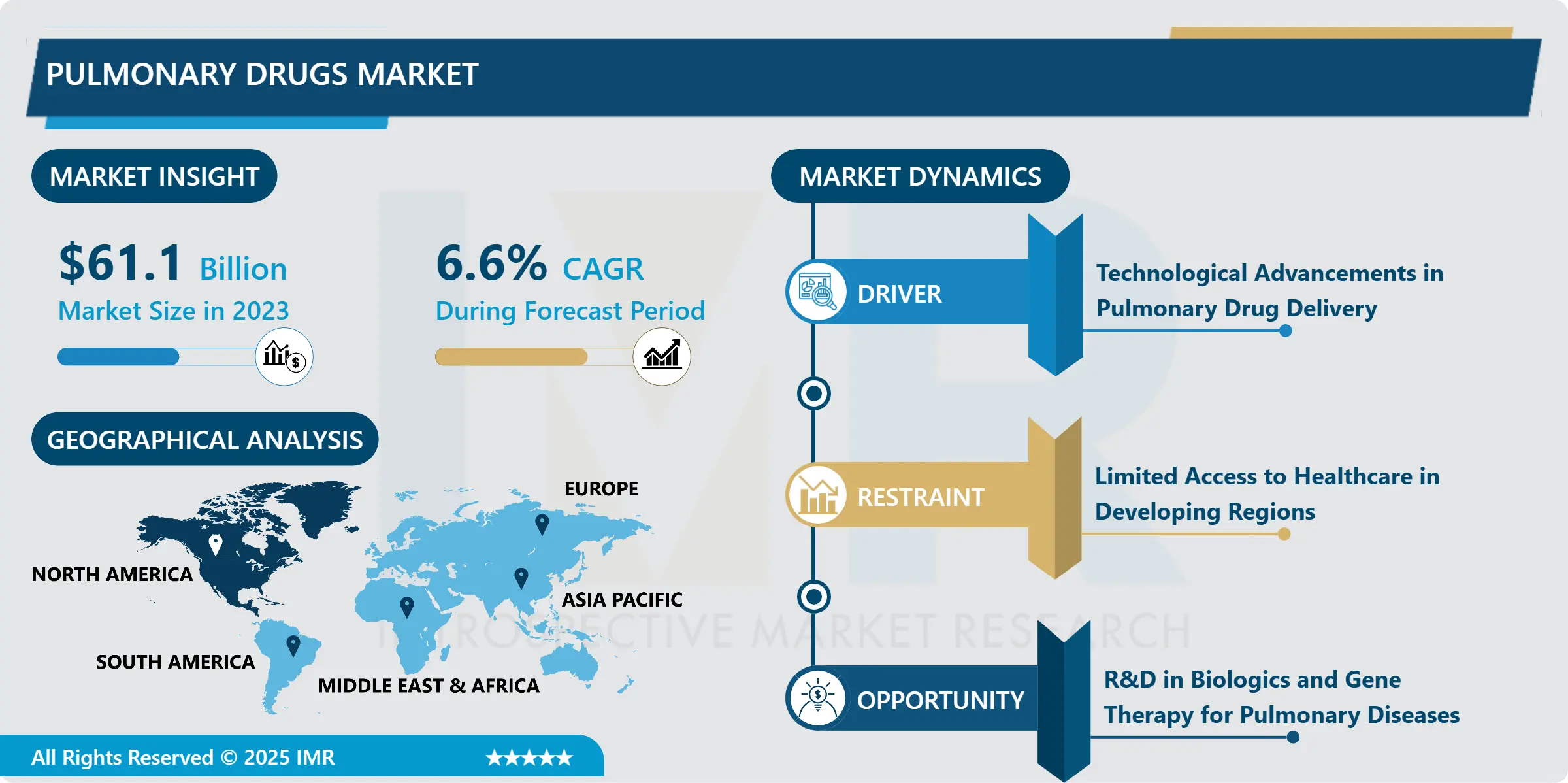
Pulmonary Drugs Market Size Was Valued at USD 61.10 Billion in 2023, and is Projected to Reach USD 108.60 Billion by 2032, Growing at a CAGR of 6.60% From 2024-2032.
The Pulmonary Drugs Market is defined as a part of pharmaceutical market which produces and provides drugs for patients with pulmonary diseases. These drugs are used in treating diseases such as asthma, COPD, cystic fibrosis and pulmonary hypertension and arterial disease. In this case, pulmonary drugs are used to address certain symptoms, restore normal lung function and generally improve the patient’s quality of life due to respiratory diseases.
The Pulmonary Drugs Market is primarily influenced by this factor because asthma and COPD are some of the most prevalent diseases in the world. Pollution, smoking and other environmental affects increases the rates of these diseases and creates the demand for effective treatment. Also, people of many age groups are becoming vulnerable to respiratory ailments in most parts, customer demand grows rapidly; lastly, the increasing number of aged people who are more sensitive to respiratory discomforts expands market demand. The increased knowledge of the diseases affecting the lungs, as well as improvements in the delivery systems of such drugs, are also contributing to the increased consumption of pulmonary drugs.
The other factor is that the advancement in the formulation, discovery and research on new drugs is steady. Thanks to recently developed inhaler devices, biologic agents, and combination therapy, patients have access to better and easier conditions for their illnesses. Other factors include government polices and healthcare schemes that raise the diagnose and management of respiratory diseases serve the market’s growth. These factors make for a growing market for pulmonary drugs for which the demand will increase among the population.
Pulmonary Drugs Market Trend Analysis:
Growing preference for inhaled drugs
A notable trend for the Pulmonary Drugs Market is that drugs with a delivery route to the lungs are on the rise since they maximize the lungs’ first pass effect and have fewer side effects to the rest of the body. Metered dose inhalers, DPI’s, and nebulizers are improving in terms of usability, portability and dosage accuracy. These improvements enhance the treatment patterns and provide better patient convenient.
Another important pattern which has been observed is an increase in the demand for biologic therapy for major respiratory disorders. Substance biologics that work selectively on the immune response components have proved efficient in the management of asthma and other chronic pulmonary diseases which fail to respond to conventional drugs. The growing popularity of biologics in.asthma and other pulmonary diseases is changing the perspectives of these markets and creating new possible for expansion.
Invest in research and development (R&D) of novel therapies
Pulmonary drugs market is an unexplored market and there are vast grounds for the development of new therapies biologics and gene therapy. Such advances may lead to better treatments for difficult to manage illnesses such as refractory asthma and COPD, for which current management is suboptimal. Furthermore, the introduction of decision support system in patient management makes it possible to use gene variants to predict the most appropriate treatment for a given respiratory disease.
Furthermore, increasing the availability of healthcare in the emerging markets covers the second growth factor for the Pulmonary Drugs Market. Prospective changes in the healthcare structure together with the growth of incidences of respiratory diseases in these regions will lead to an expansion in demand for pulmonary medicines. Businesses could benefit from increased overlay through localization, distribution, and partnership with local healthcare providers in order to address a developing market need.
Pulmonary Drugs Market Segment Analysis:
Pulmonary Drugs Market is Segmented on the basis of Drug type, Application, End User, and Region.
By Drug Type, Bronchodilators segment is expected to dominate the market during the forecast period
Based on the type of drugs, the Pulmonary Drugs Market can be classified as bronchodilators, anti-inflammatory agents and anti-asthma drugs, mucolytics and others. There are inhalers used to open up the air passages so that it becomes easier to breathe because the muscles surrounding the passage ways can be relaxed.
Steroidal drugs are essential in the treatment of chronic inflammatory illnesses such as asthma and chronic obstructive pulmonary disease. Exectorants cause sputum to become loose so that it can be easily cleared particularly in diseases such as cystic fibrosis. Other drugs encompass combined agents that may treat more than one pulmonary disease sign or symptom at the same time.
By Application, Asthma segment expected to held the largest share
This Pulmonary Drugs Market is further categorized based on the usage of drugs for asthmatic, COPD patients, Cystic fibrosis, Pulmonary arterial hypertension and other respiratory disorders. Asthma can be considered to be one of the diseases, for which the number of patients who need to take pulmonary drugs is extremely high.
COPD is predominantly smoking-related, chronic condition treated with bronchodilators and anti-inflammatory medications. This condition is commonly caused by poor genetics and can therefore require both mucoactive agents and antibiotics at some point. PAH is a disease of pulmonary arterial walls that calls for specific treatments to alleviate signs and promote lung health.
Pulmonary Drugs Market Regional Insights:
North America is Expected to Dominate the Market Over the Forecast period
North America dominates the Pulmonary Drugs Market due to the higherHCAs standards, advanced treatments and more focused presence of a number of big pharma players. This is the case with the United States, a major market having a high prevalence of asthma and COPD and an aging population. Further, the availability of socialist health care plans, and appropriate government policies to promote the usage of pulmonary drugs place this region on the topmost position.
Europe comes second when it comes to market share and countries such as Germany, England and France demonstrates high market for pulmonary drugs. The novel diseases associated with respiratory organs, together with reimbursement policies and a favourable climate to healthcare infrastructure, make Europe yet another promising market for pulmonary drugs. Therefore, the market is dominated by North America, which has a better healthcare and innovation index than any other region.
Active Key Players in the Pulmonary Drugs Market:
AbbVie (USA)
AstraZeneca (UK)
Boehringer Ingelheim (Germany)
GlaxoSmithKline (UK)
Johnson & Johnson (USA)
Merck & Co., Inc. (USA)
Novartis (Switzerland)
Pfizer (USA)
Sanofi (France)
Teva Pharmaceutical Industries Ltd. (Israel), and Other Active Players
Chapter 1: Introduction
1.1 Scope and Coverage
Chapter 2:Executive Summary
Chapter 3: Market Landscape
3.1 Market Dynamics
3.1.1 Drivers
3.1.2 Restraints
3.1.3 Opportunities
3.1.4 Challenges
3.2 Market Trend Analysis
3.3 PESTLE Analysis
3.4 Porter’s Five Forces Analysis
3.5 Industry Value Chain Analysis
3.6 Ecosystem
3.7 Regulatory Landscape
3.8 Price Trend Analysis
3.9 Patent Analysis
3.10 Technology Evolution
3.11 Investment Pockets
3.12 Import-Export Analysis
Chapter 4: Pulmonary Drugs Market by Type
4.1 Pulmonary Drugs Market Snapshot and Growth Engine
4.2 Pulmonary Drugs Market Overview
4.3 Mechanical Pump Jack
4.3.1 Introduction and Market Overview
4.3.2 Historic and Forecasted Market Size in Value USD and Volume Units (2017-2032F)
4.3.3 Key Market Trends, Growth Factors and Opportunities
4.3.4 Mechanical Pump Jack: Geographic Segmentation Analysis
4.4 Hydraulic Pump Jack
4.4.1 Introduction and Market Overview
4.4.2 Historic and Forecasted Market Size in Value USD and Volume Units (2017-2032F)
4.4.3 Key Market Trends, Growth Factors and Opportunities
4.4.4 Hydraulic Pump Jack: Geographic Segmentation Analysis
4.5 Electric Pump Jack
4.5.1 Introduction and Market Overview
4.5.2 Historic and Forecasted Market Size in Value USD and Volume Units (2017-2032F)
4.5.3 Key Market Trends, Growth Factors and Opportunities
4.5.4 Electric Pump Jack: Geographic Segmentation Analysis
Chapter 5: Pulmonary Drugs Market by Operation
5.1 Pulmonary Drugs Market Snapshot and Growth Engine
5.2 Pulmonary Drugs Market Overview
5.3 Single-Acting Pump Jack
5.3.1 Introduction and Market Overview
5.3.2 Historic and Forecasted Market Size in Value USD and Volume Units (2017-2032F)
5.3.3 Key Market Trends, Growth Factors and Opportunities
5.3.4 Single-Acting Pump Jack: Geographic Segmentation Analysis
5.4 Double-Acting Pump Jack
5.4.1 Introduction and Market Overview
5.4.2 Historic and Forecasted Market Size in Value USD and Volume Units (2017-2032F)
5.4.3 Key Market Trends, Growth Factors and Opportunities
5.4.4 Double-Acting Pump Jack: Geographic Segmentation Analysis
Chapter 6: Pulmonary Drugs Market by Application
6.1 Pulmonary Drugs Market Snapshot and Growth Engine
6.2 Pulmonary Drugs Market Overview
6.3 Oil Extraction
6.3.1 Introduction and Market Overview
6.3.2 Historic and Forecasted Market Size in Value USD and Volume Units (2017-2032F)
6.3.3 Key Market Trends, Growth Factors and Opportunities
6.3.4 Oil Extraction: Geographic Segmentation Analysis
6.4 Gas Extraction
6.4.1 Introduction and Market Overview
6.4.2 Historic and Forecasted Market Size in Value USD and Volume Units (2017-2032F)
6.4.3 Key Market Trends, Growth Factors and Opportunities
6.4.4 Gas Extraction: Geographic Segmentation Analysis
6.5 Water Extraction
6.5.1 Introduction and Market Overview
6.5.2 Historic and Forecasted Market Size in Value USD and Volume Units (2017-2032F)
6.5.3 Key Market Trends, Growth Factors and Opportunities
6.5.4 Water Extraction: Geographic Segmentation Analysis
Chapter 7: Pulmonary Drugs Market by End User
7.1 Pulmonary Drugs Market Snapshot and Growth Engine
7.2 Pulmonary Drugs Market Overview
7.3 Oil & Gas Industry
7.3.1 Introduction and Market Overview
7.3.2 Historic and Forecasted Market Size in Value USD and Volume Units (2017-2032F)
7.3.3 Key Market Trends, Growth Factors and Opportunities
7.3.4 Oil & Gas Industry: Geographic Segmentation Analysis
7.4 Water Management Industry
7.4.1 Introduction and Market Overview
7.4.2 Historic and Forecasted Market Size in Value USD and Volume Units (2017-2032F)
7.4.3 Key Market Trends, Growth Factors and Opportunities
7.4.4 Water Management Industry: Geographic Segmentation Analysis
7.5 Mining Industry
7.5.1 Introduction and Market Overview
7.5.2 Historic and Forecasted Market Size in Value USD and Volume Units (2017-2032F)
7.5.3 Key Market Trends, Growth Factors and Opportunities
7.5.4 Mining Industry: Geographic Segmentation Analysis
Chapter 8: Company Profiles and Competitive Analysis
8.1 Competitive Landscape
8.1.1 Competitive Benchmarking
8.1.2 Pulmonary Drugs Market Share by Manufacturer (2023)
8.1.3 Industry BCG Matrix
8.1.4 Heat Map Analysis
8.1.5 Mergers and Acquisitions
8.2 ASTRAZENECA (UK)
8.2.1 Company Overview
8.2.2 Key Executives
8.2.3 Company Snapshot
8.2.4 Role of the Company in the Market
8.2.5 Sustainability and Social Responsibility
8.2.6 Operating Business Segments
8.2.7 Product Portfolio
8.2.8 Business Performance
8.2.9 Key Strategic Moves and Recent Developments
8.2.10 SWOT Analysis
8.3 NOVARTIS (SWITZERLAND)
8.4 GLAXOSMITHKLINE (UK)
8.5 BOEHRINGER INGELHEIM (GERMANY)
8.6 MERCK & CO. INC. (USA)
8.7 JOHNSON & JOHNSON (USA)
8.8 PFIZER (USA)
8.9 SANOFI (FRANCE)
8.10 TEVA PHARMACEUTICAL INDUSTRIES LTD. (ISRAEL)
8.11 ABBVIE (USA)
8.12 OTHER ACTIVE PLAYERS
Chapter 9: Global Pulmonary Drugs Market By Region
9.1 Overview
9.2. North America Pulmonary Drugs Market
9.2.1 Key Market Trends, Growth Factors and Opportunities
9.2.2 Top Key Companies
9.2.3 Historic and Forecasted Market Size by Segments
9.2.4 Historic and Forecasted Market Size By Type
9.2.4.1 Mechanical Pump Jack
9.2.4.2 Hydraulic Pump Jack
9.2.4.3 Electric Pump Jack
9.2.5 Historic and Forecasted Market Size By Operation
9.2.5.1 Single-Acting Pump Jack
9.2.5.2 Double-Acting Pump Jack
9.2.6 Historic and Forecasted Market Size By Application
9.2.6.1 Oil Extraction
9.2.6.2 Gas Extraction
9.2.6.3 Water Extraction
9.2.7 Historic and Forecasted Market Size By End User
9.2.7.1 Oil & Gas Industry
9.2.7.2 Water Management Industry
9.2.7.3 Mining Industry
9.2.8 Historic and Forecast Market Size by Country
9.2.8.1 US
9.2.8.2 Canada
9.2.8.3 Mexico
9.3. Eastern Europe Pulmonary Drugs Market
9.3.1 Key Market Trends, Growth Factors and Opportunities
9.3.2 Top Key Companies
9.3.3 Historic and Forecasted Market Size by Segments
9.3.4 Historic and Forecasted Market Size By Type
9.3.4.1 Mechanical Pump Jack
9.3.4.2 Hydraulic Pump Jack
9.3.4.3 Electric Pump Jack
9.3.5 Historic and Forecasted Market Size By Operation
9.3.5.1 Single-Acting Pump Jack
9.3.5.2 Double-Acting Pump Jack
9.3.6 Historic and Forecasted Market Size By Application
9.3.6.1 Oil Extraction
9.3.6.2 Gas Extraction
9.3.6.3 Water Extraction
9.3.7 Historic and Forecasted Market Size By End User
9.3.7.1 Oil & Gas Industry
9.3.7.2 Water Management Industry
9.3.7.3 Mining Industry
9.3.8 Historic and Forecast Market Size by Country
9.3.8.1 Russia
9.3.8.2 Bulgaria
9.3.8.3 The Czech Republic
9.3.8.4 Hungary
9.3.8.5 Poland
9.3.8.6 Romania
9.3.8.7 Rest of Eastern Europe
9.4. Western Europe Pulmonary Drugs Market
9.4.1 Key Market Trends, Growth Factors and Opportunities
9.4.2 Top Key Companies
9.4.3 Historic and Forecasted Market Size by Segments
9.4.4 Historic and Forecasted Market Size By Type
9.4.4.1 Mechanical Pump Jack
9.4.4.2 Hydraulic Pump Jack
9.4.4.3 Electric Pump Jack
9.4.5 Historic and Forecasted Market Size By Operation
9.4.5.1 Single-Acting Pump Jack
9.4.5.2 Double-Acting Pump Jack
9.4.6 Historic and Forecasted Market Size By Application
9.4.6.1 Oil Extraction
9.4.6.2 Gas Extraction
9.4.6.3 Water Extraction
9.4.7 Historic and Forecasted Market Size By End User
9.4.7.1 Oil & Gas Industry
9.4.7.2 Water Management Industry
9.4.7.3 Mining Industry
9.4.8 Historic and Forecast Market Size by Country
9.4.8.1 Germany
9.4.8.2 UK
9.4.8.3 France
9.4.8.4 The Netherlands
9.4.8.5 Italy
9.4.8.6 Spain
9.4.8.7 Rest of Western Europe
9.5. Asia Pacific Pulmonary Drugs Market
9.5.1 Key Market Trends, Growth Factors and Opportunities
9.5.2 Top Key Companies
9.5.3 Historic and Forecasted Market Size by Segments
9.5.4 Historic and Forecasted Market Size By Type
9.5.4.1 Mechanical Pump Jack
9.5.4.2 Hydraulic Pump Jack
9.5.4.3 Electric Pump Jack
9.5.5 Historic and Forecasted Market Size By Operation
9.5.5.1 Single-Acting Pump Jack
9.5.5.2 Double-Acting Pump Jack
9.5.6 Historic and Forecasted Market Size By Application
9.5.6.1 Oil Extraction
9.5.6.2 Gas Extraction
9.5.6.3 Water Extraction
9.5.7 Historic and Forecasted Market Size By End User
9.5.7.1 Oil & Gas Industry
9.5.7.2 Water Management Industry
9.5.7.3 Mining Industry
9.5.8 Historic and Forecast Market Size by Country
9.5.8.1 China
9.5.8.2 India
9.5.8.3 Japan
9.5.8.4 South Korea
9.5.8.5 Malaysia
9.5.8.6 Thailand
9.5.8.7 Vietnam
9.5.8.8 The Philippines
9.5.8.9 Australia
9.5.8.10 New Zealand
9.5.8.11 Rest of APAC
9.6. Middle East & Africa Pulmonary Drugs Market
9.6.1 Key Market Trends, Growth Factors and Opportunities
9.6.2 Top Key Companies
9.6.3 Historic and Forecasted Market Size by Segments
9.6.4 Historic and Forecasted Market Size By Type
9.6.4.1 Mechanical Pump Jack
9.6.4.2 Hydraulic Pump Jack
9.6.4.3 Electric Pump Jack
9.6.5 Historic and Forecasted Market Size By Operation
9.6.5.1 Single-Acting Pump Jack
9.6.5.2 Double-Acting Pump Jack
9.6.6 Historic and Forecasted Market Size By Application
9.6.6.1 Oil Extraction
9.6.6.2 Gas Extraction
9.6.6.3 Water Extraction
9.6.7 Historic and Forecasted Market Size By End User
9.6.7.1 Oil & Gas Industry
9.6.7.2 Water Management Industry
9.6.7.3 Mining Industry
9.6.8 Historic and Forecast Market Size by Country
9.6.8.1 Turkiye
9.6.8.2 Bahrain
9.6.8.3 Kuwait
9.6.8.4 Saudi Arabia
9.6.8.5 Qatar
9.6.8.6 UAE
9.6.8.7 Israel
9.6.8.8 South Africa
9.7. South America Pulmonary Drugs Market
9.7.1 Key Market Trends, Growth Factors and Opportunities
9.7.2 Top Key Companies
9.7.3 Historic and Forecasted Market Size by Segments
9.7.4 Historic and Forecasted Market Size By Type
9.7.4.1 Mechanical Pump Jack
9.7.4.2 Hydraulic Pump Jack
9.7.4.3 Electric Pump Jack
9.7.5 Historic and Forecasted Market Size By Operation
9.7.5.1 Single-Acting Pump Jack
9.7.5.2 Double-Acting Pump Jack
9.7.6 Historic and Forecasted Market Size By Application
9.7.6.1 Oil Extraction
9.7.6.2 Gas Extraction
9.7.6.3 Water Extraction
9.7.7 Historic and Forecasted Market Size By End User
9.7.7.1 Oil & Gas Industry
9.7.7.2 Water Management Industry
9.7.7.3 Mining Industry
9.7.8 Historic and Forecast Market Size by Country
9.7.8.1 Brazil
9.7.8.2 Argentina
9.7.8.3 Rest of SA
Chapter 10 Analyst Viewpoint and Conclusion
10.1 Recommendations and Concluding Analysis
10.2 Potential Market Strategies
Chapter 11 Research Methodology
11.1 Research Process
11.2 Primary Research
11.3 Secondary Research
Q1: What would be the forecast period in the Pulmonary Drugs Market research report?
A1: The forecast period in the Pulmonary Drugs Market research report is 2024-2032.
Q2: Who are the key players in the Pulmonary Drugs Market?
A2: AstraZeneca (UK), Novartis (Switzerland), GlaxoSmithKline (UK), Boehringer Ingelheim (Germany), Merck & Co., Inc. (USA), Johnson & Johnson (USA), Pfizer (USA), Sanofi (France), Teva Pharmaceutical Industries Ltd. (Israel), AbbVie (USA) and Other Active Players.
Q3: What are the segments of the Pulmonary Drugs Market?
A3: Pulmonary Drugs Market is Segmented on the basis of Drug type, Application, End User, and Region. By Type, the market is categorized into Bronchodilators, Anti-inflammatory Drugs, Mucolytics, Others. By Application, the market is categorized into Asthma, Chronic Obstructive Pulmonary Disease (COPD), Cystic Fibrosis, Pulmonary Arterial Hypertension, Others. By End User, the market is categorized into Hospitals, Clinics, Home Care Settings. By region, it is analyzed across North America (U.S., Canada, Mexico), Eastern Europe (Russia, Bulgaria, The Czech Republic, Hungary, Poland, Romania, Rest of Eastern Europe), Western Europe (Germany, UK, France, Netherlands, Italy, Spain, Rest of Western Europe), Asia Pacific (China, India, Japan, South Korea, Malaysia, Thailand, Vietnam, The Philippines, Australia, New Zealand, Rest of APAC), Middle East & Africa (Turkiye, Bahrain, Kuwait, Saudi Arabia, Qatar, UAE, Israel, South Africa), South America (Brazil, Argentina, Rest of SA).
Q4: What is the Pulmonary Drugs Market?
A4: The Pulmonary Drugs Market is defined as a part of pharmaceutical market which produces and provides drugs for patients with pulmonary diseases. These drugs are used in treating diseases such as asthma, COPD, cystic fibrosis and pulmonary hypertension and arterial disease. In this case, pulmonary drugs are used to address certain symptoms, restore normal lung function and generally improve the patient’s quality of life due to respiratory diseases.
Q5: How big is the Pulmonary Drugs Market?
A5: Pulmonary Drugs Market Size Was Valued at USD 61.10 Billion in 2023, and is Projected to Reach USD 108.60 Billion by 2032, Growing at a CAGR of 6.60% From 2024-2032.
How to Buy a Report from eminsights.jp
On the product page, choose the license you want: Single-User License, Multi-User License or Enterprise License.
If you required report in your native language, then you can click on Translated Report button and fill out the form with report name and language you want, then our team will contact you as soon as possible.
Click the Buy Now button.
You will be redirected to the checkout page. Enter your company details and payment information.
Click Place Order to complete the purchase.
Confirmation: You’ll receive an order confirmation and our team will contact you shortly with your ordered report.
If you have any questions, fill out the contact form below or email us at bizdev@eminsights.net.
Thank you for choosing eminsights.jp!