Stay Ahead in Fast-Growing Economies.
Browse Reports Now
Pulmonary Arterial Hypertension Drug Market Comprehensive Analysis & Market Outlook (2024-2032)
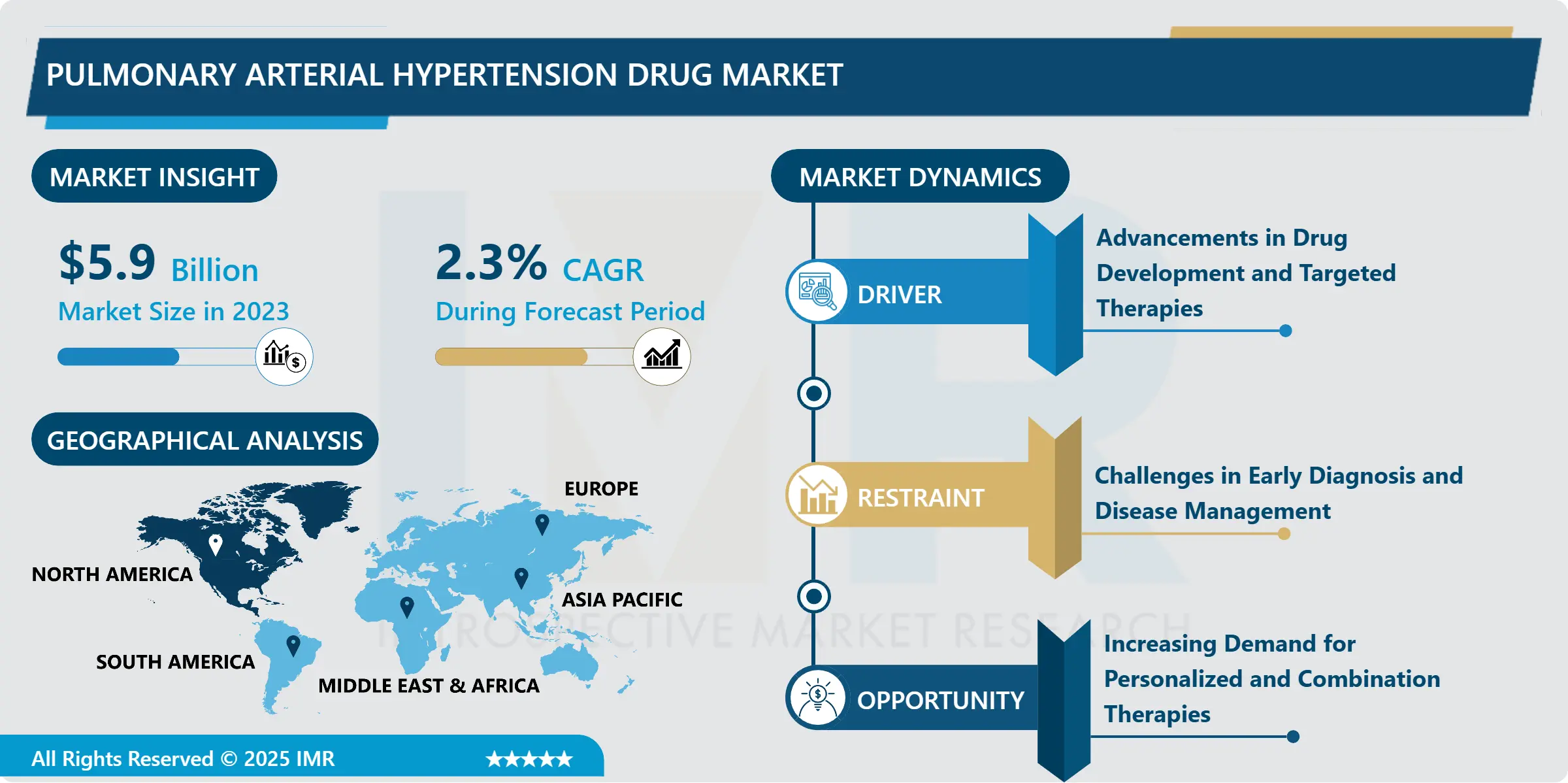
Pulmonary Arterial Hypertension Drug Market Size Was Valued at USD 5.90 Billion in 2023, and is Projected to Reach USD 7.23 Billion by 2032, Growing at a CAGR of 2.30% From 2024-2032. PAH is defined as high blood pressure in arterial circulation of the lungs and is a rare and chronic illnesses.

IMR Group
Description
Pulmonary Arterial Hypertension Drug Market Synopsis:
Pulmonary Arterial Hypertension Drug Market Size Was Valued at USD 5.90 Billion in 2023, and is Projected to Reach USD 7.23 Billion by 2032, Growing at a CAGR of 2.30% From 2024-2032.
PAH is defined as high blood pressure in arterial circulation of the lungs and is a rare and chronic illnesses. It is due to the constriction and hypertrophy of these arteries, raising its resistance, thereby placing extra work for circulation on the right side of the heart. Pharmacologic therapies for PAH act on disease pathophysiologic processes and result in prevention of vasoconstriction and vasodilation of the pulmonary vasculature, reduction of symptoms, and improved patient QOL.
The drivers of the Pulmonary Arterial Hypertension Drug Market include; rising incidence of PAH, raising awareness among doctors and development of selective agents. Increased incidence of idiopathic PAH and drug induced PAH has over the years created a high market for the drugs. Besides, better knowledge about the disease pathophysiology process and the emergence of newmeeting types of treatments are contributing to the growth of the market.
Other factors that are also stimulating the growth of the market extent include; advances in the use of technology in the formulation and production of drugs and improved health care services delivery. Exploration of new classes of drugs and combination therapies is a subject that holds hope for the sufficient treatment of PAH. Further, the rise in overall expenditure for the healthcare sector and improvement in the healthcare sector infrastructure, especially in the developed world catalyze market growth.
Pulmonary Arterial Hypertension Drug Market Trend Analysis:
Emerging Therapies
In the treatment of PAH, there are some emerging treatment tendencies, including the directions of the individual approach and combinatorial therapy. Impacts to practice: Newer technologies in biotechnology, and new classes of drug including soluble guanylate cyclase stimulators and prostacyclin receptor agonists are helping present and future patients to receive better treatment outcomes. Such a change in these therapies towards the smart and better ones is expected to foster the market in the near future.
Shift Toward Early Diagnosis: The second emerging trend is the enhanced concern of early detection of the disease. It could be as a result of enhanced diagnostic technology, and governmenet as well as professional body sponsored awareness creation to the public through various media platforms. Staging means to treat at an early stage and enables better prognosis and reduced health care cost.
Rising Awareness and Diagnostics
With awareness rates of PAH continually rising, there is a immense scope for industry growth. There are substantially high possibilities of disease progression but early diagnosis plays a powerful role in slowing down the progress of diseases and enhances the performance of patients. Pharma companies that are involved in diagnostics or that have a portfolio of early stage treatments or that are strong in what will be known as second wave therapies will indeed benefit from this source of growth.
Market in North America and Europe matures, however, emerging markets for Asia-Pacific, Latin America and Middle East exist. Bettering the healthcare infrastructure of these areas and the associated patient care will opens tremendous growth prospects for the manufacturers of PAH drug. Thus, the need for treatment of PAH diseases is expected to increase under assumption of growing investments in healthcare in these regions.
Pulmonary Arterial Hypertension Drug Market Segment Analysis:
Pulmonary Arterial Hypertension Drug Market is Segmented on the basis of Drug Type, Disease Type, End User, and Region.
By Drug Type, Prostacyclin Analogs segment is expected to dominate the market during the forecast period
The market is mainly divided into drug class which comprises Pulmonary Arterial Hypertension Drugs Prostacyclin Analogs, Endothelin Receptor Antagonists, Phosphodiesterase-5 Inhibitors, Soluble Guanylate Cyclase Stimulators, Prostacyclin Receptor Agonists, and Others. Prostacyclin Analogs, for example, epoprostenol is applied to PAH to make vessels broader to allow sufficient circulation of blood.
Endothelin Receptor Antagonists works in reducing the impacts of a substance called endothelin, which makes blood vessels constrict. Phosphodiesterase-5 Inhibitors are prescribed for arrogating pulmonary arteries and enhancing exercise tolerance. Soluble Guanylate Cyclase Stimulators are relatively recent drugs as they act by directly stimulating the enzyme which causes the blood vessels to dilate. PAH has similar mechanism of action to prostacyclin analogs, but has fewer side effects; thus, it can be used as an effective substitute. It also consists of other treatment types that make a part of the total drug market.
By Diseases, Idiopathic Pulmonary Arterial Hypertension segment expected to held the largest share
The Pulmonary Arterial Hypertension Drug Market is also segmented by its type: Idiopathic Pulmonary Arterial Hypertension (IPAH), Heritable Pulmonary Arterial Hypertension (HPAH), Drug-Induced Pulmonary Arterial Hypertension (DIPAH), and Others. IPAH is the most common type of PAH and there is no known cause of the disease, while HPAH is genetic.
DIPAH occur as a result of certain medications that can cause PAH as a side effect. There are other forms of PAH that are related to other conditions such as HIV or liver illnesses. These disease types in turn demand specific treatment approaches as a result influencing the dynamics of the drug market.
Pulmonary Arterial Hypertension Drug Market Regional Insights:
North America is Expected to Dominate the Market Over the Forecast period
North America accounted for the largest share of the Pulmonary Arterial Hypertension Drug Market due to the developed healthcare infrastructure, high level of awareness, extensive research & development activities. The region also boasts of the highest market share, and is followed by a rising trend in the number of diagnosed cases as well as the absorption capability of key players in the pharmaceutical sector. North America’s leadership can be explained by a growing focus on health care costs, government reimbursement, and the inherently strong market for new therapies.
North America continues to be the largest market for DRT, but Europe is closely behind and expanding its share rapidly as the European governments continue to invest in healthcare and as the advances in drug therapies become more prevalent. Nevertheless, there remains a significant lead for the market in North America in terms of total revenues, as a result of advanced healthcare infrastructures within each country and increased availability of new forms of treatment.
Active Key Players in the Pulmonary Arterial Hypertension Drug Market:
Actelion Pharmaceuticals Ltd. (Switzerland)
Bayer AG (Germany)
Boehringer Ingelheim International GmbH (Germany)
Eli Lilly and Company (USA)
Gilead Sciences, Inc. (USA)
GlaxoSmithKline plc (UK)
Novartis International AG (Switzerland)
Pfizer Inc. (USA)
Teva Pharmaceutical Industries Ltd. (Israel)
United Therapeutics Corporation (USA), and Other Active Players
Chapter 1: Introduction
1.1 Scope and Coverage
Chapter 2:Executive Summary
Chapter 3: Market Landscape
3.1 Market Dynamics
3.1.1 Drivers
3.1.2 Restraints
3.1.3 Opportunities
3.1.4 Challenges
3.2 Market Trend Analysis
3.3 PESTLE Analysis
3.4 Porter’s Five Forces Analysis
3.5 Industry Value Chain Analysis
3.6 Ecosystem
3.7 Regulatory Landscape
3.8 Price Trend Analysis
3.9 Patent Analysis
3.10 Technology Evolution
3.11 Investment Pockets
3.12 Import-Export Analysis
Chapter 4: Pulmonary Arterial Hypertension Drug Market by Type
4.1 Pulmonary Arterial Hypertension Drug Market Snapshot and Growth Engine
4.2 Pulmonary Arterial Hypertension Drug Market Overview
4.3 Bronchodilators
4.3.1 Introduction and Market Overview
4.3.2 Historic and Forecasted Market Size in Value USD and Volume Units (2017-2032F)
4.3.3 Key Market Trends, Growth Factors and Opportunities
4.3.4 Bronchodilators: Geographic Segmentation Analysis
4.4 Anti-inflammatory Drugs
4.4.1 Introduction and Market Overview
4.4.2 Historic and Forecasted Market Size in Value USD and Volume Units (2017-2032F)
4.4.3 Key Market Trends, Growth Factors and Opportunities
4.4.4 Anti-inflammatory Drugs: Geographic Segmentation Analysis
4.5 Mucolytics
4.5.1 Introduction and Market Overview
4.5.2 Historic and Forecasted Market Size in Value USD and Volume Units (2017-2032F)
4.5.3 Key Market Trends, Growth Factors and Opportunities
4.5.4 Mucolytics: Geographic Segmentation Analysis
4.6 Others
4.6.1 Introduction and Market Overview
4.6.2 Historic and Forecasted Market Size in Value USD and Volume Units (2017-2032F)
4.6.3 Key Market Trends, Growth Factors and Opportunities
4.6.4 Others: Geographic Segmentation Analysis
Chapter 5: Pulmonary Arterial Hypertension Drug Market by Application
5.1 Pulmonary Arterial Hypertension Drug Market Snapshot and Growth Engine
5.2 Pulmonary Arterial Hypertension Drug Market Overview
5.3 Asthma
5.3.1 Introduction and Market Overview
5.3.2 Historic and Forecasted Market Size in Value USD and Volume Units (2017-2032F)
5.3.3 Key Market Trends, Growth Factors and Opportunities
5.3.4 Asthma: Geographic Segmentation Analysis
5.4 Chronic Obstructive Pulmonary
5.4.1 Introduction and Market Overview
5.4.2 Historic and Forecasted Market Size in Value USD and Volume Units (2017-2032F)
5.4.3 Key Market Trends, Growth Factors and Opportunities
5.4.4 Chronic Obstructive Pulmonary: Geographic Segmentation Analysis
Chapter 6: Company Profiles and Competitive Analysis
6.1 Competitive Landscape
6.1.1 Competitive Benchmarking
6.1.2 Pulmonary Arterial Hypertension Drug Market Share by Manufacturer (2023)
6.1.3 Industry BCG Matrix
6.1.4 Heat Map Analysis
6.1.5 Mergers and Acquisitions
6.2 UNITED THERAPEUTICS CORPORATION (USA)
6.2.1 Company Overview
6.2.2 Key Executives
6.2.3 Company Snapshot
6.2.4 Role of the Company in the Market
6.2.5 Sustainability and Social Responsibility
6.2.6 Operating Business Segments
6.2.7 Product Portfolio
6.2.8 Business Performance
6.2.9 Key Strategic Moves and Recent Developments
6.2.10 SWOT Analysis
6.3 PFIZER INC. (USA)
6.4 BAYER AG (GERMANY)
6.5 GILEAD SCIENCES INC. (USA)
6.6 BOEHRINGER INGELHEIM INTERNATIONAL GMBH (GERMANY)
6.7 GLAXOSMITHKLINE PLC (UK)
6.8 NOVARTIS INTERNATIONAL AG (SWITZERLAND)
6.9 ELI LILLY AND COMPANY (USA)
6.10 ACTELION PHARMACEUTICALS LTD. (SWITZERLAND)
6.11 TEVA PHARMACEUTICAL INDUSTRIES LTD. (ISRAEL)
6.12 OTHER ACTIVE PLAYERS
Chapter 7: Global Pulmonary Arterial Hypertension Drug Market By Region
7.1 Overview
7.2. North America Pulmonary Arterial Hypertension Drug Market
7.2.1 Key Market Trends, Growth Factors and Opportunities
7.2.2 Top Key Companies
7.2.3 Historic and Forecasted Market Size by Segments
7.2.4 Historic and Forecasted Market Size By Type
7.2.4.1 Bronchodilators
7.2.4.2 Anti-inflammatory Drugs
7.2.4.3 Mucolytics
7.2.4.4 Others
7.2.5 Historic and Forecasted Market Size By Application
7.2.5.1 Asthma
7.2.5.2 Chronic Obstructive Pulmonary
7.2.6 Historic and Forecast Market Size by Country
7.2.6.1 US
7.2.6.2 Canada
7.2.6.3 Mexico
7.3. Eastern Europe Pulmonary Arterial Hypertension Drug Market
7.3.1 Key Market Trends, Growth Factors and Opportunities
7.3.2 Top Key Companies
7.3.3 Historic and Forecasted Market Size by Segments
7.3.4 Historic and Forecasted Market Size By Type
7.3.4.1 Bronchodilators
7.3.4.2 Anti-inflammatory Drugs
7.3.4.3 Mucolytics
7.3.4.4 Others
7.3.5 Historic and Forecasted Market Size By Application
7.3.5.1 Asthma
7.3.5.2 Chronic Obstructive Pulmonary
7.3.6 Historic and Forecast Market Size by Country
7.3.6.1 Russia
7.3.6.2 Bulgaria
7.3.6.3 The Czech Republic
7.3.6.4 Hungary
7.3.6.5 Poland
7.3.6.6 Romania
7.3.6.7 Rest of Eastern Europe
7.4. Western Europe Pulmonary Arterial Hypertension Drug Market
7.4.1 Key Market Trends, Growth Factors and Opportunities
7.4.2 Top Key Companies
7.4.3 Historic and Forecasted Market Size by Segments
7.4.4 Historic and Forecasted Market Size By Type
7.4.4.1 Bronchodilators
7.4.4.2 Anti-inflammatory Drugs
7.4.4.3 Mucolytics
7.4.4.4 Others
7.4.5 Historic and Forecasted Market Size By Application
7.4.5.1 Asthma
7.4.5.2 Chronic Obstructive Pulmonary
7.4.6 Historic and Forecast Market Size by Country
7.4.6.1 Germany
7.4.6.2 UK
7.4.6.3 France
7.4.6.4 The Netherlands
7.4.6.5 Italy
7.4.6.6 Spain
7.4.6.7 Rest of Western Europe
7.5. Asia Pacific Pulmonary Arterial Hypertension Drug Market
7.5.1 Key Market Trends, Growth Factors and Opportunities
7.5.2 Top Key Companies
7.5.3 Historic and Forecasted Market Size by Segments
7.5.4 Historic and Forecasted Market Size By Type
7.5.4.1 Bronchodilators
7.5.4.2 Anti-inflammatory Drugs
7.5.4.3 Mucolytics
7.5.4.4 Others
7.5.5 Historic and Forecasted Market Size By Application
7.5.5.1 Asthma
7.5.5.2 Chronic Obstructive Pulmonary
7.5.6 Historic and Forecast Market Size by Country
7.5.6.1 China
7.5.6.2 India
7.5.6.3 Japan
7.5.6.4 South Korea
7.5.6.5 Malaysia
7.5.6.6 Thailand
7.5.6.7 Vietnam
7.5.6.8 The Philippines
7.5.6.9 Australia
7.5.6.10 New Zealand
7.5.6.11 Rest of APAC
7.6. Middle East & Africa Pulmonary Arterial Hypertension Drug Market
7.6.1 Key Market Trends, Growth Factors and Opportunities
7.6.2 Top Key Companies
7.6.3 Historic and Forecasted Market Size by Segments
7.6.4 Historic and Forecasted Market Size By Type
7.6.4.1 Bronchodilators
7.6.4.2 Anti-inflammatory Drugs
7.6.4.3 Mucolytics
7.6.4.4 Others
7.6.5 Historic and Forecasted Market Size By Application
7.6.5.1 Asthma
7.6.5.2 Chronic Obstructive Pulmonary
7.6.6 Historic and Forecast Market Size by Country
7.6.6.1 Turkiye
7.6.6.2 Bahrain
7.6.6.3 Kuwait
7.6.6.4 Saudi Arabia
7.6.6.5 Qatar
7.6.6.6 UAE
7.6.6.7 Israel
7.6.6.8 South Africa
7.7. South America Pulmonary Arterial Hypertension Drug Market
7.7.1 Key Market Trends, Growth Factors and Opportunities
7.7.2 Top Key Companies
7.7.3 Historic and Forecasted Market Size by Segments
7.7.4 Historic and Forecasted Market Size By Type
7.7.4.1 Bronchodilators
7.7.4.2 Anti-inflammatory Drugs
7.7.4.3 Mucolytics
7.7.4.4 Others
7.7.5 Historic and Forecasted Market Size By Application
7.7.5.1 Asthma
7.7.5.2 Chronic Obstructive Pulmonary
7.7.6 Historic and Forecast Market Size by Country
7.7.6.1 Brazil
7.7.6.2 Argentina
7.7.6.3 Rest of SA
Chapter 8 Analyst Viewpoint and Conclusion
8.1 Recommendations and Concluding Analysis
8.2 Potential Market Strategies
Chapter 9 Research Methodology
9.1 Research Process
9.2 Primary Research
9.3 Secondary Research
Q1: What would be the forecast period in the Pulmonary Arterial Hypertension Drug Market research report?
A1: The forecast period in the Pulmonary Arterial Hypertension Drug Market research report is 2024-2032.
Q2: Who are the key players in the Pulmonary Arterial Hypertension Drug Market?
A2: United Therapeutics Corporation (USA), Pfizer Inc. (USA), Bayer AG (Germany), Gilead Sciences, Inc. (USA), Boehringer Ingelheim International GmbH (Germany), GlaxoSmithKline plc (UK), Novartis International AG (Switzerland), Eli Lilly and Company (USA), Actelion Pharmaceuticals Ltd. (Switzerland), Teva Pharmaceutical Industries Ltd. (Israel), and Other Active Players.
Q3: What are the segments of the Pulmonary Arterial Hypertension Drug Market?
A3: Pulmonary Arterial Hypertension Drug Market is Segmented on the basis of Drug Type, Disease Type, End User, and Region. By Drug Type, the market is categorized into Prostacyclin Analogs, Endothelin Receptor Antagonists, Phosphodiesterase-5 Inhibitors, Soluble Guanylate Cyclase Stimulators, Prostacyclin Receptor Agonists, Others. By Disease Type, the market is categorized into Idiopathic Pulmonary Arterial Hypertension, Heritable Pulmonary Arterial Hypertension, Drug-Induced Pulmonary Arterial Hypertension, Other Type. By, End User, the market is categorized into Hospitals, Homecare, Clinics. By region, it is analyzed across North America (U.S., Canada, Mexico), Eastern Europe (Russia, Bulgaria, The Czech Republic, Hungary, Poland, Romania, Rest of Eastern Europe), Western Europe (Germany, UK, France, Netherlands, Italy, Spain, Rest of Western Europe), Asia Pacific (China, India, Japan, South Korea, Malaysia, Thailand, Vietnam, The Philippines, Australia, New Zealand, Rest of APAC), Middle East & Africa (Turkiye, Bahrain, Kuwait, Saudi Arabia, Qatar, UAE, Israel, South Africa), South America (Brazil, Argentina, Rest of SA).
Q4: What is the Pulmonary Arterial Hypertension Drug Market?
A4: PAH is defined as high blood pressure in arterial circulation of the lungs and is a rare and chronic illnesses. It is due to the constriction and hypertrophy of these arteries, raising its resistance, thereby placing extra work for circulation on the right side of the heart. Pharmacologic therapies for PAH act on disease pathophysiologic processes and result in prevention of vasoconstriction and vasodilation of the pulmonary vasculature, reduction of symptoms, and improved patient QOL.
Q5: How big is the Pulmonary Arterial Hypertension Drug Market?
A5: Pulmonary Arterial Hypertension Drug Market Size Was Valued at USD 5.90 Billion in 2023, and is Projected to Reach USD 7.23 Billion by 2032, Growing at a CAGR of 2.30% From 2024-2032.
How to Buy a Report from eminsights.jp
On the product page, choose the license you want: Single-User License, Multi-User License or Enterprise License.
If you required report in your native language, then you can click on Translated Report button and fill out the form with report name and language you want, then our team will contact you as soon as possible.
Click the Buy Now button.
You will be redirected to the checkout page. Enter your company details and payment information.
Click Place Order to complete the purchase.
Confirmation: You’ll receive an order confirmation and our team will contact you shortly with your ordered report.
If you have any questions, fill out the contact form below or email us at bizdev@eminsights.net.
Thank you for choosing eminsights.jp!