Stay Ahead in Fast-Growing Economies.
Browse Reports Now
Post-Harvest Treatment Market – Global Demand & Analysis
The global market for Post-Harvest Treatment, which was anticipated at USD 1.6 billion in 2021, is expected to reach USD 2.2 billion by 2027, rising at a CAGR of 5.3 % between 2022 and 2027. Post-harvest is a process that integrates the utilization of many unit processes that occur following harvesting. Post-harvest treatment for fresh fruit, vegetables, and root crops is performed to keep the product clean, reduce moisture loss, and limit the rate of undesired chemical changes.It also helps to prevent spoilage by avoiding physical damage such as bruising.

IMR Group
Description
Post-Harvest Treatment Market Overview
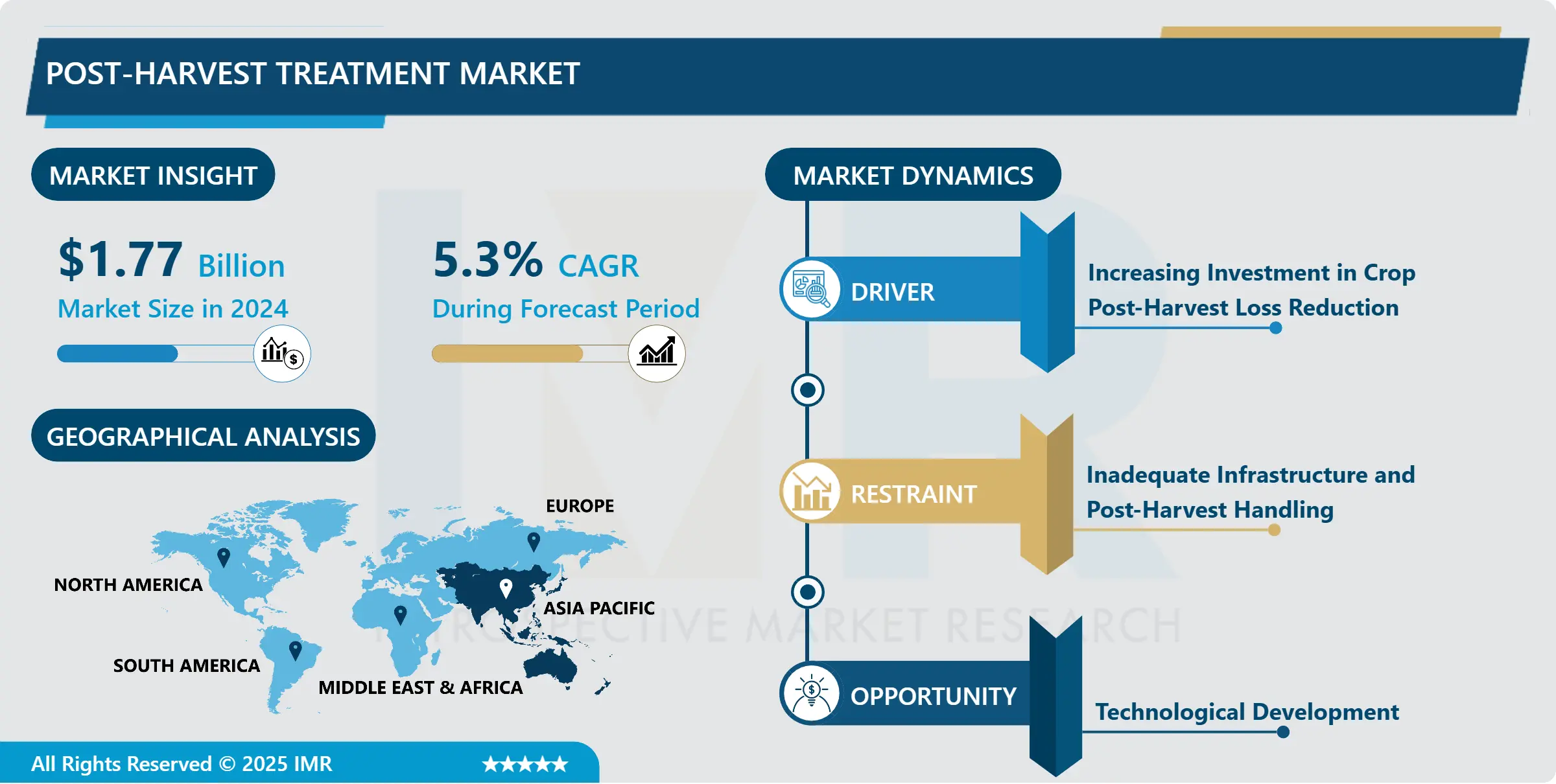
The Global Post-Harvest Treatment Market was valued at USD 1.77 billion in 2024 and is expected to reach USD 2.68 billion by the year 2030, growing at a CAGR of 5.3%.
Post-harvest is a process that integrates the utilization of many unit processes that occur following harvesting. Post-harvest treatment for fresh fruit, vegetables, and root crops is performed to keep the product clean, reduce moisture loss, and limit the rate of undesired chemical changes. It also helps to prevent spoilage by avoiding physical damage such as bruising. It heavily influences the final quality of a crop, whether it is consumed fresh or utilized as an ingredient in a processed food product. Because fruits and vegetables are perishable, the post-harvest treatment goods market for fruits and vegetables is utilized to extend their shelf life. This treatment not only extends the shelf life of fruits and vegetables, but also protects them from infections, poor storage conditions, and pests during local and foreign travel.
Mismanagement during the post-harvest season can be disastrous. Post-harvest losses are widespread, with over one-third of the world’s food going to waste or loss. According to the World Hunger Organization, food insecurity afflicted over 333 million people in Sub-Saharan Africa alone in 2016. At the same time, the post-harvest loss has a significant impact on farmer income. Furthermore, the growing trend of consumers toward the consumption of bio-based organic products raises the demand for the global market for post-harvest treatment solutions for fruits and vegetables. Its use is growing to reduce post-harvest losses, which account for approximately one-third of the total yield.
Market Dynamics and Factors for the Post-Harvest Treatment Market:
Post-Harvest Treatment Market Growth Drivers- Increasing Investment in Crop Post-Harvest Loss Reduction
Many factors influence post-harvest losses of fruits and vegetables in general. Physical, physiological, mechanical, and sanitary losses are among these variables. Fruits and vegetables are distinguished by high levels of metabolic activity and short shelf life. As a result of these variables, a significant percentage of the food is lost between harvesting and consumption. As a result, by carefully manipulating these parameters, post-harvest loss of fruits and vegetables can be significantly decreased and shelf life enhanced. By employing crucial cultural approaches, as well as proper handling and packaging, the loss can be reduced.
By safeguarding fresh food against viruses and other environmental conditions before and after harvest, the application of proper chemicals can extend the availability of fresh produce for a long time. Fruits and vegetables have also been found to benefit from controlled environment storage and regularization at low temperatures. As a result, the post-harvest treatment market is expected to develop over the forecast period.
Post-Harvest Treatment Market Limiting Factors- Inadequate Infrastructure and Post-Harvest Handling
Post-harvest handling encompasses everything from the mechanization of harvesting, handling, and processing to weather adaptation, production techniques, management decisions, transportation facilities, grading concerns, infrastructure, customer preferences/attitudes, and financial market availability. Because of inappropriate crop handling, losses occur at each of these steps of post-harvest processing. Losses occur at steps such as drying, storage, and chemical application in less-developed and emerging countries where the supply chain is not fully mechanized.
In developing nations, poor infrastructure for storage, processing, and marketing has contributed to significant levels of waste, causing restrictions in both the internal and international distribution of fruits and vegetables.
Post-Harvest Treatment Market Opportunities- Technological Development
Better cooperation and some rethinking of existing distribution networks as well as the aims of vendors, buyers, and marketers will be required to improve the delivery of high-quality, nutritious fruits and vegetables to customers. Technology can make everything possible, but the attitude of the fruit and vegetable trade players to take advantage of the changes will determine the outcome.
Post-harvest treatment manufacturers in other developing nations, such as Israel, have adopted novel technology such as chemical-free fumigation techniques for potatoes and packaging solutions for fruits and vegetables. The use of technology for post-harvest treatment of fruits and vegetables is a growing trend that presents a significant opportunity for the overall growth of the market of the product.
Market Segmentation
By type, the coating segment is expected to dominate the post-harvest treatment market over the forecast period. Coatings are most commonly used on fresh fruits to extend their postharvest life by limiting the exchange of water and gases (oxygen and carbon dioxide). This principle function allows for less weight loss during storage and, in some situations, relief of postharvest physiological issues such as chilling injury or rind collapse. Furthermore, coatings can give sheen and gloss to the fruit’s exterior appearance. Developing regions such as South America and the Asia Pacific will contribute significantly to the growth of the market for post-harvest treatment of fruits and vegetables, as these regions are large producers of fruits and vegetables, and thus these post-harvest methods and mechanisms are required to maintain the quality and shelf life of fresh produce and reduce losses.
By crop type, the fruit segment is anticipated to register a significant post-harvest treatment market share over the forecast period. Fruits and vegetables are in high demand due to the increased desire for nutritious foods. Because fruits are highly perishable, the application of post-harvest treatments helps to delay ripening, enhance shelf life, and retain the appearance and freshness of the fruit. The increased demand for organic fruits and vegetables opens up the potential for organic post-harvest products, which are likely to contribute significantly to market growth.
Players Covered in Post-Harvest Treatment market are :
AgroFresh Inc.
BASF
Bayer AG
Clariant
Decco Inc.
Citrosol
Janssen PMP (Belgium)
Futureco Bioscience
Apeel Sciences
Polynatural
Sufresca
Ceradis
Agricoat natureseal LTD.
DIC Corporation
DuPont de Nemours Inc.
FMC Corporation
FomesaFruitech
Heubach
BT Corporation
Jaysynth Dyestuff
Kolor Jet Chemical
Nufarm
Pace International; Syngenta AG
Trust Chem
Post-Harvest Solution LTD
Xeda International
Colin Campbell PTY LTD and other major players.
Regional Analysis for the Post-Harvest Treatment Market:
Asia Pacific region is anticipated to dominate the post-harvest treatment market over the forecast period. According to the FCI, every day in India, crops worth USD 19.4 million are thrown away owing to farm rejection and distribution delays. Poor infrastructure, low technical knowledge of appropriate agricultural techniques, imperfect market knowledge, and lack of access to markets are all contributing to India’s losses. As a result, many businesses concentrate on organic growth tactics including product releases, approval, and others like patents and events. Acquisitions, partnerships, and collaborations were the inorganic growth strategy activities found in the market. In Australia and New Zealand, ethyl formate is currently compounded with CO2 for commercial use. Crop management, harvest indices, optimal maturity, integrated pest and disease management, and other innovative and inventive growing systems have been devised to enhance the yield of attractive, tasty, and nutritious fruit and vegetables. Fruits and vegetables such as potatoes, apples, tomatoes, mangoes, grapes, and cucumbers are produced and exported in large quantities by China and India. Demand for post-harvest treatment solutions is predicted to rise due to the high export and consumption rates of these fruits and vegetables.
Key Industry Developments in the Post-Harvest Treatment Market:
In September 2021, Pace International LLC has launched PrimaFresh 60 OR, it is created specifically to improve dehydration control in stone fruit and enhance its fresh appeal.
In 2021, AgroFresh Solutions, Inc., a global pioneer in fruit freshness solutions, has announced the debut of a new post-harvest quality platform to reduce food waste and preserve the freshness of fruits and vegetables.
In March 2021, Lipofabrik SAS, which specializes in the manufacture, purification, formulation, and marketing of lipopeptides, has signed an agreement with Janssen PMP. Janssen PMP will create post-harvest-specific and fit-for-purpose lipopeptides formulations, including Mycosubtilin.
Chapter 1: Introduction
1.1 Scope and Coverage
Chapter 2:Executive Summary
Chapter 3: Market Landscape
3.1 Market Dynamics
3.1.1 Drivers
3.1.2 Restraints
3.1.3 Opportunities
3.1.4 Challenges
3.2 Market Trend Analysis
3.3 PESTLE Analysis
3.4 Porter’s Five Forces Analysis
3.5 Industry Value Chain Analysis
3.6 Ecosystem
3.7 Regulatory Landscape
3.8 Price Trend Analysis
3.9 Patent Analysis
3.10 Technology Evolution
3.11 Investment Pockets
3.12 Import-Export Analysis
Chapter 4: Post-Harvest Treatment Market by Type (2018-2032)
4.1 Post-Harvest Treatment Market Snapshot and Growth Engine
4.2 Market Overview
4.3 Coatings
4.3.1 Introduction and Market Overview
4.3.2 Historic and Forecasted Market Size in Value USD and Volume Units
4.3.3 Key Market Trends, Growth Factors, and Opportunities
4.3.4 Geographic Segmentation Analysis
4.4 Ethylene Blockers
4.5 Fungicides
4.6 Cleaners
4.7 Others
Chapter 5: Post-Harvest Treatment Market by Crop Type (2018-2032)
5.1 Post-Harvest Treatment Market Snapshot and Growth Engine
5.2 Market Overview
5.3 Fruits
5.3.1 Introduction and Market Overview
5.3.2 Historic and Forecasted Market Size in Value USD and Volume Units
5.3.3 Key Market Trends, Growth Factors, and Opportunities
5.3.4 Geographic Segmentation Analysis
5.4 Vegetables
Chapter 6: Company Profiles and Competitive Analysis
6.1 Competitive Landscape
6.1.1 Competitive Benchmarking
6.1.2 Post-Harvest Treatment Market Share by Manufacturer (2024)
6.1.3 Industry BCG Matrix
6.1.4 Heat Map Analysis
6.1.5 Mergers and Acquisitions
6.2 ALLSCRIPTS HEALTHCARE LLC. (U.S.)
6.2.1 Company Overview
6.2.2 Key Executives
6.2.3 Company Snapshot
6.2.4 Role of the Company in the Market
6.2.5 Sustainability and Social Responsibility
6.2.6 Operating Business Segments
6.2.7 Product Portfolio
6.2.8 Business Performance
6.2.9 Key Strategic Moves and Recent Developments
6.2.10 SWOT Analysis
6.3 CERNER CORPORATION (U.S.)
6.4 KONINKLIJKE PHILIPS N. V (NETHERLANDS)
6.5 MCKESSON CORPORATION (U.S.)
6.6 APPLE INC. (U.S.)
6.7 OMRON CORPORATION (JAPAN)
6.8 GENERAL ELECTRIC COMPANY (U.S.)
6.9 FITBIT INC. (U.S.)
6.10 IBM CORPORATION (U.S.)
6.11 NXGN MANAGEMENT LLC
Chapter 7: Global Post-Harvest Treatment Market By Region
7.1 Overview
7.2. North America Post-Harvest Treatment Market
7.2.1 Key Market Trends, Growth Factors and Opportunities
7.2.2 Top Key Companies
7.2.3 Historic and Forecasted Market Size by Segments
7.2.4 Historic and Forecasted Market Size by Type
7.2.4.1 Coatings
7.2.4.2 Ethylene Blockers
7.2.4.3 Fungicides
7.2.4.4 Cleaners
7.2.4.5 Others
7.2.5 Historic and Forecasted Market Size by Crop Type
7.2.5.1 Fruits
7.2.5.2 Vegetables
7.2.6 Historic and Forecast Market Size by Country
7.2.6.1 US
7.2.6.2 Canada
7.2.6.3 Mexico
7.3. Eastern Europe Post-Harvest Treatment Market
7.3.1 Key Market Trends, Growth Factors and Opportunities
7.3.2 Top Key Companies
7.3.3 Historic and Forecasted Market Size by Segments
7.3.4 Historic and Forecasted Market Size by Type
7.3.4.1 Coatings
7.3.4.2 Ethylene Blockers
7.3.4.3 Fungicides
7.3.4.4 Cleaners
7.3.4.5 Others
7.3.5 Historic and Forecasted Market Size by Crop Type
7.3.5.1 Fruits
7.3.5.2 Vegetables
7.3.6 Historic and Forecast Market Size by Country
7.3.6.1 Russia
7.3.6.2 Bulgaria
7.3.6.3 The Czech Republic
7.3.6.4 Hungary
7.3.6.5 Poland
7.3.6.6 Romania
7.3.6.7 Rest of Eastern Europe
7.4. Western Europe Post-Harvest Treatment Market
7.4.1 Key Market Trends, Growth Factors and Opportunities
7.4.2 Top Key Companies
7.4.3 Historic and Forecasted Market Size by Segments
7.4.4 Historic and Forecasted Market Size by Type
7.4.4.1 Coatings
7.4.4.2 Ethylene Blockers
7.4.4.3 Fungicides
7.4.4.4 Cleaners
7.4.4.5 Others
7.4.5 Historic and Forecasted Market Size by Crop Type
7.4.5.1 Fruits
7.4.5.2 Vegetables
7.4.6 Historic and Forecast Market Size by Country
7.4.6.1 Germany
7.4.6.2 UK
7.4.6.3 France
7.4.6.4 The Netherlands
7.4.6.5 Italy
7.4.6.6 Spain
7.4.6.7 Rest of Western Europe
7.5. Asia Pacific Post-Harvest Treatment Market
7.5.1 Key Market Trends, Growth Factors and Opportunities
7.5.2 Top Key Companies
7.5.3 Historic and Forecasted Market Size by Segments
7.5.4 Historic and Forecasted Market Size by Type
7.5.4.1 Coatings
7.5.4.2 Ethylene Blockers
7.5.4.3 Fungicides
7.5.4.4 Cleaners
7.5.4.5 Others
7.5.5 Historic and Forecasted Market Size by Crop Type
7.5.5.1 Fruits
7.5.5.2 Vegetables
7.5.6 Historic and Forecast Market Size by Country
7.5.6.1 China
7.5.6.2 India
7.5.6.3 Japan
7.5.6.4 South Korea
7.5.6.5 Malaysia
7.5.6.6 Thailand
7.5.6.7 Vietnam
7.5.6.8 The Philippines
7.5.6.9 Australia
7.5.6.10 New Zealand
7.5.6.11 Rest of APAC
7.6. Middle East & Africa Post-Harvest Treatment Market
7.6.1 Key Market Trends, Growth Factors and Opportunities
7.6.2 Top Key Companies
7.6.3 Historic and Forecasted Market Size by Segments
7.6.4 Historic and Forecasted Market Size by Type
7.6.4.1 Coatings
7.6.4.2 Ethylene Blockers
7.6.4.3 Fungicides
7.6.4.4 Cleaners
7.6.4.5 Others
7.6.5 Historic and Forecasted Market Size by Crop Type
7.6.5.1 Fruits
7.6.5.2 Vegetables
7.6.6 Historic and Forecast Market Size by Country
7.6.6.1 Turkiye
7.6.6.2 Bahrain
7.6.6.3 Kuwait
7.6.6.4 Saudi Arabia
7.6.6.5 Qatar
7.6.6.6 UAE
7.6.6.7 Israel
7.6.6.8 South Africa
7.7. South America Post-Harvest Treatment Market
7.7.1 Key Market Trends, Growth Factors and Opportunities
7.7.2 Top Key Companies
7.7.3 Historic and Forecasted Market Size by Segments
7.7.4 Historic and Forecasted Market Size by Type
7.7.4.1 Coatings
7.7.4.2 Ethylene Blockers
7.7.4.3 Fungicides
7.7.4.4 Cleaners
7.7.4.5 Others
7.7.5 Historic and Forecasted Market Size by Crop Type
7.7.5.1 Fruits
7.7.5.2 Vegetables
7.7.6 Historic and Forecast Market Size by Country
7.7.6.1 Brazil
7.7.6.2 Argentina
7.7.6.3 Rest of SA
Chapter 8 Analyst Viewpoint and Conclusion
8.1 Recommendations and Concluding Analysis
8.2 Potential Market Strategies
Chapter 9 Research Methodology
9.1 Research Process
9.2 Primary Research
9.3 Secondary Research
Q1: What would be the forecast period in the Post-Harvest Treatment Market research report?
A1: The forecast period in the Post-Harvest Treatment Market research report is 2025-2032
Q2: Who are the key players in Post-Harvest Treatment Market?
A2: AgroFresh Inc. BASF Bayer AG Clariant Decco Inc. Citrosol Janssen PMP (Belgium) Futureco Bioscience Apeel Sciences Polynatural Sufresca Ceradis Agricoat natureseal LTD. DIC Corporation DuPont de Nemours Inc. FMC Corporation FomesaFruitech Heubach BT Corporation Jaysynth Dyestuff Kolor Jet Chemical Nufarm Pace International; Syngenta AG Trust Chem Post-Harvest Solution LTD Xeda International Colin Campbell PTY LTD and other active players.
Q3: What are the segments of Post-Harvest Treatment market?
A3: Post-Harvest Treatment Market by Type (Coatings, Ethylene Blockers, Fungicides, Cleaners, Other), Crop Type (Fruits, Vegetables), and Region • North America (U.S., Canada, Mexico) • Eastern Europe (Russia, Bulgaria, The Czech Republic, Hungary, Poland, Romania, Rest of Eastern Europe) • Western Europe (Germany, UK, France, The Netherlands, Italy, Spain, Rest of Western Europe) • Asia Pacific (China, India, Japan, South Korea, Malaysia, Thailand, Vietnam, The Philippines, Australia, New Zealand, Rest of APAC) • Middle East & Africa (Türkiye, Bahrain, Kuwait, Saudi Arabia, Qatar, UAE, Israel, South Africa) • South America (Brazil, Argentina, Rest of SA)
Q4: What is the Post-Harvest Treatment Market?
A4: Post-harvest is a process that integrates the utilization of many unit processes that occur following harvesting. Post-harvest treatment for fresh fruit, vegetables, and root crops is performed to keep the product clean, reduce moisture loss, and limit the rate of undesired chemical changes. It also helps to prevent spoilage by avoiding physical damage such as bruising. It heavily influences the final quality of a crop, whether it is consumed fresh or utilized as an ingredient in a processed food product.
Q5: How big is the Post-Harvest Treatment Market?
A5: The Global Post-Harvest Treatment Market was valued at USD 1.77 billion in 2024 and is expected to reach USD 2.68 billion by the year 2030, growing at a CAGR of 5.3%.
How to Buy a Report from eminsights.jp
On the product page, choose the license you want: Single-User License, Multi-User License or Enterprise License.
If you required report in your native language, then you can click on Translated Report button and fill out the form with report name and language you want, then our team will contact you as soon as possible.
Click the Buy Now button.
You will be redirected to the checkout page. Enter your company details and payment information.
Click Place Order to complete the purchase.
Confirmation: You’ll receive an order confirmation and our team will contact you shortly with your ordered report.
If you have any questions, fill out the contact form below or email us at bizdev@eminsights.net.
Thank you for choosing eminsights.jp!