Stay Ahead in Fast-Growing Economies.
Browse Reports Now
Portering Chair Market – Overview and Outlook by Potential Growth (2024-2032)
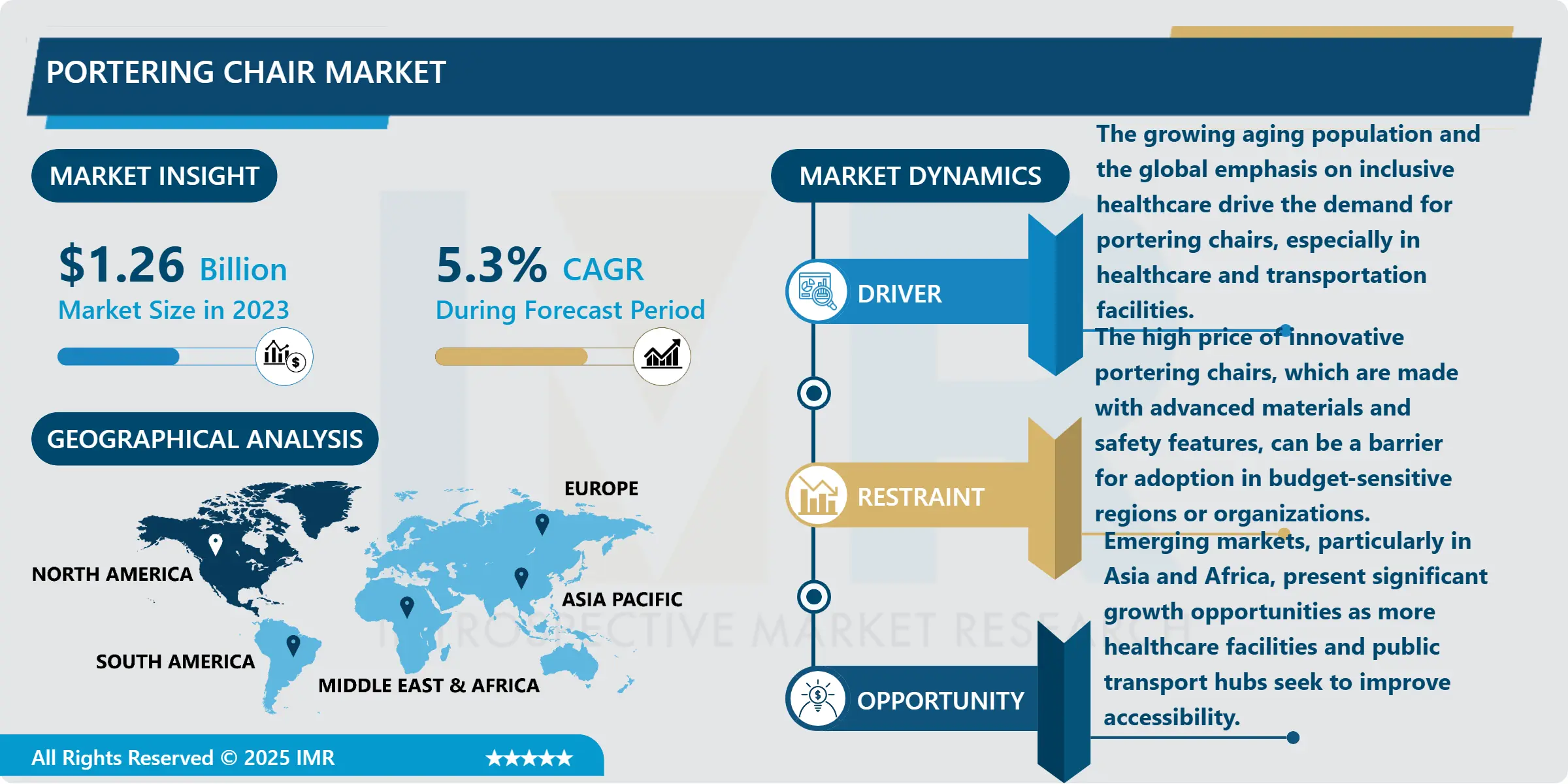
Portering Chair Market Size Was Valued at USD 1.26 Billion in 2023, and is Projected to Reach USD 2.01 Billion by 2032, Growing at a CAGR of 5.30% From 2024-2032.

IMR Group
Description
Portering Chair Market Synopsis:
Portering Chair Market Size Was Valued at USD 1.26 Billion in 2023, and is Projected to Reach USD 2.01 Billion by 2032, Growing at a CAGR of 5.30% From 2024-2032.
A portering chair is a therapeutic chair created particularly to move disabled people- patients from one place to another – usually a hospital, airport, and the likes. The chairs contain aspects such as easy mobility, foldable types and most of them are made of medical grade parts to enhance safety and comfort of the users. The portable chairs are important equipment in helping the patient or passenger who needs help in mobility, especially in crowded places including; airports, train stations or any health facility.
The portering chair market is expected to experience a gradual increase in the future demand for such mobility aids in different areas. Some of the drivers for this growth are; Increase in the geriatric population across the world, Enhanced health care spending and more focus on providing solutions to people with physical disability or occasional mobility impairment. These chairs are important in any health facility, especially hospitals whereby patients require to be transferred within the compound for treatment, tests or for other reasons. Correspondingly, terminals of airports and railway stations by now incorporate portering chairs to facilitate passengers with disabilities when moving within terminals.
Another factor that has helped boost the market is the increasing requirement for enhanced ergonomic and easy operability portering chairs. Further, there have Waisight technological improvements in material science which make the equipment lighter, stronger, and more ergonomic for use. For instance, flexibility, comfort through cushioning, and operation of the wheels are part and parcel of newer models. Further, portable and folding chair configurations facilitate the handling of the chair to be done by the care givers and the transport staffs. The portering chair market is also entering the stream of the automation and digitalization of the healthcare industry, which increases the effectiveness of patient transport.
Portering Chair Market Trend Analysis:
Increasing Demand for Lightweight and Foldable Portering Chairs
Some many course has shifted in the market of portering chair, and that is the portability course and folding chairs are among the most sought after due to their convenience when it comes to carrying and store them. Some of the most popular buildings that people use daily such as hospitals, airports among others are now embracing design that will allow mobility while at the same time reducing on comfort or safety. Lightweight models are especially useful in environments that often have to be shifted or moved from one place to the other, or possibly used in small areas since they are easy to move and stow away when not needed. This trend is in harmony with such strategic objectives as the provision of convenient transport services in order to minimize transactions costs.
Aside from portability, there is the shift towards making communication devices fitter to be used by the user and the carer. With passengers’ comfort and healthcare and transportation workers’ point of view on portering chair usage in mind, manufacturers are working on developing lightweight and easily foldable chairs to meet all requirements of both patients, drivers, nurses, and other people who must spend time inside vehicles. The other reason is that the importance of sustainability has made more airports and hospitals to engage in energy manufacturing methods and environmentally friendly materials to develop these chairs. These factors as convenience, ergonomics, and sustainability are increasing the requirement for lightweight foldable portering chairs across the industries.
Growing Aging Population and Rising Mobility Challenges
Portering chair market faces the biggest opportunity in the global ageing people and also the people with disability. With the constantly aging population, especially within the developed parts of the world, the need for mobility aids like portering chairs also rise considerably. According to the World Health Organization, it is projected that by the year 2050, sixteen percent of the total global population will be sixty years and above or older, and this will require a unique medical mobility equipment in health facilities, transportation sectors and public places. Consumer demographics are also rapidly aging which is going to create a massive demand for portering chair in medical and other public facilities as they become a mobility aid of choice to anyone with challenges in mobility.
Moreover, the increase of consciousness about the rights of people with disabilities’ introduction to the facilities increases the demand for improvement of regions’ public facilities. Governments, organizations and companies have realized that accessibility is a high priority and therefore set out rules that need to facilitate better mobility solutions for people in airports, train stations, hospitals etc. So there increases the demand for creation of mobility solutions for elderly citizens and people with disabilities. This trend is more evident in areas that are currently experiencing population Aging notably Japan, Europe and North America, assessing that the local demand for portering chairs will increase; this should act as a development opportunity to expand the market share of manufacturers and introduce new service solutions to the market to meet the needs of these regions.
Portering Chair Market Segment Analysis:
Portering Chair Market is Segmented on the basis of Type, Material, End User, and Region
By Product Type, Standard portering chairs segment is expected to dominate the market during the forecast period
The portering chair market can be segmented by the product type that each of the categories aims at fulfilling different requirements in different areas. The most conventional sort of portering chairs include basic capabilities for the simple transfer of semi-ambulatory patients or elderly persons. These sorts of chairs provide cheap solutions for several healthcare and the public transportation service industries because they are usually lightweight and long-lasting. Reclining portering chairs come equipped with backrests that can be tilted to make it possible to have additional comfort during the long transfers specifically for patients, where such a patient may need to be put in a lying down position during transportation, such a chair may be ideal for use in hospitals and clinics.
On the other hand foldable portering chairs are becoming a norm in places whereby space is a limiting factor such as airports or other public means of transport. Initially, bariatric portering chairs are taken to facilitate portering service for people with higher body weight as they guarantee safety and comfortable services. Finally, specific type of portering chairs is made according to patient needs or specific environment; it has specific features like special cushioning, extra safety provisions, or the kind of wheels needed. Such a wide spectrum of product variety simplifies its prospect of satisfying the different needs of consumers across various industries.
By Material, steel segment expected to held the largest share
The portering chair is available in different types of material of which steel is commonly used in the manufacture of the chair. Steel is appreciated for its hardness and stability, that is why chairs, which are to be designed to withstand certain heaviness or which have to last long, are preferably made of it. The portering chairs made out of steel are better in terms of stability than any other material which is more preferred in the health care centres these days. Nevertheless, it is generally found that steel chairs are more massive, this could be an issue in case of movement from one airport or a transit station to another where maneuverability could be an issue.
On the other hand aluminium is gaining popularity in the society due to its light weight and corrosion nature. Aluminium portering chairs are easier to manoeuvre and take up less space compared to their other counterparts, which makes them ideal for application where portability is of essence. Third, plastic is being used for cheaper, lighter applications but often, it cannot have the same strength or warm resistance of steel or aluminium. As all other materials, including composites ones, are similarly gaining popularity for their light weight and increased solidity offering an environmentally friendly and sturdiness. These advanced materials assist in developing better portering chairs by making it variable and more efficient to the manufactures dependent on different market demands.
Portering Chair Market Regional Insights:
North America is Expected to Dominate the Market Over the Forecast period
In the portering chair market, North America is predicted to have a leading position in 2023, owning more than 70% of the market to the United States, in terms of both presence and usage. The global demand for mobility products in this region is attributed by various factors such as; aspiring and aging populations along with an enhancing demand on accessibility gadgets due to improve health care solutions system. This call LCD-003 has become useful for the elderly population increase in their need for portering chairs especially in health facilities, airports and other transport terminals. Several airports and hospitals together with transit systems are investing in these mobility solutions to provide access to elderly travellers or persons with disabilities within public facilities. Due to an increasing number of facilities focusing on providing fully accessible environment, the demand for such chairs is also rising.
Another factor has to do with the well-established regulatory environment of North America together with high health care spending. The country, the United States of America, is expected to contribute to overall market share of portering chairs to the extent of 35 to 40% because of the superior healthcare system and because of a rising trend towards catering to the needs of disabled people availing mobility equipment. When healthcare is promoted, accessibility is created, and public infrastructure is developed further, North America appears will remain ahead in the portering chair market going into the future. Therefore, in view of this continually increasing the market demand for accessibility solutions for the mobility impaired, North America continues to be a prime market for manufacturers and developers in the sector.
Active Key Players in the Portering Chair Market:
APT Medical (Italy)
ARJO (Sweden)
Alimed Inc. (USA)
Bischoff & Bischoff GmbH (Germany)
Champion Mobility (USA)
Drive DeVilbiss Healthcare (USA)
Gendron Inc. (USA)
Graham-Field Health Products, Inc. (USA)
Invacare Corporation (USA)
Karman Healthcare (USA)
Medline Industries, Inc. (USA)
Invacare Corporation (USA)
Stryker Corporation (USA)
Sunrise Medical (Germany)
Toro Healthcare (Canada)
Other Active Players
Chapter 1: Introduction
1.1 Scope and Coverage
Chapter 2:Executive Summary
Chapter 3: Market Landscape
3.1 Market Dynamics
3.1.1 Drivers
3.1.2 Restraints
3.1.3 Opportunities
3.1.4 Challenges
3.2 Market Trend Analysis
3.3 PESTLE Analysis
3.4 Porter’s Five Forces Analysis
3.5 Industry Value Chain Analysis
3.6 Ecosystem
3.7 Regulatory Landscape
3.8 Price Trend Analysis
3.9 Patent Analysis
3.10 Technology Evolution
3.11 Investment Pockets
3.12 Import-Export Analysis
Chapter 4: Portering Chair Market by Type
4.1 Portering Chair Market Snapshot and Growth Engine
4.2 Portering Chair Market Overview
4.3 Standard Portering Chairs
4.3.1 Introduction and Market Overview
4.3.2 Historic and Forecasted Market Size in Value USD and Volume Units (2017-2032F)
4.3.3 Key Market Trends, Growth Factors and Opportunities
4.3.4 Standard Portering Chairs: Geographic Segmentation Analysis
4.4 Reclining Portering Chairs
4.4.1 Introduction and Market Overview
4.4.2 Historic and Forecasted Market Size in Value USD and Volume Units (2017-2032F)
4.4.3 Key Market Trends, Growth Factors and Opportunities
4.4.4 Reclining Portering Chairs: Geographic Segmentation Analysis
4.5 Foldable Portering Chairs
4.5.1 Introduction and Market Overview
4.5.2 Historic and Forecasted Market Size in Value USD and Volume Units (2017-2032F)
4.5.3 Key Market Trends, Growth Factors and Opportunities
4.5.4 Foldable Portering Chairs: Geographic Segmentation Analysis
4.6 Bariatric Portering Chairs
4.6.1 Introduction and Market Overview
4.6.2 Historic and Forecasted Market Size in Value USD and Volume Units (2017-2032F)
4.6.3 Key Market Trends, Growth Factors and Opportunities
4.6.4 Bariatric Portering Chairs: Geographic Segmentation Analysis
4.7 Customized Portering Chairs
4.7.1 Introduction and Market Overview
4.7.2 Historic and Forecasted Market Size in Value USD and Volume Units (2017-2032F)
4.7.3 Key Market Trends, Growth Factors and Opportunities
4.7.4 Customized Portering Chairs: Geographic Segmentation Analysis
Chapter 5: Portering Chair Market by Material
5.1 Portering Chair Market Snapshot and Growth Engine
5.2 Portering Chair Market Overview
5.3 Steel
5.3.1 Introduction and Market Overview
5.3.2 Historic and Forecasted Market Size in Value USD and Volume Units (2017-2032F)
5.3.3 Key Market Trends, Growth Factors and Opportunities
5.3.4 Steel: Geographic Segmentation Analysis
5.4 Aluminium
5.4.1 Introduction and Market Overview
5.4.2 Historic and Forecasted Market Size in Value USD and Volume Units (2017-2032F)
5.4.3 Key Market Trends, Growth Factors and Opportunities
5.4.4 Aluminium: Geographic Segmentation Analysis
5.5 Plastic
5.5.1 Introduction and Market Overview
5.5.2 Historic and Forecasted Market Size in Value USD and Volume Units (2017-2032F)
5.5.3 Key Market Trends, Growth Factors and Opportunities
5.5.4 Plastic: Geographic Segmentation Analysis
5.6 Others (Composite Materials
5.6.1 Introduction and Market Overview
5.6.2 Historic and Forecasted Market Size in Value USD and Volume Units (2017-2032F)
5.6.3 Key Market Trends, Growth Factors and Opportunities
5.6.4 Others (Composite Materials: Geographic Segmentation Analysis
5.7 etc.)
5.7.1 Introduction and Market Overview
5.7.2 Historic and Forecasted Market Size in Value USD and Volume Units (2017-2032F)
5.7.3 Key Market Trends, Growth Factors and Opportunities
5.7.4 etc.): Geographic Segmentation Analysis
Chapter 6: Portering Chair Market by End User
6.1 Portering Chair Market Snapshot and Growth Engine
6.2 Portering Chair Market Overview
6.3 Healthcare Facilities (Hospitals
6.3.1 Introduction and Market Overview
6.3.2 Historic and Forecasted Market Size in Value USD and Volume Units (2017-2032F)
6.3.3 Key Market Trends, Growth Factors and Opportunities
6.3.4 Healthcare Facilities (Hospitals: Geographic Segmentation Analysis
6.4 Clinics
6.4.1 Introduction and Market Overview
6.4.2 Historic and Forecasted Market Size in Value USD and Volume Units (2017-2032F)
6.4.3 Key Market Trends, Growth Factors and Opportunities
6.4.4 Clinics: Geographic Segmentation Analysis
6.5 Rehabilitation Centers)
6.5.1 Introduction and Market Overview
6.5.2 Historic and Forecasted Market Size in Value USD and Volume Units (2017-2032F)
6.5.3 Key Market Trends, Growth Factors and Opportunities
6.5.4 Rehabilitation Centers): Geographic Segmentation Analysis
6.6 Airports and Railway Stations
6.6.1 Introduction and Market Overview
6.6.2 Historic and Forecasted Market Size in Value USD and Volume Units (2017-2032F)
6.6.3 Key Market Trends, Growth Factors and Opportunities
6.6.4 Airports and Railway Stations: Geographic Segmentation Analysis
6.7 Public Transport (Buses
6.7.1 Introduction and Market Overview
6.7.2 Historic and Forecasted Market Size in Value USD and Volume Units (2017-2032F)
6.7.3 Key Market Trends, Growth Factors and Opportunities
6.7.4 Public Transport (Buses: Geographic Segmentation Analysis
6.8 Trains
6.8.1 Introduction and Market Overview
6.8.2 Historic and Forecasted Market Size in Value USD and Volume Units (2017-2032F)
6.8.3 Key Market Trends, Growth Factors and Opportunities
6.8.4 Trains: Geographic Segmentation Analysis
6.9 etc.)
6.9.1 Introduction and Market Overview
6.9.2 Historic and Forecasted Market Size in Value USD and Volume Units (2017-2032F)
6.9.3 Key Market Trends, Growth Factors and Opportunities
6.9.4 etc.): Geographic Segmentation Analysis
6.10 Hotels and Resorts
6.10.1 Introduction and Market Overview
6.10.2 Historic and Forecasted Market Size in Value USD and Volume Units (2017-2032F)
6.10.3 Key Market Trends, Growth Factors and Opportunities
6.10.4 Hotels and Resorts: Geographic Segmentation Analysis
6.11 Sports Venues and Events
6.11.1 Introduction and Market Overview
6.11.2 Historic and Forecasted Market Size in Value USD and Volume Units (2017-2032F)
6.11.3 Key Market Trends, Growth Factors and Opportunities
6.11.4 Sports Venues and Events: Geographic Segmentation Analysis
6.12 Others (Cruise Ships
6.12.1 Introduction and Market Overview
6.12.2 Historic and Forecasted Market Size in Value USD and Volume Units (2017-2032F)
6.12.3 Key Market Trends, Growth Factors and Opportunities
6.12.4 Others (Cruise Ships: Geographic Segmentation Analysis
6.13 Amusement Parks
6.13.1 Introduction and Market Overview
6.13.2 Historic and Forecasted Market Size in Value USD and Volume Units (2017-2032F)
6.13.3 Key Market Trends, Growth Factors and Opportunities
6.13.4 Amusement Parks: Geographic Segmentation Analysis
6.14 etc.))
6.14.1 Introduction and Market Overview
6.14.2 Historic and Forecasted Market Size in Value USD and Volume Units (2017-2032F)
6.14.3 Key Market Trends, Growth Factors and Opportunities
6.14.4 etc.)) : Geographic Segmentation Analysis
Chapter 7: Company Profiles and Competitive Analysis
7.1 Competitive Landscape
7.1.1 Competitive Benchmarking
7.1.2 Portering Chair Market Share by Manufacturer (2023)
7.1.3 Industry BCG Matrix
7.1.4 Heat Map Analysis
7.1.5 Mergers and Acquisitions
7.2 APT MEDICAL (ITALY)
7.2.1 Company Overview
7.2.2 Key Executives
7.2.3 Company Snapshot
7.2.4 Role of the Company in the Market
7.2.5 Sustainability and Social Responsibility
7.2.6 Operating Business Segments
7.2.7 Product Portfolio
7.2.8 Business Performance
7.2.9 Key Strategic Moves and Recent Developments
7.2.10 SWOT Analysis
7.3 ARJO (SWEDEN)
7.4 ALIMED INC. (USA)
7.5 BISCHOFF & BISCHOFF GMBH (GERMANY)
7.6 CHAMPION MOBILITY (USA)
7.7 DRIVE DEVILBISS HEALTHCARE (USA)
7.8 GENDRON INC. (USA)
7.9 GRAHAM-FIELD HEALTH PRODUCTS INC. (USA)
7.10 INVACARE CORPORATION (USA)
7.11 KARMAN HEALTHCARE (USA)
7.12 MEDLINE INDUSTRIES INC. (USA)
7.13 STRYKER CORPORATION (USA)
7.14 SUNRISE MEDICAL (GERMANY)
7.15 TORO HEALTHCARE (CANADA)
7.16 OTHER ACTIVE PLAYERS
Chapter 8: Global Portering Chair Market By Region
8.1 Overview
8.2. North America Portering Chair Market
8.2.1 Key Market Trends, Growth Factors and Opportunities
8.2.2 Top Key Companies
8.2.3 Historic and Forecasted Market Size by Segments
8.2.4 Historic and Forecasted Market Size By Type
8.2.4.1 Standard Portering Chairs
8.2.4.2 Reclining Portering Chairs
8.2.4.3 Foldable Portering Chairs
8.2.4.4 Bariatric Portering Chairs
8.2.4.5 Customized Portering Chairs
8.2.5 Historic and Forecasted Market Size By Material
8.2.5.1 Steel
8.2.5.2 Aluminium
8.2.5.3 Plastic
8.2.5.4 Others (Composite Materials
8.2.5.5 etc.)
8.2.6 Historic and Forecasted Market Size By End User
8.2.6.1 Healthcare Facilities (Hospitals
8.2.6.2 Clinics
8.2.6.3 Rehabilitation Centers)
8.2.6.4 Airports and Railway Stations
8.2.6.5 Public Transport (Buses
8.2.6.6 Trains
8.2.6.7 etc.)
8.2.6.8 Hotels and Resorts
8.2.6.9 Sports Venues and Events
8.2.6.10 Others (Cruise Ships
8.2.6.11 Amusement Parks
8.2.6.12 etc.))
8.2.7 Historic and Forecast Market Size by Country
8.2.7.1 US
8.2.7.2 Canada
8.2.7.3 Mexico
8.3. Eastern Europe Portering Chair Market
8.3.1 Key Market Trends, Growth Factors and Opportunities
8.3.2 Top Key Companies
8.3.3 Historic and Forecasted Market Size by Segments
8.3.4 Historic and Forecasted Market Size By Type
8.3.4.1 Standard Portering Chairs
8.3.4.2 Reclining Portering Chairs
8.3.4.3 Foldable Portering Chairs
8.3.4.4 Bariatric Portering Chairs
8.3.4.5 Customized Portering Chairs
8.3.5 Historic and Forecasted Market Size By Material
8.3.5.1 Steel
8.3.5.2 Aluminium
8.3.5.3 Plastic
8.3.5.4 Others (Composite Materials
8.3.5.5 etc.)
8.3.6 Historic and Forecasted Market Size By End User
8.3.6.1 Healthcare Facilities (Hospitals
8.3.6.2 Clinics
8.3.6.3 Rehabilitation Centers)
8.3.6.4 Airports and Railway Stations
8.3.6.5 Public Transport (Buses
8.3.6.6 Trains
8.3.6.7 etc.)
8.3.6.8 Hotels and Resorts
8.3.6.9 Sports Venues and Events
8.3.6.10 Others (Cruise Ships
8.3.6.11 Amusement Parks
8.3.6.12 etc.))
8.3.7 Historic and Forecast Market Size by Country
8.3.7.1 Russia
8.3.7.2 Bulgaria
8.3.7.3 The Czech Republic
8.3.7.4 Hungary
8.3.7.5 Poland
8.3.7.6 Romania
8.3.7.7 Rest of Eastern Europe
8.4. Western Europe Portering Chair Market
8.4.1 Key Market Trends, Growth Factors and Opportunities
8.4.2 Top Key Companies
8.4.3 Historic and Forecasted Market Size by Segments
8.4.4 Historic and Forecasted Market Size By Type
8.4.4.1 Standard Portering Chairs
8.4.4.2 Reclining Portering Chairs
8.4.4.3 Foldable Portering Chairs
8.4.4.4 Bariatric Portering Chairs
8.4.4.5 Customized Portering Chairs
8.4.5 Historic and Forecasted Market Size By Material
8.4.5.1 Steel
8.4.5.2 Aluminium
8.4.5.3 Plastic
8.4.5.4 Others (Composite Materials
8.4.5.5 etc.)
8.4.6 Historic and Forecasted Market Size By End User
8.4.6.1 Healthcare Facilities (Hospitals
8.4.6.2 Clinics
8.4.6.3 Rehabilitation Centers)
8.4.6.4 Airports and Railway Stations
8.4.6.5 Public Transport (Buses
8.4.6.6 Trains
8.4.6.7 etc.)
8.4.6.8 Hotels and Resorts
8.4.6.9 Sports Venues and Events
8.4.6.10 Others (Cruise Ships
8.4.6.11 Amusement Parks
8.4.6.12 etc.))
8.4.7 Historic and Forecast Market Size by Country
8.4.7.1 Germany
8.4.7.2 UK
8.4.7.3 France
8.4.7.4 The Netherlands
8.4.7.5 Italy
8.4.7.6 Spain
8.4.7.7 Rest of Western Europe
8.5. Asia Pacific Portering Chair Market
8.5.1 Key Market Trends, Growth Factors and Opportunities
8.5.2 Top Key Companies
8.5.3 Historic and Forecasted Market Size by Segments
8.5.4 Historic and Forecasted Market Size By Type
8.5.4.1 Standard Portering Chairs
8.5.4.2 Reclining Portering Chairs
8.5.4.3 Foldable Portering Chairs
8.5.4.4 Bariatric Portering Chairs
8.5.4.5 Customized Portering Chairs
8.5.5 Historic and Forecasted Market Size By Material
8.5.5.1 Steel
8.5.5.2 Aluminium
8.5.5.3 Plastic
8.5.5.4 Others (Composite Materials
8.5.5.5 etc.)
8.5.6 Historic and Forecasted Market Size By End User
8.5.6.1 Healthcare Facilities (Hospitals
8.5.6.2 Clinics
8.5.6.3 Rehabilitation Centers)
8.5.6.4 Airports and Railway Stations
8.5.6.5 Public Transport (Buses
8.5.6.6 Trains
8.5.6.7 etc.)
8.5.6.8 Hotels and Resorts
8.5.6.9 Sports Venues and Events
8.5.6.10 Others (Cruise Ships
8.5.6.11 Amusement Parks
8.5.6.12 etc.))
8.5.7 Historic and Forecast Market Size by Country
8.5.7.1 China
8.5.7.2 India
8.5.7.3 Japan
8.5.7.4 South Korea
8.5.7.5 Malaysia
8.5.7.6 Thailand
8.5.7.7 Vietnam
8.5.7.8 The Philippines
8.5.7.9 Australia
8.5.7.10 New Zealand
8.5.7.11 Rest of APAC
8.6. Middle East & Africa Portering Chair Market
8.6.1 Key Market Trends, Growth Factors and Opportunities
8.6.2 Top Key Companies
8.6.3 Historic and Forecasted Market Size by Segments
8.6.4 Historic and Forecasted Market Size By Type
8.6.4.1 Standard Portering Chairs
8.6.4.2 Reclining Portering Chairs
8.6.4.3 Foldable Portering Chairs
8.6.4.4 Bariatric Portering Chairs
8.6.4.5 Customized Portering Chairs
8.6.5 Historic and Forecasted Market Size By Material
8.6.5.1 Steel
8.6.5.2 Aluminium
8.6.5.3 Plastic
8.6.5.4 Others (Composite Materials
8.6.5.5 etc.)
8.6.6 Historic and Forecasted Market Size By End User
8.6.6.1 Healthcare Facilities (Hospitals
8.6.6.2 Clinics
8.6.6.3 Rehabilitation Centers)
8.6.6.4 Airports and Railway Stations
8.6.6.5 Public Transport (Buses
8.6.6.6 Trains
8.6.6.7 etc.)
8.6.6.8 Hotels and Resorts
8.6.6.9 Sports Venues and Events
8.6.6.10 Others (Cruise Ships
8.6.6.11 Amusement Parks
8.6.6.12 etc.))
8.6.7 Historic and Forecast Market Size by Country
8.6.7.1 Turkiye
8.6.7.2 Bahrain
8.6.7.3 Kuwait
8.6.7.4 Saudi Arabia
8.6.7.5 Qatar
8.6.7.6 UAE
8.6.7.7 Israel
8.6.7.8 South Africa
8.7. South America Portering Chair Market
8.7.1 Key Market Trends, Growth Factors and Opportunities
8.7.2 Top Key Companies
8.7.3 Historic and Forecasted Market Size by Segments
8.7.4 Historic and Forecasted Market Size By Type
8.7.4.1 Standard Portering Chairs
8.7.4.2 Reclining Portering Chairs
8.7.4.3 Foldable Portering Chairs
8.7.4.4 Bariatric Portering Chairs
8.7.4.5 Customized Portering Chairs
8.7.5 Historic and Forecasted Market Size By Material
8.7.5.1 Steel
8.7.5.2 Aluminium
8.7.5.3 Plastic
8.7.5.4 Others (Composite Materials
8.7.5.5 etc.)
8.7.6 Historic and Forecasted Market Size By End User
8.7.6.1 Healthcare Facilities (Hospitals
8.7.6.2 Clinics
8.7.6.3 Rehabilitation Centers)
8.7.6.4 Airports and Railway Stations
8.7.6.5 Public Transport (Buses
8.7.6.6 Trains
8.7.6.7 etc.)
8.7.6.8 Hotels and Resorts
8.7.6.9 Sports Venues and Events
8.7.6.10 Others (Cruise Ships
8.7.6.11 Amusement Parks
8.7.6.12 etc.))
8.7.7 Historic and Forecast Market Size by Country
8.7.7.1 Brazil
8.7.7.2 Argentina
8.7.7.3 Rest of SA
Chapter 9 Analyst Viewpoint and Conclusion
9.1 Recommendations and Concluding Analysis
9.2 Potential Market Strategies
Chapter 10 Research Methodology
10.1 Research Process
10.2 Primary Research
10.3 Secondary Research
Q1: What would be the forecast period in the Portering Chair Market research report?
A1: The forecast period in the Portering Chair Market research report is 2024-2032.
Q2: Who are the key players in the Portering Chair Market?
A2: APT Medical (Italy), ARJO (Sweden), Alimed Inc. (USA), Bischoff & Bischoff GmbH (Germany), Champion Mobility (USA), Drive DeVilbiss Healthcare (USA), Gendron Inc. (USA), Graham-Field Health Products, Inc. (USA), Invacare Corporation (USA), Karman Healthcare (USA), Medline Industries, Inc. (USA), Stryker Corporation (USA), Sunrise Medical (Germany), Toro Healthcare (Canada), and Other Active Players.
Q3: What are the segments of the Portering Chair Market?
A3: The Portering Chair Market is segmented into Type, Application, End User and region. By Product Type, the market is categorized into Standard Portering Chairs, Reclining Portering Chairs, Foldable Portering Chairs, Bariatric Portering Chairs, Customized Portering Chairs. By Material, the market is categorized into Steel Aluminium, Plastic, Others (Composite Materials, etc.). By End User, the market is categorized into Healthcare Facilities (Hospitals, Clinics, Rehabilitation Centers), Airports and Railway Stations, Public Transport (Buses, Trains, etc.), Hotels and Resorts, Sports Venues and Events, Others (Cruise Ships, Amusement Parks, etc.). By region, it is analyzed across North America (U.S., Canada, Mexico), Eastern Europe (Russia, Bulgaria, The Czech Republic, Hungary, Poland, Romania, Rest of Eastern Europe), Western Europe (Germany, UK, France, The Netherlands, Italy, Russia, Spain, Rest of Western Europe), Asia Pacific (China, India, Japan, South Korea, Malaysia, Thailand, Vietnam, The Philippines, Australia, New-Zealand, Rest of APAC), Middle East & Africa (Turkiye, Bahrain, Kuwait, Saudi Arabia, Qatar, UAE, Israel, South Africa), South America (Brazil, Argentina, Rest of SA).
Q4: What is the Portering Chair Market?
A4: A portering chair is a therapeutic chair created particularly to move disabled people- patients from one place to another – usually a hospital, airport, and the likes. The chairs contain aspects such as easy mobility, foldable types and most of them are made of medical grade parts to enhance safety and comfort of the users. The portable chairs are important equipment in helping the patient or passenger who needs help in mobility, especially in crowded places including; airports, train stations or any health facility.
Q5: How big is the Portering Chair Market?
A5: Portering Chair Market Size Was Valued at USD 1.26 Billion in 2023, and is Projected to Reach USD 2.01 Billion by 2032, Growing at a CAGR of 5.30% From 2024-2032.
How to Buy a Report from eminsights.jp
On the product page, choose the license you want: Single-User License, Multi-User License or Enterprise License.
If you required report in your native language, then you can click on Translated Report button and fill out the form with report name and language you want, then our team will contact you as soon as possible.
Click the Buy Now button.
You will be redirected to the checkout page. Enter your company details and payment information.
Click Place Order to complete the purchase.
Confirmation: You’ll receive an order confirmation and our team will contact you shortly with your ordered report.
If you have any questions, fill out the contact form below or email us at bizdev@eminsights.net.
Thank you for choosing eminsights.jp!