Stay Ahead in Fast-Growing Economies.
Browse Reports Now
Portable Medical Devices Market – Latest Advancement & Future Trends (2024-2032)
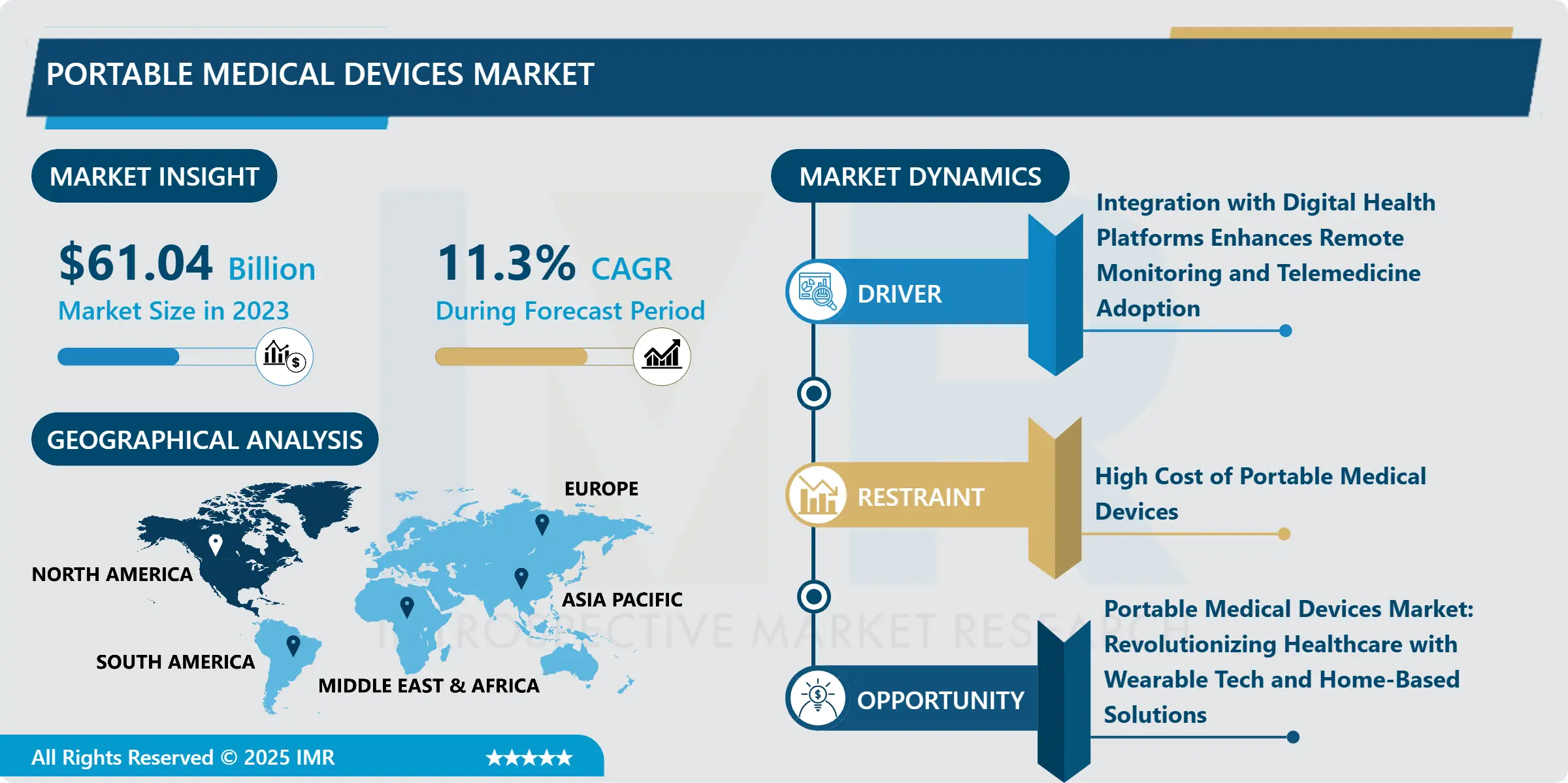
Portable Medical Devices Market Size Was Valued at USD 61.04 Billion in 2023, and is Projected to Reach USD 178.52 Billion by 2032, Growing at a CAGR of 11.30 % From 2024-2032.

IMR Group
Description
Portable Medical Devices Market Synopsis:
Portable Medical Devices Market Size Was Valued at USD 61.04 Billion in 2023, and is Projected to Reach USD 178.52 Billion by 2032, Growing at a CAGR of 11.30 % From 2024-2032.
Portable Medical Devices Market on the other hand defines the global market for light weight, carry along medical equipment for use in home and other DaCC settings. Such devices allow patient to self-observe, self-diagnose, and self-treat a number of health conditions from home, office or even from any other part of the world making healthcare more come-to-us and individualistic. The specific products that are available on the market are wearable health trackers, portable diagnostic devices (blood glucose meters, blood pressure monitors, ECG, other), therapeutic equipment (oxygen concentrators, nebulizers, CPAP machines and others), and monitoring tools (pulse oximeters). There is therefore improvement in the features of these devices by use of additional technologies for instance, integration with mobile applications, cloud solutions, as well as real time data processing. The use of telemedicine continues to advance, the necessity for home care as well as the continuously increasing rate of people with chronic diseases all contribute to ongoing market expansion. In addition, there is an increasing demand for preventive healthcare, increasing proportion of elderly people, and constant need for device-based monitoring of patients, which also indicates the gradual development of portable medical devices, facilitated by the economic growth of emerging countries.
Due to factors such as home health care, chronic diseases and the use of Portable Medical Devices as wearables, the portable medical device industry is rapidly growing. Such devices include portable glucose meters, ECG, blood pressure, devices for oxygen concentration, and concentrations, nebulizers, and other thermal devices, which is easier to use for patients and healthcare professionals. Another factor that is also contributing to the market is the_viewpoint of preventive healthcare, and subsequent use of wearable and monitoring devices such as health trackers, continuous glucose monitoring devices, pulse oximeters and others. This has enabled patients with such complications as diabetes, cardiovascular diseases, and respiratory illnesses among them, to take charge of their general health. Also, adopting telemedicine and having the remote monitoring capability not only increases the variety of areas in which portable devices can be used but also makes it possible for healthcare providers to intervene in the patient’s illness and help them in necessary.
Apart from diagnostic and curative purposes, the market is gradually moving into acute care, especially for devices such as portable defibrillators and ventilators. The trends like necessity of solutions for post-operative care, have created a demand for remote monitoring equipment and home care products that allow the patient to heal in comfort while under supervision of the healthcare specialists. Growing utilization of mobile solutions to optimize patient care procedures and the reduced hospital stays are the major reasons why ambulatory care centres, hospitals and clinics are among the biggest consumers of portable medical devices. Thus, forecasted to be highly dynamic as it remains in tow with the growing advances in healthcare technology, the global trends of portable medical devices corresponds to crucial global drivers such as the acknowledgement of personalized care, the increasing elderly population, and the increasing global concern for health issues especially in Asia-Pacific and Latin American regions.
Portable Medical Devices Market Trend Analysis:
Integration with Digital Health Platforms Enhances Remote Monitoring and Telemedicine Adoption
One of the most disruptive developments of the current healthcare industry is the integration of portable medical devices with digital health platforms which has greatly improved remote health monitoring and driven faster adoption of telehealth. In a mobile environment, tradable commodities include moveable objects such as wearable health trackers, glucose meters, ECG monitors, blood pressure cuffs; objects that can be linked to mobile applications, cloud-based platforms, and electronic health record systems to collect data for patients and providers in real time. Through integration, people’s health can be monitored from time to time, recent conditions can be managed and treatment plans can be changed remotely by the healthcare professionals. For the patients, this is a way for them to become more involved in management of their overall health, whereas in the case of healthcare providers, it provides a way to deliver custom, evidence-based treatment despite a lack in regular face-to-face conversations.
The integration of portable devices and the health care telecommunication system avails, delivers, and expands the applicability of health care services, especially in rural or developing regions. Given that telemedicine is increasingly integrated into healthcare, especially during and post-COVID-19, efficient distant tracking of persons’ conditions utilizing digital health tools has emerged as essential. Patients can interact with their providers online to get a diagnosis, share their current health stats, or await changes in their dosage or therapy. This not only helps to relieve the pressure from the clinics but also brings better outcomes for patients, as each client has an opportunity to be checked during the constant intervals, despite the impossibility of physical conversation. Increase in the usage of digital health solutions will further drive the growth of connected portable medical devices to help enhance the healthcare experience, from a cost and availability perspective at the global level.
Portable Medical Devices Market: Revolutionizing Healthcare with Wearable Tech and Home-Based Solutions
The Portable Medical Devices Market allows for a change of traditional methods of treatment in clinical and offers patients an opportunity to deal with the problem outside of a medical facility. Smartwatches, fitness tracking devices including new generation specialized devices like glucose monitors, and ECG trackers facilitate extended, uninterrupted observation of vital signs, and persistent conditions. These devices facilitate the health assessment and transfer of healthy information, hence cut down on several doctor appointments and boost up the ownership of patients. The adoption of usage of AI for analytics together with the use of mobile application apps enhance the chances and options of identifying early risk indicators and chances for preventable health care, which makes the concept a critical component of contemporary medical methodologies.
The increasing use of home health care is also the reason behind the increasing demand for mobile medical equipment. Due to the growing population of seniors, the prevalence of chronic diseases and the inclination to receive care from a distance – these devices are invaluable assistants in the treatment of diseases such as diabetes, hypertension, and respiratory diseases. People are able to manage their chronic conditions for which they receive frequent remote care from healthcare facilities. This trend will only grow stronger in the future, especially after the pandemic; portable medical devices will become even more indispensable in efforts to help cut the number of hospital visits, bring down the cost of healthcare and deliver more targeted and efficient care to millions of people around the globe.
Portable Medical Devices Market Segment Analysis:
Portable Medical Devices Market is Segmented on the basis of Type, Application, End User, and Region
By Type, Monitoring Devices segment is expected to dominate the market during the forecast period
Monitoring Devices segment is anticipated to capture the largest market share for portable medical devices during the forecast period for its increasing application across various industries and sectors especially in the vicinity of health and medical sectors related to management of chronic health and preventive care. Wearable heart rate monitors, blood pressure cuff, glucose, pulse oximeters, and continuous glucose monitoring systems, help a patient to check vital signs during their daily routine without visiting the doctor. They are intended to provide constant, wearables and non-penetrating, reading of major important health indicators, which makes them suitable for people living with chronic diseases, such as diabetes, hypertension, and cardiovascular diseases. Given the trends of elevated incidence of chronic ailments, increased use of monitors that offer continuous health status and ability to identify developing complications shall increase enormously. These devices assist patients and doctors in taking action that can prevent admission to the hospital or complication of the disease.
The growing concern towards preventive measures and rising trend of home health care are the major drivers stimulating the growth of monitor devices. As newer sensors are developed, wireless connectivity incorporated into the device as well as connection to mobile applications, these devices are becoming more user friendly and precise. Telemetric patients can monitor their vital signs from a distance, pass data to doctors, and obtain feedback immediately. In addition, the adoption of telemedicine and a continuous increase in RPMenting increases the need for these devices as they help healthcare providers diagnose and monitor the patient’s condition on a remote basis without a constant in-person visit to the hospital, which results in lower costs in the process. Other factors that make portable monitoring devices to be more dominant in the portable medical devices market include growing consumer concern towards taking control of their health, and the slowly rising acceptance of wearable health technology.
By Application, Disease Management segment expected to held the largest share
Of all the segments under Products, it is believed that Disease Management will dominate the portable medical devices market throughout the period of the study as the incidence of chronic diseases continues to grow and the need for home care devices remains on the rise. Conditions like diabetes, hypertension, heart diseases, and respiratory diseases are long term ailments and need to be managed very closely to avoid detrimental effects on the patient’s health. Blood glucose monitor, blood pressure cuff, and portable oxygen concentrator are examples of durable medial equipment that has helped patients to receive treatment at home. These devices enable fast monitoring of vital parameters of the patient’s health, becoming a source of valuable information for patients/caregivers and health care practitioners. Due to the increasing cases of chronic diseases throughout the world, there is high demand for efficient and affordable disease management systems to occasion the portable medical devices market in this segment.
As modern health systems evolve toward the patient-centered model, the importance of CGM of chronic conditions remains high. The development of portable devices has continued to improve and now come with improved accuracy, are easy to use and integrate to health care systems. This allows patients to assess their states over and over again and modify their treatments as required and all this without having to physically go to a health facility. Furthermore, RPM and telemedicine, which themselves are driving the market forward, continue to advance the use of these devices as they enable the monitoring of a patient’s status and the modification of treatment and the possibility of timely intervention for patients who do not need to visit the clinic. In light of the continued focus on cutting healthcare expenditure, increasing patient satisfaction and quality of life, and managing chronic illnesses, the disease management application segment will remain the biggest growth driver of the portable medical devices market over the next few years.
North America is Expected to Dominate the Market Over the Forecast period
North America is currently dominating the portable medical devices market, driven by several key factors. The region has experienced successful development of healthcare infrastructure and maintained high healthcare costs while quickly implementing advanced medical technologies. A rising number of elderly individuals, together with the greater incidence of diabetes along with cardiovascular disorders, and respiratory conditions, increases the need for portable diagnostic and health monitoring solutions. Market growth in the U.S. and Canada benefits from strong leading market player participation in addition to positive reimbursement policies.
Telehealth advancements and increasing public health consciousness drive healthcare providers to integrate wearable portable medical devices into clinical environments and home healthcare areas. Strong research funding in this geographic region leads to the ongoing development of portable medical technology through innovation. Market expansion receives additional boosts from rising mobile phone use and the connection between healthcare devices through IoT technology. Digital health initiatives from authorities establish a favorable regulatory framework which supports the market expansion of this sector.
Active Key Players in the Portable Medical Devices Market:
Abbott Laboratories (USA)
Becton Dickinson (USA)
Biotronik (Germany)
Boston Scientific (USA)
Dexcom, Inc. (USA)
Fitbit, Inc. (USA)
Fresenius Medical Care (Germany)
GE Healthcare (USA)
GlucoMe (Israel)
Honeywell Life Sciences (USA)
Johnson & Johnson (USA)
Medtronic (Ireland/USA)
Nokia Health (Finland)
Omron Healthcare (Japan)
Philips Healthcare (Netherlands)
ResMed Inc. (Australia)
Roche Diagnostics (Switzerland)
Siemens Healthineers (Germany)
Other Active Players
Chapter 1: Introduction
1.1 Scope and Coverage
Chapter 2:Executive Summary
Chapter 3: Market Landscape
3.1 Market Dynamics
3.1.1 Drivers
3.1.2 Restraints
3.1.3 Opportunities
3.1.4 Challenges
3.2 Market Trend Analysis
3.3 PESTLE Analysis
3.4 Porter’s Five Forces Analysis
3.5 Industry Value Chain Analysis
3.6 Ecosystem
3.7 Regulatory Landscape
3.8 Price Trend Analysis
3.9 Patent Analysis
3.10 Technology Evolution
3.11 Investment Pockets
3.12 Import-Export Analysis
Chapter 4: Portable Medical Devices Market by Type
4.1 Portable Medical Devices Market Snapshot and Growth Engine
4.2 Portable Medical Devices Market Overview
4.3 Diagnostic Devices
4.3.1 Introduction and Market Overview
4.3.2 Historic and Forecasted Market Size in Value USD and Volume Units (2017-2032F)
4.3.3 Key Market Trends, Growth Factors and Opportunities
4.3.4 Diagnostic Devices: Geographic Segmentation Analysis
4.4 Therapeutic Devices
4.4.1 Introduction and Market Overview
4.4.2 Historic and Forecasted Market Size in Value USD and Volume Units (2017-2032F)
4.4.3 Key Market Trends, Growth Factors and Opportunities
4.4.4 Therapeutic Devices: Geographic Segmentation Analysis
4.5 Monitoring Device
4.5.1 Introduction and Market Overview
4.5.2 Historic and Forecasted Market Size in Value USD and Volume Units (2017-2032F)
4.5.3 Key Market Trends, Growth Factors and Opportunities
4.5.4 Monitoring Device: Geographic Segmentation Analysis
Chapter 5: Portable Medical Devices Market by Application
5.1 Portable Medical Devices Market Snapshot and Growth Engine
5.2 Portable Medical Devices Market Overview
5.3 Chronic Disease Management
5.3.1 Introduction and Market Overview
5.3.2 Historic and Forecasted Market Size in Value USD and Volume Units (2017-2032F)
5.3.3 Key Market Trends, Growth Factors and Opportunities
5.3.4 Chronic Disease Management: Geographic Segmentation Analysis
5.4 Preventive Healthcare
5.4.1 Introduction and Market Overview
5.4.2 Historic and Forecasted Market Size in Value USD and Volume Units (2017-2032F)
5.4.3 Key Market Trends, Growth Factors and Opportunities
5.4.4 Preventive Healthcare: Geographic Segmentation Analysis
5.5 Emergency Care and Critical Monitoring
5.5.1 Introduction and Market Overview
5.5.2 Historic and Forecasted Market Size in Value USD and Volume Units (2017-2032F)
5.5.3 Key Market Trends, Growth Factors and Opportunities
5.5.4 Emergency Care and Critical Monitoring: Geographic Segmentation Analysis
5.6 Post-Surgery Care
5.6.1 Introduction and Market Overview
5.6.2 Historic and Forecasted Market Size in Value USD and Volume Units (2017-2032F)
5.6.3 Key Market Trends, Growth Factors and Opportunities
5.6.4 Post-Surgery Care: Geographic Segmentation Analysis
5.7 Other Applications
5.7.1 Introduction and Market Overview
5.7.2 Historic and Forecasted Market Size in Value USD and Volume Units (2017-2032F)
5.7.3 Key Market Trends, Growth Factors and Opportunities
5.7.4 Other Applications: Geographic Segmentation Analysis
Chapter 6: Portable Medical Devices Market by End User
6.1 Portable Medical Devices Market Snapshot and Growth Engine
6.2 Portable Medical Devices Market Overview
6.3 Hospitals & Clinics
6.3.1 Introduction and Market Overview
6.3.2 Historic and Forecasted Market Size in Value USD and Volume Units (2017-2032F)
6.3.3 Key Market Trends, Growth Factors and Opportunities
6.3.4 Hospitals & Clinics: Geographic Segmentation Analysis
6.4 Home Healthcare
6.4.1 Introduction and Market Overview
6.4.2 Historic and Forecasted Market Size in Value USD and Volume Units (2017-2032F)
6.4.3 Key Market Trends, Growth Factors and Opportunities
6.4.4 Home Healthcare: Geographic Segmentation Analysis
6.5 Ambulatory Care Centers
6.5.1 Introduction and Market Overview
6.5.2 Historic and Forecasted Market Size in Value USD and Volume Units (2017-2032F)
6.5.3 Key Market Trends, Growth Factors and Opportunities
6.5.4 Ambulatory Care Centers: Geographic Segmentation Analysis
6.6 Other
6.6.1 Introduction and Market Overview
6.6.2 Historic and Forecasted Market Size in Value USD and Volume Units (2017-2032F)
6.6.3 Key Market Trends, Growth Factors and Opportunities
6.6.4 Other: Geographic Segmentation Analysis
Chapter 7: Company Profiles and Competitive Analysis
7.1 Competitive Landscape
7.1.1 Competitive Benchmarking
7.1.2 Portable Medical Devices Market Share by Manufacturer (2023)
7.1.3 Industry BCG Matrix
7.1.4 Heat Map Analysis
7.1.5 Mergers and Acquisitions
7.2 ABBOTT LABORATORIES (USA)
7.2.1 Company Overview
7.2.2 Key Executives
7.2.3 Company Snapshot
7.2.4 Role of the Company in the Market
7.2.5 Sustainability and Social Responsibility
7.2.6 Operating Business Segments
7.2.7 Product Portfolio
7.2.8 Business Performance
7.2.9 Key Strategic Moves and Recent Developments
7.2.10 SWOT Analysis
7.3 BECTON DICKINSON (USA)
7.4 BIOTRONIK (GERMANY)
7.5 BOSTON SCIENTIFIC (USA)
7.6 DEXCOM INC. (USA)
7.7 FITBIT INC. (USA)
7.8 FRESENIUS MEDICAL CARE (GERMANY)
7.9 GE HEALTHCARE (USA)
7.10 GLUCOME (ISRAEL)
7.11 HONEYWELL LIFE SCIENCES (USA)
7.12 JOHNSON & JOHNSON (USA)
7.13 MEDTRONIC (IRELAND/USA)
7.14 NOKIA HEALTH (FINLAND)
7.15 OMRON HEALTHCARE (JAPAN)
7.16 PHILIPS HEALTHCARE (NETHERLANDS)
7.17 RESMED INC. (AUSTRALIA)
7.18 ROCHE DIAGNOSTICS (SWITZERLAND)
7.19 SIEMENS HEALTHINEERS (GERMANY)
7.20 OTHER ACTIVE PLAYERS
Chapter 8: Global Portable Medical Devices Market By Region
8.1 Overview
8.2. North America Portable Medical Devices Market
8.2.1 Key Market Trends, Growth Factors and Opportunities
8.2.2 Top Key Companies
8.2.3 Historic and Forecasted Market Size by Segments
8.2.4 Historic and Forecasted Market Size By Type
8.2.4.1 Diagnostic Devices
8.2.4.2 Therapeutic Devices
8.2.4.3 Monitoring Device
8.2.5 Historic and Forecasted Market Size By Application
8.2.5.1 Chronic Disease Management
8.2.5.2 Preventive Healthcare
8.2.5.3 Emergency Care and Critical Monitoring
8.2.5.4 Post-Surgery Care
8.2.5.5 Other Applications
8.2.6 Historic and Forecasted Market Size By End User
8.2.6.1 Hospitals & Clinics
8.2.6.2 Home Healthcare
8.2.6.3 Ambulatory Care Centers
8.2.6.4 Other
8.2.7 Historic and Forecast Market Size by Country
8.2.7.1 US
8.2.7.2 Canada
8.2.7.3 Mexico
8.3. Eastern Europe Portable Medical Devices Market
8.3.1 Key Market Trends, Growth Factors and Opportunities
8.3.2 Top Key Companies
8.3.3 Historic and Forecasted Market Size by Segments
8.3.4 Historic and Forecasted Market Size By Type
8.3.4.1 Diagnostic Devices
8.3.4.2 Therapeutic Devices
8.3.4.3 Monitoring Device
8.3.5 Historic and Forecasted Market Size By Application
8.3.5.1 Chronic Disease Management
8.3.5.2 Preventive Healthcare
8.3.5.3 Emergency Care and Critical Monitoring
8.3.5.4 Post-Surgery Care
8.3.5.5 Other Applications
8.3.6 Historic and Forecasted Market Size By End User
8.3.6.1 Hospitals & Clinics
8.3.6.2 Home Healthcare
8.3.6.3 Ambulatory Care Centers
8.3.6.4 Other
8.3.7 Historic and Forecast Market Size by Country
8.3.7.1 Russia
8.3.7.2 Bulgaria
8.3.7.3 The Czech Republic
8.3.7.4 Hungary
8.3.7.5 Poland
8.3.7.6 Romania
8.3.7.7 Rest of Eastern Europe
8.4. Western Europe Portable Medical Devices Market
8.4.1 Key Market Trends, Growth Factors and Opportunities
8.4.2 Top Key Companies
8.4.3 Historic and Forecasted Market Size by Segments
8.4.4 Historic and Forecasted Market Size By Type
8.4.4.1 Diagnostic Devices
8.4.4.2 Therapeutic Devices
8.4.4.3 Monitoring Device
8.4.5 Historic and Forecasted Market Size By Application
8.4.5.1 Chronic Disease Management
8.4.5.2 Preventive Healthcare
8.4.5.3 Emergency Care and Critical Monitoring
8.4.5.4 Post-Surgery Care
8.4.5.5 Other Applications
8.4.6 Historic and Forecasted Market Size By End User
8.4.6.1 Hospitals & Clinics
8.4.6.2 Home Healthcare
8.4.6.3 Ambulatory Care Centers
8.4.6.4 Other
8.4.7 Historic and Forecast Market Size by Country
8.4.7.1 Germany
8.4.7.2 UK
8.4.7.3 France
8.4.7.4 The Netherlands
8.4.7.5 Italy
8.4.7.6 Spain
8.4.7.7 Rest of Western Europe
8.5. Asia Pacific Portable Medical Devices Market
8.5.1 Key Market Trends, Growth Factors and Opportunities
8.5.2 Top Key Companies
8.5.3 Historic and Forecasted Market Size by Segments
8.5.4 Historic and Forecasted Market Size By Type
8.5.4.1 Diagnostic Devices
8.5.4.2 Therapeutic Devices
8.5.4.3 Monitoring Device
8.5.5 Historic and Forecasted Market Size By Application
8.5.5.1 Chronic Disease Management
8.5.5.2 Preventive Healthcare
8.5.5.3 Emergency Care and Critical Monitoring
8.5.5.4 Post-Surgery Care
8.5.5.5 Other Applications
8.5.6 Historic and Forecasted Market Size By End User
8.5.6.1 Hospitals & Clinics
8.5.6.2 Home Healthcare
8.5.6.3 Ambulatory Care Centers
8.5.6.4 Other
8.5.7 Historic and Forecast Market Size by Country
8.5.7.1 China
8.5.7.2 India
8.5.7.3 Japan
8.5.7.4 South Korea
8.5.7.5 Malaysia
8.5.7.6 Thailand
8.5.7.7 Vietnam
8.5.7.8 The Philippines
8.5.7.9 Australia
8.5.7.10 New Zealand
8.5.7.11 Rest of APAC
8.6. Middle East & Africa Portable Medical Devices Market
8.6.1 Key Market Trends, Growth Factors and Opportunities
8.6.2 Top Key Companies
8.6.3 Historic and Forecasted Market Size by Segments
8.6.4 Historic and Forecasted Market Size By Type
8.6.4.1 Diagnostic Devices
8.6.4.2 Therapeutic Devices
8.6.4.3 Monitoring Device
8.6.5 Historic and Forecasted Market Size By Application
8.6.5.1 Chronic Disease Management
8.6.5.2 Preventive Healthcare
8.6.5.3 Emergency Care and Critical Monitoring
8.6.5.4 Post-Surgery Care
8.6.5.5 Other Applications
8.6.6 Historic and Forecasted Market Size By End User
8.6.6.1 Hospitals & Clinics
8.6.6.2 Home Healthcare
8.6.6.3 Ambulatory Care Centers
8.6.6.4 Other
8.6.7 Historic and Forecast Market Size by Country
8.6.7.1 Turkiye
8.6.7.2 Bahrain
8.6.7.3 Kuwait
8.6.7.4 Saudi Arabia
8.6.7.5 Qatar
8.6.7.6 UAE
8.6.7.7 Israel
8.6.7.8 South Africa
8.7. South America Portable Medical Devices Market
8.7.1 Key Market Trends, Growth Factors and Opportunities
8.7.2 Top Key Companies
8.7.3 Historic and Forecasted Market Size by Segments
8.7.4 Historic and Forecasted Market Size By Type
8.7.4.1 Diagnostic Devices
8.7.4.2 Therapeutic Devices
8.7.4.3 Monitoring Device
8.7.5 Historic and Forecasted Market Size By Application
8.7.5.1 Chronic Disease Management
8.7.5.2 Preventive Healthcare
8.7.5.3 Emergency Care and Critical Monitoring
8.7.5.4 Post-Surgery Care
8.7.5.5 Other Applications
8.7.6 Historic and Forecasted Market Size By End User
8.7.6.1 Hospitals & Clinics
8.7.6.2 Home Healthcare
8.7.6.3 Ambulatory Care Centers
8.7.6.4 Other
8.7.7 Historic and Forecast Market Size by Country
8.7.7.1 Brazil
8.7.7.2 Argentina
8.7.7.3 Rest of SA
Chapter 9 Analyst Viewpoint and Conclusion
9.1 Recommendations and Concluding Analysis
9.2 Potential Market Strategies
Chapter 10 Research Methodology
10.1 Research Process
10.2 Primary Research
10.3 Secondary Research
Q1: What would be the forecast period in the Portable Medical Devices Market research report?
A1: The forecast period in the Portable Medical Devices Market research report is 2024-2032.
Q2: Who are the key players in the Portable Medical Devices Market?
A2: Abbott Laboratories (USA), Becton Dickinson (USA), Biotronik (Germany), Boston Scientific (USA), Dexcom, Inc. (USA), Fitbit, Inc. (USA), Fresenius Medical Care (Germany), GE Healthcare (USA), GlucoMe (Israel), Honeywell Life Sciences (USA), Johnson & Johnson (USA), Medtronic (Ireland/USA), Nokia Health (Finland), Omron Healthcare (Japan), Philips Healthcare (Netherlands), ResMed Inc. (Australia), Roche Diagnostics (Switzerland), Siemens Healthineers (Germany), and Other Active Players.
Q3: What are the segments of the Portable Medical Devices Market?
A3: The Portable Medical Devices Market is segmented into Type, Application, End User and region. By Type, the market is categorized into Diagnostic Devices, Therapeutic Devices, Monitoring Device. By Application, the market is categorized into Chronic Disease Management, Preventive Healthcare, Emergency Care and Critical Monitoring, Post-Surgery Care, Other Applications. By End User, the market is categorized into Hospitals & Clinics, Home Healthcare, Ambulatory Care Centers, Other End Users. By region, it is analyzed across North America (U.S., Canada, Mexico), Eastern Europe (Russia, Bulgaria, The Czech Republic, Hungary, Poland, Romania, Rest of Eastern Europe), Western Europe (Germany, UK, France, The Netherlands, Italy, Russia, Spain, Rest of Western Europe), Asia Pacific (China, India, Japan, South Korea, Malaysia, Thailand, Vietnam, The Philippines, Australia, New-Zealand, Rest of APAC), Middle East & Africa (Turkiye, Bahrain, Kuwait, Saudi Arabia, Qatar, UAE, Israel, South Africa), South America (Brazil, Argentina, Rest of SA).
Q4: What is the Portable Medical Devices Market?
A4: Portable Medical Devices Market on the other hand defines the global market for light weight, carry along medical equipment for use in home and other DaCC settings. Such devices allow patient to self-observe, self-diagnose, and self-treat a number of health conditions from home, office or even from any other part of the world making healthcare more come-to-us and individualistic. The specific products that are available on the market are wearable health trackers, portable diagnostic devices (blood glucose meters, blood pressure monitors, ECG, other), therapeutic equipment (oxygen concentrators, nebulizers, CPAP machines and others), and monitoring tools (pulse oximeters). There is therefore improvement in the features of these devices by use of additional technologies for instance, integration with mobile applications, cloud solutions, as well as real time data processing. The use of telemedicine continues to advance, the necessity for home care as well as the continuously increasing rate of people with chronic diseases all contribute to ongoing market expansion. In addition, there is an increasing demand for preventive healthcare, increasing proportion of elderly people, and constant need for device-based monitoring of patients, which also indicates the gradual development of portable medical devices, facilitated by the economic growth of emerging countries.
Q5: How big is the Portable Medical Devices Market?
A5: Portable Medical Devices Market Size Was Valued at USD 61.04 Billion in 2023, and is Projected to Reach USD 178.52 Billion by 2032, Growing at a CAGR of 11.30 % From 2024-2032.
How to Buy a Report from eminsights.jp
On the product page, choose the license you want: Single-User License, Multi-User License or Enterprise License.
If you required report in your native language, then you can click on Translated Report button and fill out the form with report name and language you want, then our team will contact you as soon as possible.
Click the Buy Now button.
You will be redirected to the checkout page. Enter your company details and payment information.
Click Place Order to complete the purchase.
Confirmation: You’ll receive an order confirmation and our team will contact you shortly with your ordered report.
If you have any questions, fill out the contact form below or email us at bizdev@eminsights.net.
Thank you for choosing eminsights.jp!