Stay Ahead in Fast-Growing Economies.
Browse Reports Now




Polo Shirt Market – Comprehensive Study Report with Recent Trends 2032
This shirt was the first to have a buttoned-down collar, which polo players invented in the late 19th century to keep their collars from flapping in the wind.

IMR Group
Description
Polo Shirt Market Synopsis
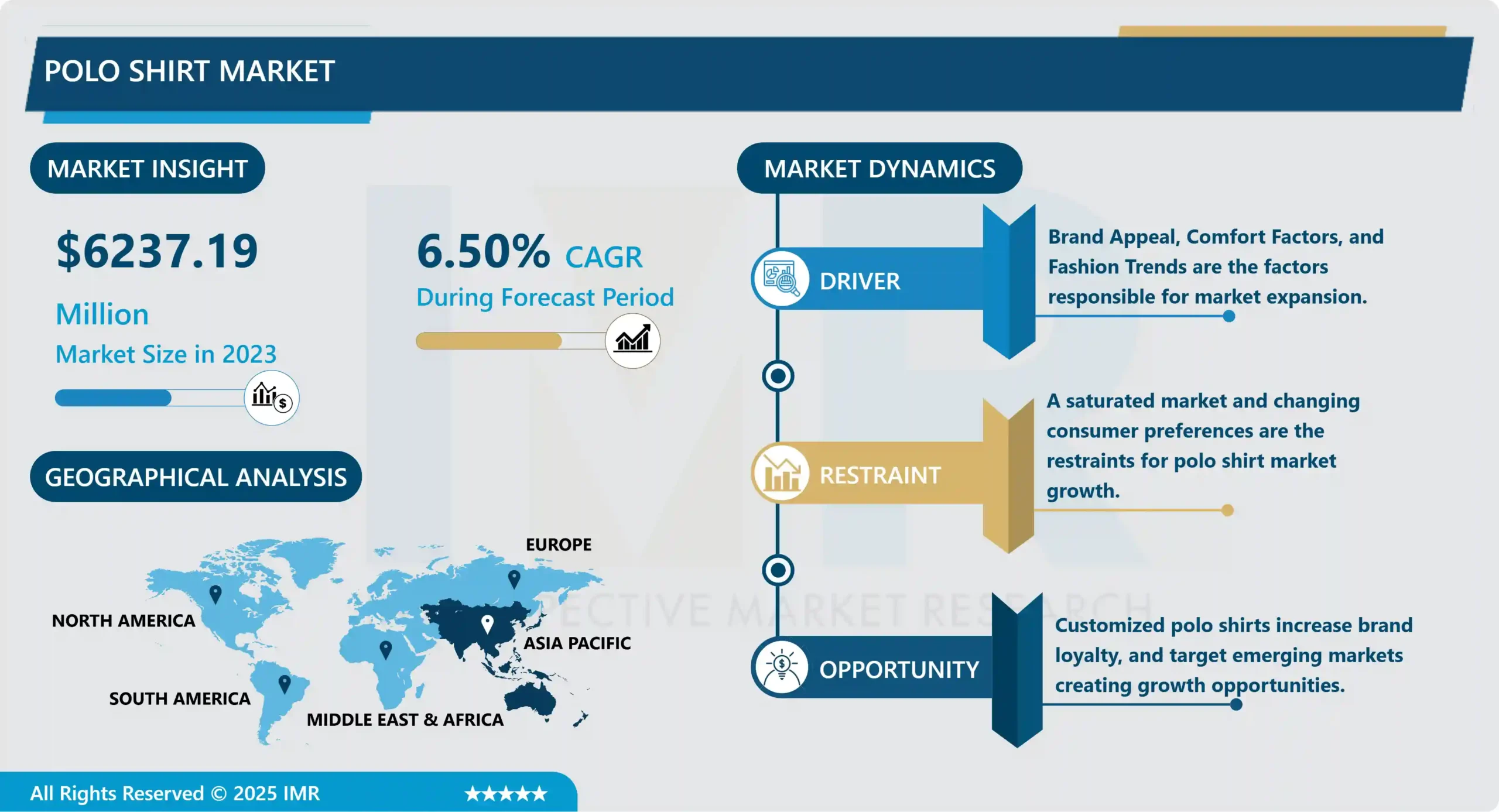
Polo Shirt Market Size Was Valued at USD 6237.19 Million in 2023 and is Projected to Reach USD 10993.49 Million by 2032, Growing at a CAGR of 6.5% From 2024-2032.
Polo shirts are usually made of knitted cotton (rather than woven cloth), usually a piqué knit, or less commonly an interlock knit (the latter frequently used, though not exclusively, with Pima cotton polos), or using other fibers such as silk, wool, synthetic fibers, or blends of natural and synthetic fibers. A dress-length version of the shirt is called a polo dress. Until the beginning of the 20th century, polo players wore thick, long-sleeved shirts made of Oxford cloth cotton.
This shirt was the first to have a buttoned-down collar, which polo players invented in the late 19th century to keep their collars from flapping in the wind. Brooks Brothers’ early president, John Brooks, noticed this while at a polo match in England and began producing such a shirt in 1896. Brooks Brothers still produce this style of button-down “polo shirt”. Polo shirts are made of knitted fabrics. From sportswear, they have gradually become one of the styles of daily wear, such as business casual, summer school uniforms for students, corporate collective clothing, and so on.
Polo shirts’ basic form is relatively fixed and the details of each component can be extended, so the polo shirt is selected for research. For a long time, polo shirts, as people’s favorite clothing style, can be suitable for sports, shopping, travel, and suits or other outerwear. Combining different colors and stripes with different heights can form a texture part library for polo shirt design. In recent years, personalized clothing customization has become a new way of producing and selling garments. It is also guided by differences in body figure and consumption needs of different consumers. Based on building a modular and diverse clothing parts library, clothing customization combined with free design can quickly modify and generate virtual design solutions suitable for consumers, and realize the integration of anthropometry, clothing pattern design, modeling, and production
Polo Shirt Market Trend Analysis
Increasing Applications in the Automotive Industry
Increasing demand for eco-friendly products is driven by consumer awareness of the environment. Consumers favor eco-friendly polo shirts made from organic cotton or recycled materials. The polo shirt sector adapts to meet customer preferences and requests for sustainability by developing new materials, production techniques, and supply chain strategies.
Consumers are looking for polo shirts that can easily go from casual to semi-formal occasions, highlighting the importance of adaptable design to fit various lifestyles. Ongoing advancements in fabric technology for polo shirts, such as moisture-wicking materials, improve both comfort and performance, catering to varied consumer preferences.
Market-oriented design aesthetics provide a variety of unique polo shirt choices by playing with colors, patterns, and embellishments to appeal to a wide range of preferences. Consumers prioritize durability, comfort, and sustainability when choosing high-quality polo shirts. Brands that prioritize quality and ethics are preferred. Businesses use consumer feedback to guide the development and marketing of polo shirts, focusing on meeting customer needs and expectations.
Opportunity
Customized polo shirts increase brand loyalty, and target emerging markets creating growth opportunities
Tailoring options such as logos and embroidery satisfy personal tastes, crafting one-of-a-kind polo shirts for selective customers desiring customized style statements. Expansion prospects are present in developing economies such as China, India, and Brazil for the polo shirt industry, capitalizing on consumer fascination with western fashion and labels, reaching out to an expanding consumer population. Investing in research and development leads to innovation, which results in the development of new polo shirt styles, materials, and production methods in order to set products apart and enhance market opportunities.
Progress in fabric production and digital printing techniques allow for the efficient creation of customizable polo shirts of high quality, which promotes creativity in design. Increasing competition motivates companies to grow by reaching new customers and markets to boost their development. Distinctive value propositions and delivery channels are essential.
Government policies, incentives, and regulations support polo shirt producers in establishing an advantageous commercial landscape. Efforts encourage development and advancement in the industry. Increased disposable income results in higher demand for clothing items such as polo shirts. Businesses can gain advantages by providing high-end choices and focusing on wealthy customer groups who value excellence and fashion.
Polo Shirt Market Segment Analysis:
Polo Shirt Market is Segmented on the basis of Type, Material, Style, Application, Gender, And Distribution Channel.
By Material, Cotton Segment Is Expected to Dominate the Market During the Forecast Period
The comfort and breathability of cotton make it a perfect option for polo shirts, as the natural fibers help air circulate to ensure wearers stay cool and comfortable. Cotton polo shirts are highly admired for their gentle feel and skin-friendly material, ideal for individuals with sensitive skin or those who prioritize comfort. Cotton polo shirts effortlessly shift from informal to somewhat formal events. Match with jeans for a casual style or chinos for a dressier outfit, accommodating different fashion tastes.
Cotton polo shirts that are durable maintain their quality and appearance even after frequent washing and wearing, retaining their shape and color for long-lasting value. Cotton, a natural fiber that is biodegradable and renewable, caters to the needs of consumers looking for eco-friendly clothing choices, which boosts the marketability of cotton polo shirts. Cotton polo shirts are in high demand because they are easily found and affordable, allowing them to be easily purchased by many people and be leaders in the market.
Cotton polo shirts can be customized and decorated in various ways, promoting brand uniqueness and individuality with different printing methods, embroideries, and design elements.
By Gender, Men Segment Held the Largest Share In 2023
Historical fondness for polo shirts in men’s fashion resulted in their widespread popularity, cementing the association between polo shirts and the male market. Men choose to wear polo shirts at both formal and informal occasions, demonstrating their authority in the fashion world. The versatility of the shirts allows for an easy shift from office attire to a more relaxed style.
Men represent a significant portion of players in sports such as golf and tennis, where polo shirts are popularly worn. This increases the need for men’s polo shirts. Clothing companies and stores concentrate on promoting polo shirts to men, solidifying their power through tailored marketing and branding strategies.
Men’s polo shirts are available in a range of sizes and cuts to accommodate a variety of body shapes, which has led to their growing popularity and market presence. Trends in men’s fashion influence the popularity of clothing items such as polo shirts. Innovative design and stylish updates are drawing in male customers, increasing the market share. The market power of men is shaped by their shopping habits, loyalty to certain brands, perceived worth, and convenience, especially in the polo shirt market.
Polo Shirt Market Regional Insights:
Asia Pacific is Expected to Dominate the Market Over the Forecast Period
The market for polo shirts in Asia-Pacific is robust due to large population and expanding economies. China, India, and Bangladesh are at the forefront of production and exports due to their combination of inexpensive production costs and skilled labor force. The region serves as a vital manufacturing center for the global fashion industry, containing many factories and textile mills that specialize in polo shirts.
Urbanization and rising disposable incomes in China and India are fueling the demand for branded clothing such as polo shirts among stylish city residents. The rise of the middle class in Asia-Pacific is leading to an increase in consumer spending on clothing, specifically on polo shirts, due to higher purchasing power and demand.
E-commerce has flourished in the area, providing customers with a diverse range of polo shirt brands and designs, fueling the market power of Asia-Pacific. Rising fashion consciousness in Asian customers has boosted the popularity of polo shirts as essential and adaptable fashion items, following Western style influences and leading to market expansion. Investments in retail infrastructure such as shopping malls and specialty stores have led to an increase in the availability of polo shirt brands in the Asia-Pacific region, resulting in higher visibility and market share for these brands.
Polo Shirt Market Active Players
Ralph Lauren Corporation (United States)
Lacoste S.A. (France)
Nike, Inc. (United States)
Adidas AG (Germany)
Tommy Hilfiger (United States)
Puma SE (Germany)
Calvin Klein (United States)
Under Armour, Inc. (United States)
Hanesbrands Inc. (United States)
Hugo Boss AG (Germany)
Uniqlo Co., Ltd. (Japan)
ASOS Plc (United Kingdom)
Burberry Group plc (United Kingdom)
Fruit of the Loom (United States)
PVH Corp. (United States)
Armani (Italy)
Gap Inc. (United States)
Zara (Spain)
Decathlon Group (France)
Columbia Sportswear Company (United States)
Lululemon Athletica Inc. (Canada)
Everlane (United States)
J. Crew Group, Inc. (United States)
Patagonia, Inc. (United States)
Levi Strauss & Co. (United States)
New Balance Athletics, Inc. (United States)
The North Face, Inc. (United States)
Chapter 1: Introduction
1.1 Scope and Coverage
Chapter 2:Executive Summary
Chapter 3: Market Landscape
3.1 Market Dynamics
3.1.1 Drivers
3.1.2 Restraints
3.1.3 Opportunities
3.1.4 Challenges
3.2 Market Trend Analysis
3.3 PESTLE Analysis
3.4 Porter’s Five Forces Analysis
3.5 Industry Value Chain Analysis
3.6 Ecosystem
3.7 Regulatory Landscape
3.8 Price Trend Analysis
3.9 Patent Analysis
3.10 Technology Evolution
3.11 Investment Pockets
3.12 Import-Export Analysis
Chapter 4: Polo Shirt Market by Type (2018-2032)
4.1 Polo Shirt Market Snapshot and Growth Engine
4.2 Market Overview
4.3 Traditional
4.3.1 Introduction and Market Overview
4.3.2 Historic and Forecasted Market Size in Value USD and Volume Units
4.3.3 Key Market Trends, Growth Factors, and Opportunities
4.3.4 Geographic Segmentation Analysis
4.4 Fashion
4.5 Polo Shirt Dresses
4.6 Polo Shirt Sets
Chapter 5: Polo Shirt Market by Material (2018-2032)
5.1 Polo Shirt Market Snapshot and Growth Engine
5.2 Market Overview
5.3 Cotton
5.3.1 Introduction and Market Overview
5.3.2 Historic and Forecasted Market Size in Value USD and Volume Units
5.3.3 Key Market Trends, Growth Factors, and Opportunities
5.3.4 Geographic Segmentation Analysis
5.4 Polyester
5.5 Blend
5.6 Organic Cotton
5.7 Silk
5.8 Bamboo
Chapter 6: Polo Shirt Market by Style (2018-2032)
6.1 Polo Shirt Market Snapshot and Growth Engine
6.2 Market Overview
6.3 Classic
6.3.1 Introduction and Market Overview
6.3.2 Historic and Forecasted Market Size in Value USD and Volume Units
6.3.3 Key Market Trends, Growth Factors, and Opportunities
6.3.4 Geographic Segmentation Analysis
6.4 Striped
6.5 Printed
6.6 Embroidered
6.7 Polo Shirts with Contrast Collars/Cuffs
Chapter 7: Polo Shirt Market by Application (2018-2032)
7.1 Polo Shirt Market Snapshot and Growth Engine
7.2 Market Overview
7.3 Casual Wear
7.3.1 Introduction and Market Overview
7.3.2 Historic and Forecasted Market Size in Value USD and Volume Units
7.3.3 Key Market Trends, Growth Factors, and Opportunities
7.3.4 Geographic Segmentation Analysis
7.4 Formal Wear
7.5 Sports
7.6 Travel Polo Shirts
Chapter 8: Polo Shirt Market by Gender (2018-2032)
8.1 Polo Shirt Market Snapshot and Growth Engine
8.2 Market Overview
8.3 Men’s
8.3.1 Introduction and Market Overview
8.3.2 Historic and Forecasted Market Size in Value USD and Volume Units
8.3.3 Key Market Trends, Growth Factors, and Opportunities
8.3.4 Geographic Segmentation Analysis
8.4 Women’s
8.5 Unisex
Chapter 9: Polo Shirt Market by Distribution Channel (2018-2032)
9.1 Polo Shirt Market Snapshot and Growth Engine
9.2 Market Overview
9.3 Hypermarkets & Supermarkets
9.3.1 Introduction and Market Overview
9.3.2 Historic and Forecasted Market Size in Value USD and Volume Units
9.3.3 Key Market Trends, Growth Factors, and Opportunities
9.3.4 Geographic Segmentation Analysis
9.4 Departmental Stores
9.5 Specialty Stores
9.6 E-commerce
Chapter 10: Company Profiles and Competitive Analysis
10.1 Competitive Landscape
10.1.1 Competitive Benchmarking
10.1.2 Polo Shirt Market Share by Manufacturer (2024)
10.1.3 Industry BCG Matrix
10.1.4 Heat Map Analysis
10.1.5 Mergers and Acquisitions
10.2 RALPH LAUREN CORPORATION (UNITED STATES)
10.2.1 Company Overview
10.2.2 Key Executives
10.2.3 Company Snapshot
10.2.4 Role of the Company in the Market
10.2.5 Sustainability and Social Responsibility
10.2.6 Operating Business Segments
10.2.7 Product Portfolio
10.2.8 Business Performance
10.2.9 Key Strategic Moves and Recent Developments
10.2.10 SWOT Analysis
10.3 LACOSTE S.A. (FRANCE)
10.4 NIKE INC. (UNITED STATES)
10.5 ADIDAS AG (GERMANY)
10.6 TOMMY HILFIGER (UNITED STATES)
10.7 PUMA SE (GERMANY)
10.8 CALVIN KLEIN (UNITED STATES)
10.9 UNDER ARMOUR INC. (UNITED STATES)
10.10 HANESBRANDS INC. (UNITED STATES)
10.11 HUGO BOSS AG (GERMANY)
10.12 UNIQLO COLTD. (JAPAN)
10.13 ASOS PLC (UNITED KINGDOM)
10.14 BURBERRY GROUP PLC (UNITED KINGDOM)
10.15 FRUIT OF THE LOOM (UNITED STATES)
10.16 PVH CORP. (UNITED STATES)
10.17 ARMANI (ITALY)
10.18 GAP INC. (UNITED STATES)
10.19 ZARA (SPAIN)
10.20 DECATHLON GROUP (FRANCE)
10.21 COLUMBIA SPORTSWEAR COMPANY (UNITED STATES)
10.22 LULULEMON ATHLETICA INC. (CANADA)
10.23 EVERLANE (UNITED STATES)
10.24 J. CREW GROUP INC. (UNITED STATES)
10.25 PATAGONIA INC. (UNITED STATES)
10.26 LEVI STRAUSS & CO. (UNITED STATES)
10.27 NEW BALANCE ATHLETICS INC. (UNITED STATES)
10.28 THE NORTH FACE INC. (UNITED STATES)
10.29 ASICS CORPORATION (JAPAN)
10.30 COLUMBIA SPORTSWEAR (UNITED STATES)
10.31 REEBOK INTERNATIONAL LTD. (UNITED STATES)
Chapter 11: Global Polo Shirt Market By Region
11.1 Overview
11.2. North America Polo Shirt Market
11.2.1 Key Market Trends, Growth Factors and Opportunities
11.2.2 Top Key Companies
11.2.3 Historic and Forecasted Market Size by Segments
11.2.4 Historic and Forecasted Market Size by Type
11.2.4.1 Traditional
11.2.4.2 Fashion
11.2.4.3 Polo Shirt Dresses
11.2.4.4 Polo Shirt Sets
11.2.5 Historic and Forecasted Market Size by Material
11.2.5.1 Cotton
11.2.5.2 Polyester
11.2.5.3 Blend
11.2.5.4 Organic Cotton
11.2.5.5 Silk
11.2.5.6 Bamboo
11.2.6 Historic and Forecasted Market Size by Style
11.2.6.1 Classic
11.2.6.2 Striped
11.2.6.3 Printed
11.2.6.4 Embroidered
11.2.6.5 Polo Shirts with Contrast Collars/Cuffs
11.2.7 Historic and Forecasted Market Size by Application
11.2.7.1 Casual Wear
11.2.7.2 Formal Wear
11.2.7.3 Sports
11.2.7.4 Travel Polo Shirts
11.2.8 Historic and Forecasted Market Size by Gender
11.2.8.1 Men’s
11.2.8.2 Women’s
11.2.8.3 Unisex
11.2.9 Historic and Forecasted Market Size by Distribution Channel
11.2.9.1 Hypermarkets & Supermarkets
11.2.9.2 Departmental Stores
11.2.9.3 Specialty Stores
11.2.9.4 E-commerce
11.2.10 Historic and Forecast Market Size by Country
11.2.10.1 US
11.2.10.2 Canada
11.2.10.3 Mexico
11.3. Eastern Europe Polo Shirt Market
11.3.1 Key Market Trends, Growth Factors and Opportunities
11.3.2 Top Key Companies
11.3.3 Historic and Forecasted Market Size by Segments
11.3.4 Historic and Forecasted Market Size by Type
11.3.4.1 Traditional
11.3.4.2 Fashion
11.3.4.3 Polo Shirt Dresses
11.3.4.4 Polo Shirt Sets
11.3.5 Historic and Forecasted Market Size by Material
11.3.5.1 Cotton
11.3.5.2 Polyester
11.3.5.3 Blend
11.3.5.4 Organic Cotton
11.3.5.5 Silk
11.3.5.6 Bamboo
11.3.6 Historic and Forecasted Market Size by Style
11.3.6.1 Classic
11.3.6.2 Striped
11.3.6.3 Printed
11.3.6.4 Embroidered
11.3.6.5 Polo Shirts with Contrast Collars/Cuffs
11.3.7 Historic and Forecasted Market Size by Application
11.3.7.1 Casual Wear
11.3.7.2 Formal Wear
11.3.7.3 Sports
11.3.7.4 Travel Polo Shirts
11.3.8 Historic and Forecasted Market Size by Gender
11.3.8.1 Men’s
11.3.8.2 Women’s
11.3.8.3 Unisex
11.3.9 Historic and Forecasted Market Size by Distribution Channel
11.3.9.1 Hypermarkets & Supermarkets
11.3.9.2 Departmental Stores
11.3.9.3 Specialty Stores
11.3.9.4 E-commerce
11.3.10 Historic and Forecast Market Size by Country
11.3.10.1 Russia
11.3.10.2 Bulgaria
11.3.10.3 The Czech Republic
11.3.10.4 Hungary
11.3.10.5 Poland
11.3.10.6 Romania
11.3.10.7 Rest of Eastern Europe
11.4. Western Europe Polo Shirt Market
11.4.1 Key Market Trends, Growth Factors and Opportunities
11.4.2 Top Key Companies
11.4.3 Historic and Forecasted Market Size by Segments
11.4.4 Historic and Forecasted Market Size by Type
11.4.4.1 Traditional
11.4.4.2 Fashion
11.4.4.3 Polo Shirt Dresses
11.4.4.4 Polo Shirt Sets
11.4.5 Historic and Forecasted Market Size by Material
11.4.5.1 Cotton
11.4.5.2 Polyester
11.4.5.3 Blend
11.4.5.4 Organic Cotton
11.4.5.5 Silk
11.4.5.6 Bamboo
11.4.6 Historic and Forecasted Market Size by Style
11.4.6.1 Classic
11.4.6.2 Striped
11.4.6.3 Printed
11.4.6.4 Embroidered
11.4.6.5 Polo Shirts with Contrast Collars/Cuffs
11.4.7 Historic and Forecasted Market Size by Application
11.4.7.1 Casual Wear
11.4.7.2 Formal Wear
11.4.7.3 Sports
11.4.7.4 Travel Polo Shirts
11.4.8 Historic and Forecasted Market Size by Gender
11.4.8.1 Men’s
11.4.8.2 Women’s
11.4.8.3 Unisex
11.4.9 Historic and Forecasted Market Size by Distribution Channel
11.4.9.1 Hypermarkets & Supermarkets
11.4.9.2 Departmental Stores
11.4.9.3 Specialty Stores
11.4.9.4 E-commerce
11.4.10 Historic and Forecast Market Size by Country
11.4.10.1 Germany
11.4.10.2 UK
11.4.10.3 France
11.4.10.4 The Netherlands
11.4.10.5 Italy
11.4.10.6 Spain
11.4.10.7 Rest of Western Europe
11.5. Asia Pacific Polo Shirt Market
11.5.1 Key Market Trends, Growth Factors and Opportunities
11.5.2 Top Key Companies
11.5.3 Historic and Forecasted Market Size by Segments
11.5.4 Historic and Forecasted Market Size by Type
11.5.4.1 Traditional
11.5.4.2 Fashion
11.5.4.3 Polo Shirt Dresses
11.5.4.4 Polo Shirt Sets
11.5.5 Historic and Forecasted Market Size by Material
11.5.5.1 Cotton
11.5.5.2 Polyester
11.5.5.3 Blend
11.5.5.4 Organic Cotton
11.5.5.5 Silk
11.5.5.6 Bamboo
11.5.6 Historic and Forecasted Market Size by Style
11.5.6.1 Classic
11.5.6.2 Striped
11.5.6.3 Printed
11.5.6.4 Embroidered
11.5.6.5 Polo Shirts with Contrast Collars/Cuffs
11.5.7 Historic and Forecasted Market Size by Application
11.5.7.1 Casual Wear
11.5.7.2 Formal Wear
11.5.7.3 Sports
11.5.7.4 Travel Polo Shirts
11.5.8 Historic and Forecasted Market Size by Gender
11.5.8.1 Men’s
11.5.8.2 Women’s
11.5.8.3 Unisex
11.5.9 Historic and Forecasted Market Size by Distribution Channel
11.5.9.1 Hypermarkets & Supermarkets
11.5.9.2 Departmental Stores
11.5.9.3 Specialty Stores
11.5.9.4 E-commerce
11.5.10 Historic and Forecast Market Size by Country
11.5.10.1 China
11.5.10.2 India
11.5.10.3 Japan
11.5.10.4 South Korea
11.5.10.5 Malaysia
11.5.10.6 Thailand
11.5.10.7 Vietnam
11.5.10.8 The Philippines
11.5.10.9 Australia
11.5.10.10 New Zealand
11.5.10.11 Rest of APAC
11.6. Middle East & Africa Polo Shirt Market
11.6.1 Key Market Trends, Growth Factors and Opportunities
11.6.2 Top Key Companies
11.6.3 Historic and Forecasted Market Size by Segments
11.6.4 Historic and Forecasted Market Size by Type
11.6.4.1 Traditional
11.6.4.2 Fashion
11.6.4.3 Polo Shirt Dresses
11.6.4.4 Polo Shirt Sets
11.6.5 Historic and Forecasted Market Size by Material
11.6.5.1 Cotton
11.6.5.2 Polyester
11.6.5.3 Blend
11.6.5.4 Organic Cotton
11.6.5.5 Silk
11.6.5.6 Bamboo
11.6.6 Historic and Forecasted Market Size by Style
11.6.6.1 Classic
11.6.6.2 Striped
11.6.6.3 Printed
11.6.6.4 Embroidered
11.6.6.5 Polo Shirts with Contrast Collars/Cuffs
11.6.7 Historic and Forecasted Market Size by Application
11.6.7.1 Casual Wear
11.6.7.2 Formal Wear
11.6.7.3 Sports
11.6.7.4 Travel Polo Shirts
11.6.8 Historic and Forecasted Market Size by Gender
11.6.8.1 Men’s
11.6.8.2 Women’s
11.6.8.3 Unisex
11.6.9 Historic and Forecasted Market Size by Distribution Channel
11.6.9.1 Hypermarkets & Supermarkets
11.6.9.2 Departmental Stores
11.6.9.3 Specialty Stores
11.6.9.4 E-commerce
11.6.10 Historic and Forecast Market Size by Country
11.6.10.1 Turkiye
11.6.10.2 Bahrain
11.6.10.3 Kuwait
11.6.10.4 Saudi Arabia
11.6.10.5 Qatar
11.6.10.6 UAE
11.6.10.7 Israel
11.6.10.8 South Africa
11.7. South America Polo Shirt Market
11.7.1 Key Market Trends, Growth Factors and Opportunities
11.7.2 Top Key Companies
11.7.3 Historic and Forecasted Market Size by Segments
11.7.4 Historic and Forecasted Market Size by Type
11.7.4.1 Traditional
11.7.4.2 Fashion
11.7.4.3 Polo Shirt Dresses
11.7.4.4 Polo Shirt Sets
11.7.5 Historic and Forecasted Market Size by Material
11.7.5.1 Cotton
11.7.5.2 Polyester
11.7.5.3 Blend
11.7.5.4 Organic Cotton
11.7.5.5 Silk
11.7.5.6 Bamboo
11.7.6 Historic and Forecasted Market Size by Style
11.7.6.1 Classic
11.7.6.2 Striped
11.7.6.3 Printed
11.7.6.4 Embroidered
11.7.6.5 Polo Shirts with Contrast Collars/Cuffs
11.7.7 Historic and Forecasted Market Size by Application
11.7.7.1 Casual Wear
11.7.7.2 Formal Wear
11.7.7.3 Sports
11.7.7.4 Travel Polo Shirts
11.7.8 Historic and Forecasted Market Size by Gender
11.7.8.1 Men’s
11.7.8.2 Women’s
11.7.8.3 Unisex
11.7.9 Historic and Forecasted Market Size by Distribution Channel
11.7.9.1 Hypermarkets & Supermarkets
11.7.9.2 Departmental Stores
11.7.9.3 Specialty Stores
11.7.9.4 E-commerce
11.7.10 Historic and Forecast Market Size by Country
11.7.10.1 Brazil
11.7.10.2 Argentina
11.7.10.3 Rest of SA
Chapter 12 Analyst Viewpoint and Conclusion
12.1 Recommendations and Concluding Analysis
12.2 Potential Market Strategies
Chapter 13 Research Methodology
13.1 Research Process
13.2 Primary Research
13.3 Secondary Research
Q1: What would be the forecast period in the Polo Shirt Market research report?
A1: The forecast period in the Polo Shirt Market research report is 2024-2032.
Q2: Who are the key players in the Polo Shirt Market?
A2: Ralph Lauren Corporation (United States), Lacoste S.A. (France), Nike, Inc. (United States), Adidas AG (Germany), Tommy Hilfiger (United States), Puma SE (Germany), Calvin Klein (United States), Under Armour, Inc. (United States), Hanesbrands Inc. (United States), Hugo Boss AG (Germany), Uniqlo Co., Ltd. (Japan), ASOS Plc (United Kingdom), Burberry Group plc (United Kingdom), Fruit of the Loom (United States), PVH Corp. (United States), Armani (Italy), Gap Inc. (United States), Zara (Spain), Decathlon Group (France), Columbia Sportswear Company (United States), Lululemon Athletica Inc. (Canada), Everlane (United States), J. Crew Group, Inc. (United States), Patagonia, Inc. (United States), Levi Strauss & Co. (United States), New Balance Athletics, Inc. (United States), The North Face, Inc. (United States), ASICS Corporation (Japan), Columbia Sportswear (United States), Reebok International Ltd. (United States) and Other Active Players.
Q3: What are the segments of the Polo Shirt Market?
A3: The Polo Shirt Market is segmented into Type, Material, Style, Application, Gender, Distribution Channel, and region. By Type, the market is categorized into Traditional, Fashion, Polo Shirt Dresses, and Polo Shirt Sets. By Material, the market is categorized into Cotton, Polyester, Blend, Organic Cotton, Silk, And Bamboo. By Style, the market is categorized into Classic, Striped, Printed, Embroidered, and Polo Shirts with Contrast Collars/Cuffs. By Application, the market is categorized into Casual Wear, Formal Wear, Sports, and Travel. By Gender, The Market Is Categorized Into Men’s, Women’s, and Unisex Polo Shirts. By Distribution Channel, the market is categorized into Hypermarkets & Supermarkets, Departmental Stores, Specialty Stores, E-commerce. By region, it is analyzed across North America (U.S.; Canada; Mexico), Eastern Europe (Bulgaria; The Czech Republic; Hungary; Poland; Romania; Rest of Eastern Europe), Western Europe (Germany; UK; France; Netherlands; Italy; Russia; Spain; Rest of Western Europe), Asia-Pacific (China; India; Japan; Southeast Asia, etc.), South America (Brazil; Argentina, etc.), Middle East & Africa (Saudi Arabia; South Africa, etc.).
Q4: What is the Polo Shirt Market?
A4: Polo shirts are usually made of knitted cotton (rather than woven cloth), usually a piqué knit, or less commonly an interlock knit (the latter used frequently, though not exclusively, with Pima cotton polos), or using other fibers such as silk, wool, synthetic fibers, or blends of natural and synthetic fibers. A dress-length version of the shirt is called a polo dress. Until the beginning of the 20th century, polo players wore thick, long-sleeved shirts made of Oxford cloth cotton.
Q5: How big is the Polo Shirt Market?
A5: Polo Shirt Market Size Was Valued at USD 6237.19 Million in 2023 and is Projected to Reach USD 10993.49 Million by 2032, Growing at a CAGR of 6.5% From 2024-2032.
How to Buy a Report from eminsights.jp
On the product page, choose the license you want: Single-User License, Multi-User License or Enterprise License.
If you required report in your native language, then you can click on Translated Report button and fill out the form with report name and language you want, then our team will contact you as soon as possible.
Click the Buy Now button.
You will be redirected to the checkout page. Enter your company details and payment information.
Click Place Order to complete the purchase.
Confirmation: You’ll receive an order confirmation and our team will contact you shortly with your ordered report.
If you have any questions, fill out the contact form below or email us at bizdev@eminsights.net.
Thank you for choosing eminsights.jp!