Stay Ahead in Fast-Growing Economies.
Browse Reports Now
Plywood Market Comprehensive Study Report & Recent Trends 2032
Plywood can be described as an artificially processed wooden material that is made from layers of thin slices of softwood, hardwood, plastic, paper impregnated with resin, fabric or formica where the ensuing layers are bonded together through heat or chemical means to create a flat sheet that is thicker than any of the individual layers.

IMR Group
Description
Plywood Market Synopsis
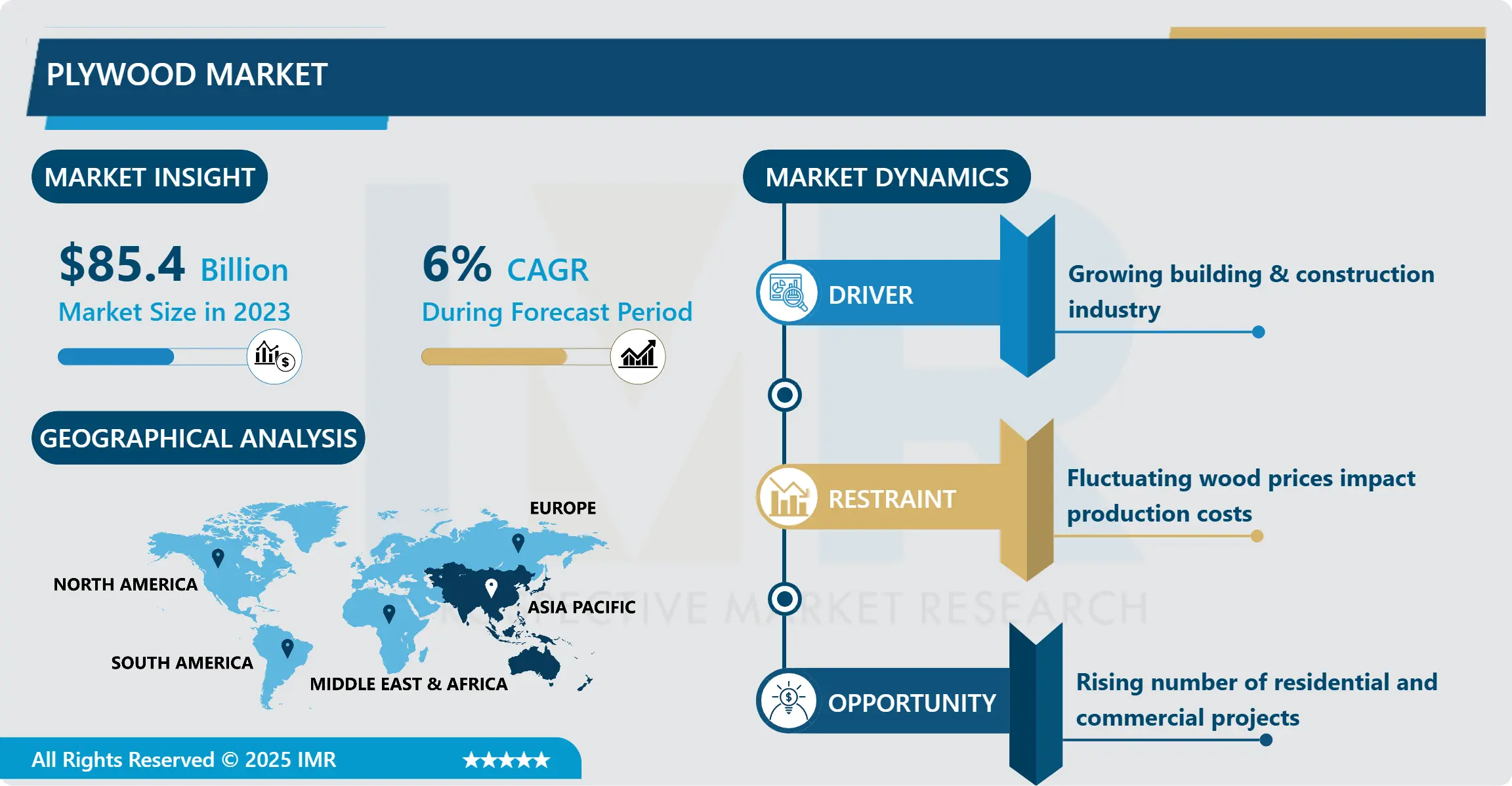
Plywood Market Size Was Valued at USD 85.4 Billion in 2023, and is Projected to Reach USD 144.3 Billion by 2032, Growing at a CAGR of 6.0% From 2024-2032.
Plywood can be described as an artificially processed wooden material that is made from layers of thin slices of softwood, hardwood, plastic, paper impregnated with resin, fabric or formica where the ensuing layers are bonded together through heat or chemical means to create a flat sheet that is thicker than any of the individual layers. It is used as the structural, exterior, interior and marine plywood for various sizes, shapes, designs, hues, and finishes. It is cheap and affordable; readily available; less complex and lighter; has extended durability; enhances stickiness to paints and dyes.
It provides enhanced dimensional stability than other WBS products like MDF and increased acceptability of engineered wood products and dimensional stability and strength over MDF. This material can suit a variety of uses and has a property that does not change its shape as it expands and contracts with the moisture in the atmosphere. Chemically It is capable of withstanding a number of chemical attacks and fire, noise, and excessive heating, dampness, wear, and rusting. It is also flexible, very ideal for roundish areas and for the most part, does not crack because it has grain across layers. It plays an important role in mounting the diminution of carbon footmark and greenhouse gas (GHG) emission as it is environment-friendly product. It also incorporating a smooth finish to the area which may be damaged by water and also for easy screwing. Apart from this, it is useful in making different goods with ease and also give a product a stylish look. Consequently, the uses of plywood are extensive in activities ranging from shipbuilding, construction, manufacturing, to furniture production in the global market.
The expansion of manufacturing industries generates demand for flat commodities such as plywood that may in turn improve performance of the plywood industry. Industries such as the hospitability are coming up in large numbers therefore increasing the market for plywood. Additionally, the rising tendency in construction and infrastructure projects especially in countries such as the Indian and China help to expand extended the plywood market.
In addition, invest in manufacturing front and storage back ends to accommodate demand for more production. Such expansion is supported by several factors such sawdust production for growth and development, construction projects and rising fluid demand for any type of wood products. To be able to capture such customers, plywood manufacturers are using the flexibility mechanization, organizational and technological processes in using…Issues regarding the increases in capacity, manufacturers are conducting intensive market study to ensure the formulation the right tactics to respond to the dynamic market changes.
Plywood Market Trend Analysis
Increasing adoption of plywood in residential areas
The usage of plywood in residential areas such as wall and floor covering as well as roof deck coatings across the globe has gone up and this is one of the factors which are fueling the growth of the market. Apart from this, the rising adoption of plywood for home enhancement as well as the rising emergence of organizational structures across the world is contributing to the growth of the market. Further, the increasing use of plywood in the marine industry for the application where the material will experience occasional contact with water without causing the plywood to rot or deteriorate is the driving force boosting the market.
In addition to this, the rise in spending capacity of people all over the world where they are now seeking furniture that is appealing to the eye and of good quality that cannot be easily damaged, also has played a key role in boosting growth of the market. Furthermore, growing use of plywood in construction concrete shuttering, door, stair, stringer, seating, framing, interior fixtures, external cladding, interior rails, baluster, internal paneling and timber joinery products is creating new avenues of growth for market investors. On the same note, the increased knowledge on the need to use products that have little impact to the world climate by reducing the carbon footprint is a great prospect. Apart from this, there is a gradual increase in the usage of green and sustainable materials, cheaper, long-lasting, comfortable touch, and soft materials by people of the whole world. This, along with the various technological improvements done in the manufacturing of Plywood to enhance the flexibility & the resistance capacity of Plywood is further significant with the growth of the market. In addition to the rising use of plywood in residences, global demand for plywood products like desks, almirah, and cabinets in offices and commercial spaces is also driving the market.
Rising demand for plywood with growing building & construction industry
There is a relatively dramatic rise in the buildings within countries of the world in the recent past. This can be described by the fact that there is ever increasing population globally as well as increasing rates of urbanization.
For example, as per the given by U. S. Department of Housing and Urban Development, there were 1 469 800 housing units being fined through building permit in the U. S A in the year 2023 Such buildings used lumber – based panels in wardrobe, floor, door and window panels among others. Thus, with improvements in construction of buildings, a subsequent demand for plywood is likely to be experienced. The economic factors that are helpful to growth of plywood industry include the rising number of houses, rising disposable income and growth in online commerce. In addition, the desk segment was driven by the fact due to the current pandemic breakage everyone had to work from home thus the demand for tables and chairs thereby increasing the market.
Plywood Market Segment Analysis:
Plywood Market Segmented based on Size, Thickness, Grade, Wood Type, Number of Ply, Sales Channel, and Application
By Wood Type, Hardwood segment is expected to dominate the market during the forecast period
In the plywood market, the hardwood segment will remain the market leader, retaining a 67.4% share by 2023. The use of hardwood plywood has remained favourite for many years, due to factors such as its stability, strength and versatility that has made it suitable for use in construction, furniture and interior decoration.
This persistent demand proves the proven status of hardwood plywood as well as its ability to meet constantly changing market demands. Therefore, it remains a keystone of the plywood market and underlines its eternal relevance and unchallenged domination in the sector.
By Number of Ply, 7 ply segment held the largest share in 2023
The segment most likely to experience massive growth in the plywood market includes 7 Ply & More and is expected to cover around 62.7% market share by 2023. This category ascendancy is well supported by the prefect market demand targeted towards higher value added, multilayered plywood products. The 7 Ply & More plywood offers much more strength and durability compared to other plywoods, making it ideal for a myriad of applications in construction, flooring, furniture and other areas where strength is required.
Therefore, the emergence of this segment reflects modern standards of child care in regard to quality and durability that consumers seek. Perhaps this is where these advanced forms of plywood play such a significant part of satisfying the high standards needed in construction and architectural initiatives in today’s world.
Plywood Market Regional Insights:
Asia-Pacific is Expected to Dominate the Market Over the Forecast period
Asia consumes majority of plywood manufactured globally, and China leads as the largest producer and consumer of plywood globally. Plywood from Asia-Pacific is exported to other significant markets like North America, Europe, and Africa for use in various usages. The progression of the Asia-Pacific plywood industry helps support the global economy and it is a crucial part of the region’s growth. For instance, in July 2022, the Greenply Industries Limited which is one of the leading interior infrastructure companies in India has rolled out the new brand communication for the innovative Zero Emission (E-0) product range Green Platinuma.
Growth in the number of countries classified as middle income in several Asia-Pacific countries has spurred consumption of furniture and thus increased the consumption of plywood which is an essential input in the production of furniture. Additionally, plywood is also used in a number of industries for various purposes like packaging and production, which is in line with general industry in the region. Developments such as these are instigating the need for plywood.
Active Key Players in the Plywood Market
Weyerhaeuser Company
Boise Cascade Company
Green ply Industries Limited
Georgia-Pacific LLC
Uniply Industries Ltd
JAYA TIASA HOLDINGS BERHAD
UPM.COM
SUBUR TIASA HOLDINGS BERHAD
SVEZA
Others
Other Key Players
Key Industry Developments in the Plywood Market:
In June 2022, Boise Cascade Company stated that it intended to acquire Coastal Plywood Company together with its two production sites in North Carolina from Coastal Forest Resources Company for $512 million. Furthermore, Coastal offers opportunities in value added products like imported and domestic plywood, lumber and treated woods throughout the eastern coast of the U S Coastal operates in Havana Florida and Chapman Alabama other processing facilities which has approximately 750 employees.
In December 20 2022, PotlatchDeltic Corporation and CatchMark Timber Trust, Inc. made their operational merger official with an all-stock transaction. PotlatchDeltics’ acquisition not only enabled the growth and enlargement of one of the very few integrated wood REIT, but it also enhanced the value which was being delivered to the shareholders.
In December of 2022, Martco, LLC, which owns RoyOMartin, a family-owned, third-generation wood procurement and manufacturing company had declared a $9. $5 million the Ray Brandt Group is to lay down on technologically innovative production tools for the Lumber plant in Natchitoches Parish.
Chapter 1: Introduction
1.1 Scope and Coverage
Chapter 2:Executive Summary
Chapter 3: Market Landscape
3.1 Market Dynamics
3.1.1 Drivers
3.1.2 Restraints
3.1.3 Opportunities
3.1.4 Challenges
3.2 Market Trend Analysis
3.3 PESTLE Analysis
3.4 Porter’s Five Forces Analysis
3.5 Industry Value Chain Analysis
3.6 Ecosystem
3.7 Regulatory Landscape
3.8 Price Trend Analysis
3.9 Patent Analysis
3.10 Technology Evolution
3.11 Investment Pockets
3.12 Import-Export Analysis
Chapter 4: Plywood Market by Size (2018-2032)
4.1 Plywood Market Snapshot and Growth Engine
4.2 Market Overview
4.3 4’x8’
4.3.1 Introduction and Market Overview
4.3.2 Historic and Forecasted Market Size in Value USD and Volume Units
4.3.3 Key Market Trends, Growth Factors, and Opportunities
4.3.4 Geographic Segmentation Analysis
4.4 4’x6’
4.5 4’x10’
4.6 3’x6’
4.7 Others
Chapter 5: Plywood Market by Thickness (2018-2032)
5.1 Plywood Market Snapshot and Growth Engine
5.2 Market Overview
5.3 18mm
Chapter 6: Plywood Market by Grade (2018-2032)
6.1 Plywood Market Snapshot and Growth Engine
6.2 Market Overview
6.3 MR Grade
6.3.1 Introduction and Market Overview
6.3.2 Historic and Forecasted Market Size in Value USD and Volume Units
6.3.3 Key Market Trends, Growth Factors, and Opportunities
6.3.4 Geographic Segmentation Analysis
6.4 BWR Grade
6.5 Fire Resistant Grade
6.6 BWP Grade
6.7 Structural Grade
Chapter 7: Plywood Market by Wood Type (2018-2032)
7.1 Plywood Market Snapshot and Growth Engine
7.2 Market Overview
7.3 Softwood
7.3.1 Introduction and Market Overview
7.3.2 Historic and Forecasted Market Size in Value USD and Volume Units
7.3.3 Key Market Trends, Growth Factors, and Opportunities
7.3.4 Geographic Segmentation Analysis
7.4 Hardwood
Chapter 8: Plywood Market by Number of Ply (2018-2032)
8.1 Plywood Market Snapshot and Growth Engine
8.2 Market Overview
8.3 3 ply
8.3.1 Introduction and Market Overview
8.3.2 Historic and Forecasted Market Size in Value USD and Volume Units
8.3.3 Key Market Trends, Growth Factors, and Opportunities
8.3.4 Geographic Segmentation Analysis
8.4 5 ply
8.5 7 ply
8.6 More
Chapter 9: Plywood Market by Sales Channel (2018-2032)
9.1 Plywood Market Snapshot and Growth Engine
9.2 Market Overview
9.3 Direct Sales
9.3.1 Introduction and Market Overview
9.3.2 Historic and Forecasted Market Size in Value USD and Volume Units
9.3.3 Key Market Trends, Growth Factors, and Opportunities
9.3.4 Geographic Segmentation Analysis
9.4 Distributors/Retailers
Chapter 10: Company Profiles and Competitive Analysis
10.1 Competitive Landscape
10.1.1 Competitive Benchmarking
10.1.2 Plywood Market Share by Manufacturer (2024)
10.1.3 Industry BCG Matrix
10.1.4 Heat Map Analysis
10.1.5 Mergers and Acquisitions
10.2 WEYERHAEUSER COMPANY
10.2.1 Company Overview
10.2.2 Key Executives
10.2.3 Company Snapshot
10.2.4 Role of the Company in the Market
10.2.5 Sustainability and Social Responsibility
10.2.6 Operating Business Segments
10.2.7 Product Portfolio
10.2.8 Business Performance
10.2.9 Key Strategic Moves and Recent Developments
10.2.10 SWOT Analysis
10.3 BOISE CASCADE COMPANY
10.4 GREEN PLY INDUSTRIES LIMITED
10.5 GEORGIA-PACIFIC LLC
10.6 UNIPLY INDUSTRIES LTD
10.7 JAYA TIASA HOLDINGS BERHAD
10.8 UPM.COM
10.9 SUBUR TIASA HOLDINGS BERHAD
10.10 SVEZA
10.11 OTHERS
10.12 OTHER KEY PLAYERS
Chapter 11: Global Plywood Market By Region
11.1 Overview
11.2. North America Plywood Market
11.2.1 Key Market Trends, Growth Factors and Opportunities
11.2.2 Top Key Companies
11.2.3 Historic and Forecasted Market Size by Segments
11.2.4 Historic and Forecasted Market Size by Size
11.2.4.1 4’x8’
11.2.4.2 4’x6’
11.2.4.3 4’x10’
11.2.4.4 3’x6’
11.2.4.5 Others
11.2.5 Historic and Forecasted Market Size by Thickness
11.2.5.1 18mm
11.2.6 Historic and Forecasted Market Size by Grade
11.2.6.1 MR Grade
11.2.6.2 BWR Grade
11.2.6.3 Fire Resistant Grade
11.2.6.4 BWP Grade
11.2.6.5 Structural Grade
11.2.7 Historic and Forecasted Market Size by Wood Type
11.2.7.1 Softwood
11.2.7.2 Hardwood
11.2.8 Historic and Forecasted Market Size by Number of Ply
11.2.8.1 3 ply
11.2.8.2 5 ply
11.2.8.3 7 ply
11.2.8.4 More
11.2.9 Historic and Forecasted Market Size by Sales Channel
11.2.9.1 Direct Sales
11.2.9.2 Distributors/Retailers
11.2.10 Historic and Forecast Market Size by Country
11.2.10.1 US
11.2.10.2 Canada
11.2.10.3 Mexico
11.3. Eastern Europe Plywood Market
11.3.1 Key Market Trends, Growth Factors and Opportunities
11.3.2 Top Key Companies
11.3.3 Historic and Forecasted Market Size by Segments
11.3.4 Historic and Forecasted Market Size by Size
11.3.4.1 4’x8’
11.3.4.2 4’x6’
11.3.4.3 4’x10’
11.3.4.4 3’x6’
11.3.4.5 Others
11.3.5 Historic and Forecasted Market Size by Thickness
11.3.5.1 18mm
11.3.6 Historic and Forecasted Market Size by Grade
11.3.6.1 MR Grade
11.3.6.2 BWR Grade
11.3.6.3 Fire Resistant Grade
11.3.6.4 BWP Grade
11.3.6.5 Structural Grade
11.3.7 Historic and Forecasted Market Size by Wood Type
11.3.7.1 Softwood
11.3.7.2 Hardwood
11.3.8 Historic and Forecasted Market Size by Number of Ply
11.3.8.1 3 ply
11.3.8.2 5 ply
11.3.8.3 7 ply
11.3.8.4 More
11.3.9 Historic and Forecasted Market Size by Sales Channel
11.3.9.1 Direct Sales
11.3.9.2 Distributors/Retailers
11.3.10 Historic and Forecast Market Size by Country
11.3.10.1 Russia
11.3.10.2 Bulgaria
11.3.10.3 The Czech Republic
11.3.10.4 Hungary
11.3.10.5 Poland
11.3.10.6 Romania
11.3.10.7 Rest of Eastern Europe
11.4. Western Europe Plywood Market
11.4.1 Key Market Trends, Growth Factors and Opportunities
11.4.2 Top Key Companies
11.4.3 Historic and Forecasted Market Size by Segments
11.4.4 Historic and Forecasted Market Size by Size
11.4.4.1 4’x8’
11.4.4.2 4’x6’
11.4.4.3 4’x10’
11.4.4.4 3’x6’
11.4.4.5 Others
11.4.5 Historic and Forecasted Market Size by Thickness
11.4.5.1 18mm
11.4.6 Historic and Forecasted Market Size by Grade
11.4.6.1 MR Grade
11.4.6.2 BWR Grade
11.4.6.3 Fire Resistant Grade
11.4.6.4 BWP Grade
11.4.6.5 Structural Grade
11.4.7 Historic and Forecasted Market Size by Wood Type
11.4.7.1 Softwood
11.4.7.2 Hardwood
11.4.8 Historic and Forecasted Market Size by Number of Ply
11.4.8.1 3 ply
11.4.8.2 5 ply
11.4.8.3 7 ply
11.4.8.4 More
11.4.9 Historic and Forecasted Market Size by Sales Channel
11.4.9.1 Direct Sales
11.4.9.2 Distributors/Retailers
11.4.10 Historic and Forecast Market Size by Country
11.4.10.1 Germany
11.4.10.2 UK
11.4.10.3 France
11.4.10.4 The Netherlands
11.4.10.5 Italy
11.4.10.6 Spain
11.4.10.7 Rest of Western Europe
11.5. Asia Pacific Plywood Market
11.5.1 Key Market Trends, Growth Factors and Opportunities
11.5.2 Top Key Companies
11.5.3 Historic and Forecasted Market Size by Segments
11.5.4 Historic and Forecasted Market Size by Size
11.5.4.1 4’x8’
11.5.4.2 4’x6’
11.5.4.3 4’x10’
11.5.4.4 3’x6’
11.5.4.5 Others
11.5.5 Historic and Forecasted Market Size by Thickness
11.5.5.1 18mm
11.5.6 Historic and Forecasted Market Size by Grade
11.5.6.1 MR Grade
11.5.6.2 BWR Grade
11.5.6.3 Fire Resistant Grade
11.5.6.4 BWP Grade
11.5.6.5 Structural Grade
11.5.7 Historic and Forecasted Market Size by Wood Type
11.5.7.1 Softwood
11.5.7.2 Hardwood
11.5.8 Historic and Forecasted Market Size by Number of Ply
11.5.8.1 3 ply
11.5.8.2 5 ply
11.5.8.3 7 ply
11.5.8.4 More
11.5.9 Historic and Forecasted Market Size by Sales Channel
11.5.9.1 Direct Sales
11.5.9.2 Distributors/Retailers
11.5.10 Historic and Forecast Market Size by Country
11.5.10.1 China
11.5.10.2 India
11.5.10.3 Japan
11.5.10.4 South Korea
11.5.10.5 Malaysia
11.5.10.6 Thailand
11.5.10.7 Vietnam
11.5.10.8 The Philippines
11.5.10.9 Australia
11.5.10.10 New Zealand
11.5.10.11 Rest of APAC
11.6. Middle East & Africa Plywood Market
11.6.1 Key Market Trends, Growth Factors and Opportunities
11.6.2 Top Key Companies
11.6.3 Historic and Forecasted Market Size by Segments
11.6.4 Historic and Forecasted Market Size by Size
11.6.4.1 4’x8’
11.6.4.2 4’x6’
11.6.4.3 4’x10’
11.6.4.4 3’x6’
11.6.4.5 Others
11.6.5 Historic and Forecasted Market Size by Thickness
11.6.5.1 18mm
11.6.6 Historic and Forecasted Market Size by Grade
11.6.6.1 MR Grade
11.6.6.2 BWR Grade
11.6.6.3 Fire Resistant Grade
11.6.6.4 BWP Grade
11.6.6.5 Structural Grade
11.6.7 Historic and Forecasted Market Size by Wood Type
11.6.7.1 Softwood
11.6.7.2 Hardwood
11.6.8 Historic and Forecasted Market Size by Number of Ply
11.6.8.1 3 ply
11.6.8.2 5 ply
11.6.8.3 7 ply
11.6.8.4 More
11.6.9 Historic and Forecasted Market Size by Sales Channel
11.6.9.1 Direct Sales
11.6.9.2 Distributors/Retailers
11.6.10 Historic and Forecast Market Size by Country
11.6.10.1 Turkiye
11.6.10.2 Bahrain
11.6.10.3 Kuwait
11.6.10.4 Saudi Arabia
11.6.10.5 Qatar
11.6.10.6 UAE
11.6.10.7 Israel
11.6.10.8 South Africa
11.7. South America Plywood Market
11.7.1 Key Market Trends, Growth Factors and Opportunities
11.7.2 Top Key Companies
11.7.3 Historic and Forecasted Market Size by Segments
11.7.4 Historic and Forecasted Market Size by Size
11.7.4.1 4’x8’
11.7.4.2 4’x6’
11.7.4.3 4’x10’
11.7.4.4 3’x6’
11.7.4.5 Others
11.7.5 Historic and Forecasted Market Size by Thickness
11.7.5.1 18mm
11.7.6 Historic and Forecasted Market Size by Grade
11.7.6.1 MR Grade
11.7.6.2 BWR Grade
11.7.6.3 Fire Resistant Grade
11.7.6.4 BWP Grade
11.7.6.5 Structural Grade
11.7.7 Historic and Forecasted Market Size by Wood Type
11.7.7.1 Softwood
11.7.7.2 Hardwood
11.7.8 Historic and Forecasted Market Size by Number of Ply
11.7.8.1 3 ply
11.7.8.2 5 ply
11.7.8.3 7 ply
11.7.8.4 More
11.7.9 Historic and Forecasted Market Size by Sales Channel
11.7.9.1 Direct Sales
11.7.9.2 Distributors/Retailers
11.7.10 Historic and Forecast Market Size by Country
11.7.10.1 Brazil
11.7.10.2 Argentina
11.7.10.3 Rest of SA
Chapter 12 Analyst Viewpoint and Conclusion
12.1 Recommendations and Concluding Analysis
12.2 Potential Market Strategies
Chapter 13 Research Methodology
13.1 Research Process
13.2 Primary Research
13.3 Secondary Research
Q1: What would be the forecast period in the Plywood Market research report?
A1: The forecast period in the Plywood Market research report is 2024-2032.
Q2: Who are the key players in the Plywood Market?
A2: Weyerhaeuser Company, Boise Cascade Company, Green ply Industries Limited, Georgia-Pacific LLC, Uniply Industries Ltd, JAYA TIASA HOLDINGS BERHAD, UPM.COM, SUBUR TIASA HOLDINGS BERHAD, SVEZA, Others , and Other Major Players.
Q3: What are the segments of the Plywood Market?
A3: The Plywood Market is segmented into size, thickness, grade, wood type, number of ply, sales channel, application, and region. By size, the market is categorized into 4’x8’, 4’x6’, 4’x10’, 3’x6’, Others. By thickness, the market is categorized into 18mm. By grade, the market is categorized into MR Grade, BWR Grade, Fire Resistant Grade, BWP Grade, Structural Grade. By region, it is analyzed across North America (U.S.; Canada; Mexico), Europe (Germany; U.K.; France; Italy; Russia; Spain, etc.), Asia-Pacific (China; India; Japan; Southeast Asia, etc.), South America (Brazil; Argentina, etc.), Middle East & Africa (Saudi Arabia; South Africa, etc.).
Q4: What is the Plywood Market?
A4: Plywood is one of the most versatile conventional building materials known today, and has many applications in the industrial scene. Plywood as one of the developed woods which is produced after laminating number of thin wooden layers known as plies. It is fairly robust, cheap and impliable, does not warp or break easily even when subjected to substantial and repeated impact. Plywood to be used in industries differs in terms of strength and other qualities of timber used. Structural plywood is normally used in construction when it comes to permanent structures for their strength and sturdiness into consideration. It is often made from hardwood, it can be used for flooring, furniture, or any other purpose depending on the preference of the owner. Structural plywood must then withstand extreme weather conditions and resist high levels of stress. Far from being decorative, this plywood is principally designed for its solidity; nevertheless, it almost always teems with numerous knots and openings.
Q5: How big is the Plywood Market?
A5: Plywood Market Size Was Valued at USD 85.4 Billion in 2023, and is Projected to Reach USD 144.3 Billion by 2032, Growing at a CAGR of 6.0% From 2024-2032.
How to Buy a Report from eminsights.jp
On the product page, choose the license you want: Single-User License, Multi-User License or Enterprise License.
If you required report in your native language, then you can click on Translated Report button and fill out the form with report name and language you want, then our team will contact you as soon as possible.
Click the Buy Now button.
You will be redirected to the checkout page. Enter your company details and payment information.
Click Place Order to complete the purchase.
Confirmation: You’ll receive an order confirmation and our team will contact you shortly with your ordered report.
If you have any questions, fill out the contact form below or email us at bizdev@eminsights.net.
Thank you for choosing eminsights.jp!